
Topic 6 1 DIGESTIVE SYSTEM Topic Outline AUDIO
- Slides: 22
Topic 6. 1 DIGESTIVE SYSTEM
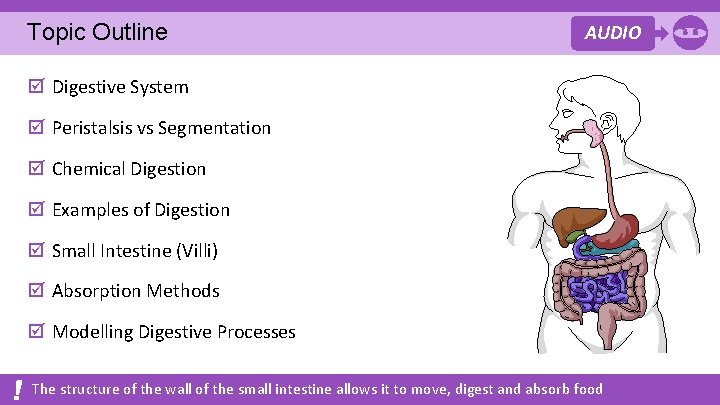
Topic Outline AUDIO þ Digestive System þ Peristalsis vs Segmentation þ Chemical Digestion þ Examples of Digestion þ Small Intestine (Villi) þ Absorption Methods þ Modelling Digestive Processes The structure of the wall of the small intestine allows it to move, digest and absorb food
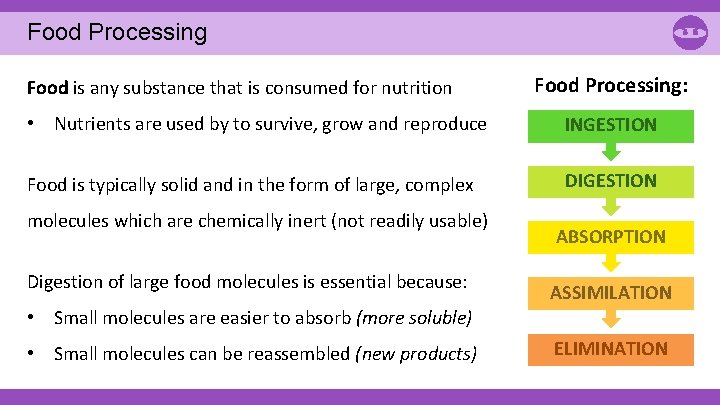
Food Processing Food is any substance that is consumed for nutrition Food Processing: • Nutrients are used by to survive, grow and reproduce INGESTION Food is typically solid and in the form of large, complex DIGESTION molecules which are chemically inert (not readily usable) Digestion of large food molecules is essential because: ABSORPTION ASSIMILATION • Small molecules are easier to absorb (more soluble) • Small molecules can be reassembled (new products) ELIMINATION
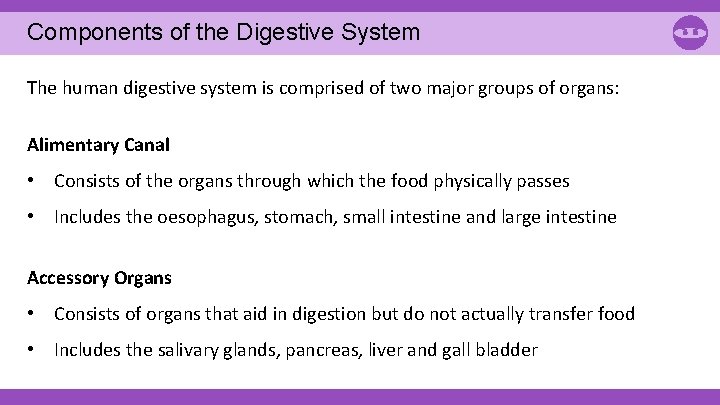
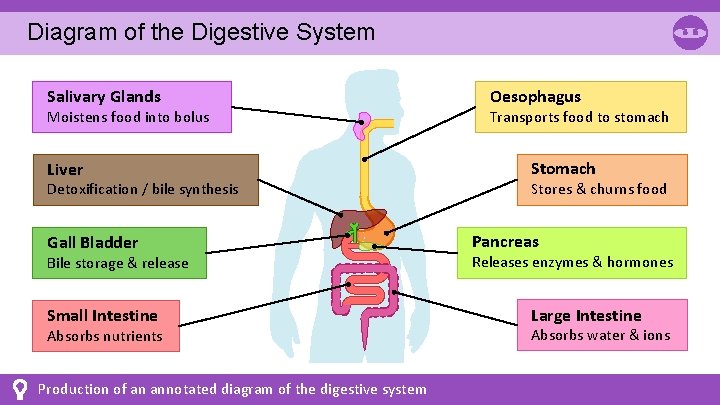
Components of the Digestive System The human digestive system is comprised of two major groups of organs: Alimentary Canal • Consists of the organs through which the food physically passes • Includes the oesophagus, stomach, small intestine and large intestine Accessory Organs • Consists of organs that aid in digestion but do not actually transfer food • Includes the salivary glands, pancreas, liver and gall bladder
Diagram of the Digestive System Salivary Glands Moistens food into bolus Liver Detoxification / bile synthesis Gall Bladder Bile storage & release Small Intestine Absorbs nutrients Production of an annotated diagram of the digestive system Oesophagus Transports food to stomach Stores & churns food Pancreas Releases enzymes & hormones Large Intestine Absorbs water & ions
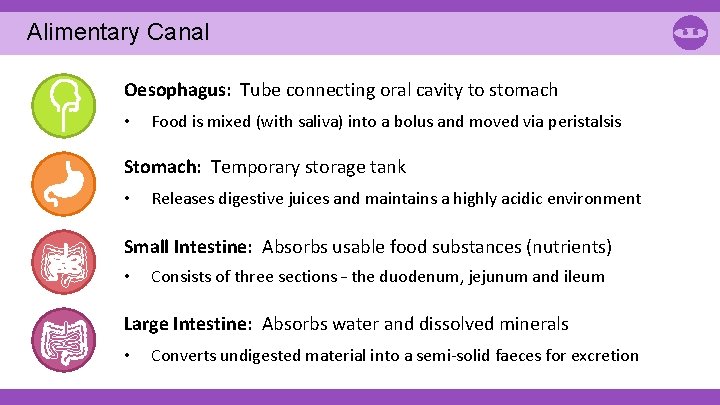
Alimentary Canal Oesophagus: Tube connecting oral cavity to stomach • Food is mixed (with saliva) into a bolus and moved via peristalsis Stomach: Temporary storage tank • Releases digestive juices and maintains a highly acidic environment Small Intestine: Absorbs usable food substances (nutrients) • Consists of three sections – the duodenum, jejunum and ileum Large Intestine: Absorbs water and dissolved minerals • Converts undigested material into a semi-solid faeces for excretion
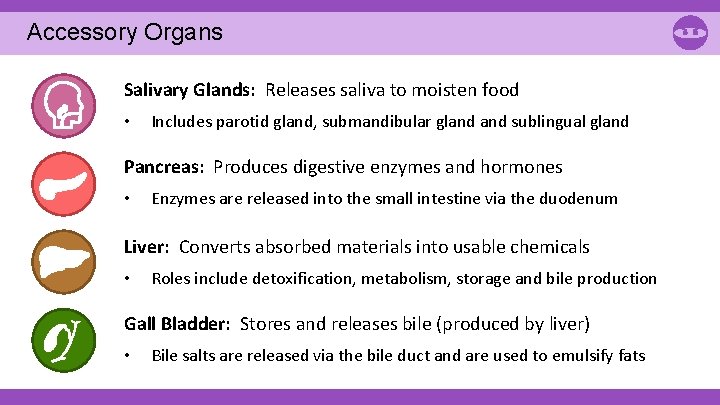
Accessory Organs Salivary Glands: Releases saliva to moisten food • Includes parotid gland, submandibular gland sublingual gland Pancreas: Produces digestive enzymes and hormones • Enzymes are released into the small intestine via the duodenum Liver: Converts absorbed materials into usable chemicals • Roles include detoxification, metabolism, storage and bile production Gall Bladder: Stores and releases bile (produced by liver) • Bile salts are released via the bile duct and are used to emulsify fats
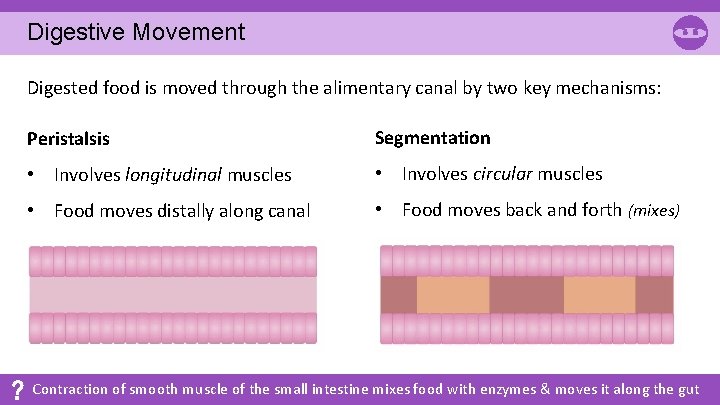
Digestive Movement Digested food is moved through the alimentary canal by two key mechanisms: Peristalsis Segmentation • Involves longitudinal muscles • Involves circular muscles • Food moves distally along canal • Food moves back and forth (mixes) Contraction of smooth muscle of the small intestine mixes food with enzymes & moves it along the gut
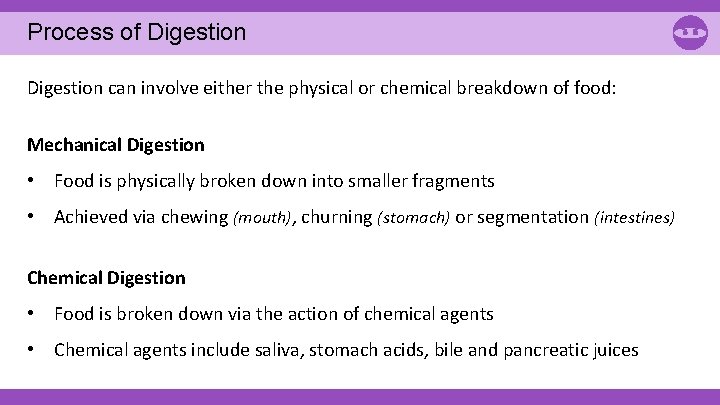
Process of Digestion can involve either the physical or chemical breakdown of food: Mechanical Digestion • Food is physically broken down into smaller fragments • Achieved via chewing (mouth), churning (stomach) or segmentation (intestines) Chemical Digestion • Food is broken down via the action of chemical agents • Chemical agents include saliva, stomach acids, bile and pancreatic juices
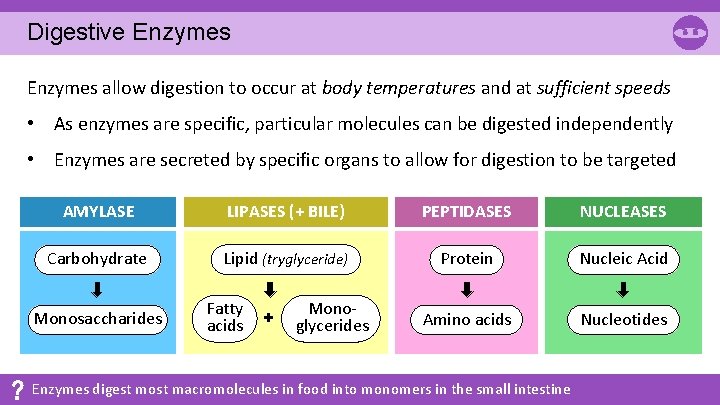
Digestive Enzymes allow digestion to occur at body temperatures and at sufficient speeds • As enzymes are specific, particular molecules can be digested independently • Enzymes are secreted by specific organs to allow for digestion to be targeted AMYLASE LIPASES (+ BILE) PEPTIDASES NUCLEASES Carbohydrate Lipid (tryglyceride) Protein Nucleic Acid Amino acids Nucleotides Monosaccharides Fatty acids + Monoglycerides Enzymes digest most macromolecules in food into monomers in the small intestine
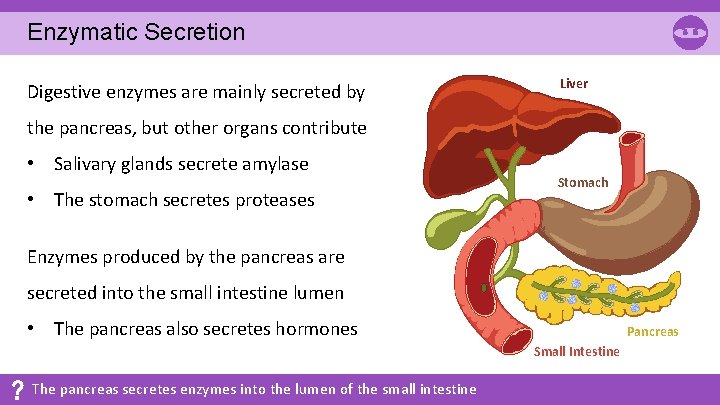
Enzymatic Secretion Digestive enzymes are mainly secreted by Liver the pancreas, but other organs contribute • Salivary glands secrete amylase • The stomach secretes proteases Stomach Enzymes produced by the pancreas are secreted into the small intestine lumen • The pancreas also secretes hormones Pancreas Small Intestine The pancreas secretes enzymes into the lumen of the small intestine
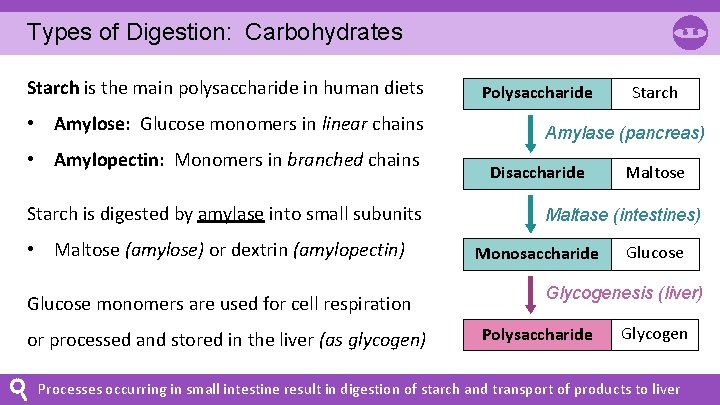
Types of Digestion: Carbohydrates Starch is the main polysaccharide in human diets • Amylose: Glucose monomers in linear chains • Amylopectin: Monomers in branched chains Starch is digested by amylase into small subunits • Maltose (amylose) or dextrin (amylopectin) Glucose monomers are used for cell respiration or processed and stored in the liver (as glycogen) Polysaccharide Starch Amylase (pancreas) Disaccharide Maltose Maltase (intestines) Monosaccharide Glucose Glycogenesis (liver) Polysaccharide Glycogen Processes occurring in small intestine result in digestion of starch and transport of products to liver
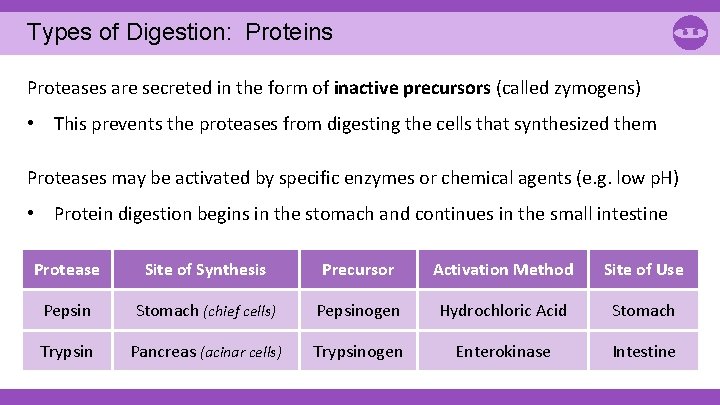
Types of Digestion: Proteins Proteases are secreted in the form of inactive precursors (called zymogens) • This prevents the proteases from digesting the cells that synthesized them Proteases may be activated by specific enzymes or chemical agents (e. g. low p. H) • Protein digestion begins in the stomach and continues in the small intestine Protease Site of Synthesis Precursor Activation Method Site of Use Pepsin Stomach (chief cells) Pepsinogen Hydrochloric Acid Stomach Trypsin Pancreas (acinar cells) Trypsinogen Enterokinase Intestine
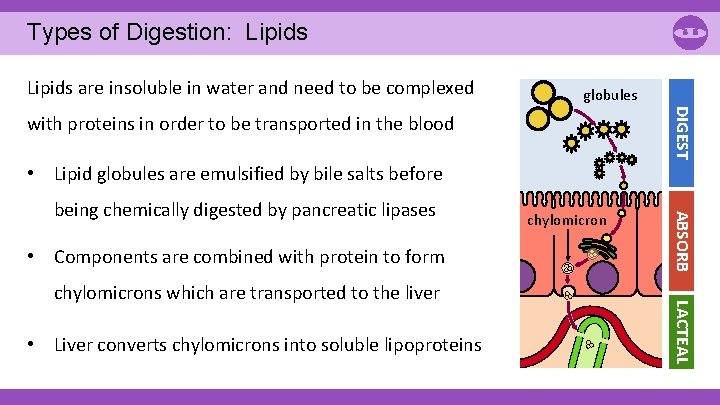
Types of Digestion: Lipids are insoluble in water and need to be complexed globules DIGEST with proteins in order to be transported in the blood • Lipid globules are emulsified by bile salts before • Components are combined with protein to form • Liver converts chylomicrons into soluble lipoproteins LACTEAL chylomicrons which are transported to the liver chylomicron ABSORB being chemically digested by pancreatic lipases
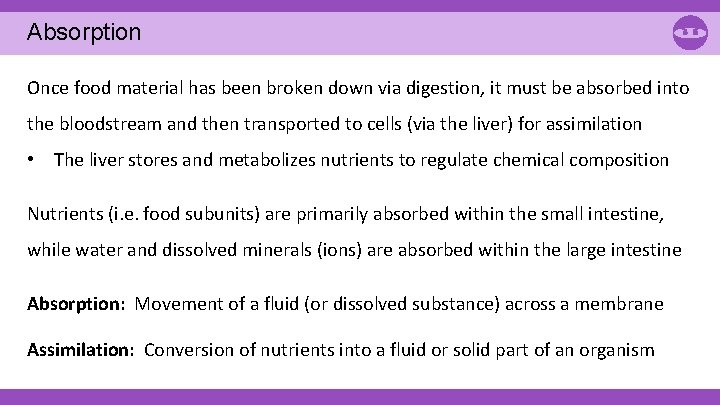
Absorption Once food material has been broken down via digestion, it must be absorbed into the bloodstream and then transported to cells (via the liver) for assimilation • The liver stores and metabolizes nutrients to regulate chemical composition Nutrients (i. e. food subunits) are primarily absorbed within the small intestine, while water and dissolved minerals (ions) are absorbed within the large intestine Absorption: Movement of a fluid (or dissolved substance) across a membrane Assimilation: Conversion of nutrients into a fluid or solid part of an organism
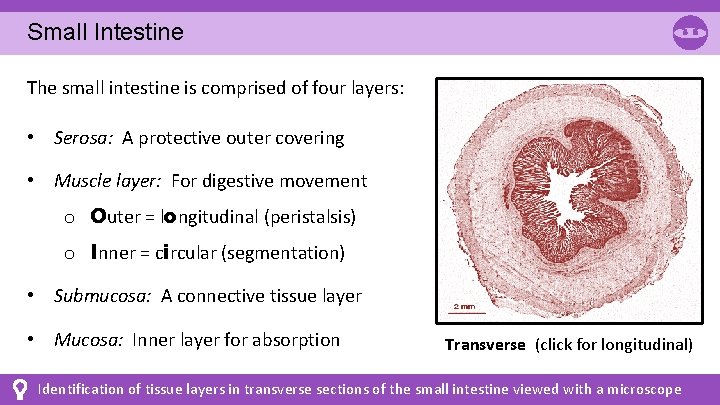
Small Intestine The small intestine is comprised of four layers: • Serosa: A protective outer covering • Muscle layer: For digestive movement o Outer = longitudinal (peristalsis) o Inner = circular (segmentation) • Submucosa: A connective tissue layer • Mucosa: Inner layer for absorption Transverse (click for longitudinal) Identification of tissue layers in transverse sections of the small intestine viewed with a microscope
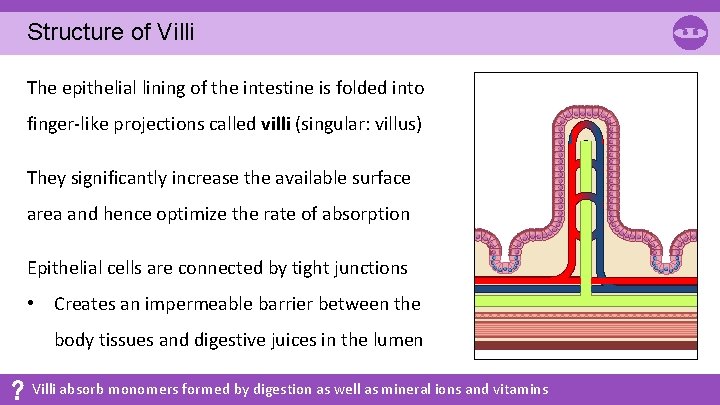
Structure of Villi The epithelial lining of the intestine is folded into finger-like projections called villi (singular: villus) They significantly increase the available surface area and hence optimize the rate of absorption Epithelial cells are connected by tight junctions • Creates an impermeable barrier between the body tissues and digestive juices in the lumen Villi absorb monomers formed by digestion as well as mineral ions and vitamins
Feature of Villi Key features of intestinal villi include: • Microvilli (increases the surface area : volume ratio) • Rich capillary network (transports digested products) • Single-layer epithelium (minimises diffusion distance) • Lacteals (absorbs lipids into the lymphatic system) • Intestinal glands (exocrine pits release enzymes) • Membrane proteins (facilitates transport of products) Mnemonic: MR SLIM Villi increase the surface area of epithelium over which absorption is carried out
Absorption: Membrane Transport Different nutrients are absorbed by a variety of distinct transport mechanisms: Secondary Active Transport: • Glucose and amino acids are co-transported with sodium ions (actively pumped) Facilitated Diffusion: • Monosaccharides, vitamins and minerals are transported by channel proteins Simple Diffusion: • Hydrophobic and lipophilic substances (fats) may freely cross the membrane Different methods of membrane transport are required to absorb different nutrients
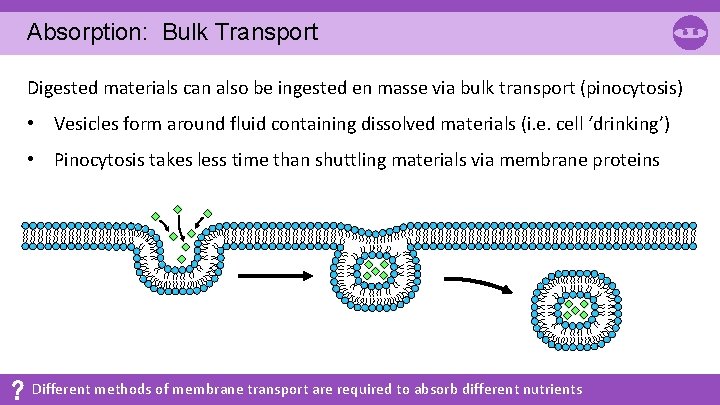
Absorption: Bulk Transport Digested materials can also be ingested en masse via bulk transport (pinocytosis) • Vesicles form around fluid containing dissolved materials (i. e. cell ‘drinking’) • Pinocytosis takes less time than shuttling materials via membrane proteins Different methods of membrane transport are required to absorb different nutrients
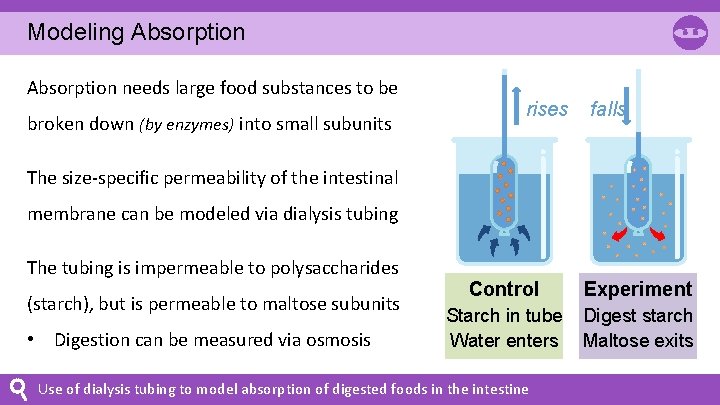
Modeling Absorption needs large food substances to be broken down (by enzymes) into small subunits rises falls The size-specific permeability of the intestinal membrane can be modeled via dialysis tubing The tubing is impermeable to polysaccharides (starch), but is permeable to maltose subunits • Digestion can be measured via osmosis Control Experiment Starch in tube Water enters Digest starch Maltose exits Use of dialysis tubing to model absorption of digested foods in the intestine
Topic Review Can you do the following? • Identify components of the digestive system • Compare types of digestive movement • Compare physical vs chemical breakdown • Explain the role of the pancreas • Describe the breakdown of types of food • Outline the structure of intestinal villi • Discuss methods of material absorption