
Topic 5 Polymorphism Inheritance is new code that
![the create. ASet example public Object[] create. ASet(Object[] items) { /* pre: items !=](https://slidetodoc.com/presentation_image_h2/11e4f42389ece9fc349b5c3cf8165aab/image-16.jpg "the create. ASet example public Object[] create. ASet(Object[] items) { /* pre: items !=")
![create. ASet examples String[] s. List = {"Texas", "texas", "Texas", "UT", "texas"}; Object[] s.](https://slidetodoc.com/presentation_image_h2/11e4f42389ece9fc349b5c3cf8165aab/image-17.jpg "create. ASet examples String[] s. List = {\"Texas\", \"texas\", \"Texas\", \"UT\", \"texas\"}; Object[] s.")
- Slides: 17
Topic 5 Polymorphism "“Inheritance is new code that reuses old code. Polymorphism is old code that reuses new code. ” - OOP Koan 1
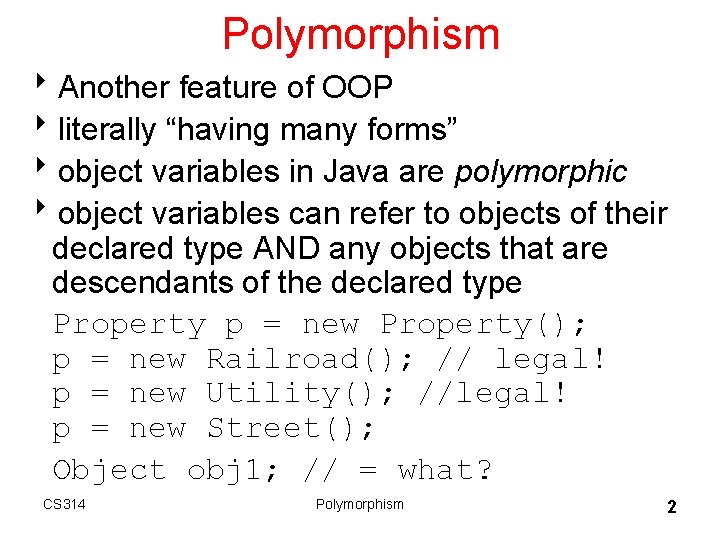
Polymorphism 8 Another feature of OOP 8 literally “having many forms” 8 object variables in Java are polymorphic 8 object variables can refer to objects of their declared type AND any objects that are descendants of the declared type Property p = new Property(); p = new Railroad(); // legal! p = new Utility(); //legal! p = new Street(); Object obj 1; // = what? CS 314 Polymorphism 2
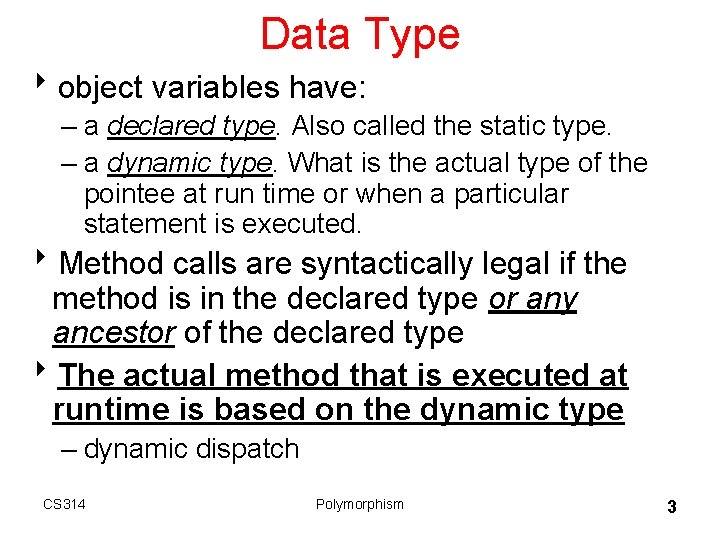
Data Type 8 object variables have: – a declared type. Also called the static type. – a dynamic type. What is the actual type of the pointee at run time or when a particular statement is executed. 8 Method calls are syntactically legal if the method is in the declared type or any ancestor of the declared type 8 The actual method that is executed at runtime is based on the dynamic type – dynamic dispatch CS 314 Polymorphism 3
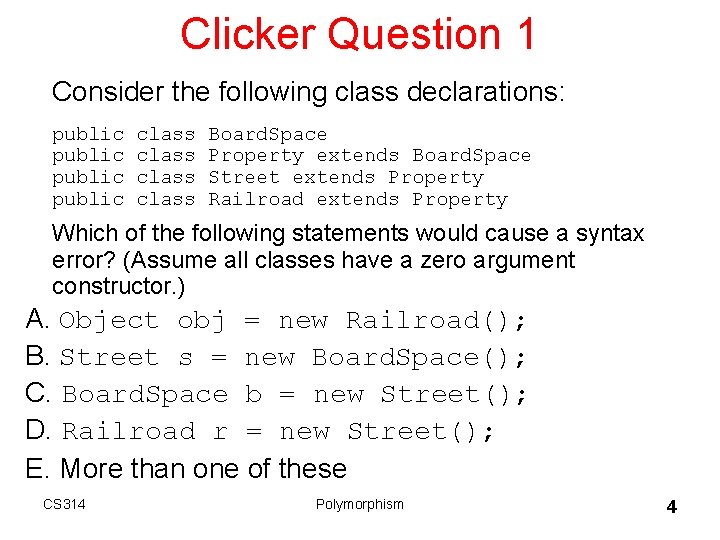
Clicker Question 1 Consider the following class declarations: public class Board. Space Property extends Board. Space Street extends Property Railroad extends Property Which of the following statements would cause a syntax error? (Assume all classes have a zero argument constructor. ) A. Object obj = new Railroad(); B. Street s = new Board. Space(); C. Board. Space b = new Street(); D. Railroad r = new Street(); E. More than one of these CS 314 Polymorphism 4
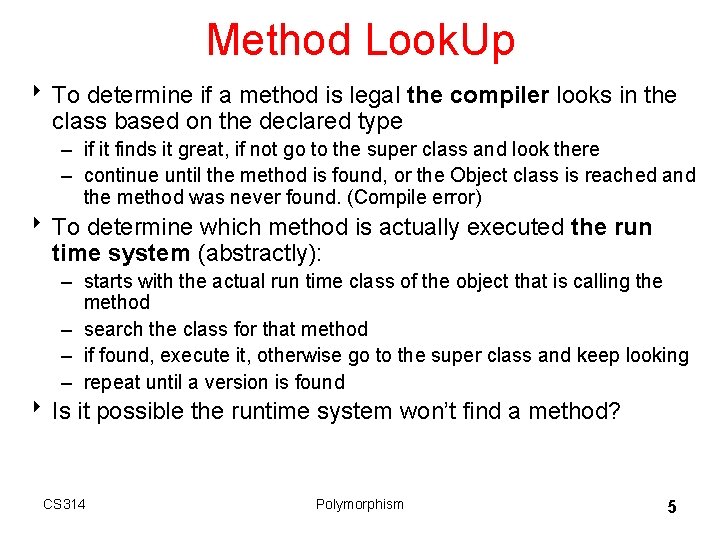
Method Look. Up 8 To determine if a method is legal the compiler looks in the class based on the declared type – if it finds it great, if not go to the super class and look there – continue until the method is found, or the Object class is reached and the method was never found. (Compile error) 8 To determine which method is actually executed the run time system (abstractly): – starts with the actual run time class of the object that is calling the method – search the class for that method – if found, execute it, otherwise go to the super class and keep looking – repeat until a version is found 8 Is it possible the runtime system won’t find a method? CS 314 Polymorphism 5
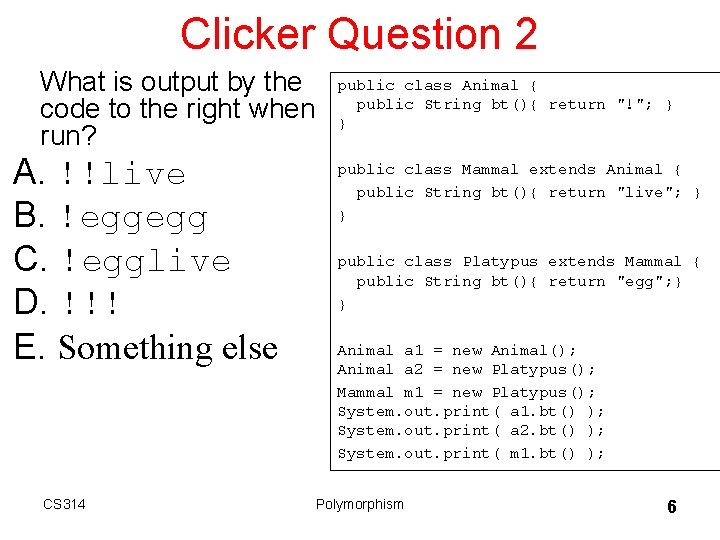
Clicker Question 2 What is output by the code to the right when run? A. !!live B. !eggegg C. !egglive D. !!! E. Something else CS 314 public class Animal { public String bt(){ return "!"; } } public class Mammal extends Animal { public String bt(){ return "live"; } } public class Platypus extends Mammal { public String bt(){ return "egg"; } } Animal a 1 = new Animal(); Animal a 2 = new Platypus(); Mammal m 1 = new Platypus(); System. out. print( a 1. bt() ); System. out. print( a 2. bt() ); System. out. print( m 1. bt() ); Polymorphism 6
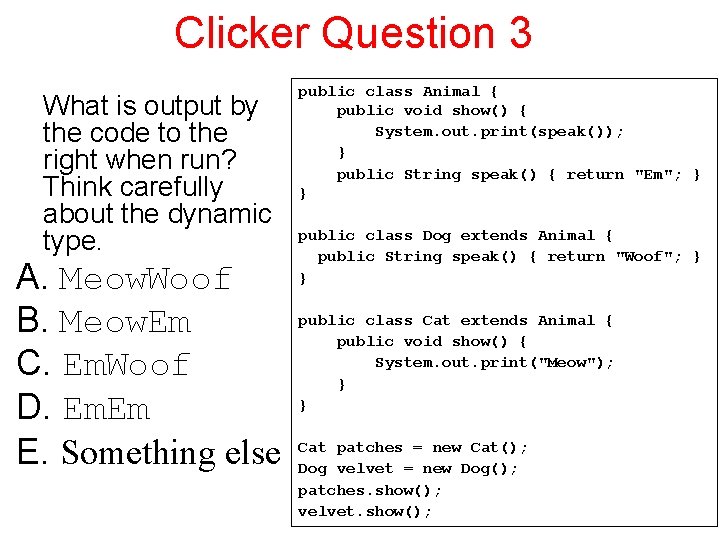
Clicker Question 3 What is output by the code to the right when run? Think carefully about the dynamic type. A. Meow. Woof B. Meow. Em C. Em. Woof D. Em E. Something else public class Animal { public void show() { System. out. print(speak()); } public String speak() { return "Em"; } } public class Dog extends Animal { public String speak() { return "Woof"; } } public class Cat extends Animal { public void show() { System. out. print("Meow"); } } Cat patches = new Cat(); Dog velvet = new Dog(); patches. show(); velvet. show();
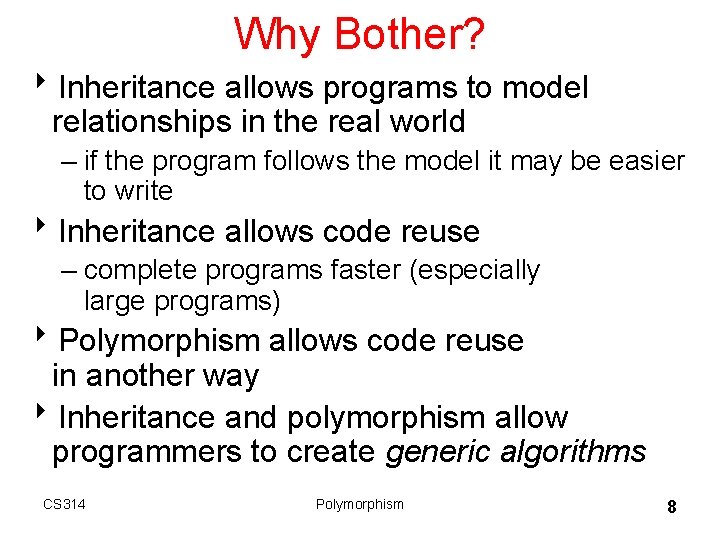
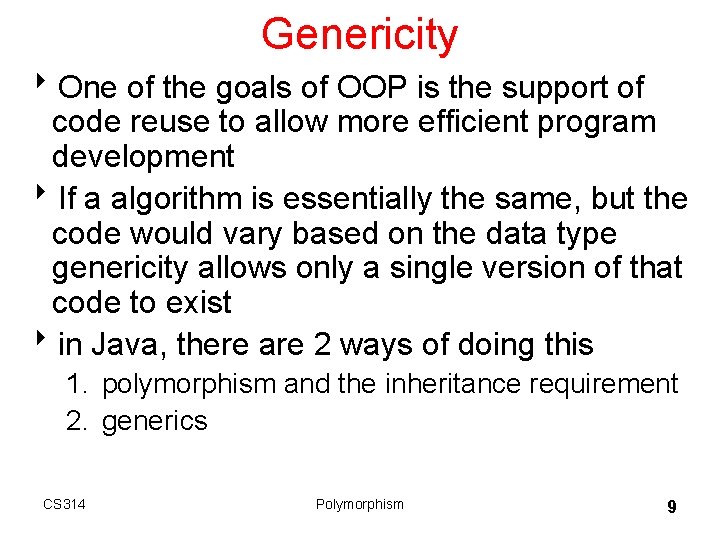
Why Bother? 8 Inheritance allows programs to model relationships in the real world – if the program follows the model it may be easier to write 8 Inheritance allows code reuse – complete programs faster (especially large programs) 8 Polymorphism allows code reuse in another way 8 Inheritance and polymorphism allow programmers to create generic algorithms CS 314 Polymorphism 8
Genericity 8 One of the goals of OOP is the support of code reuse to allow more efficient program development 8 If a algorithm is essentially the same, but the code would vary based on the data type genericity allows only a single version of that code to exist 8 in Java, there are 2 ways of doing this 1. polymorphism and the inheritance requirement 2. generics CS 314 Polymorphism 9
A Generic List Class CS 314 Polymorphism 10
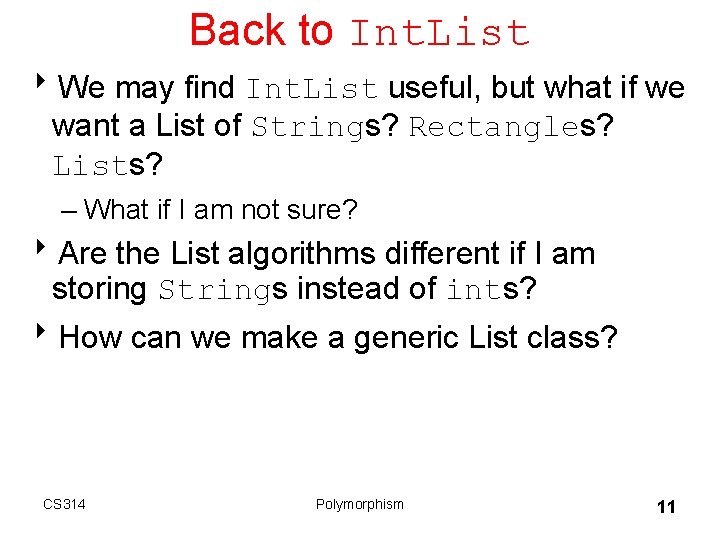
Back to Int. List 8 We may find Int. List useful, but what if we want a List of Strings? Rectangles? Lists? – What if I am not sure? 8 Are the List algorithms different if I am storing Strings instead of ints? 8 How can we make a generic List class? CS 314 Polymorphism 11
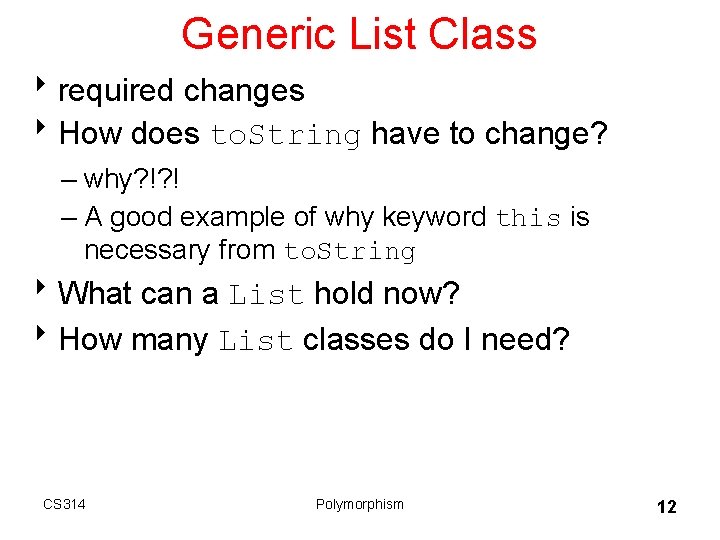
Generic List Class 8 required changes 8 How does to. String have to change? – why? !? ! – A good example of why keyword this is necessary from to. String 8 What can a List hold now? 8 How many List classes do I need? CS 314 Polymorphism 12
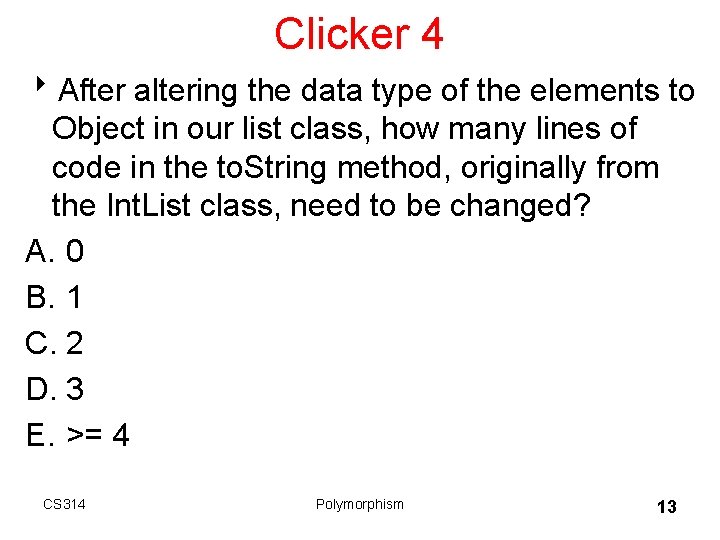
Clicker 4 8 After altering the data type of the elements to Object in our list class, how many lines of code in the to. String method, originally from the Int. List class, need to be changed? A. 0 B. 1 C. 2 D. 3 E. >= 4 CS 314 Polymorphism 13
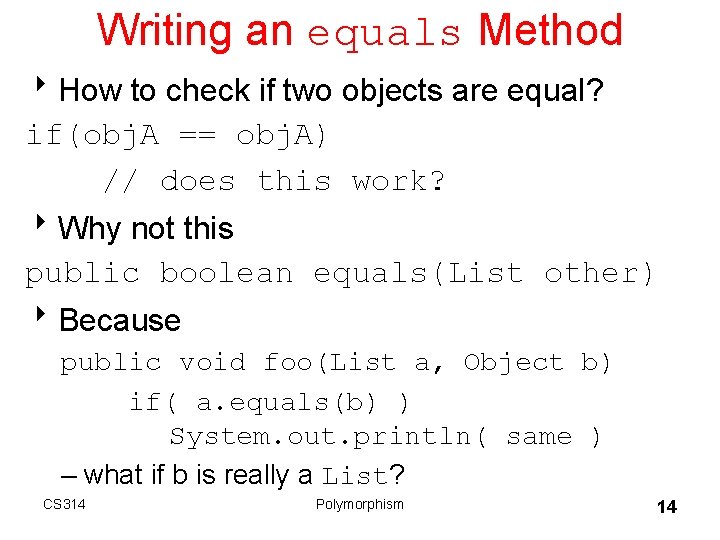
Writing an equals Method 8 How to check if two objects are equal? if(obj. A == obj. A) // does this work? 8 Why not this public boolean equals(List other) 8 Because public void foo(List a, Object b) if( a. equals(b) ) System. out. println( same ) – what if b is really a List? CS 314 Polymorphism 14
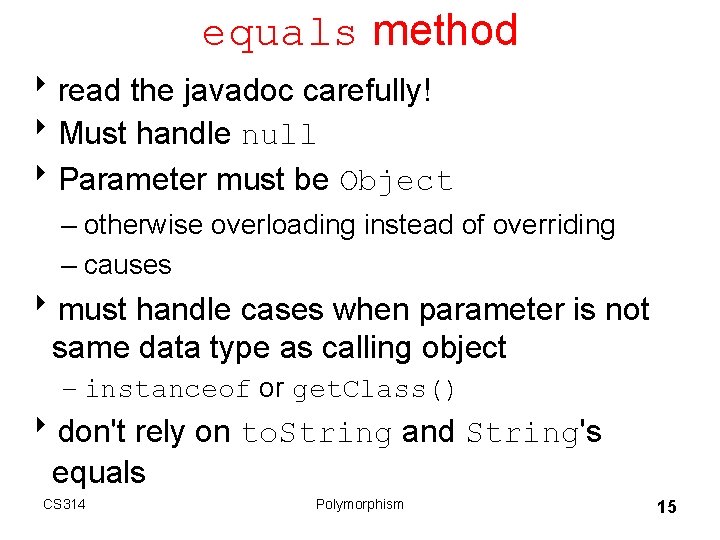
equals method 8 read the javadoc carefully! 8 Must handle null 8 Parameter must be Object – otherwise overloading instead of overriding – causes 8 must handle cases when parameter is not same data type as calling object – instanceof or get. Class() 8 don't rely on to. String and String's equals CS 314 Polymorphism 15
the create. ASet example public Object[] create. ASet(Object[] items) { /* pre: items != null, no elements of items = null post: return an array of Objects that represents a set of the elements in items. (all duplicates removed) */ {5, 1, 2, 3, 1, 5} -> {5, 1, 2, 3} CS 314 Polymorphism 16
create. ASet examples String[] s. List = {"Texas", "texas", "Texas", "UT", "texas"}; Object[] s. Set = create. ASet(s. List); for(int i = 0; i < s. Set. length; i++) System. out. println( s. Set[i] ); Object[] list = {"Hi", 1, 4, 3. 3, true, new Array. List(), "Hi", 3. 3, 4}; Object[] set = create. ASet(list); for(int i = 0; i < set. length; i++) System. out. println( set[i] ); CS 314 Polymorphism 17