
Topic 5 Density And review of Topic 4
- Slides: 12
Topic 5 Density And review of Topic 4 – Flow Rate and Viscosity
Flow Rate and Viscosity § Viscosity – the property that describes a liquid’s thinness or thickness § A thick liquid is more viscous (not vicious) e. g. molasses, oil, paint, shampoo § A thinner liquid is less viscous e. g. water, pop, alcohol
§ Flow rate is the measurement of how long it takes for a fluid to flow a certain distance § Many products require precise measurement of viscosity and flow rate for product formation and application e. g. paints, varnishes, cosmetics, lubricants
Effects of Temperature Liquids § Temperature increase= viscosity decrease § Temperature decrease= viscosity increase Gases § Temperature increase= viscosity increase § Temperature decrease=viscosity decrease
Density § Density can be described as: the “crowdedness” of the particles that make up matter § In scientific terms, density is the mass per unit volume of a substance § So, who cares and what does this mean?
§ The particle model tells us that different substances have different-sized particles § The size of the particles determines how many particles can fit into a given space § Therefore, each substance has its own unique density
§ Imagine one container with liquid water and another container with water vapour § Both liquid water and water vapour have the particles of the same size § But the particle model tells us that gas particles have more space between them than do liquid particles § Therefore, water vapour will have fewer particles than the liquid water § So water vapour is less dense!!!!!!!
Questions to ponder…. § What if gases were more dense than solids or liquids? § What if water was more dense than you? § Can you think of any liquids that may be more dense than solids?
How are mass and volume related? § Mass = the amount of matter in a substance § Volume = the amount of space occupied be a substance How can you measure the volume of a solid, liquid and gas?
IMPORTANT! CRUCIAL! IMPERATIVE! § Mass is NOT the same thing as Weight § Weight is the force of gravity exerted on an object § A force is a push or a pull or anything that causes a change in the motion of an object (always measured in Newtons (N)) § Gravity is the natural force that causes an object to move towards the centre of the Earth (9. 8 N per kilogram of mass)
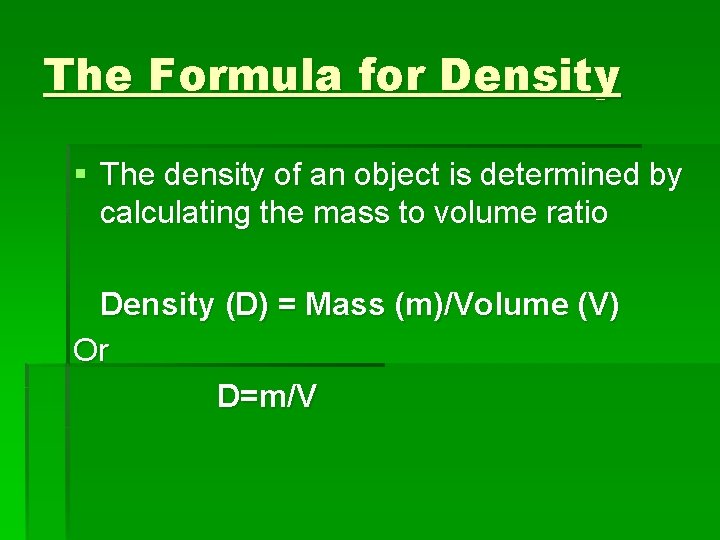
The Formula for Density § The density of an object is determined by calculating the mass to volume ratio Density (D) = Mass (m)/Volume (V) Or D=m/V
§ The density of solids is usually given in g/cm 3 § The density of liquids and gases is usually given in g/L or g/m. L e. g. density of Mercury equals 13. 55 g/m. L Important to know: 1 gram/cubic centimetre (g/cm 3) Equals 1 gram/millilitre (g/m. L)