
Topic 4 Orders of Growth September 2008 Fall
Topic 4 Orders of Growth September 2008 Fall 2008 Programming Development Techniques 1
Orders of growth • When a procedure is called, how do time and memory grow as a function of the size of the input? • Size of an integer = its value • Size of a string = its length • Size of a graph structure = # of nodes or # of links Fall 2008 Programming Development Techniques 2
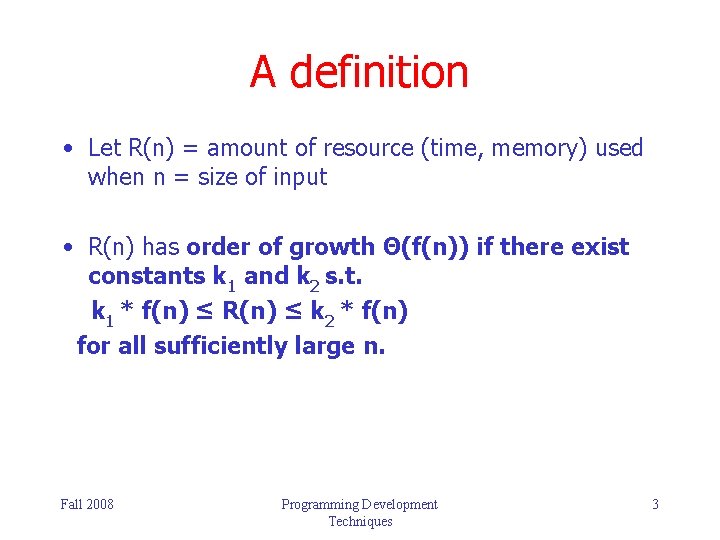
A definition • Let R(n) = amount of resource (time, memory) used when n = size of input • R(n) has order of growth Θ(f(n)) if there exist constants k 1 and k 2 s. t. k 1 * f(n) ≤ R(n) ≤ k 2 * f(n) for all sufficiently large n. Fall 2008 Programming Development Techniques 3
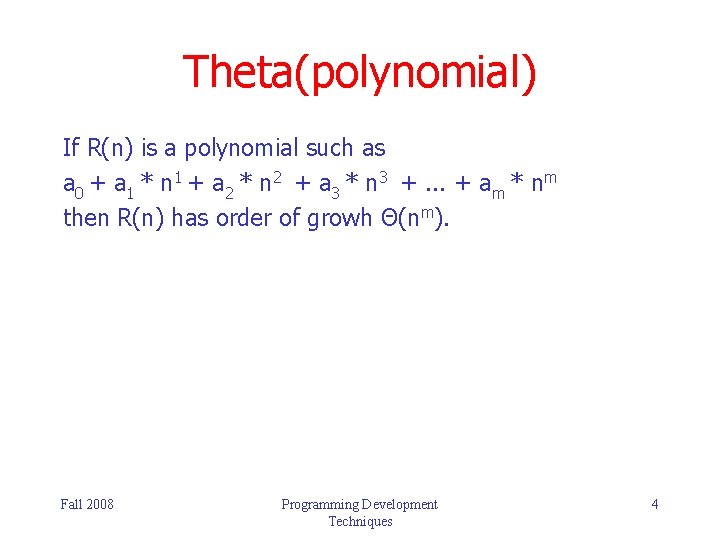
Theta(polynomial) If R(n) is a polynomial such as a 0 + a 1 * n 1 + a 2 * n 2 + a 3 * n 3 +. . . + am * nm then R(n) has order of growh Θ(nm). Fall 2008 Programming Development Techniques 4
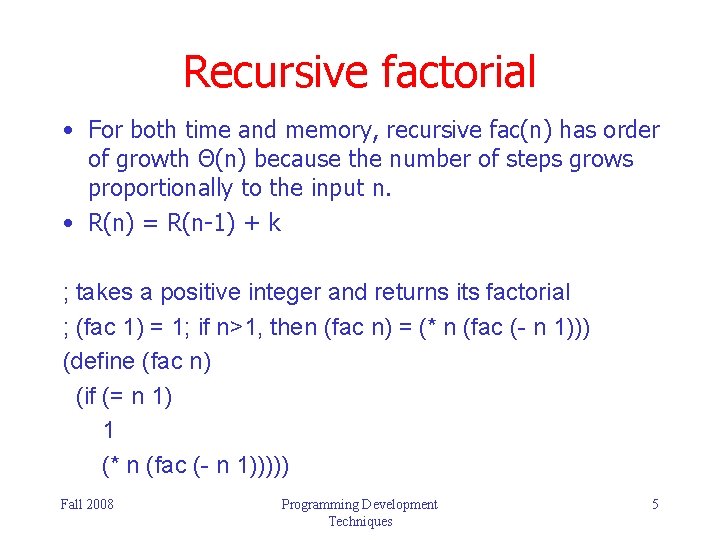
Recursive factorial • For both time and memory, recursive fac(n) has order of growth Θ(n) because the number of steps grows proportionally to the input n. • R(n) = R(n-1) + k ; takes a positive integer and returns its factorial ; (fac 1) = 1; if n>1, then (fac n) = (* n (fac (- n 1))) (define (fac n) (if (= n 1) 1 (* n (fac (- n 1))))) Fall 2008 Programming Development Techniques 5
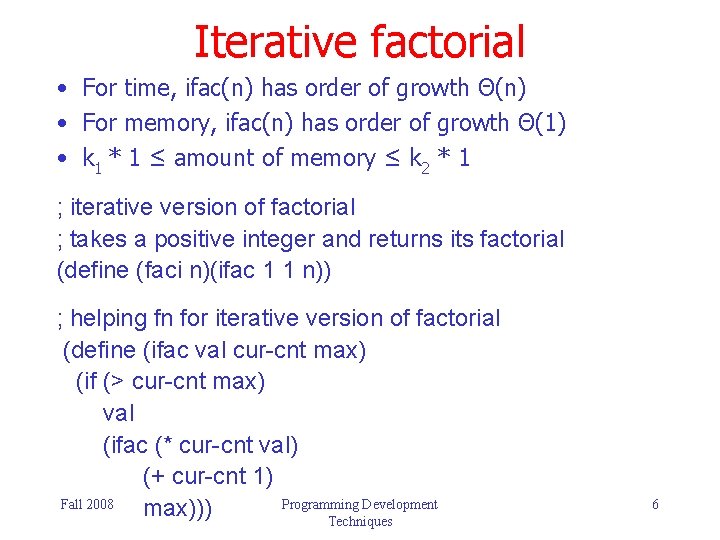
Iterative factorial • For time, ifac(n) has order of growth Θ(n) • For memory, ifac(n) has order of growth Θ(1) • k 1 * 1 ≤ amount of memory ≤ k 2 * 1 ; iterative version of factorial ; takes a positive integer and returns its factorial (define (faci n)(ifac 1 1 n)) ; helping fn for iterative version of factorial (define (ifac val cur-cnt max) (if (> cur-cnt max) val (ifac (* cur-cnt val) (+ cur-cnt 1) Fall 2008 Programming Development max))) Techniques 6
Orders of Growth • Orders of growth provide only a crude description of the behavior of a process. • This is still often very useful – especially as numbers (n’s) are very large. • The difference between a process that is linear (O(n)) versus O(n 2) can mean the difference between being able to run the algorithm on a particular input and not being able to run it. Fall 2008 Programming Development Techniques 7
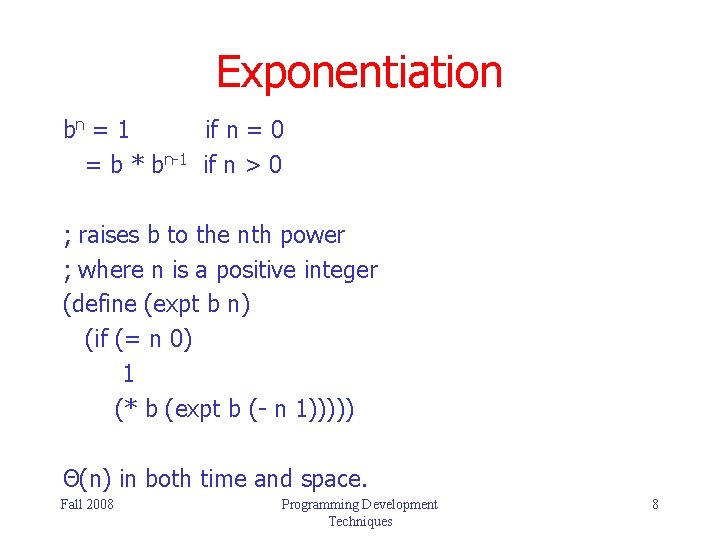
Exponentiation bn = 1 if n = 0 = b * bn-1 if n > 0 ; raises b to the nth power ; where n is a positive integer (define (expt b n) (if (= n 0) 1 (* b (expt b (- n 1))))) Θ(n) in both time and space. Fall 2008 Programming Development Techniques 8

Can we do better? • We could do better by developing a procedure that generated a linear iterative process rather than a recursive one. Fall 2008 Programming Development Techniques 9
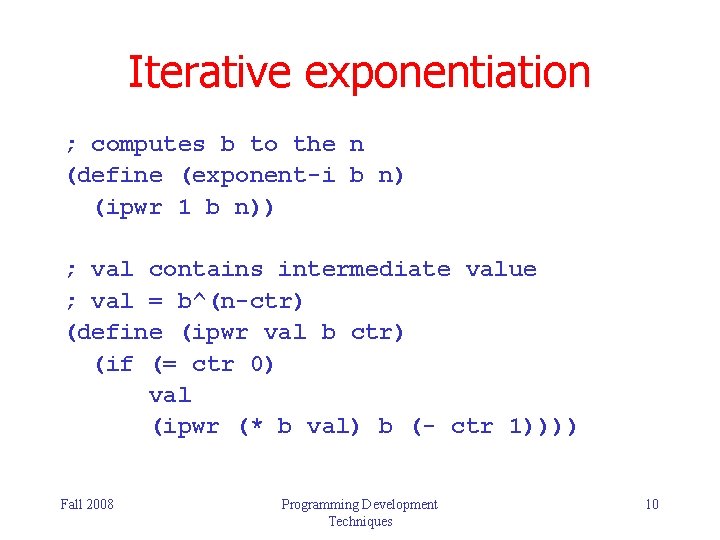
Iterative exponentiation ; computes b to the n (define (exponent-i b n) (ipwr 1 b n)) ; val contains intermediate value ; val = b^(n-ctr) (define (ipwr val b ctr) (if (= ctr 0) val (ipwr (* b val) b (- ctr 1)))) Fall 2008 Programming Development Techniques 10
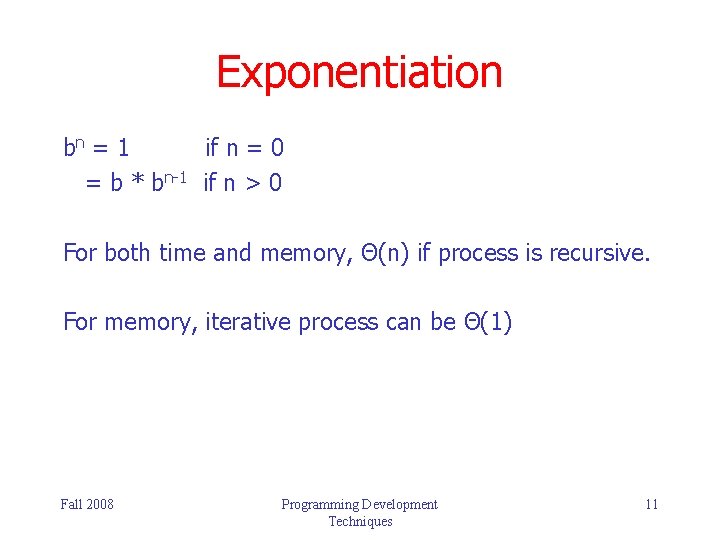
Exponentiation bn = 1 if n = 0 = b * bn-1 if n > 0 For both time and memory, Θ(n) if process is recursive. For memory, iterative process can be Θ(1) Fall 2008 Programming Development Techniques 11
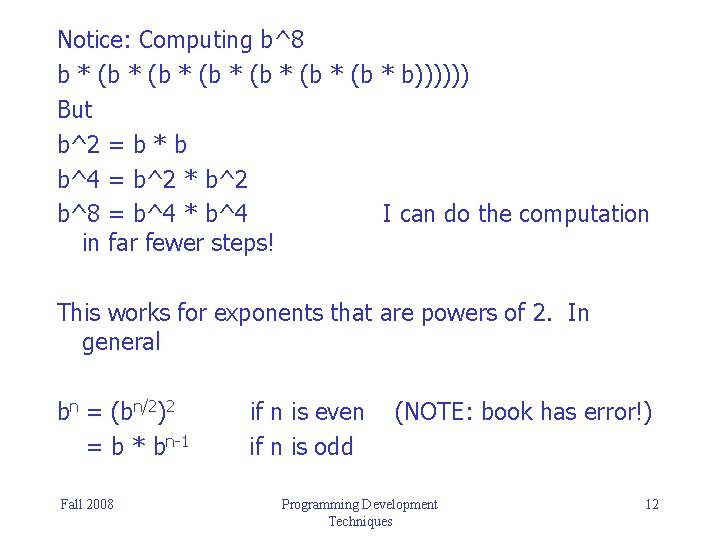
Notice: Computing b^8 b * (b * (b * b)))))) But b^2 = b * b b^4 = b^2 * b^2 b^8 = b^4 * b^4 I can do the computation in far fewer steps! This works for exponents that are powers of 2. In general bn = (bn/2)2 = b * bn-1 Fall 2008 if n is even if n is odd (NOTE: book has error!) Programming Development Techniques 12
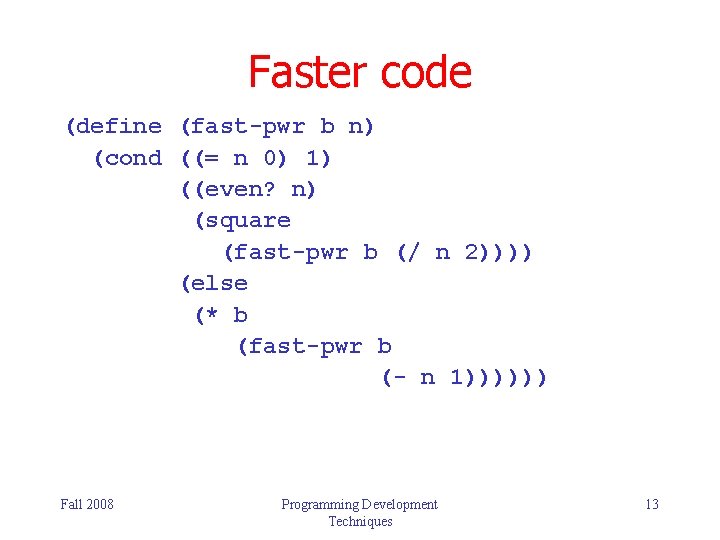
Faster code (define (fast-pwr b n) (cond ((= n 0) 1) ((even? n) (square (fast-pwr b (/ n 2)))) (else (* b (fast-pwr b (- n 1)))))) Fall 2008 Programming Development Techniques 13
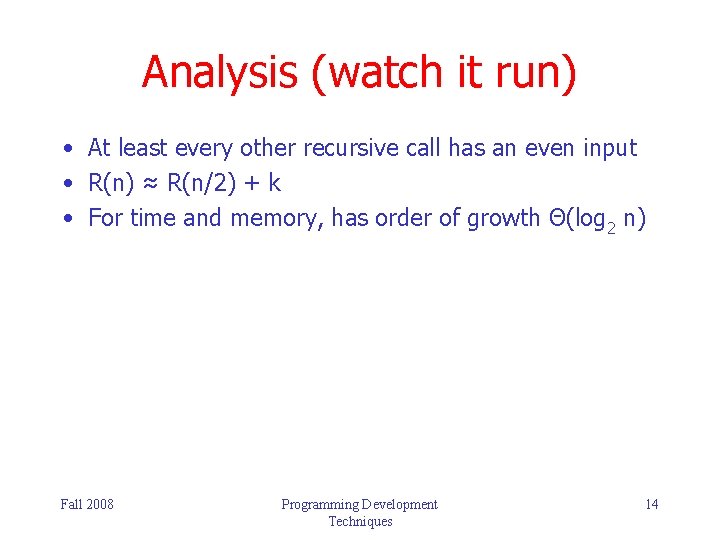
Analysis (watch it run) • At least every other recursive call has an even input • R(n) ≈ R(n/2) + k • For time and memory, has order of growth Θ(log 2 n) Fall 2008 Programming Development Techniques 14
- Slides: 14