
Topic 4 Microeconomics Review Monopoly EC 3322 Semester

- Slides: 23
Topic 4: Microeconomics Review: Monopoly EC 3322 Semester I – 2008/2009 Yohanes E. Riyanto EC 3322 (Industrial Organization I) 1
Monopoly n A firm is a monopoly if it is the only supplier of a product for which there is no close substitute. n A monopoly can set price without being afraid of being undercut by its rivals. n Since the firm is a price-setter, it faces a downward-sloping market demand it can raise its price above marginal cost. n A monopoly sets its output to maximize its profit (just like a competitive firm) since demand is downward sloping the more it sells, the lower the price will be. q n A competitive firm individual demand curve is horizontal the price does not fall if it expands quantity. A firm’s behavior and government regulation influence the firm’s ability to become and remain a monopoly. Yohanes E. Riyanto EC 3322 (Industrial Organization I) 2
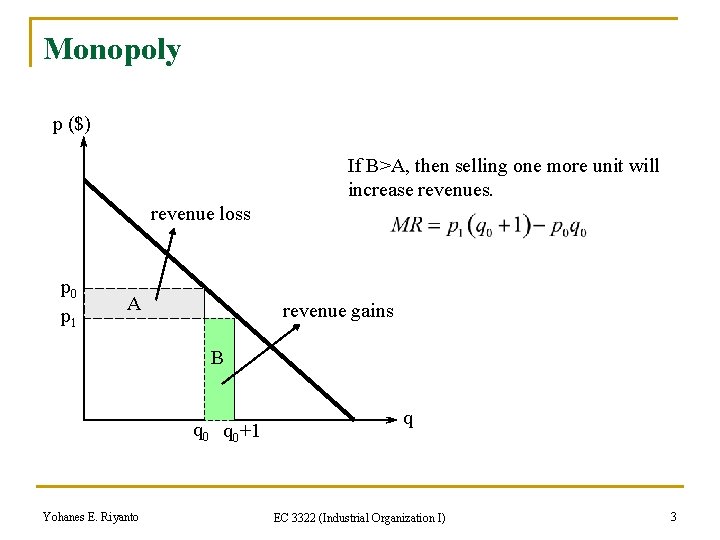
Monopoly p ($) If B>A, then selling one more unit will increase revenues. revenue loss p 0 p 1 A revenue gains B q 0+1 Yohanes E. Riyanto q EC 3322 (Industrial Organization I) 3
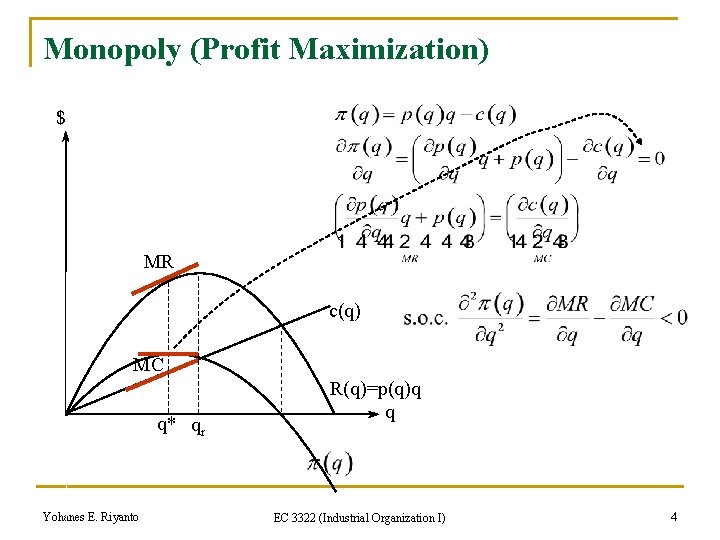
Monopoly (Profit Maximization) $ MR c(q) MC q* qr Yohanes E. Riyanto R(q)=p(q)q q EC 3322 (Industrial Organization I) 4
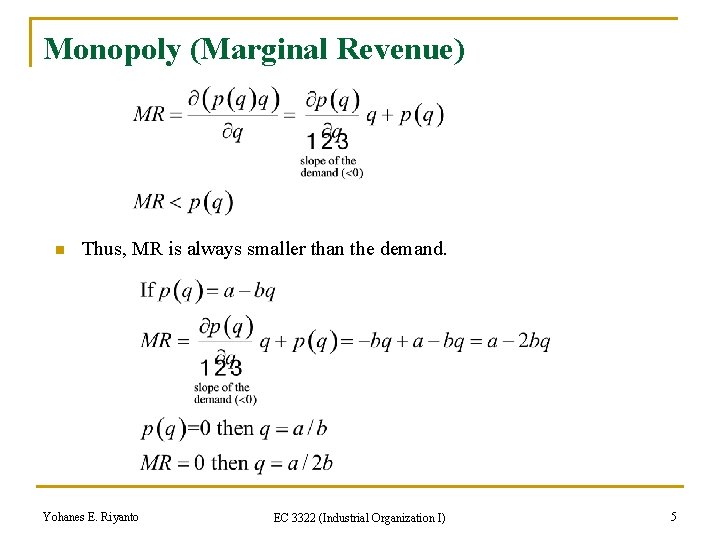
Monopoly (Marginal Revenue) n Thus, MR is always smaller than the demand. Yohanes E. Riyanto EC 3322 (Industrial Organization I) 5
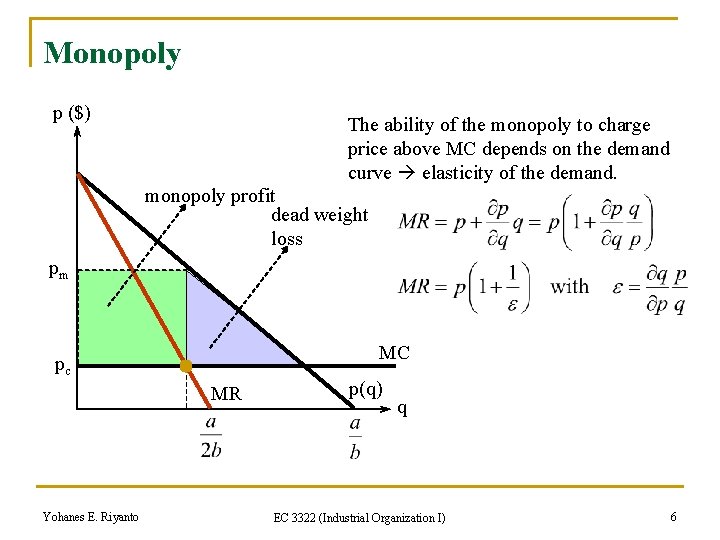
Monopoly p ($) The ability of the monopoly to charge price above MC depends on the demand curve elasticity of the demand. monopoly profit dead weight loss pm MC pc MR Yohanes E. Riyanto p(q) q EC 3322 (Industrial Organization I) 6
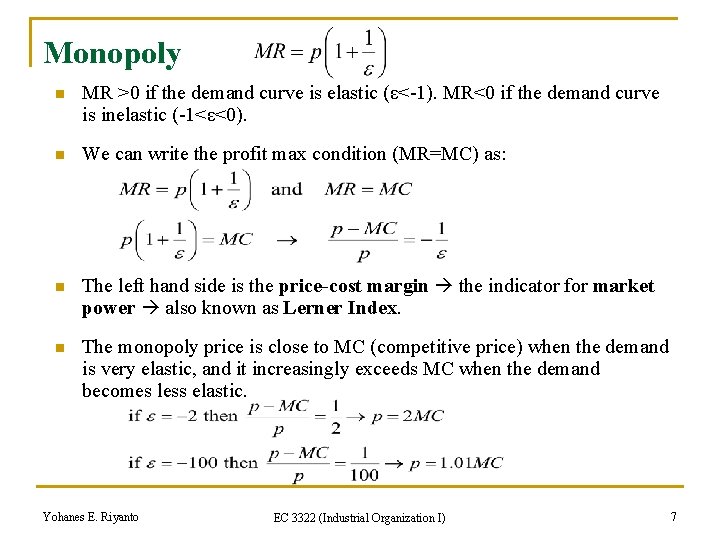
Monopoly n MR >0 if the demand curve is elastic (ε<-1). MR<0 if the demand curve is inelastic (-1<ε<0). n We can write the profit max condition (MR=MC) as: n The left hand side is the price-cost margin the indicator for market power also known as Lerner Index. n The monopoly price is close to MC (competitive price) when the demand is very elastic, and it increasingly exceeds MC when the demand becomes less elastic. Yohanes E. Riyanto EC 3322 (Industrial Organization I) 7
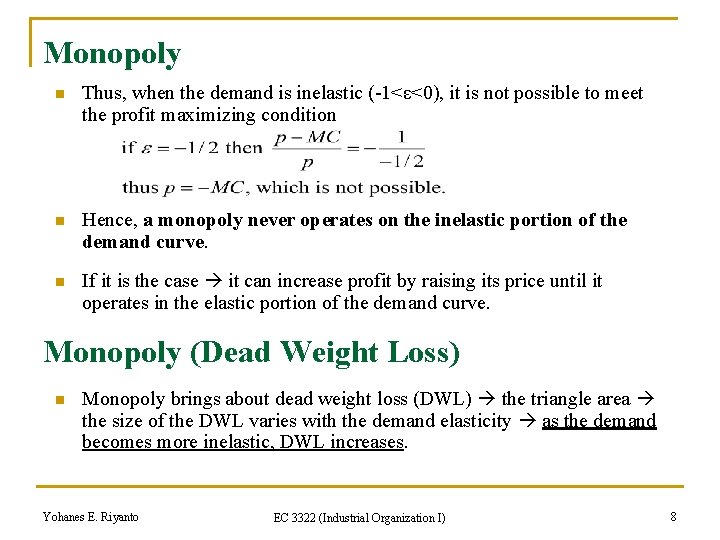
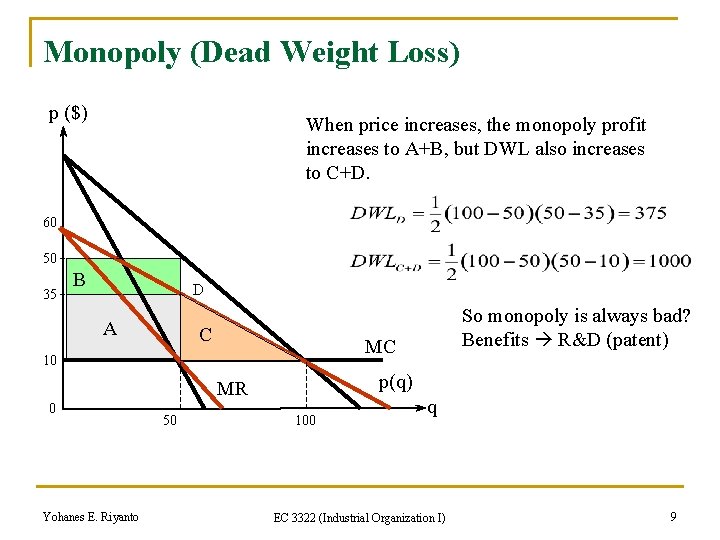
Monopoly n Thus, when the demand is inelastic (-1<ε<0), it is not possible to meet the profit maximizing condition n Hence, a monopoly never operates on the inelastic portion of the demand curve. n If it is the case it can increase profit by raising its price until it operates in the elastic portion of the demand curve. Monopoly (Dead Weight Loss) n Monopoly brings about dead weight loss (DWL) the triangle area the size of the DWL varies with the demand elasticity as the demand becomes more inelastic, DWL increases. Yohanes E. Riyanto EC 3322 (Industrial Organization I) 8
Monopoly (Dead Weight Loss) p ($) When price increases, the monopoly profit increases to A+B, but DWL also increases to C+D. 60 50 35 B D A C MC 10 p(q) MR 0 Yohanes E. Riyanto 50 So monopoly is always bad? Benefits R&D (patent) 100 q EC 3322 (Industrial Organization I) 9
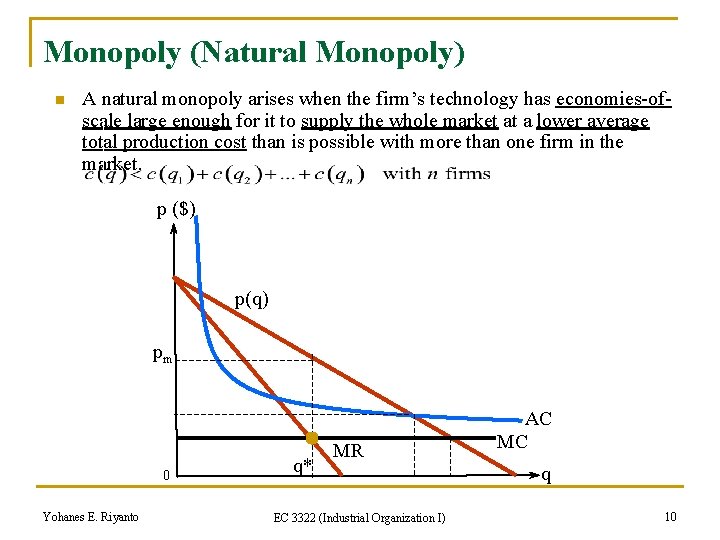
Monopoly (Natural Monopoly) n A natural monopoly arises when the firm’s technology has economies-ofscale large enough for it to supply the whole market at a lower average total production cost than is possible with more than one firm in the market. p ($) p(q) pm 0 Yohanes E. Riyanto q* MR EC 3322 (Industrial Organization I) AC MC q 10
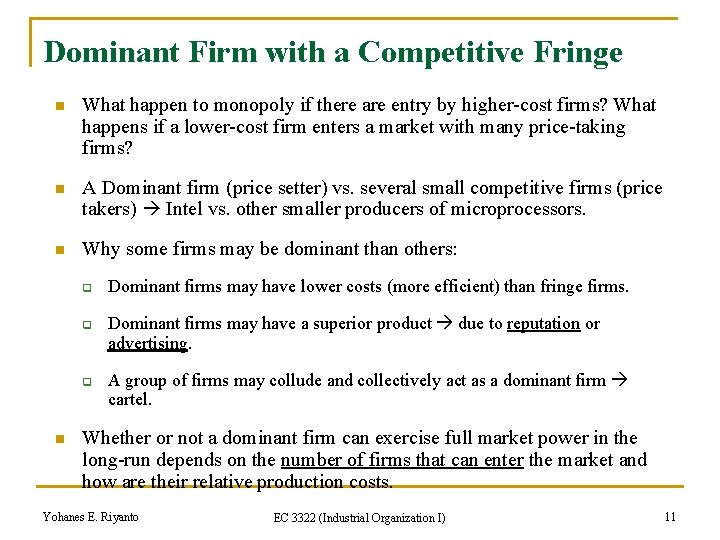
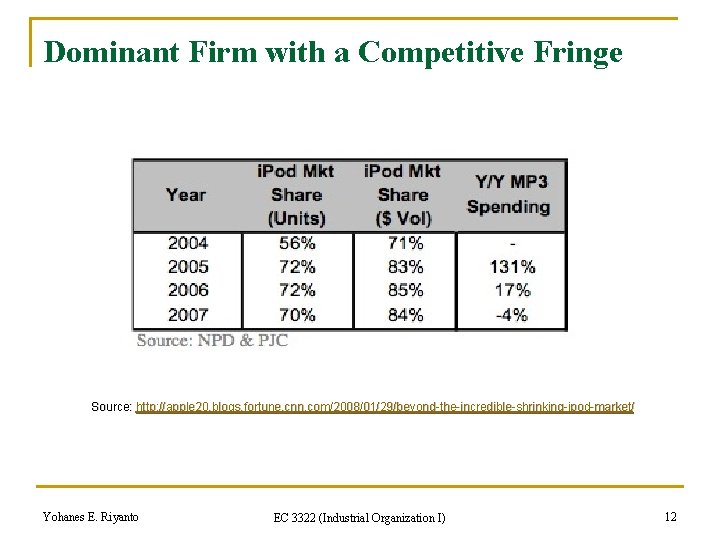
Dominant Firm with a Competitive Fringe n What happen to monopoly if there are entry by higher-cost firms? What happens if a lower-cost firm enters a market with many price-taking firms? n A Dominant firm (price setter) vs. several small competitive firms (price takers) Intel vs. other smaller producers of microprocessors. n Why some firms may be dominant than others: q q q n Dominant firms may have lower costs (more efficient) than fringe firms. Dominant firms may have a superior product due to reputation or advertising. A group of firms may collude and collectively act as a dominant firm cartel. Whether or not a dominant firm can exercise full market power in the long-run depends on the number of firms that can enter the market and how are their relative production costs. Yohanes E. Riyanto EC 3322 (Industrial Organization I) 11
Dominant Firm with a Competitive Fringe Source: http: //apple 20. blogs. fortune. cnn. com/2008/01/29/beyond-the-incredible-shrinking-ipod-market/ Yohanes E. Riyanto EC 3322 (Industrial Organization I) 12
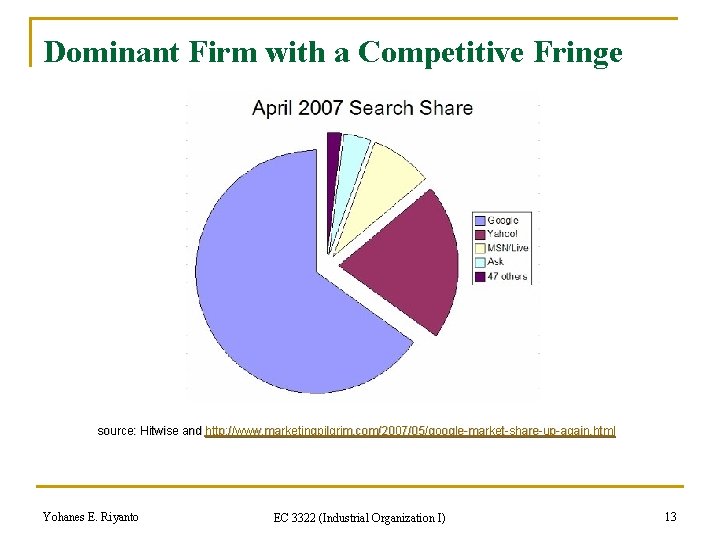
Dominant Firm with a Competitive Fringe source: Hitwise and http: //www. marketingpilgrim. com/2007/05/google-market-share-up-again. html Yohanes E. Riyanto EC 3322 (Industrial Organization I) 13
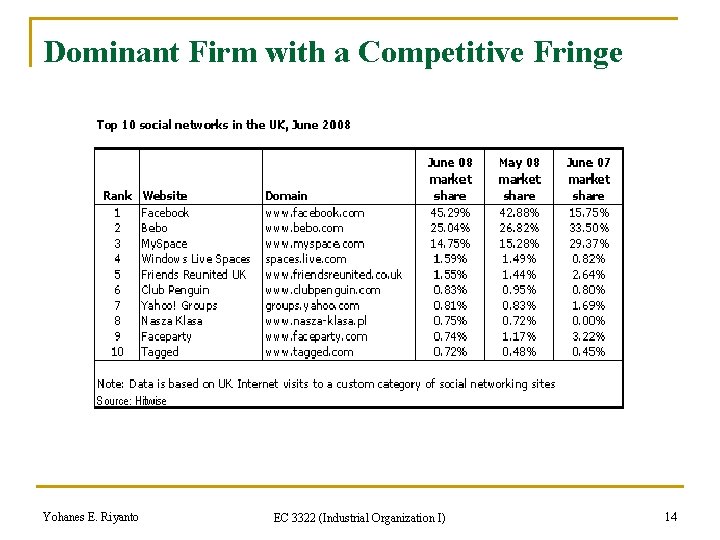
Dominant Firm with a Competitive Fringe Yohanes E. Riyanto EC 3322 (Industrial Organization I) 14
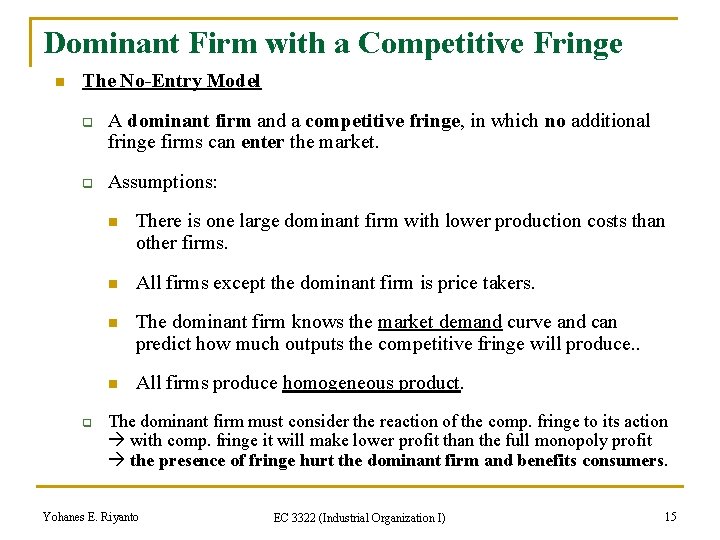
Dominant Firm with a Competitive Fringe n The No-Entry Model q q q A dominant firm and a competitive fringe, in which no additional fringe firms can enter the market. Assumptions: n There is one large dominant firm with lower production costs than other firms. n All firms except the dominant firm is price takers. n The dominant firm knows the market demand curve and can predict how much outputs the competitive fringe will produce. . n All firms produce homogeneous product. The dominant firm must consider the reaction of the comp. fringe to its action with comp. fringe it will make lower profit than the full monopoly profit the presence of fringe hurt the dominant firm and benefits consumers. Yohanes E. Riyanto EC 3322 (Industrial Organization I) 15
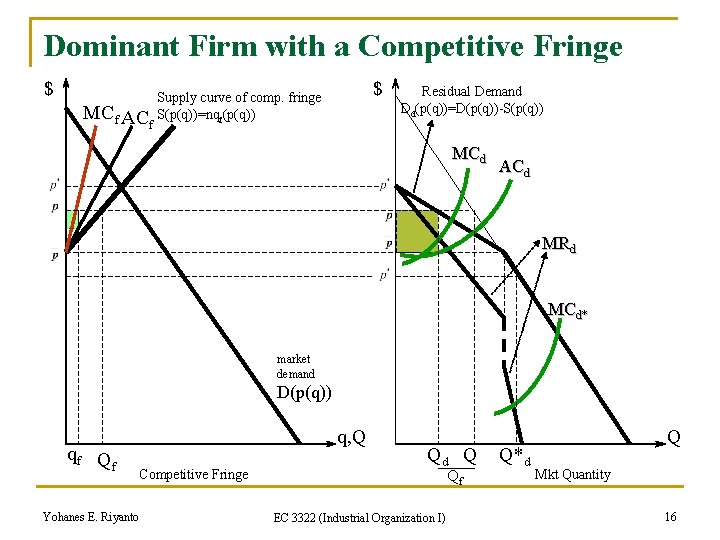
Dominant Firm with a Competitive Fringe $ MCf ACf $ Supply curve of comp. fringe S(p(q))=nqf(p(q)) Residual Demand Dd(p(q))=D(p(q))-S(p(q)) MCd ACd MRd MCd* market demand D(p(q)) qf Q f q, Q Competitive Fringe Yohanes E. Riyanto Qd Q Qf EC 3322 (Industrial Organization I) Q*d Q Mkt Quantity 16
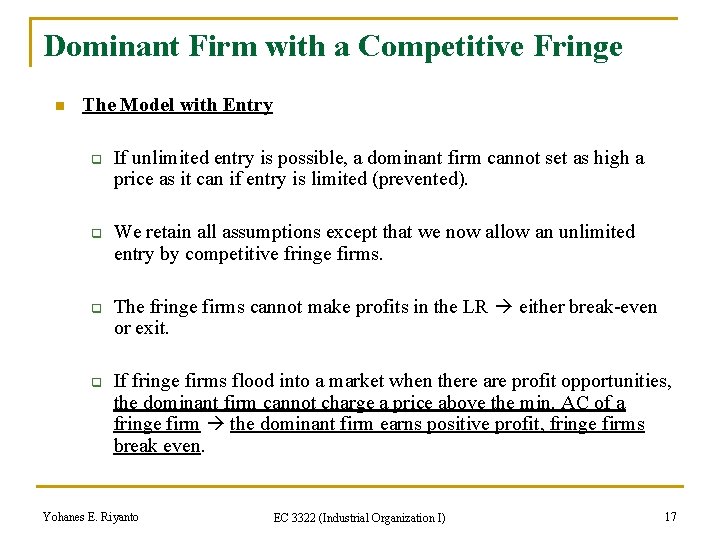
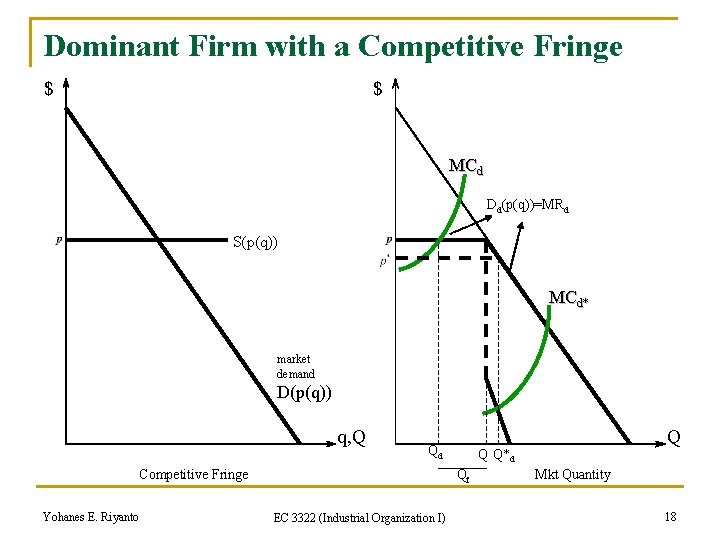
Dominant Firm with a Competitive Fringe n The Model with Entry q q If unlimited entry is possible, a dominant firm cannot set as high a price as it can if entry is limited (prevented). We retain all assumptions except that we now allow an unlimited entry by competitive fringe firms. The fringe firms cannot make profits in the LR either break-even or exit. If fringe firms flood into a market when there are profit opportunities, the dominant firm cannot charge a price above the min. AC of a fringe firm the dominant firm earns positive profit, fringe firms break even. Yohanes E. Riyanto EC 3322 (Industrial Organization I) 17
Dominant Firm with a Competitive Fringe $ $ MCd Dd(p(q))=MRd S(p(q)) MCd* market demand D(p(q)) q, Q Qd Competitive Fringe Yohanes E. Riyanto Q Q*d Qf EC 3322 (Industrial Organization I) Q Mkt Quantity 18
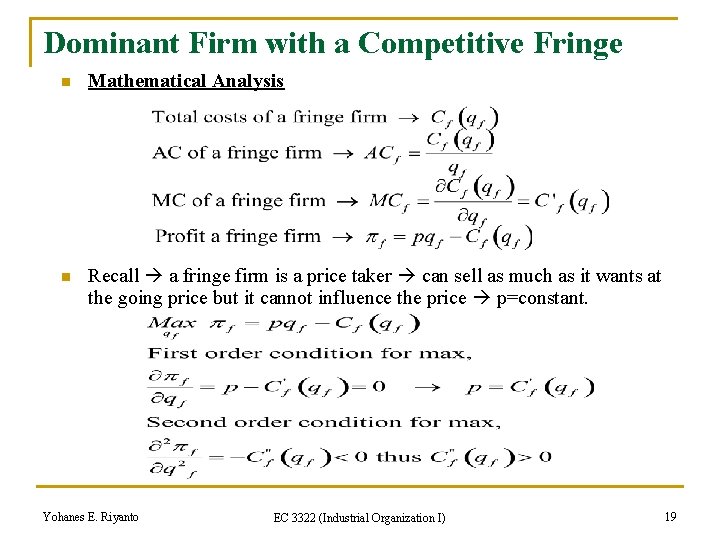
Dominant Firm with a Competitive Fringe n Mathematical Analysis n Recall a fringe firm is a price taker can sell as much as it wants at the going price but it cannot influence the price p=constant. Yohanes E. Riyanto EC 3322 (Industrial Organization I) 19
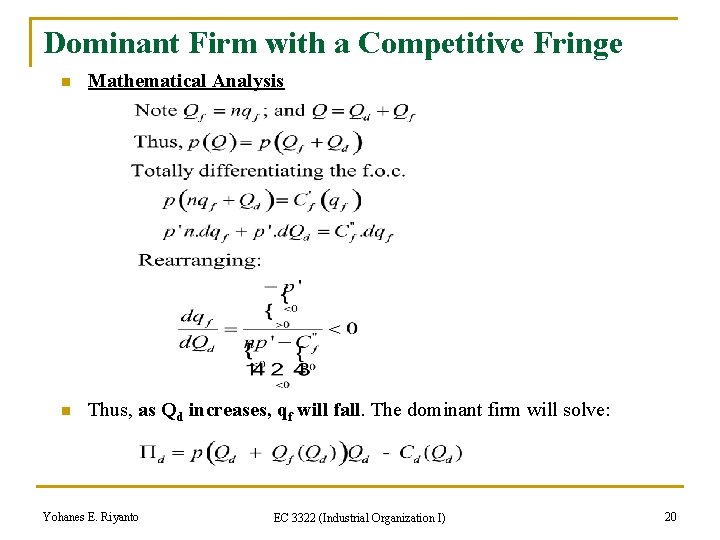
Dominant Firm with a Competitive Fringe n Mathematical Analysis n Thus, as Qd increases, qf will fall. The dominant firm will solve: Yohanes E. Riyanto EC 3322 (Industrial Organization I) 20
Dominant Firm with a Competitive Fringe n Mathematical Analysis n This ratio is positive and can be verified to be smaller than 1 (given that p’<0). Yohanes E. Riyanto EC 3322 (Industrial Organization I) 21
Antitrust Policy on Monopolization n Recall monopoly power creates inefficiencies (DWL), although there maybe some benefits (economies of scale-efficiency and R&D) as well. n Exercise of monopoly power is usually subjected to antitrust policy. n Examples: AT&T (1982) and Microsoft (2002) AT&T was a holding company controlling 22 local distribution telephone companies, Bell Long Lines Division, Western Electric, and Bell Labs. Its control on the telecommunication industry was the result of a combination of government regulation, vertical integration and aggressive competitive practices. The complaints AT&T monopolized the industry by adopting strategies; 1) keeping out independent equipment manufacturers from AT&T markets by solely purchasing all equipments from AT&T’s subsidiary, Western Electric and 2) preventing competition by not giving access to independent carriers from interconnecting with the AT&T systems. US Justice Dept ordered AT&T to be broken up into allowed to keep Western Electric, Long Lines and Bell Labs but must divest its 22 local operating companies. Yohanes E. Riyanto EC 3322 (Industrial Organization I) 22
Antitrust Policy on Monopolization Microsoft In 1998, the US Dept. of Justice filed an antitrust action against Microsoft with allegation that Microsoft had abused and exercised monopoly power in the market for PC operating systems. Windows has 90% market share. Microsoft tied its browser (Internet Explorer) with Windows such that it restricted the market for competing browsers. Microsoft argued that Windows and IE are inextricably linked and the browser is an integral part of the operating system. In June 2000, DC judge Thomas Penfield Jackson ruled that Microsoft was a monopolist in the market for Intel-compatible PC operating systems. It should be broken up into 2 companies, i. e. one to produce the OS and one to produce other software. Upon appeal, the court affirmed the previous finding of Microsoft’s monopolization but overturned the ruling that Microsoft should be broken-up. In Dec 2002, the US Dept. of Justice reached a final settlement agreement with Microsoft restricts some of Microsoft’s actions and establishing monitoring system to ensure compliance, in addition of monetary damages. Yohanes E. Riyanto EC 3322 (Industrial Organization I) 23