
Topic 4 Cognitive Errors 2 Prof Dr Chew

- Slides: 15
Topic 4: Cognitive Errors 2 Prof. Dr. Chew Keng Sheng Faculty of Medicine and Health Sciences, Universiti Malaysia Sarawak This Open. Course. Ware@UNIMAS and its related course materials are licensed under a Creative Commons Attribution-Non. Commercial-Share. Alike 4. 0 International License.
Objectives • By the end of this lecture, the learners will be able to 1. outline the affective factors that predispose us to commit cognitive errors 2. describe the effects of sleep deprivation 3. describe the challenges in implementing cognitive debiasing strategies
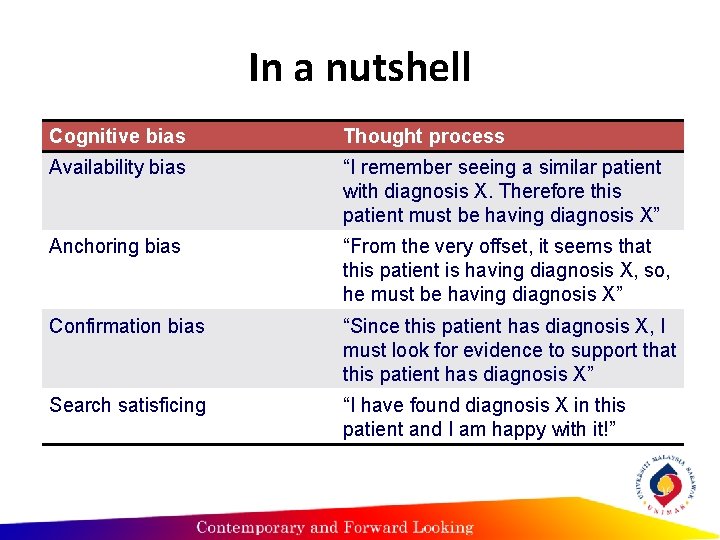
In a nutshell Cognitive bias Thought process Availability bias “I remember seeing a similar patient with diagnosis X. Therefore this patient must be having diagnosis X” Anchoring bias “From the very offset, it seems that this patient is having diagnosis X, so, he must be having diagnosis X” Confirmation bias “Since this patient has diagnosis X, I must look for evidence to support that this patient has diagnosis X” Search satisficing “I have found diagnosis X in this patient and I am happy with it!”
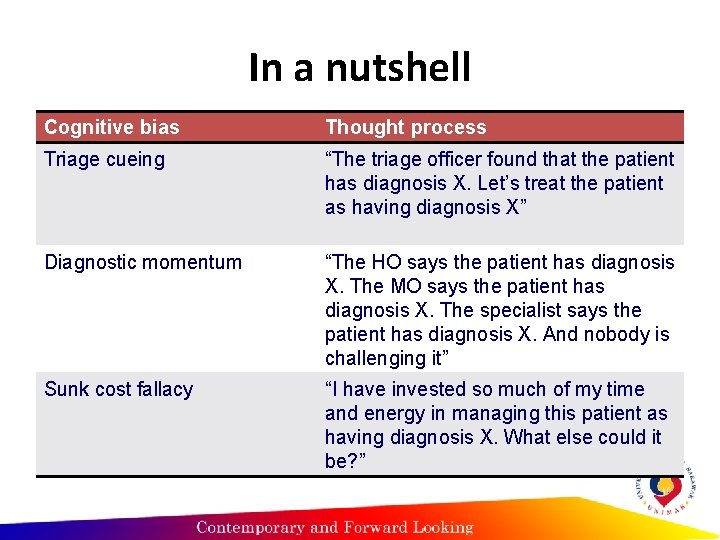
In a nutshell Cognitive bias Thought process Triage cueing “The triage officer found that the patient has diagnosis X. Let’s treat the patient as having diagnosis X” Diagnostic momentum “The HO says the patient has diagnosis X. The MO says the patient has diagnosis X. The specialist says the patient has diagnosis X. And nobody is challenging it” Sunk cost fallacy “I have invested so much of my time and energy in managing this patient as having diagnosis X. What else could it be? ”
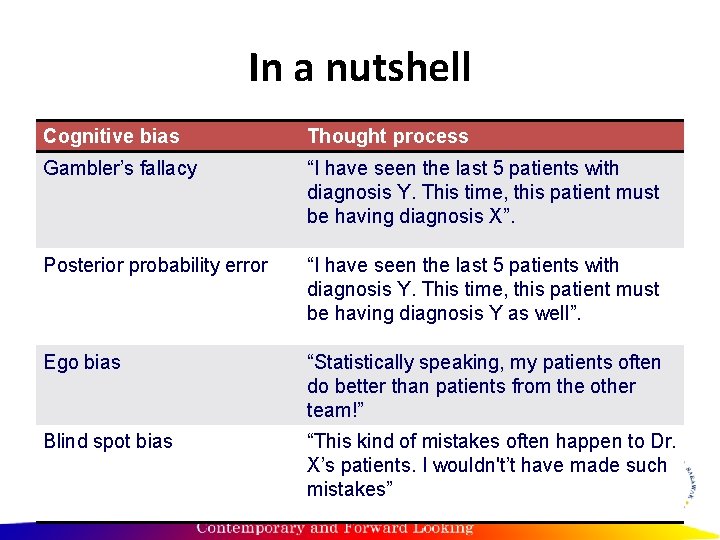
In a nutshell Cognitive bias Thought process Gambler’s fallacy “I have seen the last 5 patients with diagnosis Y. This time, this patient must be having diagnosis X”. Posterior probability error “I have seen the last 5 patients with diagnosis Y. This time, this patient must be having diagnosis Y as well”. Ego bias “Statistically speaking, my patients often do better than patients from the other team!” Blind spot bias “This kind of mistakes often happen to Dr. X’s patients. I wouldn't’t have made such mistakes”
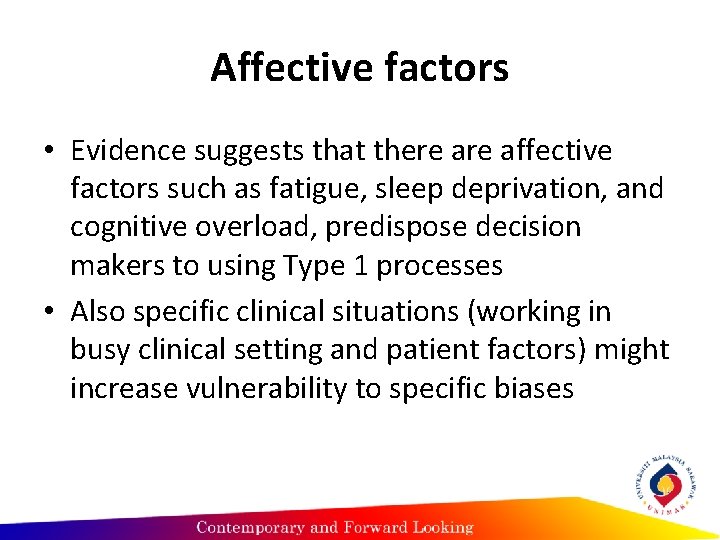
Affective factors • Evidence suggests that there affective factors such as fatigue, sleep deprivation, and cognitive overload, predispose decision makers to using Type 1 processes • Also specific clinical situations (working in busy clinical setting and patient factors) might increase vulnerability to specific biases
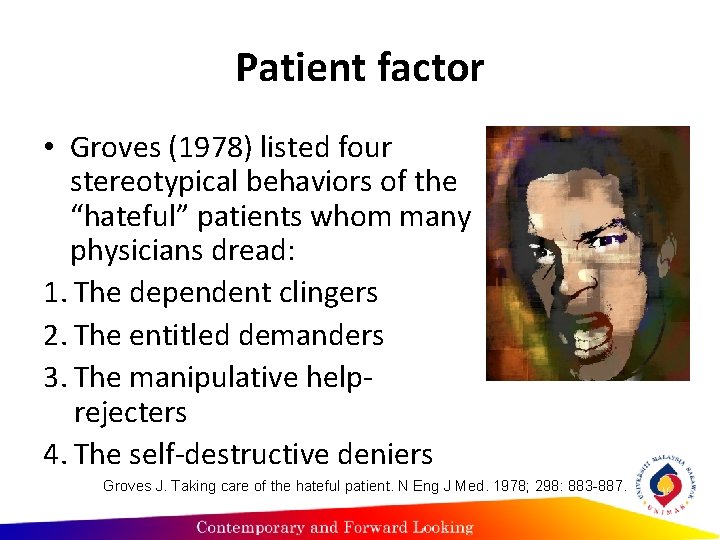
Patient factor • Groves (1978) listed four stereotypical behaviors of the “hateful” patients whom many physicians dread: 1. The dependent clingers 2. The entitled demanders 3. The manipulative helprejecters 4. The self-destructive deniers Groves J. Taking care of the hateful patient. N Eng J Med. 1978; 298: 883 -887.
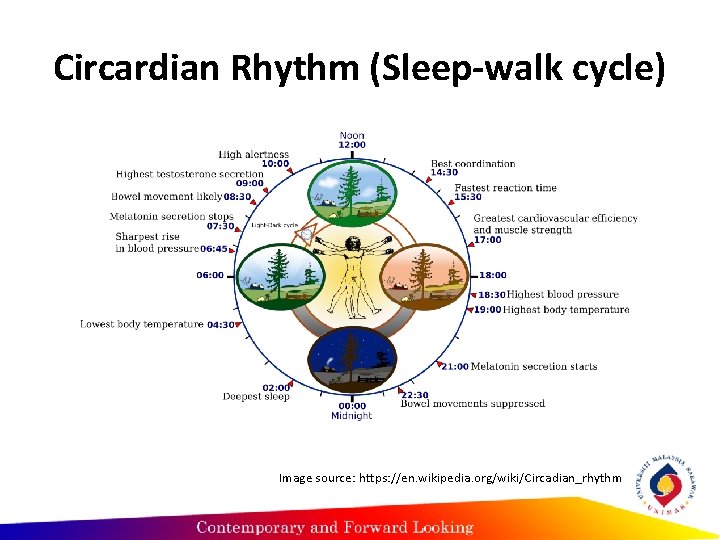
Circardian Rhythm (Sleep-walk cycle) Image source: https: //en. wikipedia. org/wiki/Circadian_rhythm
Anchor period sleep • Anchor period concept – the period of 3 – 4 hours within the circadian rhythm where sleep must be obtained in order to preserve circadian rhythm • Around 0200 – 0600 hour, depends of the person’s usual day-cycle • Loss of anchor period sleep �circadian dyssynchrony
Sleep deprivation • After 17 hours of continuous wakefulness, hand-eye coordination task would have declined to such a level equivalent to that of a blood alcohol level of 0. 05%. • And at 24 hour of sustained wakefulness, the impairment in psychomotor function is equivalent to a blood alcohol concentration of 0. 1% Dawson D, Reid K: Fatigue, alcohol and performance impairment (scientific correspondence). Nature 1997; 388: 235
Sleep deprivation • A fatigued worker will also have a tendency to slow down work his work processes in order to maintain accuracy (known as the “speedaccuracy trade-off”) Dawson D, Reid K: Fatigue, alcohol and performance impairment (scientific correspondence). Nature 1997; 388: 235
Sleep deprivation • A prospective investigation of more than one million individuals conducted by the American Cancer Society found that men who reported “usual” daily sleep times of less than 4 hours were 2. 8 times more likely to have died within a 6 -year follow-up as men who obtained 7. 0– 7. 9 hours of sleep. Kripke DF, Simons RN, Garfinkel L, Hammond EC: Short and long sleep and sleeping pills: Is increased mortality associated? Arch Gen Psychiatry 1979; 36: 103– 16
Busy Environment
Not an easy task • Even though cognitive errors detected, very unlikely one strategy works for all • Need for multiple approaches • Very unlikely one shot will work • Need for multiple innoculations • Need for extra vigilance in critical conditions • Need for lifelong maintenance
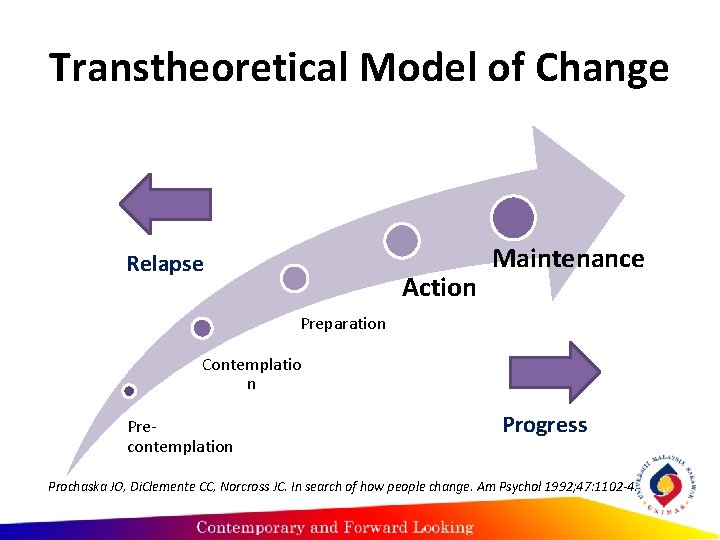
Transtheoretical Model of Change Relapse Action Maintenance Preparation Contemplatio n Precontemplation Progress Prochaska JO, Di. Clemente CC, Norcross JC. In search of how people change. Am Psychol 1992; 47: 1102 -4.