
Topic 4 Chemical Bonding Structures 4 2 Covalent
Topic 4: Chemical Bonding & Structures 4. 2 – Covalent Bonding 4. 3 – Covalent Structures 1
Covalent Bonding Covalent bonds form when atoms share electrons. Atoms that lack the necessary electrons to form a stable octet are most likely to form covalent bonds. Covalent bonds are most likely to form between two nonmetals. 2
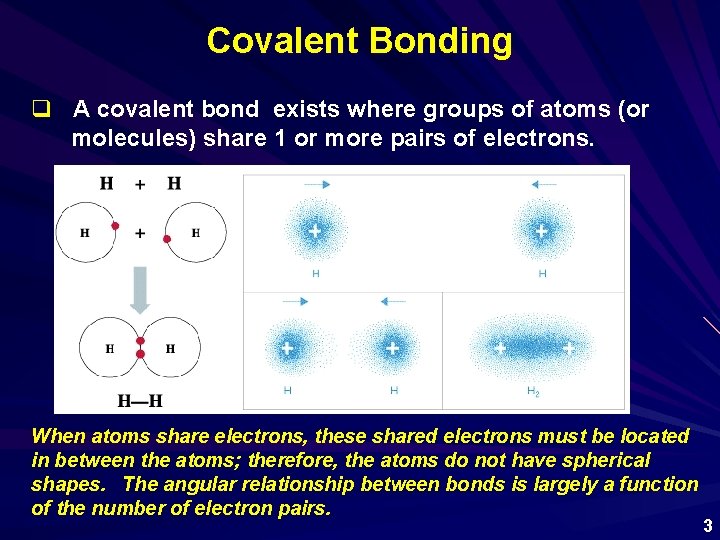
Covalent Bonding q A covalent bond exists where groups of atoms (or molecules) share 1 or more pairs of electrons. When atoms share electrons, these shared electrons must be located in between the atoms; therefore, the atoms do not have spherical shapes. The angular relationship between bonds is largely a function of the number of electron pairs. 3
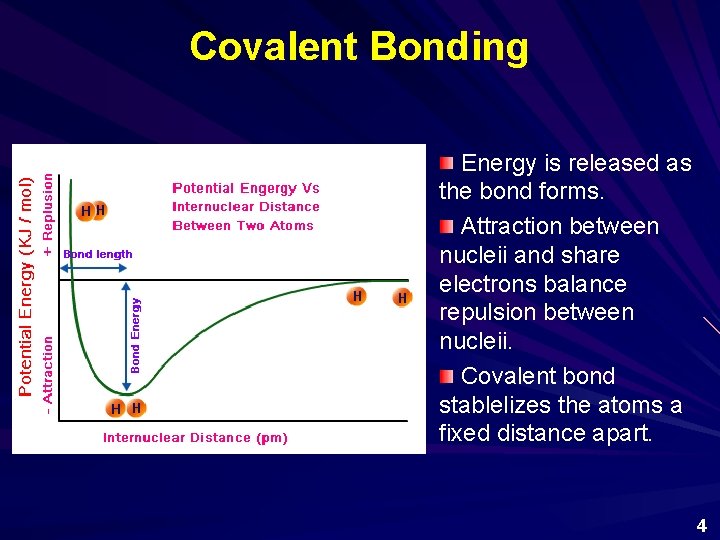
Covalent Bonding Energy is released as the bond forms. Attraction between nucleii and share electrons balance repulsion between nucleii. Covalent bond stablelizes the atoms a fixed distance apart. 4

Multiple Covalent Bonds Atoms can share more than one pair of electrons. Greater electrostatic attraction on the atomic nucleii, Shorter bond length, Greater bond strength 5
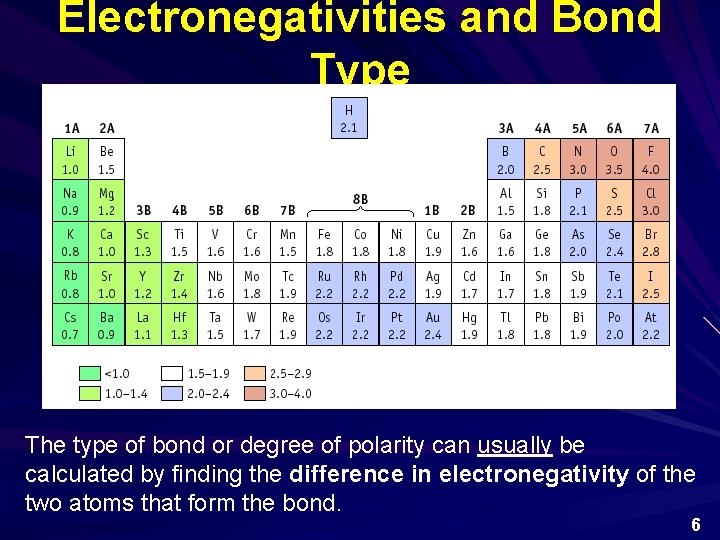
Electronegativities and Bond Type The type of bond or degree of polarity can usually be calculated by finding the difference in electronegativity of the two atoms that form the bond. 6
The Rule of 1. 8 Used to determine if a bond is ionic or covalent Ionic and covalent are not separate things but differences in degree Atoms that have electronegativity differences greater than 1. 8 usually form ionic bonds. i. e Na. Cl Atoms that have electronegativity differences less than or equal to 1. 8 form polar covalent bonds. i. e H 2 O The smaller the electronegativity difference the less polar the bond will be. If the difference is zero the bond is nonpolar (totally) covalent. i. e. Cl 2. 7
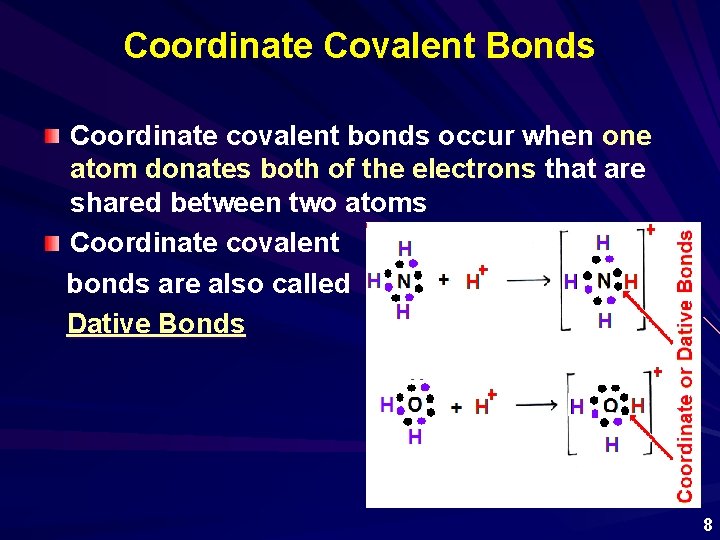
Coordinate Covalent Bonds Coordinate covalent bonds occur when one atom donates both of the electrons that are shared between two atoms Coordinate covalent bonds are also called Dative Bonds 8
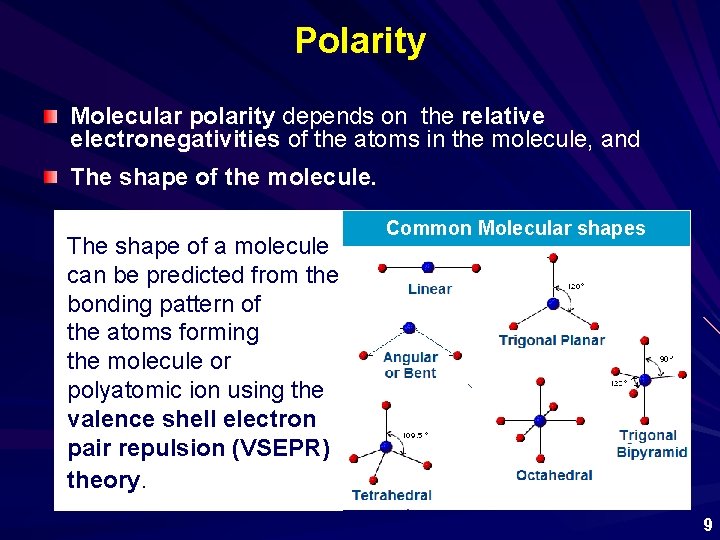
Polarity Molecular polarity depends on the relative electronegativities of the atoms in the molecule, and The shape of the molecule. The shape of a molecule can shape be predicted The of a from the bonding pattern of molecule can be the atoms forming predicted from the molecule or bonding pattern of the polyatomic ion using the atoms forming valence shell electron pairmolecule repulsionor (VSEPR) theory. polyatomic ion. Common Molecular shapes 9
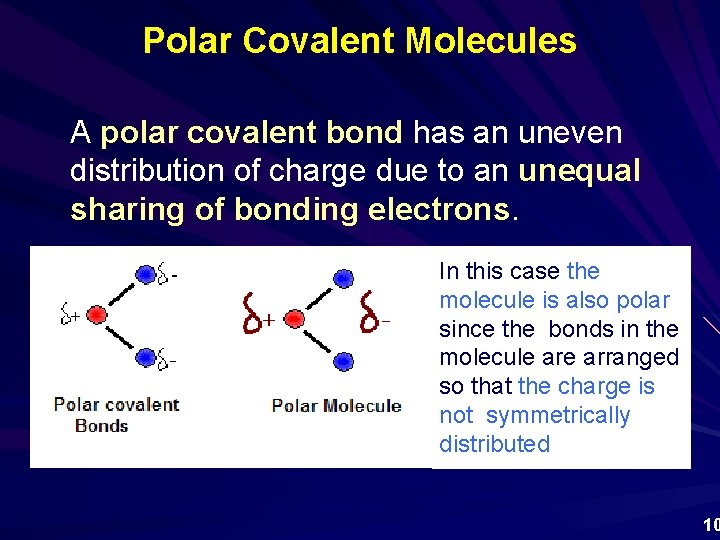
Polar Covalent Molecules A polar covalent bond has an uneven distribution of charge due to an unequal sharing of bonding electrons. In this case the molecule is also polar since the bonds in the molecule arranged so that the charge is not symmetrically distributed 10
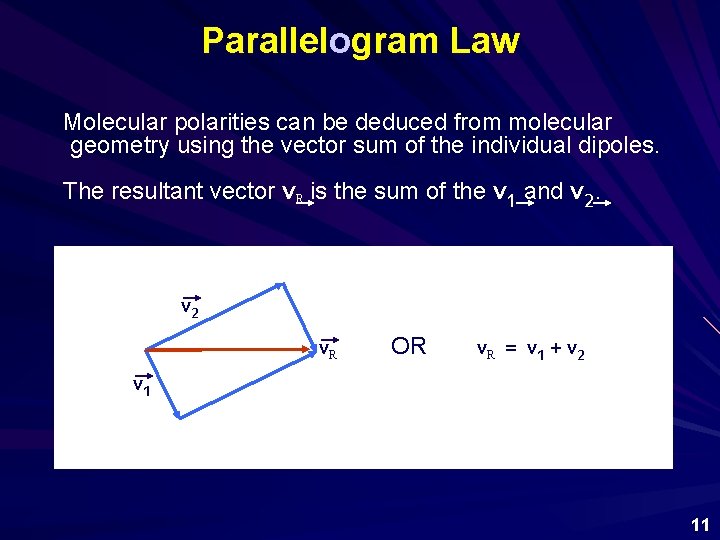
Parallelogram Law Molecular polarities can be deduced from molecular geometry using the vector sum of the individual dipoles. The resultant vector v. R is the sum of the v 1 and v 2 v. R OR v. R = v 1 + v 2 v 1 11
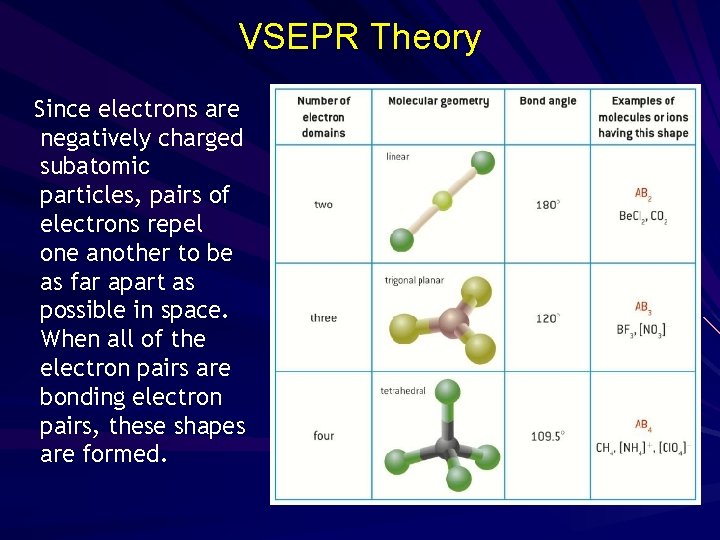
VSEPR Theory Since electrons are negatively charged subatomic particles, pairs of electrons repel one another to be as far apart as possible in space. When all of the electron pairs are bonding electron pairs, these shapes are formed.
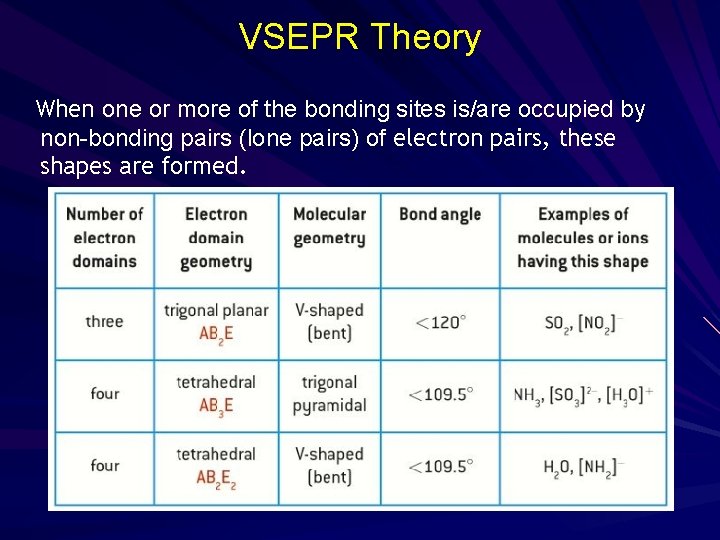
VSEPR Theory When one or more of the bonding sites is/are occupied by non-bonding pairs (lone pairs) of electron pairs, these shapes are formed.
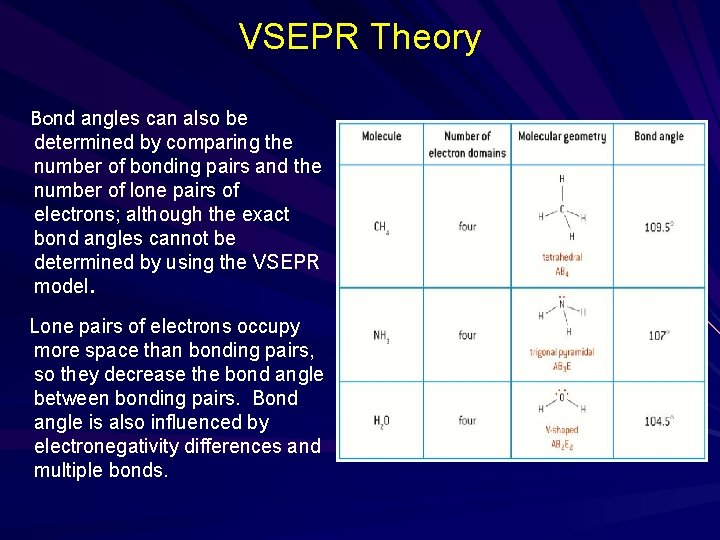
VSEPR Theory Bond angles can also be determined by comparing the number of bonding pairs and the number of lone pairs of electrons; although the exact bond angles cannot be determined by using the VSEPR model. Lone pairs of electrons occupy more space than bonding pairs, so they decrease the bond angle between bonding pairs. Bond angle is also influenced by electronegativity differences and multiple bonds.
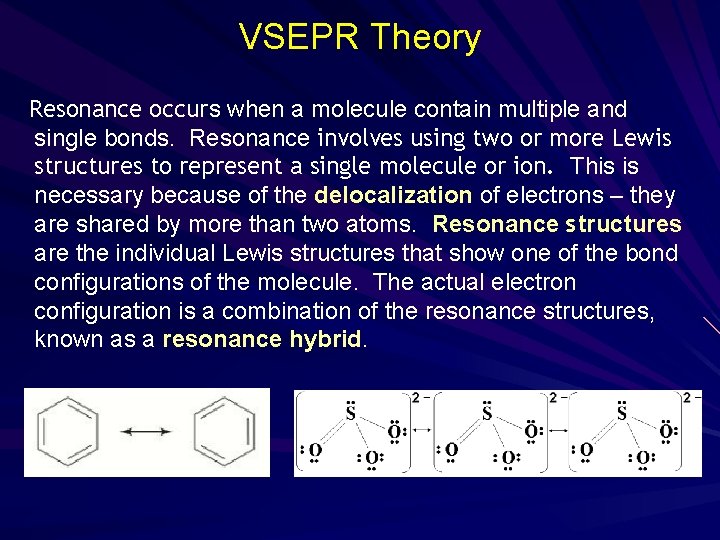
VSEPR Theory Resonance occurs when a molecule contain multiple and single bonds. Resonance involves using two or more Lewis structures to represent a single molecule or ion. This is necessary because of the delocalization of electrons – they are shared by more than two atoms. Resonance structures are the individual Lewis structures that show one of the bond configurations of the molecule. The actual electron configuration is a combination of the resonance structures, known as a resonance hybrid.
VSEPR Theory It is also possible in a few species that the central atom will have less than an octet of valence electrons; these are incomplete octets. An example is beryllium chloride; Be. Cl 2 or Be. Cl 3. In other species, an expanded octet is possible. Examples of these are phosphorus pentachloride (PCl 5) and Sulfur hexafluoride (SF 6).
Polarity Molecules that contain polar covalent bonds may or may not be polar molecules. The polarity of a molecule is determined by measuring the dipole moment. This depends on two factors: 1. The degree of the overall separation of charge between the atoms in the bond 2. The distance between the positive and negative poles 17
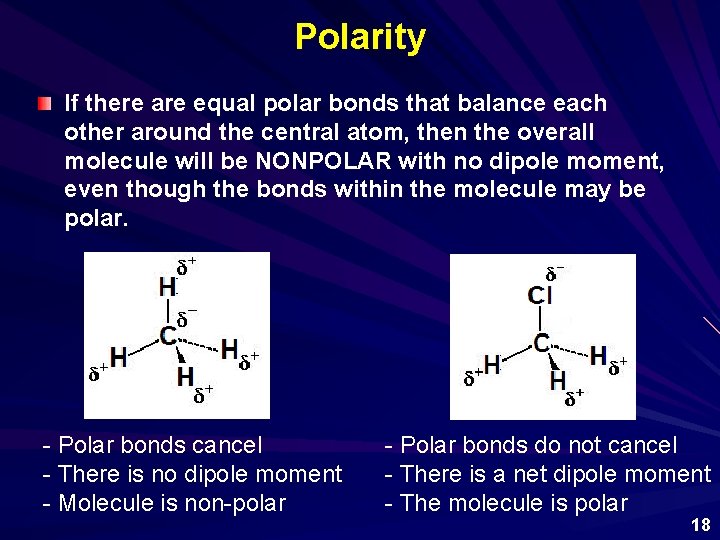
Polarity If there are equal polar bonds that balance each other around the central atom, then the overall molecule will be NONPOLAR with no dipole moment, even though the bonds within the molecule may be polar. - Polar bonds cancel - There is no dipole moment - Molecule is non-polar - Polar bonds do not cancel - There is a net dipole moment - The molecule is polar 18
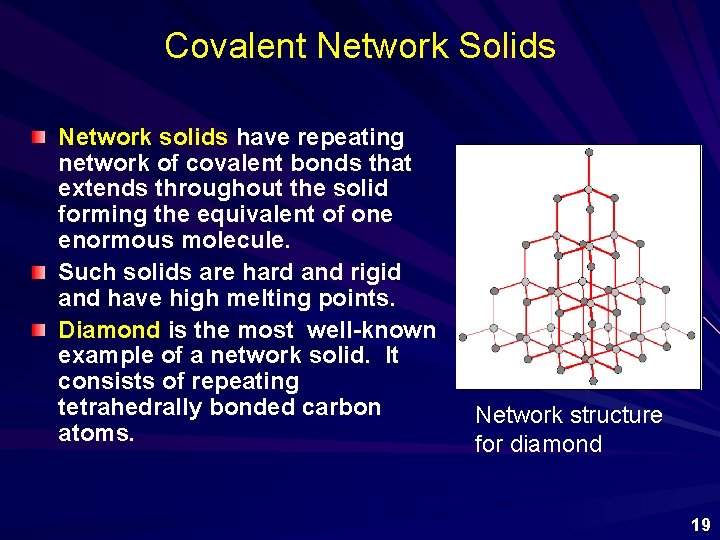
Covalent Network Solids Network solids have repeating network of covalent bonds that extends throughout the solid forming the equivalent of one enormous molecule. Such solids are hard and rigid and have high melting points. Diamond is the most well-known example of a network solid. It consists of repeating tetrahedrally bonded carbon atoms. Network structure for diamond 19
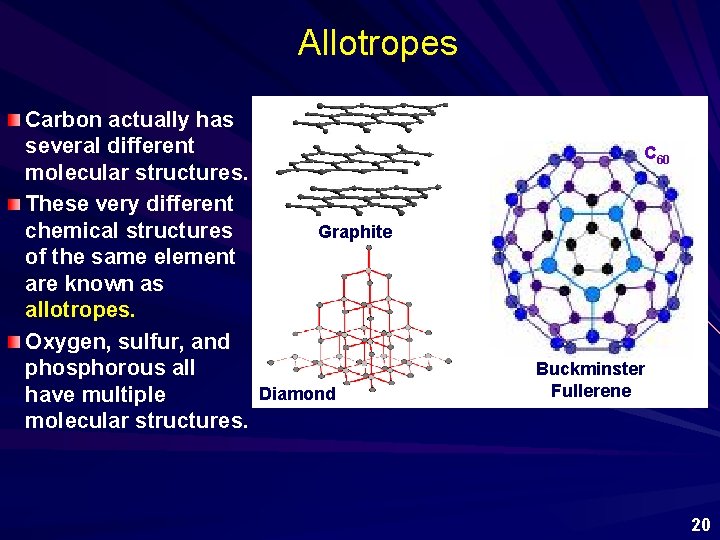
Allotropes Carbon actually has several different molecular structures. These very different chemical structures Graphite of the same element are known as allotropes. Oxygen, sulfur, and phosphorous all Diamond have multiple molecular structures. C 60 Buckminster Fullerene 20
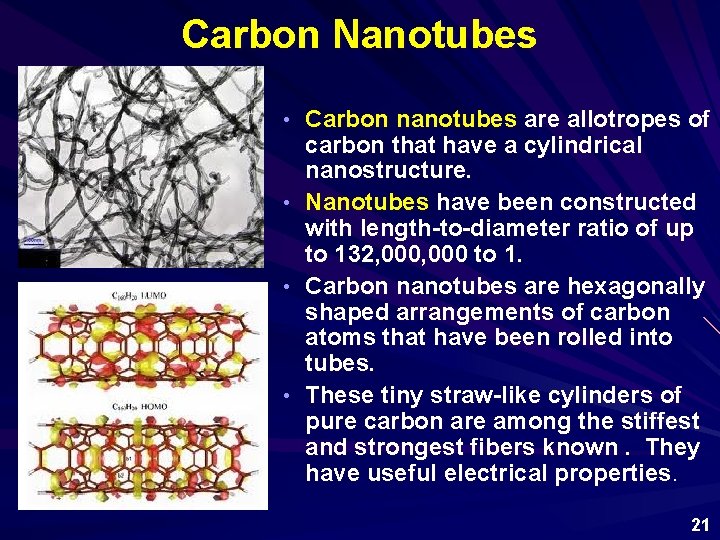
Carbon Nanotubes • Carbon nanotubes are allotropes of carbon that have a cylindrical nanostructure. • Nanotubes have been constructed with length-to-diameter ratio of up to 132, 000 to 1. • Carbon nanotubes are hexagonally shaped arrangements of carbon atoms that have been rolled into tubes. • These tiny straw-like cylinders of pure carbon are among the stiffest and strongest fibers known. They have useful electrical properties. 21

Homework Complete Kerboodle QUIZs for Sections 4. 2 and 4. 3 Read Section 4. 4 – Intermolecular Forces
- Slides: 22