
Topic 4 3 Scale of Production Production Systems
- Slides: 25
Topic 4. 3 Scale of Production
Production Systems 1. Craft production: Small-scale production process centered on manual skills 2. Mechanized production: Volume production process involving machines controlled by humans 3. Automated Production: Volume production process involving machines controlled by production computers
One-Off Production § Individual product or prototype for larger-scale production § Often made with craft production techniques or combination of craft and machines § Close relationship between manufacturer and consumer due to user needs dominate § Examples: prototypes, specialist models, hand crafted items, specialist engineering, specialist architecture and just plain old one offs
One-off Production Advantages §Highly customizable to consumers needs §Flexibility for designer and consumer §Allow for testing of prototypes before continuous flow production Disadvantages § Can be expensive as tools or machinery needed are included in final cost § Time consuming if craft manufacturing techniques are used § Product may not be designed for disassembly (Df. D); no interchangeable parts
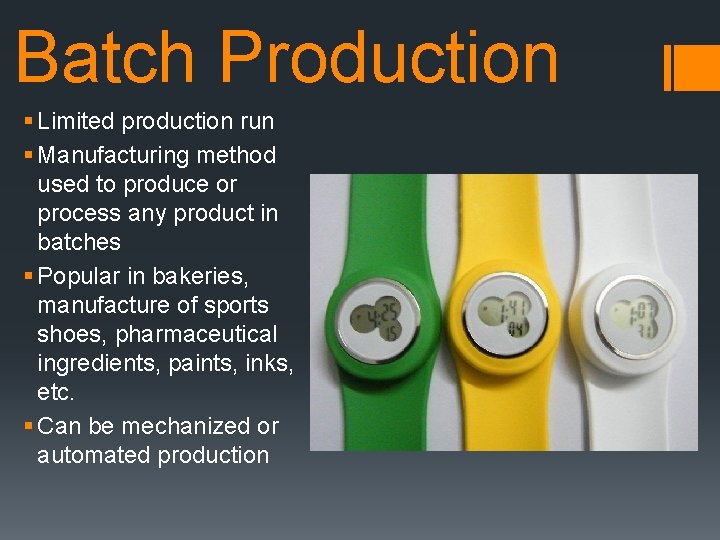
Batch Production § Limited production run § Manufacturing method used to produce or process any product in batches § Popular in bakeries, manufacture of sports shoes, pharmaceutical ingredients, paints, inks, etc. § Can be mechanized or automated production
Batch Production Advantages § Cheaper than one-off production § Customizable products § Easily adjust to market demands or seasonal items § Greater consumer choice § For smaller or upstart companies that can’t afford continuous flow production § Can reduce initial capital because single production line can be used Disadvantages §Down time between productions runs when retooling §Products have to be stored raising cost per item
Continuous Flow Production §Production method used to manufacture, produce or process materials without interruption §Thousands of standardized products are continuously made 24 hours a day 7 days a week §Carried out to maximize production while reducing costs of starting and stopping production process §Can be mechanized or automated process with only a handful of workers needed
Continuous Flow Production Advantages §Cheaper than other production methods §Part or product needs replacing consumer is assured that it still exists §Lack of inventory which reduces storage costs Disadvantages §Standard products so less choice for consumer §Automated production is high in initial costs §Training of staff to run machines and CIM
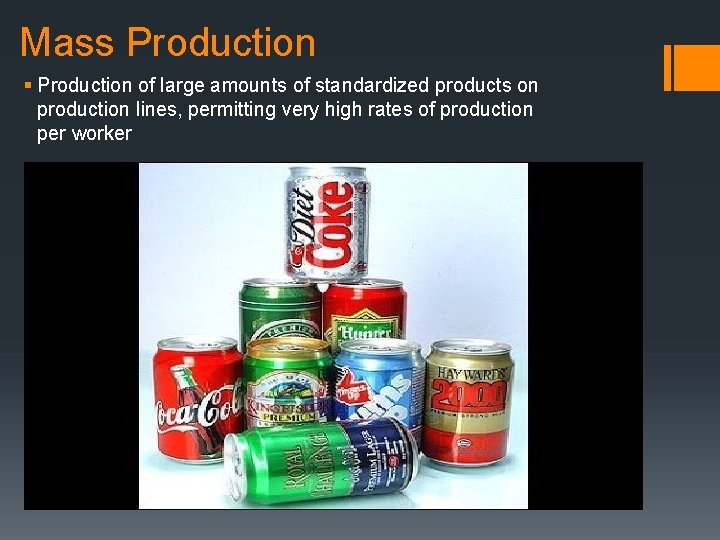
Mass Production § Production of large amounts of standardized products on production lines, permitting very high rates of production per worker
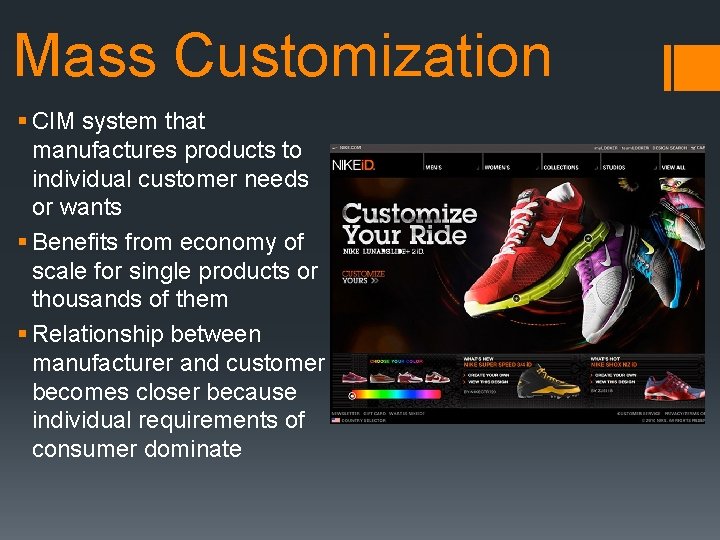
Mass Customization § CIM system that manufactures products to individual customer needs or wants § Benefits from economy of scale for single products or thousands of them § Relationship between manufacturer and customer becomes closer because individual requirements of consumer dominate
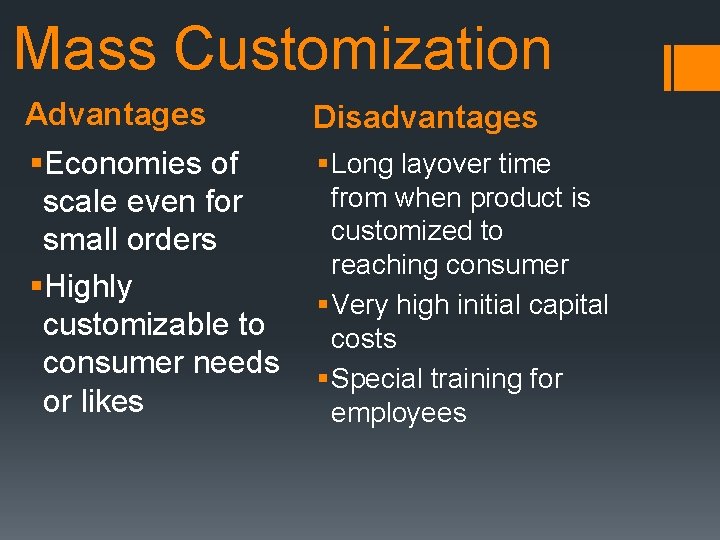
Mass Customization Advantages Disadvantages §Economies of scale even for small orders §Highly customizable to consumer needs or likes § Long layover time from when product is customized to reaching consumer § Very high initial capital costs § Special training for employees
Selecting Scale of Production §When selecting an appropriate scale of production for a product, manufacturers must consider a number of factors, including: § Product characteristics § Material characteristics § Size of market § Nature of market § Desired manufacturing processes § Desired production system.
Robots in Automated Production Topic 4. 6
What is the significance of this topic in Design Tech? §Designers need to know about the latest technology in order to ensure they are using the best manufacturing process. §Robots increase: § Efficiency § Consistency §Are there moral and ethical issues that need to be considered?
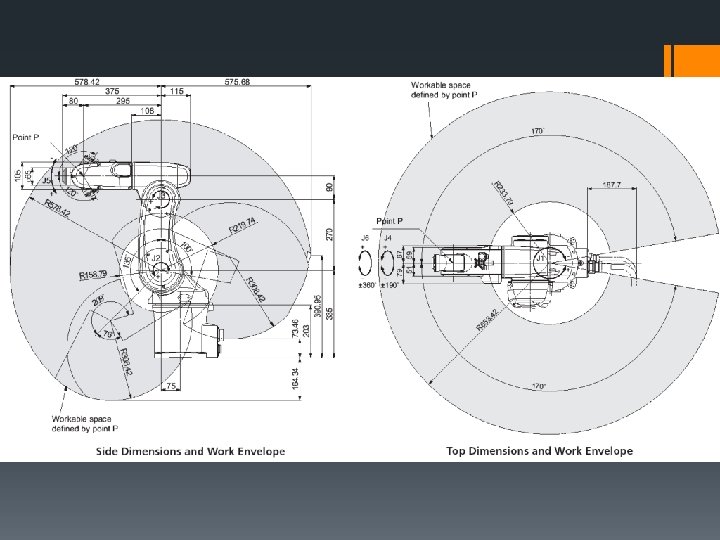
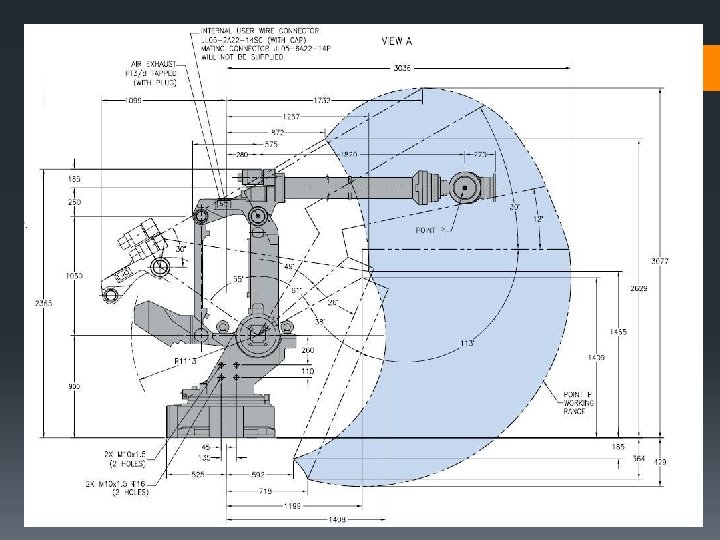
Concepts and Principles §Primary characteristics of robots §Work Envelope §The range of motion that dictates a robot’s ability to perform certain tasks §Load Capacity §The weight a robot can manipulate § http: //www. staubli. com/en/robotics/6 -axis-scaraindustrial-robot/all-6 -axis-scara-robot/
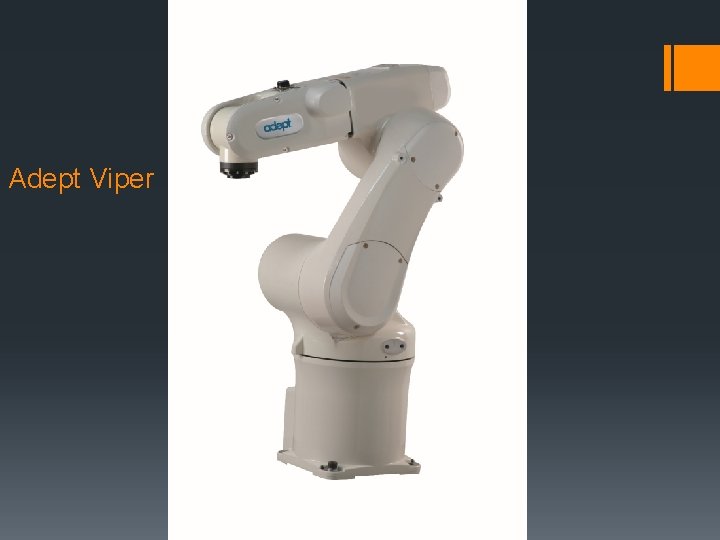
Adept Viper
Single-task vs. Multi-task Robots vs. Teams of Robots §Single-task § Can only do one task at a time § https: //www. youtube. com/watch? v=v 9 oe. OYMRvu. Q §Multi-task § Can do multiple tasks at one time § https: //www. youtube. com/watch? v=Nrea-6 JYXm. M §Teams of Robots § Groups of robots work together in the production process § https: //www. youtube. com/watch? v=htu. Voxu. MQFQ
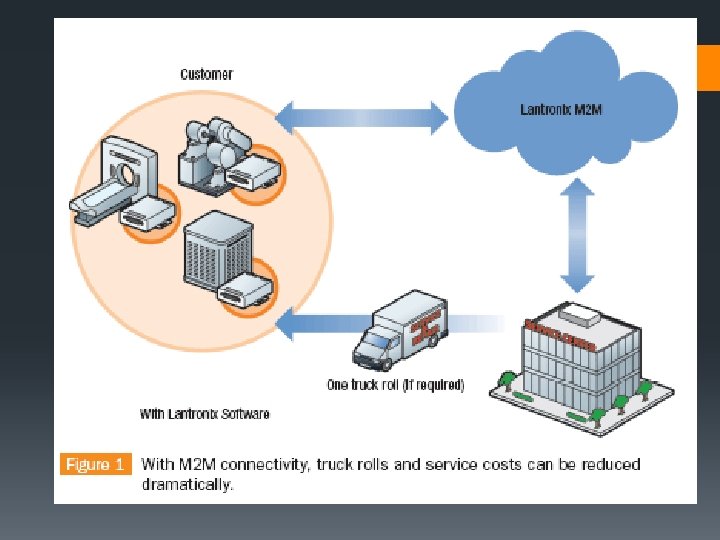
Machine to Machine (M 2 M) §The ability of machines to communicate with one another via wireless or wired networks without the need of human interaction.
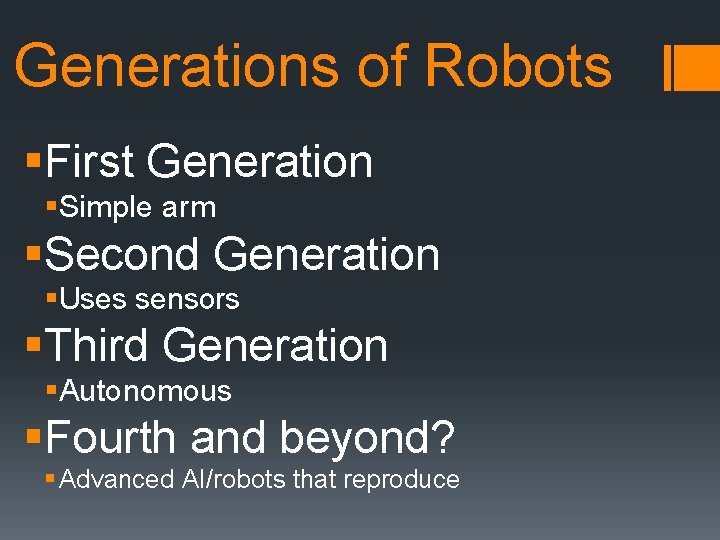
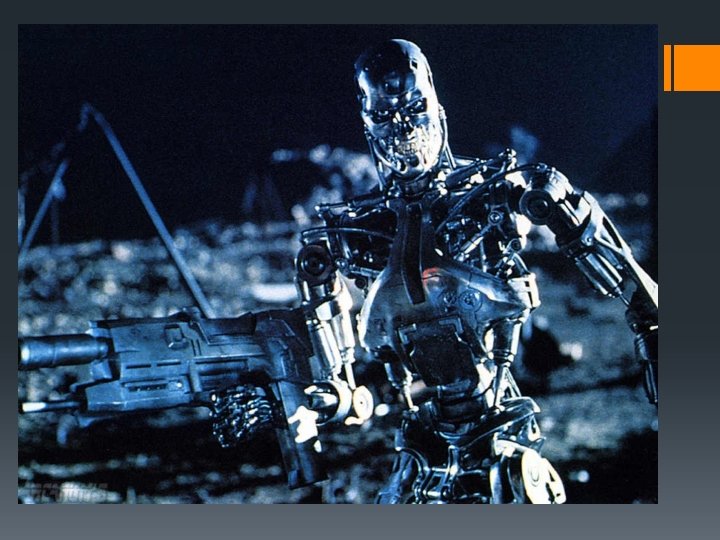
Generations of Robots §First Generation §Simple arm §Second Generation §Uses sensors §Third Generation §Autonomous §Fourth and beyond? § Advanced AI/robots that reproduce
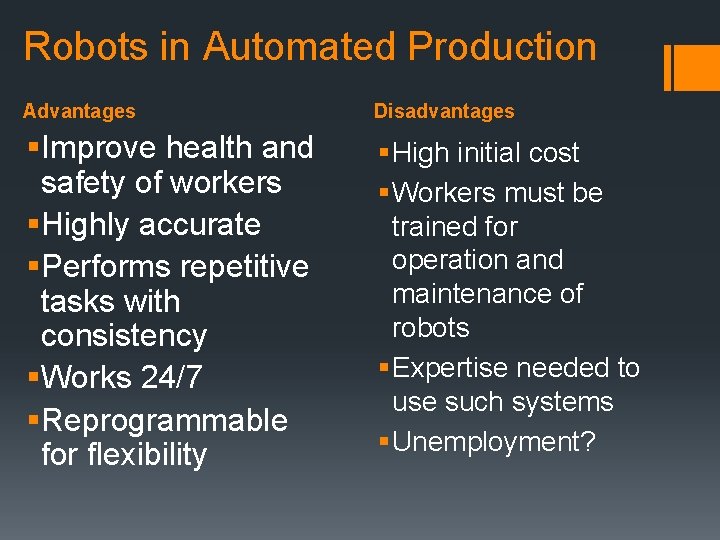
Robots in Automated Production Advantages Disadvantages §Improve health and safety of workers §Highly accurate §Performs repetitive tasks with consistency §Works 24/7 §Reprogrammable for flexibility § High initial cost § Workers must be trained for operation and maintenance of robots § Expertise needed to use such systems § Unemployment?
Ethical questions? §The increased use of robots in manufacturing is good and necessary for economic growth. §Robots do not threaten the human place in the production of goods. (i. e. employment levels) §The advantages of using robots in manufacturing far out ways the disadvantages.