
Topic 3 The second law of thermodynamics Predict

- Slides: 21
Topic 3 The second law of thermodynamics Predict the direction of changes
Contents n Spontaneous processes The second law of thermodynamics The Carnot Heat Engine Entropy and Clausius inequality Gibbs and Helmholz energies and their applications n Thermodynamic relationships n n State A ? State B Reactants ? Products
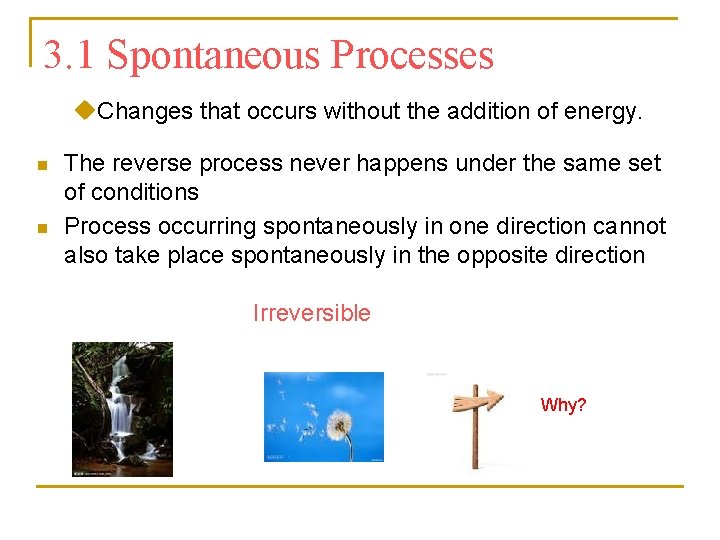
3. 1 Spontaneous Processes u. Changes that occurs without the addition of energy. n n The reverse process never happens under the same set of conditions Process occurring spontaneously in one direction cannot also take place spontaneously in the opposite direction Irreversible Why?
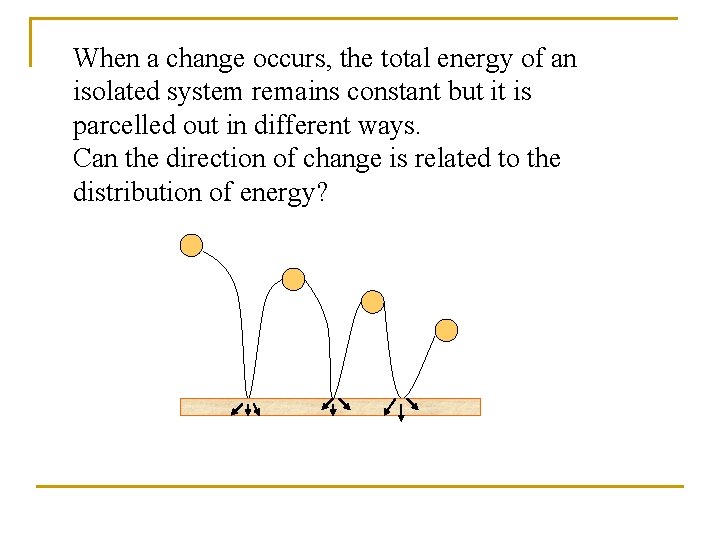
When a change occurs, the total energy of an isolated system remains constant but it is parcelled out in different ways. Can the direction of change is related to the distribution of energy?
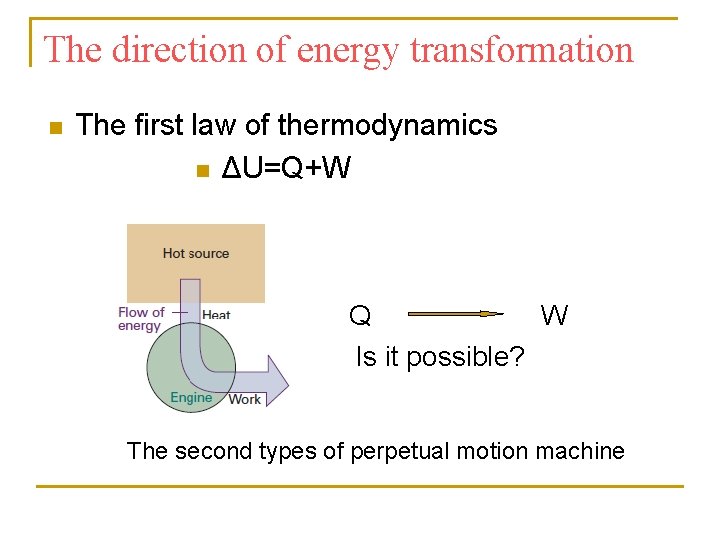
The direction of energy transformation n The first law of thermodynamics n ΔU=Q+W Q W Is it possible? The second types of perpetual motion machine
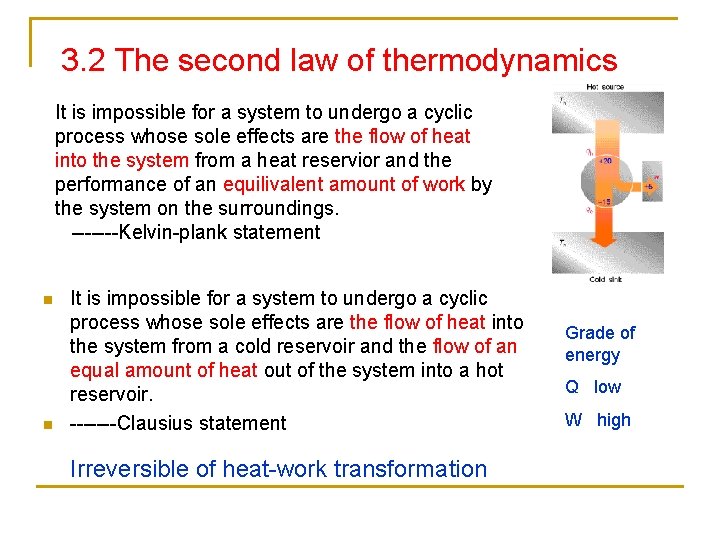
3. 2 The second law of thermodynamics It is impossible for a system to undergo a cyclic process whose sole effects are the flow of heat into the system from a heat reservior and the performance of an equilivalent amount of work by the system on the surroundings. -------Kelvin-plank statement n n It is impossible for a system to undergo a cyclic process whose sole effects are the flow of heat into the system from a cold reservoir and the flow of an equal amount of heat out of the system into a hot reservoir. -------Clausius statement Irreversible of heat-work transformation Grade of energy Q low W high
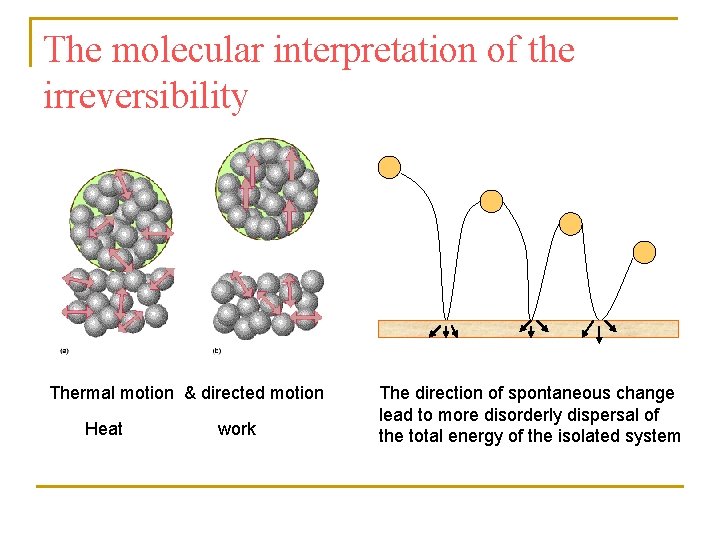
The molecular interpretation of the irreversibility Thermal motion & directed motion Heat work The direction of spontaneous change lead to more disorderly dispersal of the total energy of the isolated system
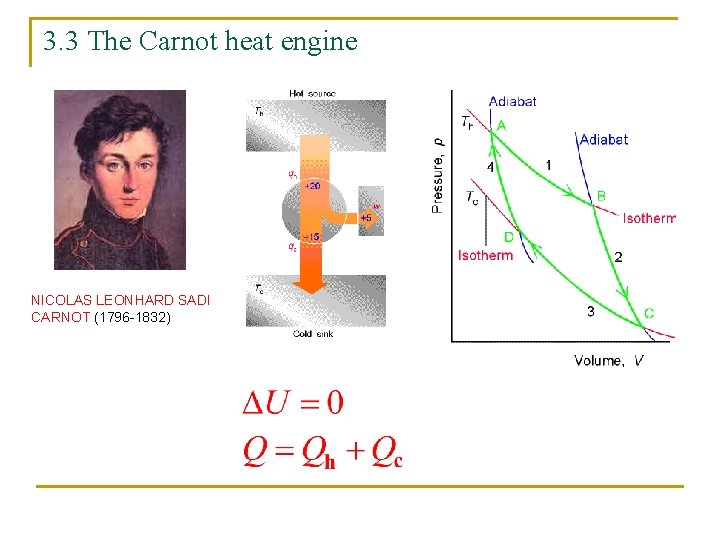
3. 3 The Carnot heat engine NICOLAS LEONHARD SADI CARNOT (1796 -1832)
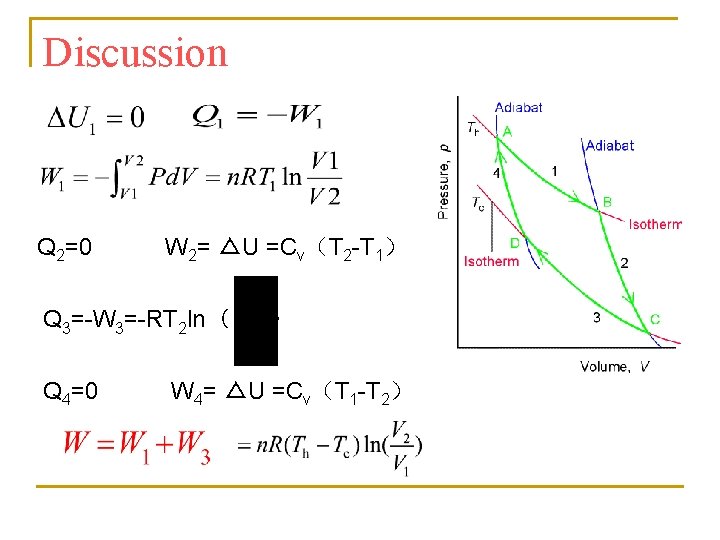
Discussion Q 2=0 W 2= △U =Cv(T 2 -T 1) Q 3=-W 3=-RT 2 ln( Q 4=0 ) W 4= △U =Cv(T 1 -T 2)
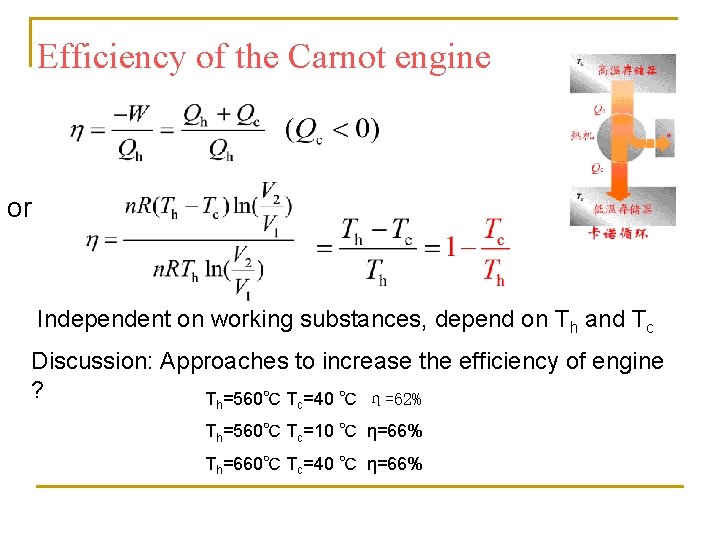
Efficiency of the Carnot engine or Independent on working substances, depend on Th and Tc Discussion: Approaches to increase the efficiency of engine ? Th=560℃ Tc=40 ℃ η=62% Th=560℃ Tc=10 ℃ η=66% Th=660℃ Tc=40 ℃ η=66%
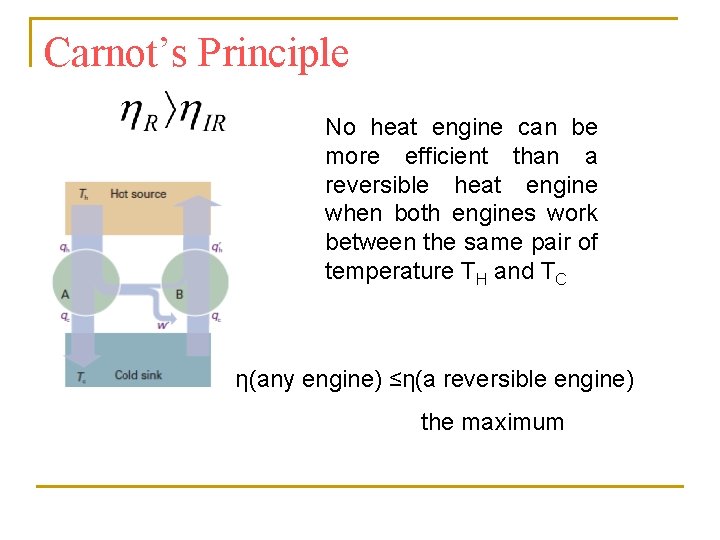
Carnot’s Principle No heat engine can be more efficient than a reversible heat engine when both engines work between the same pair of temperature TH and TC η(any engine) ≤η(a reversible engine) the maximum
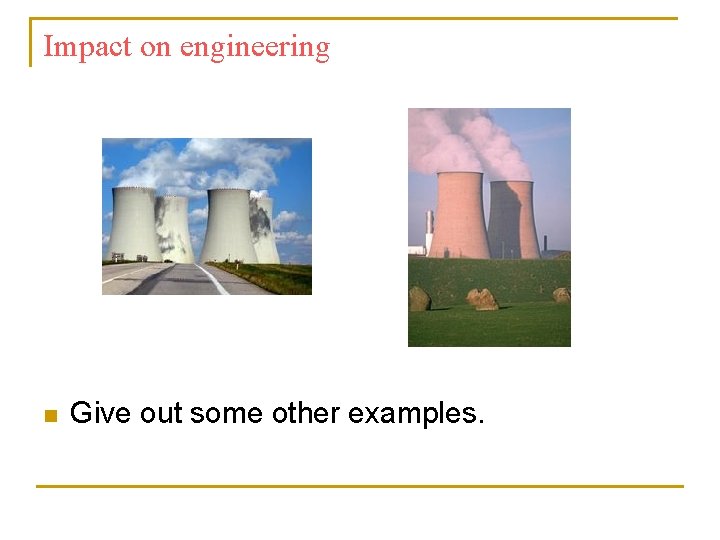
Impact on engineering n Give out some other examples.
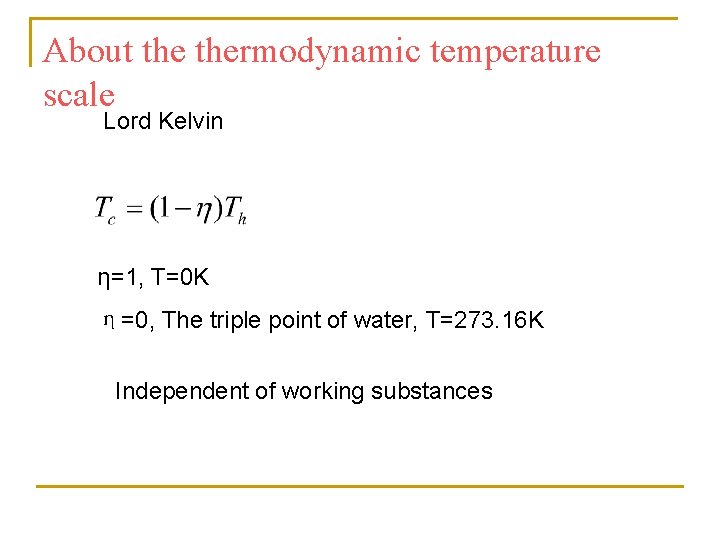
About thermodynamic temperature scale Lord Kelvin η=1, T=0 K η=0, The triple point of water, T=273. 16 K Independent of working substances
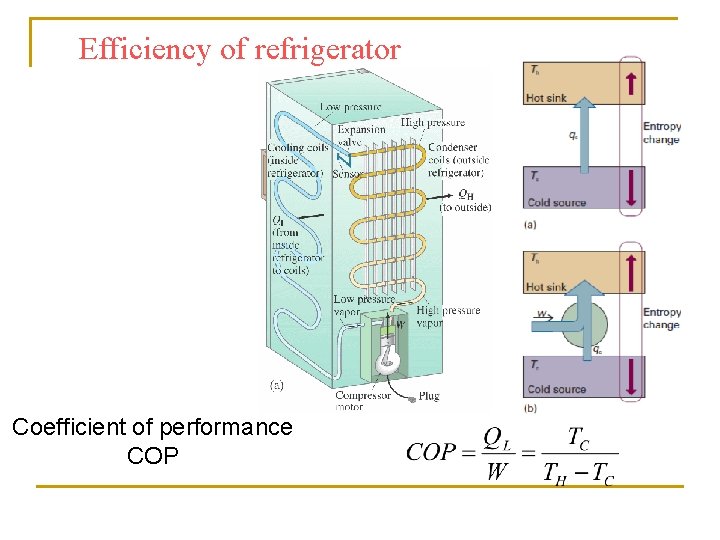
Efficiency of refrigerator Coefficient of performance COP
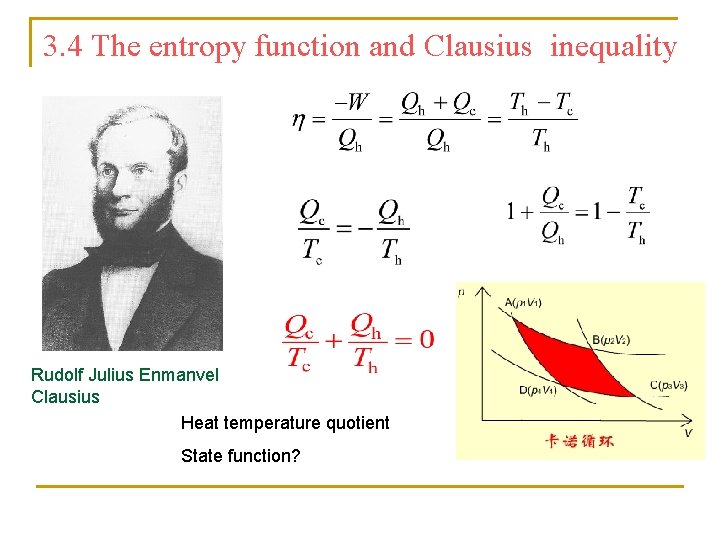
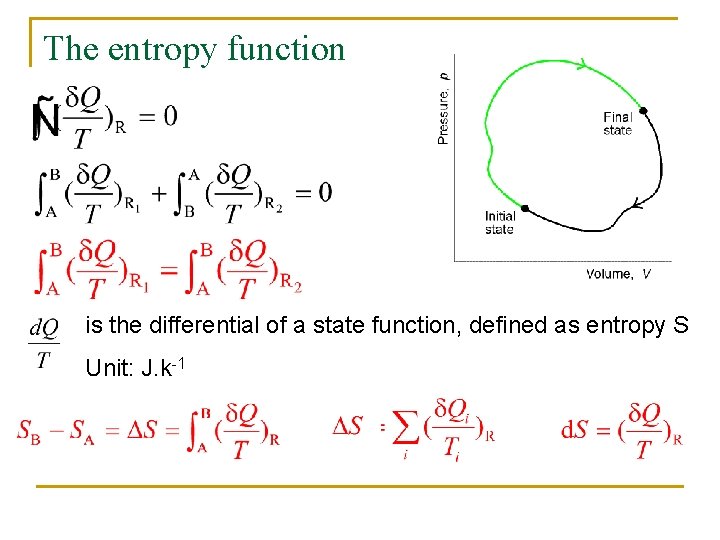
3. 4 The entropy function and Clausius inequality Rudolf Julius Enmanvel Clausius Heat temperature quotient State function?
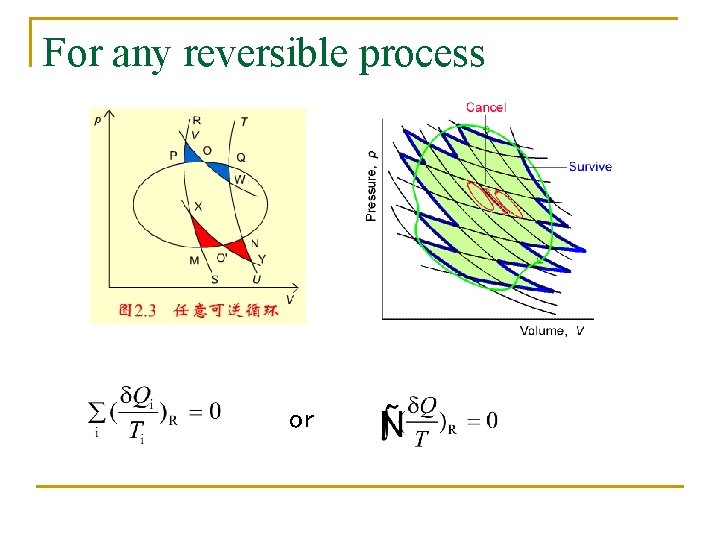
For any reversible process or
The entropy function is the differential of a state function, defined as entropy S Unit: J. k-1
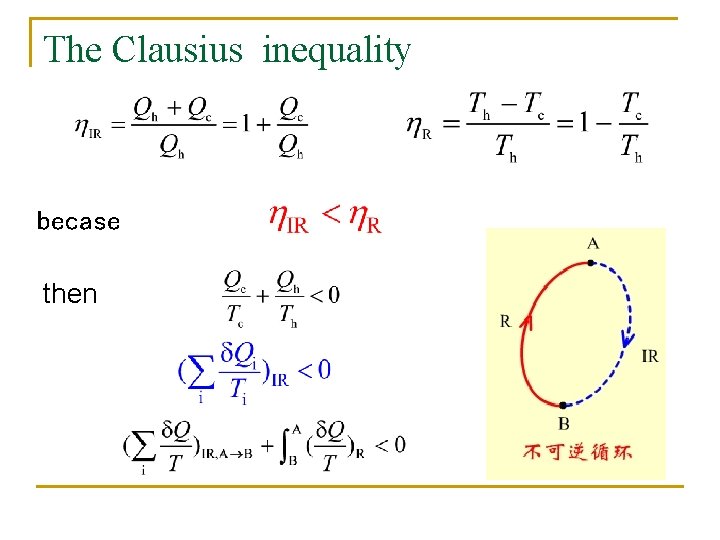
The Clausius inequality becase then
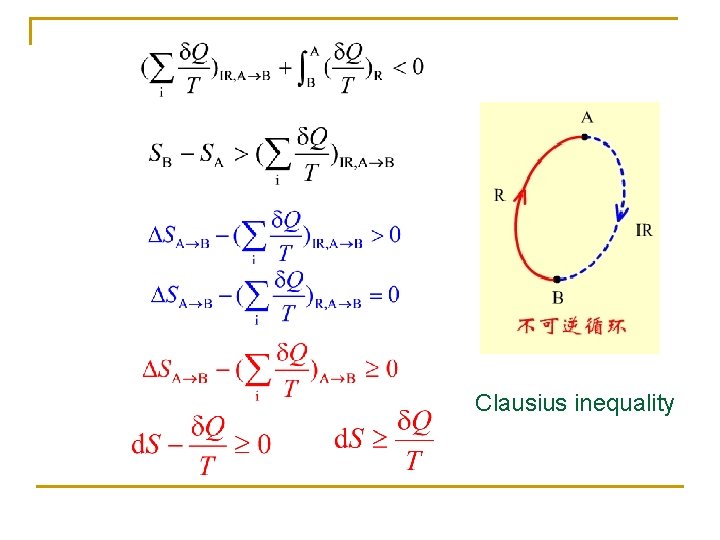
Clausius inequality
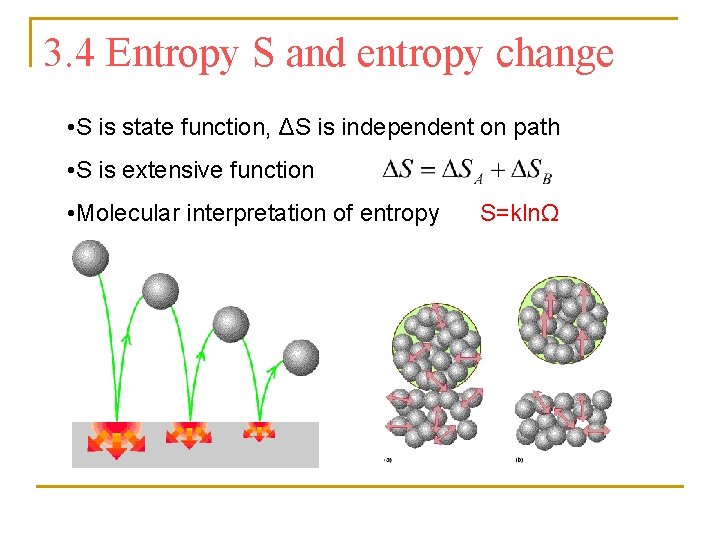
3. 4 Entropy S and entropy change • S is state function, ΔS is independent on path • S is extensive function • Molecular interpretation of entropy S=klnΩ
Homework: n Y: P 56: 1, 2, 3 n Preview: A: 4. 2 -4. 4 Y: 2. 5; 2. 6 n n