
Topic 3 Selection of ICT tools for different
- Slides: 16
Topic 3. Selection of ICT tools for different learning. Online assessment types and tools. This work is licensed under a Creative Commons Attribution-Non. Commercial. Share. Alike 4. 0 International License. Assoc. prof. dr. Airina Volungevičienė, Prof. dr. Margarita Teresevičienė Dr. Virginija Bortkevičienė, Danutė Pranckutė Vytautas Magnus University KA 2 Strategic Partnerships – 2016 -1 -HU 01 -KA 202 -022916
TYPES OF ASSESSMENT TASKS 1. 2. 3. 4. 5. 6. 7. Short form and multiple-choice tests; Short answer test; Essay; Performance test; Written report; Fieldwork/practicum tests form and multiple-choice tests; Projects; 8. 9. 10. 11. 12. 13. 14. Presentations; Case studies; Posters; Journals; Portfolios; Group work; Participation. References: Curtin Teaching and Learning. (2010). Developing Appropriate Assessment Tasks. In Teaching and Learning at Curtin 2010. (pp. 22 -46). Curtin University: Perth KA 2 Strategic Partnerships – 2016 -1 -HU 01 -KA 202 -022916
SELECTING METHODS OF ASSESSMENT Nightingale et al (1996) provide eight broad categories of learning outcomes which are listed below. Within each category some suitable methods are suggested: 1. Thinking critically and making judgements; 2. Solving problems and developing plans; 3. Performing procedures and demonstrating techniques; 4. Managing and developing oneself; 5. Accessing and managing information; 6. Demonstrating knowledge and understanding; 7. Designing, creating, performing; 8. Communicating. References: https: //www. brookes. ac. uk/services/ocsld/resources/methods. html KA 2 Strategic Partnerships – 2016 -1 -HU 01 -KA 202 -022916
1. Thinking critically and making judgements (Developing arguments, reflecting, evaluating, assessing, judging) • • • Essay; Report; Journal; Present a case for an interest group; Prepare a committee briefing paper for a specific meeting; Book review (or article). References: https: //www. brookes. ac. uk/services/ocsld/resources/methods. html KA 2 Strategic Partnerships – 2016 -1 -HU 01 -KA 202 -022916
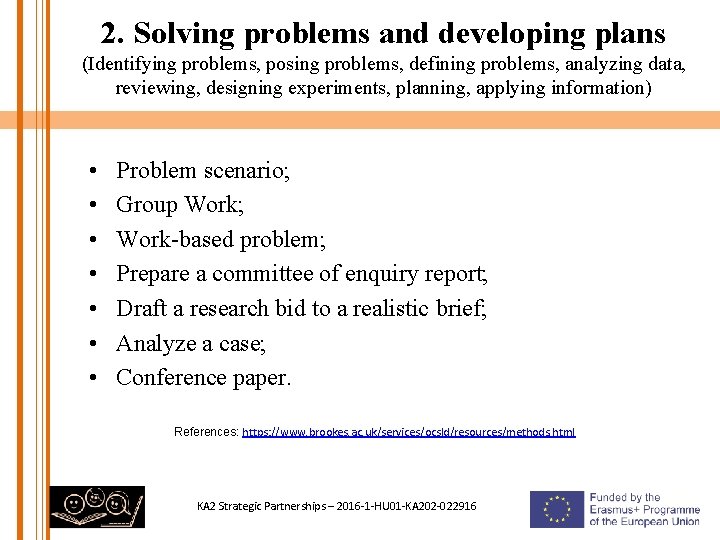
2. Solving problems and developing plans (Identifying problems, posing problems, defining problems, analyzing data, reviewing, designing experiments, planning, applying information) • • Problem scenario; Group Work; Work-based problem; Prepare a committee of enquiry report; Draft a research bid to a realistic brief; Analyze a case; Conference paper. References: https: //www. brookes. ac. uk/services/ocsld/resources/methods. html KA 2 Strategic Partnerships – 2016 -1 -HU 01 -KA 202 -022916
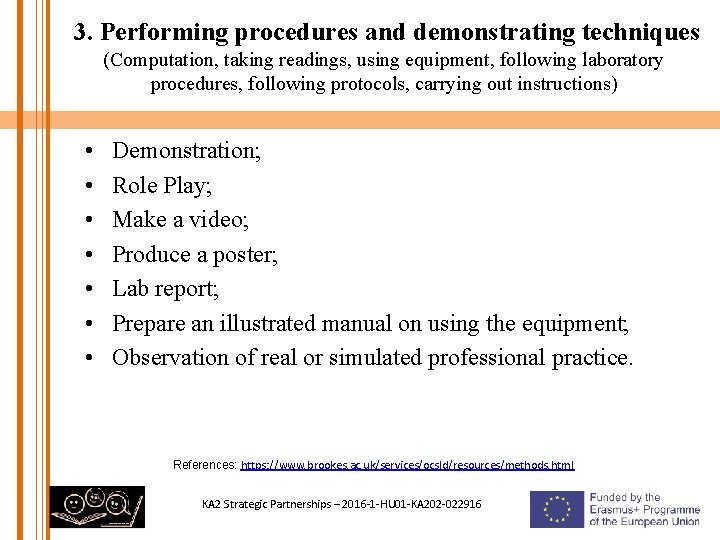
3. Performing procedures and demonstrating techniques (Computation, taking readings, using equipment, following laboratory procedures, following protocols, carrying out instructions) • • Demonstration; Role Play; Make a video; Produce a poster; Lab report; Prepare an illustrated manual on using the equipment; Observation of real or simulated professional practice. References: https: //www. brookes. ac. uk/services/ocsld/resources/methods. html KA 2 Strategic Partnerships – 2016 -1 -HU 01 -KA 202 -022916
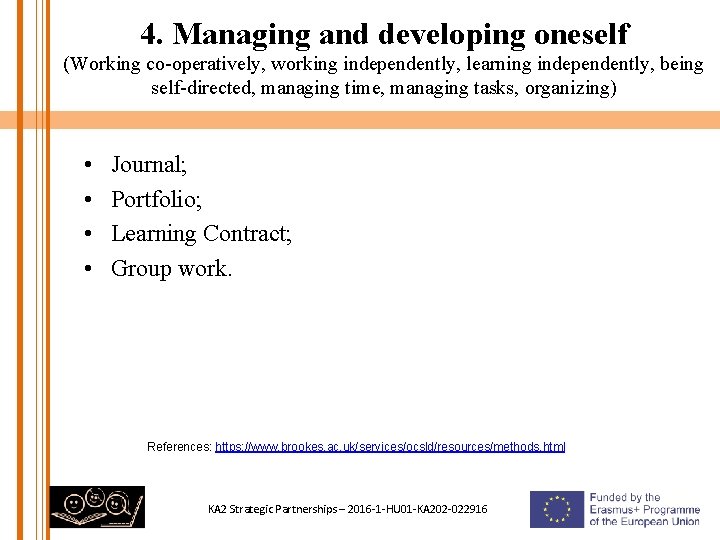
4. Managing and developing oneself (Working co-operatively, working independently, learning independently, being self-directed, managing time, managing tasks, organizing) • • Journal; Portfolio; Learning Contract; Group work. References: https: //www. brookes. ac. uk/services/ocsld/resources/methods. html KA 2 Strategic Partnerships – 2016 -1 -HU 01 -KA 202 -022916
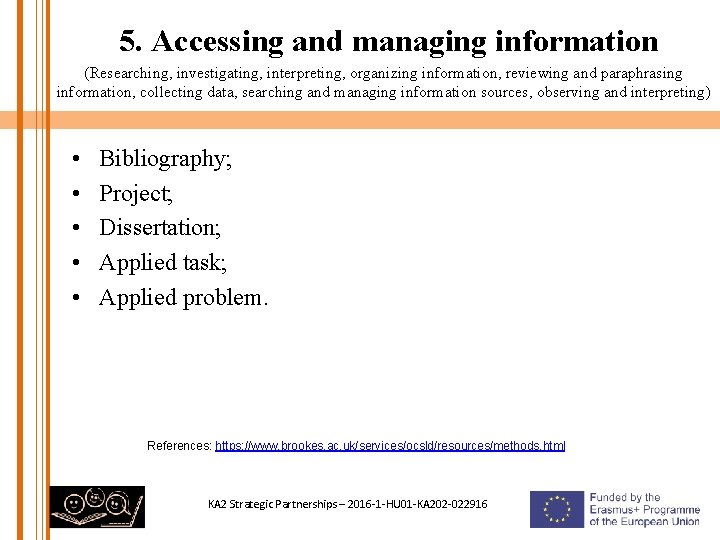
5. Accessing and managing information (Researching, investigating, interpreting, organizing information, reviewing and paraphrasing information, collecting data, searching and managing information sources, observing and interpreting) • • • Bibliography; Project; Dissertation; Applied task; Applied problem. References: https: //www. brookes. ac. uk/services/ocsld/resources/methods. html KA 2 Strategic Partnerships – 2016 -1 -HU 01 -KA 202 -022916
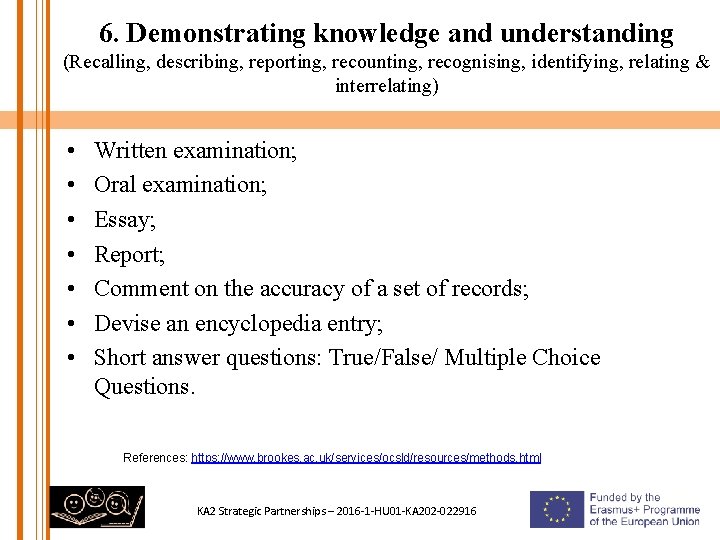
6. Demonstrating knowledge and understanding (Recalling, describing, reporting, recounting, recognising, identifying, relating & interrelating) • • Written examination; Oral examination; Essay; Report; Comment on the accuracy of a set of records; Devise an encyclopedia entry; Short answer questions: True/False/ Multiple Choice Questions. References: https: //www. brookes. ac. uk/services/ocsld/resources/methods. html KA 2 Strategic Partnerships – 2016 -1 -HU 01 -KA 202 -022916
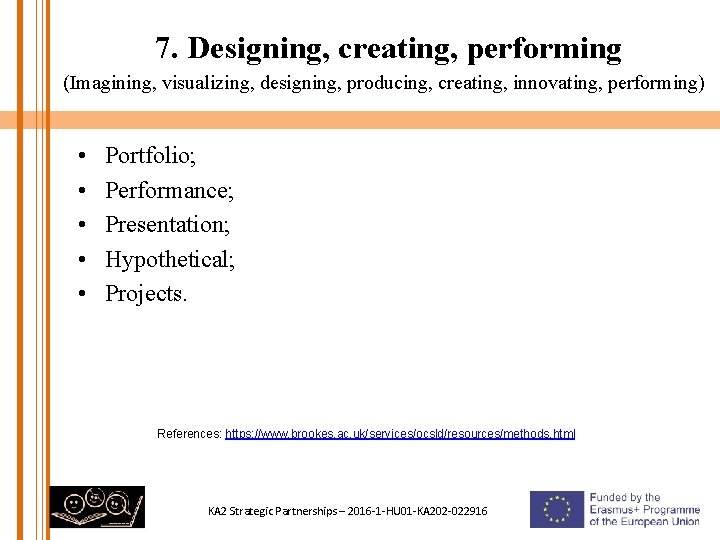
7. Designing, creating, performing (Imagining, visualizing, designing, producing, creating, innovating, performing) • • • Portfolio; Performance; Presentation; Hypothetical; Projects. References: https: //www. brookes. ac. uk/services/ocsld/resources/methods. html KA 2 Strategic Partnerships – 2016 -1 -HU 01 -KA 202 -022916
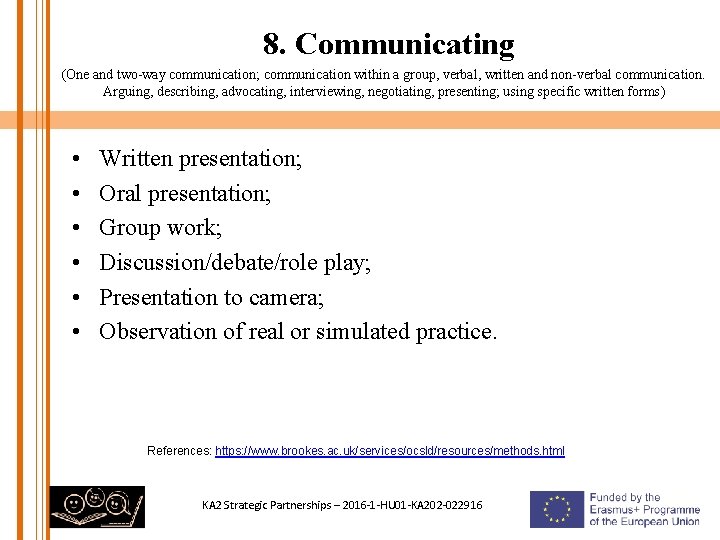
8. Communicating (One and two-way communication; communication within a group, verbal, written and non-verbal communication. Arguing, describing, advocating, interviewing, negotiating, presenting; using specific written forms) • • • Written presentation; Oral presentation; Group work; Discussion/debate/role play; Presentation to camera; Observation of real or simulated practice. References: https: //www. brookes. ac. uk/services/ocsld/resources/methods. html KA 2 Strategic Partnerships – 2016 -1 -HU 01 -KA 202 -022916
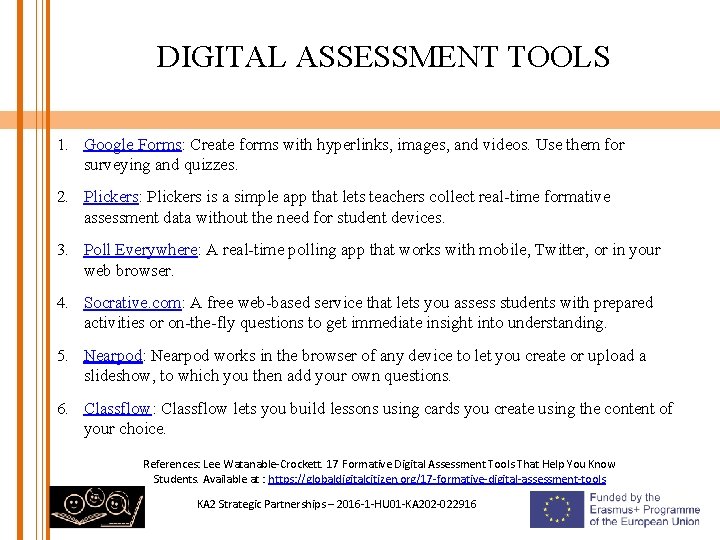
DIGITAL ASSESSMENT TOOLS 1. Google Forms: Create forms with hyperlinks, images, and videos. Use them for surveying and quizzes. 2. Plickers: Plickers is a simple app that lets teachers collect real-time formative assessment data without the need for student devices. 3. Poll Everywhere: A real-time polling app that works with mobile, Twitter, or in your web browser. 4. Socrative. com: A free web-based service that lets you assess students with prepared activities or on-the-fly questions to get immediate insight into understanding. 5. Nearpod: Nearpod works in the browser of any device to let you create or upload a slideshow, to which you then add your own questions. 6. Classflow: Classflow lets you build lessons using cards you create using the content of your choice. References: Lee Watanable-Crockett. 17 Formative Digital Assessment Tools That Help You Know Students. Available at : https: //globaldigitalcitizen. org/17 -formative-digital-assessment-tools KA 2 Strategic Partnerships – 2016 -1 -HU 01 -KA 202 -022916
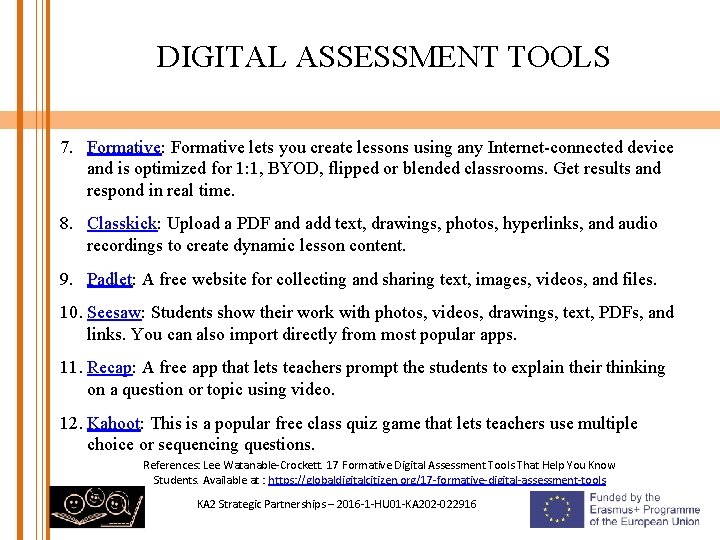
DIGITAL ASSESSMENT TOOLS 7. Formative: Formative lets you create lessons using any Internet-connected device and is optimized for 1: 1, BYOD, flipped or blended classrooms. Get results and respond in real time. 8. Classkick: Upload a PDF and add text, drawings, photos, hyperlinks, and audio recordings to create dynamic lesson content. 9. Padlet: A free website for collecting and sharing text, images, videos, and files. 10. Seesaw: Students show their work with photos, videos, drawings, text, PDFs, and links. You can also import directly from most popular apps. 11. Recap: A free app that lets teachers prompt the students to explain their thinking on a question or topic using video. 12. Kahoot: This is a popular free class quiz game that lets teachers use multiple choice or sequencing questions. References: Lee Watanable-Crockett. 17 Formative Digital Assessment Tools That Help You Know Students. Available at : https: //globaldigitalcitizen. org/17 -formative-digital-assessment-tools KA 2 Strategic Partnerships – 2016 -1 -HU 01 -KA 202 -022916
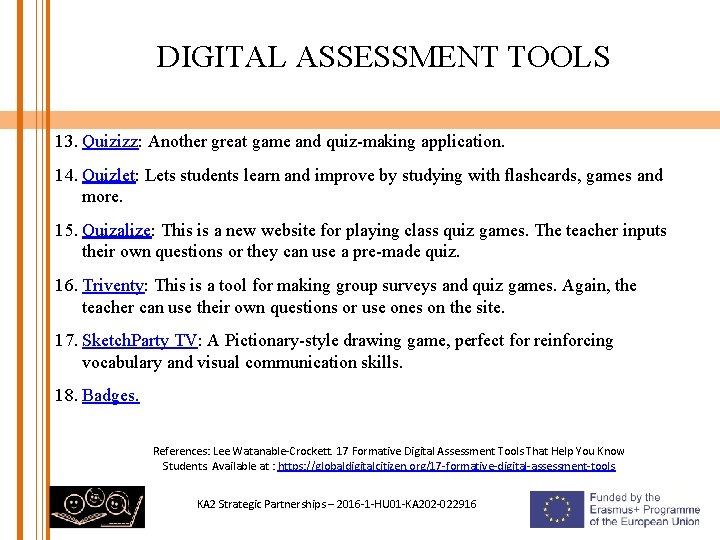
DIGITAL ASSESSMENT TOOLS 13. Quizizz: Another great game and quiz-making application. 14. Quizlet: Lets students learn and improve by studying with flashcards, games and more. 15. Quizalize: This is a new website for playing class quiz games. The teacher inputs their own questions or they can use a pre-made quiz. 16. Triventy: This is a tool for making group surveys and quiz games. Again, the teacher can use their own questions or use ones on the site. 17. Sketch. Party TV: A Pictionary-style drawing game, perfect for reinforcing vocabulary and visual communication skills. 18. Badges. References: Lee Watanable-Crockett. 17 Formative Digital Assessment Tools That Help You Know Students. Available at : https: //globaldigitalcitizen. org/17 -formative-digital-assessment-tools KA 2 Strategic Partnerships – 2016 -1 -HU 01 -KA 202 -022916
References • https: //www. waikato. ac. nz/students/student-assessment/types-of-assessment-tasks • http: //dera. ioe. ac. uk/7800/1/Assessmentfor. Learning. pdf • https: //www. brookes. ac. uk/services/ocsld/resources/methods. html • Lee Watanable-Crockett. Formative Digital Assessment Tools That Help You Know Students. Available at : https: //globaldigitalcitizen. org/17 formative-digital-assessment-tools • https: //emedia. rmit. edu. au/learninglab/content/assessment-tasks : KA 2 Strategic Partnerships – 2016 -1 -HU 01 -KA 202 -022916
References • Broadfoot, P. M. , Daugherty, R. , Gardner, J. , Harlen, W. , James, M. , & Stobart, G. (2002). Assessment for learning: 10 principles. Cambridge, UK: University of Cambridge School of Education. • Curtin Teaching and Learning. (2010). Developing Appropriate Assessment Tasks. In Teaching and Learning at Curtin 2010. (pp. 22 -46). Curtin University: Perth. KA 2 Strategic Partnerships – 2016 -1 -HU 01 -KA 202 -022916