
Topic 3 Motion in Two Dimensions College Physics


- Slides: 45
Topic 3: Motion in Two Dimensions College Physics, 11 e Raymond A. Serway; Chris Vuille
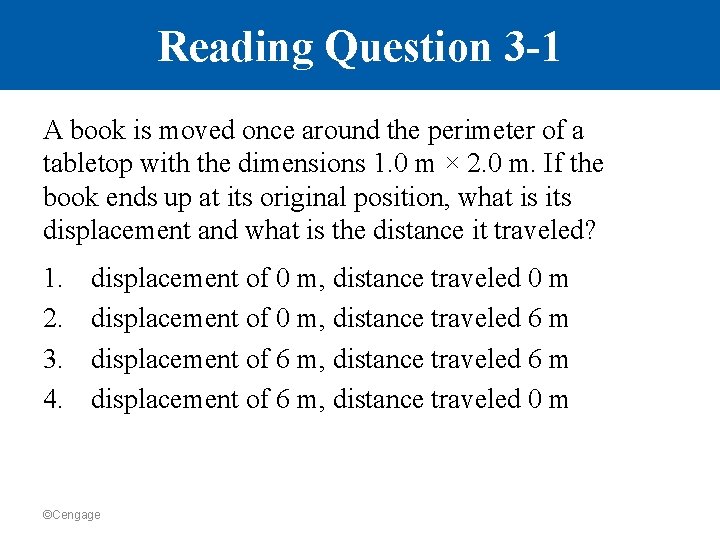
Reading Question 3 -1 A book is moved once around the perimeter of a tabletop with the dimensions 1. 0 m × 2. 0 m. If the book ends up at its original position, what is its displacement and what is the distance it traveled? 1. 2. 3. 4. displacement of 0 m, distance traveled 0 m displacement of 0 m, distance traveled 6 m displacement of 6 m, distance traveled 0 m ©Cengage
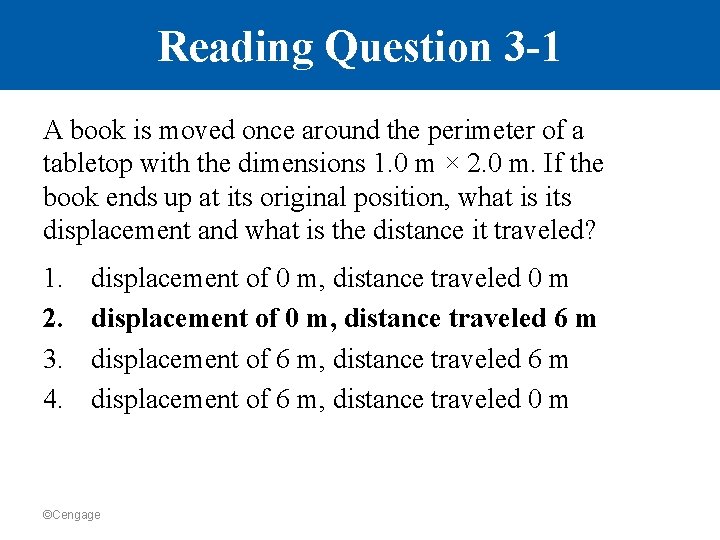
Reading Question 3 -1 A book is moved once around the perimeter of a tabletop with the dimensions 1. 0 m × 2. 0 m. If the book ends up at its original position, what is its displacement and what is the distance it traveled? 1. 2. 3. 4. displacement of 0 m, distance traveled 0 m displacement of 0 m, distance traveled 6 m displacement of 6 m, distance traveled 0 m ©Cengage
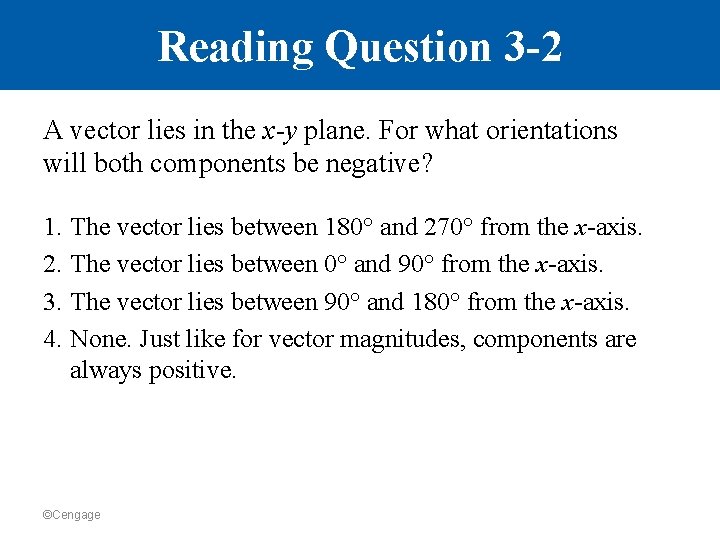
Reading Question 3 -2 A vector lies in the x-y plane. For what orientations will both components be negative? 1. The vector lies between 180° and 270° from the x-axis. 2. The vector lies between 0° and 90° from the x-axis. 3. The vector lies between 90° and 180° from the x-axis. 4. None. Just like for vector magnitudes, components are always positive. ©Cengage
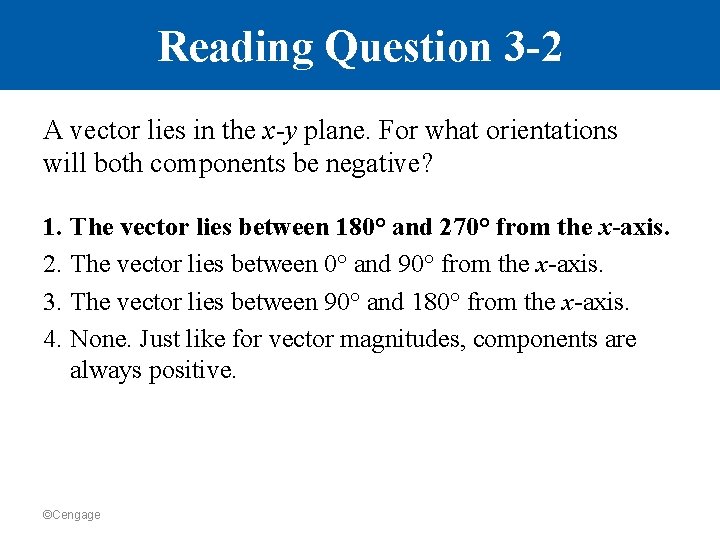
Reading Question 3 -2 A vector lies in the x-y plane. For what orientations will both components be negative? 1. The vector lies between 180° and 270° from the x-axis. 2. The vector lies between 0° and 90° from the x-axis. 3. The vector lies between 90° and 180° from the x-axis. 4. None. Just like for vector magnitudes, components are always positive. ©Cengage
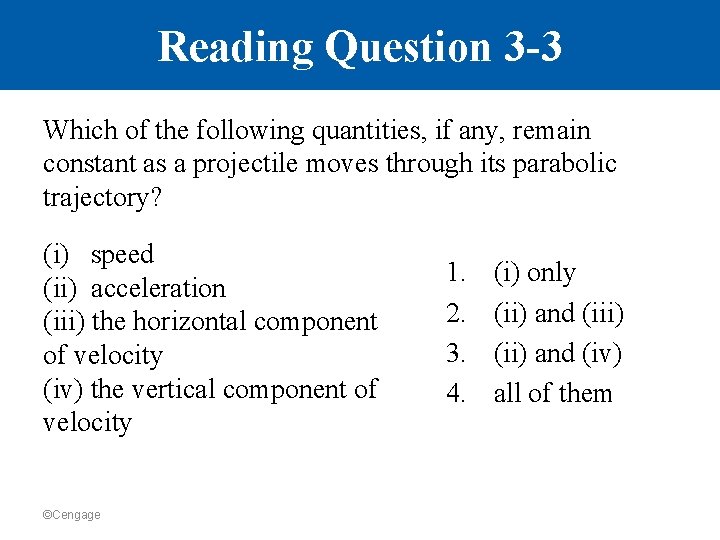
Reading Question 3 -3 Which of the following quantities, if any, remain constant as a projectile moves through its parabolic trajectory? (i) speed (ii) acceleration (iii) the horizontal component of velocity (iv) the vertical component of velocity ©Cengage 1. 2. 3. 4. (i) only (ii) and (iii) (ii) and (iv) all of them
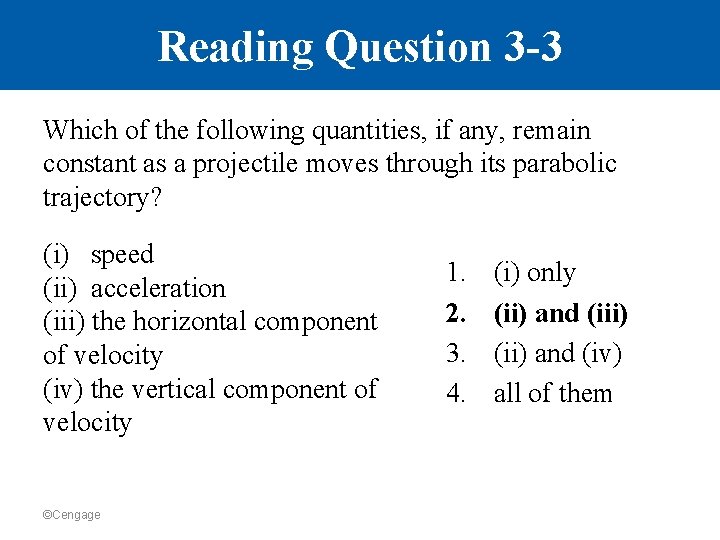
Reading Question 3 -3 Which of the following quantities, if any, remain constant as a projectile moves through its parabolic trajectory? (i) speed (ii) acceleration (iii) the horizontal component of velocity (iv) the vertical component of velocity ©Cengage 1. 2. 3. 4. (i) only (ii) and (iii) (ii) and (iv) all of them
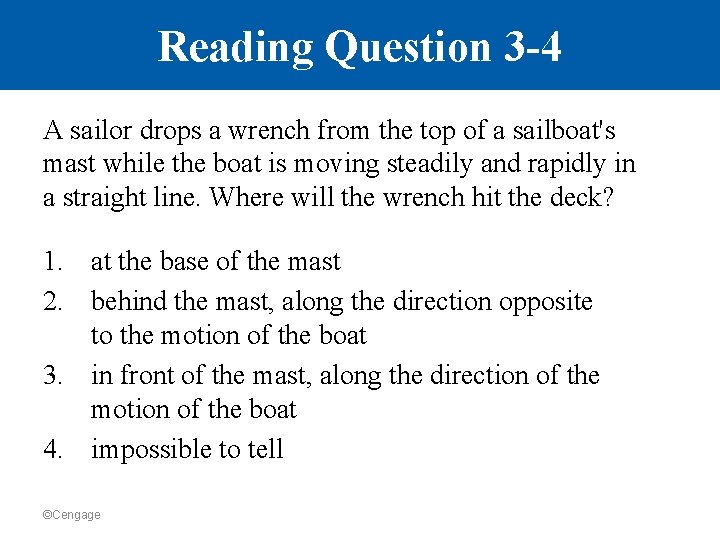
Reading Question 3 -4 A sailor drops a wrench from the top of a sailboat's mast while the boat is moving steadily and rapidly in a straight line. Where will the wrench hit the deck? 1. at the base of the mast 2. behind the mast, along the direction opposite to the motion of the boat 3. in front of the mast, along the direction of the motion of the boat 4. impossible to tell ©Cengage
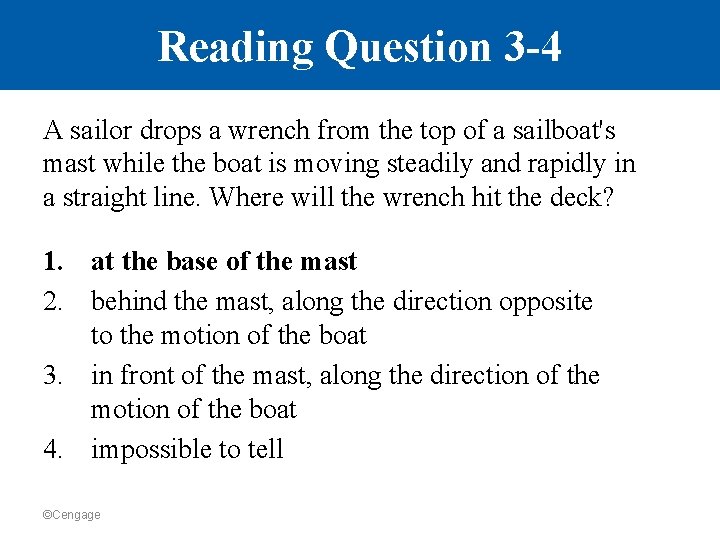
Reading Question 3 -4 A sailor drops a wrench from the top of a sailboat's mast while the boat is moving steadily and rapidly in a straight line. Where will the wrench hit the deck? 1. at the base of the mast 2. behind the mast, along the direction opposite to the motion of the boat 3. in front of the mast, along the direction of the motion of the boat 4. impossible to tell ©Cengage
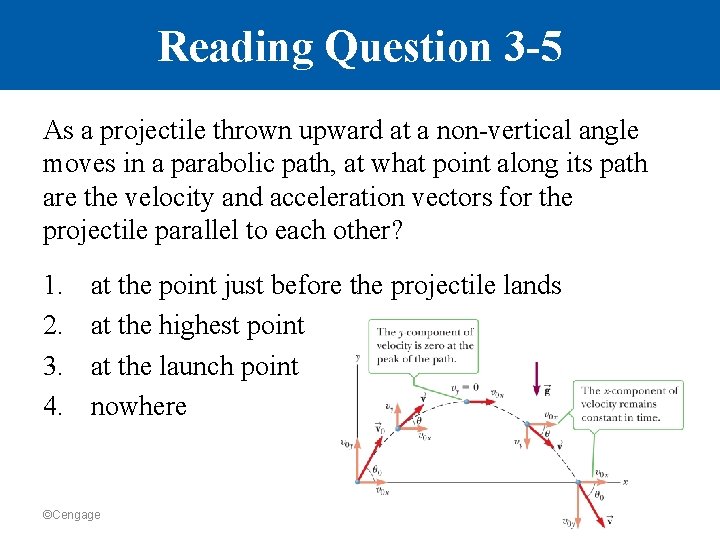
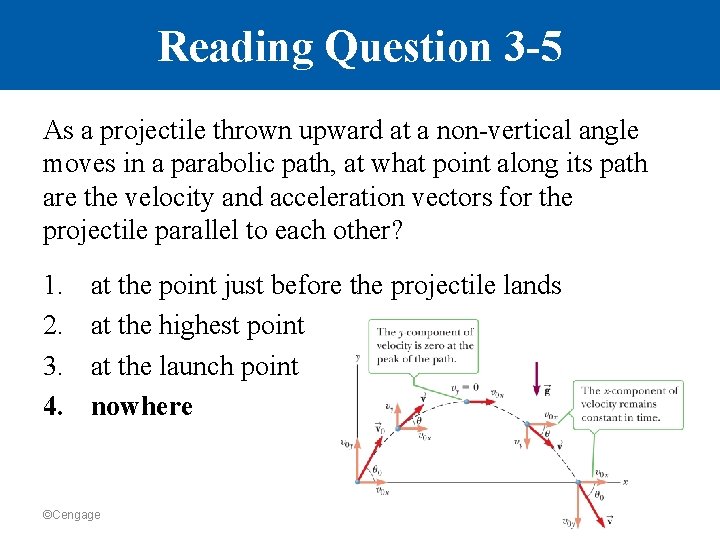
Reading Question 3 -5 As a projectile thrown upward at a non-vertical angle moves in a parabolic path, at what point along its path are the velocity and acceleration vectors for the projectile parallel to each other? 1. 2. 3. 4. at the point just before the projectile lands at the highest point at the launch point nowhere ©Cengage
Reading Question 3 -5 As a projectile thrown upward at a non-vertical angle moves in a parabolic path, at what point along its path are the velocity and acceleration vectors for the projectile parallel to each other? 1. 2. 3. 4. at the point just before the projectile lands at the highest point at the launch point nowhere ©Cengage
Topic 3: Motion in Two Dimensions TOPIC DISCUSSION ©Cengage
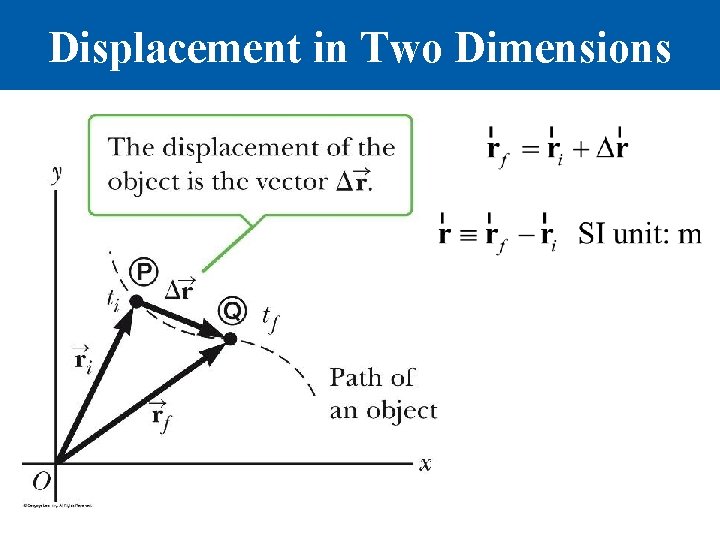
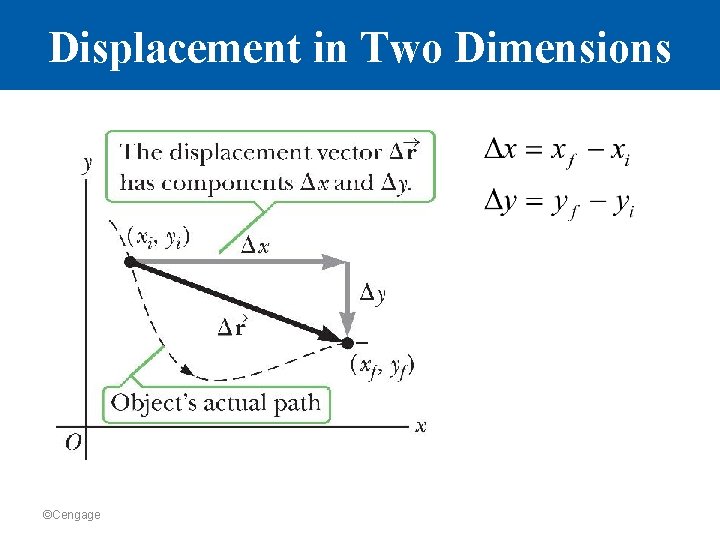
Displacement in Two Dimensions
Displacement in Two Dimensions ©Cengage
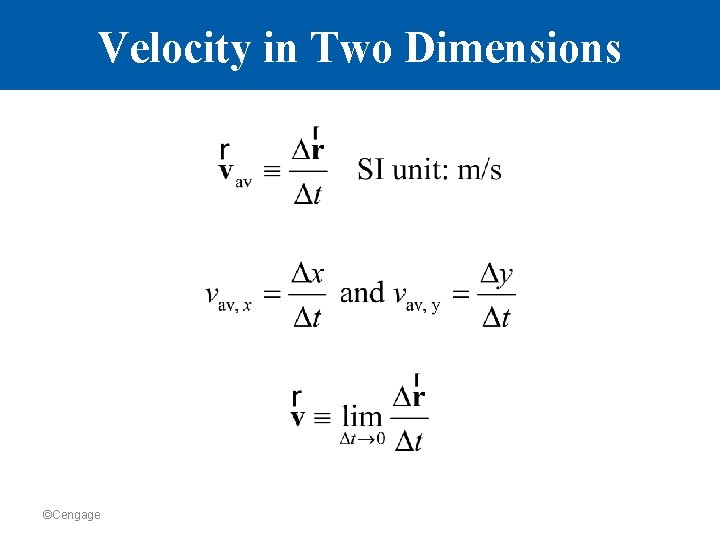
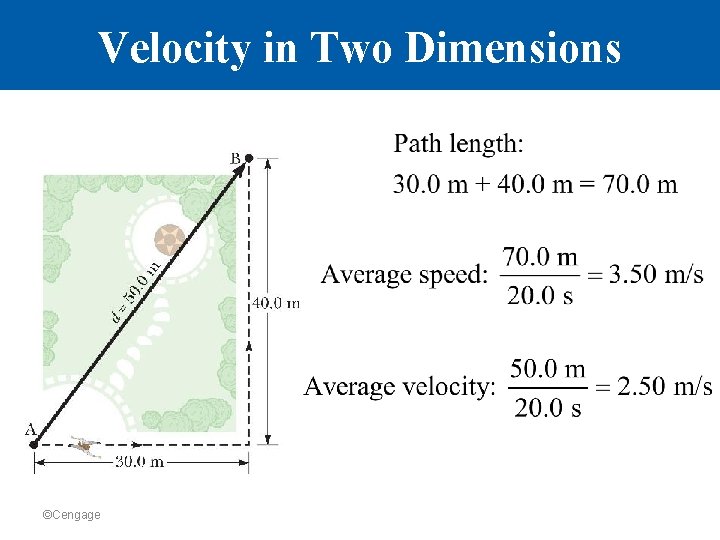
Velocity in Two Dimensions ©Cengage
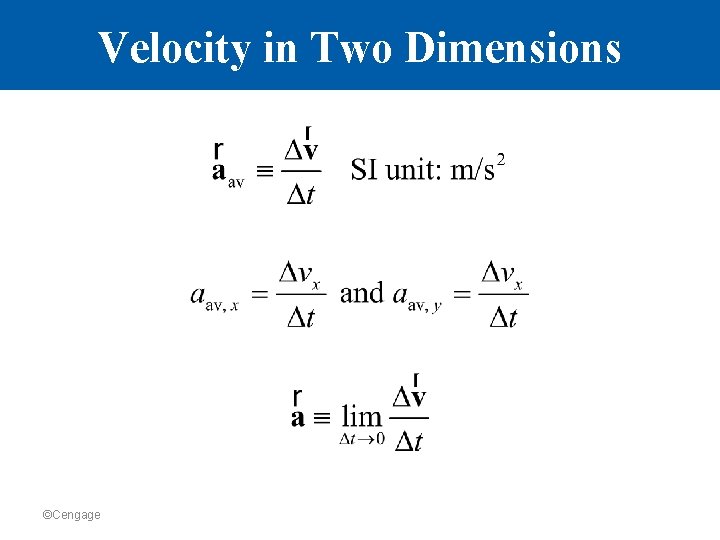
Velocity in Two Dimensions ©Cengage
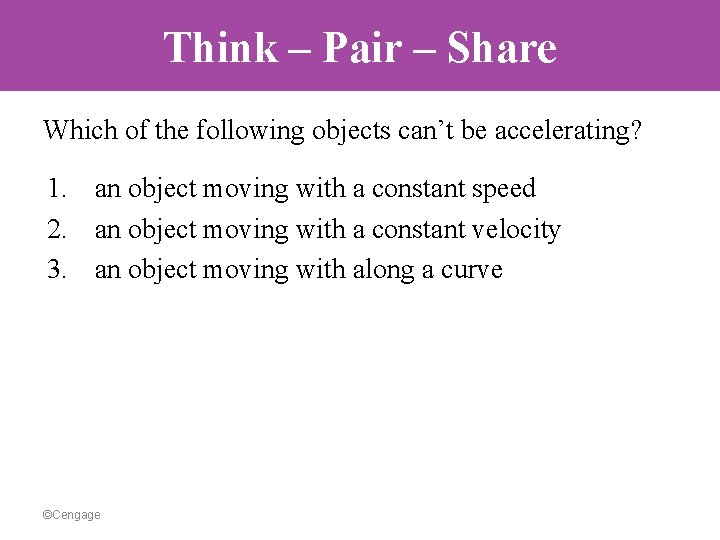
Think – Pair – Share Which of the following objects can’t be accelerating? 1. an object moving with a constant speed 2. an object moving with a constant velocity 3. an object moving with along a curve ©Cengage
Think – Pair – Share Consider the following controls in an automobile: gas pedal, brake, steering wheel. The controls in this list that cause an acceleration of the car are 1. 2. 3. 4. all three controls. the gas pedal and the brake. only the gas pedal. ©Cengage
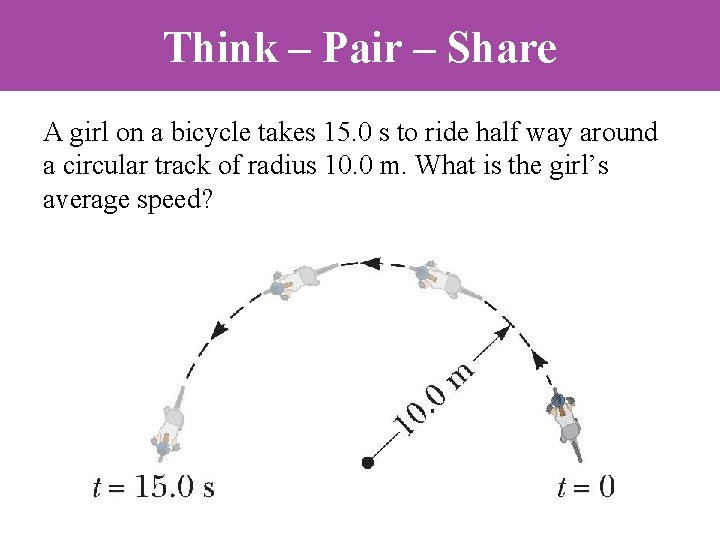
Think – Pair – Share A girl on a bicycle takes 15. 0 s to ride half way around a circular track of radius 10. 0 m. What is the girl’s average speed?
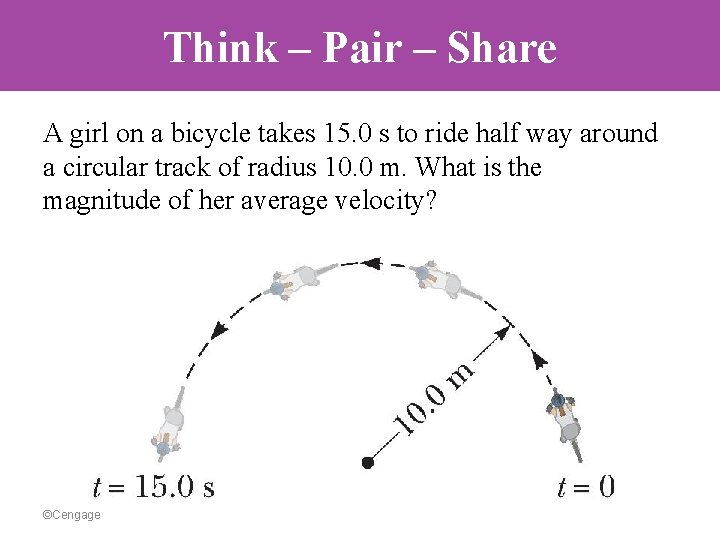
Think – Pair – Share A girl on a bicycle takes 15. 0 s to ride half way around a circular track of radius 10. 0 m. What is the magnitude of her average velocity? ©Cengage
Velocity in Two Dimensions ©Cengage
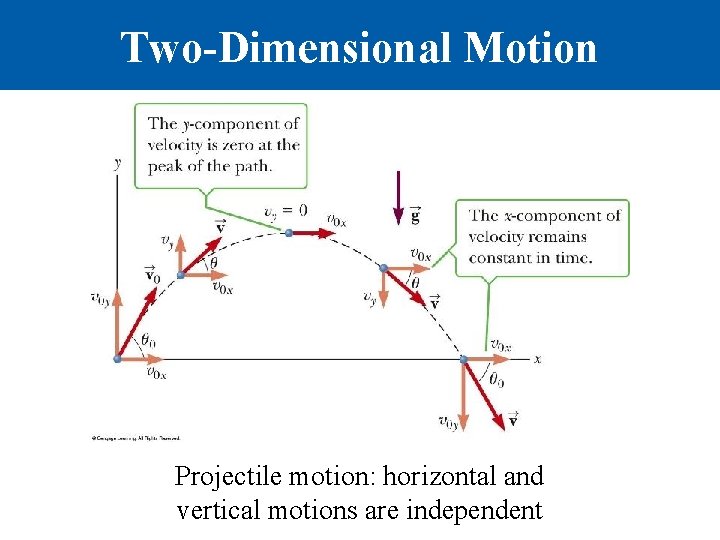
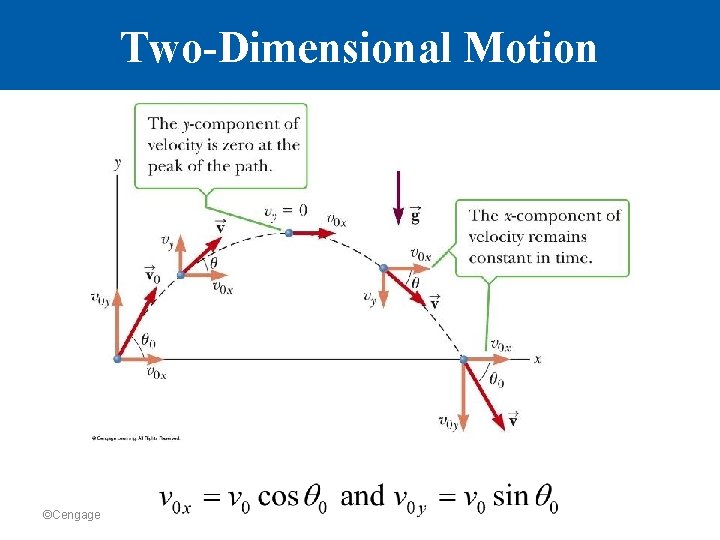
Two-Dimensional Motion Projectile motion: horizontal and vertical motions are independent
Two-Dimensional Motion ©Cengage
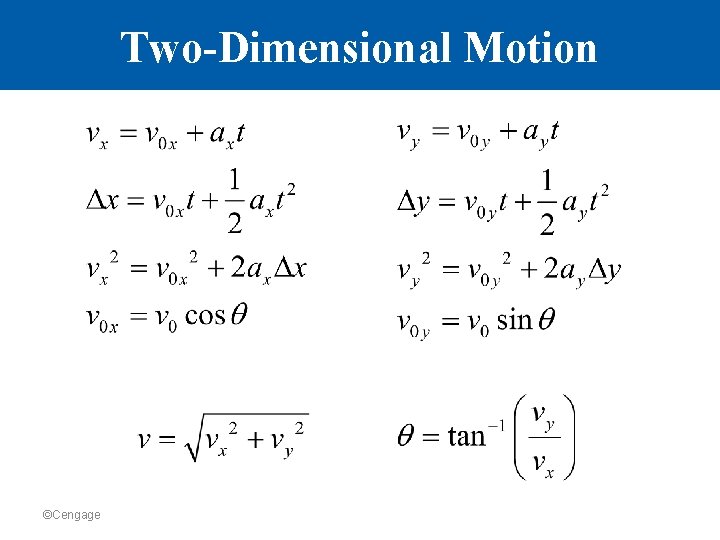
Two-Dimensional Motion
Two-Dimensional Motion ©Cengage
Two-Dimensional Motion ©Cengage
Two-Dimensional Motion ©Cengage
Two-Dimensional Motion ©Cengage
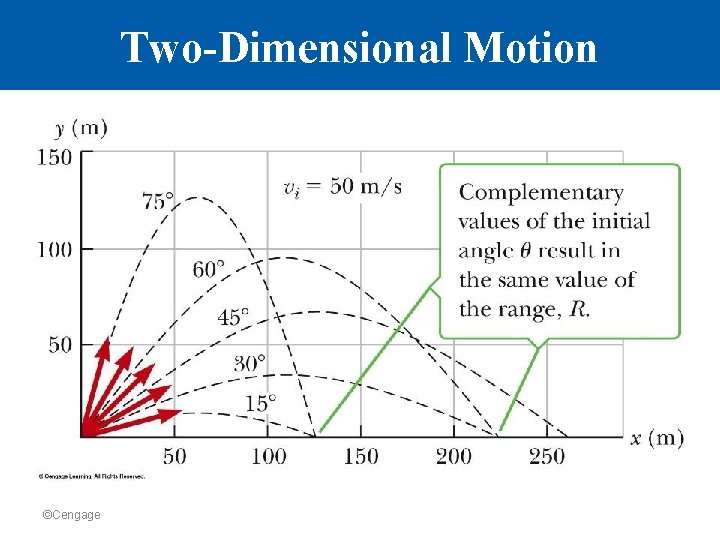
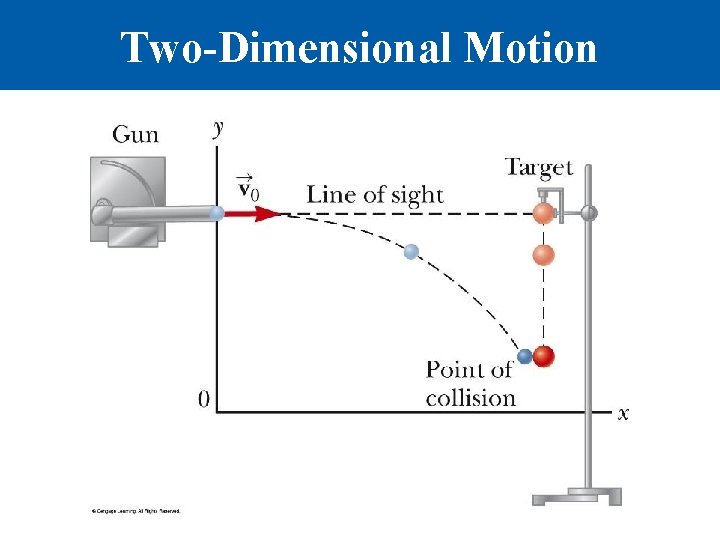
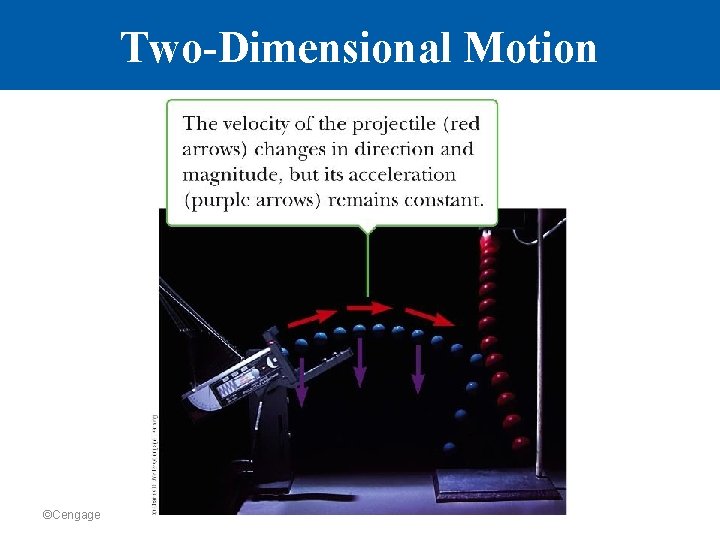
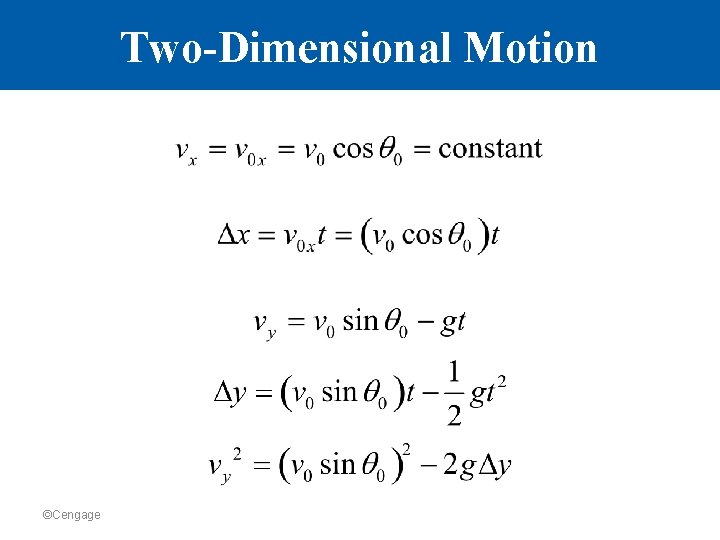
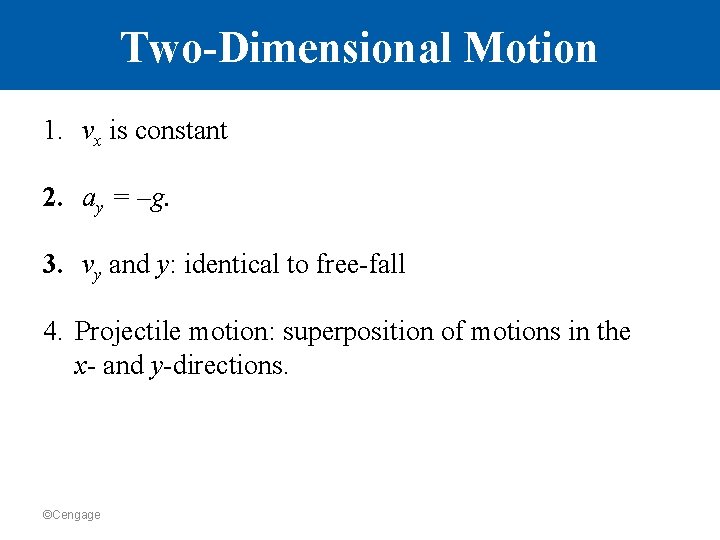
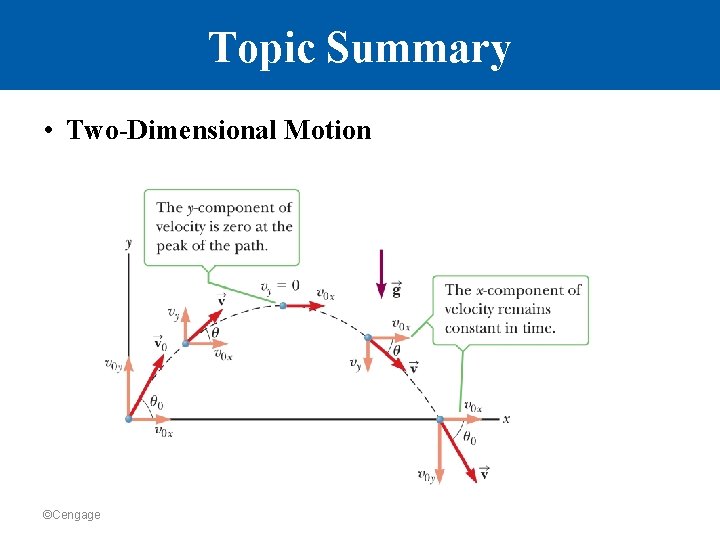
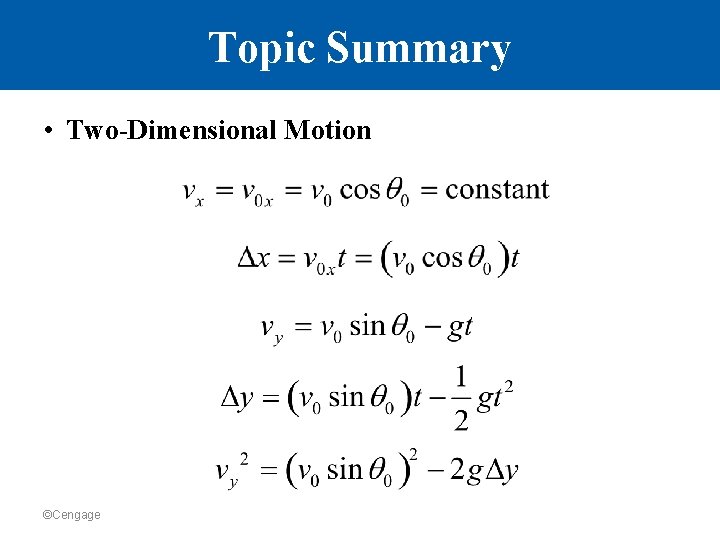
Two-Dimensional Motion 1. vx is constant 2. ay = –g. 3. vy and y: identical to free-fall 4. Projectile motion: superposition of motions in the x- and y-directions. ©Cengage
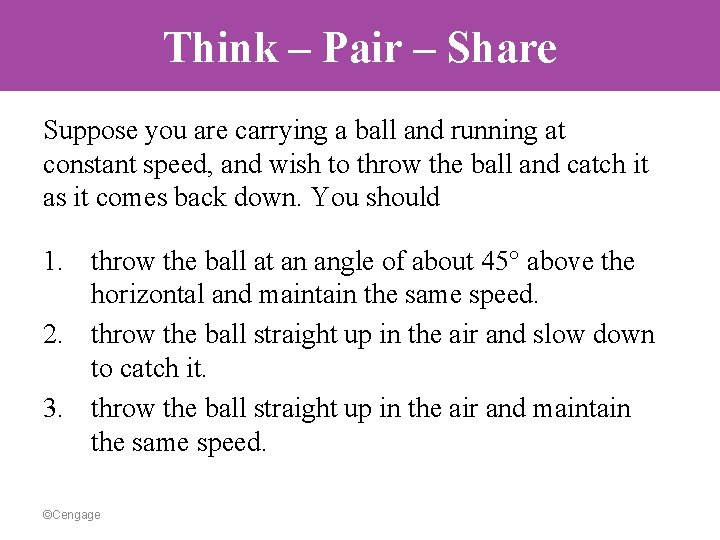
Think – Pair – Share Suppose you are carrying a ball and running at constant speed, and wish to throw the ball and catch it as it comes back down. You should 1. throw the ball at an angle of about 45° above the horizontal and maintain the same speed. 2. throw the ball straight up in the air and slow down to catch it. 3. throw the ball straight up in the air and maintain the same speed. ©Cengage
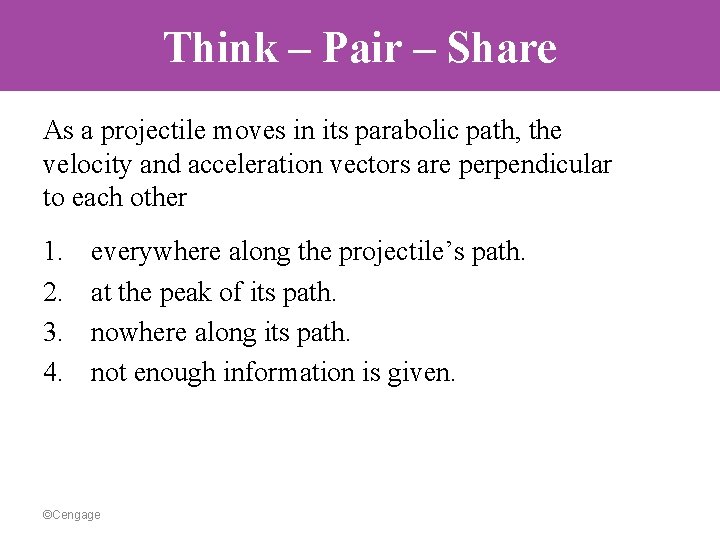
Think – Pair – Share As a projectile moves in its parabolic path, the velocity and acceleration vectors are perpendicular to each other 1. 2. 3. 4. everywhere along the projectile’s path. at the peak of its path. nowhere along its path. not enough information is given. ©Cengage
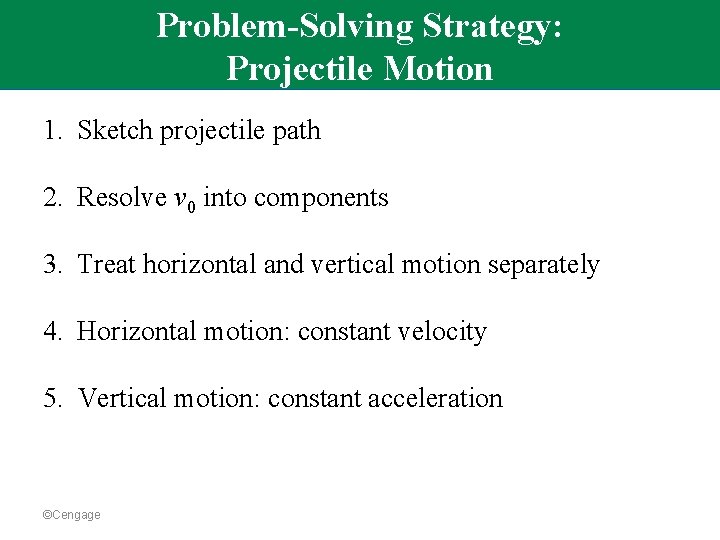
Problem-Solving Strategy: Projectile Motion 1. Sketch projectile path 2. Resolve v 0 into components 3. Treat horizontal and vertical motion separately 4. Horizontal motion: constant velocity 5. Vertical motion: constant acceleration ©Cengage
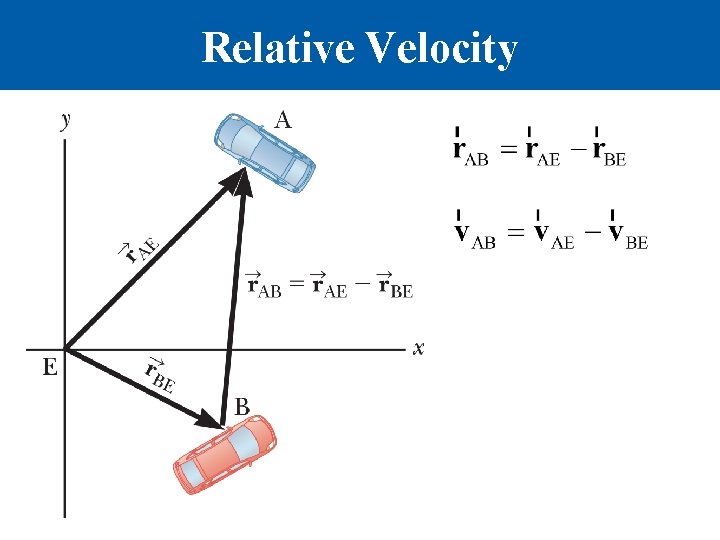
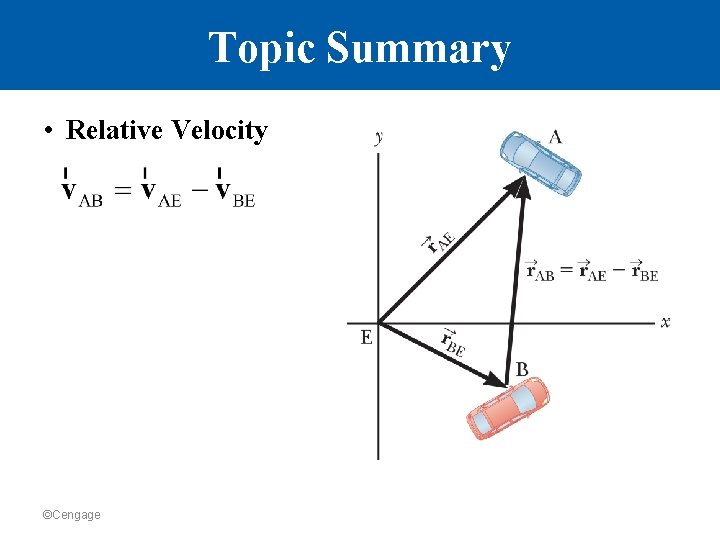
Relative Velocity
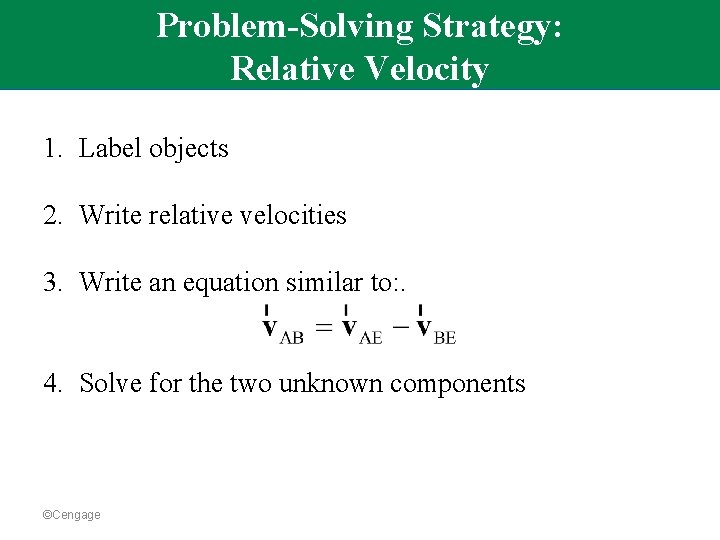
Problem-Solving Strategy: Relative Velocity 1. Label objects 2. Write relative velocities 3. Write an equation similar to: . 4. Solve for the two unknown components ©Cengage
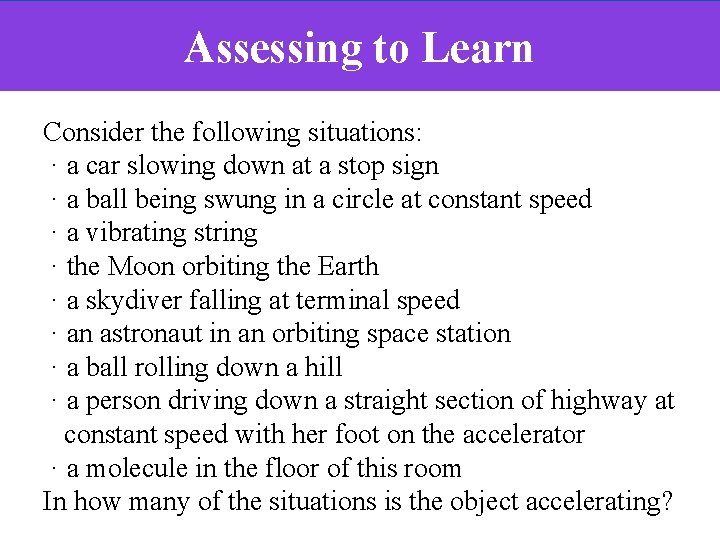
Assessing to Learn Consider the following situations: · a car slowing down at a stop sign · a ball being swung in a circle at constant speed · a vibrating string · the Moon orbiting the Earth · a skydiver falling at terminal speed · an astronaut in an orbiting space station · a ball rolling down a hill · a person driving down a straight section of highway at constant speed with her foot on the accelerator · a molecule in the floor of this room In how many of the situations is the object accelerating?
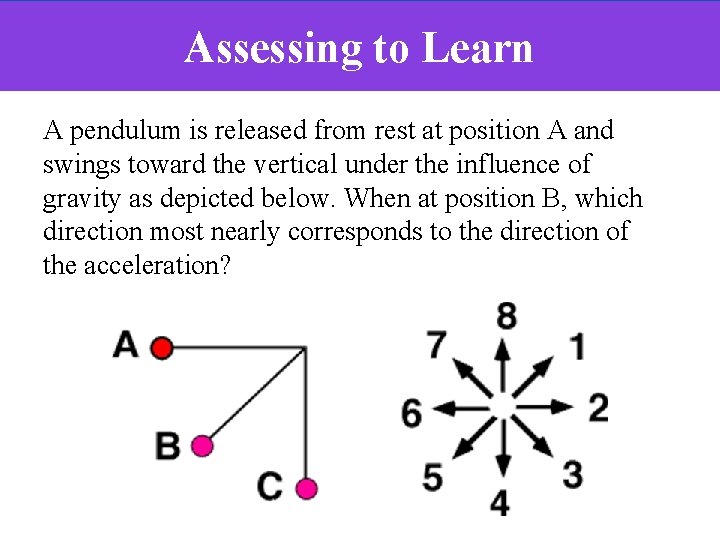
Assessing to Learn A pendulum is released from rest at position A and swings toward the vertical under the influence of gravity as depicted below. When at position B, which direction most nearly corresponds to the direction of the acceleration?
Topic 3: Motion in Two Dimensions TOPIC SUMMARY ©Cengage
©Cengage
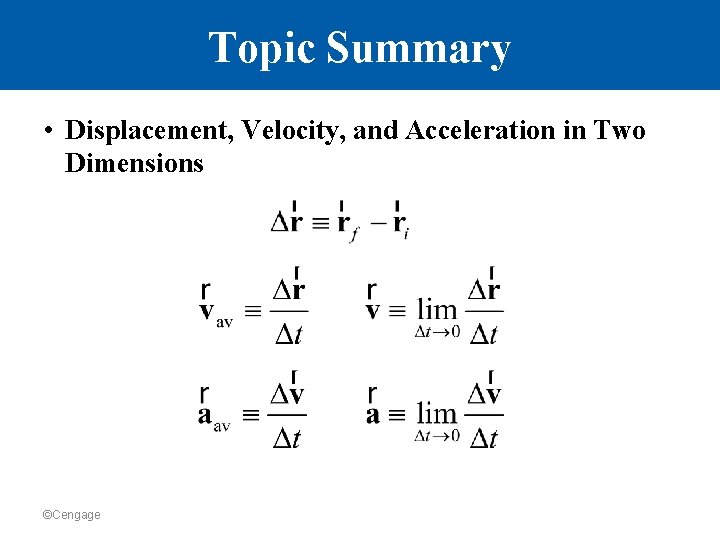
Topic Summary • Displacement, Velocity, and Acceleration in Two Dimensions ©Cengage
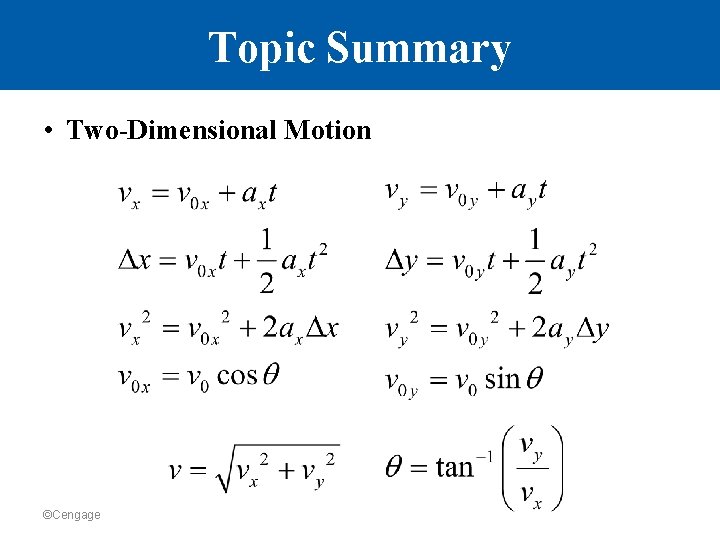
Topic Summary • Two-Dimensional Motion ©Cengage
Topic Summary • Two-Dimensional Motion ©Cengage
Topic Summary • Two-Dimensional Motion ©Cengage
Topic Summary • Relative Velocity ©Cengage
©Cengage
©Cengage