
Topic 3 Fiscal Policy Circular Flow Investment Taxes
- Slides: 15
Topic 3: Fiscal Policy Circular Flow Investment Taxes and Government Spending 1
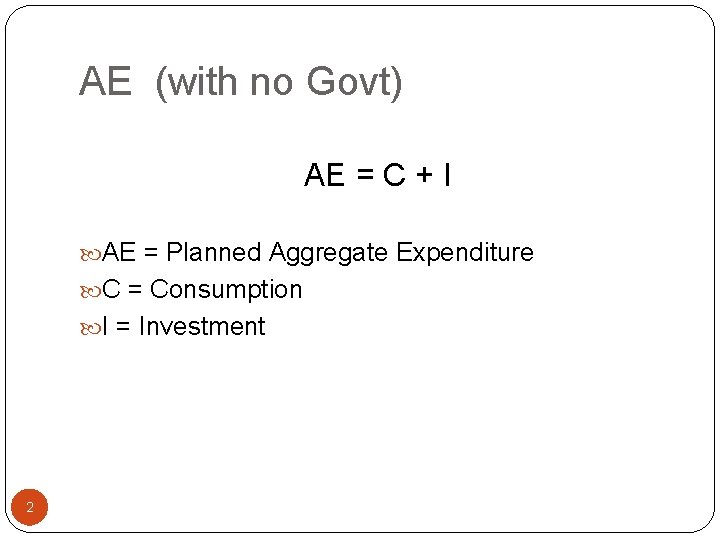
AE (with no Govt) AE = C + I AE = Planned Aggregate Expenditure C = Consumption I = Investment 2
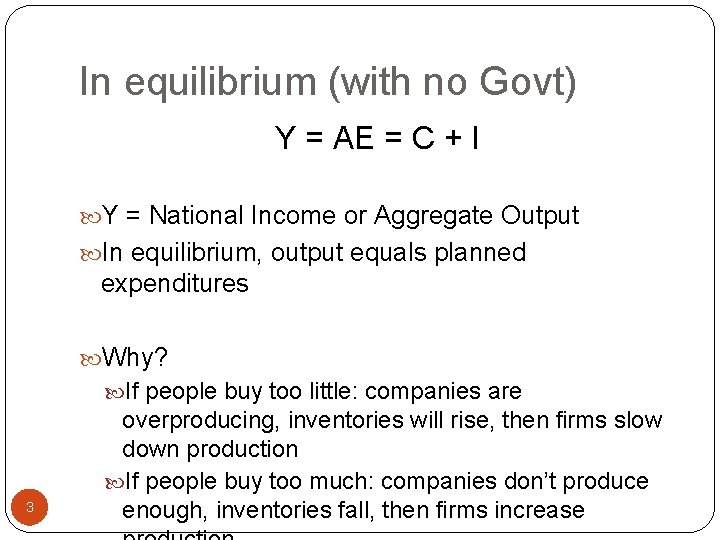
In equilibrium (with no Govt) Y = AE = C + I Y = National Income or Aggregate Output In equilibrium, output equals planned expenditures Why? If people buy too little: companies are 3 overproducing, inventories will rise, then firms slow down production If people buy too much: companies don’t produce enough, inventories fall, then firms increase
Types of Investment 1. 2. 3. Inventories are important: If people buy too little: companies are 4 overproducing, inventories will rise, then firms slow down production If people buy too much: companies don’t produce enough, inventories fall, then firms increase production e. g. , end of 2008
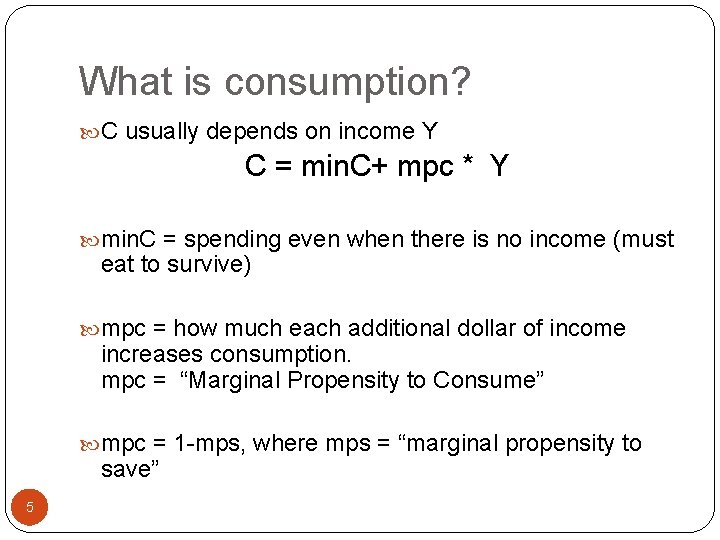
What is consumption? C usually depends on income Y C = min. C+ mpc * Y min. C = spending even when there is no income (must eat to survive) mpc = how much each additional dollar of income increases consumption. mpc = “Marginal Propensity to Consume” mpc = 1 -mps, where mps = “marginal propensity to save” 5
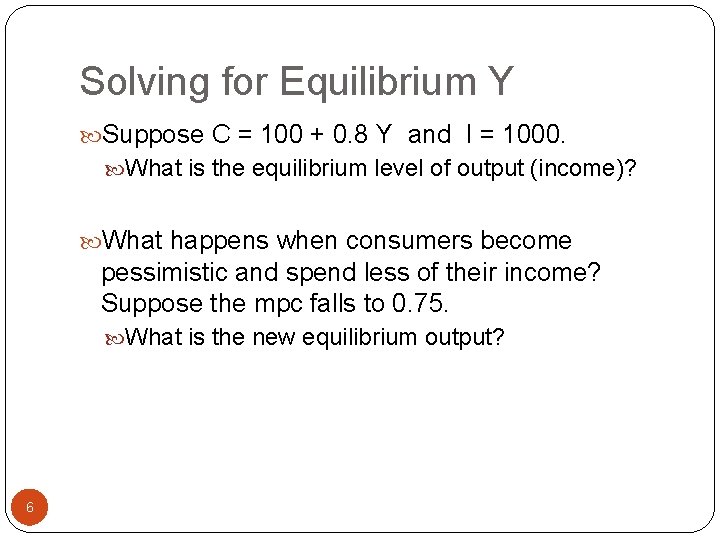
Solving for Equilibrium Y Suppose C = 100 + 0. 8 Y and I = 1000. What is the equilibrium level of output (income)? What happens when consumers become pessimistic and spend less of their income? Suppose the mpc falls to 0. 75. What is the new equilibrium output? 6
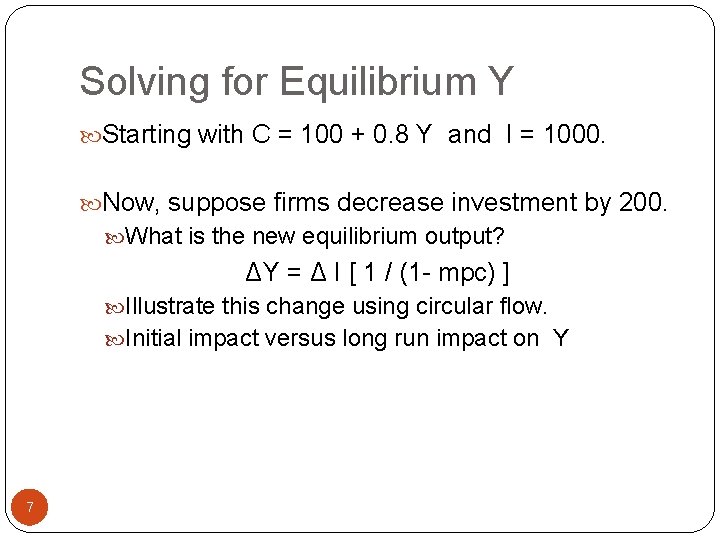
Solving for Equilibrium Y Starting with C = 100 + 0. 8 Y and I = 1000. Now, suppose firms decrease investment by 200. What is the new equilibrium output? ΔY = Δ I [ 1 / (1 - mpc) ] Illustrate this change using circular flow. Initial impact versus long run impact on Y 7
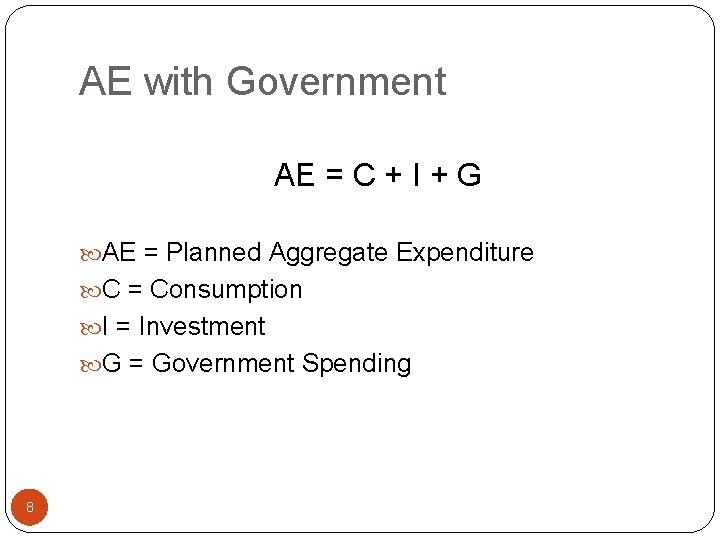
AE with Government AE = C + I + G AE = Planned Aggregate Expenditure C = Consumption I = Investment G = Government Spending 8
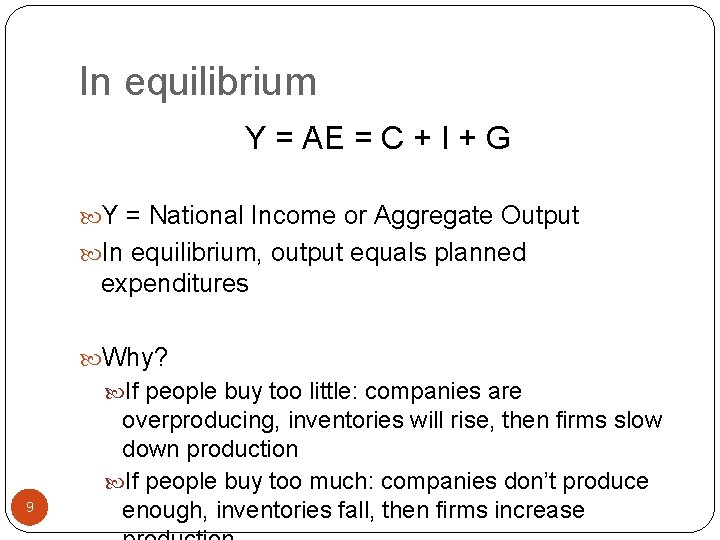
In equilibrium Y = AE = C + I + G Y = National Income or Aggregate Output In equilibrium, output equals planned expenditures Why? If people buy too little: companies are 9 overproducing, inventories will rise, then firms slow down production If people buy too much: companies don’t produce enough, inventories fall, then firms increase
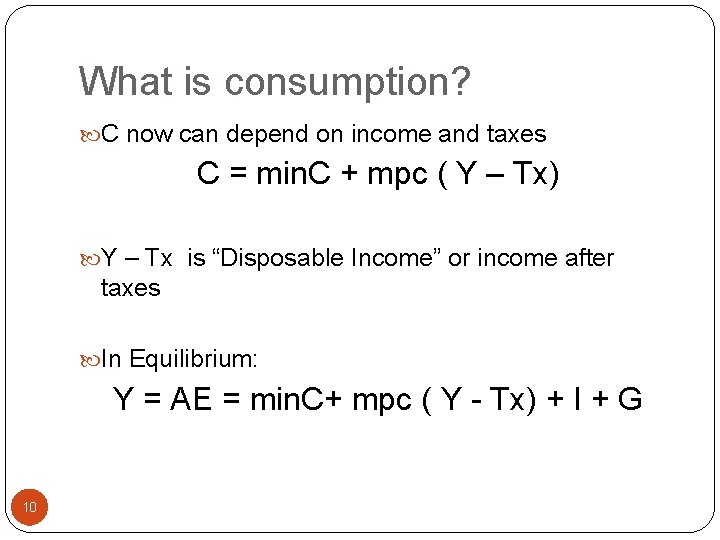
What is consumption? C now can depend on income and taxes C = min. C + mpc ( Y – Tx) Y – Tx is “Disposable Income” or income after taxes In Equilibrium: Y = AE = min. C+ mpc ( Y - Tx) + I + G 10
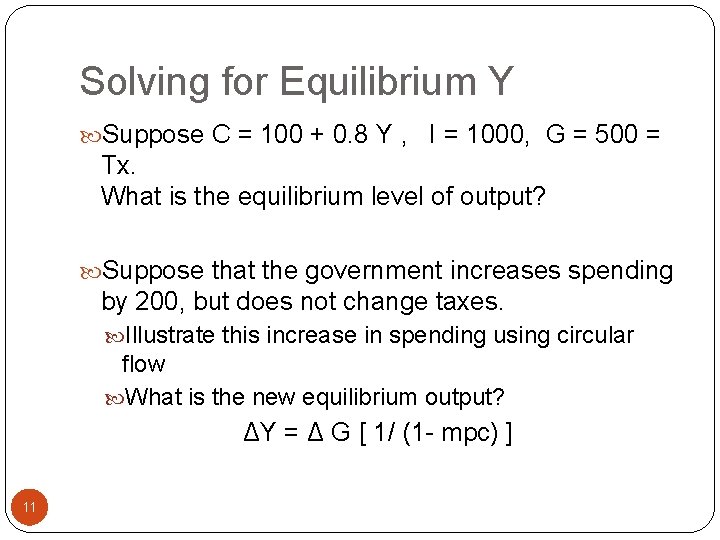
Solving for Equilibrium Y Suppose C = 100 + 0. 8 Y , I = 1000, G = 500 = Tx. What is the equilibrium level of output? Suppose that the government increases spending by 200, but does not change taxes. Illustrate this increase in spending using circular flow What is the new equilibrium output? ΔY = Δ G [ 1/ (1 - mpc) ] 11
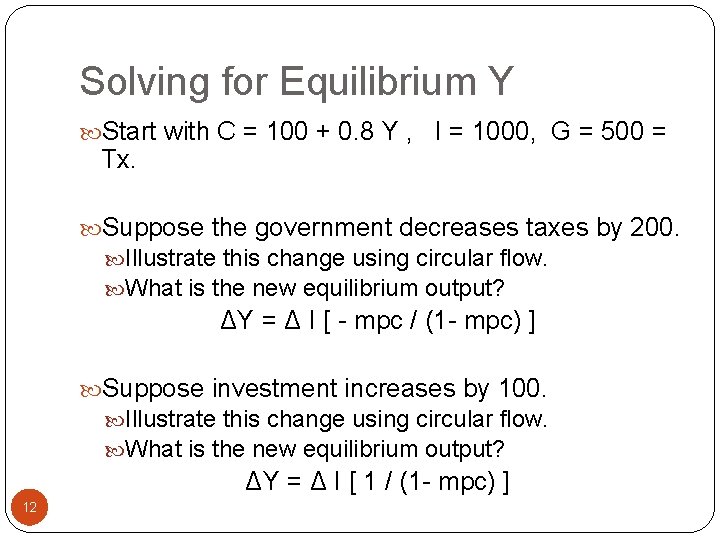
Solving for Equilibrium Y Start with C = 100 + 0. 8 Y , I = 1000, G = 500 = Tx. Suppose the government decreases taxes by 200. Illustrate this change using circular flow. What is the new equilibrium output? ΔY = Δ I [ - mpc / (1 - mpc) ] Suppose investment increases by 100. Illustrate this change using circular flow. What is the new equilibrium output? ΔY = Δ I [ 1 / (1 - mpc) ] 12
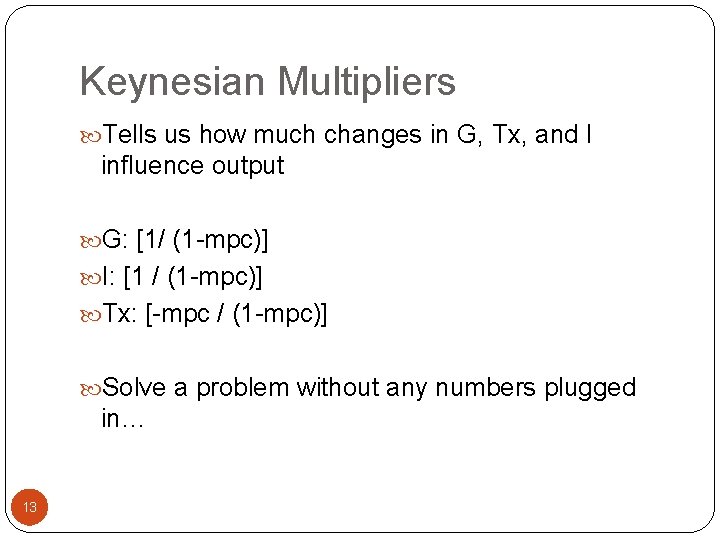
Keynesian Multipliers Tells us how much changes in G, Tx, and I influence output G: [1/ (1 -mpc)] I: [1 / (1 -mpc)] Tx: [-mpc / (1 -mpc)] Solve a problem without any numbers plugged in… 13
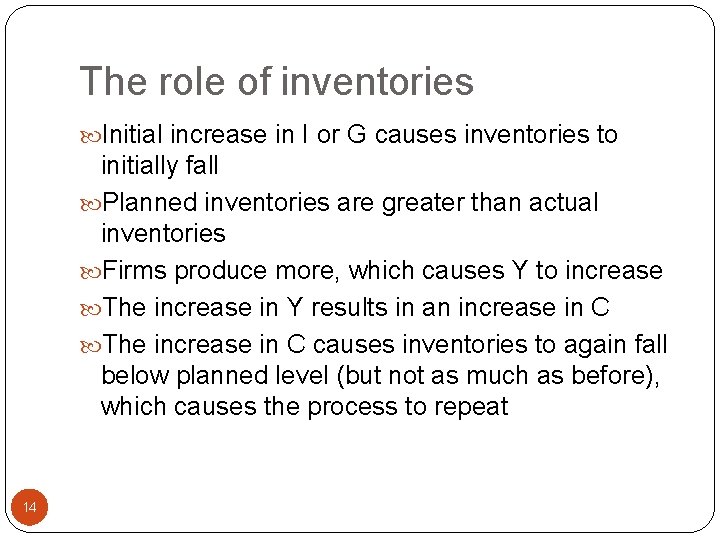
The role of inventories Initial increase in I or G causes inventories to initially fall Planned inventories are greater than actual inventories Firms produce more, which causes Y to increase The increase in Y results in an increase in C The increase in C causes inventories to again fall below planned level (but not as much as before), which causes the process to repeat 14
Other Examples and Problems …. . 15