
Topic 3 b RunTime Environment Data Layout Dynamic
Topic 3 -b Run-Time Environment Data Layout Dynamic Memory Allocation and Heap 1/23/2022 1

Data Layout 1. Static allocation • Storage allocation was fixed during the entire execution of a program 2. Stack allocation • Space is pushed and popped on a run-time stack during program execution such as procedure calls and returns. 3. Heap allocation • Allow space to be allocated and freed at any time. 1/23/2022 coursecpeg 421 -08 sTopic-3 b. ppt 2
Static Allocation 1. Bindings between names and storage are fixed. 2. The values of local names are retained across activations of a procedure. 3. Addressing is efficient 4. Limitations: • No recursive procedures • No dynamic data structures 1/23/2022 coursecpeg 421 -08 sTopic-3 b. ppt 3
Layout of Local Data • The amount of storage needed for a name is determined from its type. • Basic data types: char, real, integer, . . etc • Aggregates: record (struct), array, . . etc. • Address for local data objects: fixed length data is laid out as declarations are processed. The compiler tracks the number of memory locations allocated as the relative address (or offset) for local data objects. • Alignment requirements: for example an array of 10 chars may end up allocating 12 bytes. 1/23/2022 coursecpeg 421 -08 sTopic-3 b. ppt 4
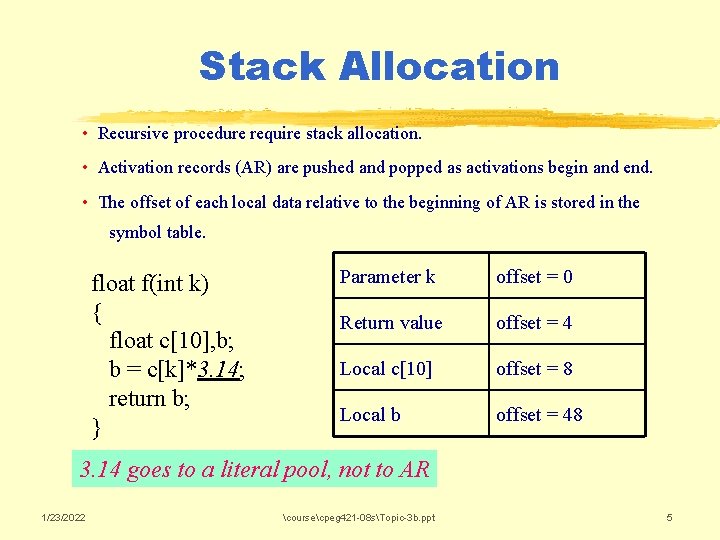
Stack Allocation • Recursive procedure require stack allocation. • Activation records (AR) are pushed and popped as activations begin and end. • The offset of each local data relative to the beginning of AR is stored in the symbol table. float f(int k) { float c[10], b; b = c[k]*3. 14; return b; } Parameter k offset = 0 Return value offset = 4 Local c[10] offset = 8 Local b offset = 48 3. 14 goes to a literal pool, not to AR 1/23/2022 coursecpeg 421 -08 sTopic-3 b. ppt 5
Dynamic Memory Allocation • Who needs the dynamic memory allocation? Objects whose size cannot be determined at compile time. • Where to allocate Stack or Heap. • Objects of dynamic memory allocation Variable-length objects, malloc() function, etc. • Allocation Strategy and trade-off allocate on stack if possible. The stack can be allocated only for an object if it is local to a procedure and becomes inaccessable when the procedure returns. 1/23/2022 coursecpeg 421 -08 sTopic-3 b. ppt 6

Dynamic Arrays Allocation • The bounds of dynamic arrays are determined at runtime rather than compile time. for example: f(int n) { float a[n], b[n*10]; …} • Dynamic arrays cannot be allocated within an AR, they can be allocated on the top of stack as soon as their associated declaration is evaluated. 1/23/2022 coursecpeg 421 -08 sTopic-3 b. ppt 7
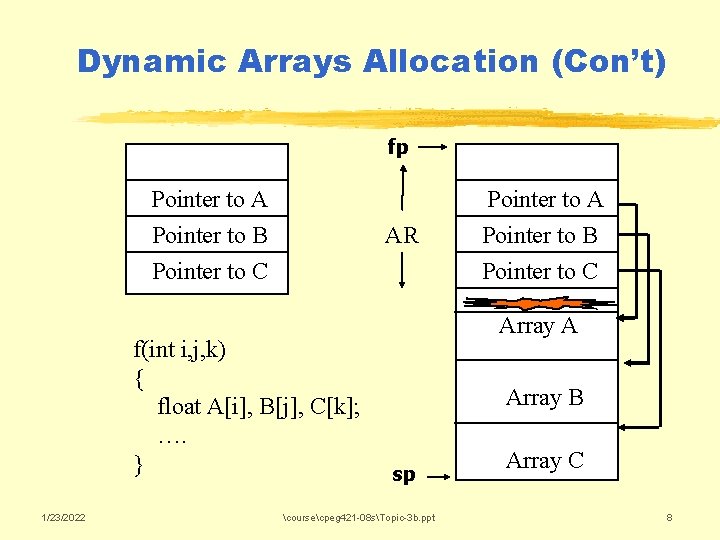
Dynamic Arrays Allocation (Con’t) fp Pointer to A Pointer to B Pointer to C AR f(int i, j, k) { float A[i], B[j], C[k]; …. } 1/23/2022 Pointer to A Pointer to B Pointer to C Array A Array B sp coursecpeg 421 -08 sTopic-3 b. ppt Array C 8
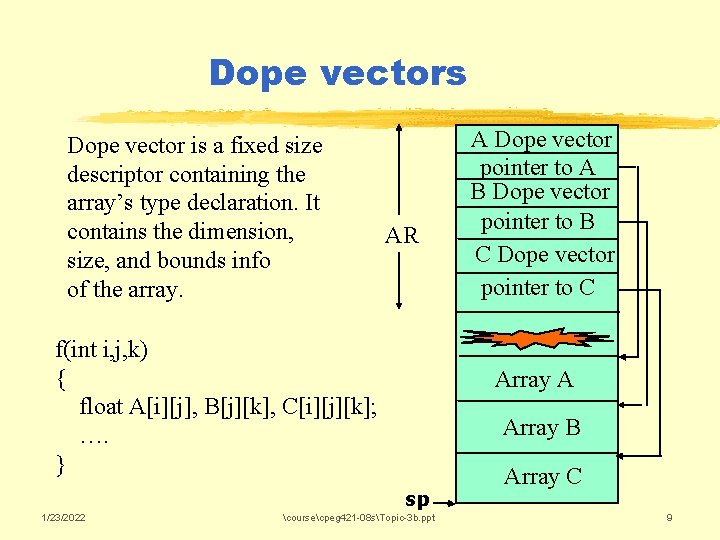
Dope vectors Dope vector is a fixed size descriptor containing the array’s type declaration. It contains the dimension, size, and bounds info of the array. AR f(int i, j, k) { float A[i][j], B[j][k], C[i][j][k]; …. } Array A Array B sp 1/23/2022 A Dope vector pointer to A B Dope vector pointer to B C Dope vector pointer to C coursecpeg 421 -08 sTopic-3 b. ppt Array C 9
Heap Memory Allocation Heap allocation is when an executing program requests that the operating system give it a block of main memory. Features of heap allocation ● Programs may request memory and may also return previously dynamically allocated memory. ● Memory may be returned whenever it is no longer needed. Memory can be returned in any order without any relation to the order in which it was allocated. ● The heap may develop "holes" where previously allocated memory has been returned between blocks of memory still in use. ● A new dynamic request for memory might return a range of addresses out of one of the holes. But it might not use up all the hole, so further dynamic requests might be satisfied out of the original hole. ● Keeping track of allocated and deallocated memory is complicated. A modern operating system does all this. 1/23/2022 coursecpeg 421 -08 sTopic-3 b. ppt 10
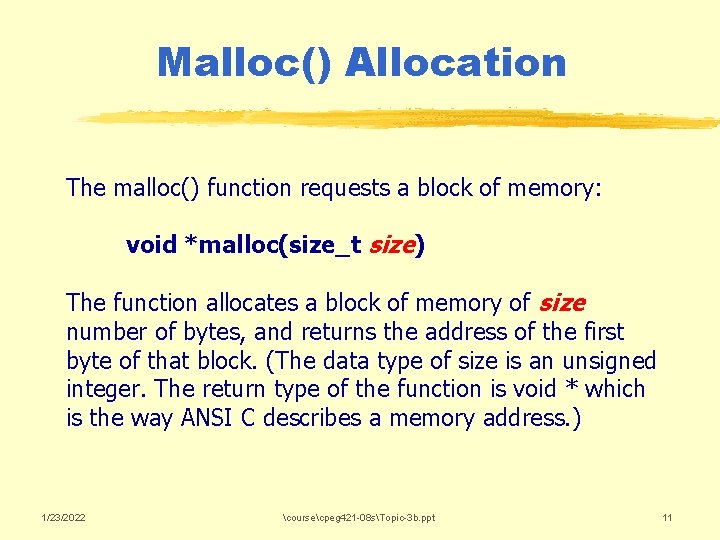
Malloc() Allocation The malloc() function requests a block of memory: void *malloc(size_t size) The function allocates a block of memory of size number of bytes, and returns the address of the first byte of that block. (The data type of size is an unsigned integer. The return type of the function is void * which is the way ANSI C describes a memory address. ) 1/23/2022 coursecpeg 421 -08 sTopic-3 b. ppt 11
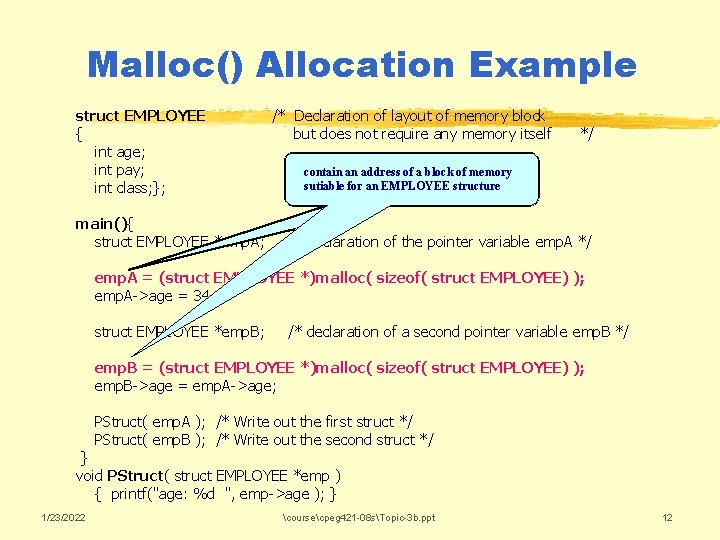
Malloc() Allocation Example struct EMPLOYEE { int age; int pay; int class; }; main(){ struct EMPLOYEE *emp. A; /* Declaration of layout of memory block but does not require any memory itself */ contain an address of a block of memory sutiable for an EMPLOYEE structure /* declaration of the pointer variable emp. A */ emp. A = (struct EMPLOYEE *)malloc( sizeof( struct EMPLOYEE) ); emp. A->age = 34; struct EMPLOYEE *emp. B; /* declaration of a second pointer variable emp. B */ emp. B = (struct EMPLOYEE *)malloc( sizeof( struct EMPLOYEE) ); emp. B->age = emp. A->age; PStruct( emp. A ); /* Write out the first struct */ PStruct( emp. B ); /* Write out the second struct */ } void PStruct( struct EMPLOYEE *emp ) { printf("age: %d ", emp->age ); } 1/23/2022 coursecpeg 421 -08 sTopic-3 b. ppt 12
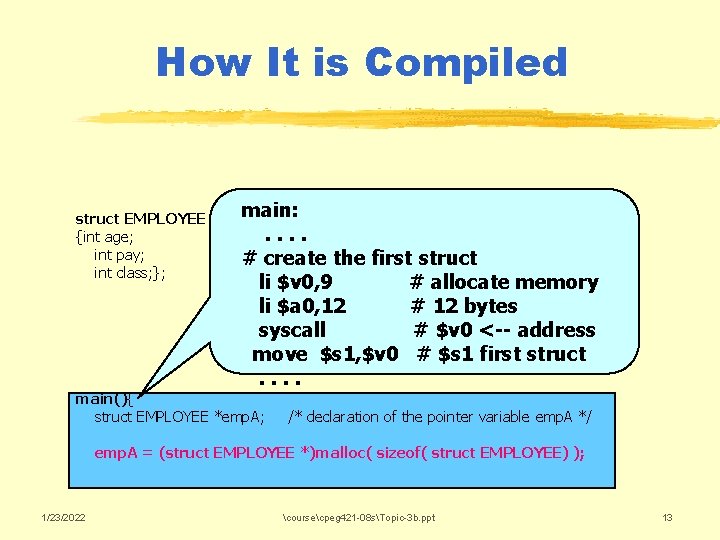
How It is Compiled struct EMPLOYEE {int age; int pay; int class; }; main: . . # create the first struct li $v 0, 9 # allocate memory li $a 0, 12 # 12 bytes syscall # $v 0 <-- address move $s 1, $v 0 # $s 1 first struct. . main(){ struct EMPLOYEE *emp. A; /* declaration of the pointer variable emp. A */ emp. A = (struct EMPLOYEE *)malloc( sizeof( struct EMPLOYEE) ); 1/23/2022 coursecpeg 421 -08 sTopic-3 b. ppt 13
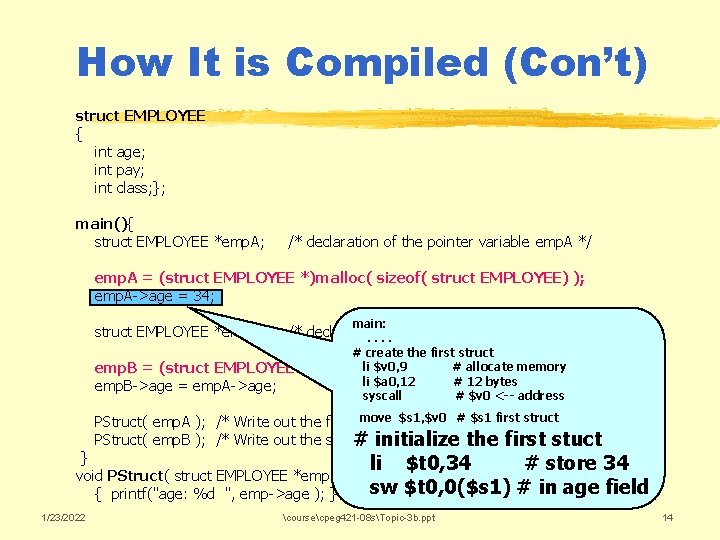
How It is Compiled (Con’t) struct EMPLOYEE { int age; int pay; int class; }; main(){ struct EMPLOYEE *emp. A; /* declaration of the pointer variable emp. A */ emp. A = (struct EMPLOYEE *)malloc( sizeof( struct EMPLOYEE) ); emp. A->age = 34; struct EMPLOYEE *emp. B; main: /* declaration. . . of. a second pointer variable emp. B */ emp. B = (struct EMPLOYEE emp. B->age = emp. A->age; # create the first struct li $v 0, 9 # allocate memory *)malloc( sizeof( struct EMPLOYEE) li $a 0, 12 # 12 bytes syscall # $v 0 <-- address ); move */ $s 1, $v 0 # $s 1 first struct PStruct( emp. A ); /* Write out the first struct PStruct( emp. B ); /* Write out the second struct */ # initialize the first stuct } void PStruct( struct EMPLOYEE *emp ) { printf("age: %d ", emp->age ); } 1/23/2022 li $t 0, 34 # store 34 sw $t 0, 0($s 1) # in age field coursecpeg 421 -08 sTopic-3 b. ppt 14
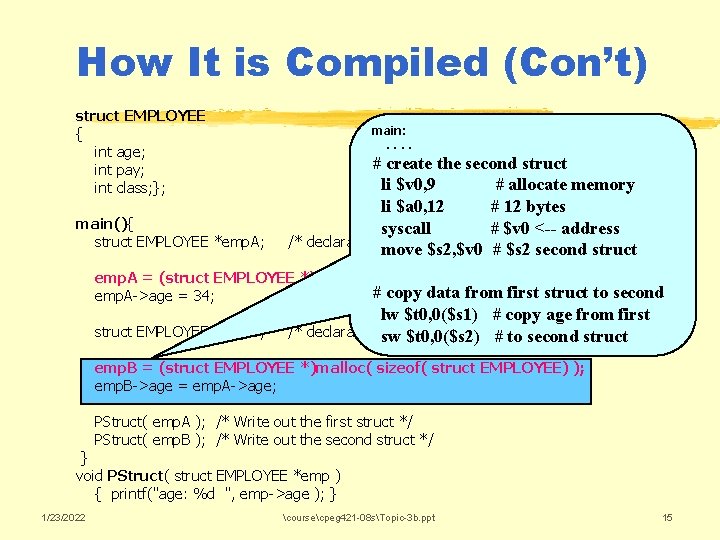
How It is Compiled (Con’t) struct EMPLOYEE { int age; int pay; int class; }; main(){ struct EMPLOYEE *emp. A; main: . . # create the second struct li $v 0, 9 # allocate memory li $a 0, 12 # 12 bytes syscall # $v 0 <-- address /* declaration of the pointer variable emp. A */ move $s 2, $v 0 # $s 2 second struct emp. A = (struct EMPLOYEE *)malloc( sizeof( struct EMPLOYEE) ); # copy data from first struct emp. A->age = 34; struct EMPLOYEE *emp. B; to second lw $t 0, 0($s 1) # copy age from first /* declaration sw of a$t 0, 0($s 2) second pointer */ # tovariable secondemp. B struct emp. B = (struct EMPLOYEE *)malloc( sizeof( struct EMPLOYEE) ); emp. B->age = emp. A->age; PStruct( emp. A ); /* Write out the first struct */ PStruct( emp. B ); /* Write out the second struct */ } void PStruct( struct EMPLOYEE *emp ) { printf("age: %d ", emp->age ); } 1/23/2022 coursecpeg 421 -08 sTopic-3 b. ppt 15
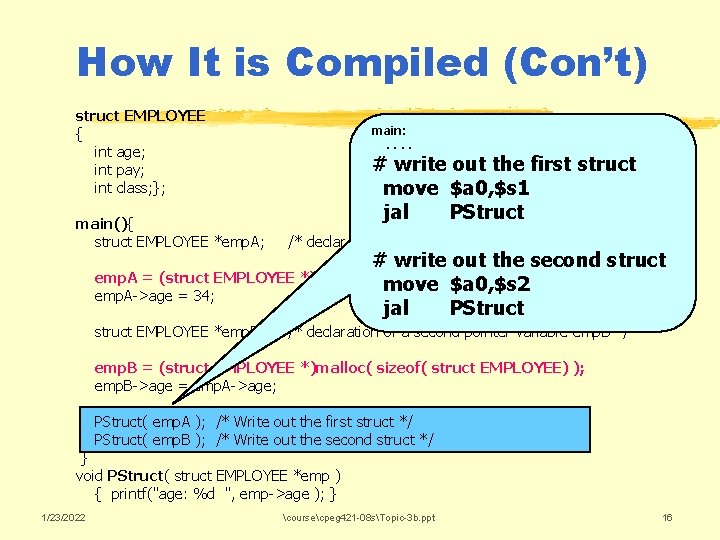
How It is Compiled (Con’t) struct EMPLOYEE { int age; int pay; int class; }; main(){ struct EMPLOYEE *emp. A; main: . . # write out the first struct move $a 0, $s 1 jal PStruct /* declaration of the pointer variable emp. A */ # write out the second struct emp. A = (struct EMPLOYEE *)malloc( sizeof( struct EMPLOYEE) ); move $a 0, $s 2 emp. A->age = 34; jal PStruct struct EMPLOYEE *emp. B; /* declaration of a second pointer variable emp. B */ emp. B = (struct EMPLOYEE *)malloc( sizeof( struct EMPLOYEE) ); emp. B->age = emp. A->age; PStruct( emp. A ); /* Write out the first struct */ PStruct( emp. B ); /* Write out the second struct */ } void PStruct( struct EMPLOYEE *emp ) { printf("age: %d ", emp->age ); } 1/23/2022 coursecpeg 421 -08 sTopic-3 b. ppt 16
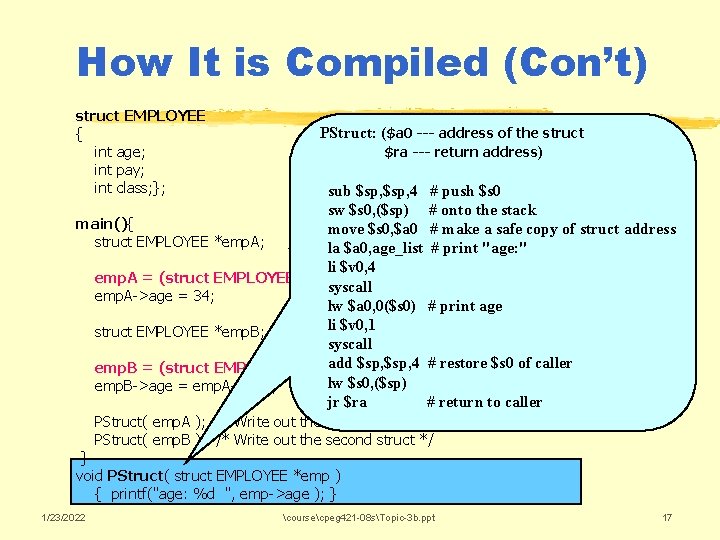
How It is Compiled (Con’t) struct EMPLOYEE { int age; int pay; int class; }; PStruct: ($a 0 --- address of the struct $ra --- return address) sub $sp, 4 # push $s 0 sw $s 0, ($sp) # onto the stack main(){ move $s 0, $a 0 # make a safe copy of struct address struct EMPLOYEE *emp. A; /* declaration of the pointer la $a 0, age_list # print variable "age: " emp. A */ li $v 0, 4 emp. A = (struct EMPLOYEE *)malloc( sizeof( struct EMPLOYEE) ); syscall emp. A->age = 34; lw $a 0, 0($s 0) # print age li $v 0, 1 of a second pointer variable emp. B */ struct EMPLOYEE *emp. B; /* declaration syscall add $sp, 4 restore. EMPLOYEE) $s 0 of caller); emp. B = (struct EMPLOYEE *)malloc( sizeof(#struct lw $s 0, ($sp) emp. B->age = emp. A->age; jr $ra # return to caller PStruct( emp. A ); /* Write out the first struct */ PStruct( emp. B ); /* Write out the second struct */ } void PStruct( struct EMPLOYEE *emp ) { printf("age: %d ", emp->age ); } 1/23/2022 coursecpeg 421 -08 sTopic-3 b. ppt 17
Heap Memory Manager • It keeps track of the free space in heap storage at all times. § Allocation gives a chunk of contiguous heap memory of requested size § Deallocation return the deallocated space to the pool of free space 1/23/2022 coursecpeg 421 -08 sTopic-3 b. ppt 18
Reducing Fragmentation • Initially, the heap is one contiguous unit of free space. As the program allocates and deallocates, this space is broken into free and used chunks. • Allocation and deallocation must be careful in dealing with fragmentation issues. 1/23/2022 coursecpeg 421 -08 sTopic-3 b. ppt 19
First-fit, Best-fit, Next-fit • First-fit To allocate the requested memory in the first hole in which it fits. (fast, but lots of small holes) • Best-fit To allocate the requested memory in the smallest hole that is large enough. (low locality) • Next-fit To allocate in the chunk that has last been split (like first-fit but remember the searching position) 1/23/2022 coursecpeg 421 -08 sTopic-3 b. ppt 20
Heap Deallocation • No deallocation § Stop when space run out • Explicit (manual) deallocation § free (C, PL/1), delete (C++), dispose (Pascal), deallocation (Ada) § May lead to memory leak and dangling reference • Implicit deallocation § Reference count § Garbage collection 1/23/2022 coursecpeg 421 -08 sTopic-3 b. ppt 21
Non-local names In a language with nested procedures (or blocks) and static scope (lexical scope), some names are neither local nor global, they are non-local names. 1/23/2022 coursecpeg 421 -08 sTopic-3 b. ppt 22
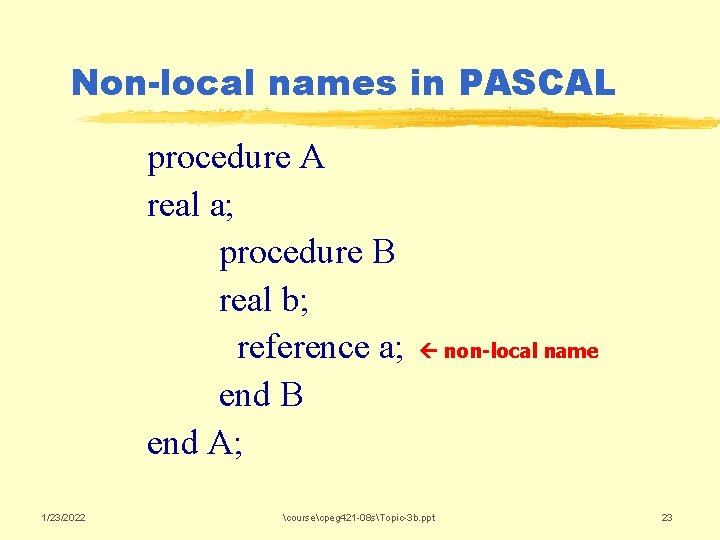
Non-local names in PASCAL procedure A real a; procedure B real b; reference a; end B end A; 1/23/2022 non-local name coursecpeg 421 -08 sTopic-3 b. ppt 23
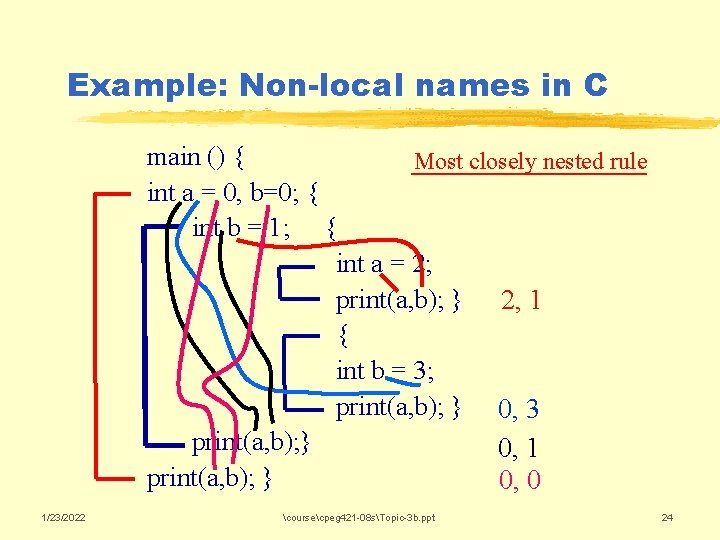
Example: Non-local names in C main () { Most closely nested rule int a = 0, b=0; { int b = 1; { int a = 2; print(a, b); } 2, 1 { int b = 3; print(a, b); } 0, 3 print(a, b); } 0, 1 print(a, b); } 0, 0 1/23/2022 coursecpeg 421 -08 sTopic-3 b. ppt 24
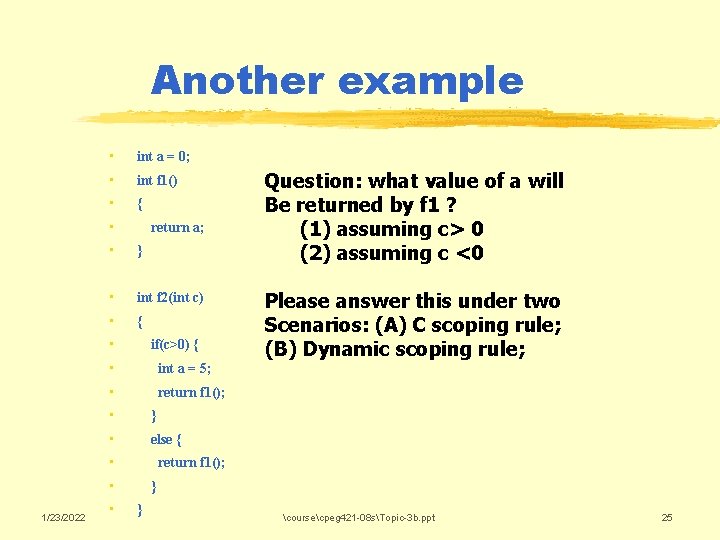
Another example • int a = 0; • int f 1() • { • return a; • } • int f 2(int c) • { • if(c>0) { • int a = 5; • return f 1(); • } • else { • • Please answer this under two Scenarios: (A) C scoping rule; (B) Dynamic scoping rule; return f 1(); • 1/23/2022 Question: what value of a will Be returned by f 1 ? (1) assuming c> 0 (2) assuming c <0 } } coursecpeg 421 -08 sTopic-3 b. ppt 25
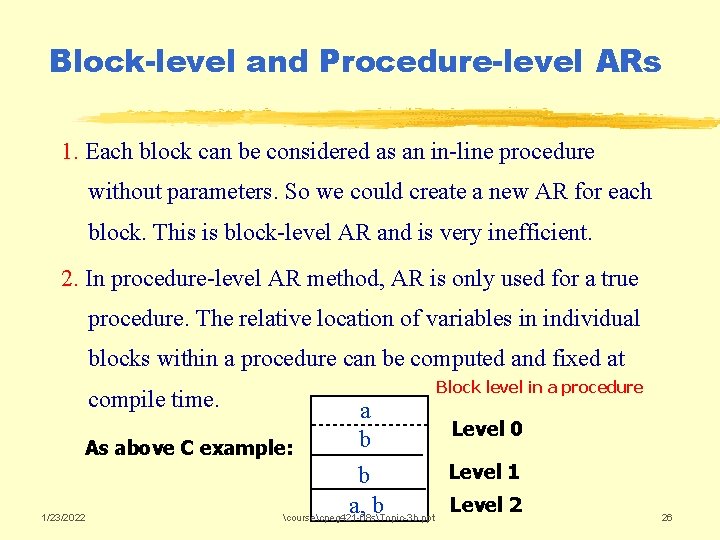
Block-level and Procedure-level ARs 1. Each block can be considered as an in-line procedure without parameters. So we could create a new AR for each block. This is block-level AR and is very inefficient. 2. In procedure-level AR method, AR is only used for a true procedure. The relative location of variables in individual blocks within a procedure can be computed and fixed at compile time. Block level in a procedure a Level 0 b As above C example: Level 1 b Level 2 a, b 1/23/2022 coursecpeg 421 -08 sTopic-3 b. ppt 26
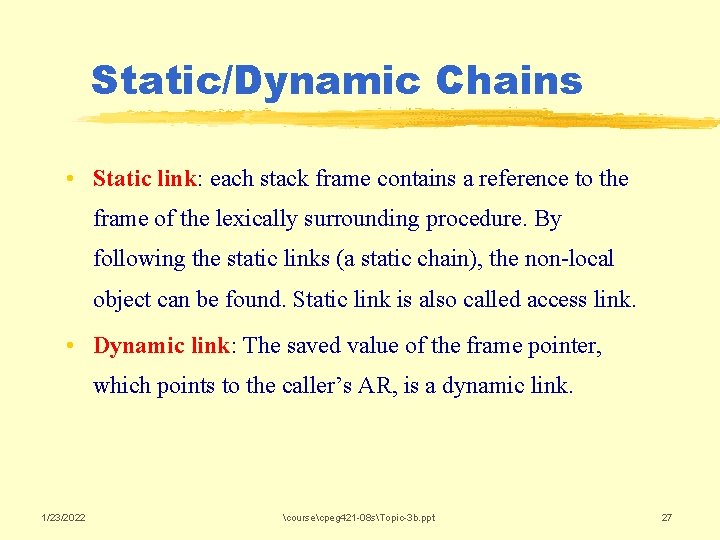
Static/Dynamic Chains • Static link: each stack frame contains a reference to the frame of the lexically surrounding procedure. By following the static links (a static chain), the non-local object can be found. Static link is also called access link. • Dynamic link: The saved value of the frame pointer, which points to the caller’s AR, is a dynamic link. 1/23/2022 coursecpeg 421 -08 sTopic-3 b. ppt 27
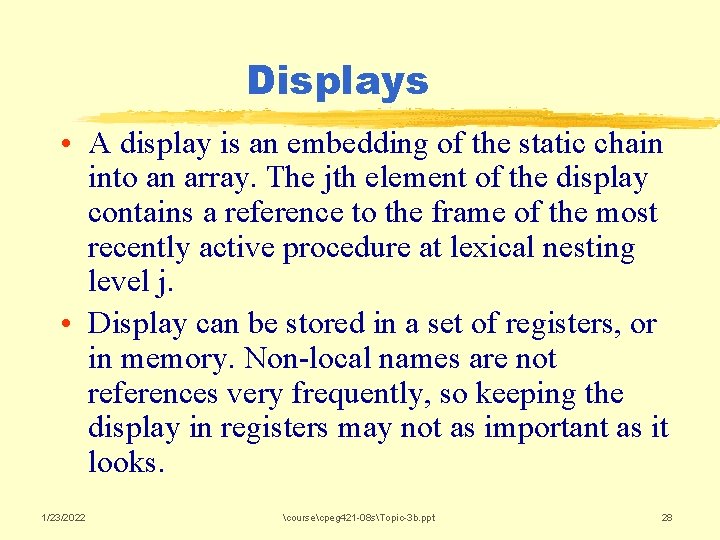
Displays • A display is an embedding of the static chain into an array. The jth element of the display contains a reference to the frame of the most recently active procedure at lexical nesting level j. • Display can be stored in a set of registers, or in memory. Non-local names are not references very frequently, so keeping the display in registers may not as important as it looks. 1/23/2022 coursecpeg 421 -08 sTopic-3 b. ppt 28
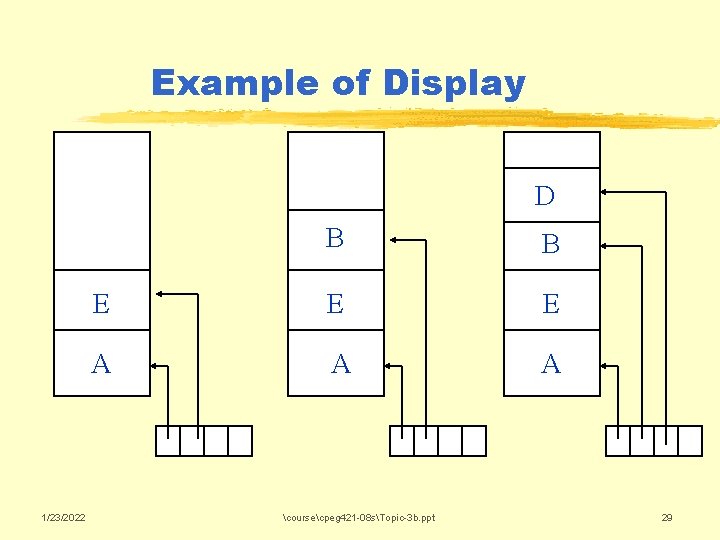
Example of Display D 1/23/2022 B B E E E A A A coursecpeg 421 -08 sTopic-3 b. ppt 29
Summary • Binding names to storage locations • Activation Record (AR) • Parameter passing • Storage allocations • Accessing non-local names 1/23/2022 coursecpeg 421 -08 sTopic-3 b. ppt 30
- Slides: 30