
Topic 3 Algebra Dr J Frost jfrosttiffin kingston
Topic 3: Algebra Dr J Frost (jfrost@tiffin. kingston. sch. uk) Last modified: 21 st August 2013
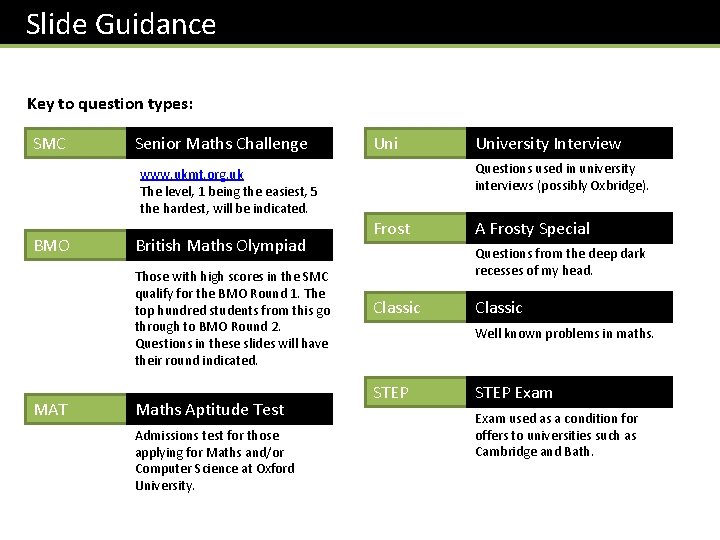
Slide Guidance Key to question types: SMC Senior Maths Challenge Uni Questions used in university interviews (possibly Oxbridge). www. ukmt. org. uk The level, 1 being the easiest, 5 the hardest, will be indicated. BMO British Maths Olympiad Those with high scores in the SMC qualify for the BMO Round 1. The top hundred students from this go through to BMO Round 2. Questions in these slides will have their round indicated. MAT Maths Aptitude Test Admissions test for those applying for Maths and/or Computer Science at Oxford University Interview Frost A Frosty Special Questions from the deep dark recesses of my head. Classic Well known problems in maths. STEP Exam used as a condition for offers to universities such as Cambridge and Bath.
Slide Guidance ? Any box with a ? can be clicked to reveal the answer (this works particularly well with interactive whiteboards!). Make sure you’re viewing the slides in slideshow mode. For multiple choice questions (e. g. SMC), click your choice to reveal the answer (try below!) Question: The capital of Spain is: A: London B: Paris C: Madrid
ζ Topic 3 – Algebra Part 1: Recursive Expressions and Expansion Identities
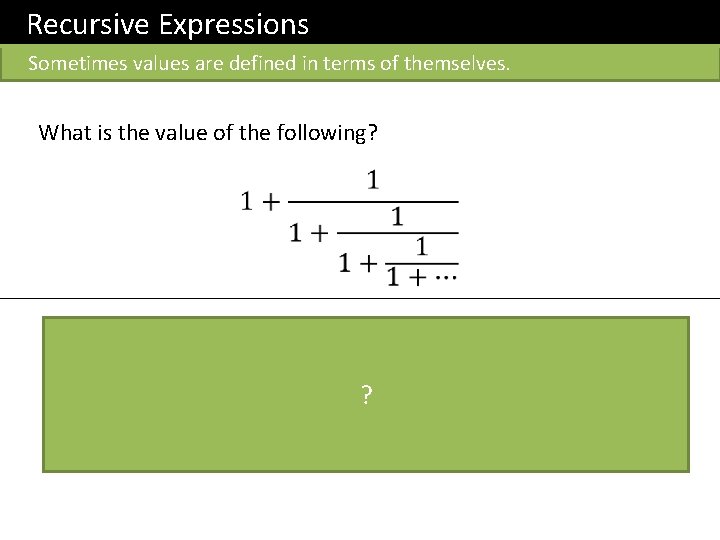
Recursive Expressions Sometimes values are defined in terms of themselves. What is the value of the following? ?

Recursive Expressions ?
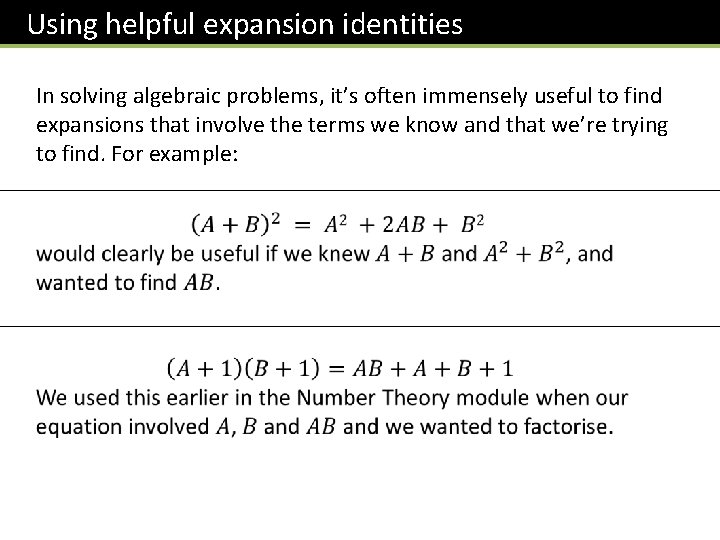
Using helpful expansion identities In solving algebraic problems, it’s often immensely useful to find expansions that involve the terms we know and that we’re trying to find. For example:
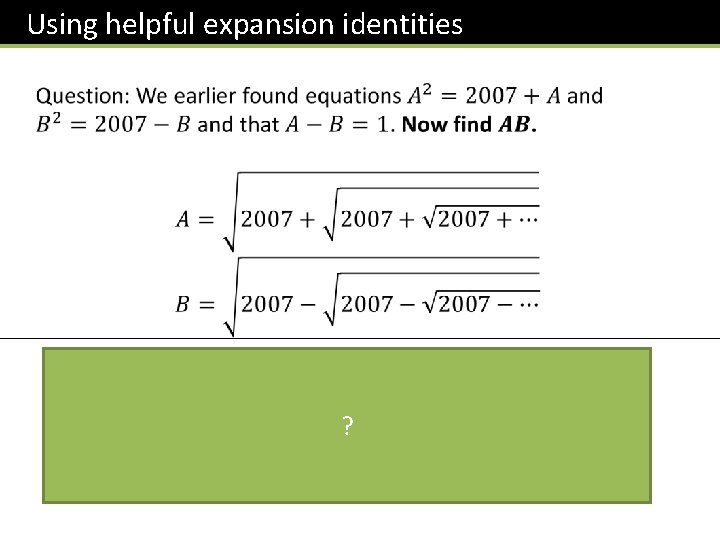
Using helpful expansion identities ?
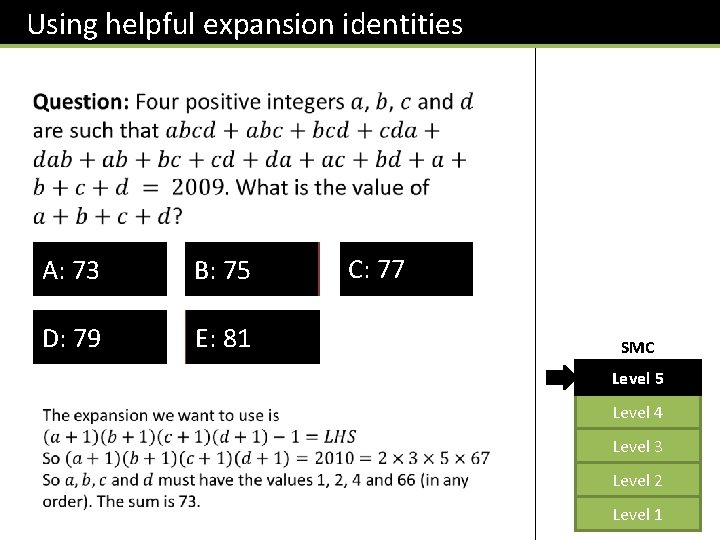
Using helpful expansion identities A: 73 B: 75 D: 79 E: 81 C: 77 SMC Level 5 Level 4 Level 3 Level 2 Level 1
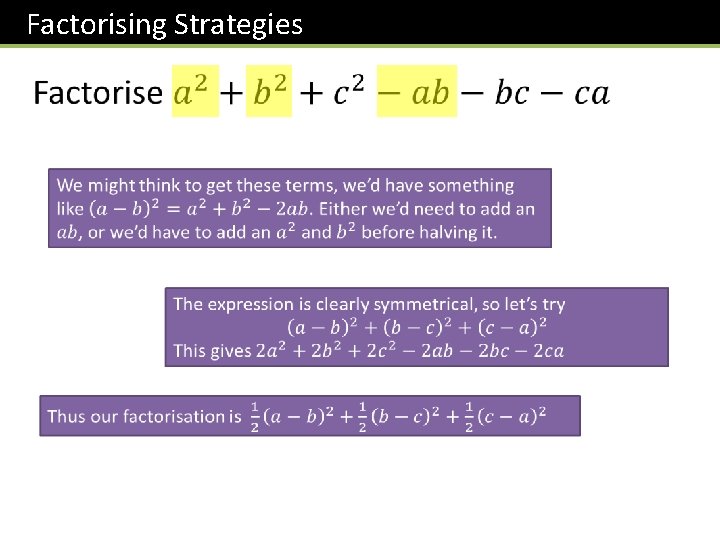
Factorising Strategies
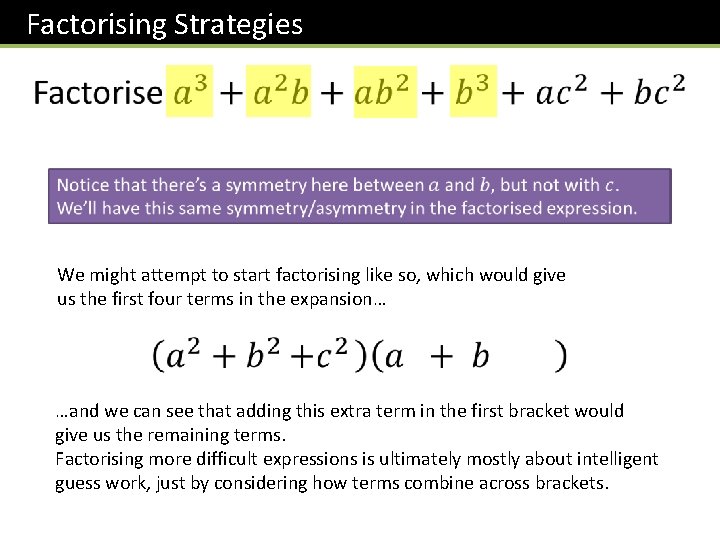
Factorising Strategies We might attempt to start factorising like so, which would give us the first four terms in the expansion… …and we can see that adding this extra term in the first bracket would give us the remaining terms. Factorising more difficult expressions is ultimately mostly about intelligent guess work, just by considering how terms combine across brackets.
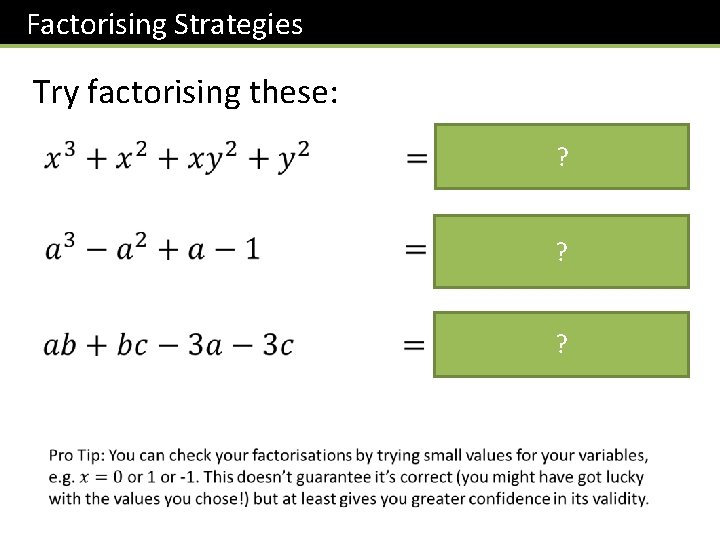
Factorising Strategies Try factorising these: ? ? ?
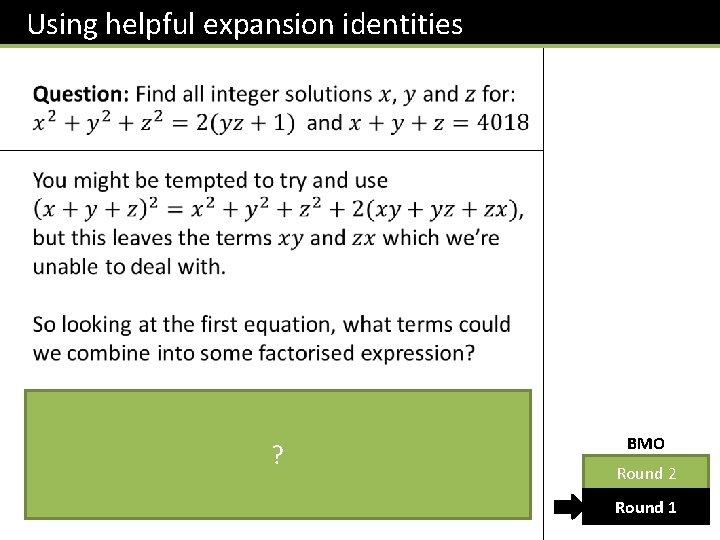
Using helpful expansion identities ? BMO Round 2 Round 1
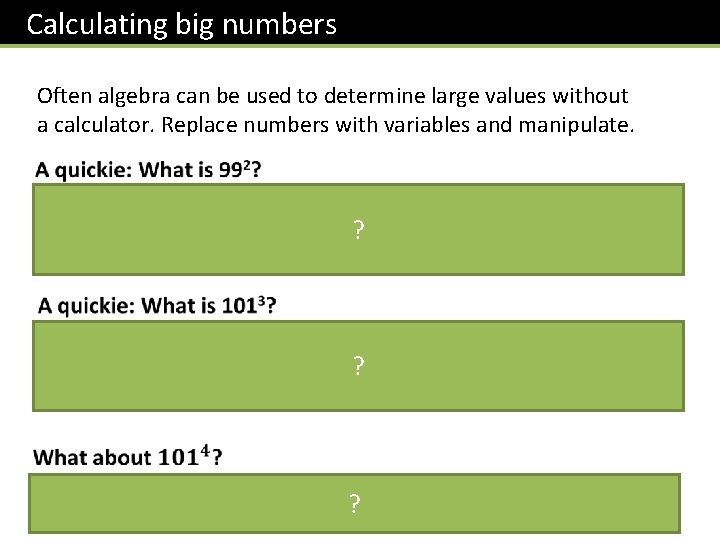
Calculating big numbers Often algebra can be used to determine large values without a calculator. Replace numbers with variables and manipulate. ? ? ?
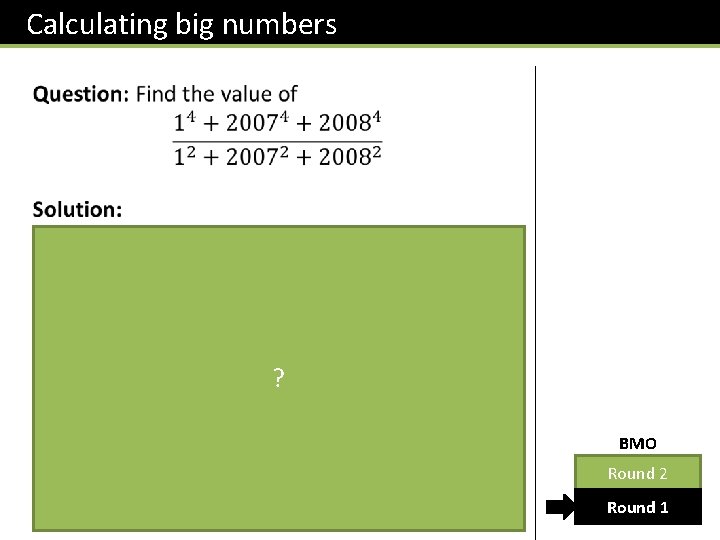
Calculating big numbers ? BMO Round 2 Round 1
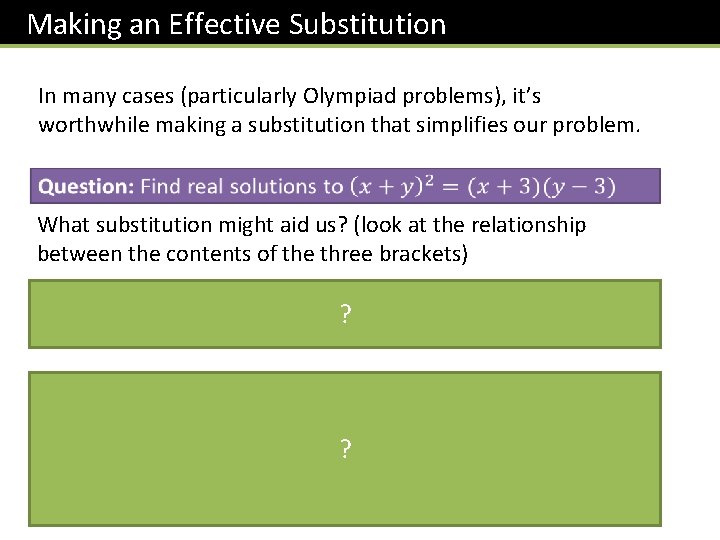
Making an Effective Substitution In many cases (particularly Olympiad problems), it’s worthwhile making a substitution that simplifies our problem. What substitution might aid us? (look at the relationship between the contents of the three brackets) ? ?
ζ Topic 3 – Algebra Part 2: Simultaneous Equations & Surds
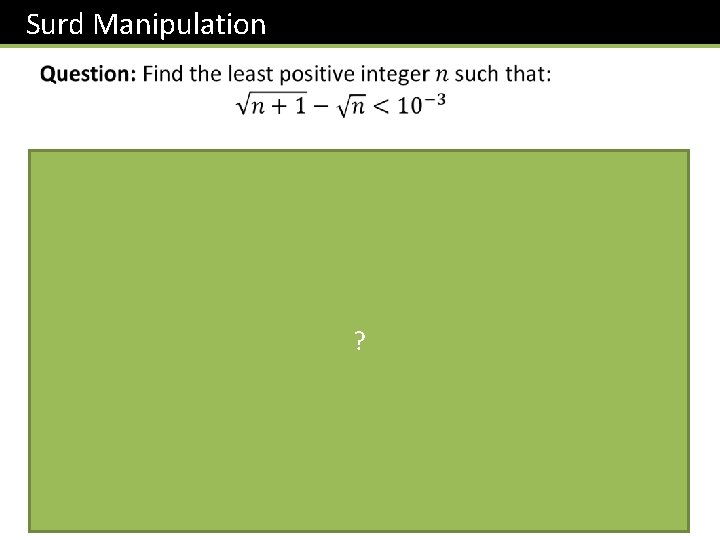
Surd Manipulation ?
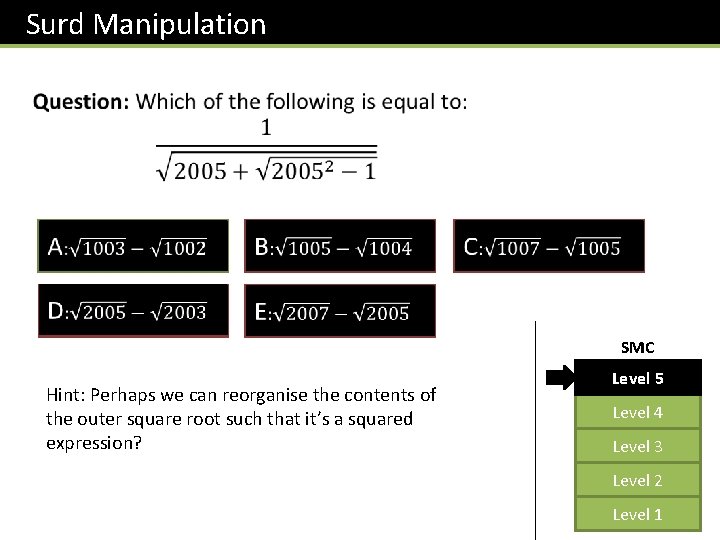
Surd Manipulation SMC Hint: Perhaps we can reorganise the contents of the outer square root such that it’s a squared expression? Level 5 Level 4 Level 3 Level 2 Level 1
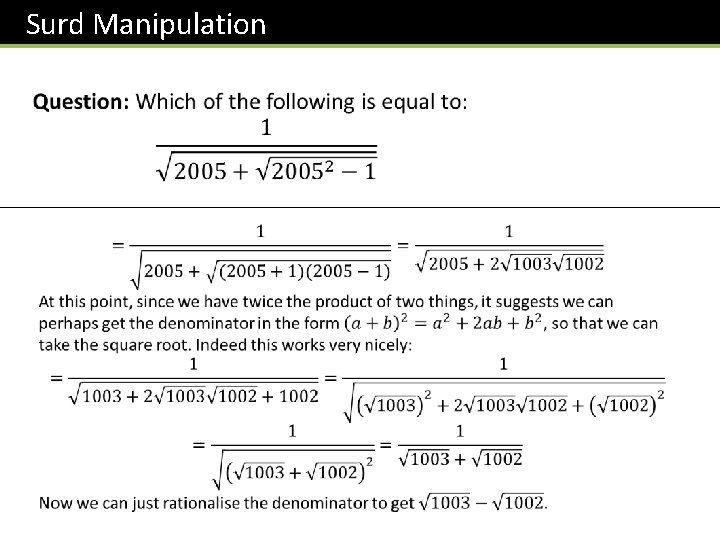
Surd Manipulation
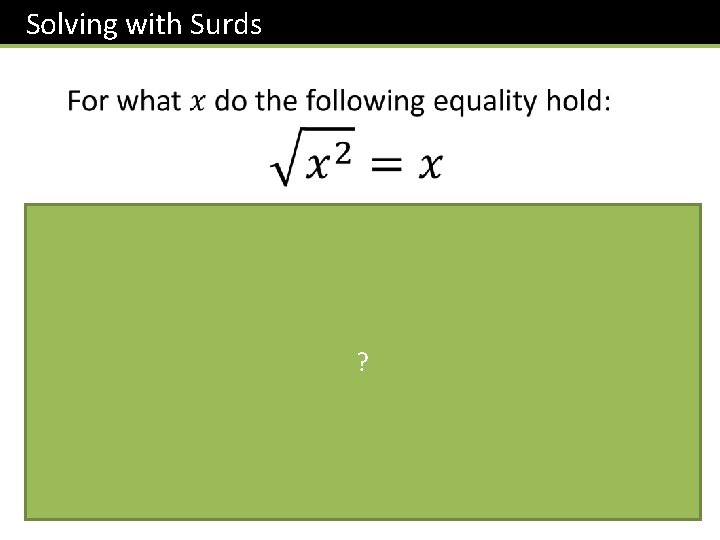
Solving with Surds ?
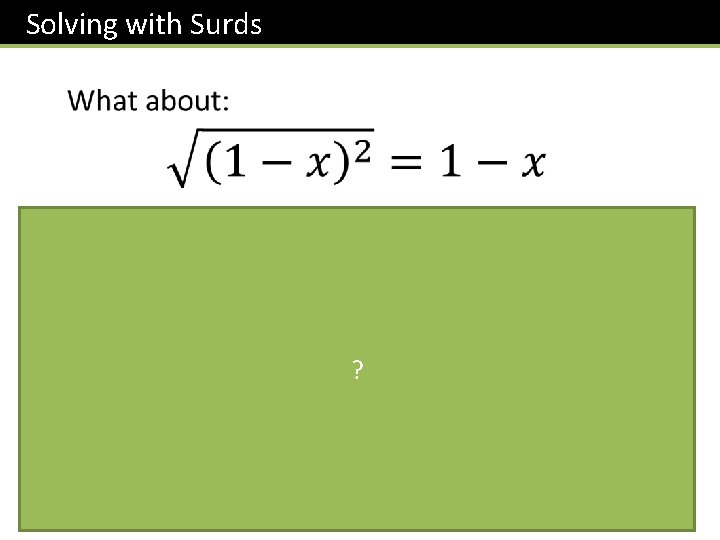
Solving with Surds ? 1 1
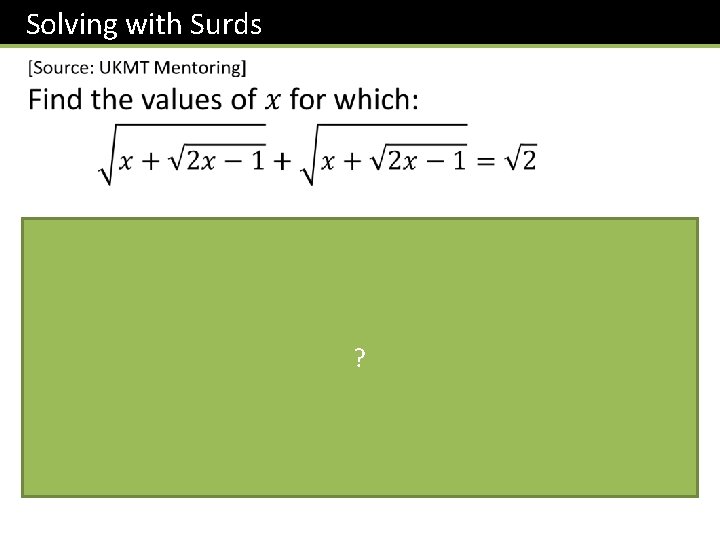
Solving with Surds ?
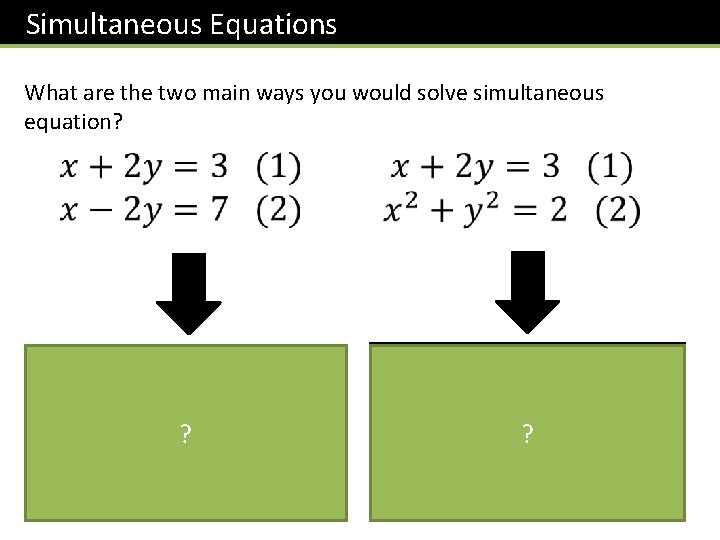
Simultaneous Equations What are the two main ways you would solve simultaneous equation? Elimination Substitution ? ?
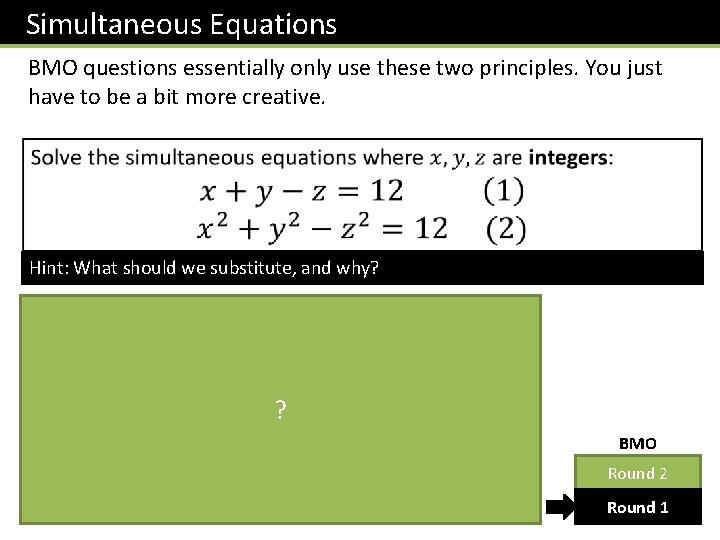
Simultaneous Equations BMO questions essentially only use these two principles. You just have to be a bit more creative. Hint: What should we substitute, and why? ? BMO Round 2 Round 1
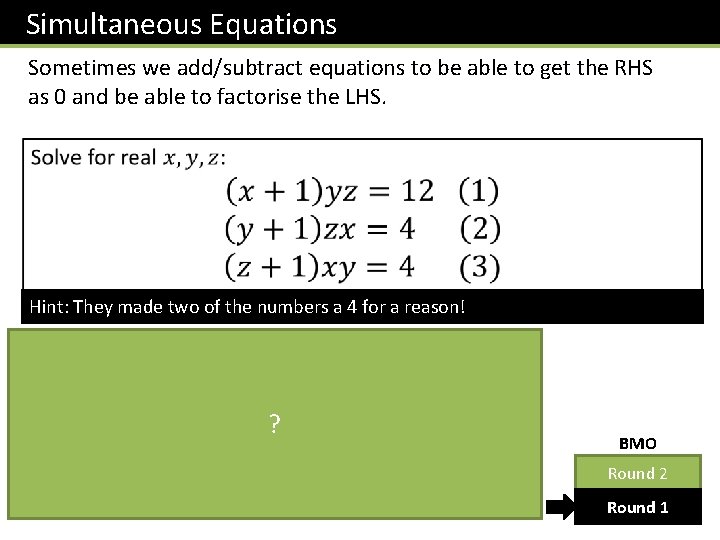
Simultaneous Equations Sometimes we add/subtract equations to be able to get the RHS as 0 and be able to factorise the LHS. Hint: They made two of the numbers a 4 for a reason! ? BMO Round 2 Round 1
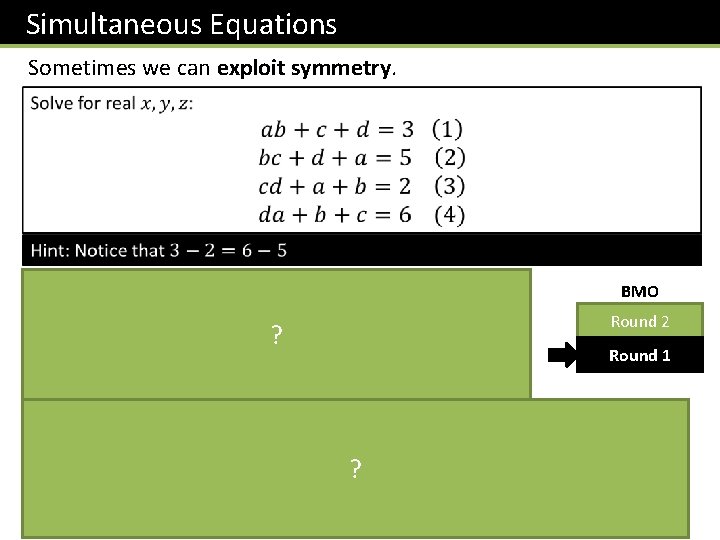
Simultaneous Equations Sometimes we can exploit symmetry. BMO Round 2 ? Round 1 ?
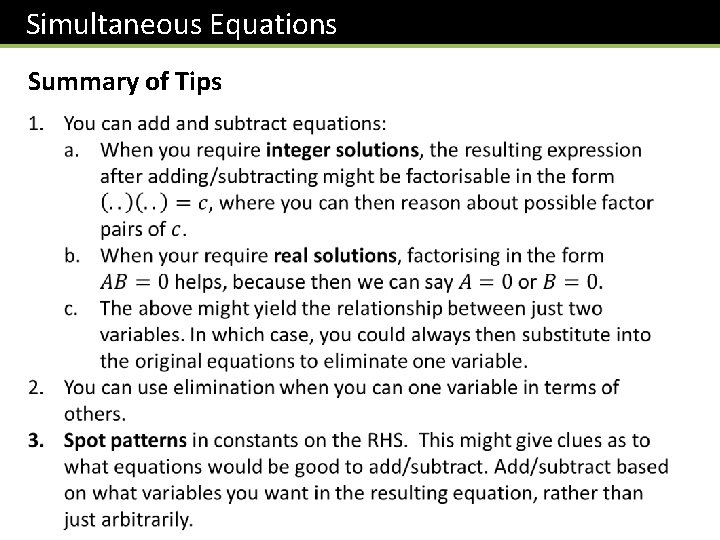
Simultaneous Equations Summary of Tips
ζ Topic 3 – Algebra Part 3: Inequalities
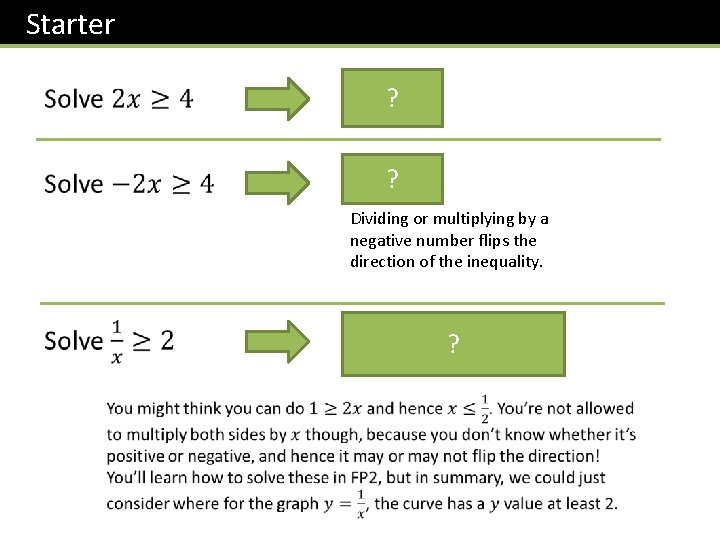
Starter ? ? Dividing or multiplying by a negative number flips the direction of the inequality. ?
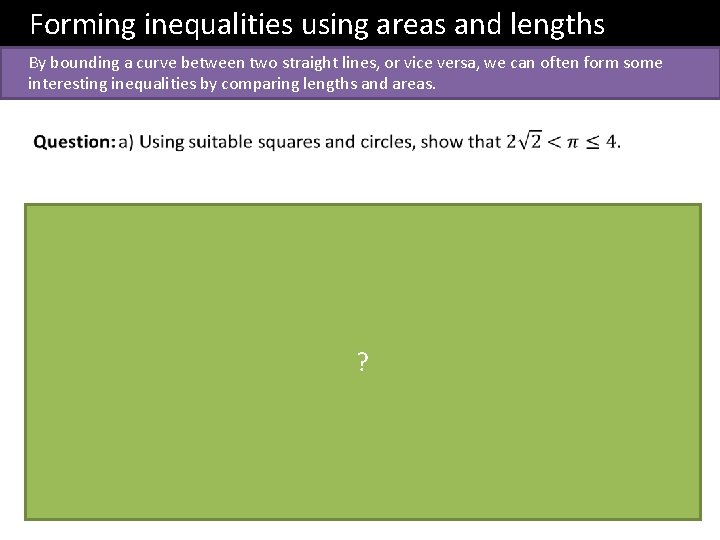
Forming inequalities using areas and lengths By bounding a curve between two straight lines, or vice versa, we can often form some interesting inequalities by comparing lengths and areas. ?
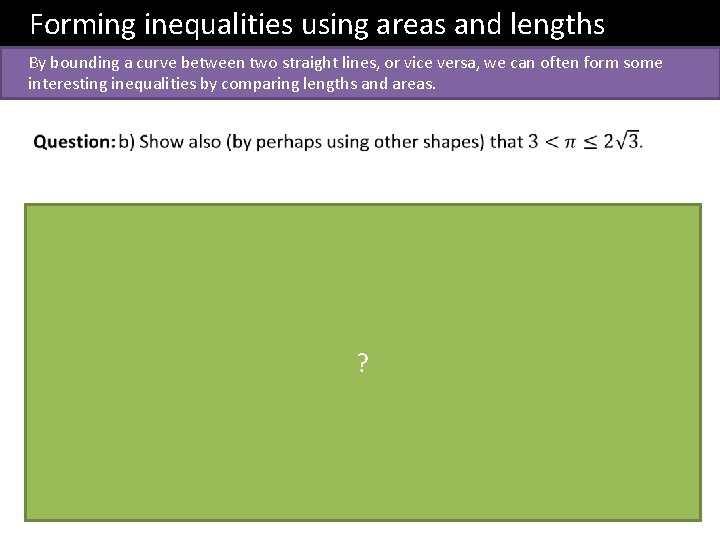
Forming inequalities using areas and lengths By bounding a curve between two straight lines, or vice versa, we can often form some interesting inequalities by comparing lengths and areas. b) ?
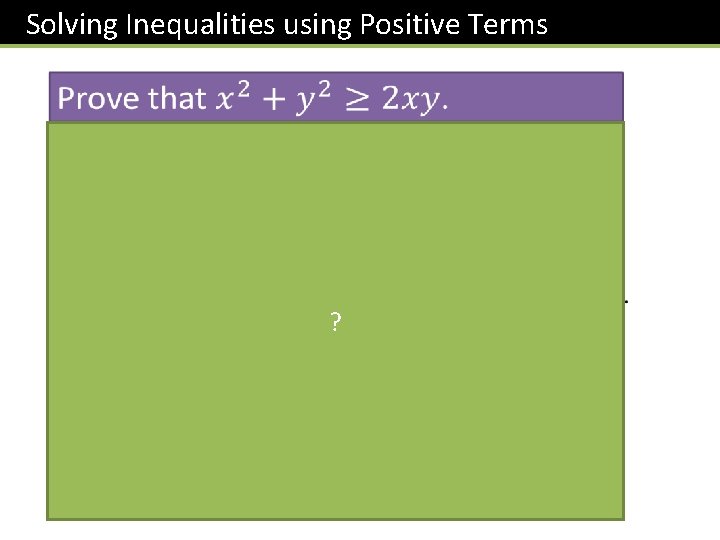
Solving Inequalities using Positive Terms This looks suspiciously factorisable. How therefore might I prove this inequality? ?
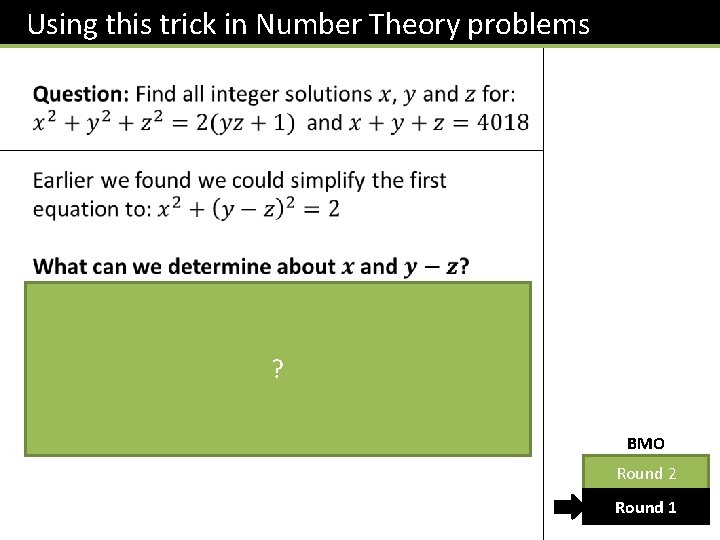
Using this trick in Number Theory problems ? BMO Round 2 Round 1
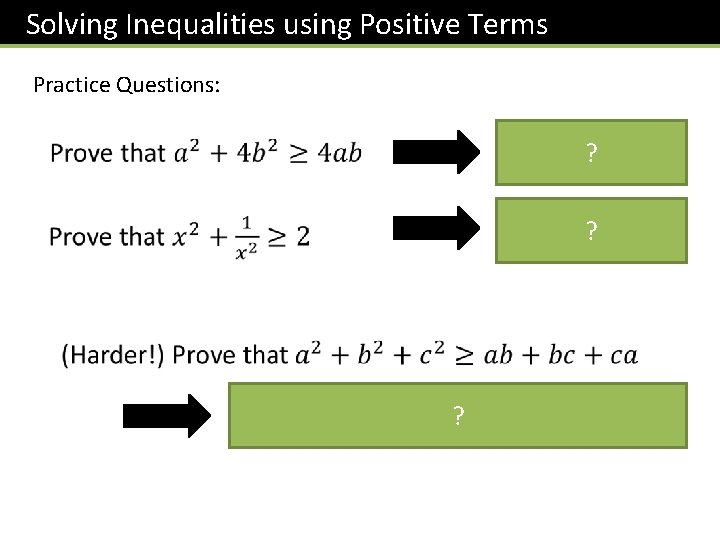
Solving Inequalities using Positive Terms Practice Questions: ? ? ?
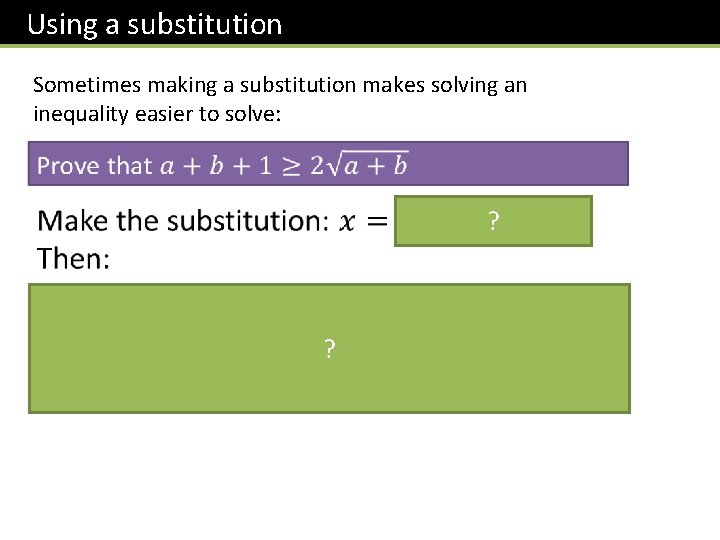
Using a substitution Sometimes making a substitution makes solving an inequality easier to solve: ? ?
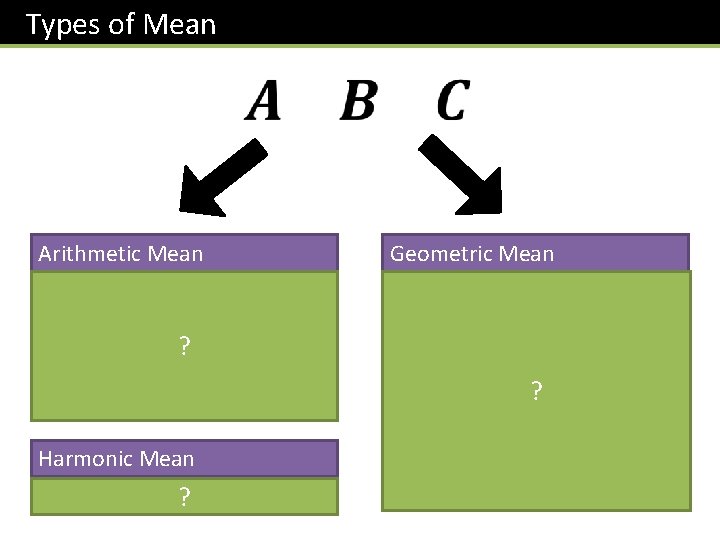
Types of Mean Arithmetic Mean Geometric Mean ? ? Harmonic Mean The average of? rates.
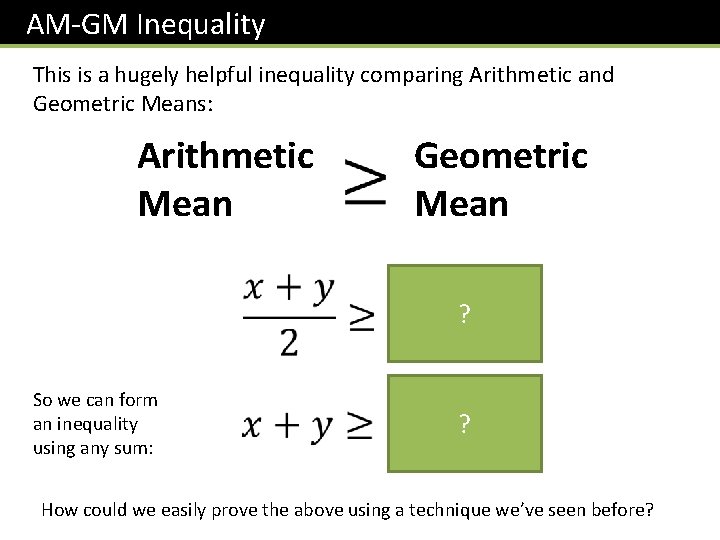
AM-GM Inequality This is a hugely helpful inequality comparing Arithmetic and Geometric Means: Arithmetic Mean Geometric Mean ? So we can form an inequality using any sum: ? How could we easily prove the above using a technique we’ve seen before?
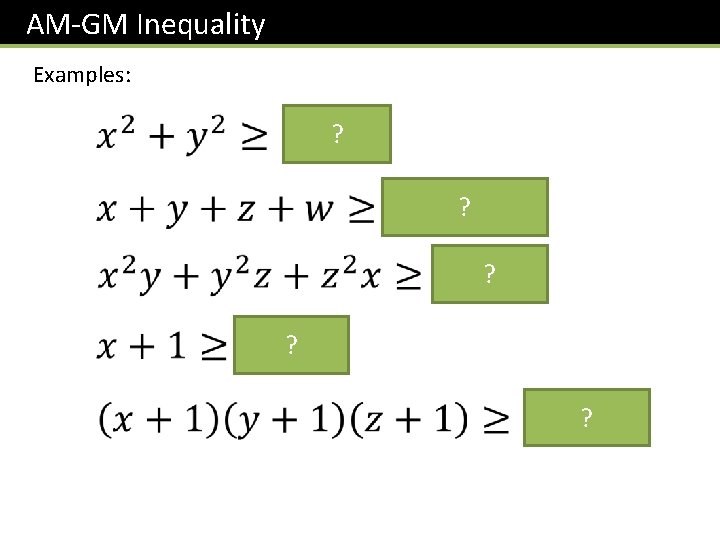
AM-GM Inequality Examples: ? ? ?
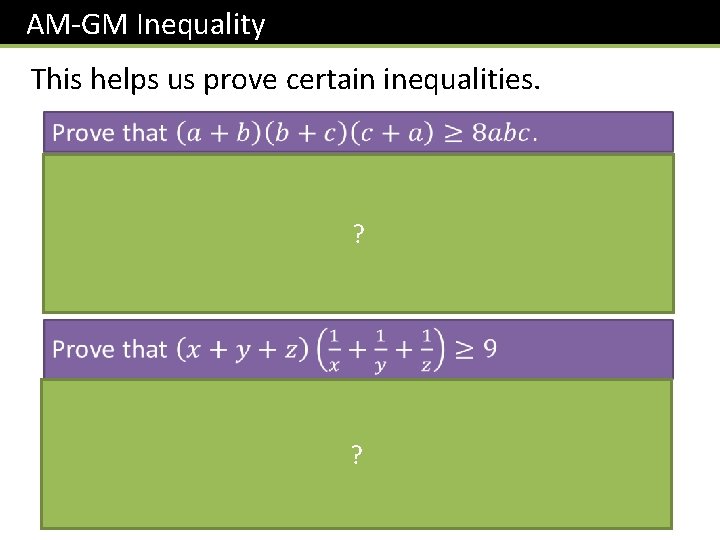
AM-GM Inequality This helps us prove certain inequalities. ? ?
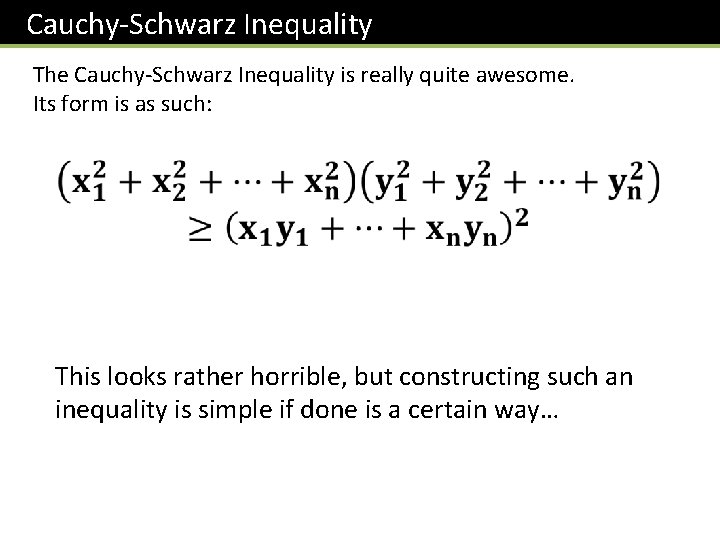
Cauchy-Schwarz Inequality The Cauchy-Schwarz Inequality is really quite awesome. Its form is as such: This looks rather horrible, but constructing such an inequality is simple if done is a certain way…
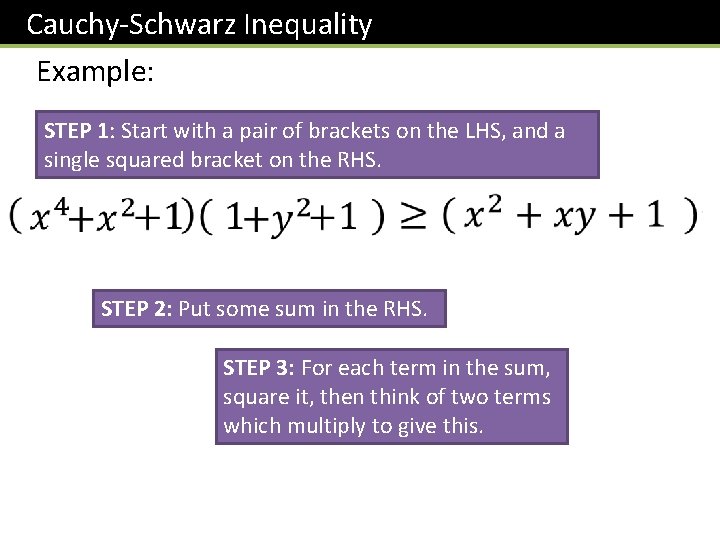
Cauchy-Schwarz Inequality Example: STEP 1: Start with a pair of brackets on the LHS, and a single squared bracket on the RHS. STEP 2: Put some sum in the RHS. STEP 3: For each term in the sum, square it, then think of two terms which multiply to give this.
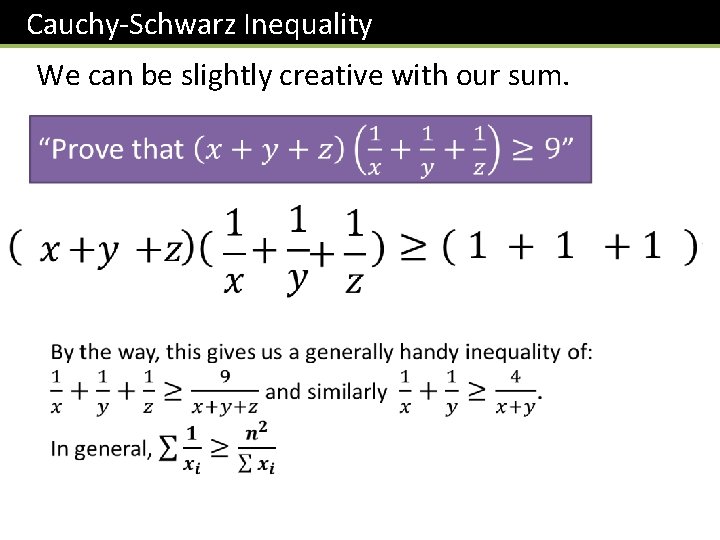
Cauchy-Schwarz Inequality We can be slightly creative with our sum.
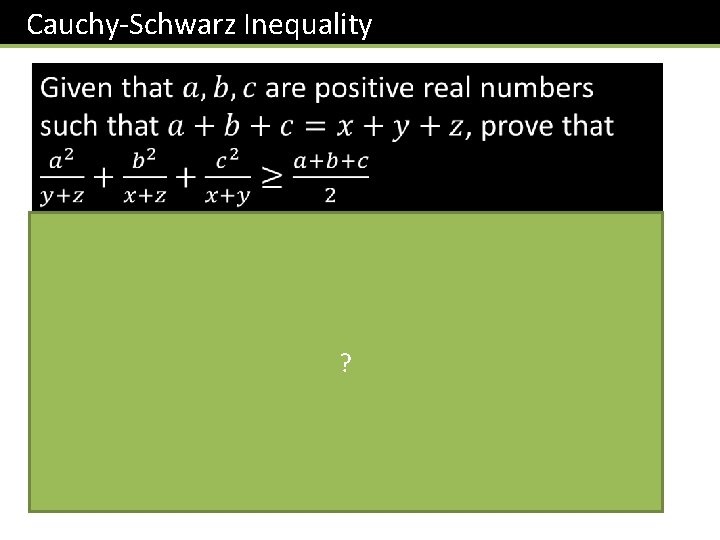
Cauchy-Schwarz Inequality ?
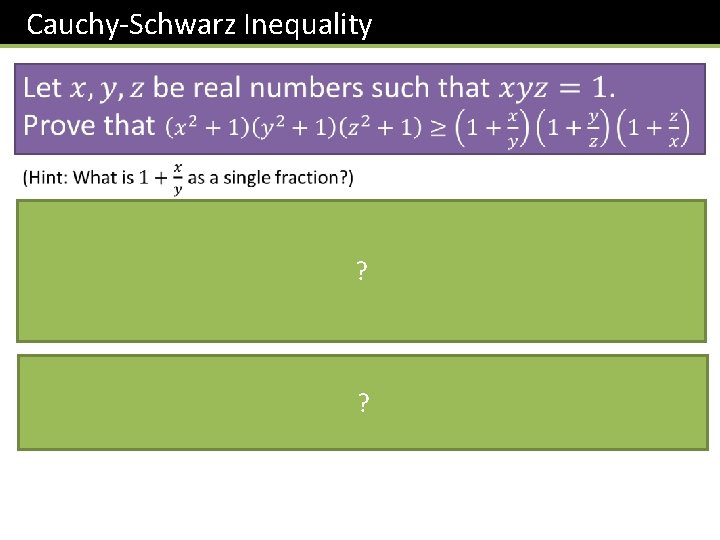
Cauchy-Schwarz Inequality ? ?
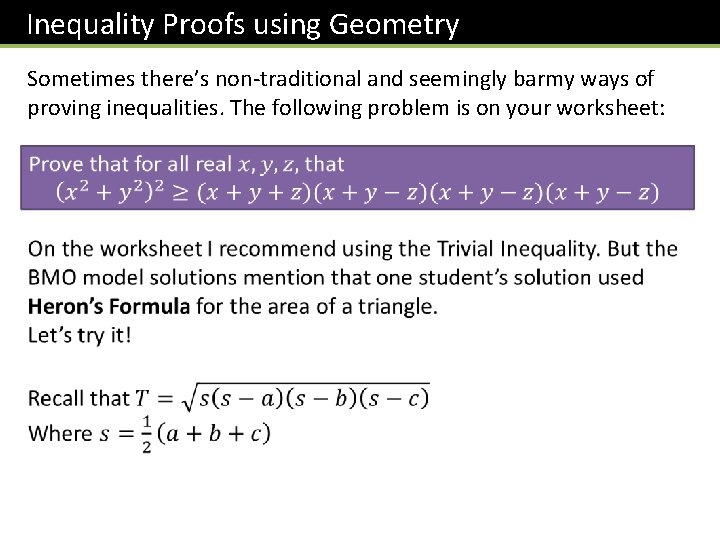
Inequality Proofs using Geometry Sometimes there’s non-traditional and seemingly barmy ways of proving inequalities. The following problem is on your worksheet:
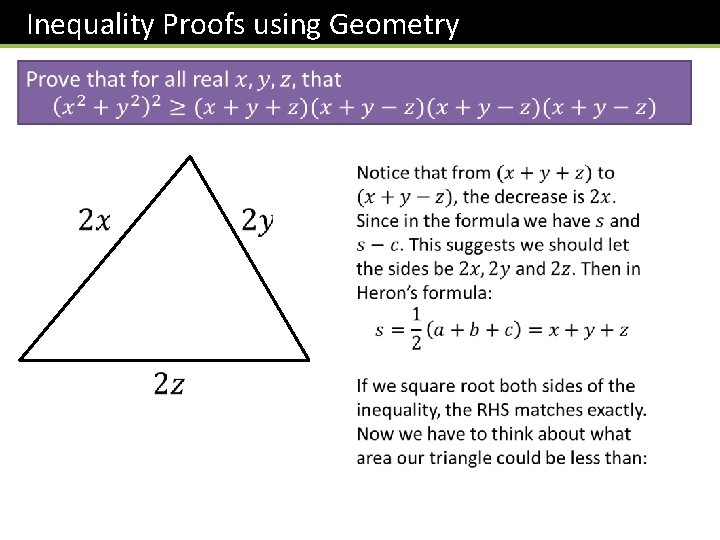
Inequality Proofs using Geometry
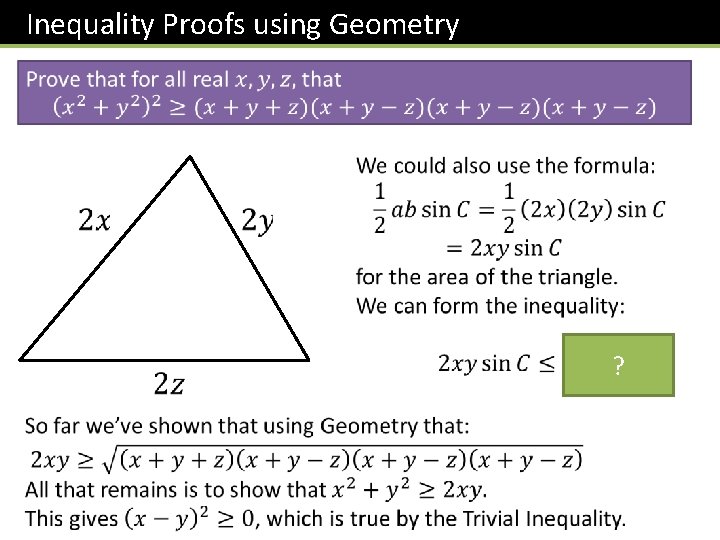
Inequality Proofs using Geometry ?
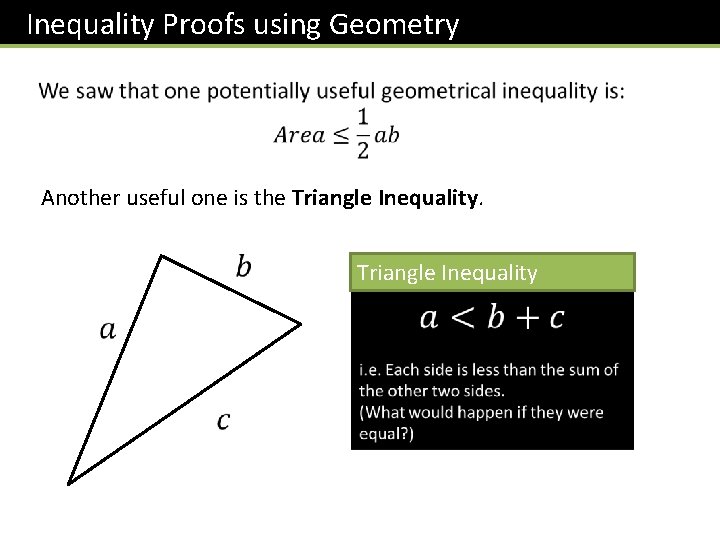
Inequality Proofs using Geometry Another useful one is the Triangle Inequality
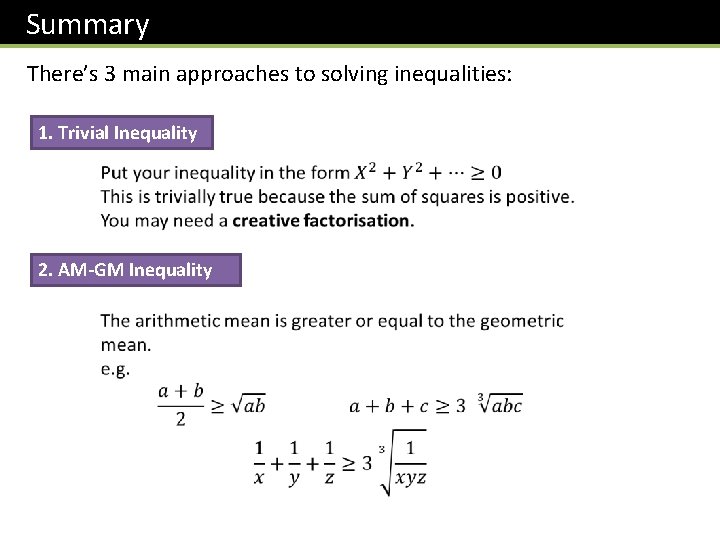
Summary There’s 3 main approaches to solving inequalities: 1. Trivial Inequality 2. AM-GM Inequality
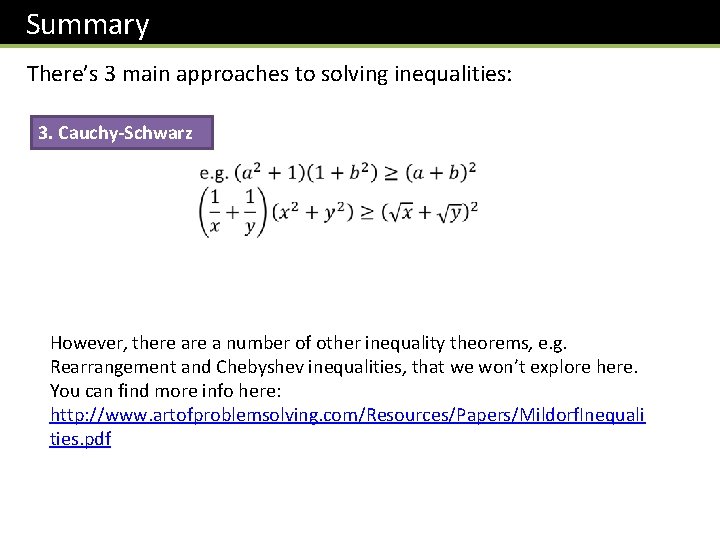
Summary There’s 3 main approaches to solving inequalities: 3. Cauchy-Schwarz However, there a number of other inequality theorems, e. g. Rearrangement and Chebyshev inequalities, that we won’t explore here. You can find more info here: http: //www. artofproblemsolving. com/Resources/Papers/Mildorf. Inequali ties. pdf
- Slides: 51