
Topic 28 classes and objects part 2 Copyright
Topic 28 classes and objects, part 2 Copyright Pearson Education, 2010 Based on slides bu Marty Stepp and Stuart Reges from http: //www. buildingjavaprograms. com/
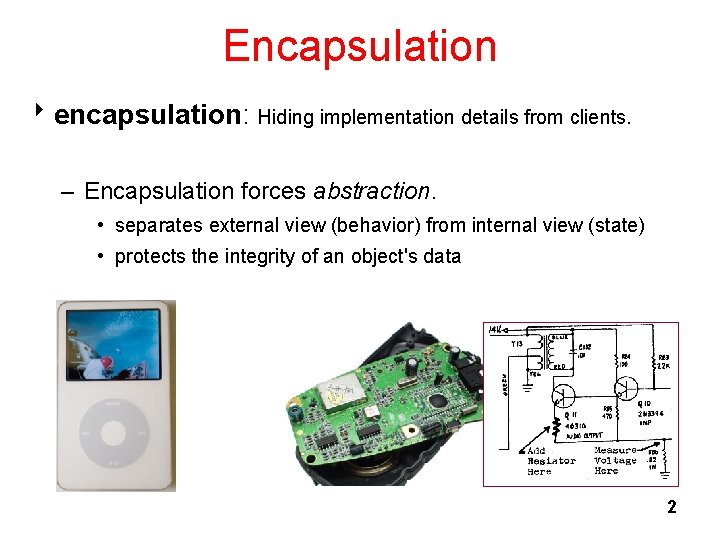
Encapsulation 8 encapsulation: Hiding implementation details from clients. – Encapsulation forces abstraction. • separates external view (behavior) from internal view (state) • protects the integrity of an object's data 2
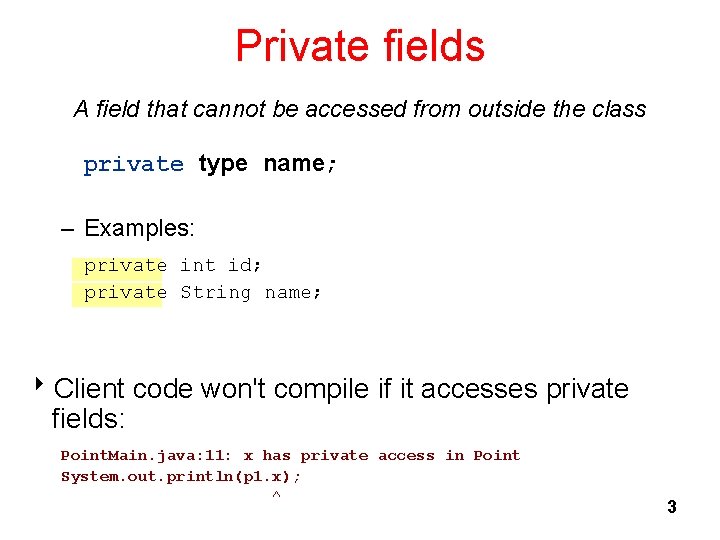
Private fields A field that cannot be accessed from outside the class private type name; – Examples: private int id; private String name; 8 Client code won't compile if it accesses private fields: Point. Main. java: 11: x has private access in Point System. out. println(p 1. x); ^ 3

Accessing private state // A "read-only" access to the x field ("accessor") public int get. X() { return x; } // Allows clients to change the x field ("mutator") public void set. X(int new. X) { x = new. X; } – Client code will look more like this: System. out. println(p 1. get. X()); p 1. set. X(14); 4
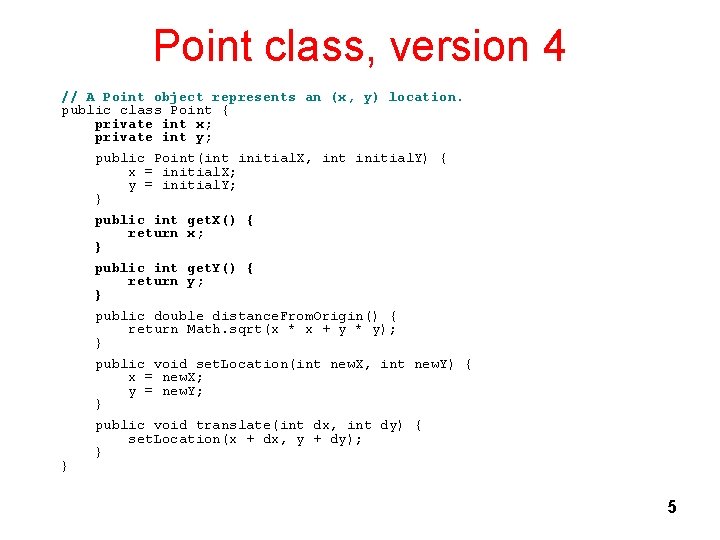
Point class, version 4 // A Point object represents an (x, y) location. public class Point { private int x; private int y; public Point(int initial. X, int initial. Y) { x = initial. X; y = initial. Y; } public int get. X() { return x; } public int get. Y() { return y; } public double distance. From. Origin() { return Math. sqrt(x * x + y * y); } public void set. Location(int new. X, int new. Y) { x = new. X; y = new. Y; } } public void translate(int dx, int dy) { set. Location(x + dx, y + dy); } 5
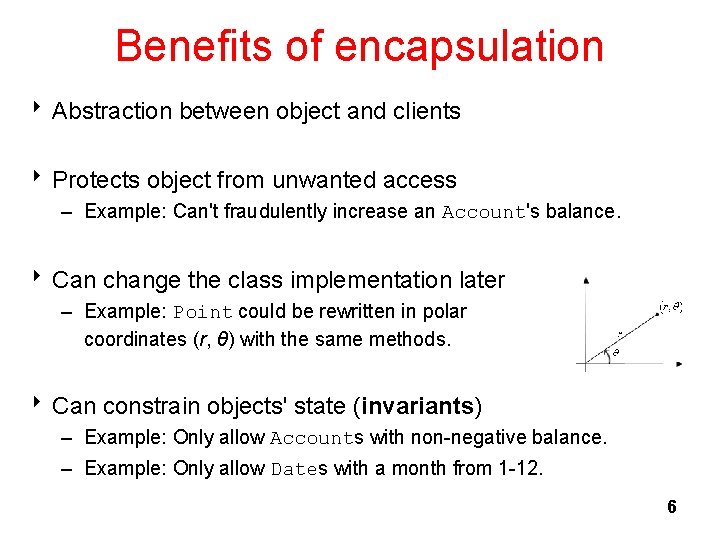
Benefits of encapsulation 8 Abstraction between object and clients 8 Protects object from unwanted access – Example: Can't fraudulently increase an Account's balance. 8 Can change the class implementation later – Example: Point could be rewritten in polar coordinates (r, θ) with the same methods. 8 Can constrain objects' state (invariants) – Example: Only allow Accounts with non-negative balance. – Example: Only allow Dates with a month from 1 -12. 6
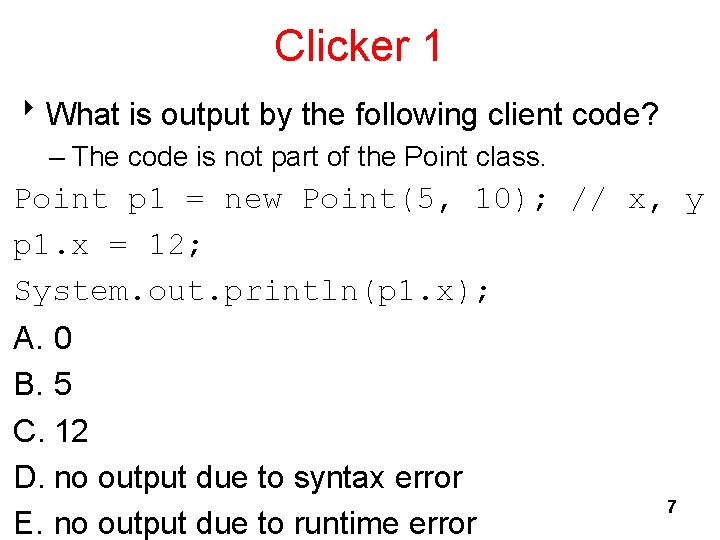
Clicker 1 8 What is output by the following client code? – The code is not part of the Point class. Point p 1 = new Point(5, 10); // x, y p 1. x = 12; System. out. println(p 1. x); A. 0 B. 5 C. 12 D. no output due to syntax error E. no output due to runtime error 7
The keyword this reading: 8. 3 8
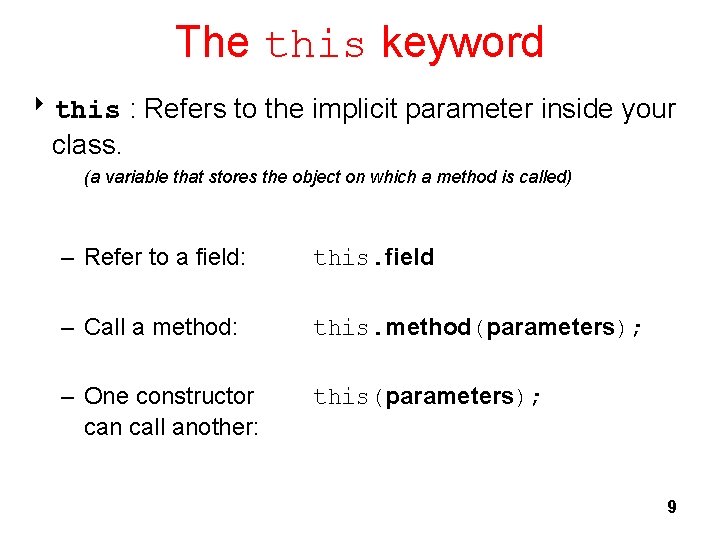
The this keyword 8 this : Refers to the implicit parameter inside your class. (a variable that stores the object on which a method is called) – Refer to a field: this. field – Call a method: this. method(parameters); – One constructor can call another: this(parameters); 9
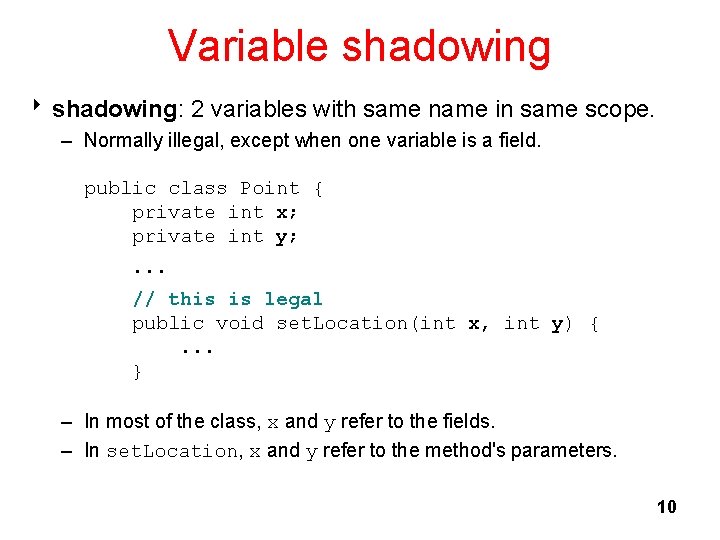
Variable shadowing 8 shadowing: 2 variables with same name in same scope. – Normally illegal, except when one variable is a field. public class Point { private int x; private int y; . . . // this is legal public void set. Location(int x, int y) {. . . } – In most of the class, x and y refer to the fields. – In set. Location, x and y refer to the method's parameters. 10
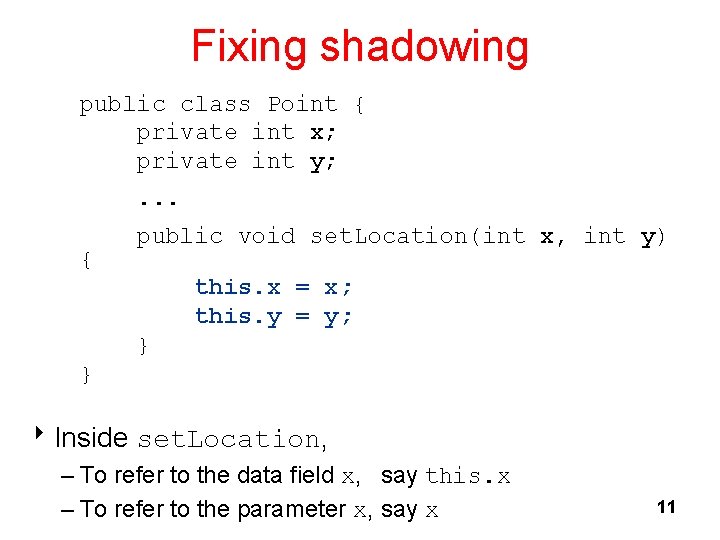
Fixing shadowing public class Point { private int x; private int y; . . . { public void set. Location(int x, int y) this. x = x; this. y = y; } } 8 Inside set. Location, – To refer to the data field x, say this. x – To refer to the parameter x, say x 11
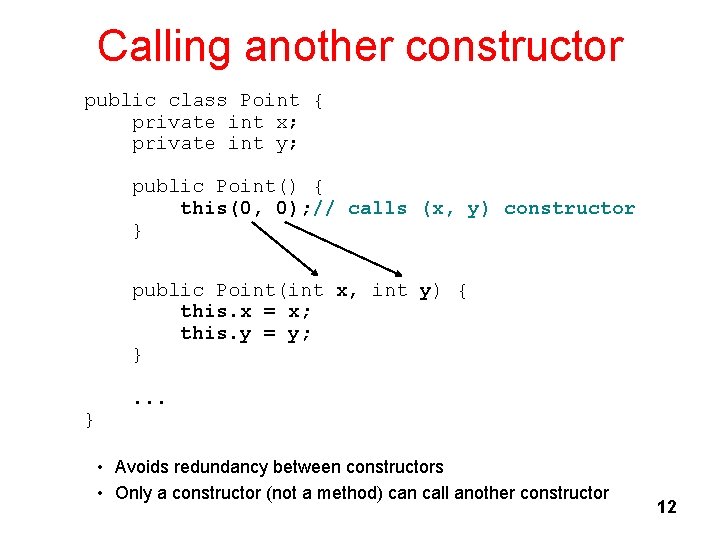
Calling another constructor public class Point { private int x; private int y; public Point() { this(0, 0); // calls (x, y) constructor } public Point(int x, int y) { this. x = x; this. y = y; } } . . . • Avoids redundancy between constructors • Only a constructor (not a method) can call another constructor 12
- Slides: 12