
Topic 25 Dynamic Programming Thus I thought dynamic


- Slides: 37
Topic 25 Dynamic Programming "Thus, I thought dynamic programming was a good name. It was something not even a Congressman could object to. So I used it as an umbrella for my activities" - Richard E. Bellman
Origins 8 A method for solving complex problems by breaking them into smaller, easier, sub problems 8 Term Dynamic Programming coined by mathematician Richard Bellman in early 1950 s – employed by Rand Corporation – Rand had many, large military contracts – Secretary of Defense, Charles Wilson “against research, especially mathematical research” – how could any one oppose "dynamic"? CS 314 Dynamic Programming 2
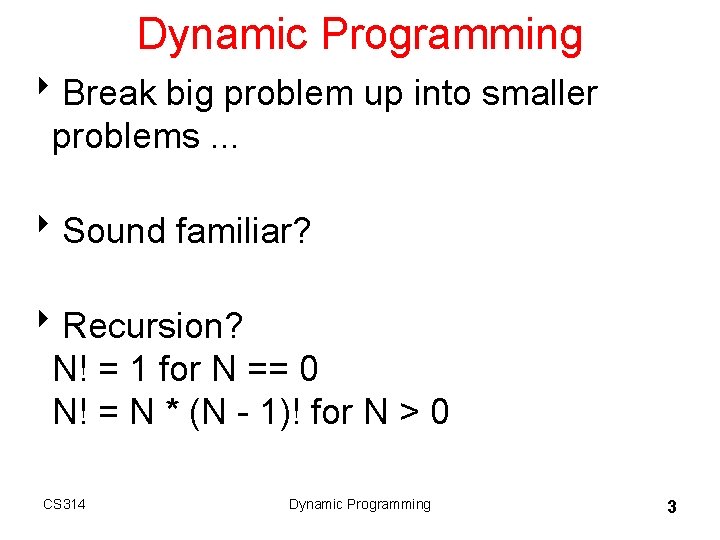
Dynamic Programming 8 Break big problem up into smaller problems. . . 8 Sound familiar? 8 Recursion? N! = 1 for N == 0 N! = N * (N - 1)! for N > 0 CS 314 Dynamic Programming 3
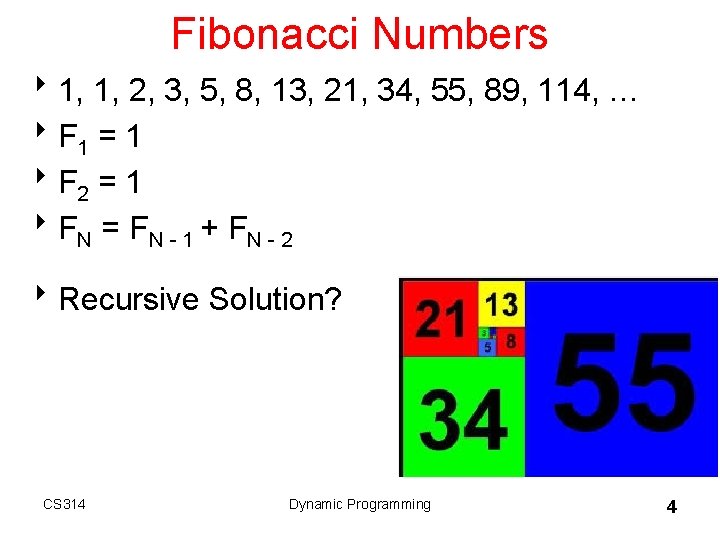
Fibonacci Numbers 81, 1, 2, 3, 5, 8, 13, 21, 34, 55, 89, 114, … 8 F 1 = 1 8 F 2 = 1 8 FN = FN - 1 + FN - 2 8 Recursive Solution? CS 314 Dynamic Programming 4
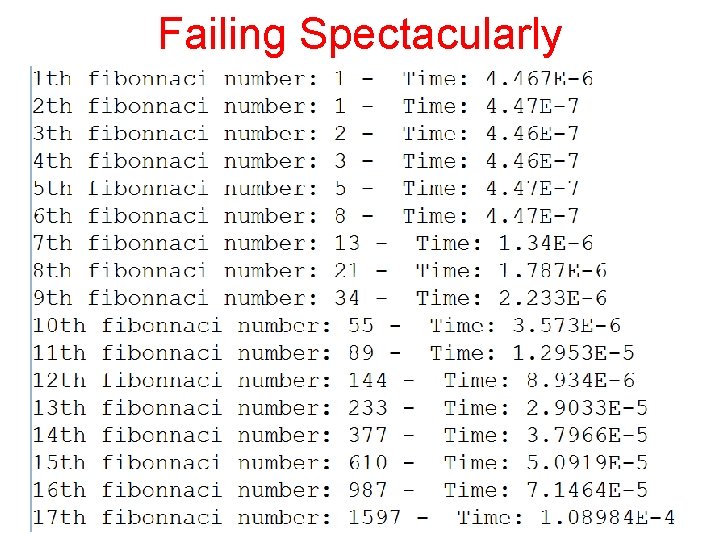
Failing Spectacularly 8 Naïve recursive method 8 Clicker 1 - Order of this method? A. O(1) B. O(log N) C. O(N) D. O(N 2) E. O(2 N) CS 314 Dynamic Programming 5
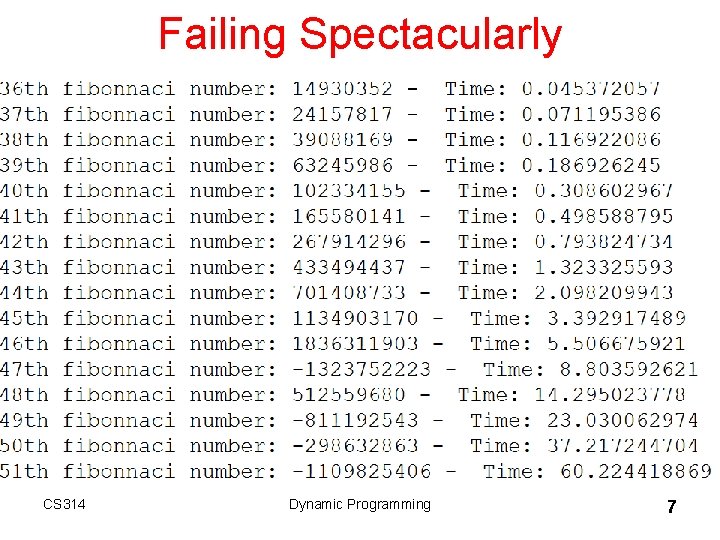
Failing Spectacularly CS 314 Dynamic Programming 6
Failing Spectacularly CS 314 Dynamic Programming 7
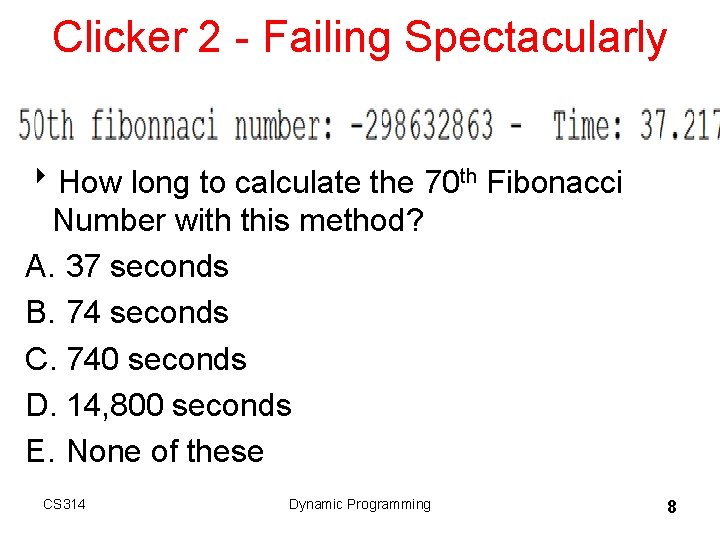
Clicker 2 - Failing Spectacularly 8 How long to calculate the 70 th Fibonacci Number with this method? A. 37 seconds B. 74 seconds C. 740 seconds D. 14, 800 seconds E. None of these CS 314 Dynamic Programming 8
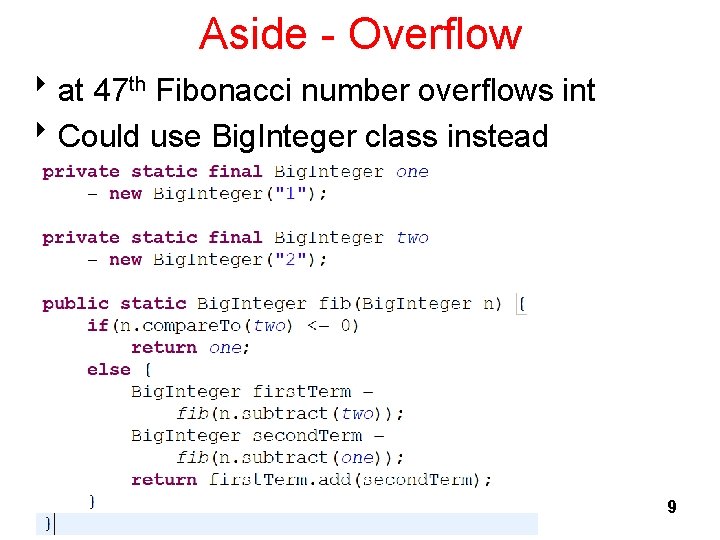
Aside - Overflow 8 at 47 th Fibonacci number overflows int 8 Could use Big. Integer class instead CS 314 Dynamic Programming 9
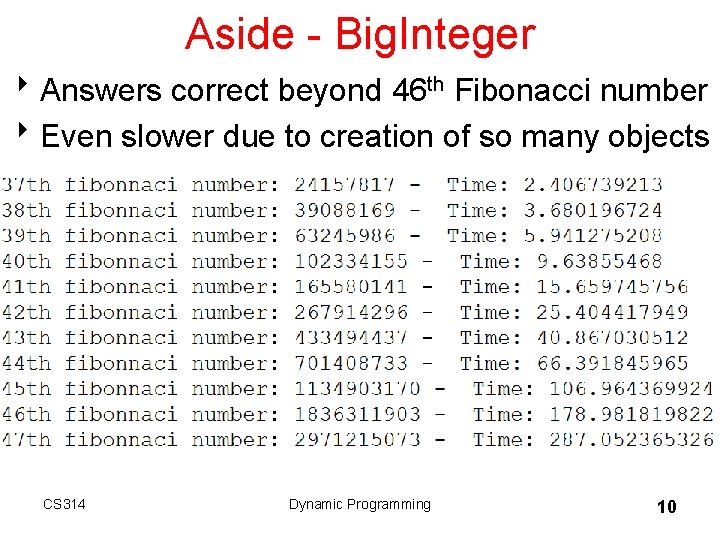
Aside - Big. Integer 8 Answers correct beyond 46 th Fibonacci number 8 Even slower due to creation of so many objects CS 314 Dynamic Programming 10
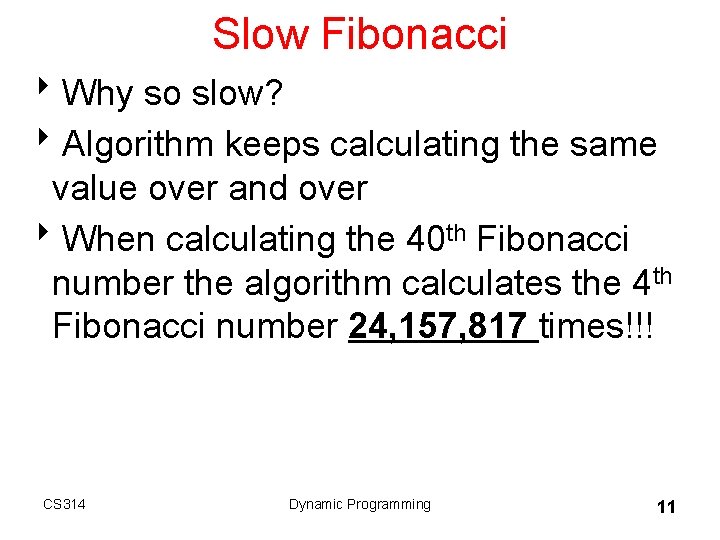
Slow Fibonacci 8 Why so slow? 8 Algorithm keeps calculating the same value over and over 8 When calculating the 40 th Fibonacci number the algorithm calculates the 4 th Fibonacci number 24, 157, 817 times!!! CS 314 Dynamic Programming 11
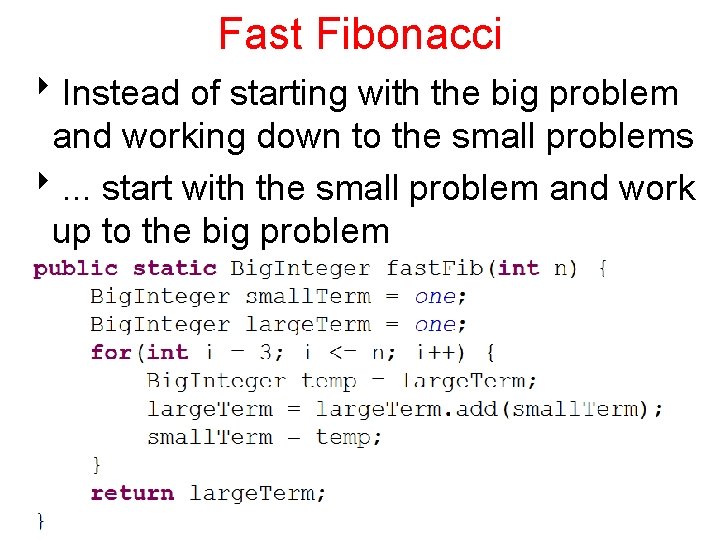
Fast Fibonacci 8 Instead of starting with the big problem and working down to the small problems 8. . . start with the small problem and work up to the big problem CS 314 Dynamic Programming 12
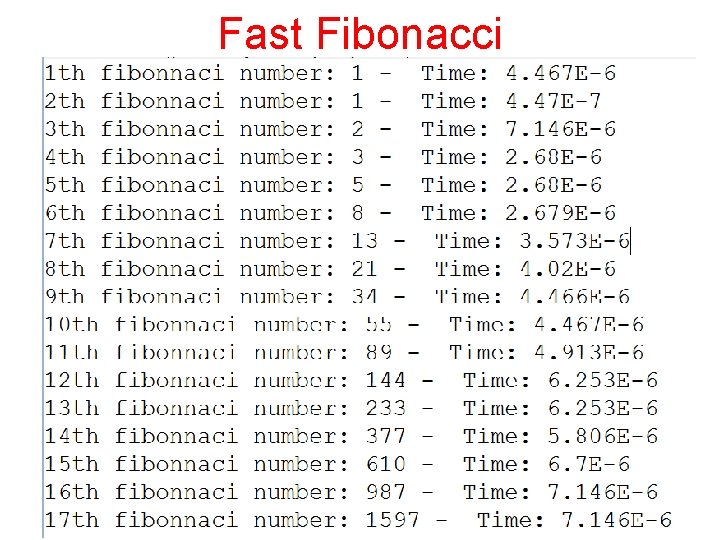
Fast Fibonacci CS 314 Dynamic Programming 13
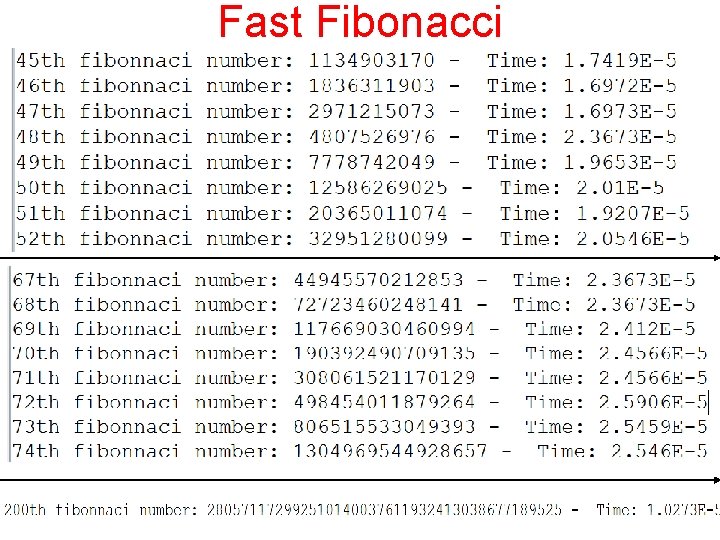
Fast Fibonacci CS 314 Dynamic Programming 14
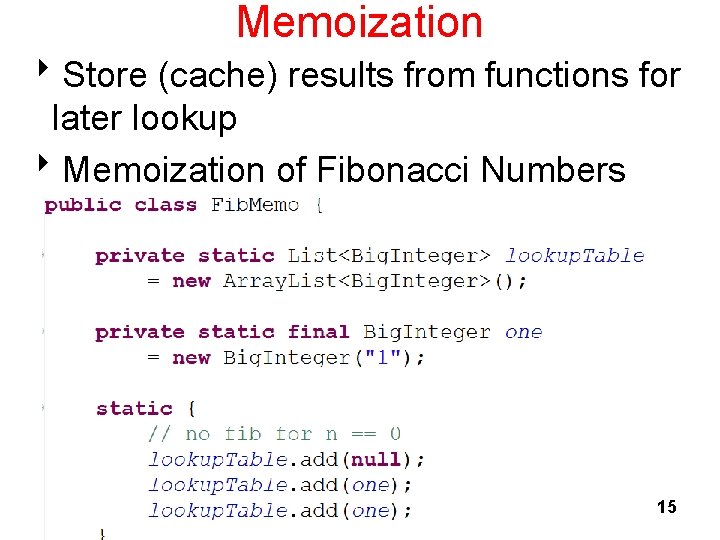
Memoization 8 Store (cache) results from functions for later lookup 8 Memoization of Fibonacci Numbers CS 314 Dynamic Programming 15
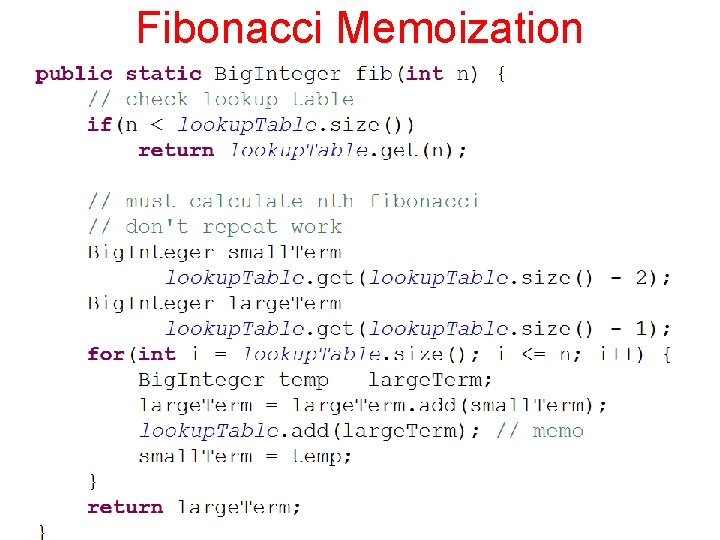
Fibonacci Memoization CS 314 Dynamic Programming 16
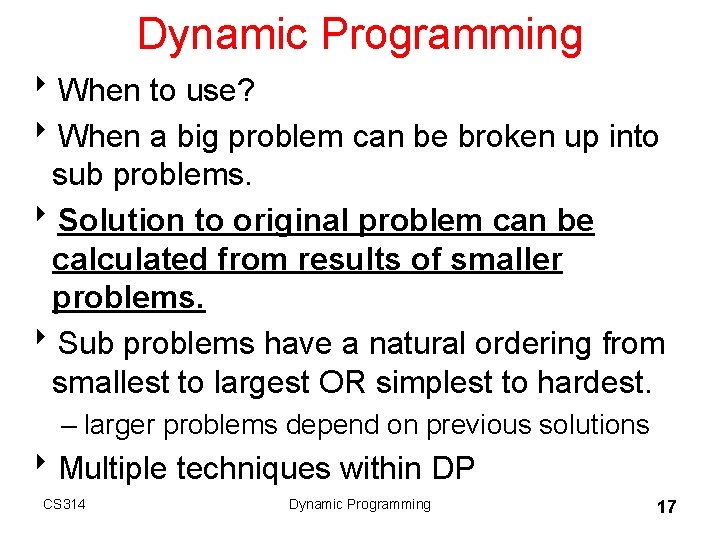
Dynamic Programming 8 When to use? 8 When a big problem can be broken up into sub problems. 8 Solution to original problem can be calculated from results of smaller problems. 8 Sub problems have a natural ordering from smallest to largest OR simplest to hardest. – larger problems depend on previous solutions 8 Multiple techniques within DP CS 314 Dynamic Programming 17
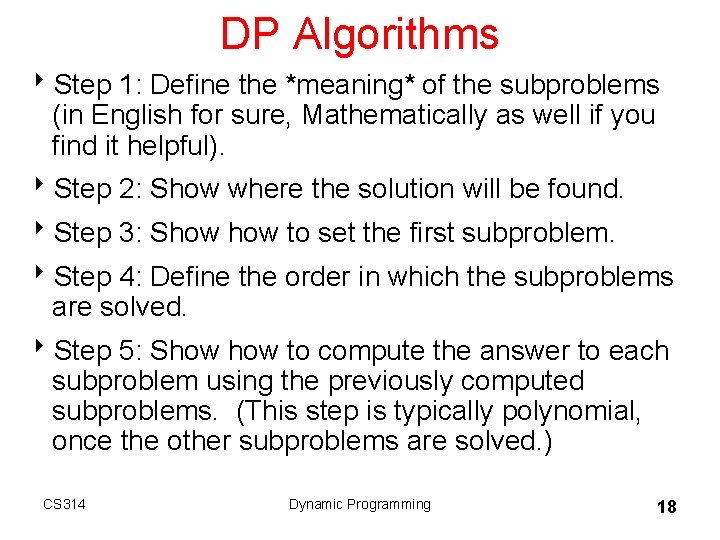
DP Algorithms 8 Step 1: Define the *meaning* of the subproblems (in English for sure, Mathematically as well if you find it helpful). 8 Step 2: Show where the solution will be found. 8 Step 3: Show to set the first subproblem. 8 Step 4: Define the order in which the subproblems are solved. 8 Step 5: Show to compute the answer to each subproblem using the previously computed subproblems. (This step is typically polynomial, once the other subproblems are solved. ) CS 314 Dynamic Programming 18
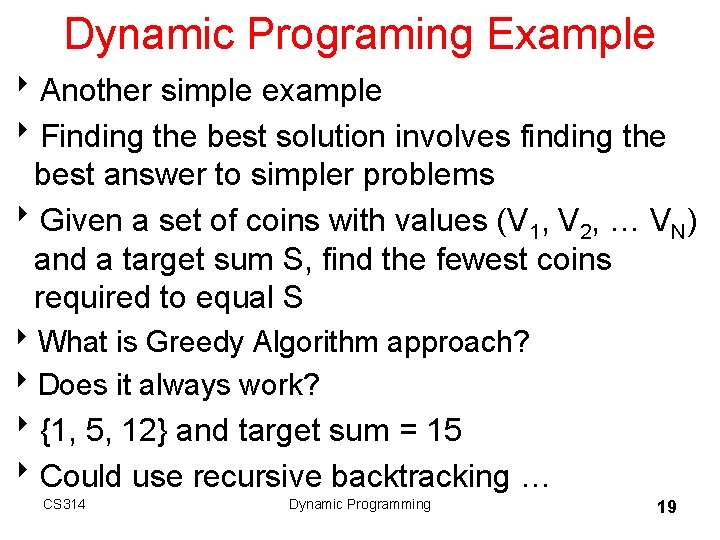
Dynamic Programing Example 8 Another simple example 8 Finding the best solution involves finding the best answer to simpler problems 8 Given a set of coins with values (V 1, V 2, … VN) and a target sum S, find the fewest coins required to equal S 8 What is Greedy Algorithm approach? 8 Does it always work? 8{1, 5, 12} and target sum = 15 8 Could use recursive backtracking … CS 314 Dynamic Programming 19
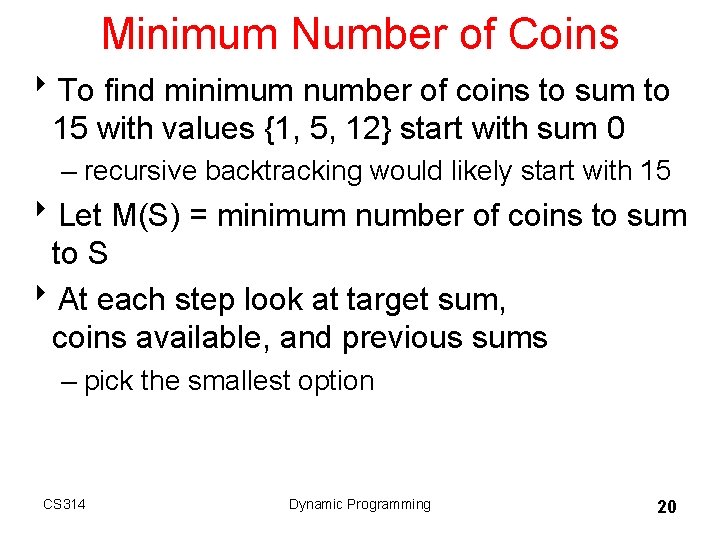
Minimum Number of Coins 8 To find minimum number of coins to sum to 15 with values {1, 5, 12} start with sum 0 – recursive backtracking would likely start with 15 8 Let M(S) = minimum number of coins to sum to S 8 At each step look at target sum, coins available, and previous sums – pick the smallest option CS 314 Dynamic Programming 20
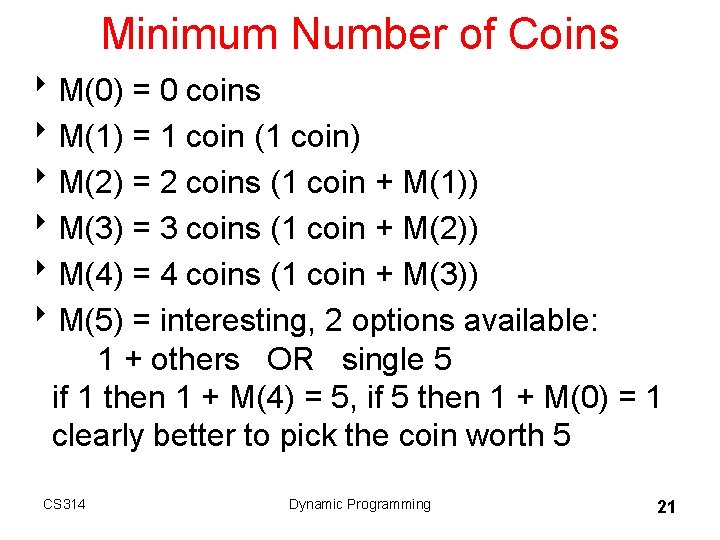
Minimum Number of Coins 8 M(0) = 0 coins 8 M(1) = 1 coin (1 coin) 8 M(2) = 2 coins (1 coin + M(1)) 8 M(3) = 3 coins (1 coin + M(2)) 8 M(4) = 4 coins (1 coin + M(3)) 8 M(5) = interesting, 2 options available: 1 + others OR single 5 if 1 then 1 + M(4) = 5, if 5 then 1 + M(0) = 1 clearly better to pick the coin worth 5 CS 314 Dynamic Programming 21
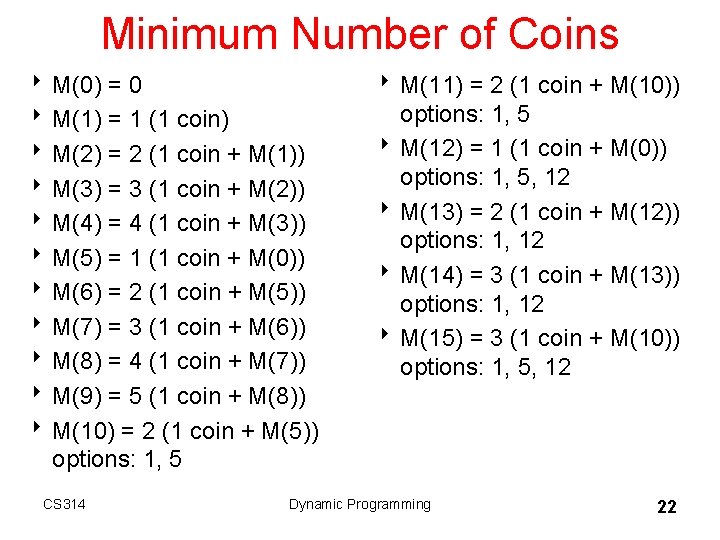
Minimum Number of Coins 8 M(0) = 0 8 M(1) = 1 (1 coin) 8 M(2) = 2 (1 coin + M(1)) 8 M(3) = 3 (1 coin + M(2)) 8 M(4) = 4 (1 coin + M(3)) 8 M(5) = 1 (1 coin + M(0)) 8 M(6) = 2 (1 coin + M(5)) 8 M(7) = 3 (1 coin + M(6)) 8 M(8) = 4 (1 coin + M(7)) 8 M(9) = 5 (1 coin + M(8)) 8 M(10) = 2 (1 coin + M(5)) options: 1, 5 CS 314 8 M(11) = 2 (1 coin + M(10)) options: 1, 5 8 M(12) = 1 (1 coin + M(0)) options: 1, 5, 12 8 M(13) = 2 (1 coin + M(12)) options: 1, 12 8 M(14) = 3 (1 coin + M(13)) options: 1, 12 8 M(15) = 3 (1 coin + M(10)) options: 1, 5, 12 Dynamic Programming 22
KNAPSACK PROBLEM RECURSIVE BACKTRACKING AND DYNAMIC PROGRAMMING CS 314 Dynamic Programming 23
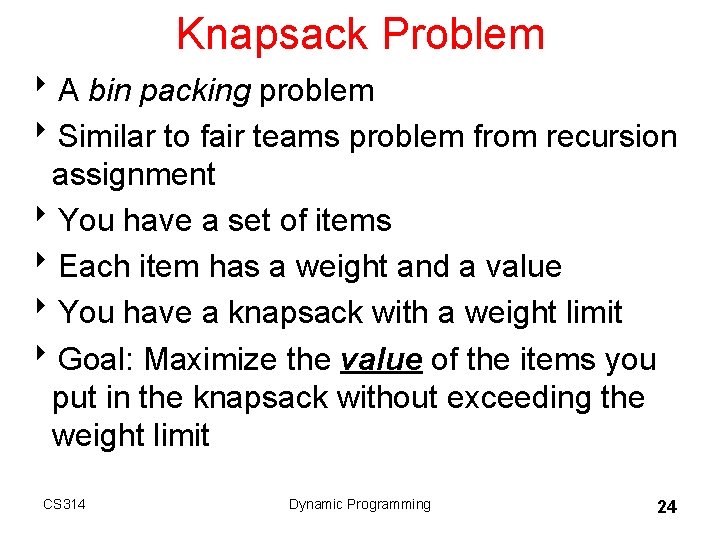
Knapsack Problem 8 A bin packing problem 8 Similar to fair teams problem from recursion assignment 8 You have a set of items 8 Each item has a weight and a value 8 You have a knapsack with a weight limit 8 Goal: Maximize the value of the items you put in the knapsack without exceeding the weight limit CS 314 Dynamic Programming 24
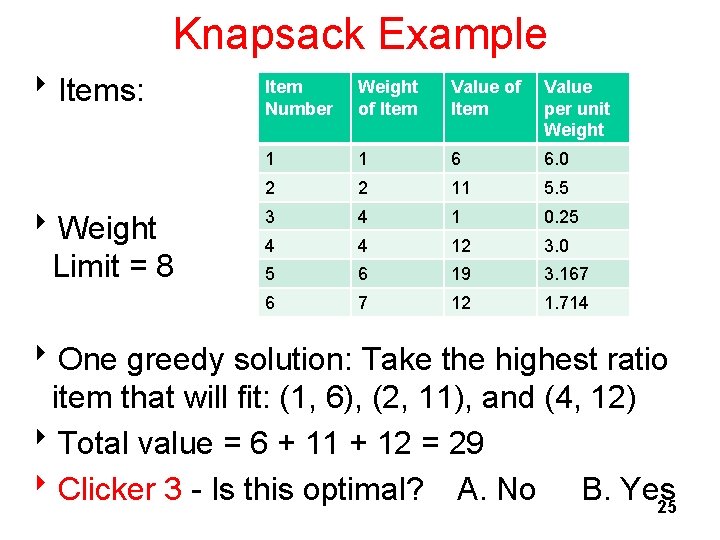
Knapsack Example 8 Items: 8 Weight Limit = 8 Item Number Weight of Item Value per unit Weight 1 1 6 6. 0 2 2 11 5. 5 3 4 1 0. 25 4 4 12 3. 0 5 6 19 3. 167 6 7 12 1. 714 8 One greedy solution: Take the highest ratio item that will fit: (1, 6), (2, 11), and (4, 12) 8 Total value = 6 + 11 + 12 = 29 8 Clicker 3 - Is this optimal? A. No B. Yes 25
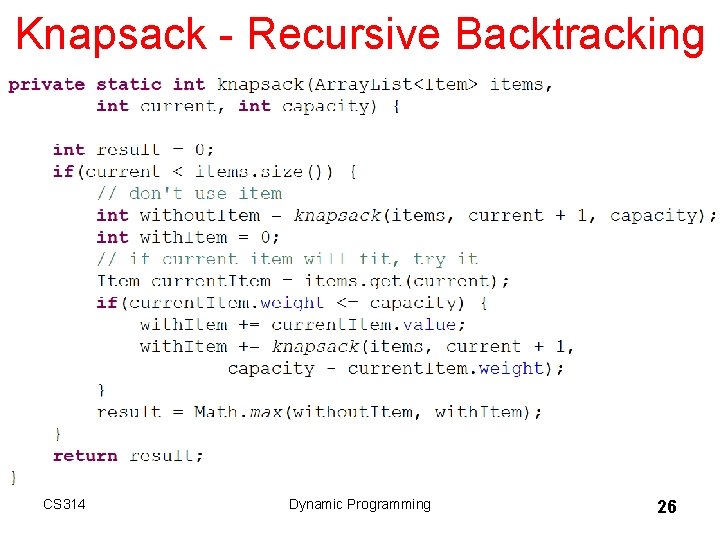
Knapsack - Recursive Backtracking CS 314 Dynamic Programming 26
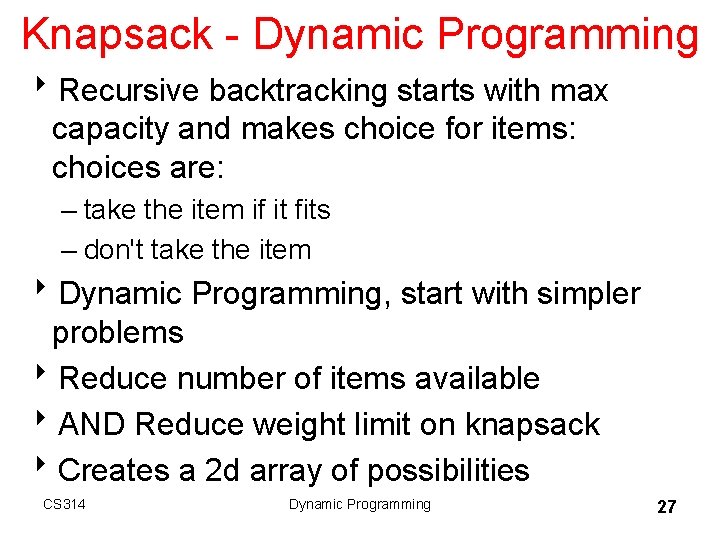
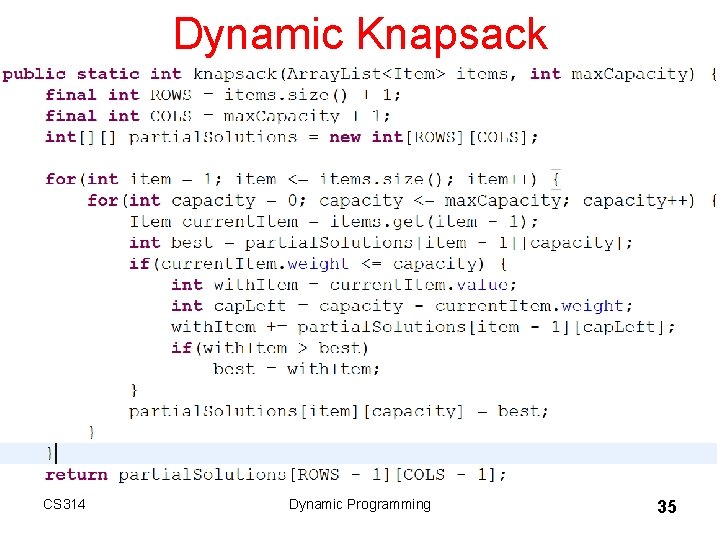
Knapsack - Dynamic Programming 8 Recursive backtracking starts with max capacity and makes choice for items: choices are: – take the item if it fits – don't take the item 8 Dynamic Programming, start with simpler problems 8 Reduce number of items available 8 AND Reduce weight limit on knapsack 8 Creates a 2 d array of possibilities CS 314 Dynamic Programming 27
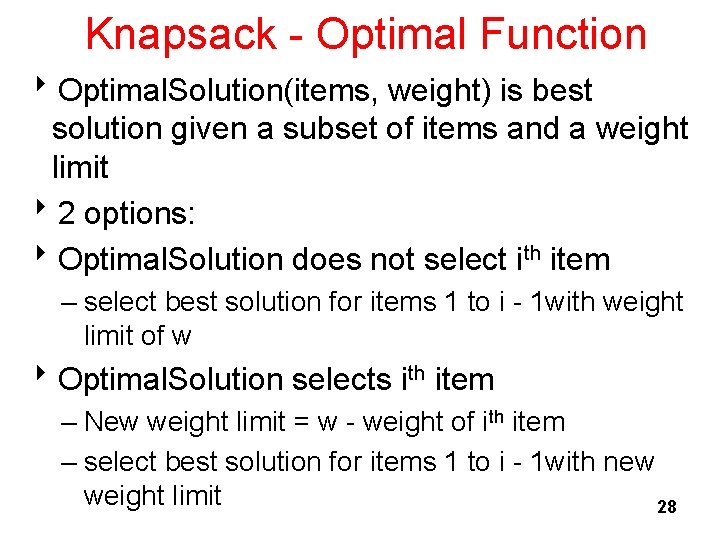
Knapsack - Optimal Function 8 Optimal. Solution(items, weight) is best solution given a subset of items and a weight limit 82 options: 8 Optimal. Solution does not select ith item – select best solution for items 1 to i - 1 with weight limit of w 8 Optimal. Solution selects ith item – New weight limit = w - weight of ith item – select best solution for items 1 to i - 1 with new weight limit 28
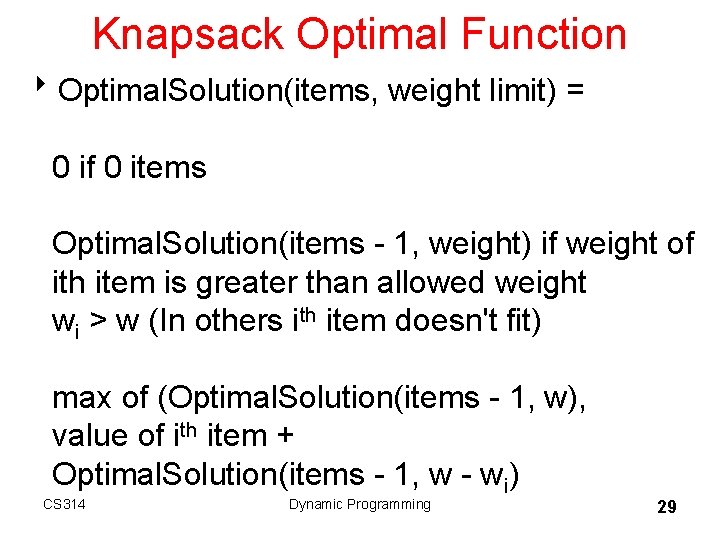
Knapsack Optimal Function 8 Optimal. Solution(items, weight limit) = 0 if 0 items Optimal. Solution(items - 1, weight) if weight of ith item is greater than allowed weight wi > w (In others ith item doesn't fit) max of (Optimal. Solution(items - 1, w), value of ith item + Optimal. Solution(items - 1, w - wi) CS 314 Dynamic Programming 29
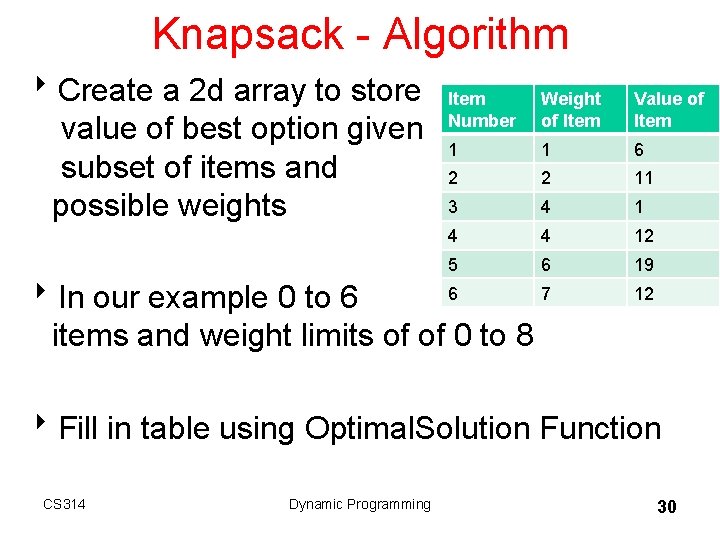
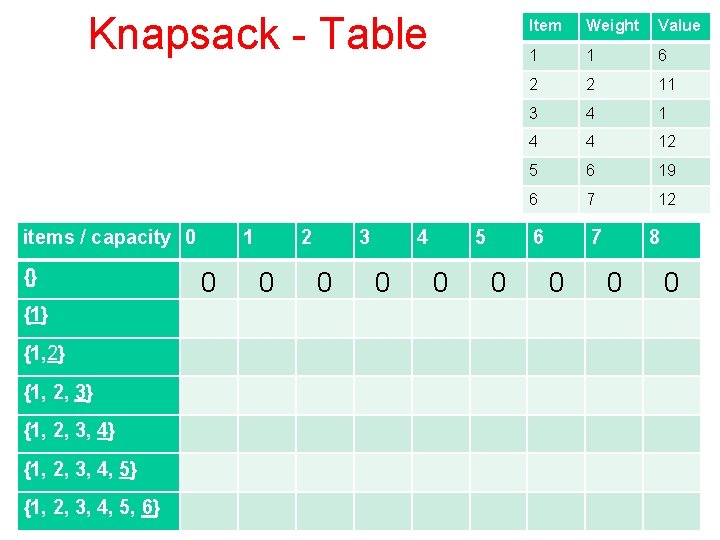
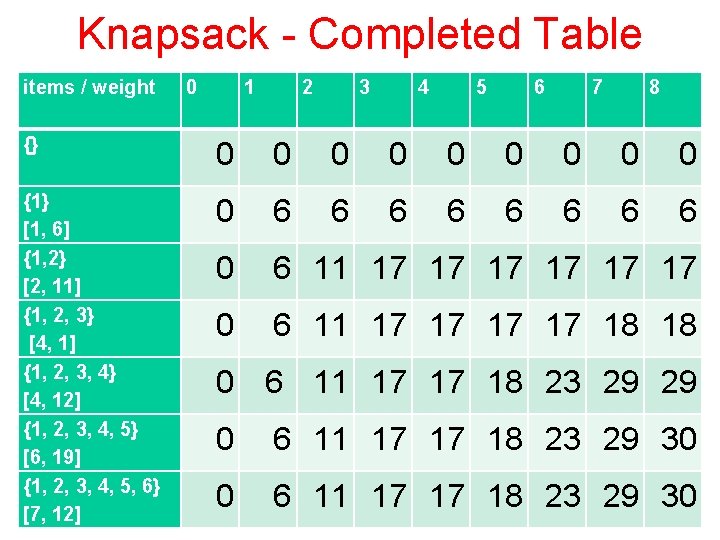
Knapsack - Algorithm 8 Create a 2 d array to store value of best option given subset of items and possible weights Item Number Weight of Item Value of Item 1 1 6 2 2 11 3 4 1 4 4 12 5 6 19 6 7 8 In our example 0 to 6 items and weight limits of of 0 to 8 12 8 Fill in table using Optimal. Solution Function CS 314 Dynamic Programming 30
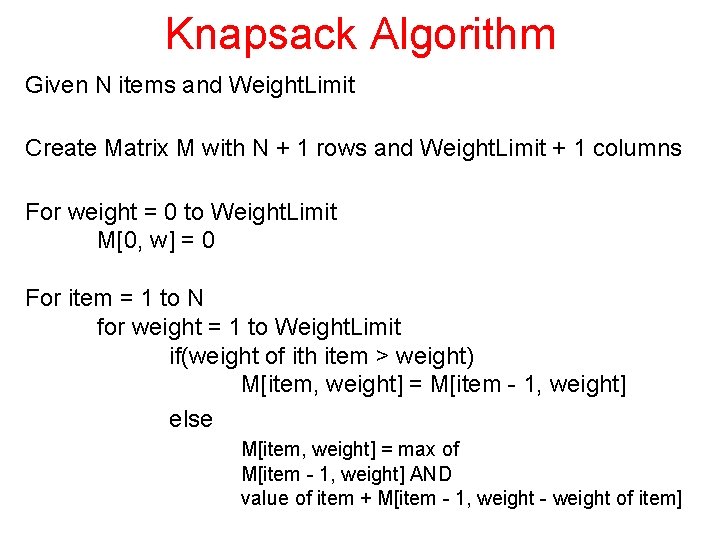
Knapsack Algorithm Given N items and Weight. Limit Create Matrix M with N + 1 rows and Weight. Limit + 1 columns For weight = 0 to Weight. Limit M[0, w] = 0 For item = 1 to N for weight = 1 to Weight. Limit if(weight of ith item > weight) M[item, weight] = M[item - 1, weight] else M[item, weight] = max of M[item - 1, weight] AND value of item + M[item - 1, weight - weight of item]
Knapsack - Table items / capacity 0 {} {1, 2} {1, 2, 3, 4} {1, 2, 3, 4, 5} {1, CS 314 2, 3, 4, 5, 6} 1 0 2 0 3 4 0 0 0 Dynamic Programming 5 0 Item Weight Value 1 1 6 2 2 11 3 4 1 4 4 12 5 6 19 6 7 12 6 7 0 8 0 32
Knapsack - Completed Table items / weight {} {1} [1, 6] {1, 2} [2, 11] {1, 2, 3} [4, 1] {1, 2, 3, 4} [4, 12] {1, 2, 3, 4, 5} [6, 19] {1, 2, 3, 4, 5, 6} CS 314 [7, 12] 0 1 2 3 4 5 6 7 8 0 0 0 0 0 0 6 6 6 6 0 6 11 17 17 17 0 6 11 17 17 18 18 0 6 11 17 17 18 23 29 29 0 6 11 17 17 18 23 29 30 0 6 Dynamic Programming 11 17 17 18 23 29 3330
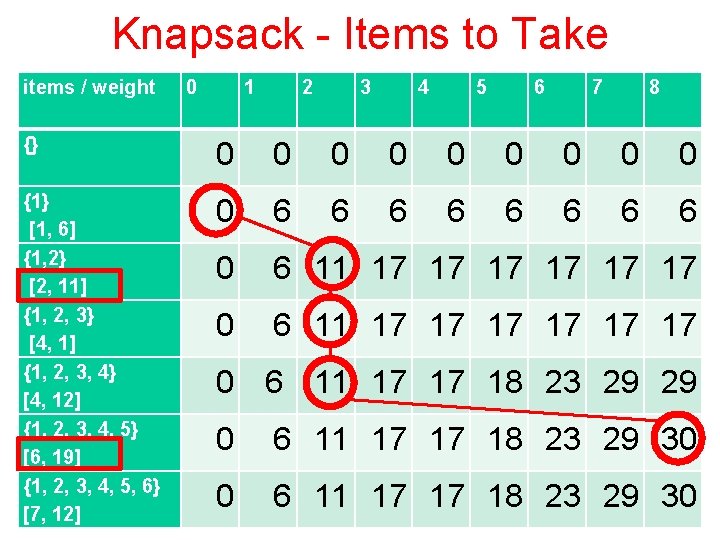
Knapsack - Items to Take items / weight {} {1} [1, 6] {1, 2} [2, 11] {1, 2, 3} [4, 1] {1, 2, 3, 4} [4, 12] {1, 2, 3, 4, 5} [6, 19] {1, 2, 3, 4, 5, 6} CS 314 [7, 12] 0 1 2 3 4 5 6 7 8 0 0 0 0 0 0 6 6 6 6 0 6 11 17 17 17 0 6 11 17 17 18 23 29 29 0 6 11 17 17 18 23 29 30 0 6 Dynamic Programming 11 17 17 18 23 29 3430
Dynamic Knapsack CS 314 Dynamic Programming 35
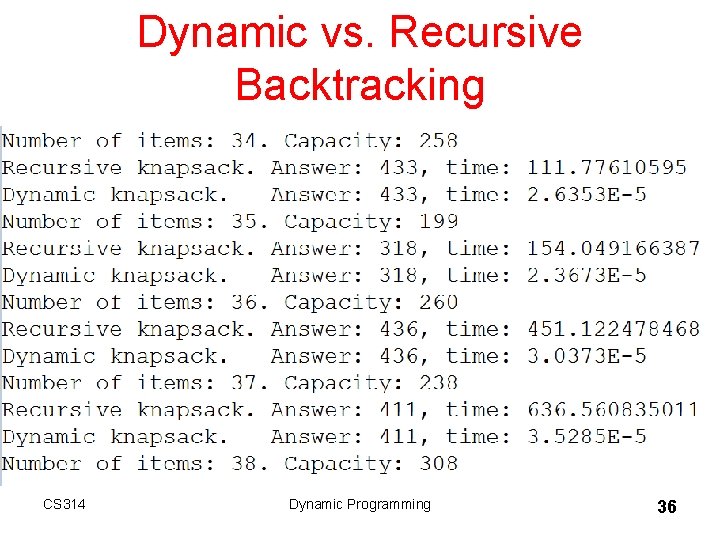
Dynamic vs. Recursive Backtracking CS 314 Dynamic Programming 36
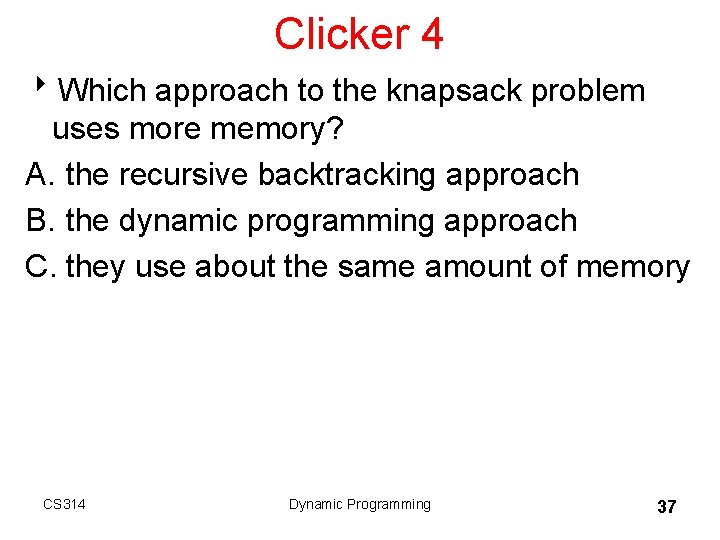
Clicker 4 8 Which approach to the knapsack problem uses more memory? A. the recursive backtracking approach B. the dynamic programming approach C. they use about the same amount of memory CS 314 Dynamic Programming 37