
Topic 2 Summary Transformations Reflections You may be
Topic 2 Summary Transformations
Reflections You may be asked to reflect about: 1) x axis 2) y axis 3) line y=x 4) line y=-x 5) any horizontal line such as y=3 6) any vertical line such as x=2
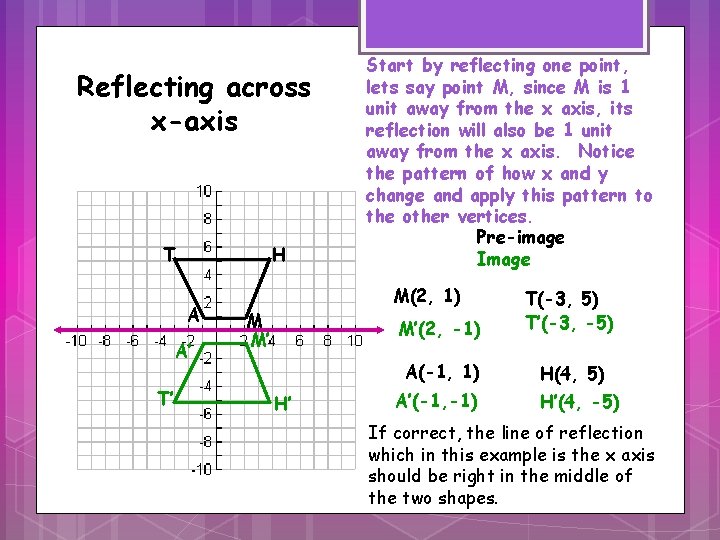
Reflecting across x-axis T H A A’ T’ Start by reflecting one point, lets say point M, since M is 1 unit away from the x axis, its reflection will also be 1 unit away from the x axis. Notice the pattern of how x and y change and apply this pattern to the other vertices. Pre-image Image M(2, 1) M M’ H’ M’(2, -1) T(-3, 5) T’(-3, -5) A(-1, 1) H(4, 5) A’(-1, -1) H’(4, -5) If correct, the line of reflection which in this example is the x axis should be right in the middle of the two shapes.
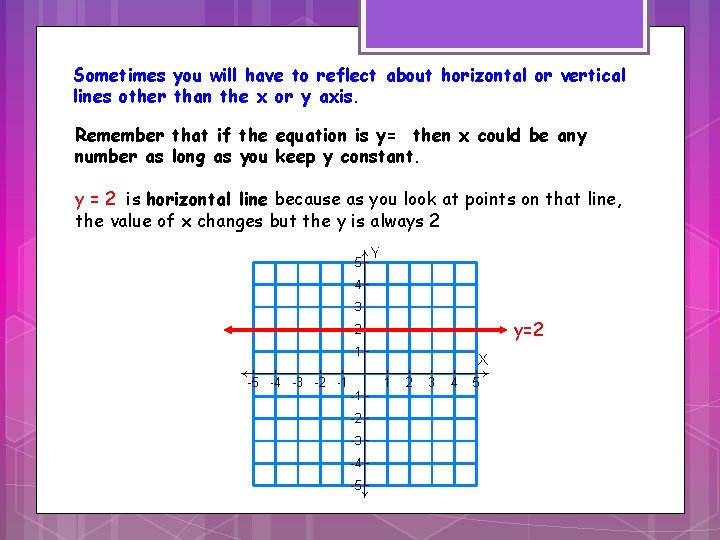
Sometimes you will have to reflect about horizontal or vertical lines other than the x or y axis. Remember that if the equation is y= then x could be any number as long as you keep y constant. y = 2 is horizontal line because as you look at points on that line, the value of x changes but the y is always 2 y=2
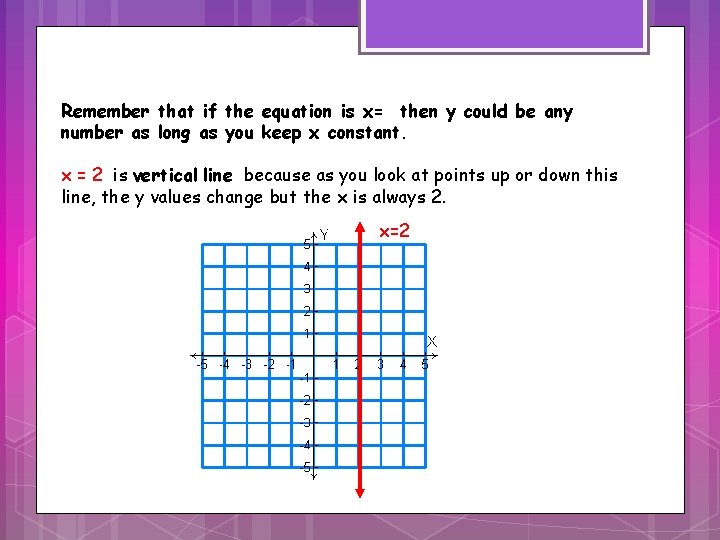
Remember that if the equation is x= then y could be any number as long as you keep x constant. x = 2 is vertical line because as you look at points up or down this line, the y values change but the x is always 2. x=2

Reflecting across a vertical line Reflect across x = 2 1) Draw line of reflection A D B C B' C' A' 2) Pick a starting point, count how far it is from line of reflection D' 3) Go that same distance on the other side of line 4) Label the new point 5) Continue with other points
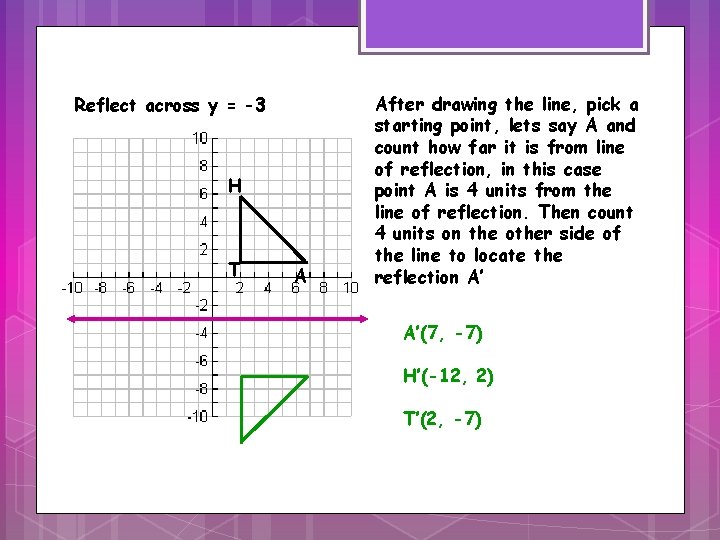
Reflect across y = -3 H T A After drawing the line, pick a starting point, lets say A and count how far it is from line of reflection, in this case point A is 4 units from the line of reflection. Then count 4 units on the other side of the line to locate the reflection A’ A’(7, -7) H’(-12, 2) T’(2, -7)
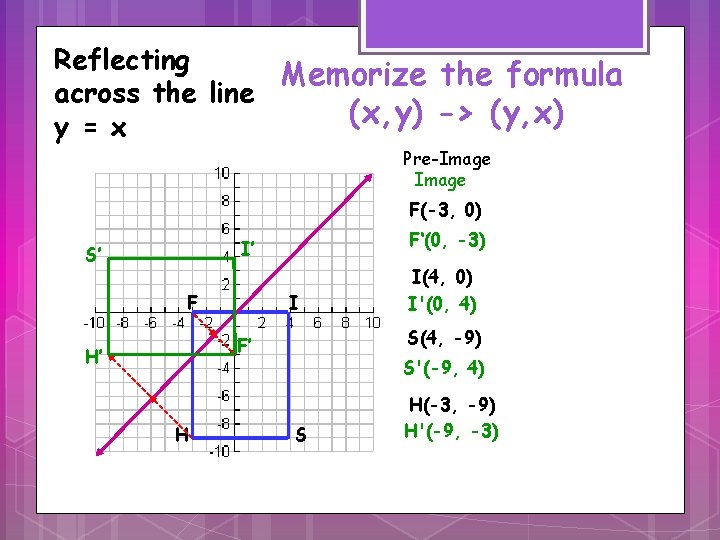
Reflecting Memorize the formula across the line (x, y) -> (y, x) y = x Pre-Image F(-3, 0) F‘(0, -3) I’ S’ F I S(4, -9) F’ H’ H I(4, 0) I'(0, 4) S'(-9, 4) S H(-3, -9) H'(-9, -3)
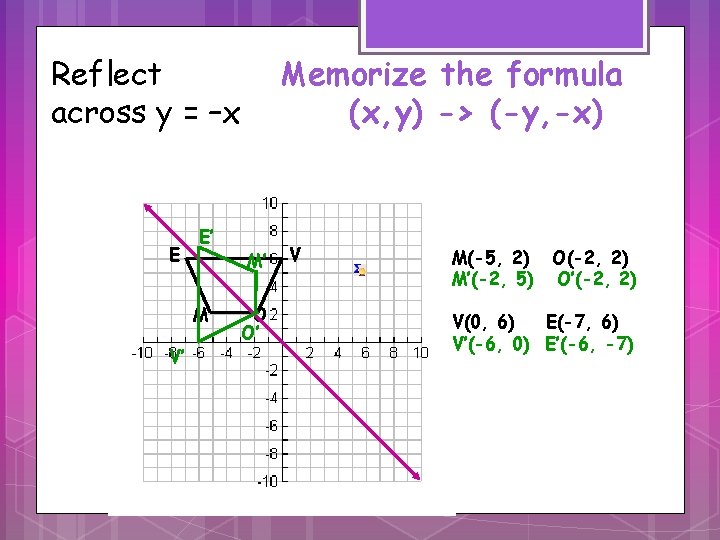
Reflect across y = –x E E’ M V’ Memorize the formula (x, y) -> (-y, -x) M’ O O’ V M(-5, 2) M’(-2, 5) O(-2, 2) O’(-2, 2) V(0, 6) E(-7, 6) V’(-6, 0) E’(-6, -7)
Rotations Remember that each time a point is rotated 90 degrees, two things happen: 1) The point moves to the quadrant to the left or to the right depending on the direction of the rotation (clockwise vs counterclockwise) 2) The values of x and y of the original point (preimage) switch places.
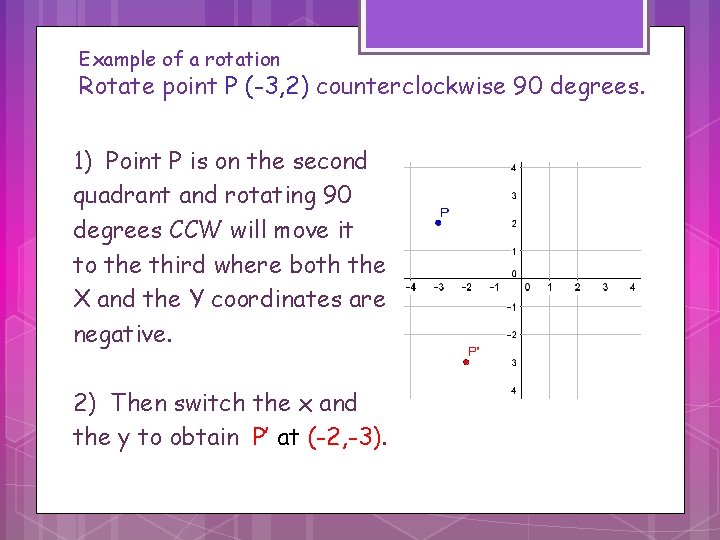
Example of a rotation Rotate point P (-3, 2) counterclockwise 90 degrees. 1) Point P is on the second quadrant and rotating 90 degrees CCW will move it to the third where both the X and the Y coordinates are negative. 2) Then switch the x and the y to obtain P’ at (-2, -3).
Translations When moving to the right or to the left the x value changes. To the right you add, to the left, you would subract. When moving up or down, the y value of the point changes. Up the y value increases, so you add. Down the y value decreases, so you would subtract. Examples: 1) 2) The rule for Left 2, Up 3 would be (x-2, y+3) The rule for Right 1, Down 10 would be (x+1, y-10)
- Slides: 12