
Topic 2 Negotiation strategy PLAN 1 Strategic approaches
- Slides: 20
Topic 2. Negotiation strategy PLAN: 1. Strategic approaches to negotiation 2. Principled approach 3. System approach in negotiation
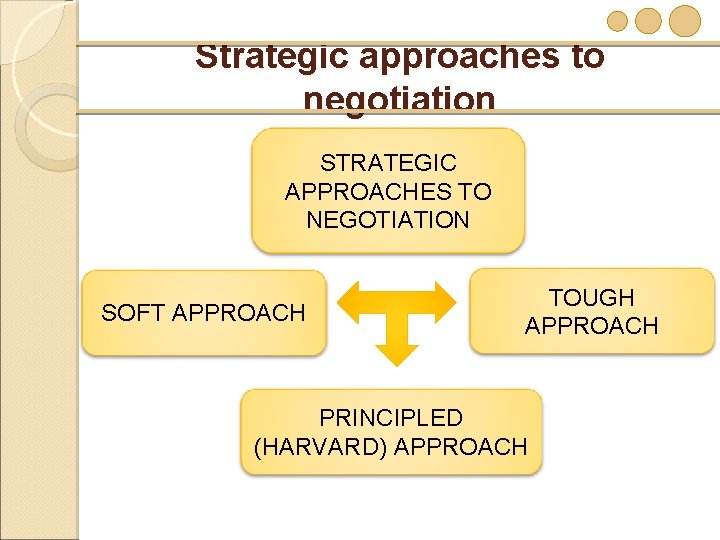
Strategic approaches to negotiation STRATEGIC APPROACHES TO NEGOTIATION SOFT APPROACH TOUGH APPROACH PRINCIPLED (HARVARD) APPROACH
Strategic approaches to negotiation A tough approach is a strategic approach, when both sides, taking opposite positions, persistently defend them, using tactical methods to mislead the opponent in relation to the true goal, and make small concessions necessary for the continuation of negotiation. During the negotiation, the dispute can turn into a contest of wills and agreement can not be reached.
Strategic approaches to negotiation A soft approach is a strategic approach, when each side considers the other side friendly. Instead of placing a stake on achieving victory, they emphasize the need to achieve at least an agreement. The strategy of a soft approach is to make offers and make concessions, trust the other side, be friendly and avoid confrontation where necessary. With this approach, the parties can come to unclear and unreasonable decisions.
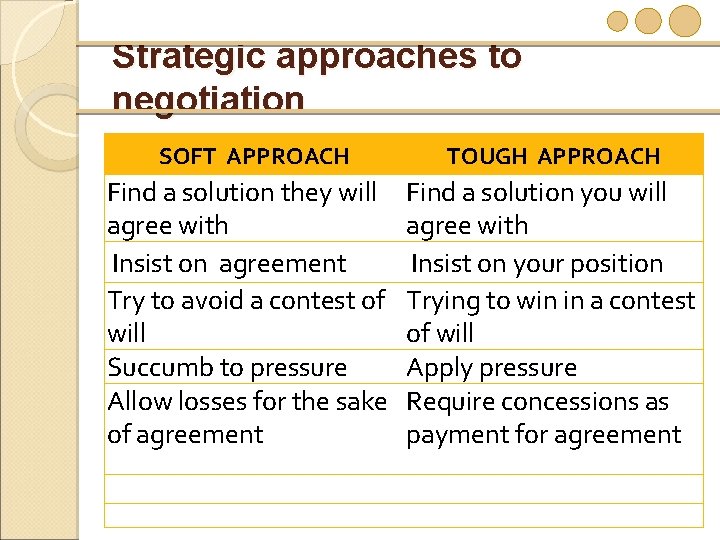
Strategic approaches to negotiation SOFT APPROACH TOUGH APPROACH Find a solution they will agree with Insist on agreement Try to avoid a contest of will Succumb to pressure Allow losses for the sake of agreement Find a solution you will agree with Insist on your position Trying to win in a contest of will Apply pressure Require concessions as payment for agreement
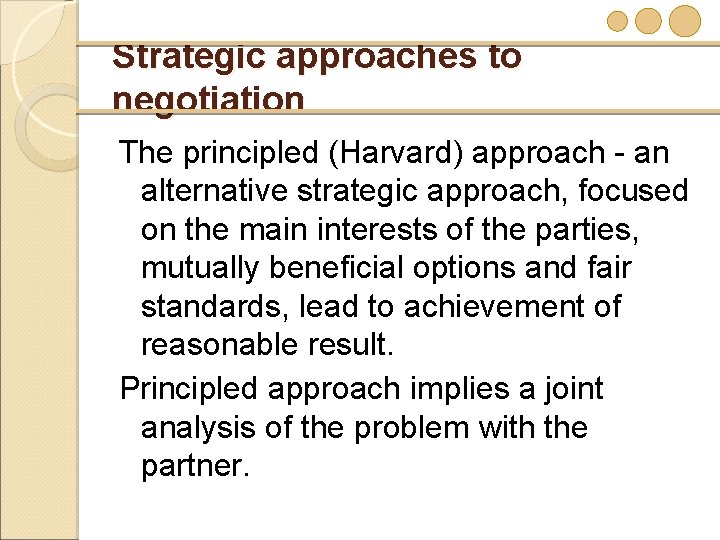
Strategic approaches to negotiation The principled (Harvard) approach - an alternative strategic approach, focused on the main interests of the parties, mutually beneficial options and fair standards, lead to achievement of reasonable result. Principled approach implies a joint analysis of the problem with the partner.
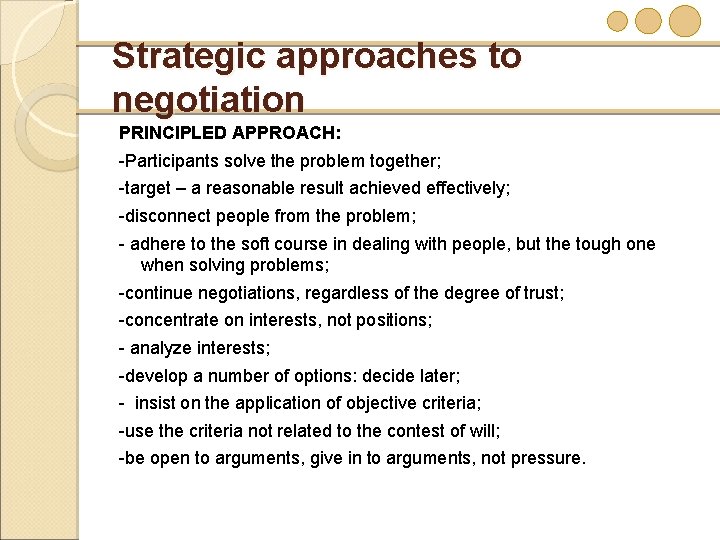
Strategic approaches to negotiation PRINCIPLED APPROACH: -Participants solve the problem together; -target – a reasonable result achieved effectively; -disconnect people from the problem; - adhere to the soft course in dealing with people, but the tough one when solving problems; -continue negotiations, regardless of the degree of trust; -concentrate on interests, not positions; - analyze interests; -develop a number of options: decide later; - insist on the application of objective criteria; -use the criteria not related to the contest of will; -be open to arguments, give in to arguments, not pressure.
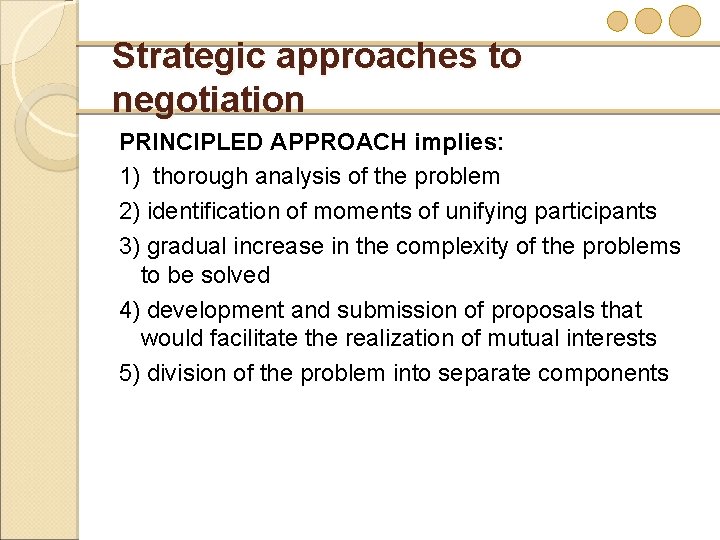
Strategic approaches to negotiation PRINCIPLED APPROACH implies: 1) thorough analysis of the problem 2) identification of moments of unifying participants 3) gradual increase in the complexity of the problems to be solved 4) development and submission of proposals that would facilitate the realization of mutual interests 5) division of the problem into separate components
PRINCIPLED APPROACH Principal negotiations are characterized by four basic rules recommendations, which constitute the basic elements of negotiations. Rule one: Separate the negotiators from the problem. We need to focus on the essence of the problem, not on the relations of the parties. You can not criticize the opponent's personal qualities. For successful negotiation: • design a working relationship; • maintain a working relationship; • separate the relationship from the discussion on the merits of the case; • do not conduct a positional auction; • deal not with problems, but with people.
PRINCIPLED APPROACH Rule two: Concentrate on interests, not positions. Instead of arguing about positions, we need to explore each other's interests. For example, in one kitchen there are two cooks, and both simultaneously needed an orange. And there is only one orange! If you focus on the positions - then, at best, both will get half the orange. But, if you identify interests, it turns out that one cook needs citron and another - juice. To understand the interests of the parties regarding their positions, you need to do the following: • explain your interests; • Identify the interests of the other party; • discuss a common topic; • be specific, but flexible; • be persistent in defending your interests.
PRINCIPLED APPROACH Rule 3: develop mutually beneficial options. The reason for misunderstanding is the rejection of creative consideration of mutually beneficial options. In order to solve common problems, the following rules must be observed: • separate judgments from decisions; • expand the range of approaches; • look for mutual benefits; • help the partner to make a decision.
PRINCIPLED APPROACH Rule 4: insist on using objective criteria and procedures. To achieve reasonable agreement, independent of the aspirations of the parties, you can apply: • fair criteria on the merits of the problem; • fair procedures for regulating opposing interests. For the talks to be fair, independent experts, observers, mediators are invited.
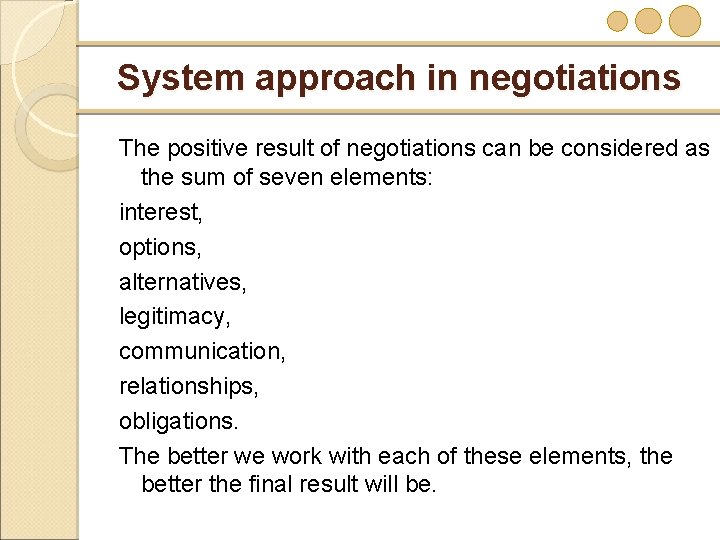
System approach in negotiations The positive result of negotiations can be considered as the sum of seven elements: interest, options, alternatives, legitimacy, communication, relationships, obligations. The better we work with each of these elements, the better the final result will be.
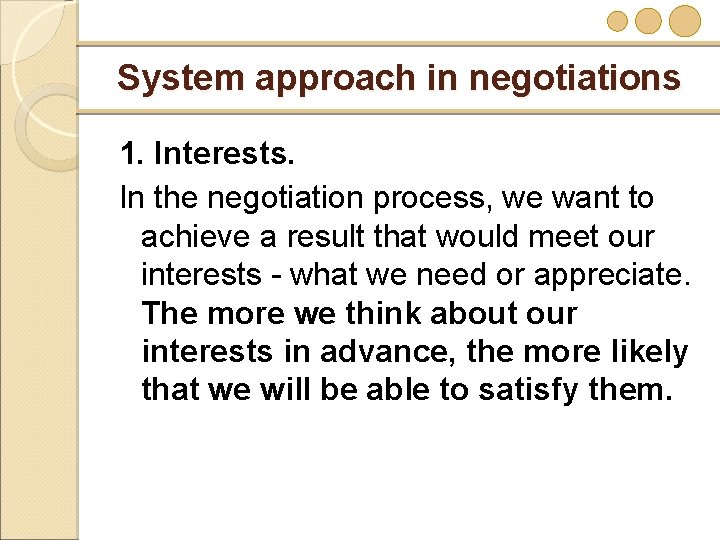
System approach in negotiations 1. Interests. In the negotiation process, we want to achieve a result that would meet our interests - what we need or appreciate. The more we think about our interests in advance, the more likely that we will be able to satisfy them.
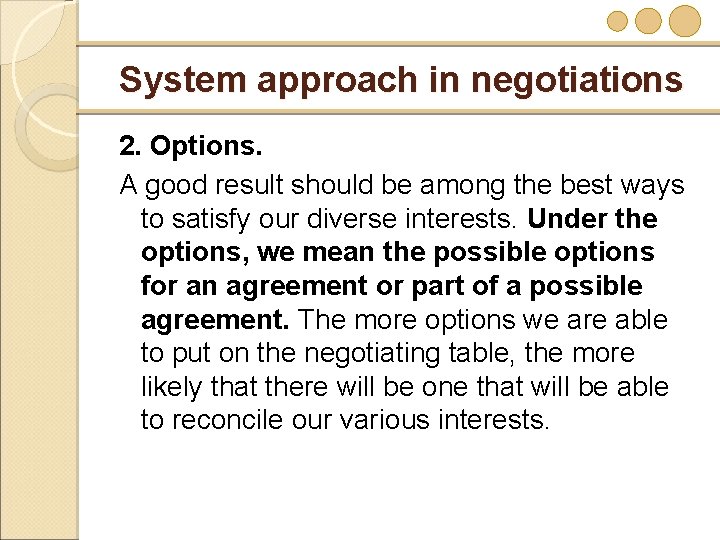
System approach in negotiations 2. Options. A good result should be among the best ways to satisfy our diverse interests. Under the options, we mean the possible options for an agreement or part of a possible agreement. The more options we are able to put on the negotiating table, the more likely that there will be one that will be able to reconcile our various interests.
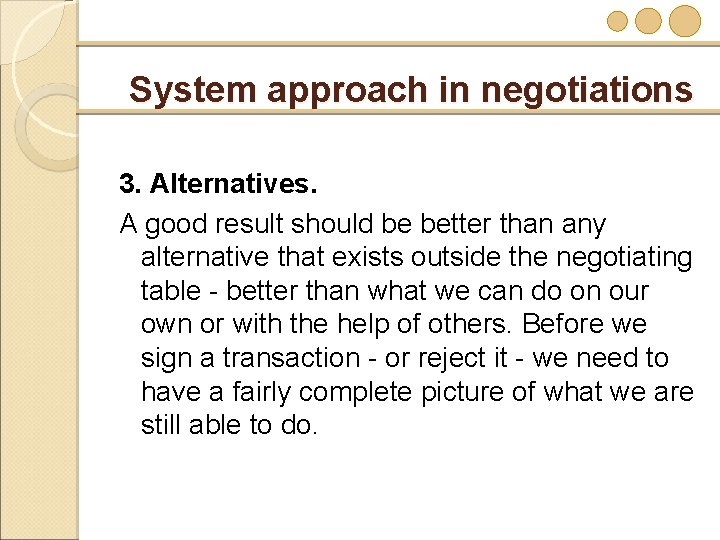
System approach in negotiations 3. Alternatives. A good result should be better than any alternative that exists outside the negotiating table - better than what we can do on our own or with the help of others. Before we sign a transaction - or reject it - we need to have a fairly complete picture of what we are still able to do.
System approach in negotiations 4. Legitimacy. We do not want to be treated unfairly, other people do not want this as well. Therefore, it will be useful to find external standards that we could use as a sword for the conviction of others, that they are treated fairly, and as a shield to protect ourselves from the wrong behavior of the opposite party.
System approach in negotiations 5. Communication. Under equal conditions, the outcome of the negotiations will be better if it is achieved skillfully, which requires a good two-way communication, since each of the parties to the negotiation wants to influence the other. We need to think ahead about what we can hear and what we need to say.
System approach in negotiations 6. Relationships. A good result of negotiations will lead to the fact that our working relations will improve rather than get worse. The preparation gives an opportunity to take into account the factor of human interaction - to think about people at the negotiation table. We must have at least some vision of how to establish a relationship that facilitates rather than hinders reaching agreement.
System approach in negotiations 7. Obligations. The quality of the outcome of the negotiation is assessed, in addition, according to the content and reality of the promises that will be given to them. In all likelihood, these obligations will be more easily met if we consider in advance the concrete promises that, in terms of their implementation, we can actually give or expect from the opposite side during the conduct or at the conclusion of negotiations.