
Topic 2 8 The Adaptable Brain This Photo
Topic 2. 8 - The Adaptable Brain This Photo by Unknown Author is licensed under CC BY-NC-ND

Brain (Neuro) Plasticity • The ability for our brains to form new connections after the neurons are damaged • The younger you are, the more plastic your brain is
Neurogenesis • Brain modification usually takes the form of reorganization • New evidence suggests that human brains may also be capable of generating new brain cells, but research is ongoing • Natural promoters of neurogenesis include – Exercise – Sleep – Non-stressful but stimulating environments
Brain reorganization • Some of the brain’s neural tissue can reorganize in response to damage • We can see this in stroke victims and people with damaged limbs, but children experience the best results because the younger we are, the more plastic our brains are. Watch the story of Camryn: • https: //www. youtube. com/watch? v=bn. O p 9 Kp. VDLI
The Brain and Consciousness • Consciousness is our awareness of ourselves and our environment, but cognitive neuroscientists disagree about what actually demonstrates consciousness • In many cases, we may utilize dual processing, in which we process information on separate conscious and unconscious tracks • Scientists also see evidence of the “twotrack” mind: – https: //www. youtube. com/watch? v=l. Bx. Yh 7 ijf 40

Biological Rhythms § Your state of consciousness is partially based on your circadian rhythm: § your biological clock § regular bodily rhythms that occur on a 24 -hour cycle, such as those of wakefulness and body temperature
States of Consciousness § Hallucinations § Sensory experiences without sensory input § Dissociation § a split in consciousness, allowing some thoughts and behaviors to occur simultaneously with others § Hypnosis § an interaction in which “the hypnotist” suggests to “the subject” that certain feelings, thoughts, or behaviors will spontaneously occur
Psychoactive Drugs § Depressants § drugs that reduce neural activity § slow body functions § alcohol, barbiturates, opiates § Stimulants § drugs that excite neural activity § speed up body functions § caffeine, nicotine, amphetamines, cocaine § Hallucinogens § psychedelic (mind-manifesting) drugs that distort perceptions and evoke sensory images in the absence of sensory input § LSD
Drug Dependence § Physical Dependence § physiological need for a drug § marked by unpleasant withdrawal symptoms § Psychological Dependence § a psychological need to use a drug § for example, to relieve negative emotions
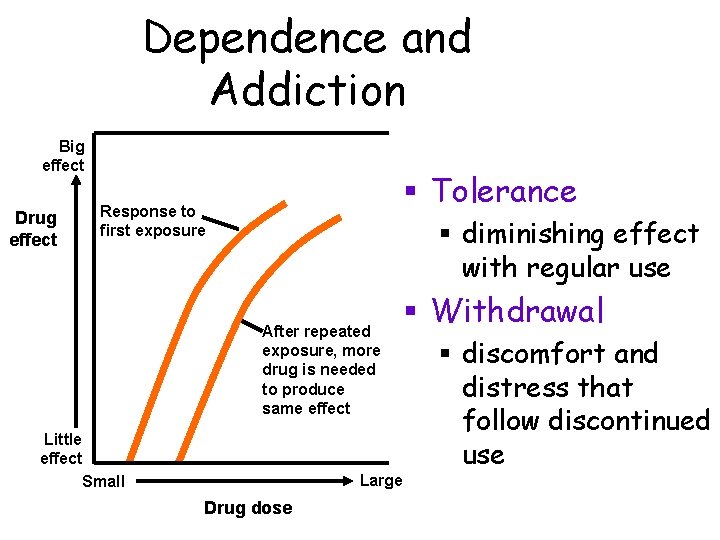
Dependence and Addiction Big effect Drug effect § Tolerance Response to first exposure § diminishing effect with regular use After repeated exposure, more drug is needed to produce same effect Little effect Small Large Drug dose § Withdrawal § discomfort and distress that follow discontinued use
- Slides: 10