
Topic 2 5 Understanding external influences on business
Topic 2. 5 Understanding external influences on business 2. 5. 1 Organisational structures Edexcel GCSE (9 -1) Business Dynamic Learning © Hodder & Stoughton PRESENTATION
Topic 2. 5 Understanding external influences on business 2. 5. 1 Organisational structures This section covers the following: • What an organisational structure is • Hierarchical and flat structures • Centralised and decentralised organisations Edexcel GCSE (9 -1) Business Dynamic Learning © Hodder & Stoughton PRESENTATION
Topic 2. 5 Understanding external influences on business 2. 5. 1 Organisational structures PRESENTATION Key words Organisation chart • A diagram that shows the internal structure of an organisation. Hierarchical structure • An organisation with many layers of management, therefore creating a tall organisational pyramid Edexcel GCSE (9 -1) Business Dynamic Learning © Hodder & Stoughton
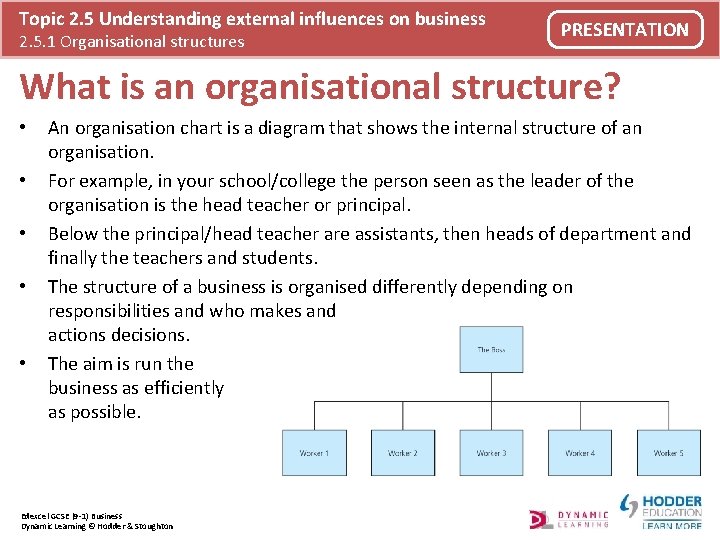
Topic 2. 5 Understanding external influences on business 2. 5. 1 Organisational structures PRESENTATION What is an organisational structure? • • • An organisation chart is a diagram that shows the internal structure of an organisation. For example, in your school/college the person seen as the leader of the organisation is the head teacher or principal. Below the principal/head teacher are assistants, then heads of department and finally the teachers and students. The structure of a business is organised differently depending on responsibilities and who makes and actions decisions. The aim is run the business as efficiently as possible. Edexcel GCSE (9 -1) Business Dynamic Learning © Hodder & Stoughton
Topic 2. 5 Understanding external influences on business 2. 5. 1 Organisational structures PRESENTATION Hierarchical structures • A hierarchical structure is an organisation with many layers of management, therefore creating a tall organisational pyramid. • Large organisations such as public limited companies, the armed forces or the police have a complicated management structure. • Most of the responsibility is at the top of the pyramid with few people, it is a tall structure. • Managers underneath have responsibility for those on the next layer below them and so on. • The staff at the bottom of the pyramid are responsible for their role only. • See the following slide for a hierarchical structure. Edexcel GCSE (9 -1) Business Dynamic Learning © Hodder & Stoughton

Topic 2. 5 Understanding external influences on business 2. 5. 1 Organisational structures Hierarchical structures Edexcel GCSE (9 -1) Business Dynamic Learning © Hodder & Stoughton PRESENTATION
Topic 2. 5 Understanding external influences on business 2. 5. 1 Organisational structures PRESENTATION Advantages and disadvantages • Advantages include a clear career path for staff, as decisions are passed down from the top, standards can be maintained, and it is easier to check work at each level. • Disadvantages include that there can be divisions between managers and workers, communication from top to bottom is difficult due to the layers, and too many layers of managers slow down business decisions. • British Gas and M&S are examples of a business that uses this type of structure – managers do the planning and staff put the plans into action. Edexcel GCSE (9 -1) Business Dynamic Learning © Hodder & Stoughton
Topic 2. 5 Understanding external influences on business 2. 5. 1 Organisational structures PRESENTATION Key words Flat structure • An organisation with few layers of hierarchy – presumably because each manager is responsible for many staff Edexcel GCSE (9 -1) Business Dynamic Learning © Hodder & Stoughton
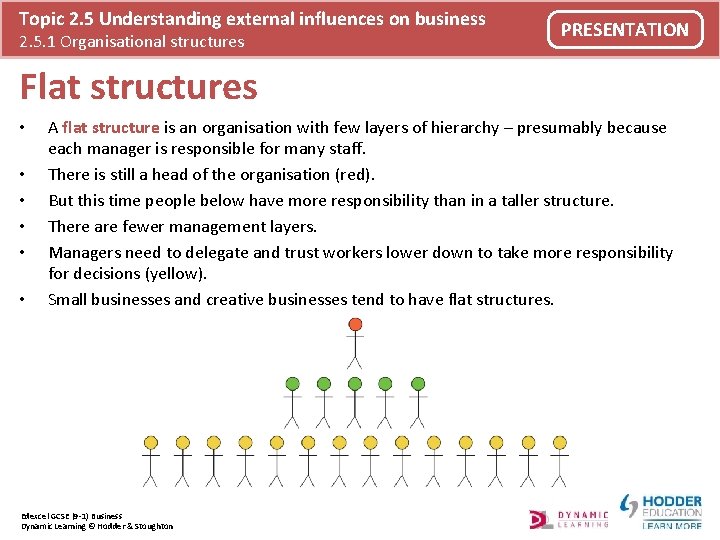
Topic 2. 5 Understanding external influences on business 2. 5. 1 Organisational structures PRESENTATION Flat structures • • • A flat structure is an organisation with few layers of hierarchy – presumably because each manager is responsible for many staff. There is still a head of the organisation (red). But this time people below have more responsibility than in a taller structure. There are fewer management layers. Managers need to delegate and trust workers lower down to take more responsibility for decisions (yellow). Small businesses and creative businesses tend to have flat structures. Edexcel GCSE (9 -1) Business Dynamic Learning © Hodder & Stoughton
Topic 2. 5 Understanding external influences on business 2. 5. 1 Organisational structures PRESENTATION Advantages and disadvantages • Advantages include fewer managers needed so lower costs, there is more job satisfaction as staff have more responsibility, and communication up and down the organisation is quicker as there are fewer layers. • Disadvantages include that managers have more responsibility for more staff, managers may lose control of staff as they have so many to supervise, leading to overwork and stress and fewer chances for promotion as there are less layers. • Examples of businesses with flat organisational structure include the games software company Valve and Google. Edexcel GCSE (9 -1) Business Dynamic Learning © Hodder & Stoughton
Topic 2. 5 Understanding external influences on business 2. 5. 1 Organisational structures PRESENTATION Key words Centralised organisation • An organisation in which most decisions are made at head office Edexcel GCSE (9 -1) Business Dynamic Learning © Hodder & Stoughton
Topic 2. 5 Understanding external influences on business 2. 5. 1 Organisational structures PRESENTATION Centralised organisations • A centralised organisation is an organisation in which most decisions are made at head office. • Examples of business that have centralised structure include banks and supermarkets, e. g. head offices of Asda and local outlets. • Head office makes the decisions and the branches are responsible for implementing them. • Advantages include that decisions can be taken looking at the whole business, central managers can ensure branches follow decisions consistently and decision making and communication is quick. • Disadvantages include reduced delegation leading to slower response to changes in the market, business opportunities can be lost as only the centre can make any decisions, and lack of staff satisfaction as people feel less involved. Edexcel GCSE (9 -1) Business Dynamic Learning © Hodder & Stoughton
Topic 2. 5 Understanding external influences on business 2. 5. 1 Organisational structures PRESENTATION Key words Decentralised organisation • An organisation that allows staff to make decisions at a local level Edexcel GCSE (9 -1) Business Dynamic Learning © Hodder & Stoughton
Topic 2. 5 Understanding external influences on business 2. 5. 1 Organisational structures PRESENTATION Decentralisation • A decentralised organisation is an organisation that allows staff to make decisions at a local level. • The head office may decide the overall policy such as increasing sales by 10% but the local branch will decide how this is achieved. • Tesco and Morrison’s are examples of decentralised organisations, allowing local manages to decide how they meet central objectives. • Advantages of decentralisation include that decisions are made closer to the customer, better and faster response to local market conditions and improved staff motivation. • Disadvantages include it being harder to ensure consistent practices across each location, duplication of jobs across the organisation and being harder to achieve good financial control of the business. Edexcel GCSE (9 -1) Business Dynamic Learning © Hodder & Stoughton
Topic 2. 5 Understanding external influences on business 2. 5. 1 Organisational structures PRESENTATION Summary questions Write down or discuss the answers to these questions. • What is an organisation chart? • Is a hierarchical organisation structure flat or tall? Explain why. • What happens to the number of managers if a business goes from a hierarchical to a flat organisational structure? • Give an advantage and a disadvantage of a flat organisational structure. • What is a centralised organisational structure? • What is a decentralised organisational structure? Edexcel GCSE (9 -1) Business Dynamic Learning © Hodder & Stoughton
- Slides: 15