
Topic 2 5 Understanding external influences on business
Topic 2. 5 Understanding external influences on business 2. 5. 3 Effective training and development PRESENTATION Effective training and development Edexcel GCSE (9 -1) Business Dynamic Learning © Hodder & Stoughton
Topic 2. 5 Understanding external influences on business 2. 5. 3 Effective training and development PRESENTATION Effective training and development This section covers the following: • What training and development of staff is • Different ways of training and developing employees • Why businesses train and develop employees Edexcel GCSE (9 -1) Business Dynamic Learning © Hodder & Stoughton
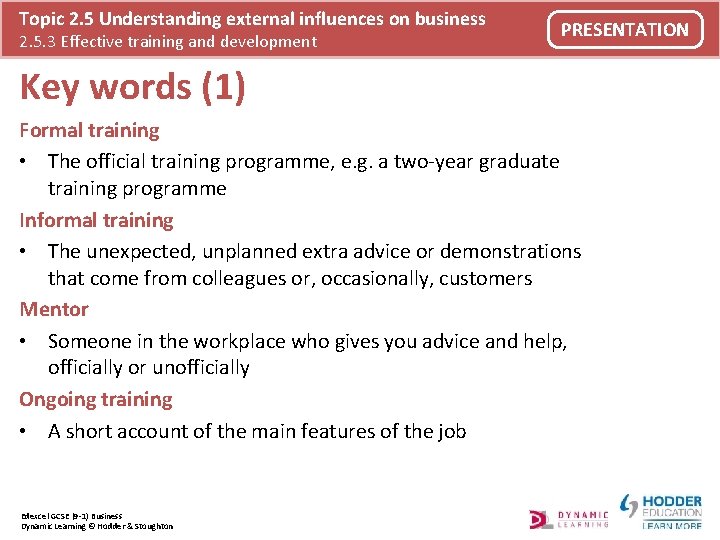
Topic 2. 5 Understanding external influences on business 2. 5. 3 Effective training and development PRESENTATION Key words (1) Formal training • The official training programme, e. g. a two-year graduate training programme Informal training • The unexpected, unplanned extra advice or demonstrations that come from colleagues or, occasionally, customers Mentor • Someone in the workplace who gives you advice and help, officially or unofficially Ongoing training • A short account of the main features of the job Edexcel GCSE (9 -1) Business Dynamic Learning © Hodder & Stoughton
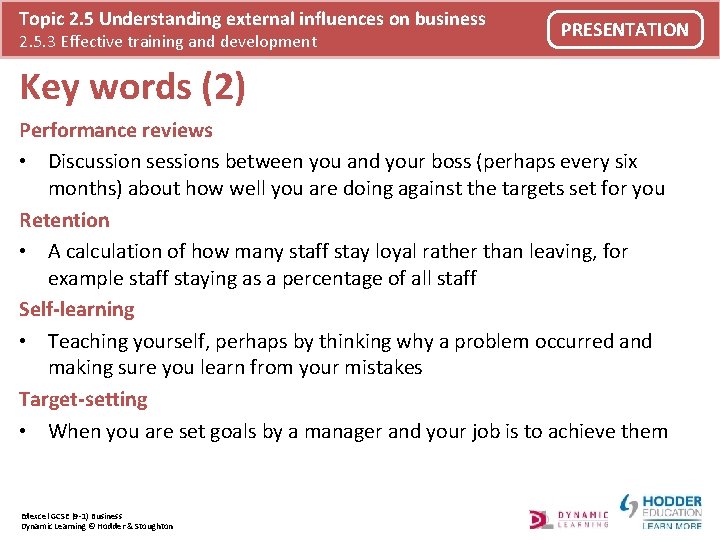
Topic 2. 5 Understanding external influences on business 2. 5. 3 Effective training and development PRESENTATION Key words (2) Performance reviews • Discussion sessions between you and your boss (perhaps every six months) about how well you are doing against the targets set for you Retention • A calculation of how many staff stay loyal rather than leaving, for example staff staying as a percentage of all staff Self-learning • Teaching yourself, perhaps by thinking why a problem occurred and making sure you learn from your mistakes Target-setting • When you are set goals by a manager and your job is to achieve them Edexcel GCSE (9 -1) Business Dynamic Learning © Hodder & Stoughton
Topic 2. 5 Understanding external influences on business 2. 5. 3 Effective training and development PRESENTATION Training and development of staff • Training is the process of an individual acquiring job-related skills and knowledge. • Development is the process of improving and increasing capabilities of staff through access to education and other opportunities in the workplace, or through an outside organisation such as a university. • Training and development can help improve productivity and motivate the workforce, enhancing the quality of the products and services offered by the business. • Research shows that the best UK businesses spend up to 50% more on training each member of staff than the worst performing businesses. • Training can boost profits but it is also very expensive, at least in the short term. Edexcel GCSE (9 -1) Business Dynamic Learning © Hodder & Stoughton
Topic 2. 5 Understanding external influences on business 2. 5. 3 Effective training and development PRESENTATION Benefits and costs of training Benefits of training Costs of training • Increases the level and range of • Can be expensive, both in hours skills available to the business, spent providing the training and leading to improvements in the cost of sending staff to efficiency and quality outside courses • Increases the range of skills within • Production may be disrupted a workforce, allowing it to respond while training is taking place, quickly to changes in technology or leading to lost output demand • Newly trained workers may be • Can lead to a more motivated persuaded to leave and take up workforce by creating new jobs elsewhere (known as opportunities for development poaching), meaning the benefits and promotion of training are enjoyed by other Edexcel GCSE (9 -1) Business Dynamic Learning © Hodder & Stoughton
Topic 2. 5 Understanding external influences on business 2. 5. 3 Effective training and development PRESENTATION Ways of training and developing staff • Formal training is the official training programme, for example a twoyear graduate training programme. • Informal training is the unexpected, unplanned extra advice or demonstrations that come from colleagues or, occasionally, customers. • Self-learning is teaching yourself, perhaps by thinking why a problem occurred and making sure you learn from your mistakes, e. g. what went wrong and why? • Ongoing training is regular, perhaps weekly, training sessions for all staff. • Businesses with wage bills of £ 3 m per year or Apprenticeships more have now must pay 1% of the bill to the government. The money can be claimed back for apprenticeships. Edexcel GCSE (9 -1) Business Dynamic Learning © Hodder & Stoughton
Topic 2. 5 Understanding external influences on business 2. 5. 3 Effective training and development PRESENTATION Target-setting and performance reviews • Most large employers have at least yearly meetings with staff to help organise their careers within the business. • Performance reviews are where discussion sessions between the employee and their boss (perhaps every six months) about how well the employee is doing against the targets set for them. • Target-setting is when an employee is set goals by a manager and the employees job is to achieve them, e. g. stack so many shelves per hour. • Part of target setting can include training and development targets, e. g. learn the supervisors job or telephone skills. • Research has shown that the most important role for encouraging staff to develop is held by their supervisor, as a mentor. • Mentor is someone in the workplace who gives you advice and help, officially or unofficially. Edexcel GCSE (9 -1) Business Dynamic Learning © Hodder & Stoughton
Topic 2. 5 Understanding external influences on business 2. 5. 3 Effective training and development PRESENTATION Why train and develop employees? • Work process change on a regular basis so employees need to keep up to date, e. g. new machines to make cars or new mixes of coffees at Starbucks. • A well-educated work force is a much more creative workforce and can spot opportunities for the business to improve and make more profit. • Training and development motivate staff to achieve high quality standards and to stay with the business. • Retention is a calculation of how many staff stay loyal rather than leaving, for example staff staying as a percentage of all staff. • Development can include staff helping to grow a business, e. g. Jaguar Land Rover has sent 33% of staff abroad to set up new ventures and this development has contributed to a labour retention rate of 95%. Edexcel GCSE (9 -1) Business Dynamic Learning © Hodder & Stoughton
Topic 2. 5 Understanding external influences on business 2. 5. 3 Effective training and development PRESENTATION Summary questions Write down or discuss the answers to these questions. • What is informal training? • Name a benefit and cost of training to a business. • Why is ongoing training important to a successful business? • What is target setting? • Give two reasons why a business will train and develop staff. • Give a reason why a business might decide not to train and develop staff. Edexcel GCSE (9 -1) Business Dynamic Learning © Hodder & Stoughton
- Slides: 10