
Topic 2 4 Process Explanation Food decay Purpose

- Slides: 16
Topic 2 -4 Process Explanation
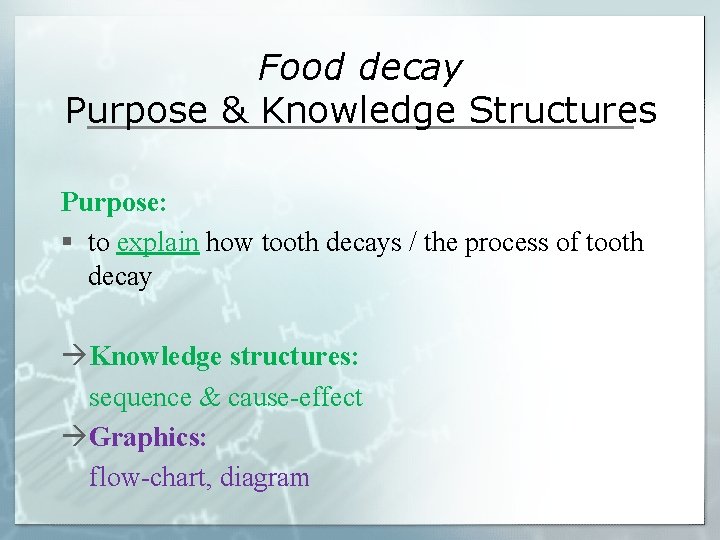
Food decay Purpose & Knowledge Structures Purpose: § to explain how tooth decays / the process of tooth decay Knowledge structures: sequence & cause-effect Graphics: flow-chart, diagram
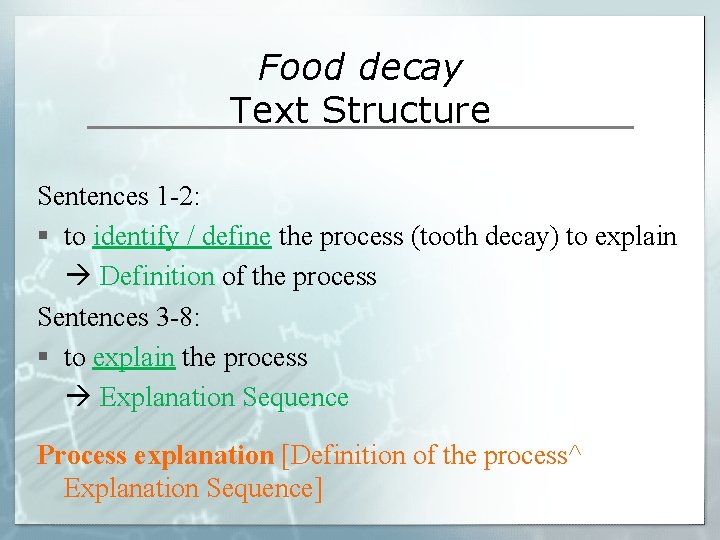
Food decay Text Structure Sentences 1 -2: § to identify / define the process (tooth decay) to explain Definition of the process Sentences 3 -8: § to explain the process Explanation Sequence Process explanation [Definition of the process^ Explanation Sequence]
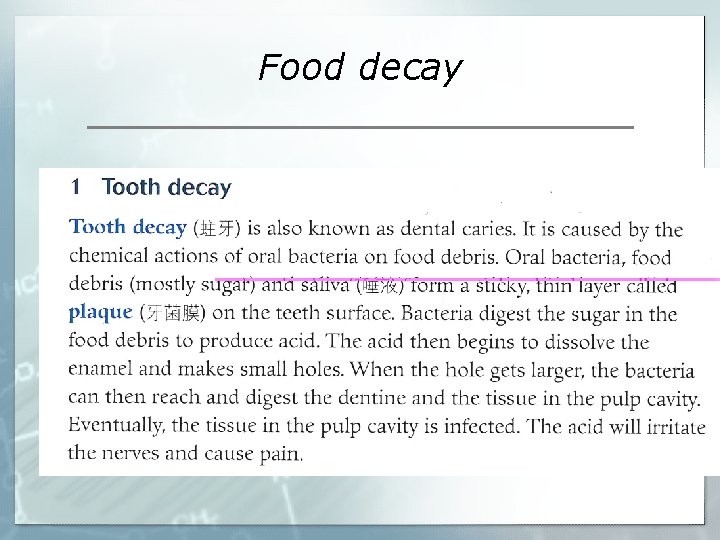
Food decay
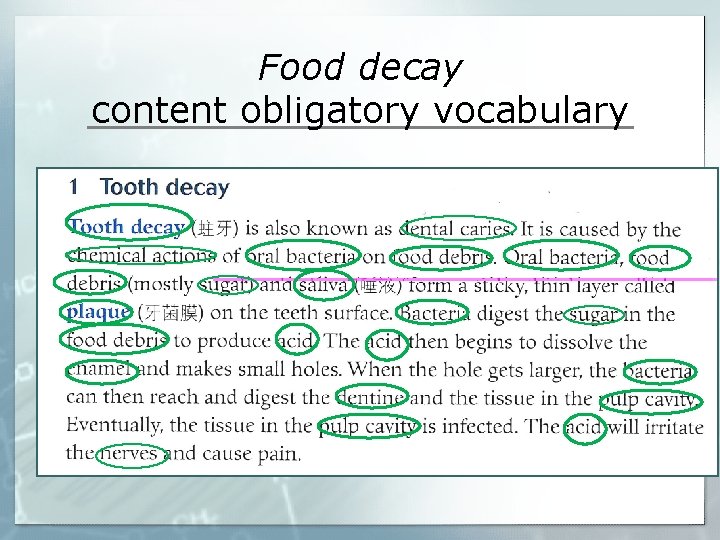
Food decay content obligatory vocabulary
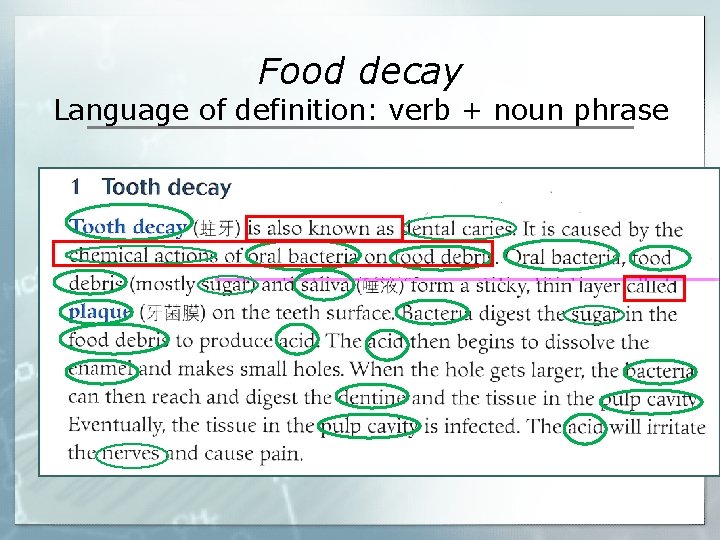
Food decay Language of definition: verb + noun phrase
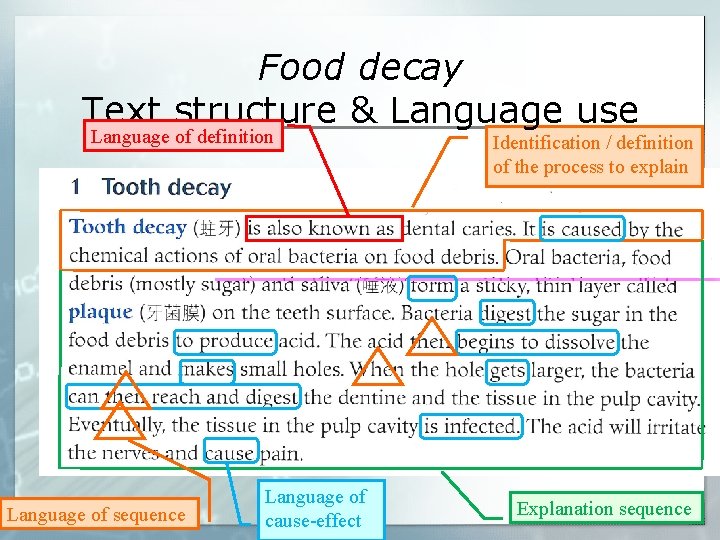
Food decay Text structure & Language use Language of definition Language of sequence Language of cause-effect Identification / definition of the process to explain Explanation sequence
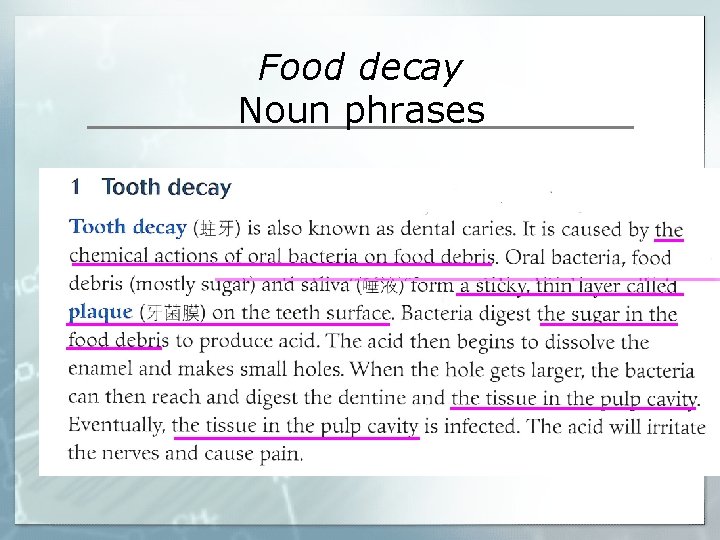
Food decay Noun phrases
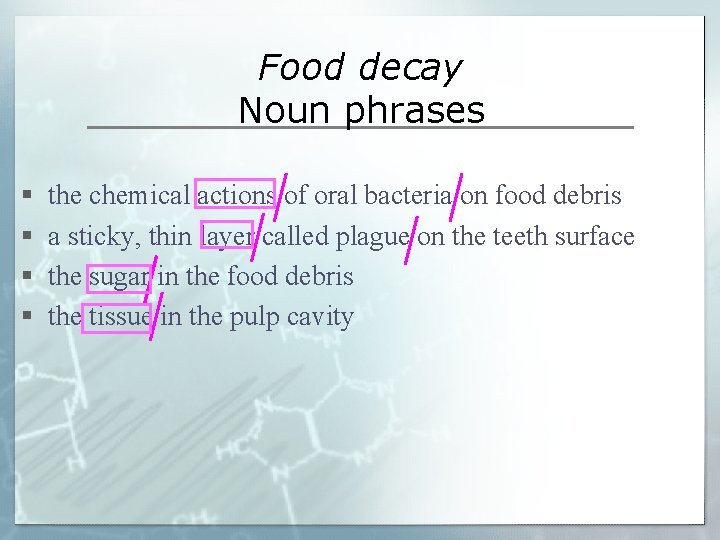
Food decay Noun phrases § § the chemical actions of oral bacteria on food debris a sticky, thin layer called plague on the teeth surface the sugar in the food debris the tissue in the pulp cavity
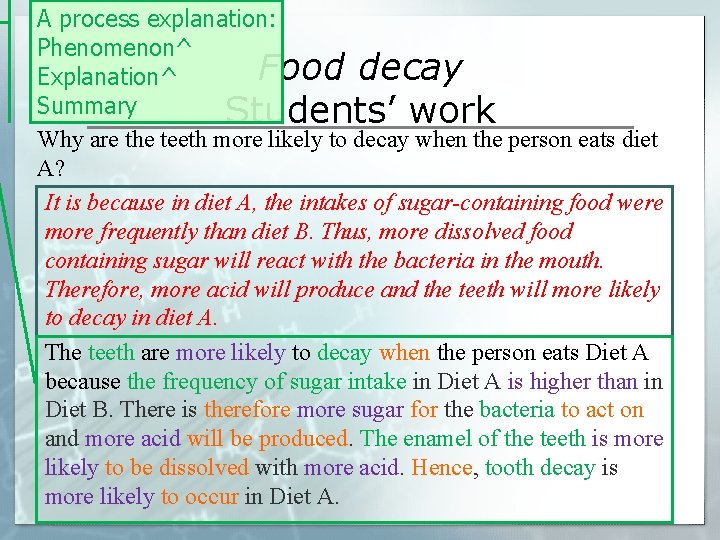
A process explanation: Phenomenon^ Food decay Explanation^ Summary Students’ work Why are the teeth more likely to decay when the person eats diet A? It is because in diet A, the intakes of sugar-containing food were more frequently than diet B. Thus, more dissolved food containing sugar will react with the bacteria in the mouth. Therefore, more acid will produce and the teeth will more likely to decay in diet A. The teeth are more likely to decay when the person eats Diet A because the frequency of sugar intake in Diet A is higher than in Diet B. There is therefore more sugar for the bacteria to act on and more acid will be produced. The enamel of the teeth is more likely to be dissolved with more acid. Hence, tooth decay is more likely to occur in Diet A.
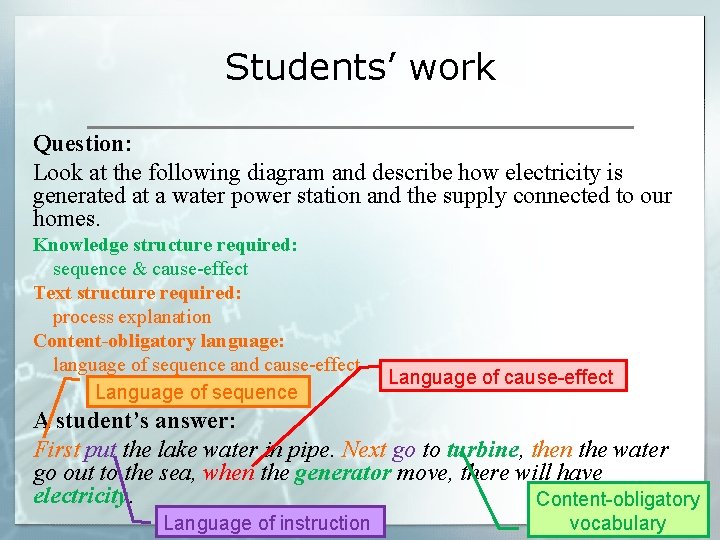
Students’ work Question: Look at the following diagram and describe how electricity is generated at a water power station and the supply connected to our homes. Knowledge structure required: sequence & cause-effect Text structure required: process explanation Content-obligatory language: language of sequence and cause-effect Language of sequence Language of cause-effect A student’s answer: First put the lake water in pipe. Next go to turbine, then the water go out to the sea, when the generator move, there will have electricity. Content-obligatory Language of instruction vocabulary
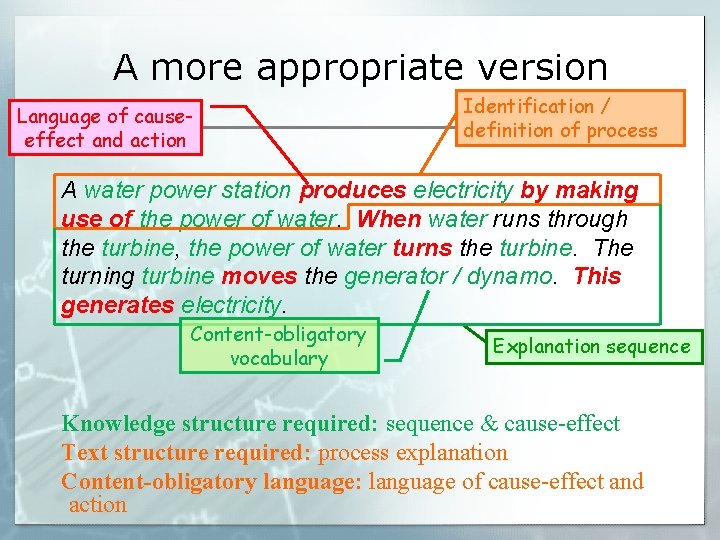
A more appropriate version Language of causeeffect and action Identification / definition of process A water power station produces electricity by making use of the power of water. When water runs through the turbine, the power of water turns the turbine. The turning turbine moves the generator / dynamo. This generates electricity. Content-obligatory vocabulary Explanation sequence Knowledge structure required: sequence & cause-effect Text structure required: process explanation Content-obligatory language: language of cause-effect and action
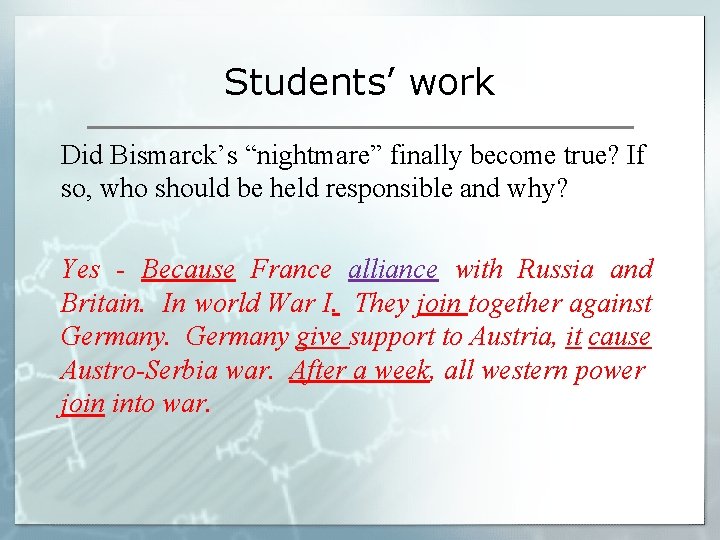
Students’ work Did Bismarck’s “nightmare” finally become true? If so, who should be held responsible and why? Yes - Because France alliance with Russia and Britain. In world War I. They join together against Germany give support to Austria, it cause Austro-Serbia war. After a week, all western power join into war.
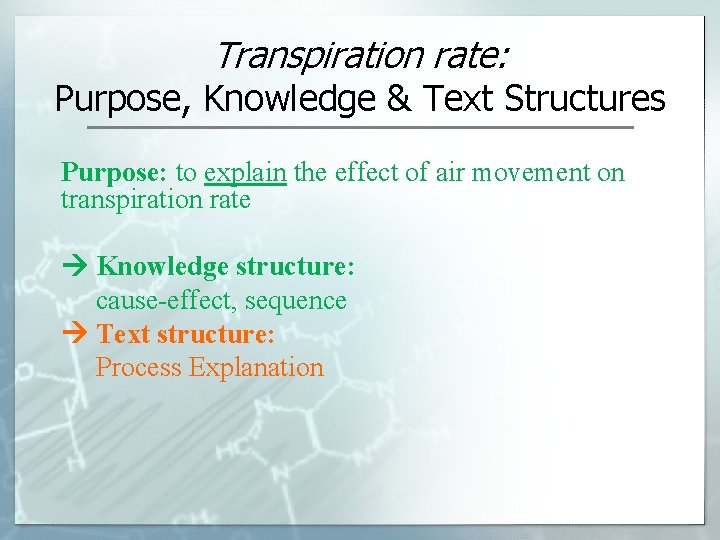
Transpiration rate: Purpose, Knowledge & Text Structures Purpose: to explain the effect of air movement on transpiration rate Knowledge structure: cause-effect, sequence Text structure: Process Explanation
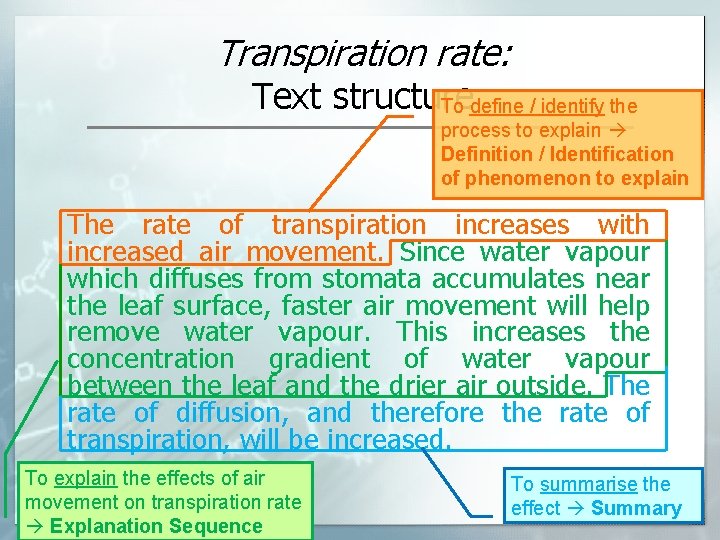
Transpiration rate: Text structure To define / identify the process to explain Definition / Identification of phenomenon to explain The rate of transpiration increases with increased air movement. Since water vapour which diffuses from stomata accumulates near the leaf surface, faster air movement will help remove water vapour. This increases the concentration gradient of water vapour between the leaf and the drier air outside. The rate of diffusion, and therefore the rate of transpiration, will be increased. To explain the effects of air movement on transpiration rate Explanation Sequence To summarise the effect Summary
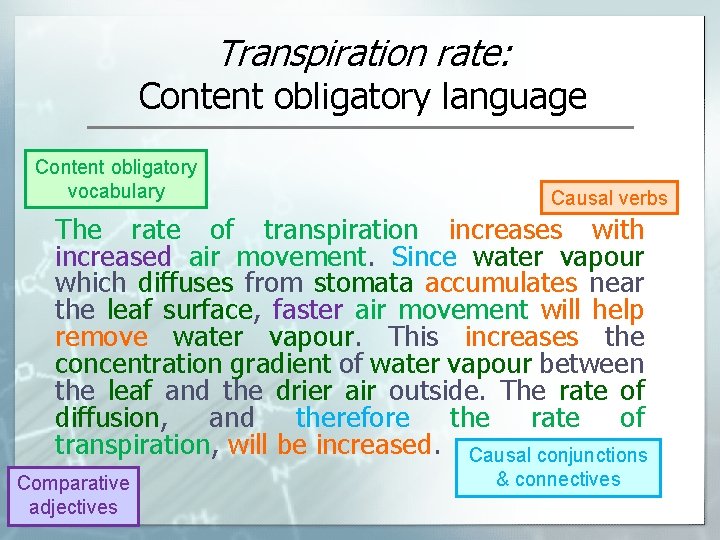
Transpiration rate: Content obligatory language Content obligatory vocabulary Causal verbs The rate of transpiration increases with increased air movement. Since water vapour which diffuses from stomata accumulates near the leaf surface, faster air movement will help remove water vapour. This increases the concentration gradient of water vapour between the leaf and the drier air outside. The rate of diffusion, and therefore the rate of transpiration, will be increased. Causal conjunctions Comparative adjectives & connectives