
TOPIC 2 2 INTRODUCTION TO THE FEDERAL BUDGET
TOPIC 2. 2 INTRODUCTION TO THE FEDERAL BUDGET Unit 2: Interactions Among Branches of Government
SETTING THE FEDERAL BUDGET • Federal government covers expenses for fiscal year (October – September) • Recent budgets have been trillions of dollars • Mandatory Spending: spending required by existing laws that is “locked in” the budget • Spending that does not have to be approved annually • Can only be changed by new legislation • Over 2/3 of federal spending • Entitlement program: program that provide benefits for those who qualify under the law, regardless of income • Interest on federal debt

SETTING THE FEDERAL BUDGET • Discretionary Spending: spending for programs and policies at the discretion of Congress and the president • Spending that has to be authorized every year by Congress and the president • Defense • Education • Scientific research • Agriculture

WHO SETS THE BUDGET? • Involves both the President and Congress • President submits his budget for Congressional authorization • Congress produces a budget resolution providing broad spending goals • Appropriations committees allocate for specific programs • Congress passes, then President signs
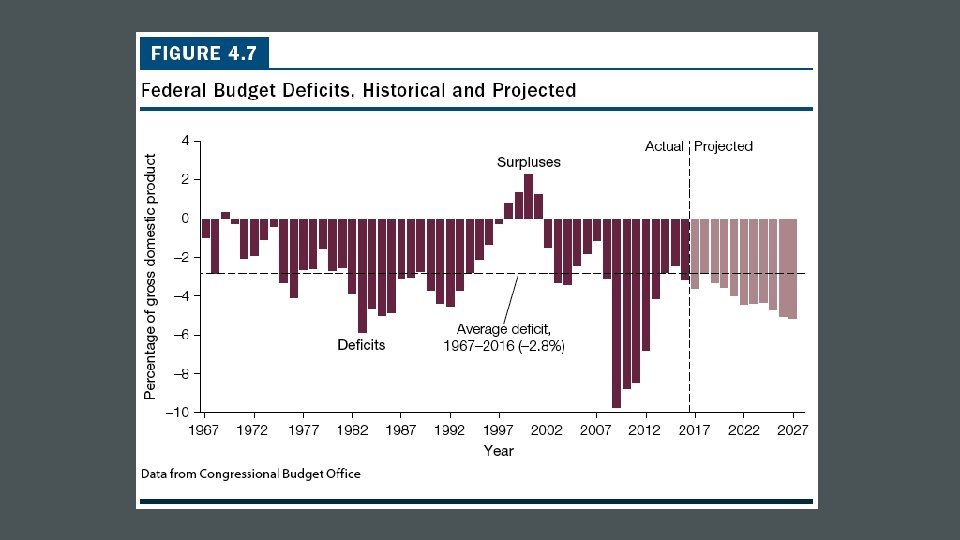
TAXATION, DEFICITS, AND DEBTS • Government takes in revenue via income taxes • Government spends money via the budget • Government spending less than government revenue = Budget Surplus • Government spending greater than government revenue = Budget Deficit • Over time, multiple deficits = National Debt
ENTITLEMENT PROGRAMS • Provide benefits to people who are entitled to them by law • Social Security • Medicare—age-based (elderly) • Medicaid—needs-based (low income) • Temporary Assistance for Needy Families—often called welfare • Supplemental Nutrition Assistance Program—often called food stamps • Supplemental Security Income—provide unemployment
CONGRESS AND PUBLIC POLICY: SOCIAL INSURANCE • Social Security • Created in 1935 as old age pension/insurance via payroll tax • Designed to be self-funding, but beneficiaries outnumber contributors • Under severe financial stress yet one of the most untouched issues in politics
9 © AP Gov with La. Money
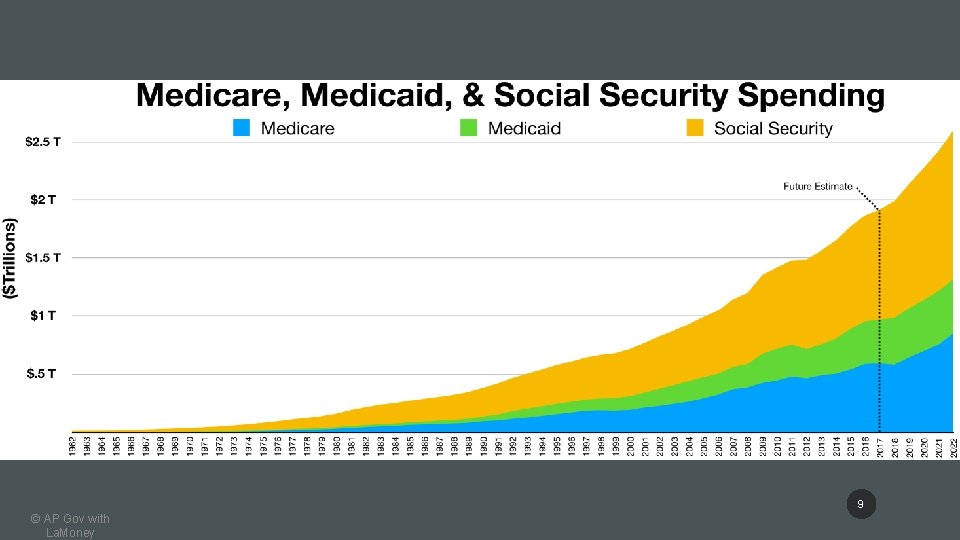
SOCIAL SECURITY & MEDICARE • In 2020 Social Security spending is projected to be just over $1. 1 trillion and Medicare spending is projected to be $679 billion. • As seen in the last graph, this spending on this programs has dramatically increased and is projected to continue its increase for decades. • By 2035 the program will only be able to pay out 79% of the promised benefits.
SOCIAL SECURITY & MEDICARE • Why is the spending on these programs increasing so dramatically? • The very large Baby Boomer generation is retiring • Longer life expectancy • What can be done to fix these programs before the point of crisis comes? • Increase payroll taxes • Decrease benefits • Increase age requirements • Why is it so politically difficult to fix these programs? • Need 60 votes to get past a filibuster in Senate; raising taxes and
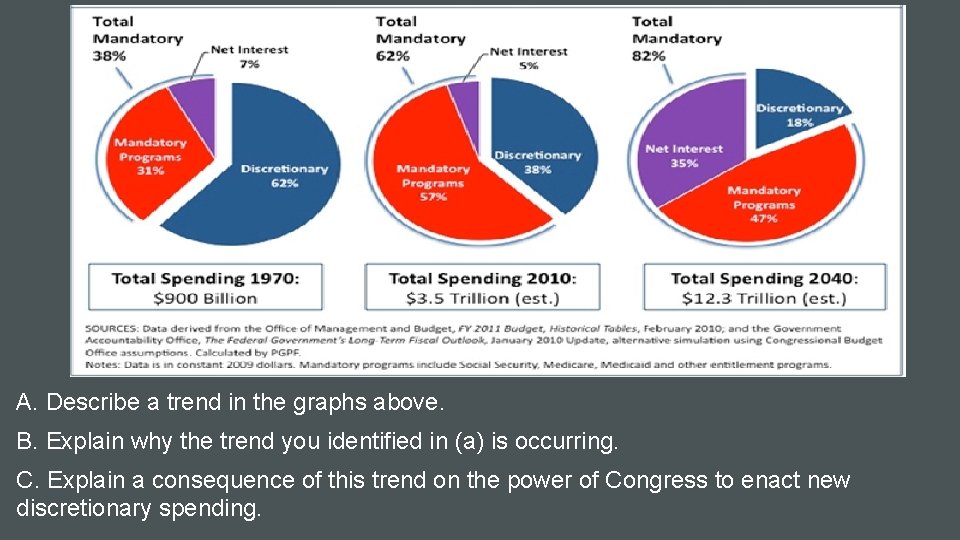
A. Describe a trend in the graphs above. B. Explain why the trend you identified in (a) is occurring. C. Explain a consequence of this trend on the power of Congress to enact new discretionary spending.
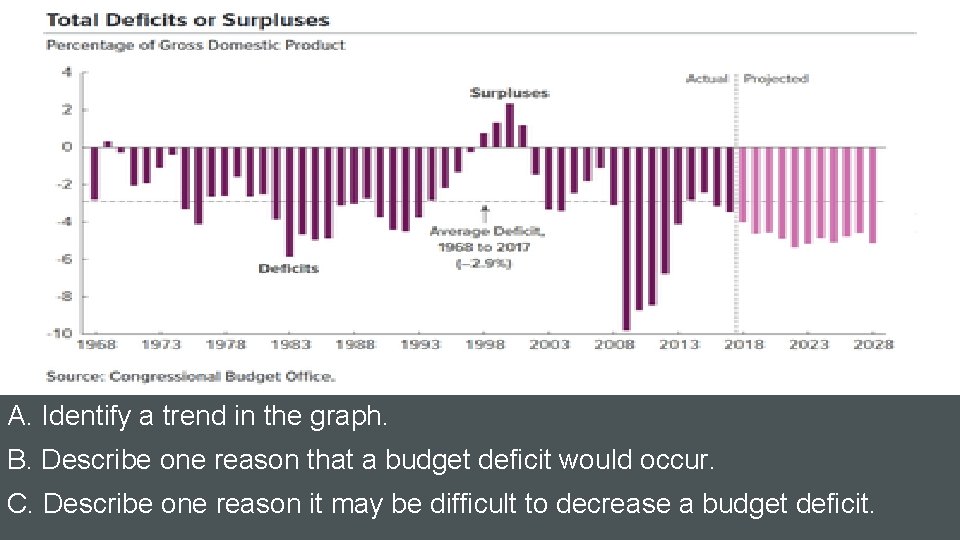
A. Identify a trend in the graph. B. Describe one reason that a budget deficit would occur. C. Describe one reason it may be difficult to decrease a budget deficit.
RISING ENTITLEMENT COSTS & BUDGETARY PRESSURE • Congress must generate a budget that addresses both discretionary and mandatory spending, and as entitlement costs grow, discretionary spending opportunities will decrease unless tax revenues increase or the budget deficit increases • Pork Barrel Legislation • Legislation that brings tangible benefits to a district: $, jobs, programs • Logrolling • Vote trading: “You vote for mine, I vote for yours”
- Slides: 14