
Topic 17 Analysis of Algorithms Analysis of Algorithms
- Slides: 47
Topic 17 Analysis of Algorithms
Analysis of Algorithms- Review • Efficiency of an algorithm can be measured in terms of : • Time complexity: a measure of the amount of time required to execute an algorithm • Space complexity: amount of memory required • Which measure is more important? • It often depends on the limitations of the technology available at time of analysis (e. g. processor speed vs memory space) 2
Time Complexity Analysis • Objectives of time complexity analysis: • To determine the feasibility of an algorithm by estimating an upper bound on the amount of work performed • To compare different algorithms before deciding which one to implement • Time complexity analysis for an algorithm is independent of the programming language and the machine used 3
Time Complexity Analysis • Time complexity expresses the relationship between • the size of the input • and the execution time for the algorithm • Usually expressed as a proportionality, rather than an exact function 4
Time Complexity Measurement • Essentially based on the number of basic operations in an algorithm: • • • Number of arithmetic operations performed Number of comparisons Number of times through a critical loop Number of array elements accessed etc. • Think of this as the work done 5
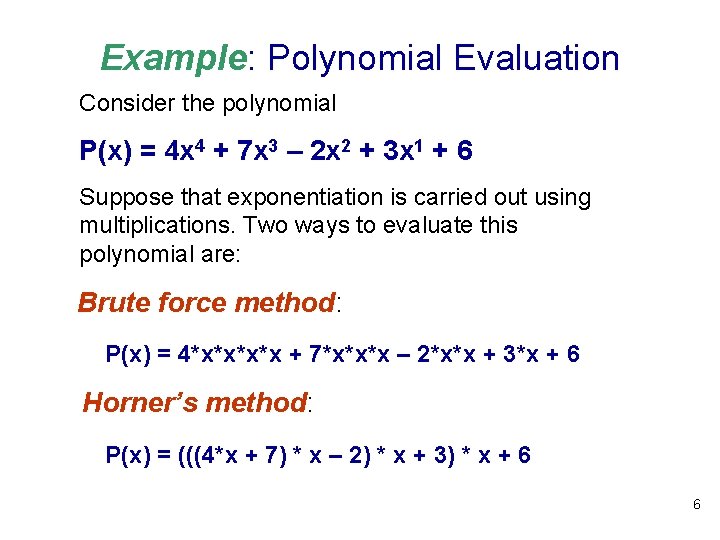
Example: Polynomial Evaluation Consider the polynomial P(x) = 4 x 4 + 7 x 3 – 2 x 2 + 3 x 1 + 6 Suppose that exponentiation is carried out using multiplications. Two ways to evaluate this polynomial are: Brute force method: P(x) = 4*x*x + 7*x*x*x – 2*x*x + 3*x + 6 Horner’s method: P(x) = (((4*x + 7) * x – 2) * x + 3) * x + 6 6
Method of analysis • What are the basic operations here? • multiplication, addition, and subtraction • We’ll only consider the number of multiplications, since the number of additions and subtractions are the same in each solution • We’ll examine the general form of a polynomial of degree n, and express our result in terms of n • We’ll look at the worst case (maximum number of multiplications) to get an upper bound on the work 7
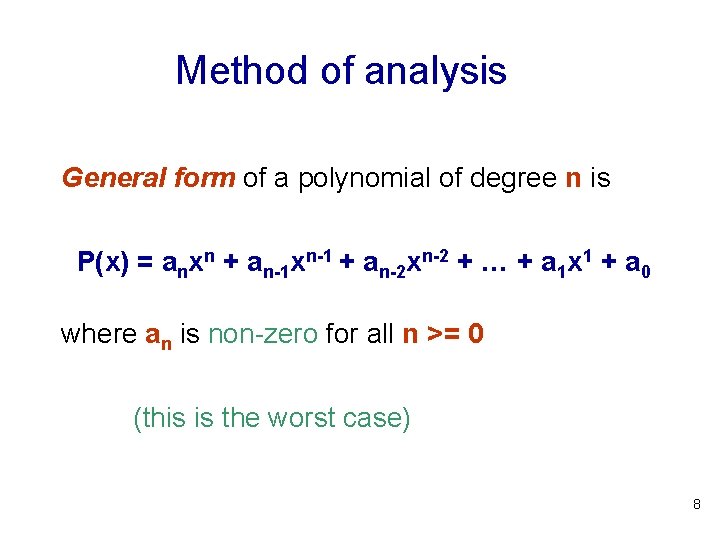
Method of analysis General form of a polynomial of degree n is P(x) = anxn + an-1 xn-1 + an-2 xn-2 + … + a 1 x 1 + a 0 where an is non-zero for all n >= 0 (this is the worst case) 8
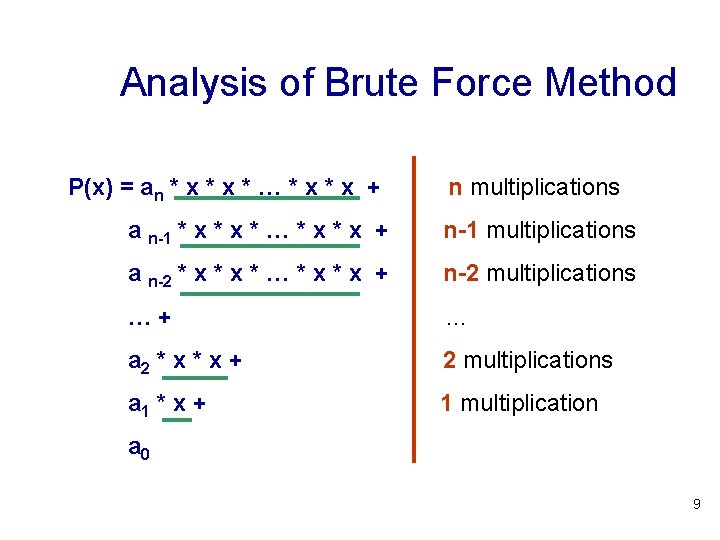
Analysis of Brute Force Method P(x) = an * x * … * x + n multiplications a n-1 * x * … * x + n-1 multiplications a n-2 * x * … * x + n-2 multiplications …+ … a 2 * x + 2 multiplications a 1 * x + 1 multiplication a 0 9
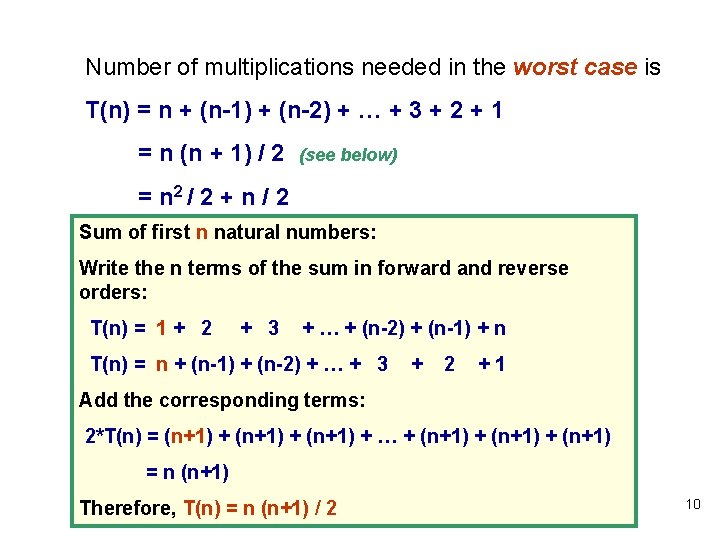
Number of multiplications needed in the worst case is T(n) = n + (n-1) + (n-2) + … + 3 + 2 + 1 = n (n + 1) / 2 (see below) = n 2 / 2 + n / 2 Sum of first n natural numbers: Write the n terms of the sum in forward and reverse orders: T(n) = 1 + 2 + 3 + … + (n-2) + (n-1) + n T(n) = n + (n-1) + (n-2) + … + 3 + 2 +1 Add the corresponding terms: 2*T(n) = (n+1) + … + (n+1) = n (n+1) Therefore, T(n) = n (n+1) / 2 10
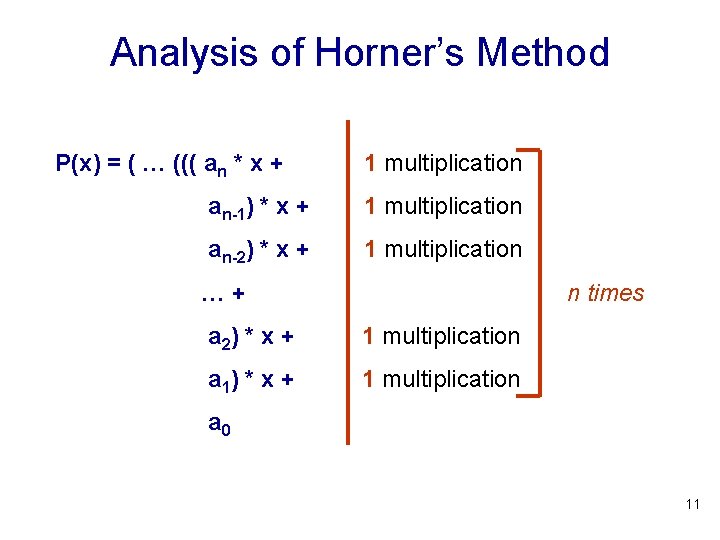
Analysis of Horner’s Method P(x) = ( … ((( an * x + 1 multiplication an-1) * x + 1 multiplication an-2) * x + 1 multiplication …+ n times a 2) * x + 1 multiplication a 1) * x + 1 multiplication a 0 11
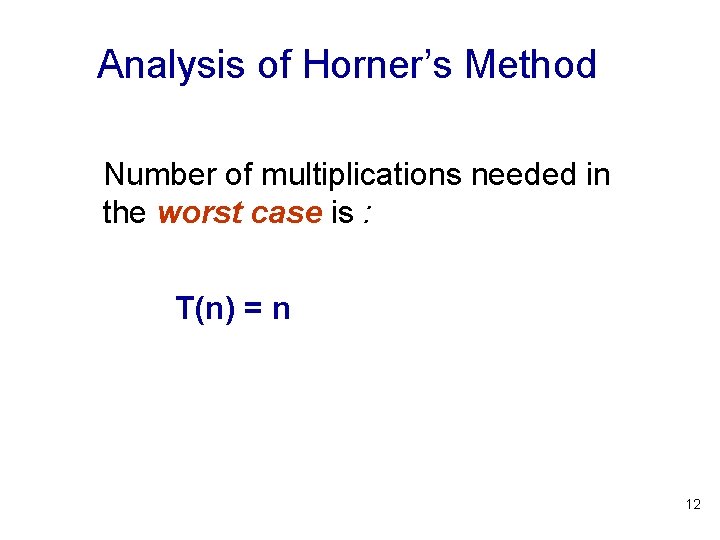
Analysis of Horner’s Method Number of multiplications needed in the worst case is : T(n) = n 12
Big-O Notation • Analysis of Brute Force and Horner’s methods came up with exact formulae for the maximum number of multiplications • In general, though, we want upper bounds rather than exact formulae: we will use the Big-O notation introduced earlier … 13
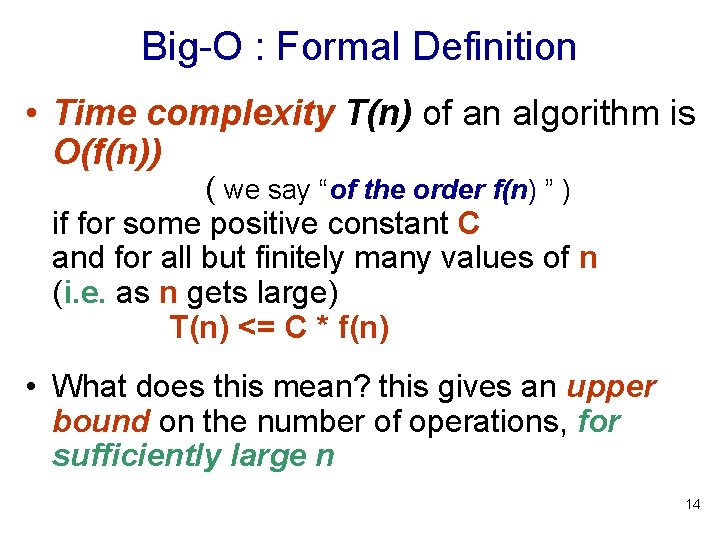
Big-O : Formal Definition • Time complexity T(n) of an algorithm is O(f(n)) ( we say “of the order f(n) ” ) if for some positive constant C and for all but finitely many values of n (i. e. as n gets large) T(n) <= C * f(n) • What does this mean? this gives an upper bound on the number of operations, for sufficiently large n 14
Big-O Analysis • We want our f(n) to be an easily recognized elementary function that describes the performance of the algorithm 15
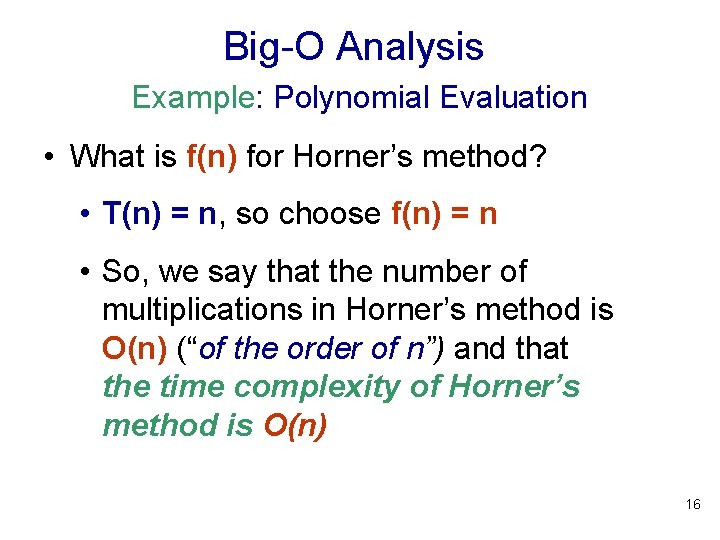
Big-O Analysis Example: Polynomial Evaluation • What is f(n) for Horner’s method? • T(n) = n, so choose f(n) = n • So, we say that the number of multiplications in Horner’s method is O(n) (“of the order of n”) and that the time complexity of Horner’s method is O(n) 16
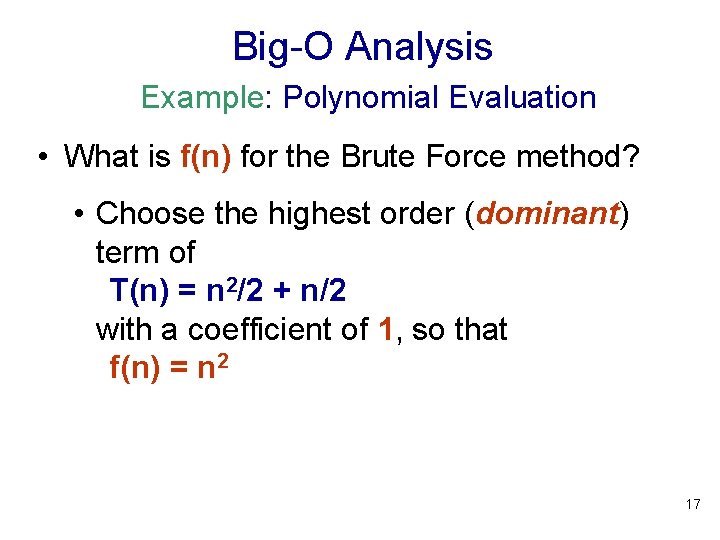
Big-O Analysis Example: Polynomial Evaluation • What is f(n) for the Brute Force method? • Choose the highest order (dominant) term of T(n) = n 2/2 + n/2 with a coefficient of 1, so that f(n) = n 2 17
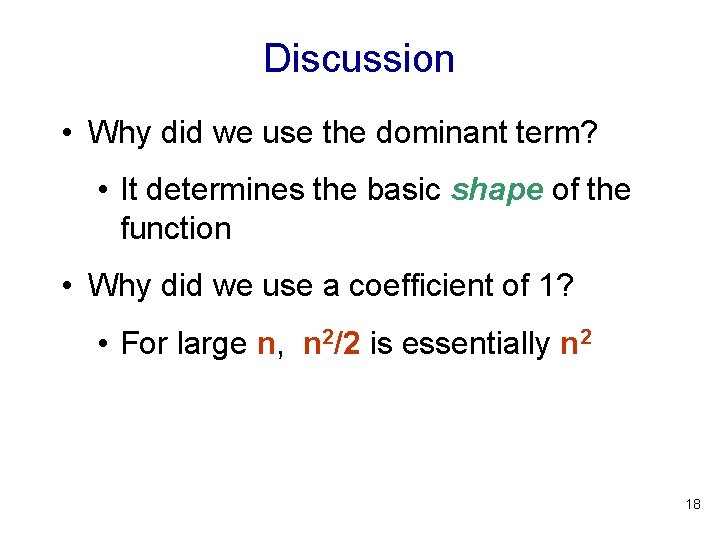
Discussion • Why did we use the dominant term? • It determines the basic shape of the function • Why did we use a coefficient of 1? • For large n, n 2/2 is essentially n 2 18
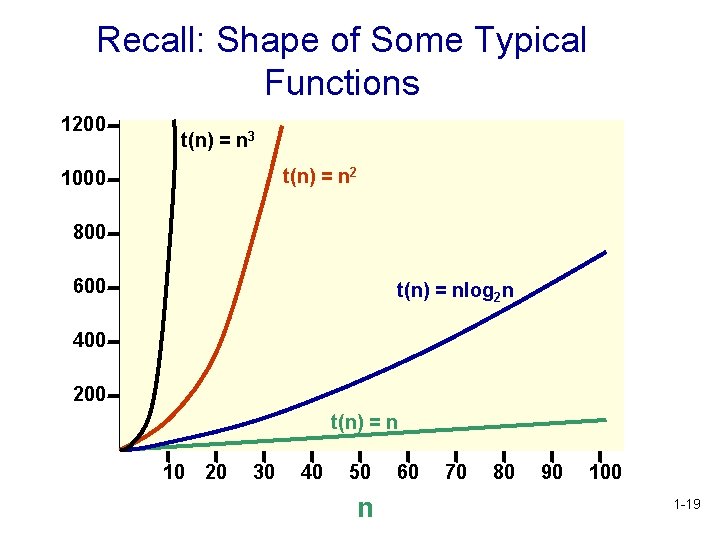
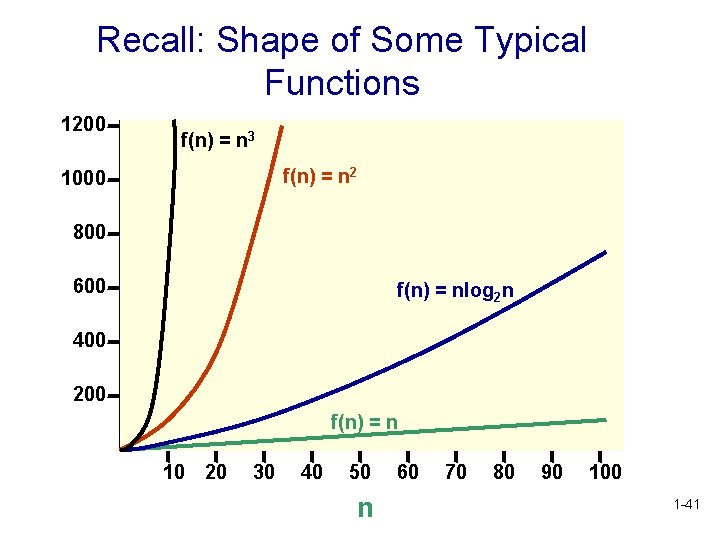
Recall: Shape of Some Typical Functions 1200 t(n) = n 3 t(n) = n 2 1000 800 600 t(n) = nlog 2 n 400 200 t(n) = n 10 20 30 40 50 n 60 70 80 90 100 1 -19 19
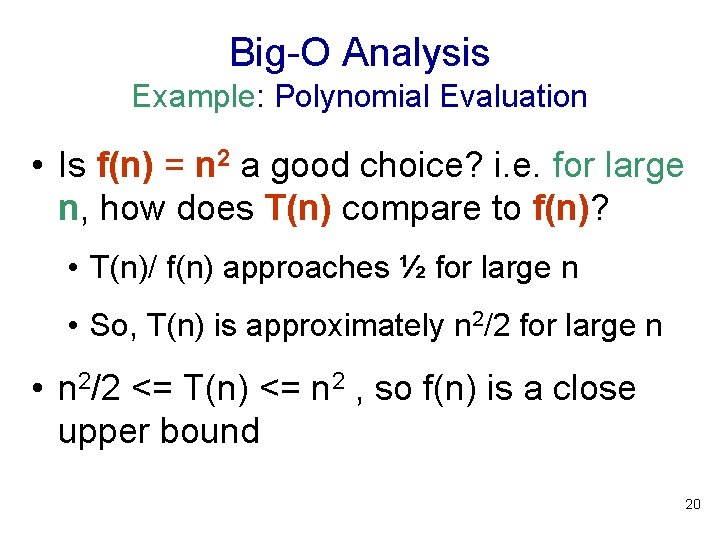
Big-O Analysis Example: Polynomial Evaluation • Is f(n) = n 2 a good choice? i. e. for large n, how does T(n) compare to f(n)? • T(n)/ f(n) approaches ½ for large n • So, T(n) is approximately n 2/2 for large n • n 2/2 <= T(n) <= n 2 , so f(n) is a close upper bound 20
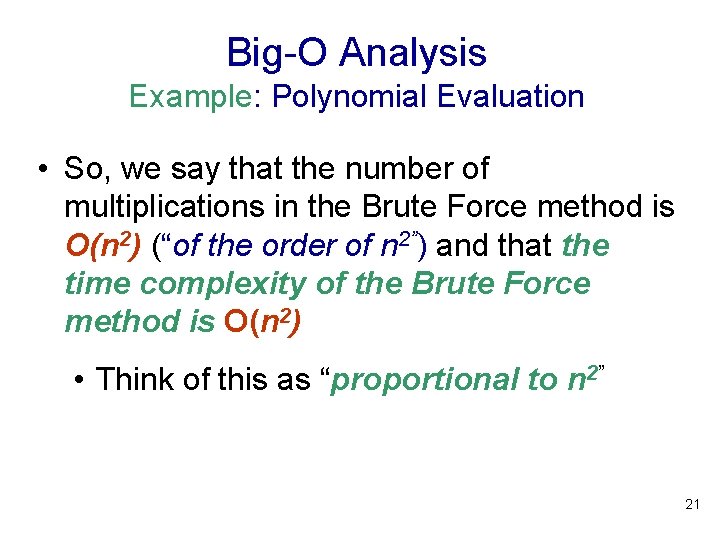
Big-O Analysis Example: Polynomial Evaluation • So, we say that the number of multiplications in the Brute Force method is O(n 2) (“of the order of n 2”) and that the time complexity of the Brute Force method is O(n 2) • Think of this as “proportional to n 2” 21
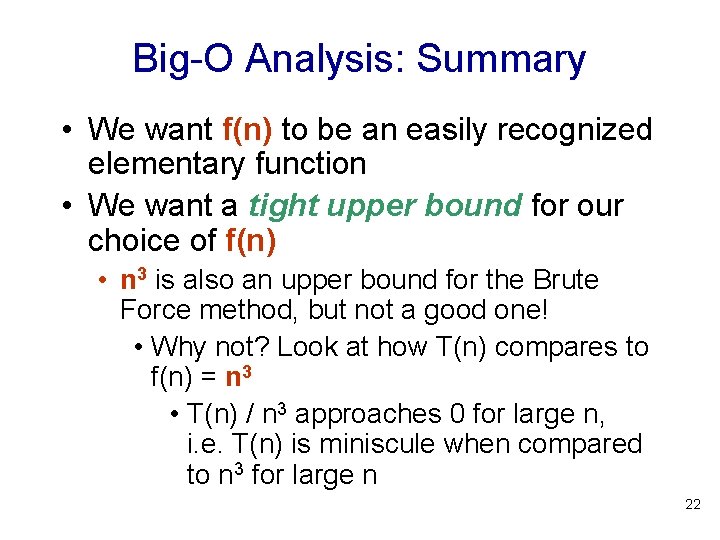
Big-O Analysis: Summary • We want f(n) to be an easily recognized elementary function • We want a tight upper bound for our choice of f(n) • n 3 is also an upper bound for the Brute Force method, but not a good one! • Why not? Look at how T(n) compares to f(n) = n 3 • T(n) / n 3 approaches 0 for large n, i. e. T(n) is miniscule when compared to n 3 for large n 22
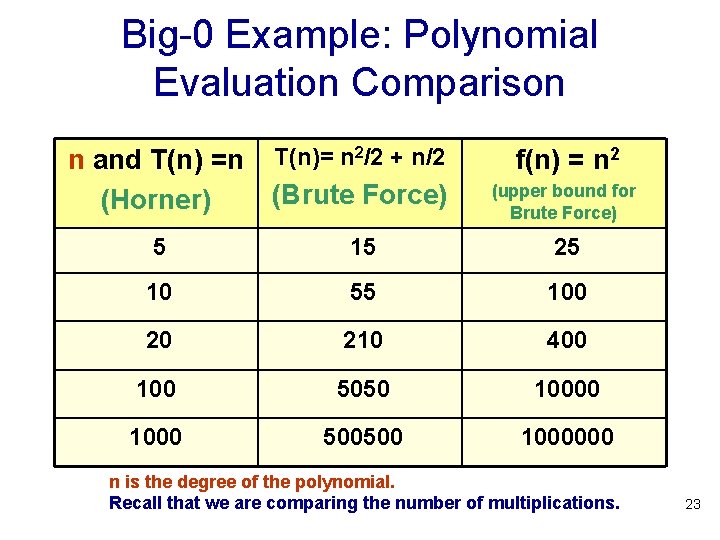
Big-0 Example: Polynomial Evaluation Comparison n and T(n) =n (Horner) T(n)= n 2/2 + n/2 f(n) = n 2 (Brute Force) (upper bound for Brute Force) 5 15 25 10 55 100 20 210 400 100 5050 1000 500500 1000000 n is the degree of the polynomial. Recall that we are comparing the number of multiplications. 23
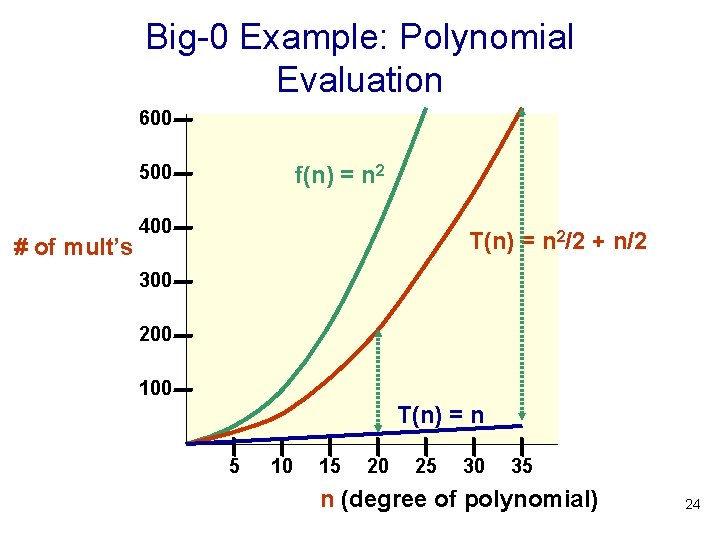
Big-0 Example: Polynomial Evaluation 600 500 # of mult’s f(n) = n 2 400 T(n) = n 2/2 + n/2 300 200 100 T(n) = n 5 10 15 20 25 30 35 n (degree of polynomial) 24
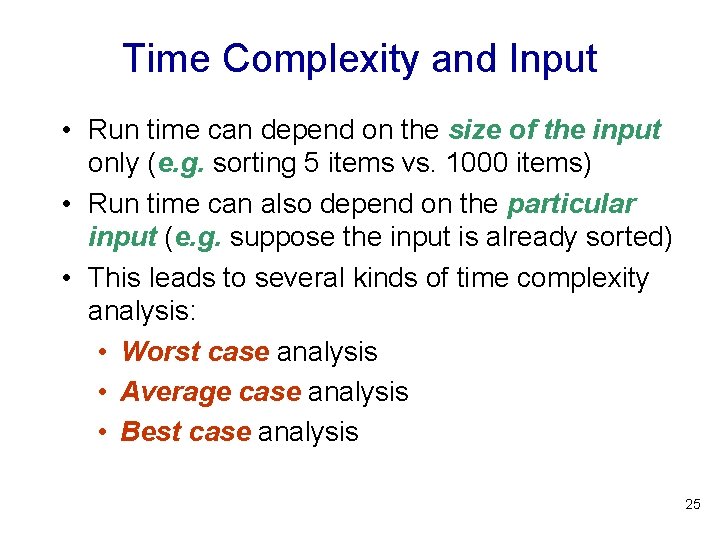
Time Complexity and Input • Run time can depend on the size of the input only (e. g. sorting 5 items vs. 1000 items) • Run time can also depend on the particular input (e. g. suppose the input is already sorted) • This leads to several kinds of time complexity analysis: • Worst case analysis • Average case analysis • Best case analysis 25
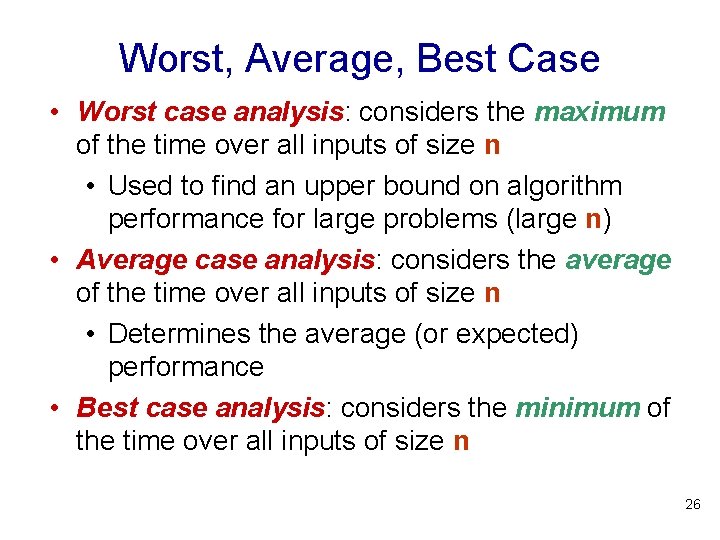
Worst, Average, Best Case • Worst case analysis: considers the maximum of the time over all inputs of size n • Used to find an upper bound on algorithm performance for large problems (large n) • Average case analysis: considers the average of the time over all inputs of size n • Determines the average (or expected) performance • Best case analysis: considers the minimum of the time over all inputs of size n 26
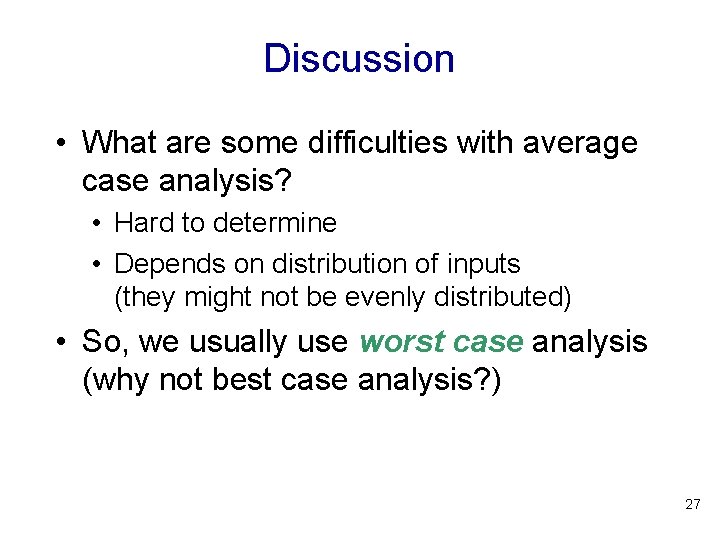
Discussion • What are some difficulties with average case analysis? • Hard to determine • Depends on distribution of inputs (they might not be evenly distributed) • So, we usually use worst case analysis (why not best case analysis? ) 27
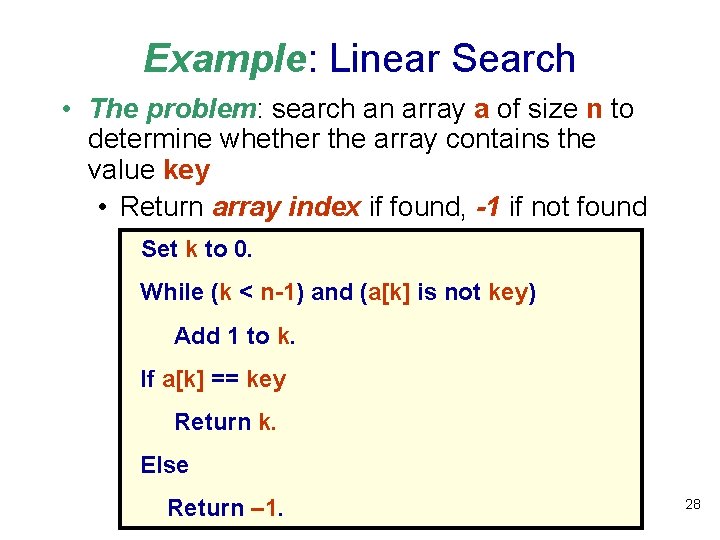
Example: Linear Search • The problem: search an array a of size n to determine whether the array contains the value key • Return array index if found, -1 if not found Set k to 0. While (k < n-1) and (a[k] is not key) Add 1 to k. If a[k] == key Return k. Else Return – 1. 28
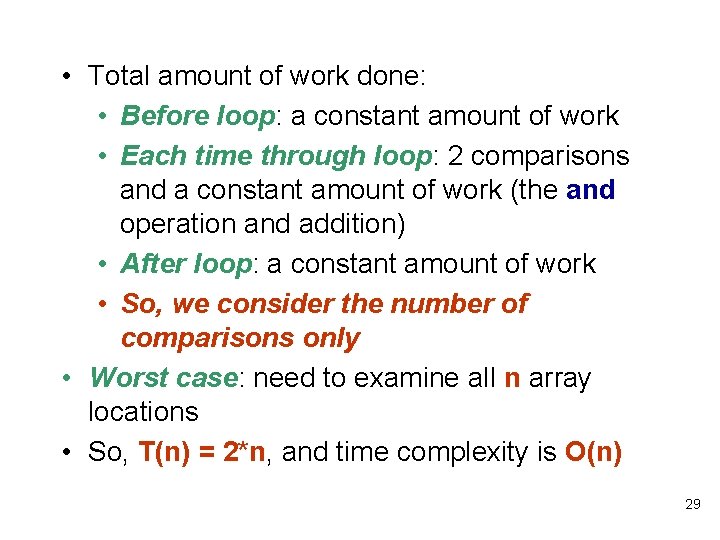
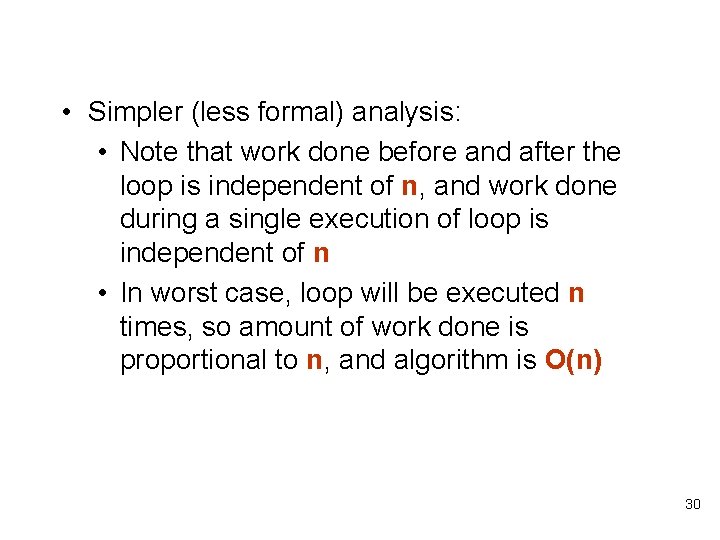
• Total amount of work done: • Before loop: a constant amount of work • Each time through loop: 2 comparisons and a constant amount of work (the and operation and addition) • After loop: a constant amount of work • So, we consider the number of comparisons only • Worst case: need to examine all n array locations • So, T(n) = 2*n, and time complexity is O(n) 29
• Simpler (less formal) analysis: • Note that work done before and after the loop is independent of n, and work done during a single execution of loop is independent of n • In worst case, loop will be executed n times, so amount of work done is proportional to n, and algorithm is O(n) 30
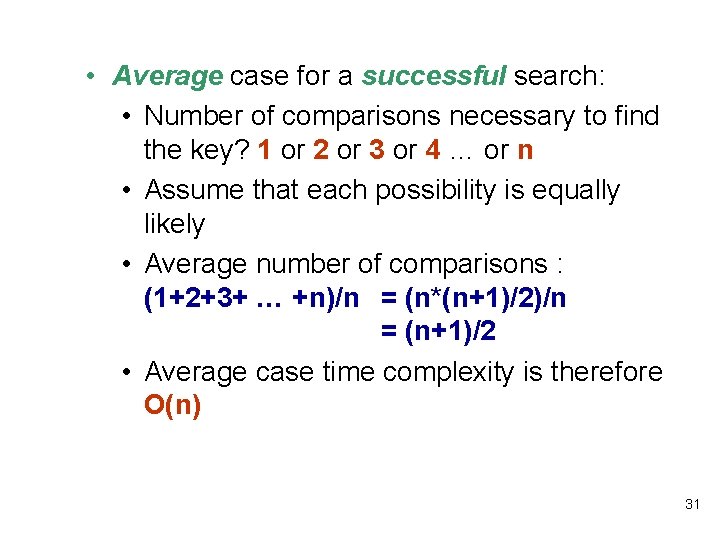
• Average case for a successful search: • Number of comparisons necessary to find the key? 1 or 2 or 3 or 4 … or n • Assume that each possibility is equally likely • Average number of comparisons : (1+2+3+ … +n)/n = (n*(n+1)/2)/n = (n+1)/2 • Average case time complexity is therefore O(n) 31
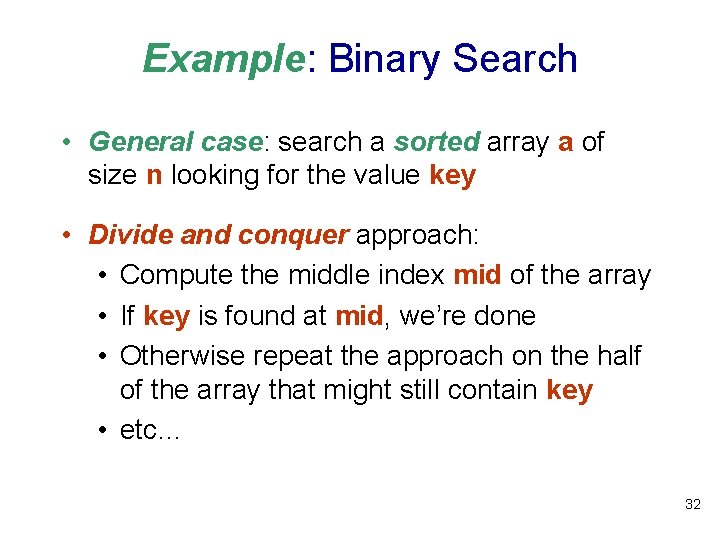
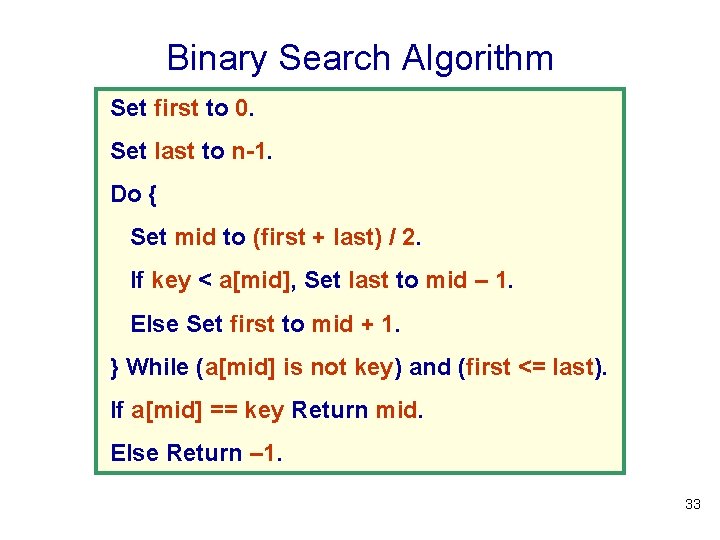
Example: Binary Search • General case: search a sorted array a of size n looking for the value key • Divide and conquer approach: • Compute the middle index mid of the array • If key is found at mid, we’re done • Otherwise repeat the approach on the half of the array that might still contain key • etc… 32
Binary Search Algorithm Set first to 0. Set last to n-1. Do { Set mid to (first + last) / 2. If key < a[mid], Set last to mid – 1. Else Set first to mid + 1. } While (a[mid] is not key) and (first <= last). If a[mid] == key Return mid. Else Return – 1. 33
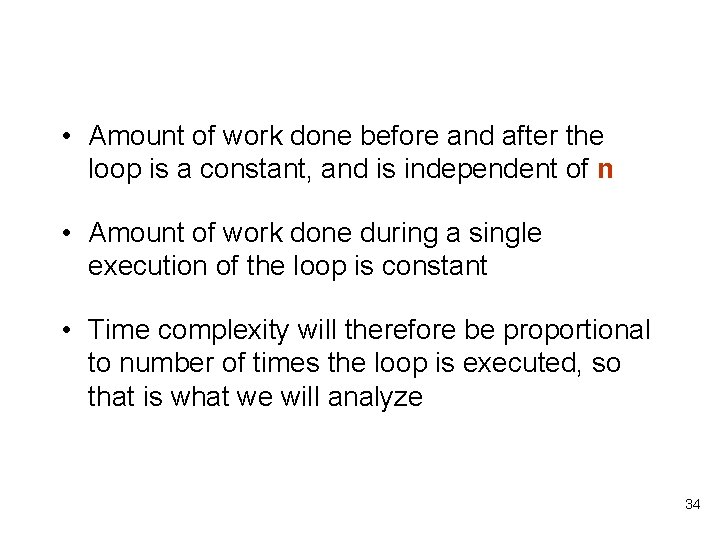
• Amount of work done before and after the loop is a constant, and is independent of n • Amount of work done during a single execution of the loop is constant • Time complexity will therefore be proportional to number of times the loop is executed, so that is what we will analyze 34
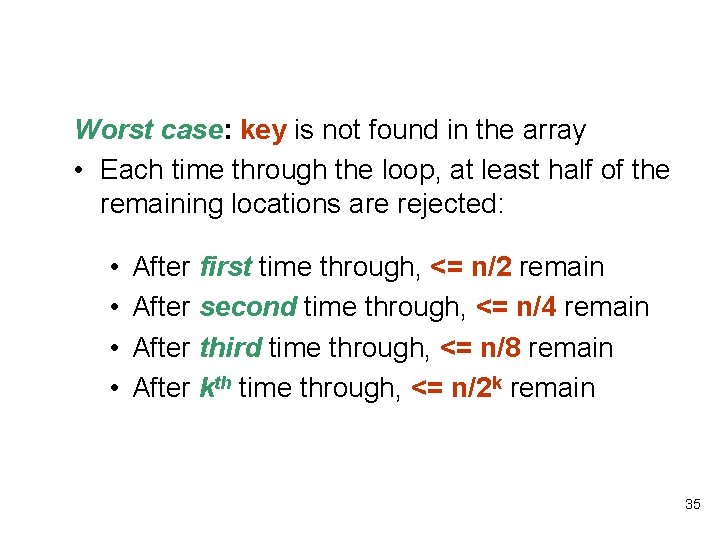
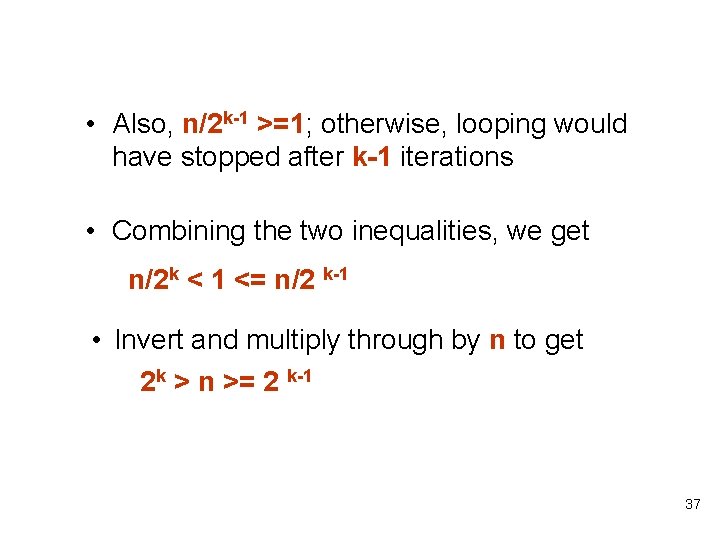
Worst case: key is not found in the array • Each time through the loop, at least half of the remaining locations are rejected: • • After first time through, <= n/2 remain After second time through, <= n/4 remain After third time through, <= n/8 remain After kth time through, <= n/2 k remain 35
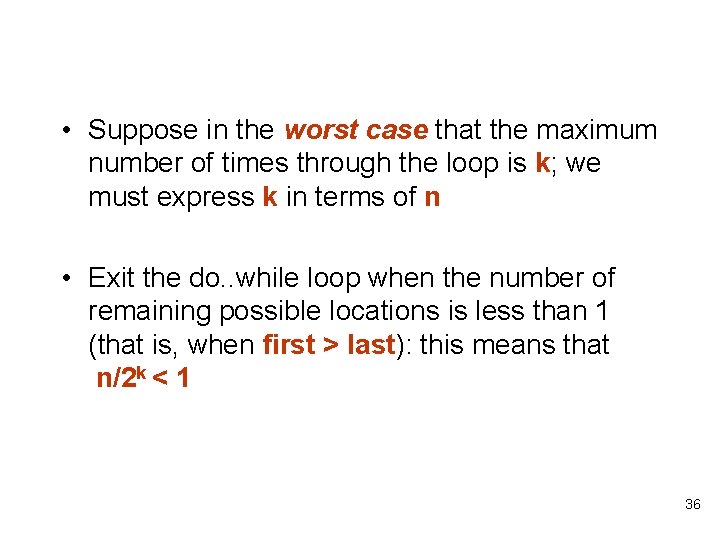
• Suppose in the worst case that the maximum number of times through the loop is k; we must express k in terms of n • Exit the do. . while loop when the number of remaining possible locations is less than 1 (that is, when first > last): this means that n/2 k < 1 36
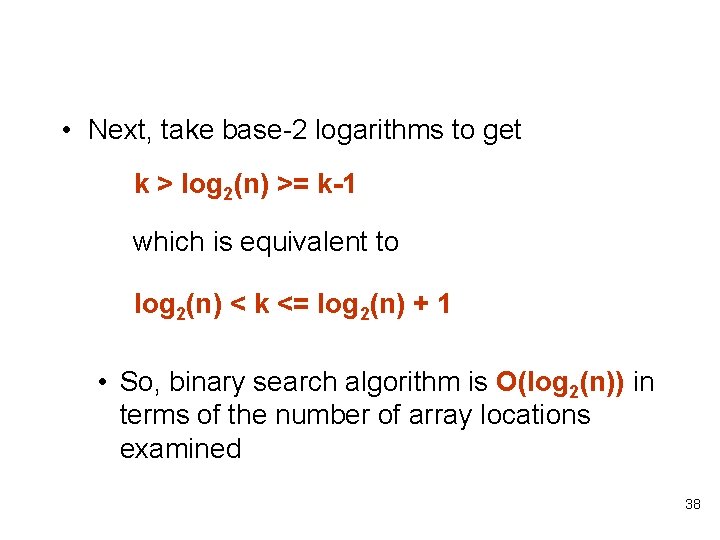
• Also, n/2 k-1 >=1; otherwise, looping would have stopped after k-1 iterations • Combining the two inequalities, we get n/2 k < 1 <= n/2 k-1 • Invert and multiply through by n to get 2 k > n >= 2 k-1 37
• Next, take base-2 logarithms to get k > log 2(n) >= k-1 which is equivalent to log 2(n) < k <= log 2(n) + 1 • So, binary search algorithm is O(log 2(n)) in terms of the number of array locations examined 38
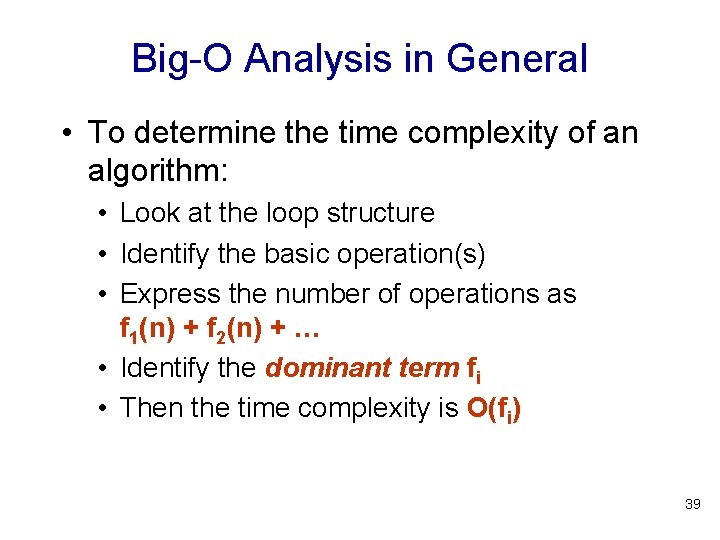
Big-O Analysis in General • To determine the time complexity of an algorithm: • Look at the loop structure • Identify the basic operation(s) • Express the number of operations as f 1(n) + f 2(n) + … • Identify the dominant term fi • Then the time complexity is O(fi) 39
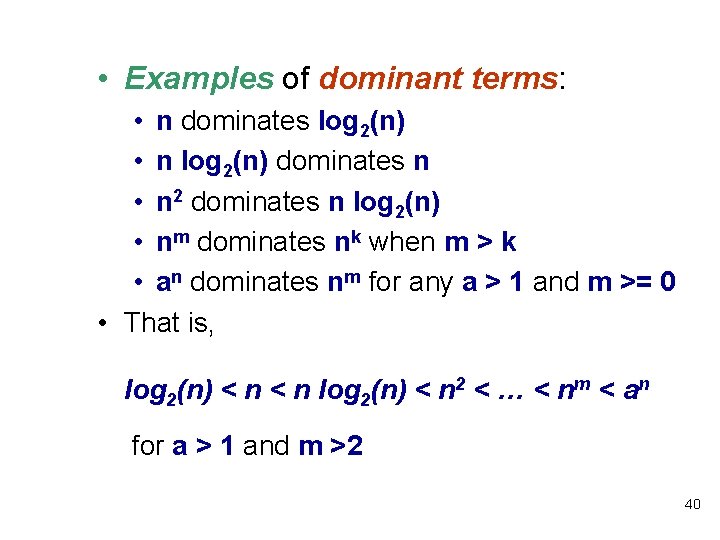
• Examples of dominant terms: • n dominates log 2(n) • n log 2(n) dominates n • n 2 dominates n log 2(n) • nm dominates nk when m > k • an dominates nm for any a > 1 and m >= 0 • That is, log 2(n) < n 2 < … < nm < an for a > 1 and m >2 40
Recall: Shape of Some Typical Functions 1200 f(n) = n 3 f(n) = n 2 1000 800 600 f(n) = nlog 2 n 400 200 f(n) = n 10 20 30 40 50 n 60 70 80 90 100 1 -41 41
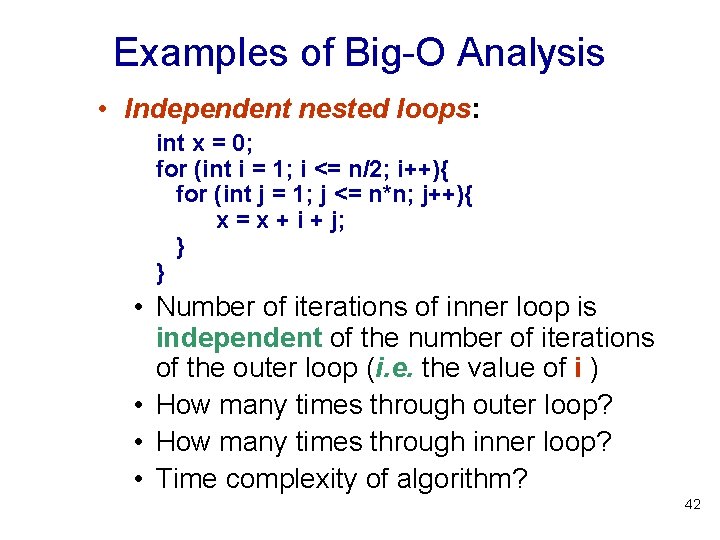
Examples of Big-O Analysis • Independent nested loops: int x = 0; for (int i = 1; i <= n/2; i++){ for (int j = 1; j <= n*n; j++){ x = x + i + j; } } • Number of iterations of inner loop is independent of the number of iterations of the outer loop (i. e. the value of i ) • How many times through outer loop? • How many times through inner loop? • Time complexity of algorithm? 42
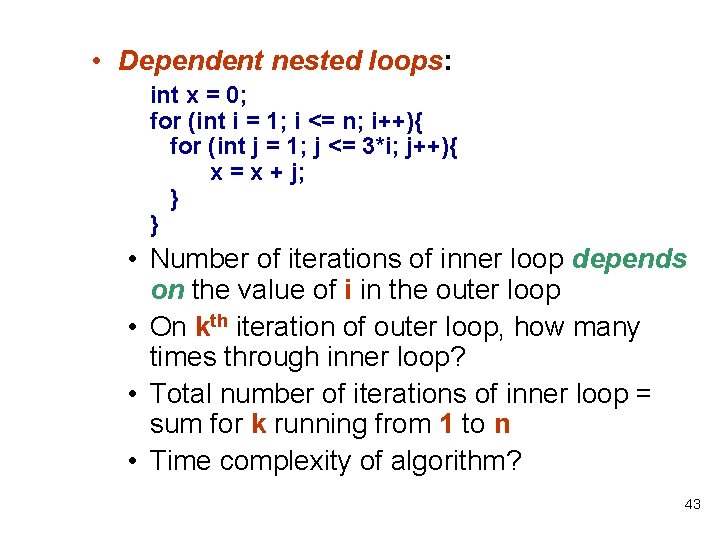
• Dependent nested loops: int x = 0; for (int i = 1; i <= n; i++){ for (int j = 1; j <= 3*i; j++){ x = x + j; } } • Number of iterations of inner loop depends on the value of i in the outer loop • On kth iteration of outer loop, how many times through inner loop? • Total number of iterations of inner loop = sum for k running from 1 to n • Time complexity of algorithm? 43
Usefulness of Big-O • We can compare algorithms for efficiency, for example: • Linear search vs binary search • Different sort algorithms • Iterative vs recursive solutions (recall Fibonacci sequence!) • We can estimate actual run times if we know the time complexity of the algorithm(s) we are analyzing 44
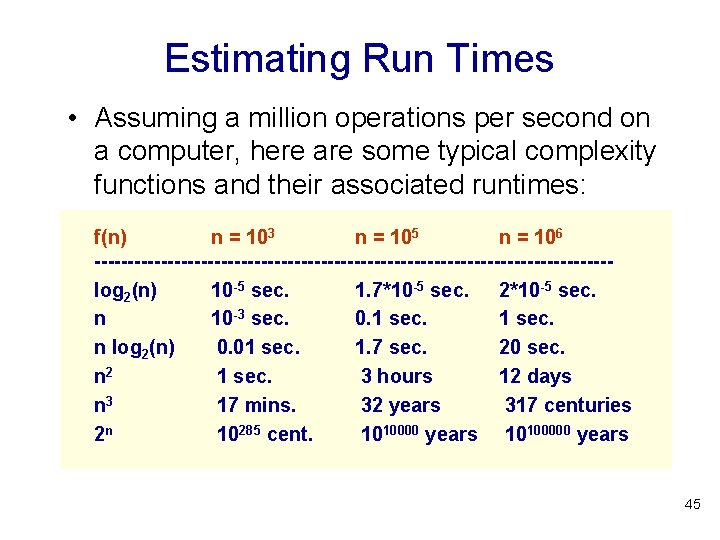
Estimating Run Times • Assuming a million operations per second on a computer, here are some typical complexity functions and their associated runtimes: f(n) n = 103 n = 105 n = 106 ---------------------------------------log 2(n) 10 -5 sec. 1. 7*10 -5 sec. 2*10 -5 sec. n 10 -3 sec. 0. 1 sec. n log 2(n) 0. 01 sec. 1. 7 sec. 20 sec. n 2 1 sec. 3 hours 12 days n 3 17 mins. 32 years 317 centuries 2 n 10285 cent. 1010000 years 10100000 years 45
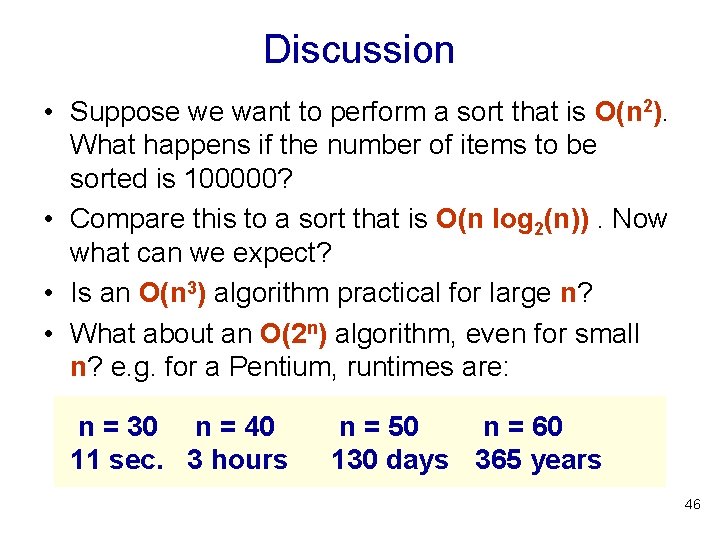
Discussion • Suppose we want to perform a sort that is O(n 2). What happens if the number of items to be sorted is 100000? • Compare this to a sort that is O(n log 2(n)). Now what can we expect? • Is an O(n 3) algorithm practical for large n? • What about an O(2 n) algorithm, even for small n? e. g. for a Pentium, runtimes are: n = 30 n = 40 11 sec. 3 hours n = 50 n = 60 130 days 365 years 46
Intractable Problems • A problem is said to be intractable if solving it by computer is impractical • Algorithms with time complexity O(2 n) take too long to solve even for moderate values of n • What are some examples we have seen? 47