
Topic 14 while loops and loop patterns Given
- Slides: 23
Topic 14 while loops and loop patterns "Given enough eyeballs, all bugs are shallow (e. g. , given a large enough beta-tester and co -developer base, almost every problem will be characterized quickly and the fix obvious to someone). " -Linus's Law, by Eric Raymond Copyright Pearson Education, 2010 Based on slides bu Marty Stepp and Stuart Reges from http: //www. buildingjavaprograms. com/
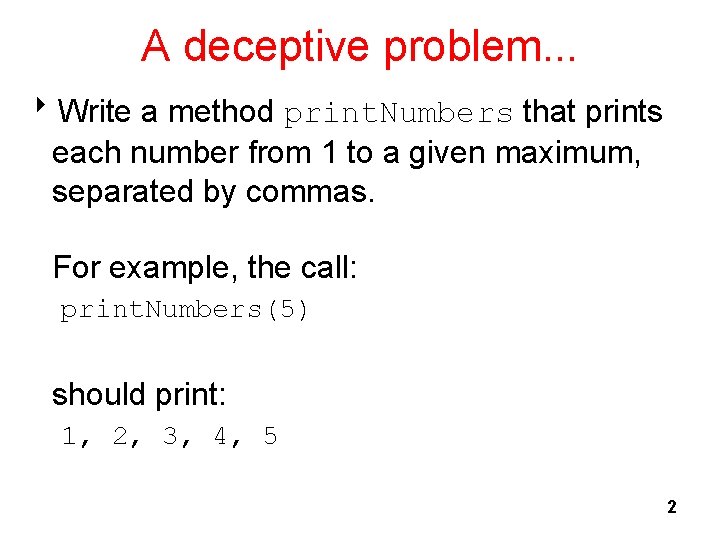
A deceptive problem. . . 8 Write a method print. Numbers that prints each number from 1 to a given maximum, separated by commas. For example, the call: print. Numbers(5) should print: 1, 2, 3, 4, 5 2
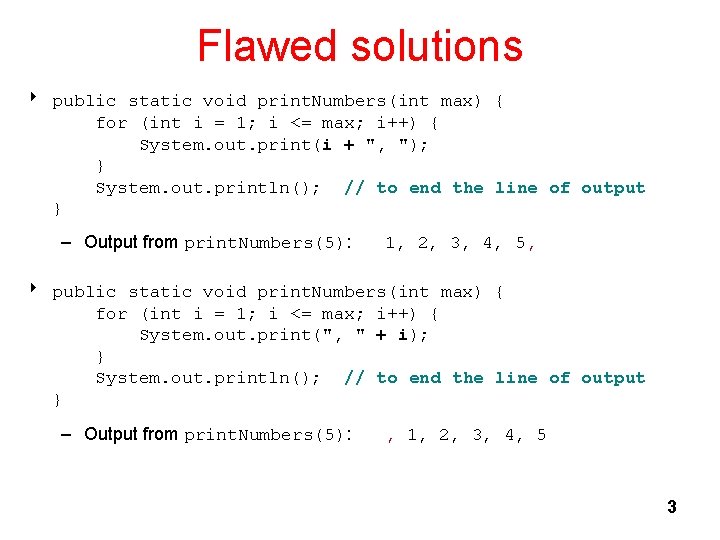
Flawed solutions 8 public static void print. Numbers(int max) { for (int i = 1; i <= max; i++) { System. out. print(i + ", "); } System. out. println(); // to end the line of output } – Output from print. Numbers(5): 1, 2, 3, 4, 5, 8 public static void print. Numbers(int max) { for (int i = 1; i <= max; i++) { System. out. print(", " + i); } System. out. println(); // to end the line of output } – Output from print. Numbers(5): , 1, 2, 3, 4, 5 3
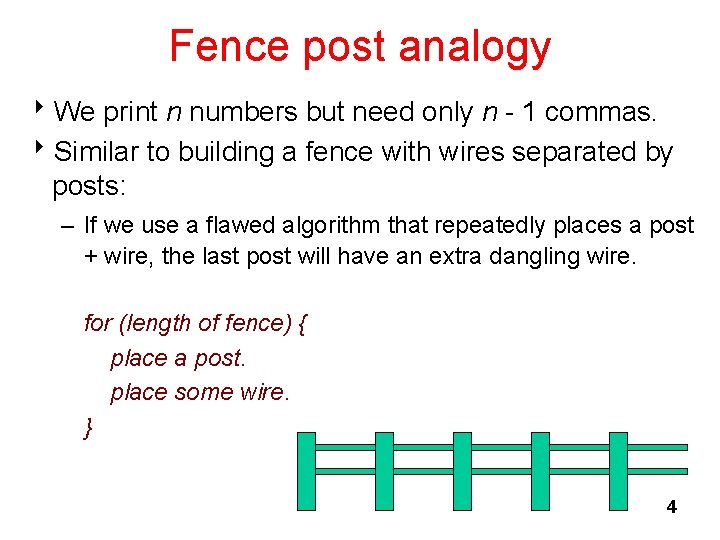
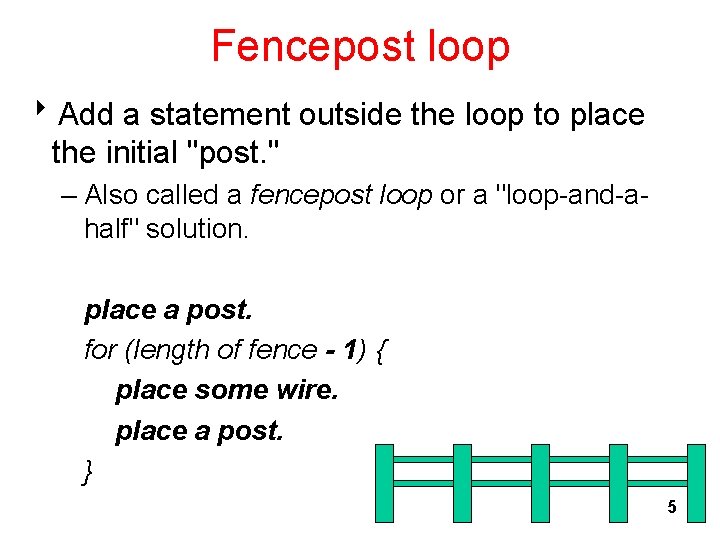
Fence post analogy 8 We print n numbers but need only n - 1 commas. 8 Similar to building a fence with wires separated by posts: – If we use a flawed algorithm that repeatedly places a post + wire, the last post will have an extra dangling wire. for (length of fence) { place a post. place some wire. } 4
Fencepost loop 8 Add a statement outside the loop to place the initial "post. " – Also called a fencepost loop or a "loop-and-ahalf" solution. place a post. for (length of fence - 1) { place some wire. place a post. } 5
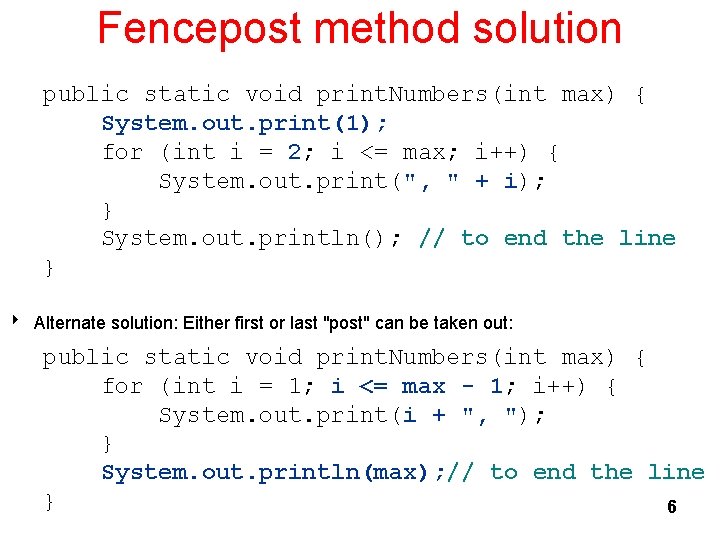
Fencepost method solution public static void print. Numbers(int max) { System. out. print(1); for (int i = 2; i <= max; i++) { System. out. print(", " + i); } System. out. println(); // to end the line } 8 Alternate solution: Either first or last "post" can be taken out: public static void print. Numbers(int max) { for (int i = 1; i <= max - 1; i++) { System. out. print(i + ", "); } System. out. println(max); // to end the line } 6
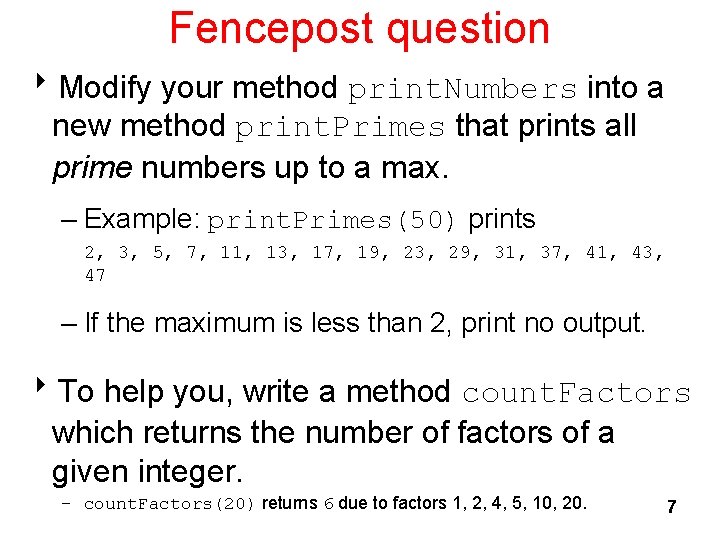
Fencepost question 8 Modify your method print. Numbers into a new method print. Primes that prints all prime numbers up to a max. – Example: print. Primes(50) prints 2, 3, 5, 7, 11, 13, 17, 19, 23, 29, 31, 37, 41, 43, 47 – If the maximum is less than 2, print no output. 8 To help you, write a method count. Factors which returns the number of factors of a given integer. – count. Factors(20) returns 6 due to factors 1, 2, 4, 5, 10, 20. 7
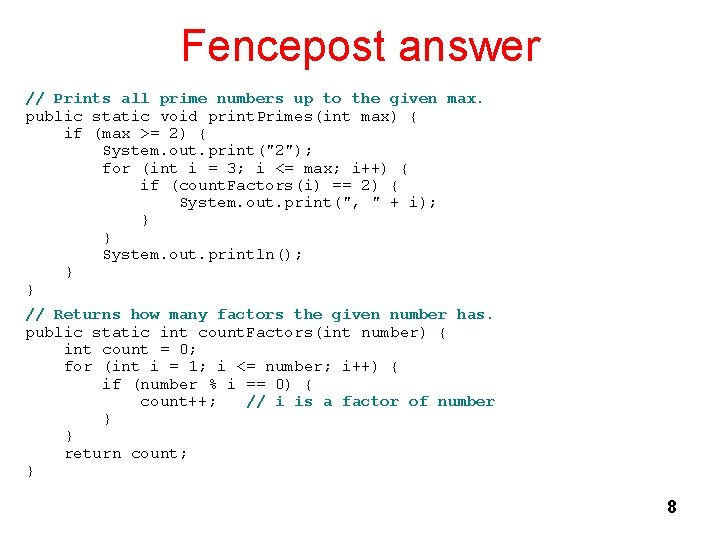
Fencepost answer // Prints all prime numbers up to the given max. public static void print. Primes(int max) { if (max >= 2) { System. out. print("2"); for (int i = 3; i <= max; i++) { if (count. Factors(i) == 2) { System. out. print(", " + i); } } System. out. println(); } } // Returns how many factors the given number has. public static int count. Factors(int number) { int count = 0; for (int i = 1; i <= number; i++) { if (number % i == 0) { count++; // i is a factor of number } } return count; } 8
while loops reading: 5. 1 9
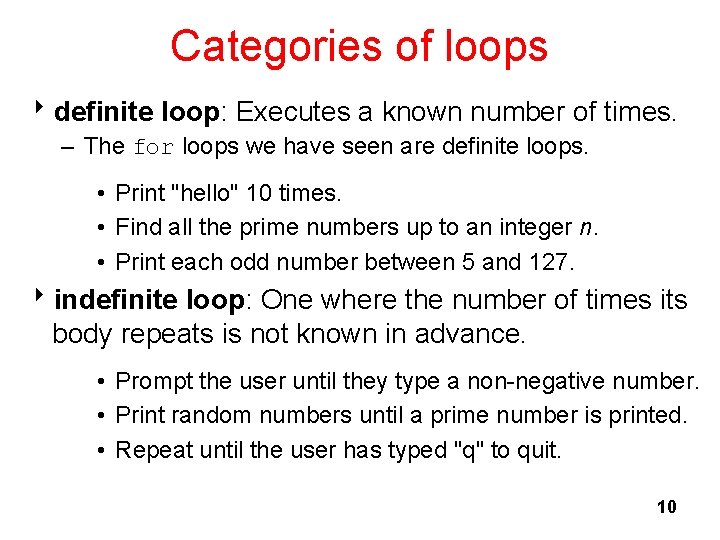
Categories of loops 8 definite loop: Executes a known number of times. – The for loops we have seen are definite loops. • Print "hello" 10 times. • Find all the prime numbers up to an integer n. • Print each odd number between 5 and 127. 8 indefinite loop: One where the number of times its body repeats is not known in advance. • Prompt the user until they type a non-negative number. • Print random numbers until a prime number is printed. • Repeat until the user has typed "q" to quit. 10
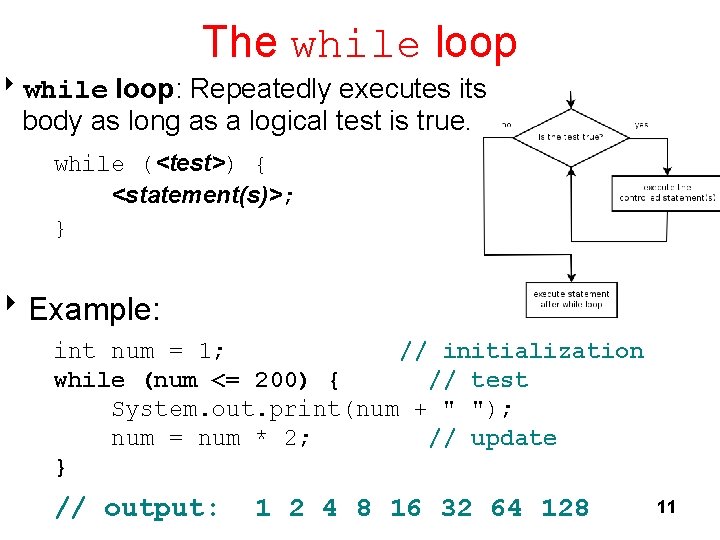
The while loop 8 while loop: Repeatedly executes its body as long as a logical test is true. while (<test>) { <statement(s)>; } 8 Example: int num = 1; // initialization while (num <= 200) { // test System. out. print(num + " "); num = num * 2; // update } // output: 1 2 4 8 16 32 64 128 11
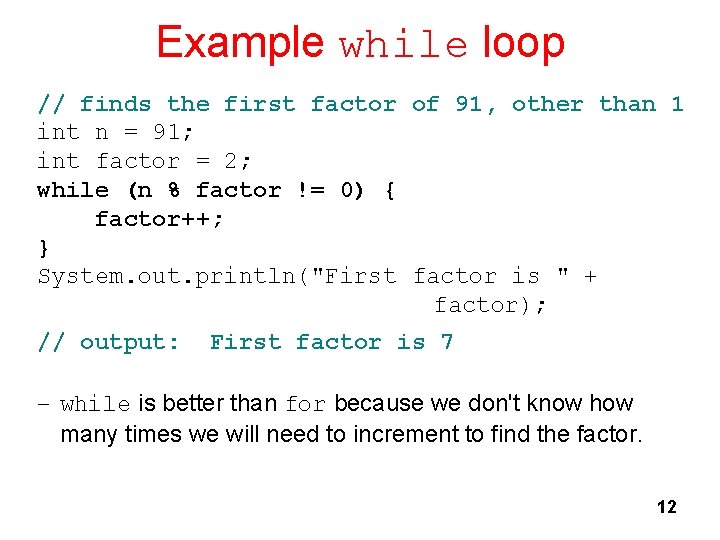
Example while loop // finds the first factor of 91, other than 1 int n = 91; int factor = 2; while (n % factor != 0) { factor++; } System. out. println("First factor is " + factor); // output: First factor is 7 – while is better than for because we don't know how many times we will need to increment to find the factor. 12
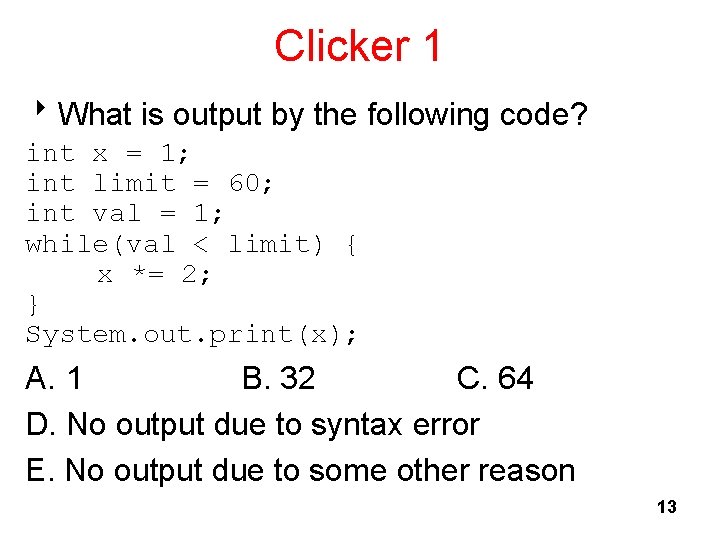
Clicker 1 8 What is output by the following code? int x = 1; int limit = 60; int val = 1; while(val < limit) { x *= 2; } System. out. print(x); A. 1 B. 32 C. 64 D. No output due to syntax error E. No output due to some other reason 13
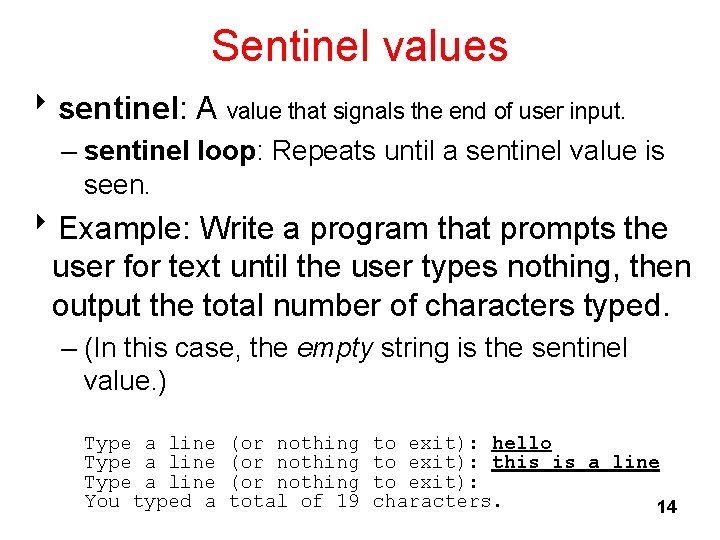
Sentinel values 8 sentinel: A value that signals the end of user input. – sentinel loop: Repeats until a sentinel value is seen. 8 Example: Write a program that prompts the user for text until the user types nothing, then output the total number of characters typed. – (In this case, the empty string is the sentinel value. ) Type a line You typed a (or nothing total of 19 to exit): hello to exit): this is a line to exit): characters. 14
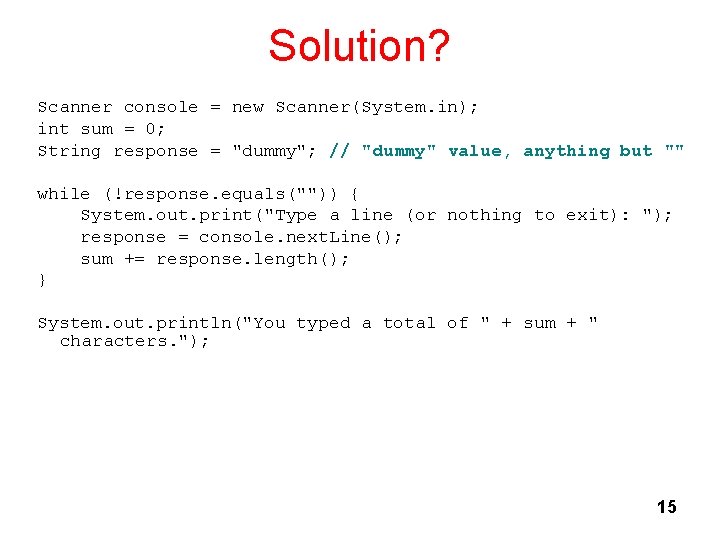
Solution? Scanner console = new Scanner(System. in); int sum = 0; String response = "dummy"; // "dummy" value, anything but "" while (!response. equals("")) { System. out. print("Type a line (or nothing to exit): "); response = console. next. Line(); sum += response. length(); } System. out. println("You typed a total of " + sum + " characters. "); 15
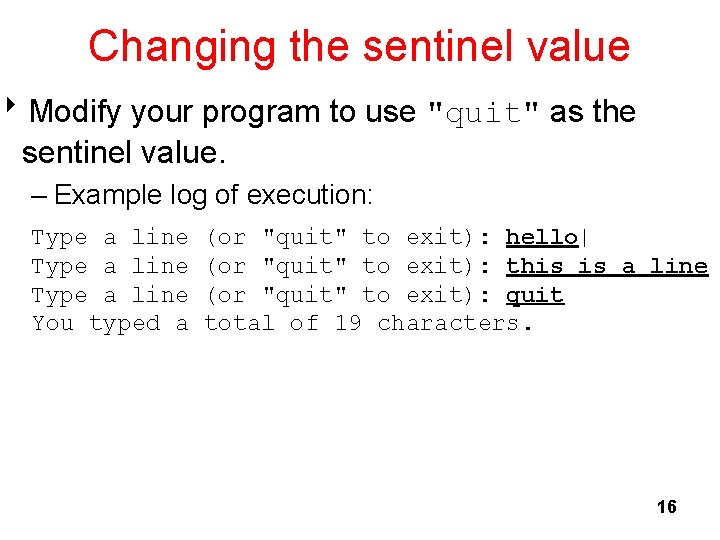
Changing the sentinel value 8 Modify your program to use "quit" as the sentinel value. – Example log of execution: Type a line You typed a (or "quit" to exit): hello| (or "quit" to exit): this is a line (or "quit" to exit): quit total of 19 characters. 16
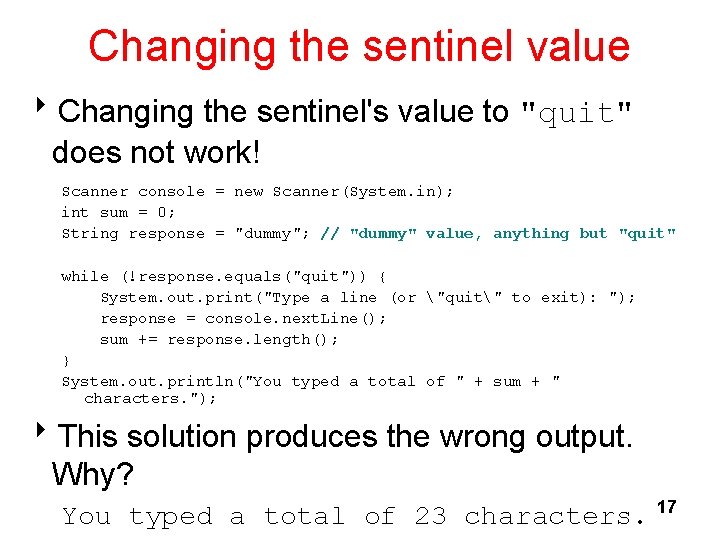
Changing the sentinel value 8 Changing the sentinel's value to "quit" does not work! Scanner console = new Scanner(System. in); int sum = 0; String response = "dummy"; // "dummy" value, anything but "quit" while (!response. equals("quit")) { System. out. print("Type a line (or "quit" to exit): "); response = console. next. Line(); sum += response. length(); } System. out. println("You typed a total of " + sum + " characters. "); 8 This solution produces the wrong output. Why? You typed a total of 23 characters. 17
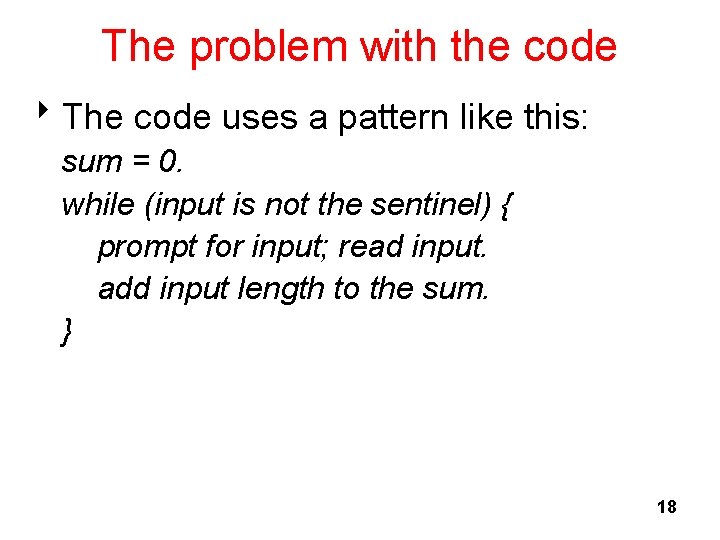
The problem with the code 8 The code uses a pattern like this: sum = 0. while (input is not the sentinel) { prompt for input; read input. add input length to the sum. } 18
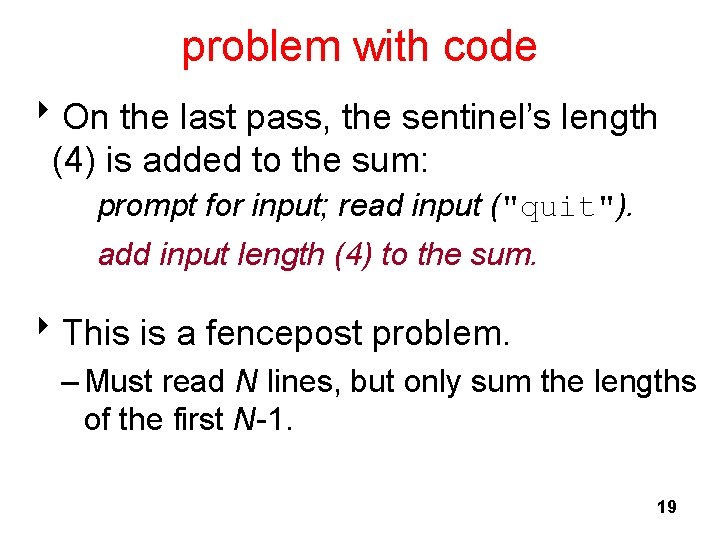
problem with code 8 On the last pass, the sentinel’s length (4) is added to the sum: prompt for input; read input ("quit"). add input length (4) to the sum. 8 This is a fencepost problem. – Must read N lines, but only sum the lengths of the first N-1. 19
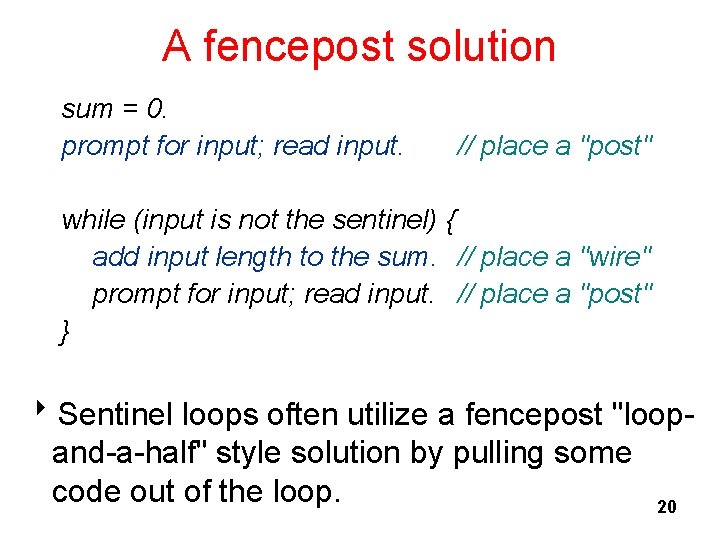
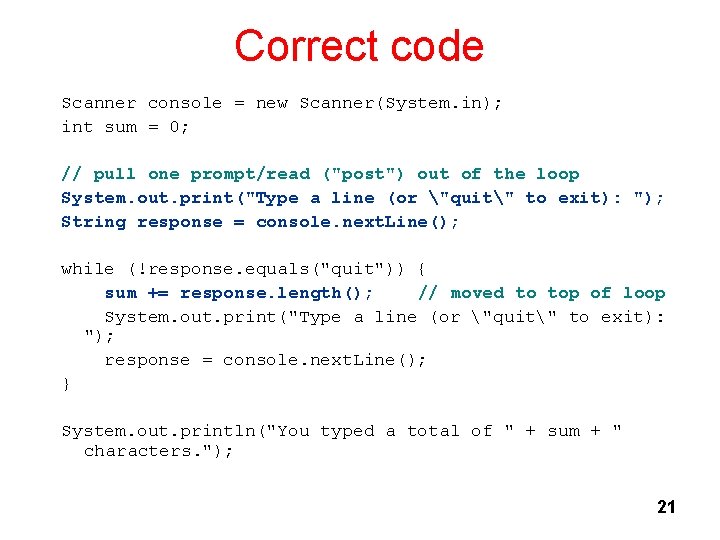
A fencepost solution sum = 0. prompt for input; read input. // place a "post" while (input is not the sentinel) { add input length to the sum. // place a "wire" prompt for input; read input. // place a "post" } 8 Sentinel loops often utilize a fencepost "loopand-a-half" style solution by pulling some code out of the loop. 20
Correct code Scanner console = new Scanner(System. in); int sum = 0; // pull one prompt/read ("post") out of the loop System. out. print("Type a line (or "quit" to exit): "); String response = console. next. Line(); while (!response. equals("quit")) { sum += response. length(); // moved to top of loop System. out. print("Type a line (or "quit" to exit): "); response = console. next. Line(); } System. out. println("You typed a total of " + sum + " characters. "); 21
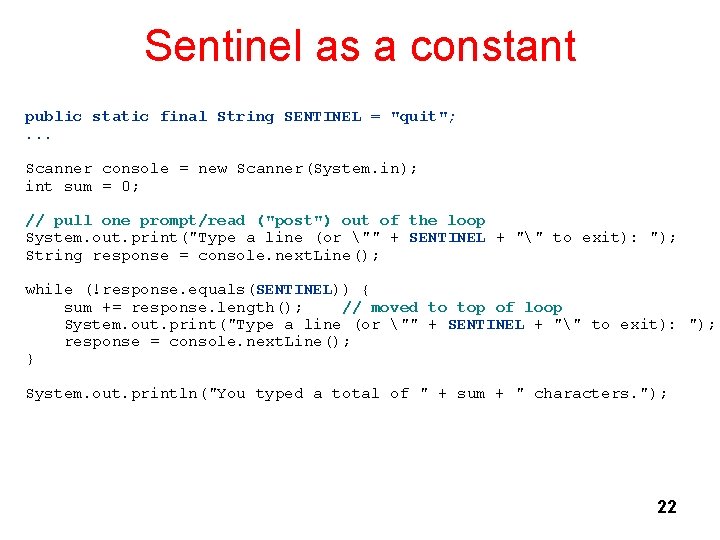
Sentinel as a constant public static final String SENTINEL = "quit"; . . . Scanner console = new Scanner(System. in); int sum = 0; // pull one prompt/read ("post") out of the loop System. out. print("Type a line (or "" + SENTINEL + "" to exit): "); String response = console. next. Line(); while (!response. equals(SENTINEL)) { sum += response. length(); // moved to top of loop System. out. print("Type a line (or "" + SENTINEL + "" to exit): "); response = console. next. Line(); } System. out. println("You typed a total of " + sum + " characters. "); 22
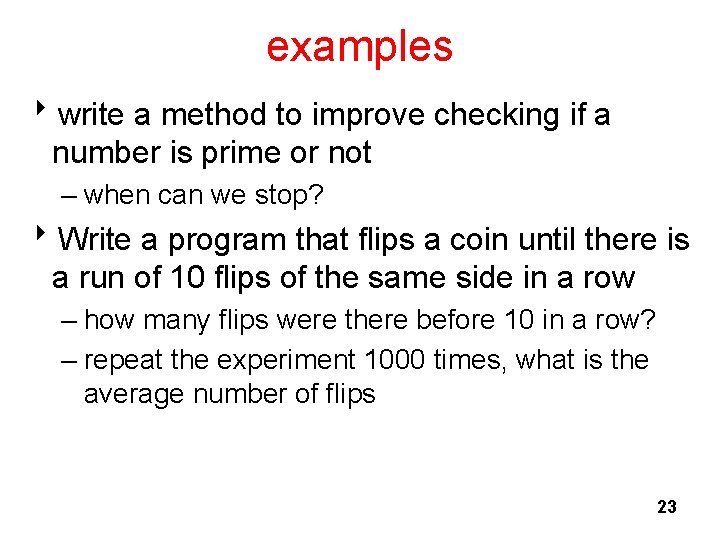
examples 8 write a method to improve checking if a number is prime or not – when can we stop? 8 Write a program that flips a coin until there is a run of 10 flips of the same side in a row – how many flips were there before 10 in a row? – repeat the experiment 1000 times, what is the average number of flips 23