
Topic 12 Electromagnetic induction l 12 3 Transmission
- Slides: 14
Topic 12: Electromagnetic induction l 12. 3: Transmission of electrical power
Energy losses l Energy is lost when it is transmitted l At the power transmission lines l transformers
Large amounts of electrical energy Are transmitted each second, from the power stations to the consumers, often over large distances. l Since power = current x voltage, we could use: l either a) a low voltage and a high current, l or b) a high voltage and a low current. l
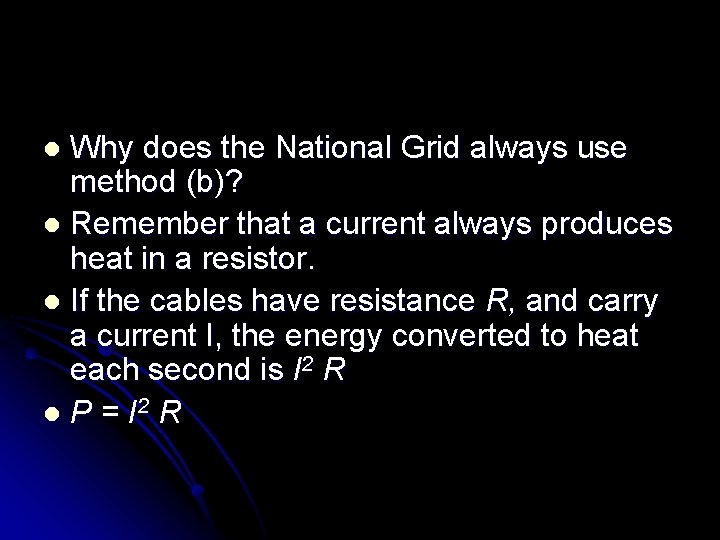
Why does the National Grid always use method (b)? l Remember that a current always produces heat in a resistor. l If the cables have resistance R, and carry a current I, the energy converted to heat each second is I 2 R l P = I 2 R l
l This means that in method (a) the high current produces a lot of heat in the cables and little of the energy from the power station gets to the consumer. l Method (b) is used because the low current minimises the power loss. Transformers at each end of the system step the voltage up and then down. l
Losses in transformers Copper losses: the wires have some resistance l Hystereis loss: Magnetising and demagnetising uses power l Eddy currents: small currents form in the core l
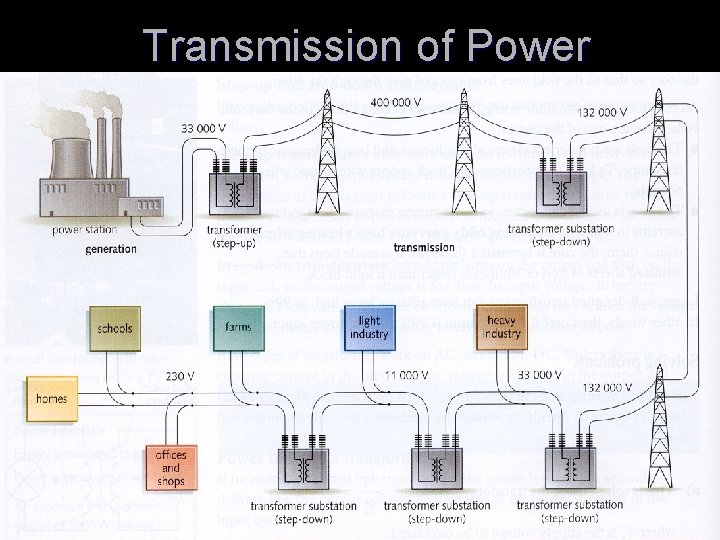
Transmission of Power
At the power station side: l Voltage is stepped up with a transformer to 275000 V l This reduces electrical loss in the transmission lines l
At the end of the line l Voltage is stepped-down with a transformer to l 33000 V: heavy industry l 11000 V: Light industry l 230 V : Homes l
Health risks How many transformers are there in your home? l How many electric fields are you exposed to everyday? l What about wireless internet? l Can these pose a threat to our health? l
Electric fields from power lines and mobile phone masts are all around us l Electric fields are known to interact with tissues by inducing electric fields and currents in them. l Some studies have found a higher rate of cancer in people living close to power lines l
How can these fields do this? Results from animal studies conducted so far suggest that electric fields do not initiate or promote cancer. l Electric fields and magnetic fields were classified as possibly carcinogenic to humans based on epidemiological studies of childhood leukaemia l
l "Possibly carcinogenic to humans" is a classification used to denote an agent for which there is limited evidence of carcinogenicity in humans and less than sufficient evidence for carcinogenicity in experimental animals.
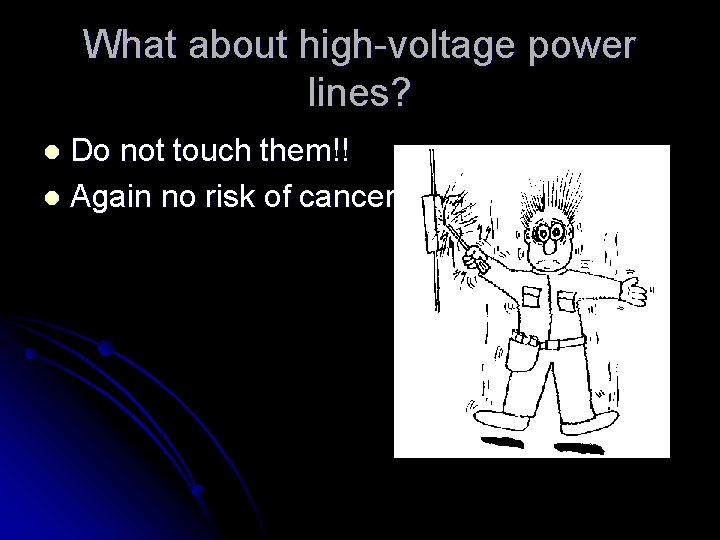
What about high-voltage power lines? Do not touch them!! l Again no risk of cancer has been found l