
Topic 11 3 EXCRETORY SYSTEM Topic Outline AUDIO

- Slides: 25
Topic 11. 3 EXCRETORY SYSTEM
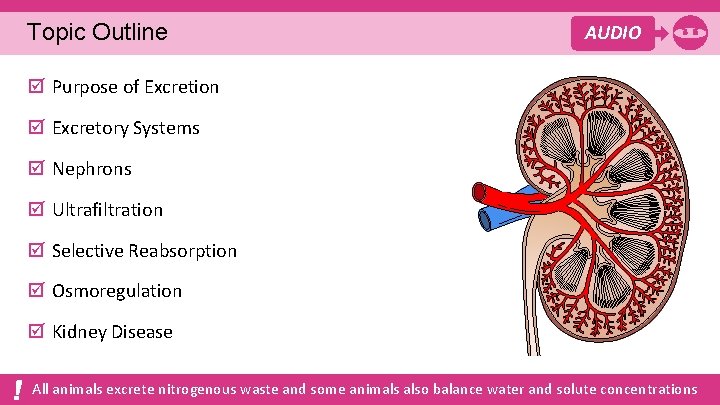
Topic Outline AUDIO þ Purpose of Excretion þ Excretory Systems þ Nephrons þ Ultrafiltration þ Selective Reabsorption þ Osmoregulation þ Kidney Disease All animals excrete nitrogenous waste and some animals also balance water and solute concentrations
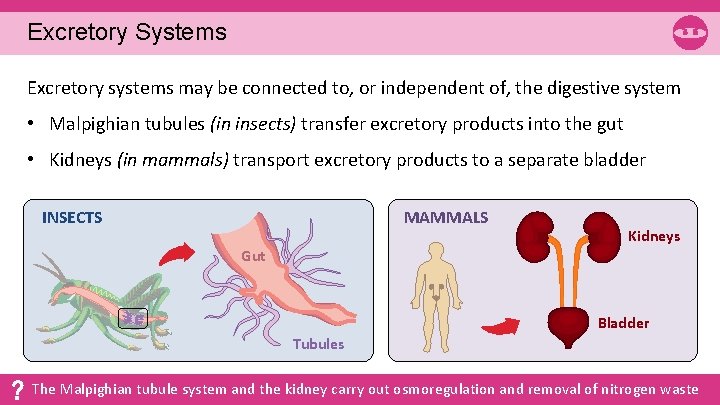
Excretion is the removal from the body of waste products of metabolic activity All animals possess a specialised excretory system that performs two key roles: • Removes nitrogenous wastes that may be toxic in large concentrations • Removes excess water to maintain suitable osmolarity within cells and tissues Excretory systems may differ according to the animal and its environment • Insects possess Malpighian tubules that are connected to the digestive system • Mammals possess autonomous kidneys that are separate from other systems
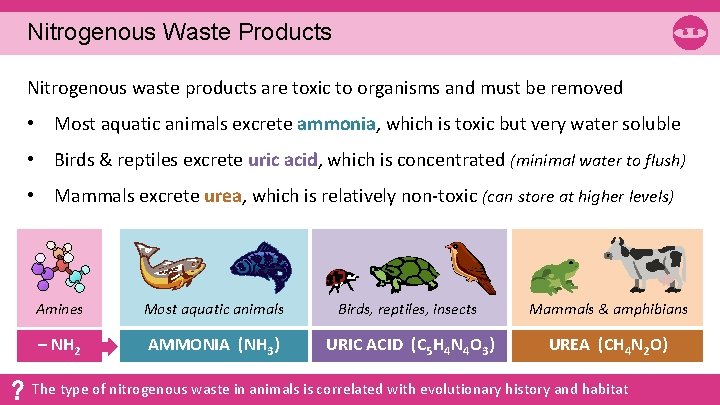
Nitrogenous Waste Products Nitrogenous waste products are toxic to organisms and must be removed • Most aquatic animals excrete ammonia, which is toxic but very water soluble • Birds & reptiles excrete uric acid, which is concentrated (minimal water to flush) • Mammals excrete urea, which is relatively non-toxic (can store at higher levels) Amines Most aquatic animals Birds, reptiles, insects Mammals & amphibians – NH 2 AMMONIA (NH 3) URIC ACID (C 5 H 4 N 4 O 3) UREA (CH 4 N 2 O) The type of nitrogenous waste in animals is correlated with evolutionary history and habitat
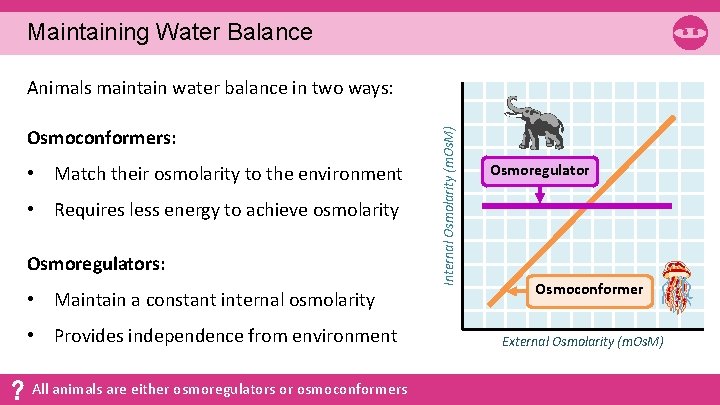
Maintaining Water Balance Osmoconformers: • Match their osmolarity to the environment • Requires less energy to achieve osmolarity Osmoregulators: • Maintain a constant internal osmolarity • Provides independence from environment All animals are either osmoregulators or osmoconformers Internal Osmolarity (m. Os. M) Animals maintain water balance in two ways: Osmoregulator Osmoconformer External Osmolarity (m. Os. M)
Excretory Systems Excretory systems may be connected to, or independent of, the digestive system • Malpighian tubules (in insects) transfer excretory products into the gut • Kidneys (in mammals) transport excretory products to a separate bladder MAMMALS INSECTS Kidneys Gut Bladder Tubules The Malpighian tubule system and the kidney carry out osmoregulation and removal of nitrogen waste
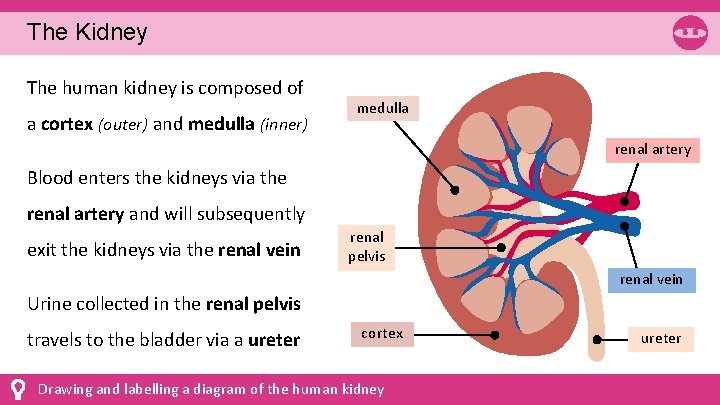
The Kidney The human kidney is composed of a cortex (outer) and medulla (inner) medulla renal artery Blood enters the kidneys via the renal artery and will subsequently exit the kidneys via the renal vein renal pelvis renal vein Urine collected in the renal pelvis travels to the bladder via a ureter cortex Drawing and labelling a diagram of the human kidney ureter
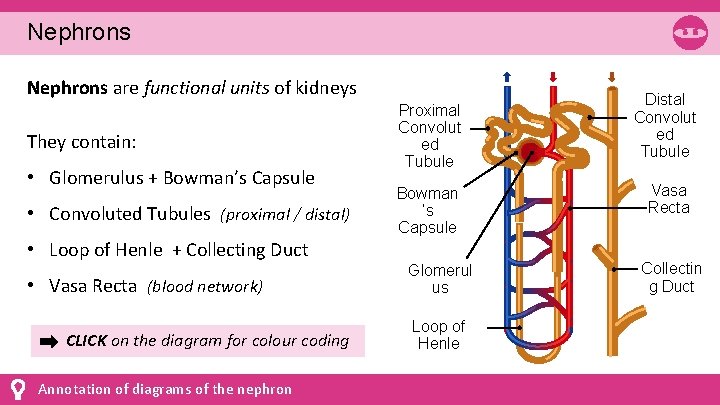
Nephrons are functional units of kidneys They contain: • Glomerulus + Bowman’s Capsule • Convoluted Tubules (proximal / distal) Proximal Convolut ed Tubule Bowman ’s Capsule • Loop of Henle + Collecting Duct • Vasa Recta (blood network) CLICK on the diagram for colour coding Annotation of diagrams of the nephron Glomerul us Loop of Henle Distal Convolut ed Tubule Vasa Recta Collectin g Duct
Process of Excretion The nephrons excrete waste and regulate water levels via three key processes: • Ultrafiltration – Blood is filtered at the Bowman’s capsule to form a filtrate • Selective Reabsorption – Usable content is reabsorbed by convoluted tubules • Osmoregulation – Salt gradient is established in the medulla to retain water Bowman’s Capsule Proximal Tubule Loop of Henle Distal Tubule Collecting Duct Ultrafiltration Reabsorption Salt gradient Reabsorption Water retention
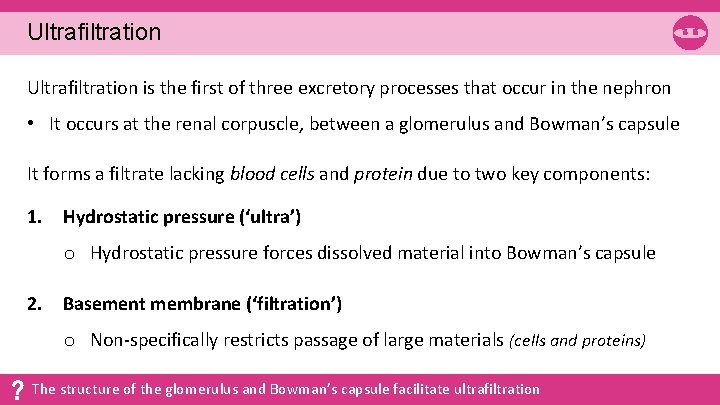
Ultrafiltration is the first of three excretory processes that occur in the nephron • It occurs at the renal corpuscle, between a glomerulus and Bowman’s capsule It forms a filtrate lacking blood cells and protein due to two key components: 1. Hydrostatic pressure (‘ultra’) o Hydrostatic pressure forces dissolved material into Bowman’s capsule 2. Basement membrane (‘filtration’) o Non-specifically restricts passage of large materials (cells and proteins) The structure of the glomerulus and Bowman’s capsule facilitate ultrafiltration
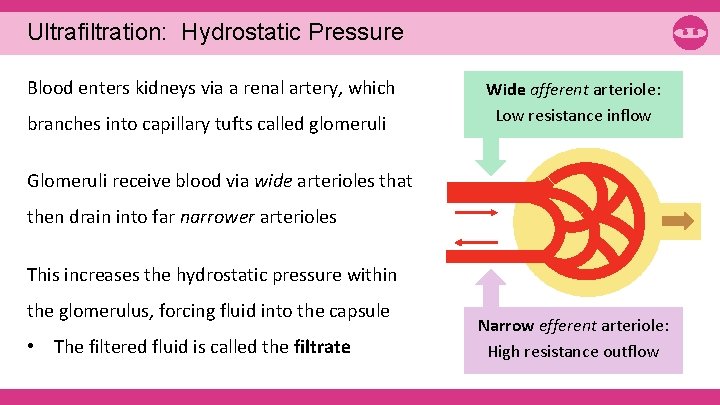
Ultrafiltration: Hydrostatic Pressure Blood enters kidneys via a renal artery, which branches into capillary tufts called glomeruli Wide afferent arteriole: Low resistance inflow Glomeruli receive blood via wide arterioles that then drain into far narrower arterioles This increases the hydrostatic pressure within the glomerulus, forcing fluid into the capsule • The filtered fluid is called the filtrate Narrow efferent arteriole: High resistance outflow
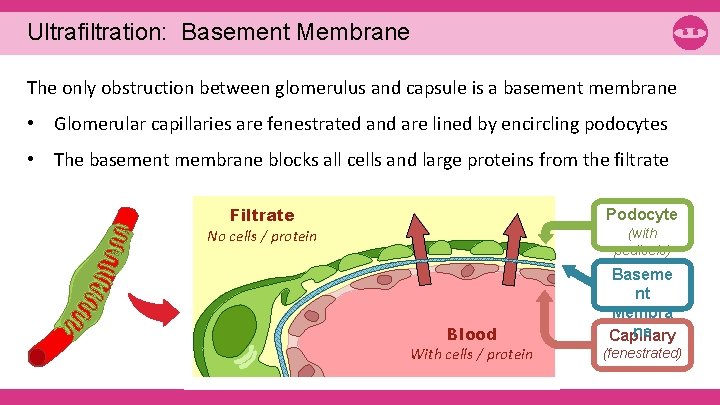
Ultrafiltration: Basement Membrane The only obstruction between glomerulus and capsule is a basement membrane • Glomerular capillaries are fenestrated and are lined by encircling podocytes • The basement membrane blocks all cells and large proteins from the filtrate Filtrate No cells / protein Podocyte (with pedicels) Blood With cells / protein Baseme nt Membra ne Capillary (fenestrated)
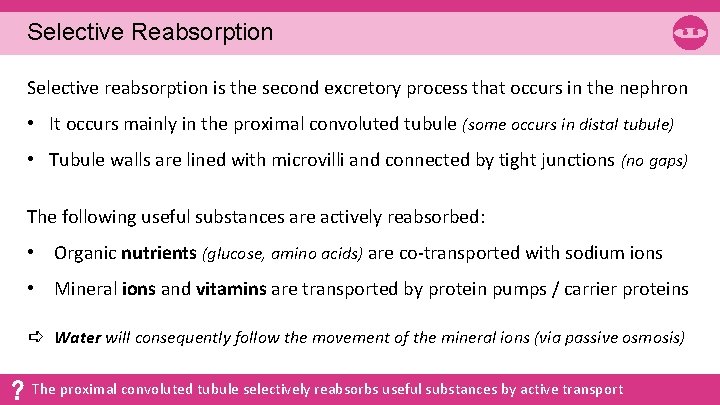
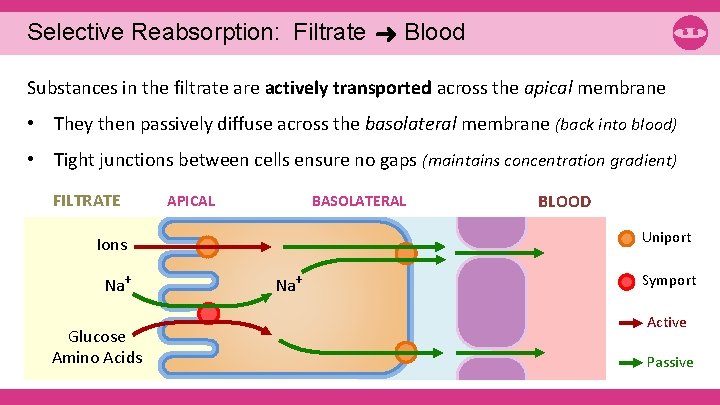
Selective Reabsorption Selective reabsorption is the second excretory process that occurs in the nephron • It occurs mainly in the proximal convoluted tubule (some occurs in distal tubule) • Tubule walls are lined with microvilli and connected by tight junctions (no gaps) The following useful substances are actively reabsorbed: • Organic nutrients (glucose, amino acids) are co-transported with sodium ions • Mineral ions and vitamins are transported by protein pumps / carrier proteins ➪ Water will consequently follow the movement of the mineral ions (via passive osmosis) The proximal convoluted tubule selectively reabsorbs useful substances by active transport
Selective Reabsorption: Filtrate ➜ Blood Substances in the filtrate are actively transported across the apical membrane • They then passively diffuse across the basolateral membrane (back into blood) • Tight junctions between cells ensure no gaps (maintains concentration gradient) FILTRATE APICAL BASOLATERAL Uniport Ions Na+ Glucose Amino Acids BLOOD Na+ Symport Active Passive
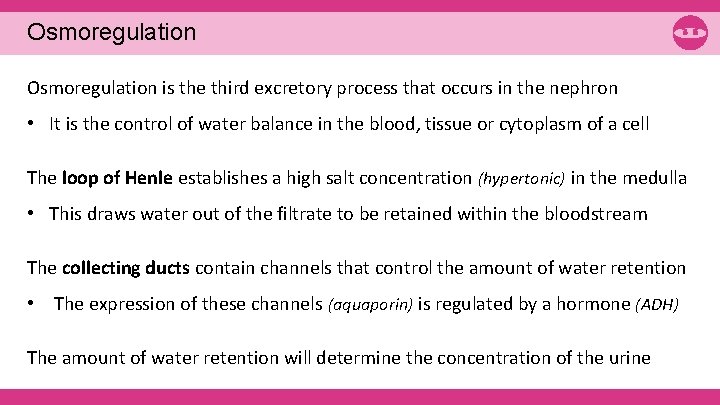
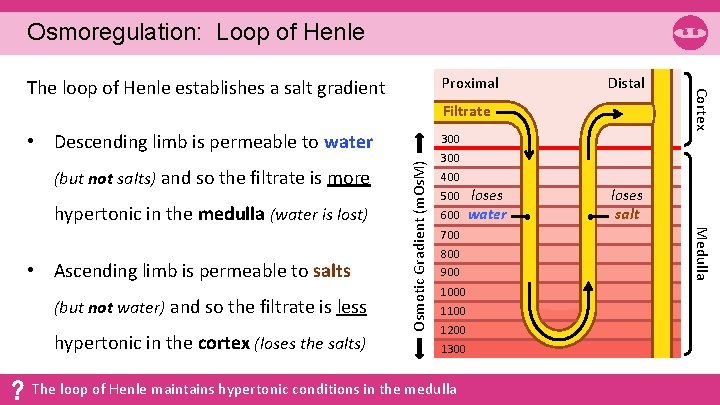
Osmoregulation is the third excretory process that occurs in the nephron • It is the control of water balance in the blood, tissue or cytoplasm of a cell The loop of Henle establishes a high salt concentration (hypertonic) in the medulla • This draws water out of the filtrate to be retained within the bloodstream The collecting ducts contain channels that control the amount of water retention • The expression of these channels (aquaporin) is regulated by a hormone (ADH) The amount of water retention will determine the concentration of the urine
Osmoregulation: Loop of Henle Distal Filtrate • Descending limb is permeable to water hypertonic in the medulla (water is lost) (but not water) and so the filtrate is less hypertonic in the cortex (loses the salts) 300 400 500 600 700 800 900 1000 1100 1200 1300 The loop of Henle maintains hypertonic conditions in the medulla loses water loses salt Medulla • Ascending limb is permeable to salts 300 Osmotic Gradient (m. Os. M) (but not salts) and so the filtrate is more Cortex Proximal The loop of Henle establishes a salt gradient
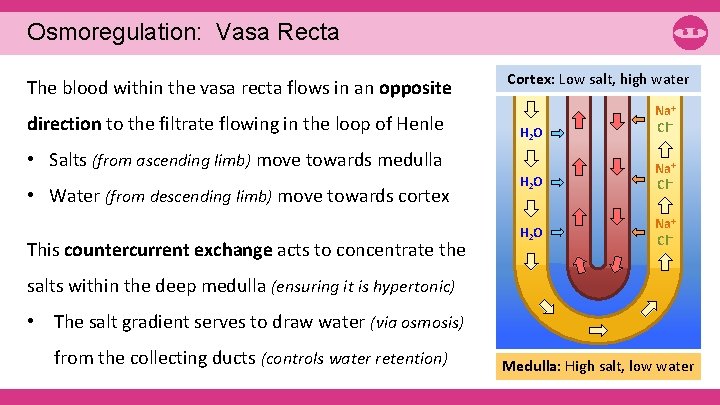
Osmoregulation: Vasa Recta The blood within the vasa recta flows in an opposite direction to the filtrate flowing in the loop of Henle Cortex: Low salt, high water H 2 O • Salts (from ascending limb) move towards medulla • Water (from descending limb) move towards cortex This countercurrent exchange acts to concentrate the Na+ Cl– H 2 O Na+ Cl– salts within the deep medulla (ensuring it is hypertonic) • The salt gradient serves to draw water (via osmosis) from the collecting ducts (controls water retention) Medulla: High salt, low water
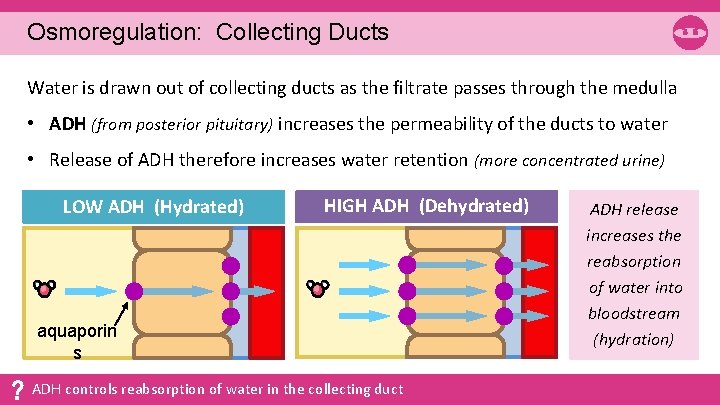
Osmoregulation: Collecting Ducts Water is drawn out of collecting ducts as the filtrate passes through the medulla • ADH (from posterior pituitary) increases the permeability of the ducts to water • Release of ADH therefore increases water retention (more concentrated urine) LOW ADH (Hydrated) HIGH ADH (Dehydrated) aquaporin s ADH controls reabsorption of water in the collecting duct ADH release increases the reabsorption of water into bloodstream (hydration)
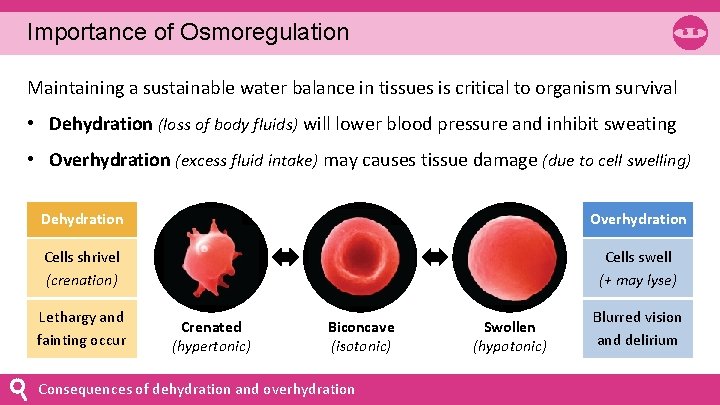
Importance of Osmoregulation Maintaining a sustainable water balance in tissues is critical to organism survival • Dehydration (loss of body fluids) will lower blood pressure and inhibit sweating • Overhydration (excess fluid intake) may causes tissue damage (due to cell swelling) Dehydration Overhydration Cells shrivel (crenation) Cells swell (+ may lyse) Lethargy and fainting occur Crenated (hypertonic) Biconcave (isotonic) Consequences of dehydration and overhydration Swollen (hypotonic) Blurred vision and delirium
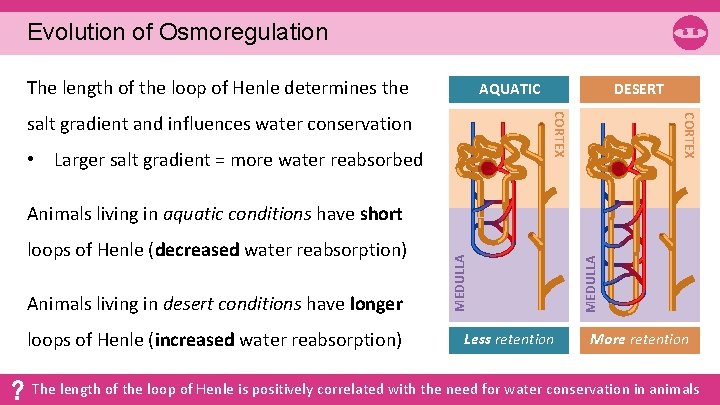
Evolution of Osmoregulation The length of the loop of Henle determines the AQUATIC • Larger salt gradient = more water reabsorbed CORTEX salt gradient and influences water conservation DESERT Animals living in desert conditions have longer loops of Henle (increased water reabsorption) Less retention MEDULLA loops of Henle (decreased water reabsorption) MEDULLA Animals living in aquatic conditions have short More retention The length of the loop of Henle is positively correlated with the need for water conservation in animals
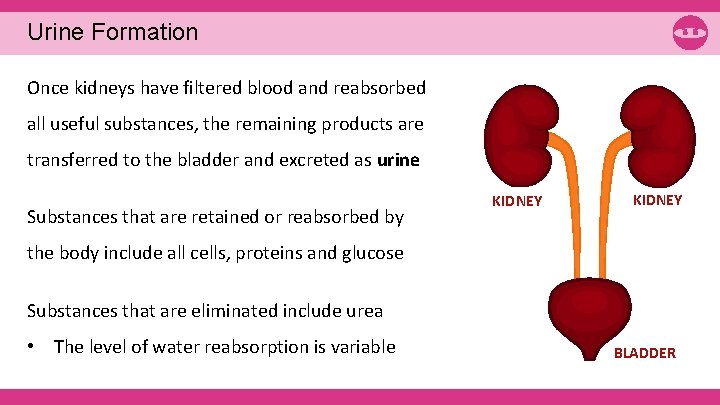
Urine Formation Once kidneys have filtered blood and reabsorbed all useful substances, the remaining products are transferred to the bladder and excreted as urine Substances that are retained or reabsorbed by KIDNEY the body include all cells, proteins and glucose Substances that are eliminated include urea • The level of water reabsorption is variable BLADDER
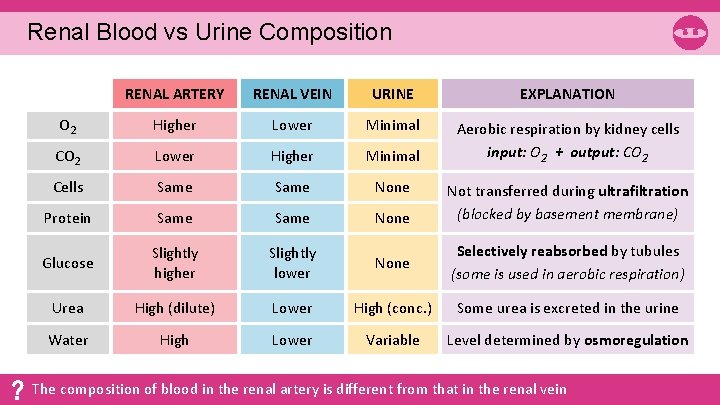
Renal Blood vs Urine Composition RENAL ARTERY RENAL VEIN URINE EXPLANATION O 2 Higher Lower Minimal CO 2 Lower Higher Minimal Aerobic respiration by kidney cells input: O 2 + output: CO 2 Cells Same None Protein Same None Glucose Slightly higher Slightly lower None Selectively reabsorbed by tubules (some is used in aerobic respiration) Urea High (dilute) Lower High (conc. ) Some urea is excreted in the urine Water High Lower Variable Level determined by osmoregulation Not transferred during ultrafiltration (blocked by basement membrane) The composition of blood in the renal artery is different from that in the renal vein
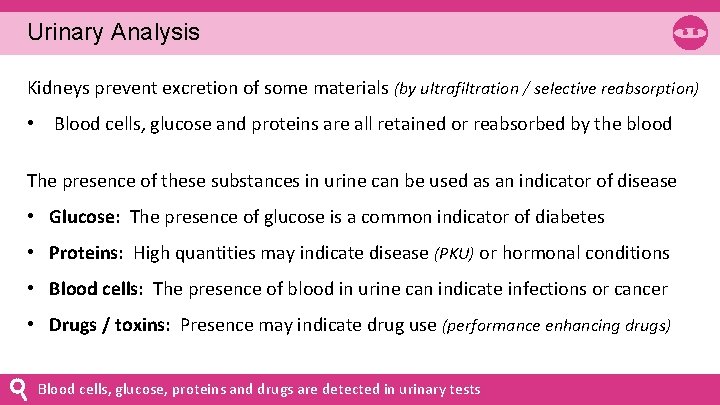
Urinary Analysis Kidneys prevent excretion of some materials (by ultrafiltration / selective reabsorption) • Blood cells, glucose and proteins are all retained or reabsorbed by the blood The presence of these substances in urine can be used as an indicator of disease • Glucose: The presence of glucose is a common indicator of diabetes • Proteins: High quantities may indicate disease (PKU) or hormonal conditions • Blood cells: The presence of blood in urine can indicate infections or cancer • Drugs / toxins: Presence may indicate drug use (performance enhancing drugs) Blood cells, glucose, proteins and drugs are detected in urinary tests
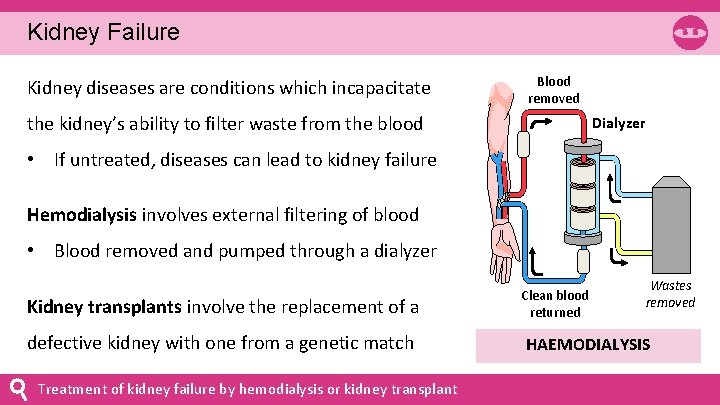
Kidney Failure Kidney diseases are conditions which incapacitate Blood removed the kidney’s ability to filter waste from the blood Dialyzer • If untreated, diseases can lead to kidney failure Hemodialysis involves external filtering of blood • Blood removed and pumped through a dialyzer Kidney transplants involve the replacement of a defective kidney with one from a genetic match Treatment of kidney failure by hemodialysis or kidney transplant Clean blood returned Wastes removed HAEMODIALYSIS
Topic Review Can you do the following? • Describe the purpose of excretion • Draw and label a human kidney • Annotate the structures of a nephron • Outline the process of ultrafiltration • Outline the process of selective reabsorption • Outline the process of osmoregulation • Analyze urine composition in health and disease