
Topic 10 Bitwise Operators Outline Binary representation of

Topic 10: Bitwise Operators
Outline • Binary representation of integer numbers • Operations on bits – – – The Bitwise AND Operator The Bitwise Inclusive-OR Operator The Bitwise Exclusive-OR Operator The Ones Complement Operator The Left Shift Operator The Right Shift Operator • Review: Operators: The complete table of operator's precedence
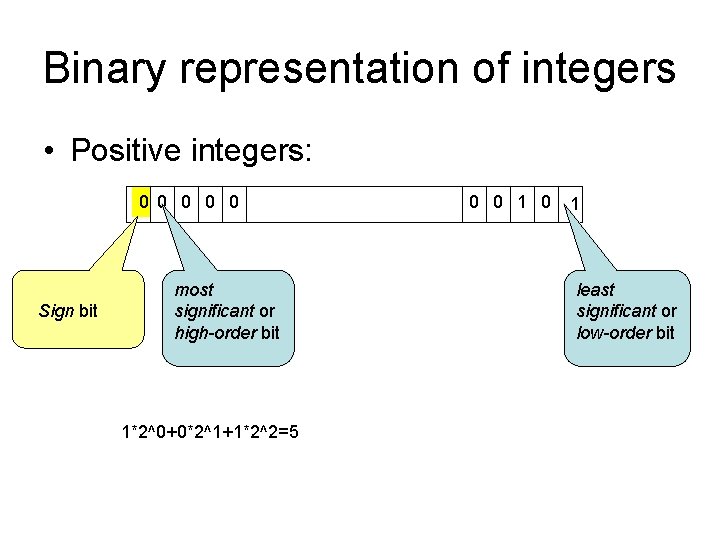
Binary representation of integers • Positive integers: 0 0 0 Sign bit most significant or high-order bit 1*2^0+0*2^1+1*2^2=5 0 0 1 least significant or low-order bit
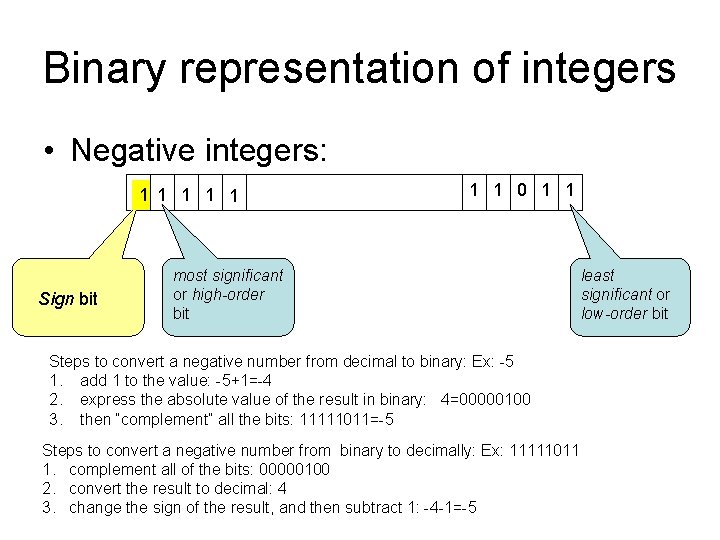
Binary representation of integers • Negative integers: 1 1 1 Sign bit 1 1 0 1 1 most significant or high-order bit Steps to convert a negative number from decimal to binary: Ex: -5 1. add 1 to the value: -5+1=-4 2. express the absolute value of the result in binary: 4=00000100 3. then “complement” all the bits: 11111011=-5 Steps to convert a negative number from binary to decimally: Ex: 11111011 1. complement all of the bits: 00000100 2. convert the result to decimal: 4 3. change the sign of the result, and then subtract 1: -4 -1=-5 least significant or low-order bit
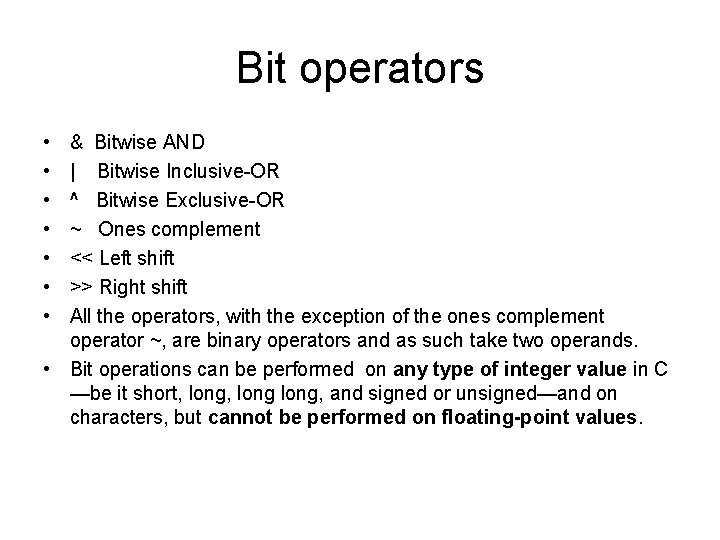
Bit operators • • & Bitwise AND | Bitwise Inclusive-OR ^ Bitwise Exclusive-OR ~ Ones complement << Left shift >> Right shift All the operators, with the exception of the ones complement operator ~, are binary operators and as such take two operands. • Bit operations can be performed on any type of integer value in C —be it short, long, and signed or unsigned—and on characters, but cannot be performed on floating-point values.

Bitwise AND b 1 b 2 b 1&b 2 0 0 1 1 1 int a=25; int b=77; printf(“%x %x %x”, a, b, a&b); 0 0 0 0 1 1 0 0 1 a=0 x 19 0 0 0 1 1 0 1 b=0 x 4 d 0 0 0 0 0 1 a&b=0 x 9
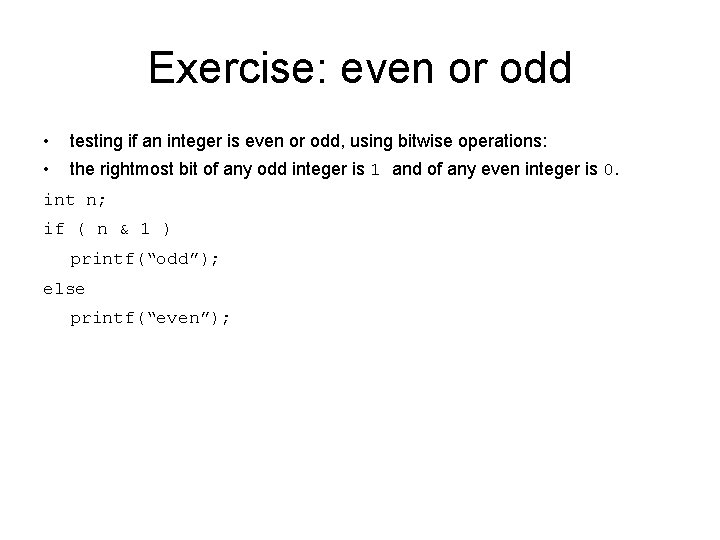
Exercise: even or odd • testing if an integer is even or odd, using bitwise operations: • the rightmost bit of any odd integer is 1 and of any even integer is 0. int n; if ( n & 1 ) printf(“odd”); else printf(“even”);
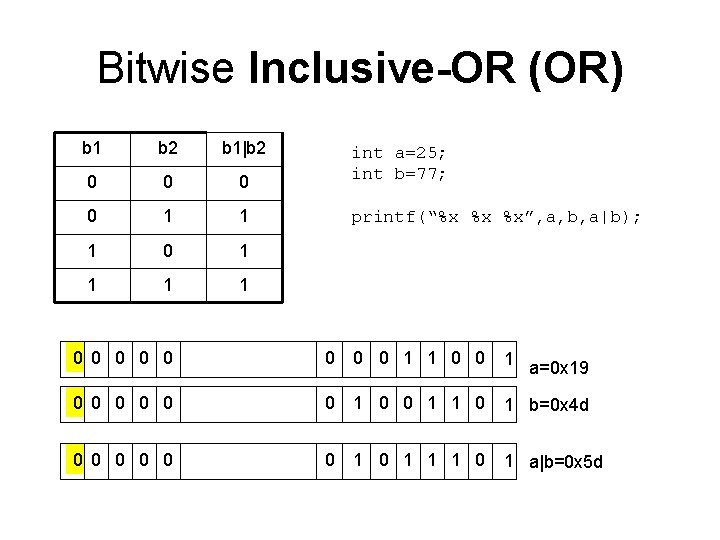
Bitwise Inclusive-OR (OR) b 1 b 2 b 1|b 2 0 0 0 int a=25; int b=77; 0 1 1 printf(“%x %x %x”, a, b, a|b); 1 0 1 1 0 0 0 0 1 1 0 0 1 a=0 x 19 0 0 0 1 1 0 1 b=0 x 4 d 0 0 0 1 0 1 1 1 0 1 a|b=0 x 5 d
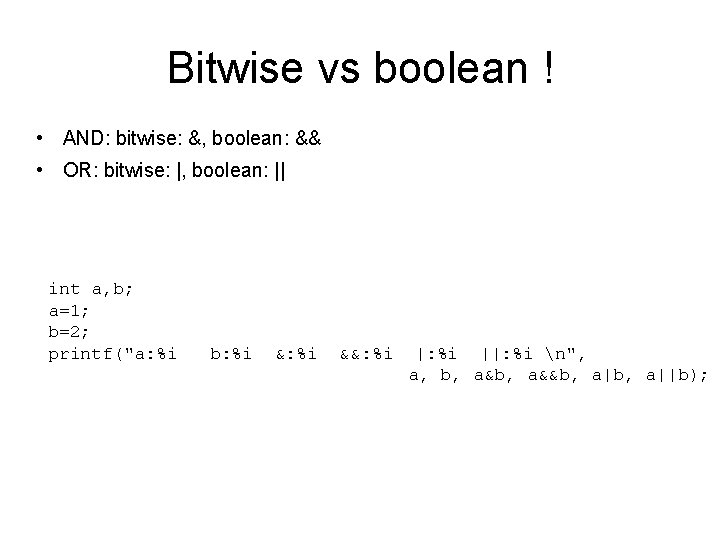
Bitwise vs boolean ! • AND: bitwise: &, boolean: && • OR: bitwise: |, boolean: || int a, b; a=1; b=2; printf("a: %i b: %i &&: %i ||: %i n", a, b, a&&b, a||b);
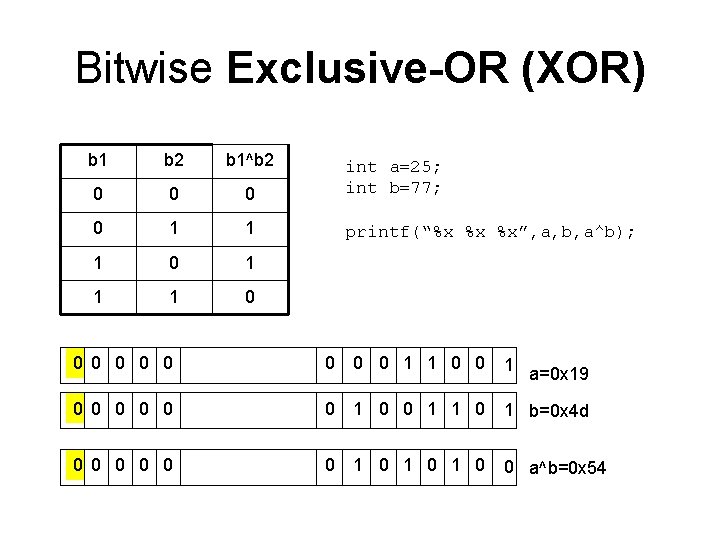
Bitwise Exclusive-OR (XOR) b 1 b 2 b 1^b 2 0 0 0 int a=25; int b=77; 0 1 1 printf(“%x %x %x”, a, b, a^b); 1 0 1 1 1 0 0 0 0 0 1 1 0 0 1 a=0 x 19 0 0 0 1 1 0 1 b=0 x 4 d 0 0 0 1 0 1 0 0 a^b=0 x 54
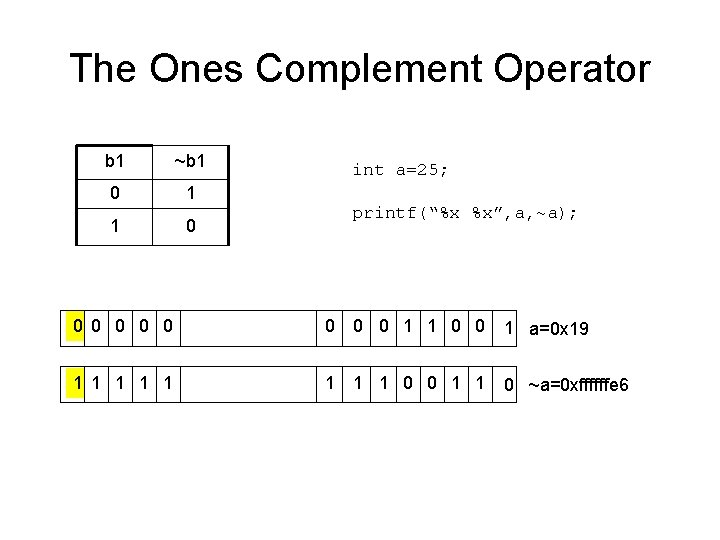
The Ones Complement Operator b 1 ~b 1 0 1 1 0 int a=25; printf(“%x %x”, a, ~a); 0 0 0 0 1 1 0 0 1 a=0 x 19 1 1 1 1 0 0 1 1 0 ~a=0 xffffffe 6
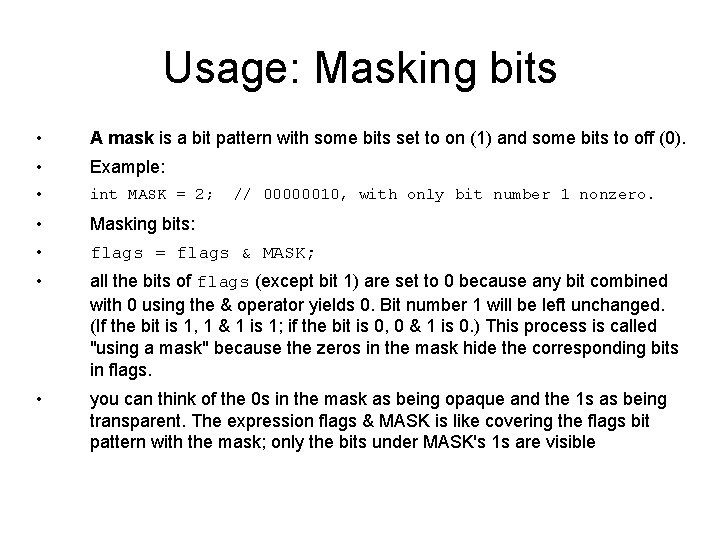
Usage: Masking bits • A mask is a bit pattern with some bits set to on (1) and some bits to off (0). • Example: • int MASK = 2; • Masking bits: • flags = flags & MASK; • all the bits of flags (except bit 1) are set to 0 because any bit combined with 0 using the & operator yields 0. Bit number 1 will be left unchanged. (If the bit is 1, 1 & 1 is 1; if the bit is 0, 0 & 1 is 0. ) This process is called "using a mask" because the zeros in the mask hide the corresponding bits in flags. • you can think of the 0 s in the mask as being opaque and the 1 s as being transparent. The expression flags & MASK is like covering the flags bit pattern with the mask; only the bits under MASK's 1 s are visible // 00000010, with only bit number 1 nonzero.
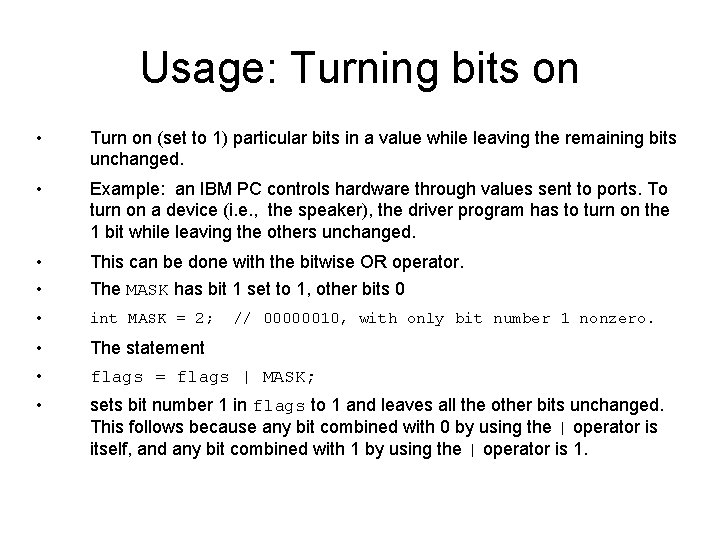
Usage: Turning bits on • Turn on (set to 1) particular bits in a value while leaving the remaining bits unchanged. • Example: an IBM PC controls hardware through values sent to ports. To turn on a device (i. e. , the speaker), the driver program has to turn on the 1 bit while leaving the others unchanged. • This can be done with the bitwise OR operator. • The MASK has bit 1 set to 1, other bits 0 • int MASK = 2; • The statement • flags = flags | MASK; • sets bit number 1 in flags to 1 and leaves all the other bits unchanged. This follows because any bit combined with 0 by using the | operator is itself, and any bit combined with 1 by using the | operator is 1. // 00000010, with only bit number 1 nonzero.
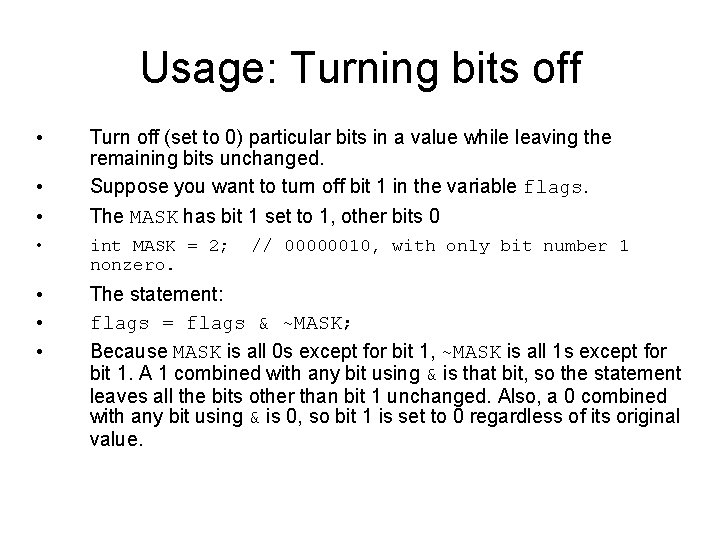
Usage: Turning bits off • • • Turn off (set to 0) particular bits in a value while leaving the remaining bits unchanged. Suppose you want to turn off bit 1 in the variable flags. The MASK has bit 1 set to 1, other bits 0 • int MASK = 2; nonzero. • • • The statement: flags = flags & ~MASK; Because MASK is all 0 s except for bit 1, ~MASK is all 1 s except for bit 1. A 1 combined with any bit using & is that bit, so the statement leaves all the bits other than bit 1 unchanged. Also, a 0 combined with any bit using & is 0, so bit 1 is set to 0 regardless of its original value. // 00000010, with only bit number 1
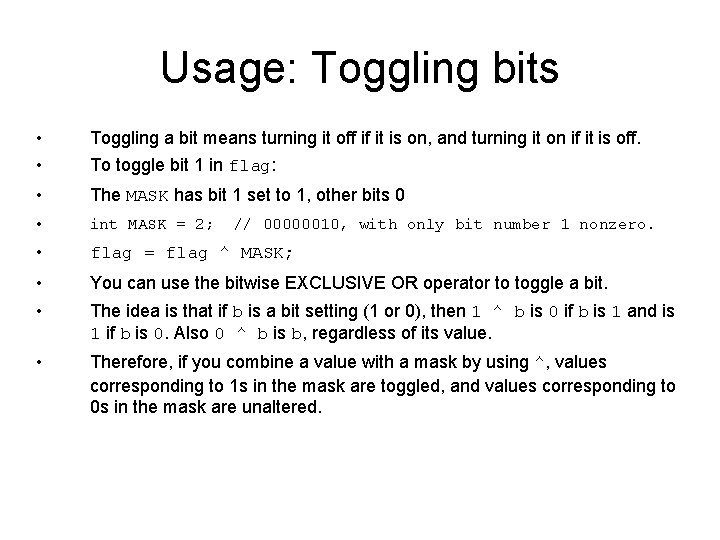
Usage: Toggling bits • Toggling a bit means turning it off if it is on, and turning it on if it is off. • To toggle bit 1 in flag: • The MASK has bit 1 set to 1, other bits 0 • int MASK = 2; • flag = flag ^ MASK; • You can use the bitwise EXCLUSIVE OR operator to toggle a bit. • The idea is that if b is a bit setting (1 or 0), then 1 ^ b is 0 if b is 1 and is 1 if b is 0. Also 0 ^ b is b, regardless of its value. • Therefore, if you combine a value with a mask by using ^, values corresponding to 1 s in the mask are toggled, and values corresponding to 0 s in the mask are unaltered. // 00000010, with only bit number 1 nonzero.
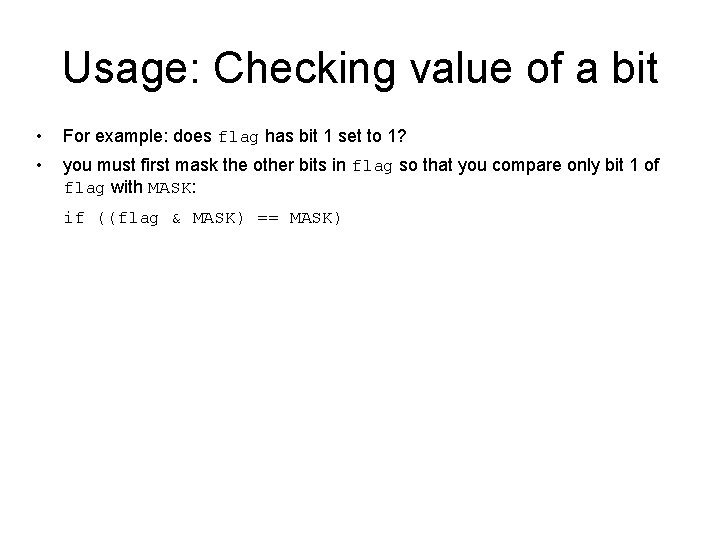
Usage: Checking value of a bit • For example: does flag has bit 1 set to 1? • you must first mask the other bits in flag so that you compare only bit 1 of flag with MASK: if ((flag & MASK) == MASK)
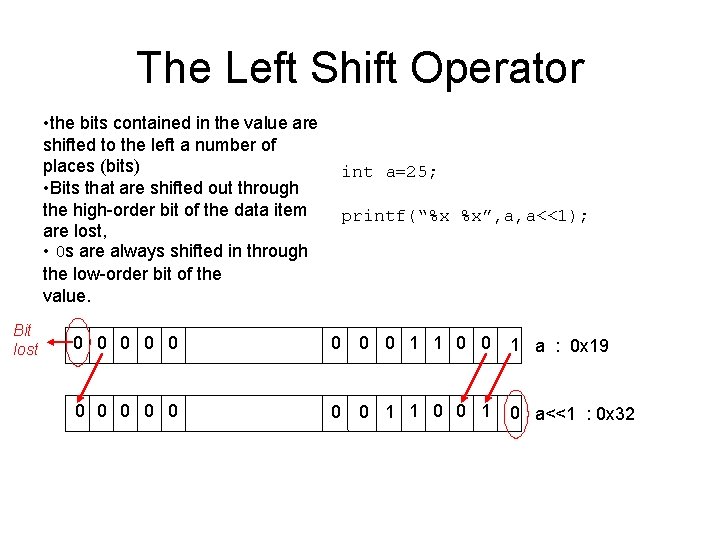
The Left Shift Operator • the bits contained in the value are shifted to the left a number of places (bits) int a=25; • Bits that are shifted out through the high-order bit of the data item printf(“%x %x”, a, a<<1); are lost, • 0 s are always shifted in through the low-order bit of the value. shifted to the left. Associated with this Bit 0 0 0 0 1 1 0 0 1 a : 0 x 19 lost 0 0 0 0 1 1 0 0 1 0 a<<1 : 0 x 32
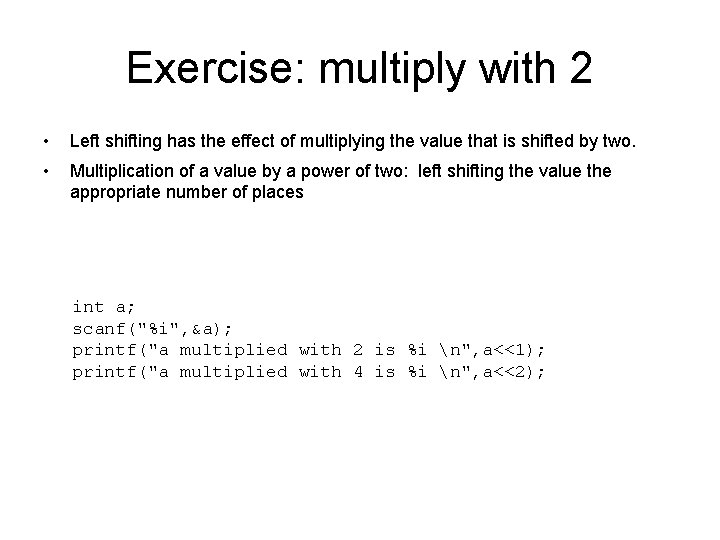
Exercise: multiply with 2 • Left shifting has the effect of multiplying the value that is shifted by two. • Multiplication of a value by a power of two: left shifting the value the appropriate number of places int a; scanf("%i", &a); printf("a multiplied with 2 is %i n", a<<1); printf("a multiplied with 4 is %i n", a<<2);
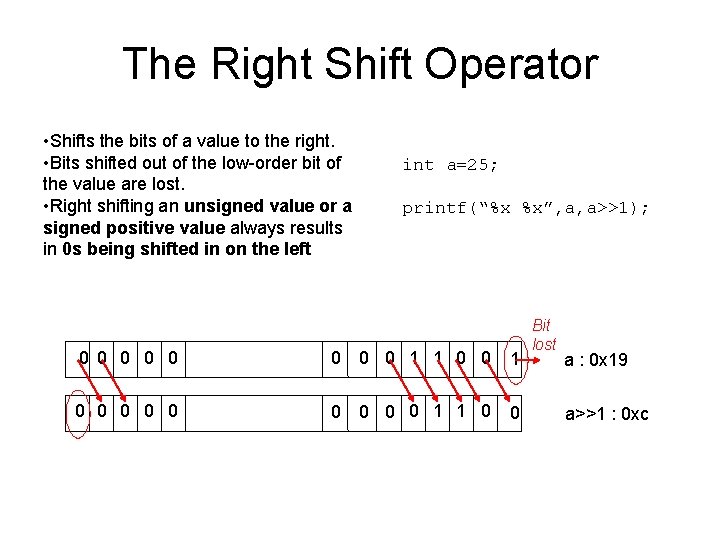
The Right Shift Operator • Shifts the bits of a value to the right. • Bits shifted out of the low-order bit of the value are lost. • Right shifting an unsigned value or a signed positive value always results in 0 s being shifted in on the left int a=25; printf(“%x %x”, a, a>>1); 0 0 0 0 1 1 0 0 Bit lost a : 0 x 19 a>>1 : 0 xc
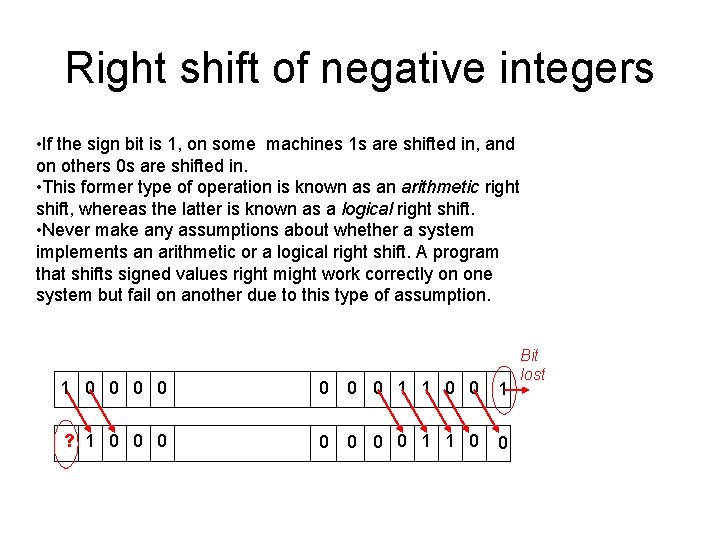
Right shift of negative integers • If the sign bit is 1, on some machines 1 s are shifted in, and on others 0 s are shifted in. • This former type of operation is known as an arithmetic right shift, whereas the latter is known as a logical right shift. • Never make any assumptions about whether a system implements an arithmetic or a logical right shift. A program that shifts signed values right might work correctly on one system but fail on another due to this type of assumption. 1 0 0 0 0 1 1 0 0 1 ? 1 0 0 0 0 1 1 0 0 Bit lost
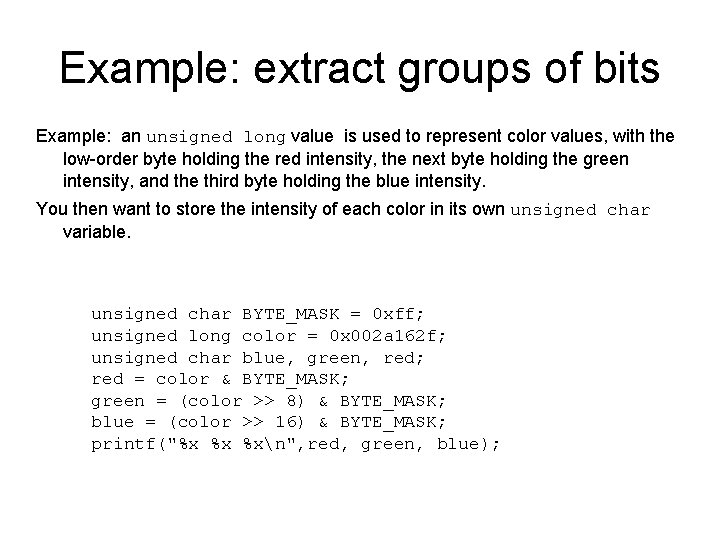
Example: extract groups of bits Example: an unsigned long value is used to represent color values, with the low-order byte holding the red intensity, the next byte holding the green intensity, and the third byte holding the blue intensity. You then want to store the intensity of each color in its own unsigned char variable. unsigned char BYTE_MASK = 0 xff; unsigned long color = 0 x 002 a 162 f; unsigned char blue, green, red; red = color & BYTE_MASK; green = (color >> 8) & BYTE_MASK; blue = (color >> 16) & BYTE_MASK; printf("%x %x %xn", red, green, blue);
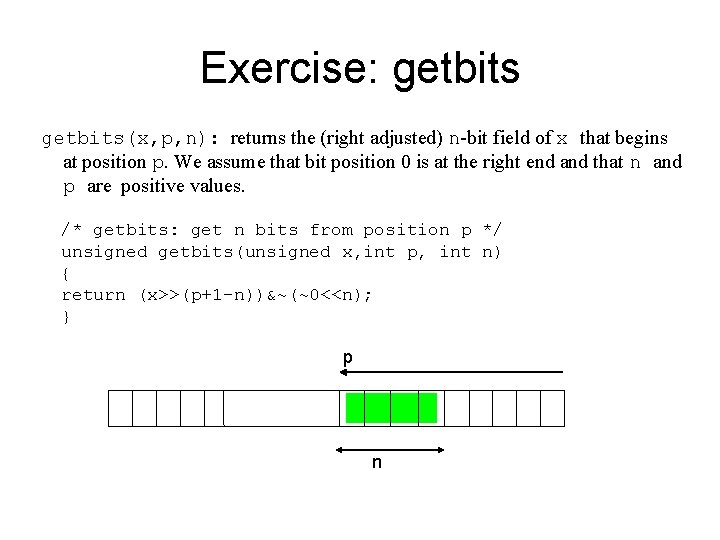
Exercise: getbits(x, p, n): returns the (right adjusted) n-bit field of x that begins at position p. We assume that bit position 0 is at the right end and that n and p are positive values. /* getbits: get n bits from position p */ unsigned getbits(unsigned x, int p, int n) { return (x>>(p+1 -n))&~(~0<<n); } p n
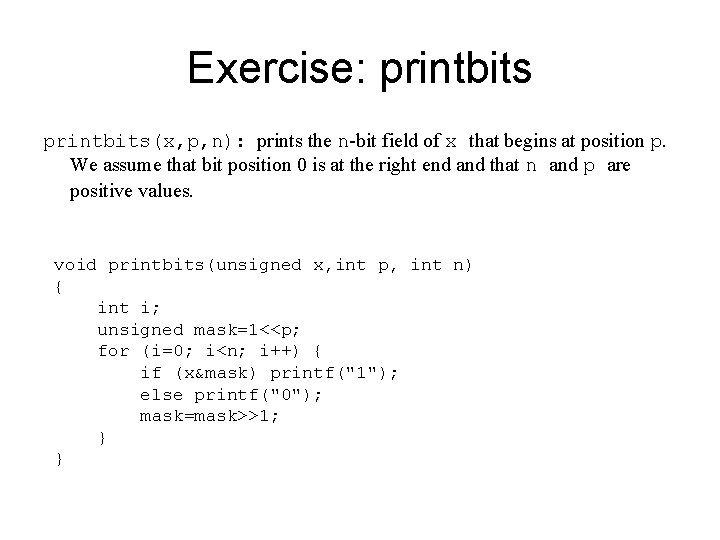
Exercise: printbits(x, p, n): prints the n-bit field of x that begins at position p. We assume that bit position 0 is at the right end and that n and p are positive values. void printbits(unsigned x, int p, int n) { int i; unsigned mask=1<<p; for (i=0; i<n; i++) { if (x&mask) printf("1"); else printf("0"); mask=mask>>1; } }
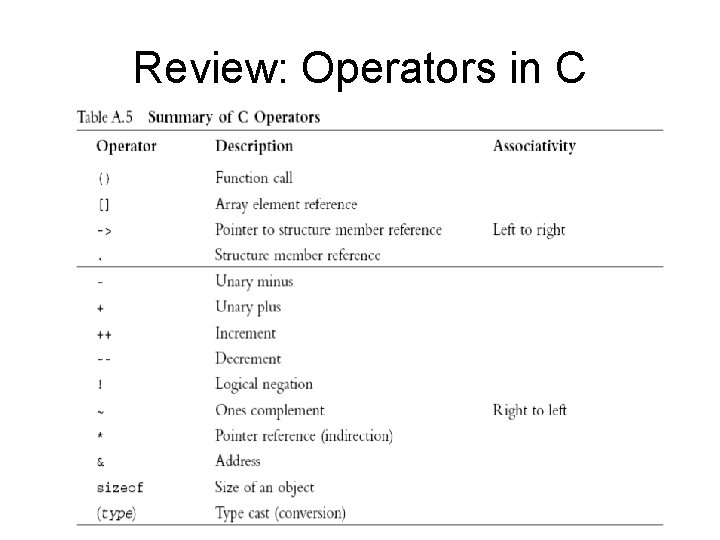
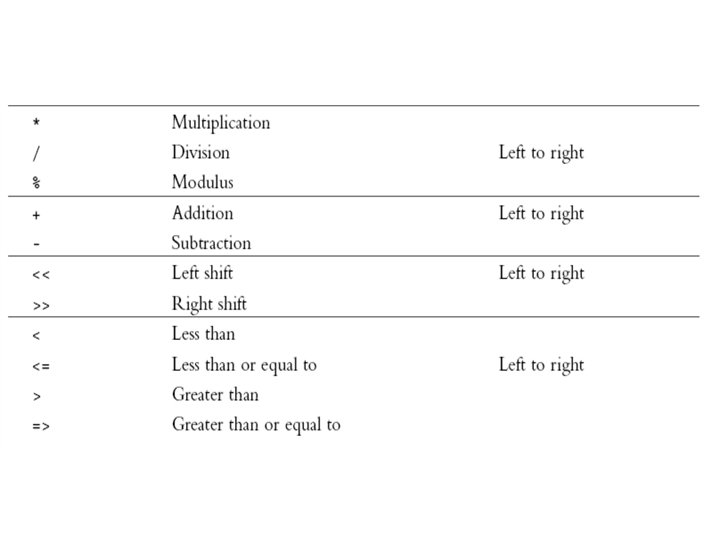
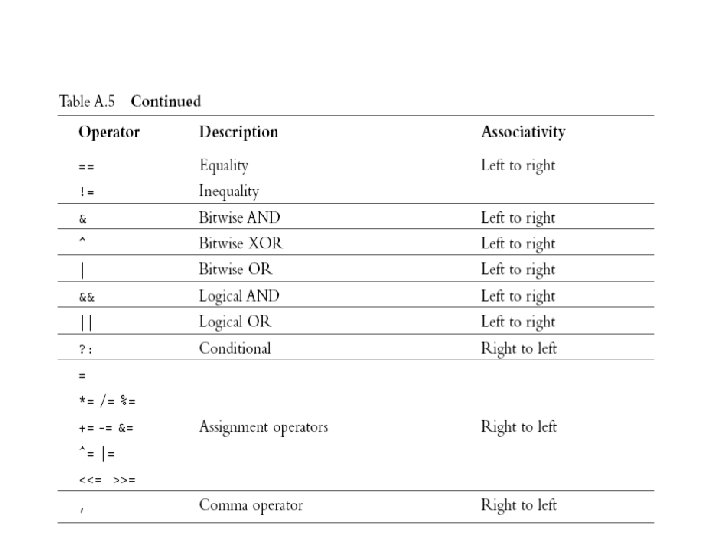
Review: Operators in C
- Slides: 26