
Topic 1 Solid waste sources Definitions Waste means
- Slides: 11
Topic (1): Solid waste sources: Definitions: “Waste” means a material that is discarded or is being accumulated, stored, or physically, chemically or biologically treated prior to being discarded or that has served its originally intended use and is normally discarded or that is a manufacturing or mining by-product and is normally discarded. “Solid Waste” means any discarded garbage, refuse, sludge from a waste treatment plant, water supply plant, or pollution control facility and other discarded material including solid, liquid, semi-solid, or contained gaseous materials resulting from industrial, commercial, mining, or agricultural operations and from community activities. (EPA, 1995)
a Solid waste is material, which is not in liquid form, and has no value to the person who is responsible for it. Synonyms to solid waste are terms such as “garbage”, “trash”, “refuse” and “rubbish”. Refuse or solid waste includes all unwanted or discarded waste material arising from houses and streets and from commercial, industrial, and agricultural activities of man. (WHO, 2002)
Sources of solid wastes in a community are, in general, related to land use and zoning. Although any number of source classifications can be developed, the following categories have been found useful: (1) residential, (2) commercial, (3) institutional, (4) construction and demolition, (5) municipal services, (6) treatment plant sites, (7) industrial, and (8) agricultural (Handbook of solid waste).
The knowledge about sources of solid wastes along with the information of the composition and rate of generation, will help in the process of design and operation of the functional elements associated with the disposal and management of solid wastes.
Topic (2): Types and characteristics of solid waste: (1) 1. Garbage: wastes from food, slaughterhouses, canning and freezing industries. 2. Rubbish: non-garbage wastes either combustible or noncombustible. These include wood, paper, rubber, leather and garden wastes as comustible wastes whereas the noncombustible wastes include glass, metal, ceramics, stones and soil. 3. Ashes: Residues of combustion, solid products after heating and cooking or incineration by the municipal, industrial, hospital and apartments areas. 4. Large wastes: Demolition and construction wastes, automobiles, furniture’s, refrigerators and other home appliances, trees, fires etc.
5. Dead animals: House holds pets, birds, rodents, zoo animals, and anatomical and pathological tissues from hospitals. 6. Sewage sludge: These include screening wastes, settled solids and sludges. 7. Industrial wastes: Chemicals, paints, sand explosives. 8. Mining wastes: Tailings, slug ropes, culm piles at mine areas 9. Agricultural wastes: Farm animal manure, crop residues and others. Traditionally these wastes are categorized into the following five types.
Topic (2): Types and characteristics of solid waste: (2) 1. Residential: It refers to wastes generated mainly from dwelling, apartments, and consisted of left over food scrapes, vegetables, peeled material, plastics, wood pieces, clothes and ashes. 2. Commercial: This mainly consists of grocery materials, leftover food, glasses, and metals, ashes generated from stores, hotels, markets, shops and medical facilities. 3. Institutional: The wastes generated from schools, colleges and offices include, paper, plastics, and glasses. 4. Municipal: This includes dust, leaf litter, building debris, and treatment plant sediments. These arise from various activities like demolition, construction, street cleaning, land scraping etc. 5. Agricultural: This mainly includes spoiled food grains, vegetables, grass, litter etc. , generated from fields and farms.
Physical Characteristics: Density: It is expressed as mass per unit volume (kg/m³). This parameter is required for designing a solid waste management program. Significant changes in the density occur as waste moves from sources to disposal site, as a result of scavenging, handling, wetting, and drying by the weather and vibration during transport. Density is critical in the design of sanitary landfill as well as for storage, collection and transport of wastes. Efficient operation of landfill requires compaction of wastes to optimum density.
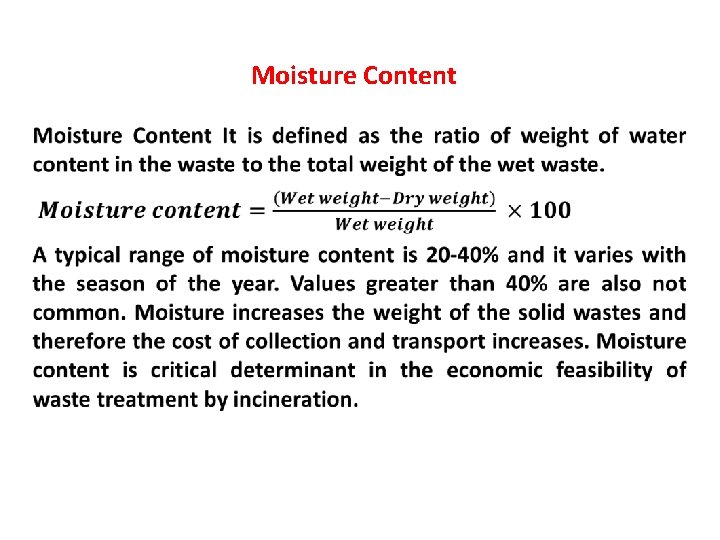
Moisture Content
Chemical Characteristics: Information of chemical characteristics is important in evaluating alternative processing and recovery options. Typically waste is considered as combination of combustible and noncombustible components.
Topic (3): Factors affecting production: characterization of solid waste streams and the estimation of solid waste generation rates are critical data required to propose any sustainable solutions to municipal solid waste management Furthermore, point out that it is necessary to have detailed information on quantification and characterization of solid waste for proper handling of solid waste at different levels of the solid waste management system.