
Topic 1 Measurement and uncertainties Physics has some


- Slides: 43
Topic 1: Measurement and uncertainties
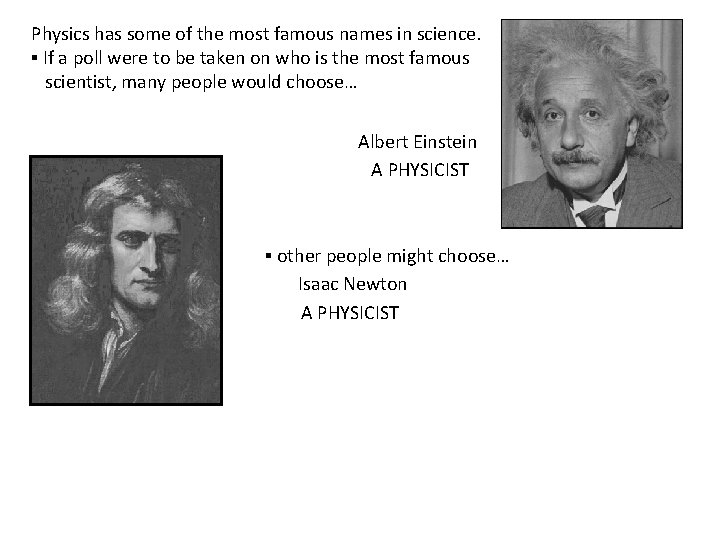
Physics has some of the most famous names in science. ▪ If a poll were to be taken on who is the most famous scientist, many people would choose… Albert Einstein A PHYSICIST ▪ other people might choose… Isaac Newton A PHYSICIST
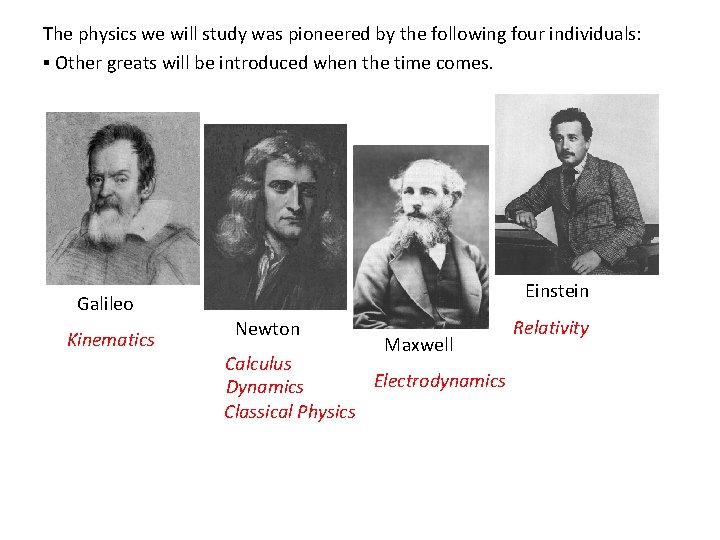
The physics we will study was pioneered by the following four individuals: ▪ Other greats will be introduced when the time comes. Einstein Galileo Kinematics Newton Maxwell Calculus Electrodynamics Dynamics Classical Physics Relativity
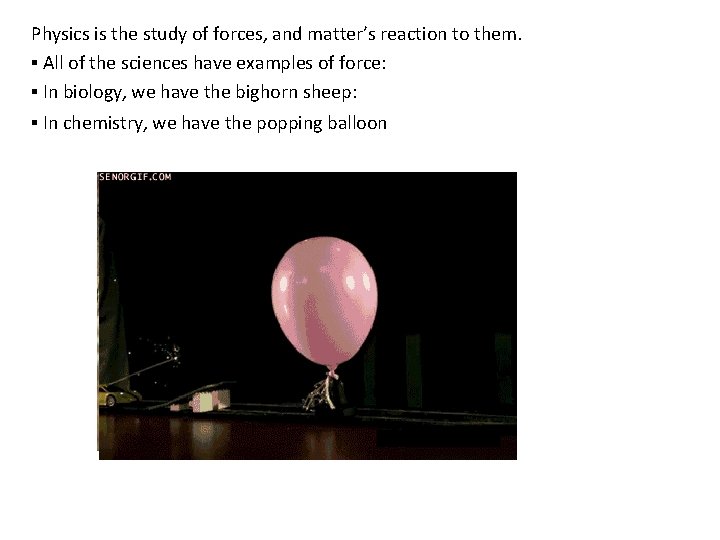
Physics is the study of forces, and matter’s reaction to them. ▪ All of the sciences have examples of force: ▪ In biology, we have the bighorn sheep: ▪ In chemistry, we have the popping balloon Fn 1 F 21 Kilo Newtons f 1 F 12 Fn 2 W 1 W 2 f 2
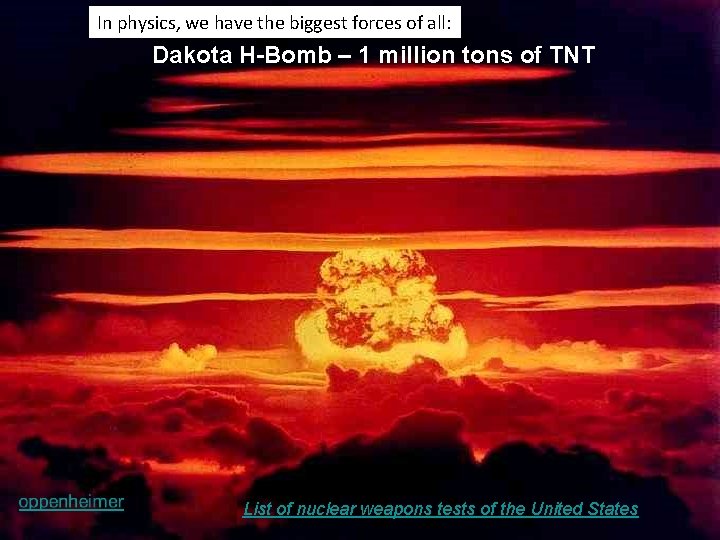
In physics, we have the biggest forces of all: Dakota H-Bomb – 1 million tons of TNT List of nuclear weapons tests of the United States
Meteor Crater - Arizona 100 Dakota H-Bombs
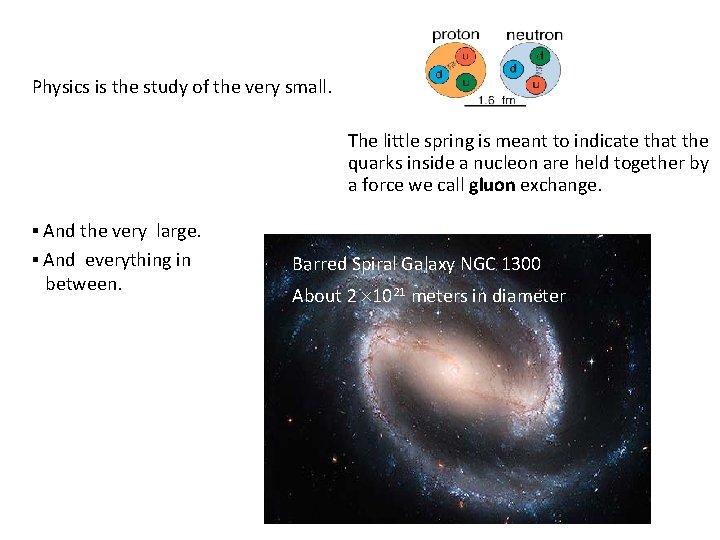
Physics is the study of the very small. ▪ And the very large. ▪ And everything in between. The little spring is meant to indicate that the quarks inside a nucleon are held together by a force we call gluon exchange. Barred Spiral Galaxy NGC 1300 About 2 1021 meters in diameter
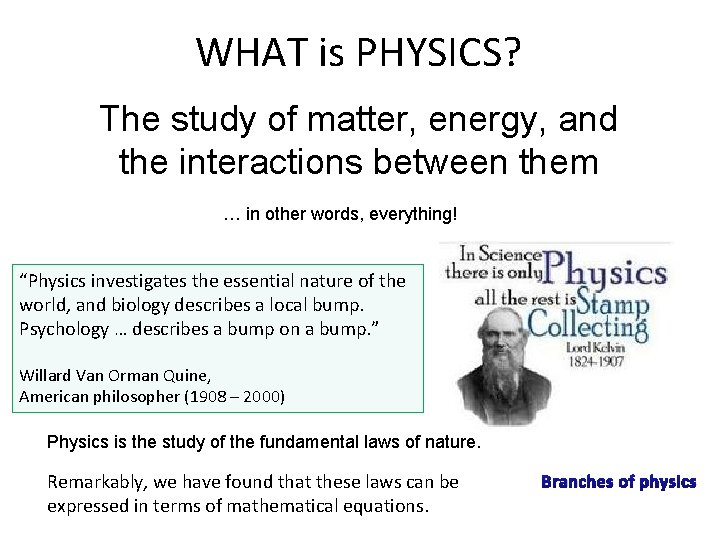
WHAT is PHYSICS? The study of matter, energy, and the interactions between them … in other words, everything! “Physics investigates the essential nature of the world, and biology describes a local bump. Psychology … describes a bump on a bump. ” Willard Van Orman Quine, American philosopher (1908 – 2000) Physics is the study of the fundamental laws of nature. Remarkably, we have found that these laws can be expressed in terms of mathematical equations. Branches of physics
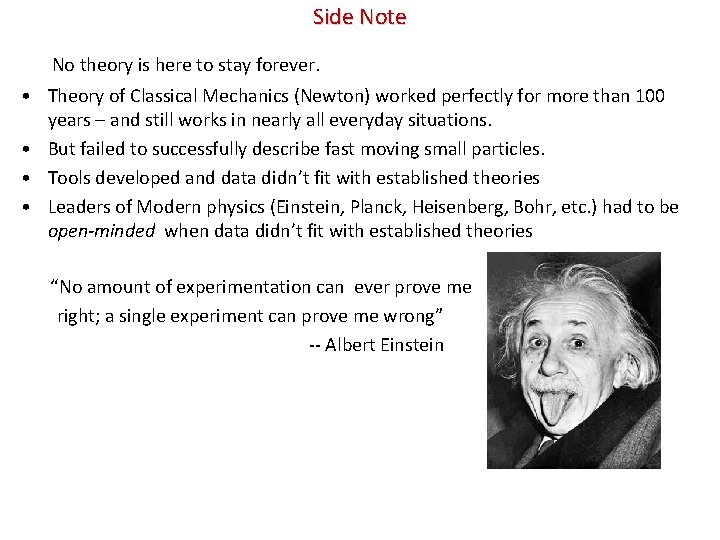
Side Note No theory is here to stay forever. • Theory of Classical Mechanics (Newton) worked perfectly for more than 100 years – and still works in nearly all everyday situations. • But failed to successfully describe fast moving small particles. • Tools developed and data didn’t fit with established theories • Leaders of Modern physics (Einstein, Planck, Heisenberg, Bohr, etc. ) had to be open-minded when data didn’t fit with established theories “No amount of experimentation can ever prove me right; a single experiment can prove me wrong” -- Albert Einstein
Side Note Quantum mechanics is the science of the very small: on the scale of atoms and subatomic particles. Science of very fast: ● Special theory of relativity – Albert Einstein. In nearly all everyday situations, Einstein’s theory gives predictions almost the same as Newton’s. Main distinction is in extreme case of very high speed (close to the speed of light) The new theory gave us much more: Our view of the world is affected with that theory. – Our concepts of space and time underwent a huge change – mass and energy as a single entity ( E = mc 2 ).
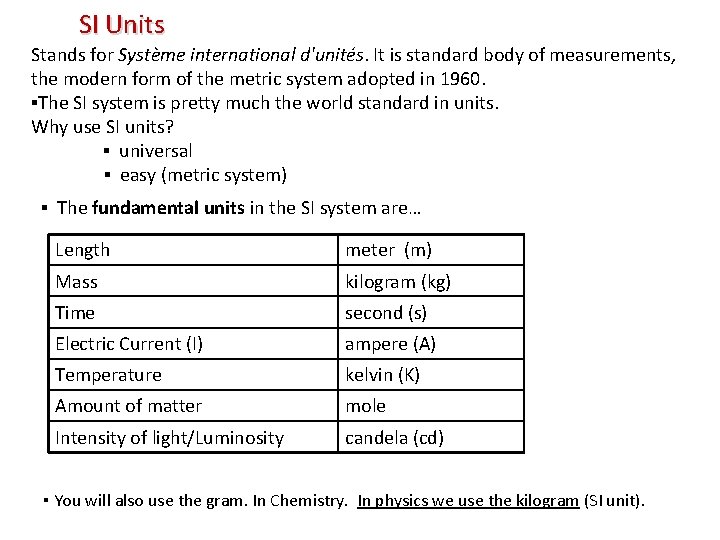
SI Units Stands for Système international d'unités. It is standard body of measurements, the modern form of the metric system adopted in 1960. ▪The SI system is pretty much the world standard in units. Why use SI units? ▪ universal ▪ easy (metric system) ▪ The fundamental units in the SI system are… Length meter (m) Mass kilogram (kg) Time second (s) Electric Current (I) ampere (A) Temperature kelvin (K) Amount of matter mole Intensity of light/Luminosity candela (cd) ▪ You will also use the gram. In Chemistry. In physics we use the kilogram (SI unit).
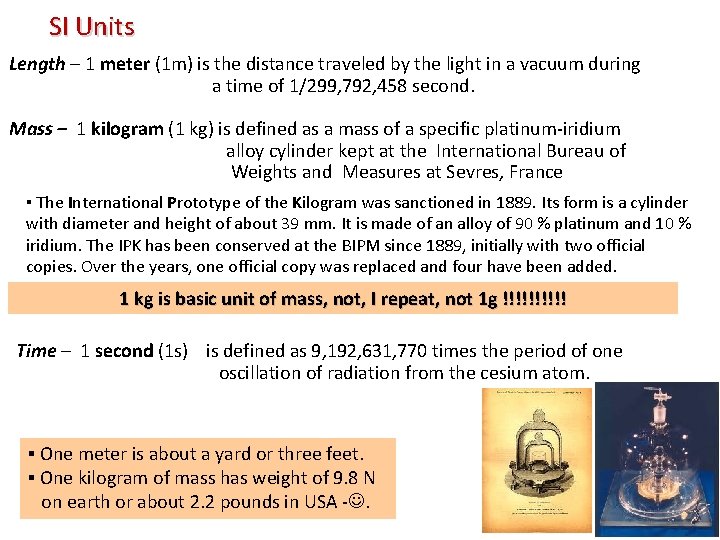
SI Units Length – 1 meter (1 m) is the distance traveled by the light in a vacuum during a time of 1/299, 792, 458 second. Mass – 1 kilogram (1 kg) is defined as a mass of a specific platinum-iridium alloy cylinder kept at the International Bureau of Weights and Measures at Sevres, France ▪ The International Prototype of the Kilogram was sanctioned in 1889. Its form is a cylinder with diameter and height of about 39 mm. It is made of an alloy of 90 % platinum and 10 % iridium. The IPK has been conserved at the BIPM since 1889, initially with two official copies. Over the years, one official copy was replaced and four have been added. 1 kg is basic unit of mass, not, I repeat, not 1 g !!!!! Time – 1 second (1 s) is defined as 9, 192, 631, 770 times the period of one oscillation of radiation from the cesium atom. ▪ One meter is about a yard or three feet. ▪ One kilogram of mass has weight of 9. 8 N on earth or about 2. 2 pounds in USA -.
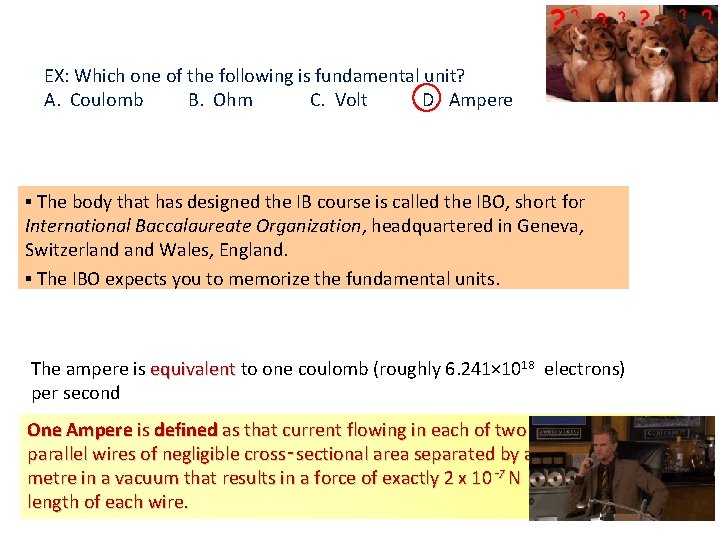
EX: Which one of the following is fundamental unit? A. Coulomb B. Ohm C. Volt D. Ampere ▪ The body that has designed the IB course is called the IBO, short for International Baccalaureate Organization, headquartered in Geneva, Switzerland Wales, England. ▪ The IBO expects you to memorize the fundamental units. 18 electrons) The ampere is equivalent to one coulomb (roughly 6. 241× 10 equivalent per second One Ampere is defined as that current flowing in each of two infinitely‑long parallel wires of negligible cross‑sectional area separated by a distance of one metre in a vacuum that results in a force of exactly 2 x 10‑ 7 N per metre of length of each wire.
Learning Intentions • You have already learned about… – What is physics – The 7 fundamental units • What you will learn about… – Derived units – Converting between units
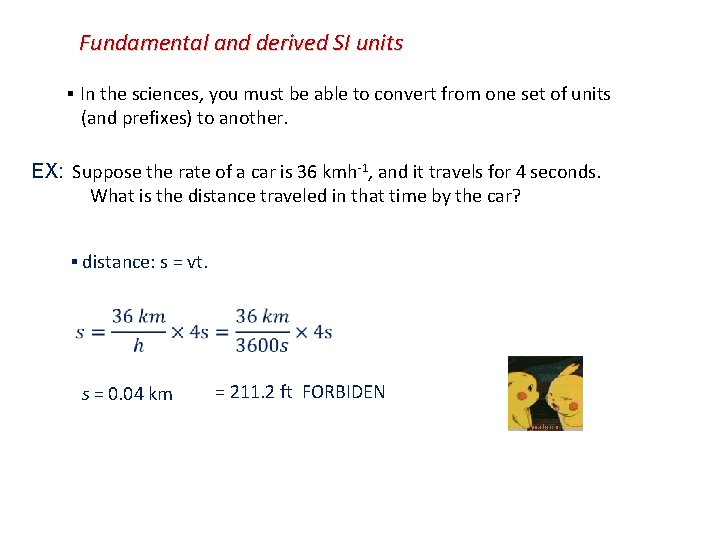
Fundamental and derived SI units ▪ In the sciences, you must be able to convert from one set of units (and prefixes) to another. EX: Suppose the rate of a car is 36 kmh-1, and it travels for 4 seconds. What is the distance traveled in that time by the car? ▪ distance: s = vt. s = 0. 04 km = 211. 2 ft FORBIDEN
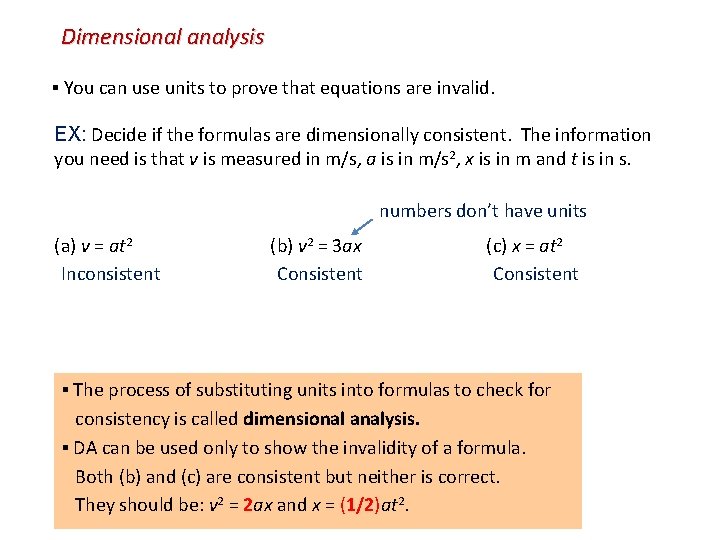
Dimensional analysis ▪ You can use units to prove that equations are invalid. EX: Decide if the formulas are dimensionally consistent. The information you need is that v is measured in m/s, a is in m/s 2, x is in m and t is in s. numbers don’t have units (a) v = at 2 Inconsistent (b) v 2 = 3 ax Consistent (c) x = at 2 Consistent ▪ The process of substituting units into formulas to check for consistency is called dimensional analysis. ▪ DA can be used only to show the invalidity of a formula. Both (b) and (c) are consistent but neither is correct. They should be: v 2 = 2 ax and x = (1/2)at 2.
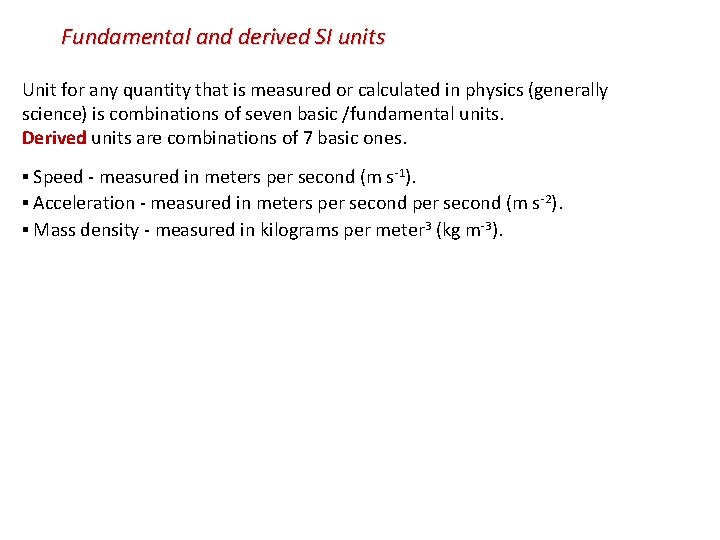
Fundamental and derived SI units Unit for any quantity that is measured or calculated in physics (generally science) is combinations of seven basic /fundamental units. Derived units are combinations of 7 basic ones. ▪ Speed - measured in meters per second (m s-1). ▪ Acceleration - measured in meters per second (m s-2). ▪ Mass density - measured in kilograms per meter 3 (kg m-3).
Scientific notation and prefixes Swine flu virus: diameter of 10 to 300 nanometers (nanometer is equal to one billionth of a meter) 0. 0000001 m becomes 1. 0 x 10 -13 m
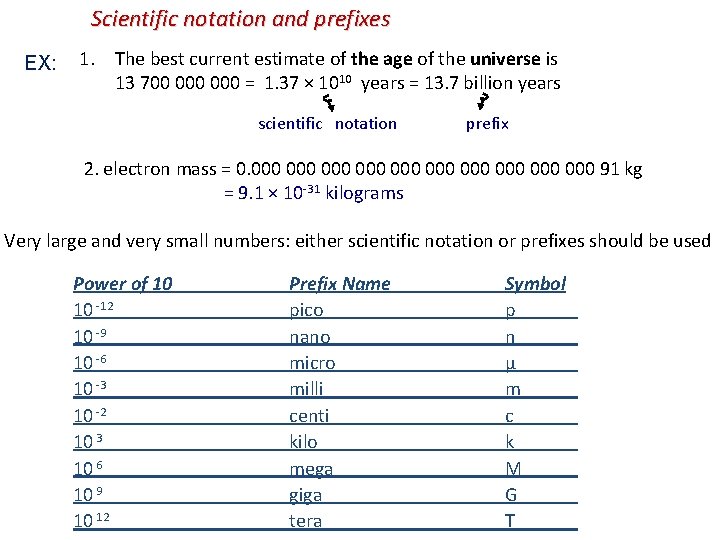
Scientific notation and prefixes EX: 1. The best current estimate of the age of the universe is 13 700 000 = 1. 37 × 1010 years = 13. 7 billion years scientific notation prefix 2. electron mass = 0. 000 000 000 91 kg = 9. 1 × 10 -31 kilograms Very large and very small numbers: either scientific notation or prefixes should be used Power of 10 10 -12 10 -9 10 -6 10 -3 10 -2 10 3 10 6 10 9 10 12 Prefix Name pico nano micro milli centi kilo mega giga tera Symbol p n µ m c k M G T
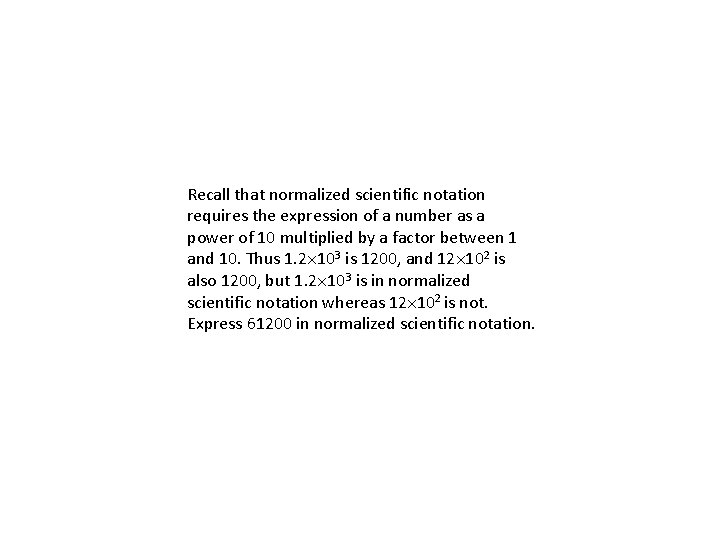
Recall that normalized scientific notation requires the expression of a number as a power of 10 multiplied by a factor between 1 and 10. Thus 1. 2 103 is 1200, and 12 102 is also 1200, but 1. 2 103 is in normalized scientific notation whereas 12 102 is not. Express 61200 in normalized scientific notation.
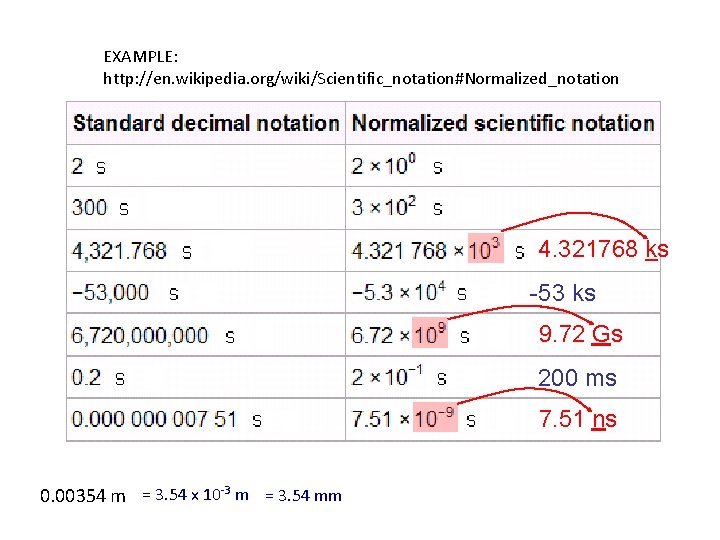
EXAMPLE: http: //en. wikipedia. org/wiki/Scientific_notation#Normalized_notation 4. 321768 ks -53 ks 9. 72 Gs 200 ms 7. 51 ns 0. 00354 m = 3. 54 x 10 -3 m = 3. 54 mm
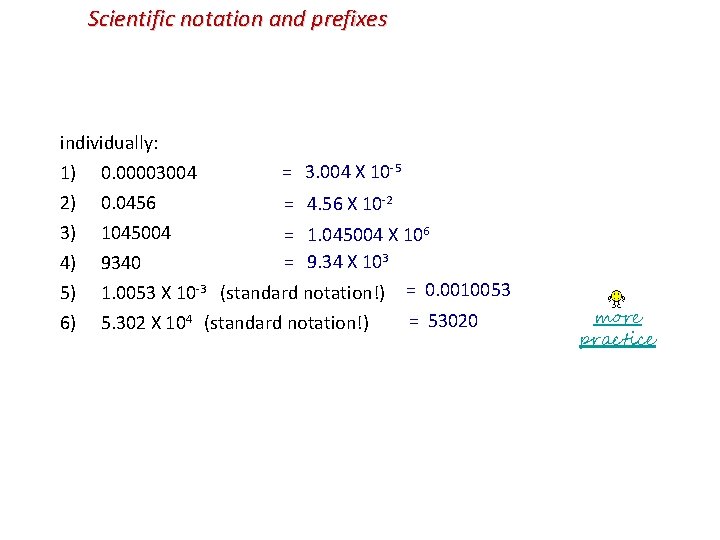
Scientific notation and prefixes individually: = 3. 004 X 10 -5 1) 0. 00003004 2) 0. 0456 = 4. 56 X 10 -2 3) 1045004 = 1. 045004 X 106 = 9. 34 X 103 4) 9340 5) 1. 0053 X 10 -3 (standard notation!) = 0. 0010053 = 53020 6) 5. 302 X 104 (standard notation!) more practice
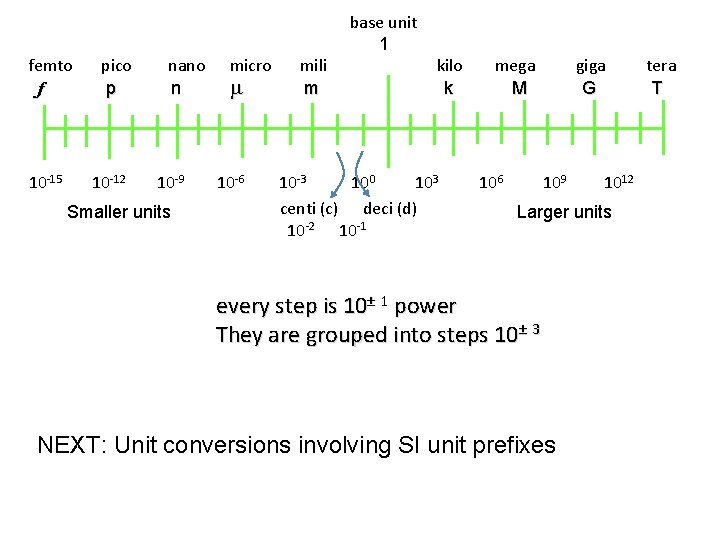
base unit 1 femto pico nano micro mili kilo mega giga tera f p n m m k M G T 10 -15 10 -12 10 -9 10 -6 10 -3 100 103 106 109 1012 centi (c) deci (d) Larger units Smaller units -2 -1 10 10 every step is 10± 1 power They are grouped into steps 10± 3 NEXT: Unit conversions involving SI unit prefixes
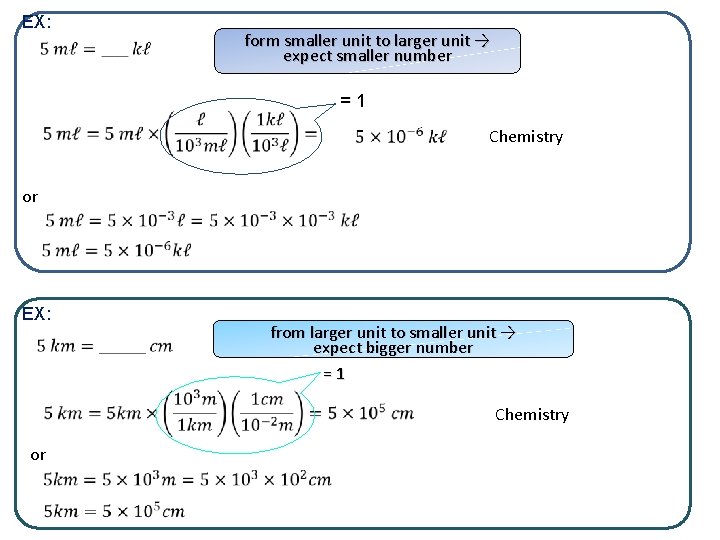
EX: form smaller unit to larger unit → expect smaller number =1 Chemistry or EX: or from larger unit to smaller unit → expect bigger number = 1 Chemistry
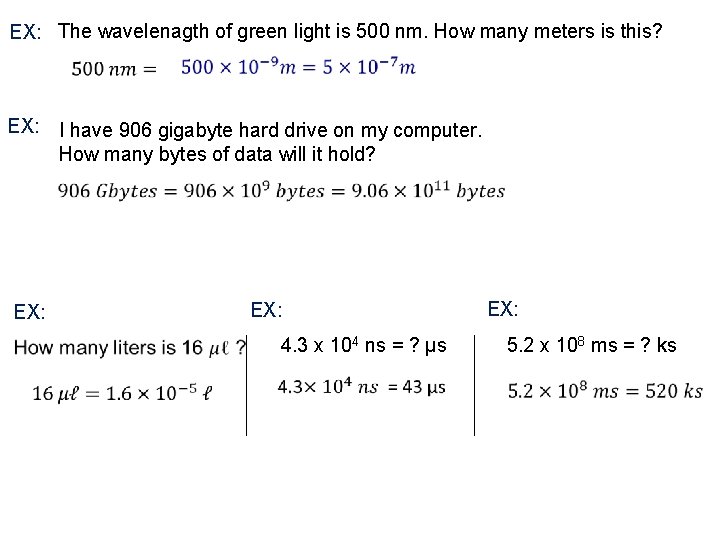
EX: The wavelenagth of green light is 500 nm. How many meters is this? EX: I have 906 gigabyte hard drive on my computer. How many bytes of data will it hold? EX: 4. 3 x 10⁴ ns = ? µs 5. 2 x 10⁸ ms = ? ks
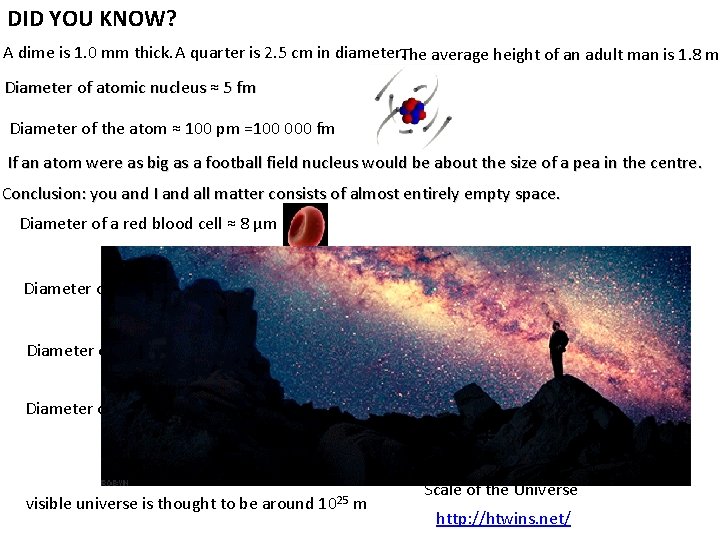
DID YOU KNOW? A dime is 1. 0 mm thick. A quarter is 2. 5 cm in diameter. The average height of an adult man is 1. 8 m. Diameter of atomic nucleus ≈ 5 fm Diameter of the atom ≈ 100 pm =100 000 fm If an atom were as big as a football field nucleus would be about the size of a pea in the centre. Conclusion: you and I and all matter consists of almost entirely empty space. Diameter of a red blood cell ≈ 8 μm Diameter of Earth ≈ 13 Mm Diameter of sun ≈ 1. 4 Gm Diameter of Milky Way ≈ 9500 Tm visible universe is thought to be around 1025 m Scale of the Universe http: //htwins. net/
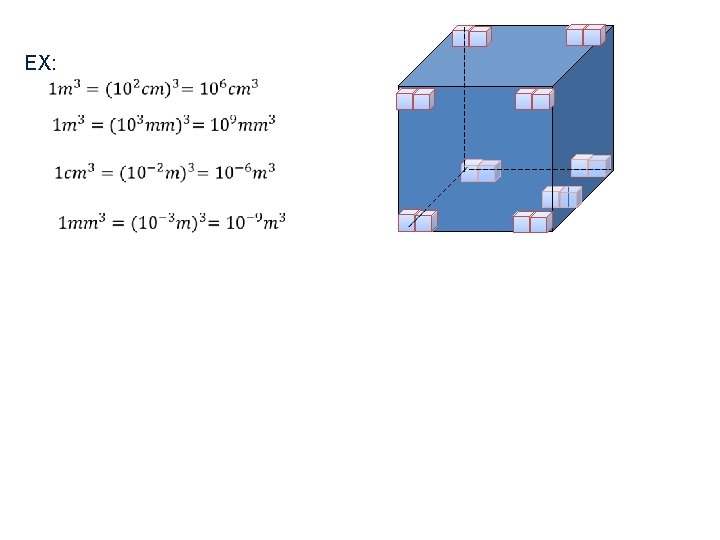
EX:
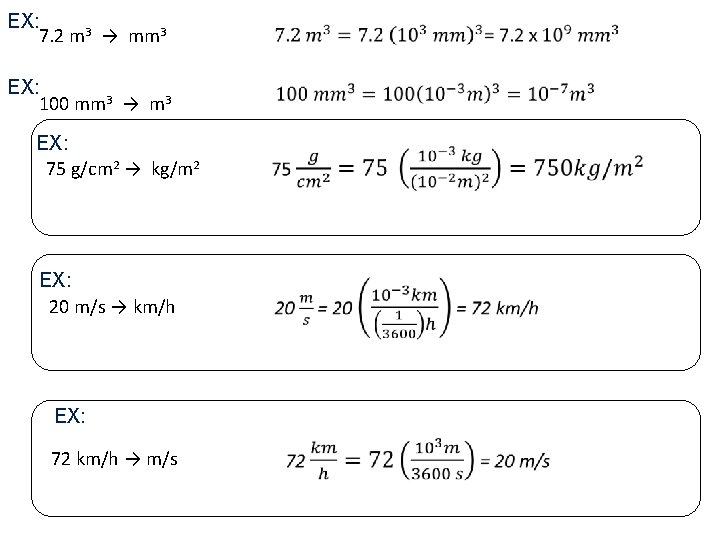
EX: 7. 2 m 3 → mm 3 EX: 100 mm 3 → m 3 EX: 75 g/cm 2 → kg/m 2 EX: 20 m/s → km/h EX: 72 km/h → m/s
Done with units (fundamental and derived) scientific notation prefixes Forward to …. .
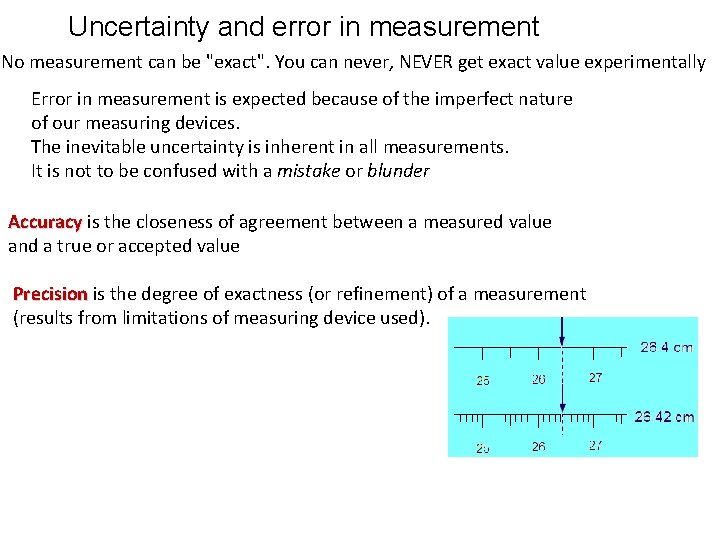
Uncertainty and error in measurement No measurement can be "exact". You can never, NEVER get exact value experimentally Error in measurement is expected because of the imperfect nature of our measuring devices. The inevitable uncertainty is inherent in all measurements. It is not to be confused with a mistake or blunder Accuracy is the closeness of agreement between a measured value and a true or accepted value Precision is the degree of exactness (or refinement) of a measurement (results from limitations of measuring device used).
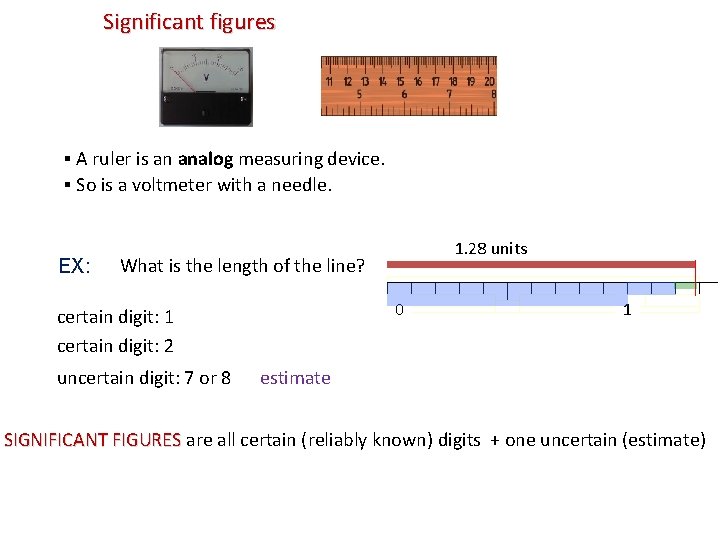
Significant figures ▪ A ruler is an analog measuring device. ▪ So is a voltmeter with a needle. EX: 1. 28 units What is the length of the line? 0 certain digit: 1 certain digit: 2 uncertain digit: 7 or 8 1 estimate SIGNIFICANT FIGURES are all certain (reliably known) digits + one uncertain (estimate) SIGNIFICANT FIGURES
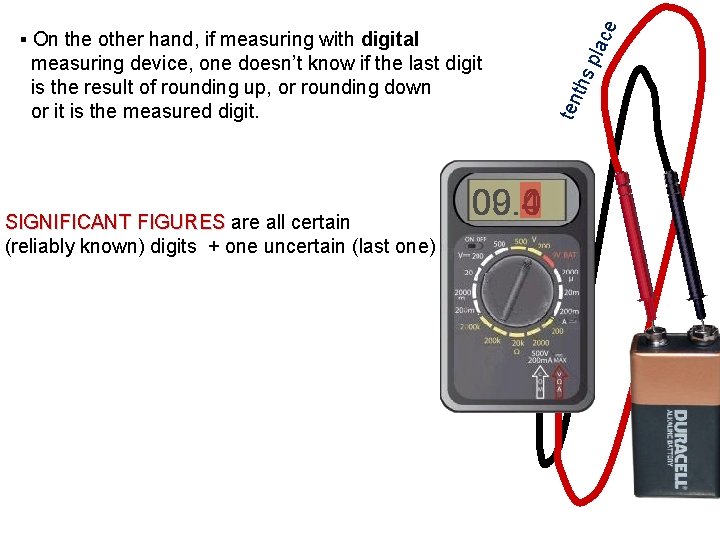
SIGNIFICANT FIGURES are all certain (reliably known) digits + one uncertain (last one) 09. 4 00. 0 e pla c ten ths ▪ On the other hand, if measuring with digital measuring device, one doesn’t know if the last digit is the result of rounding up, or rounding down or it is the measured digit.
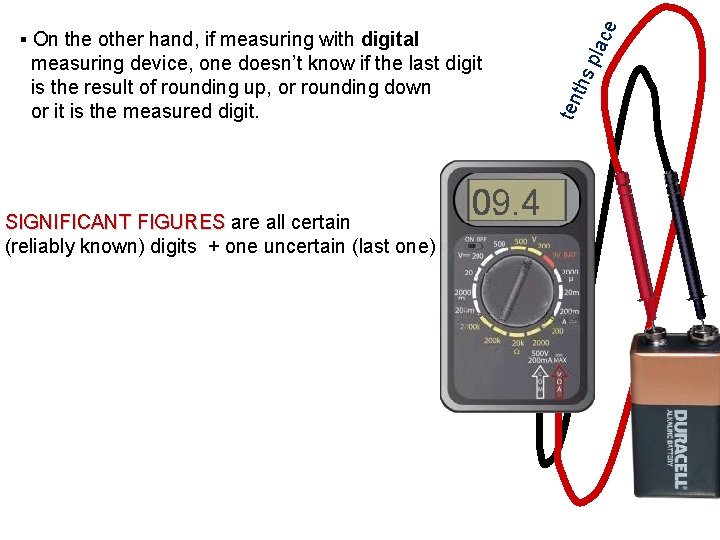
SIGNIFICANT FIGURES are all certain (reliably known) digits + one uncertain (last one) 09. 4 0. e pla c ten ths ▪ On the other hand, if measuring with digital measuring device, one doesn’t know if the last digit is the result of rounding up, or rounding down or it is the measured digit.
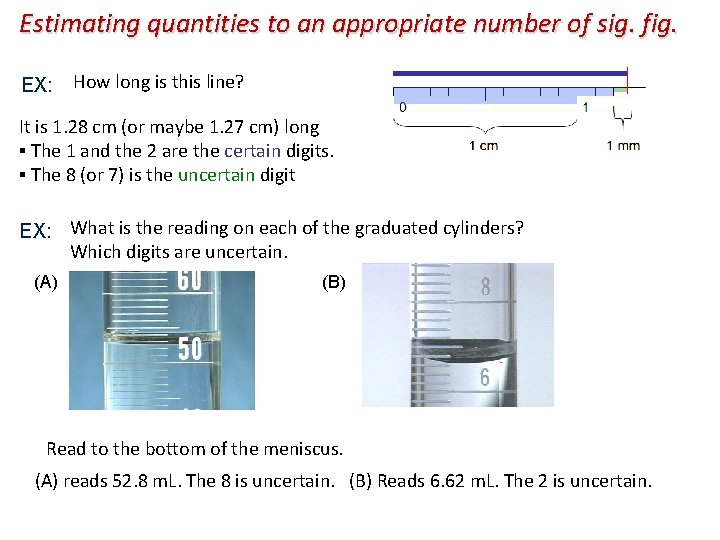
Estimating quantities to an appropriate number of sig. fig. EX: How long is this line? It is 1. 28 cm (or maybe 1. 27 cm) long ▪ The 1 and the 2 are the certain digits. ▪ The 8 (or 7) is the uncertain digit EX: What is the reading on each of the graduated cylinders? Which digits are uncertain. (A) (B) Read to the bottom of the meniscus. (A) reads 52. 8 m. L. The 8 is uncertain. (B) Reads 6. 62 m. L. The 2 is uncertain.
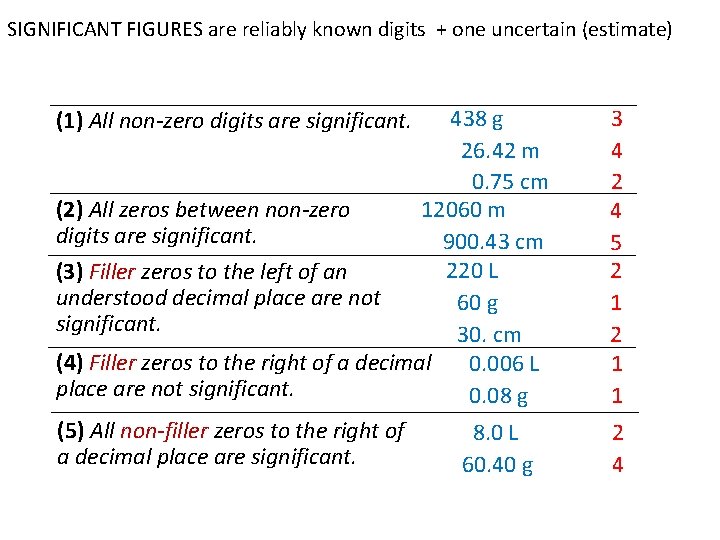
SIGNIFICANT FIGURES are reliably known digits + one uncertain (estimate) 438 g 26. 42 m 0. 75 cm (2) All zeros between non-zero 12060 m digits are significant. 900. 43 cm 220 L (3) Filler zeros to the left of an understood decimal place are not 60 g significant. 30. cm (4) Filler zeros to the right of a decimal 0. 006 L place are not significant. 0. 08 g (5) All non-filler zeros to the right of 8. 0 L a decimal place are significant. 60. 40 g (1) All non-zero digits are significant. 3 4 2 4 5 2 1 1 2 4
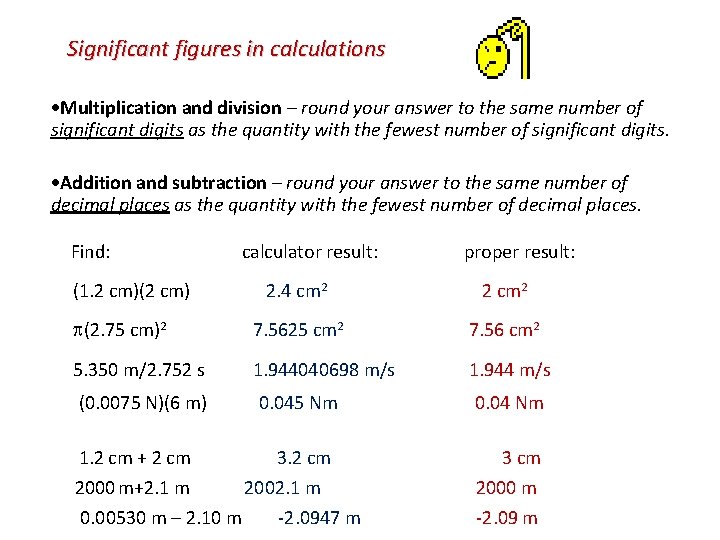
Significant figures in calculations Multiplication and division – round your answer to the same number of significant digits as the quantity with the fewest number of significant digits. Addition and subtraction – round your answer to the same number of decimal places as the quantity with the fewest number of decimal places. Find: calculator result: proper result: (1. 2 cm)(2 cm) 2. 4 cm 2 2 cm 2 (2. 75 cm)2 7. 5625 cm 2 7. 56 cm 2 5. 350 m/2. 752 s 1. 944040698 m/s 1. 944 m/s (0. 0075 N)(6 m) 0. 045 Nm 1. 2 cm + 2 cm 3. 2 cm 2000 m+2. 1 m 2002. 1 m 0. 00530 m – 2. 10 m -2. 0947 m 0. 04 Nm 3 cm 2000 m -2. 09 m
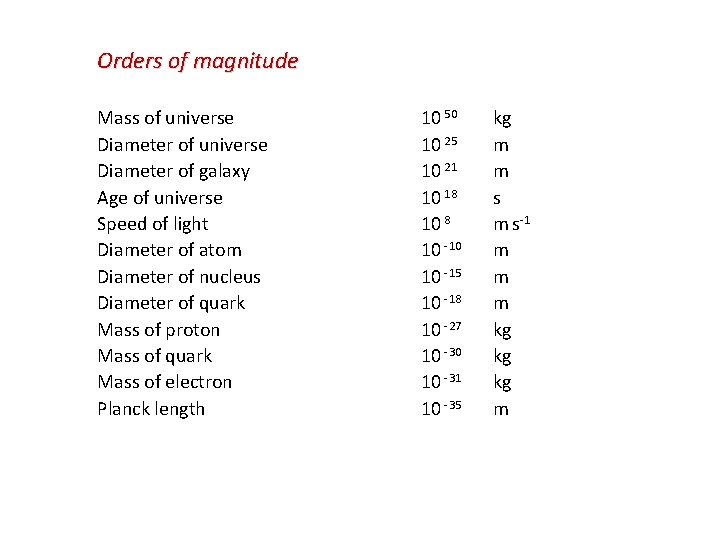
Orders of magnitude Mass of universe Diameter of galaxy Age of universe Speed of light Diameter of atom Diameter of nucleus Diameter of quark Mass of proton Mass of quark Mass of electron Planck length 10 50 10 25 10 21 10 18 10 -10 10 -15 10 -18 10 -27 10 -30 10 -31 10 -35 kg m m s-1 m m m kg kg kg m
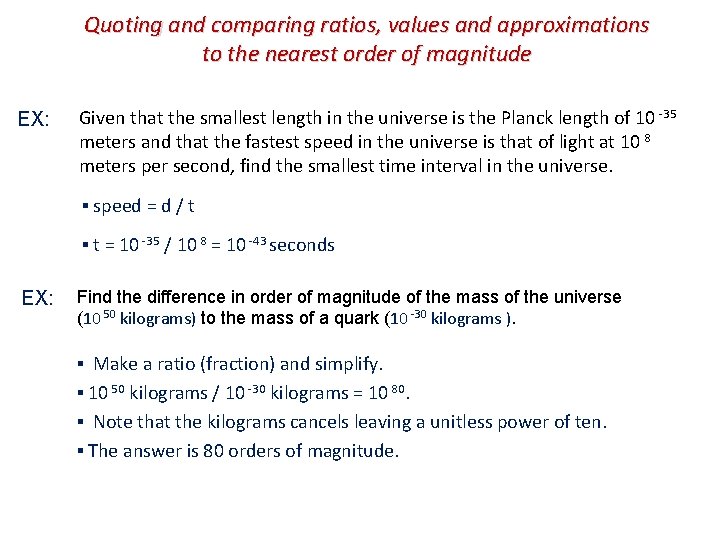
Quoting and comparing ratios, values and approximations to the nearest order of magnitude EX: Given that the smallest length in the universe is the Planck length of 10 -35 meters and that the fastest speed in the universe is that of light at 10 8 meters per second, find the smallest time interval in the universe. ▪ speed = d / t ▪ t = 10 -35 / 10 8 = 10 -43 seconds EX: Find the difference in order of magnitude of the mass of the universe (10 50 kilograms) to the mass of a quark (10 -30 kilograms ). ▪ Make a ratio (fraction) and simplify. ▪ 10 50 kilograms / 10 -30 kilograms = 10 80. ▪ Note that the kilograms cancels leaving a unitless power of ten. ▪ The answer is 80 orders of magnitude.
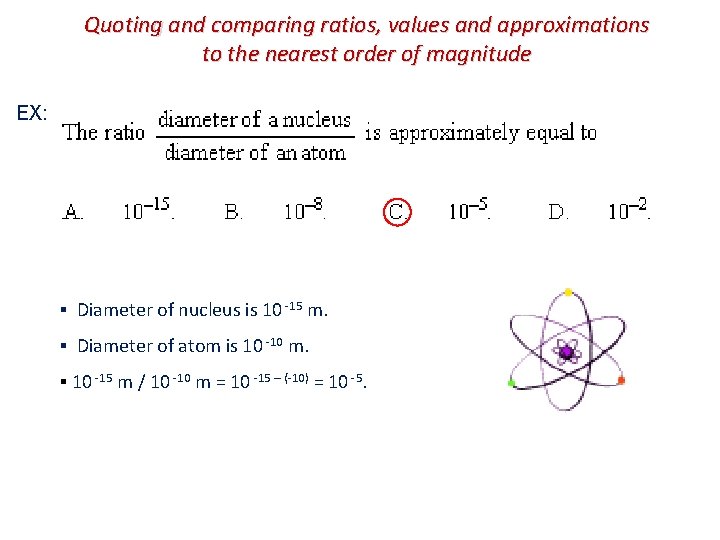
Quoting and comparing ratios, values and approximations to the nearest order of magnitude EX: ▪ Diameter of nucleus is 10 -15 m. ▪ Diameter of atom is 10 -10 m. ▪ 10 -15 m / 10 -10 m = 10 -15 – (-10) = 10 -5.
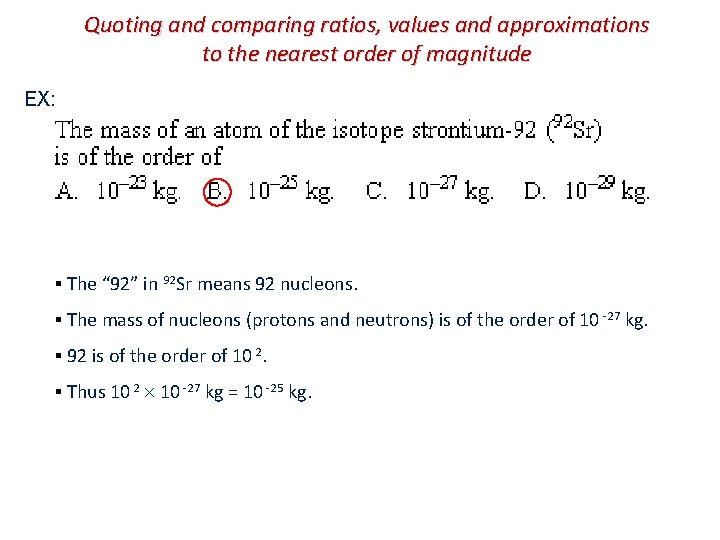
Quoting and comparing ratios, values and approximations to the nearest order of magnitude EX: ▪ The “ 92” in 92 Sr means 92 nucleons. ▪ The mass of nucleons (protons and neutrons) is of the order of 10 -27 kg. ▪ 92 is of the order of 10 2. ▪ Thus 10 2 10 -27 kg = 10 -25 kg.
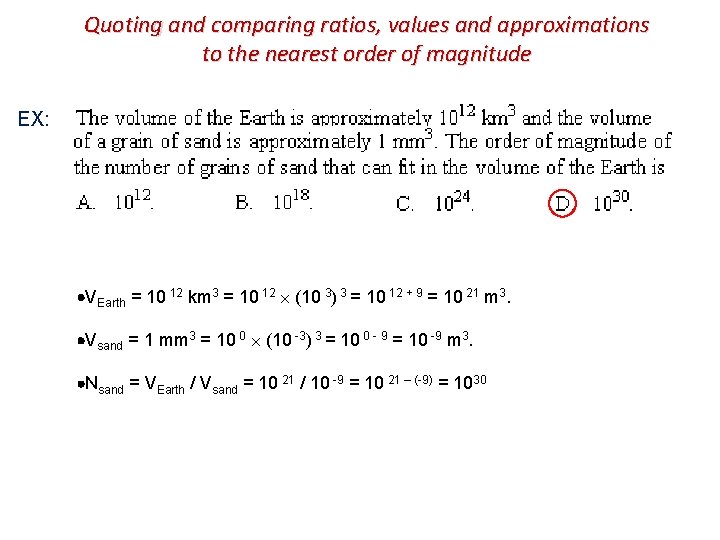
Quoting and comparing ratios, values and approximations to the nearest order of magnitude EX: VEarth = 10 12 km 3 = 10 12 (10 3) 3 = 10 12 + 9 = 10 21 m 3. Vsand = 1 mm 3 = 10 0 (10 -3) 3 = 10 0 - 9 = 10 -9 m 3. Nsand = VEarth / Vsand = 10 21 / 10 -9 = 10 21 – (-9) = 1030
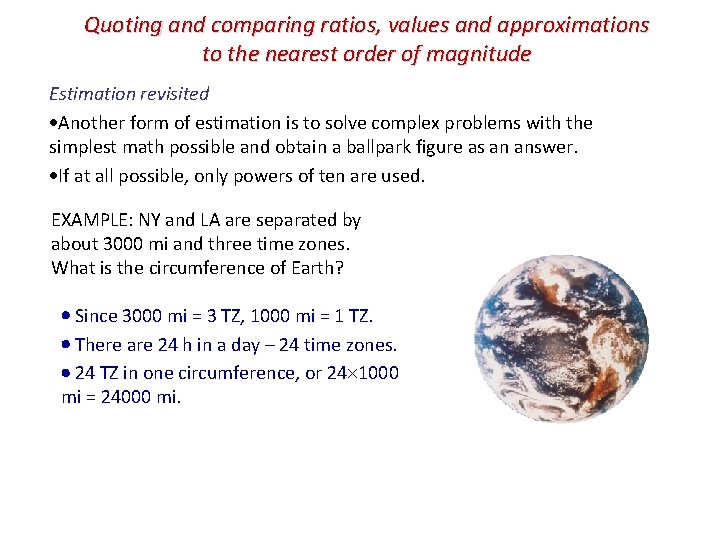
Quoting and comparing ratios, values and approximations to the nearest order of magnitude Estimation revisited Another form of estimation is to solve complex problems with the simplest math possible and obtain a ballpark figure as an answer. If at all possible, only powers of ten are used. EXAMPLE: NY and LA are separated by about 3000 mi and three time zones. What is the circumference of Earth? Since 3000 mi = 3 TZ, 1000 mi = 1 TZ. There are 24 h in a day – 24 time zones. 24 TZ in one circumference, or 24 1000 mi = 24000 mi.
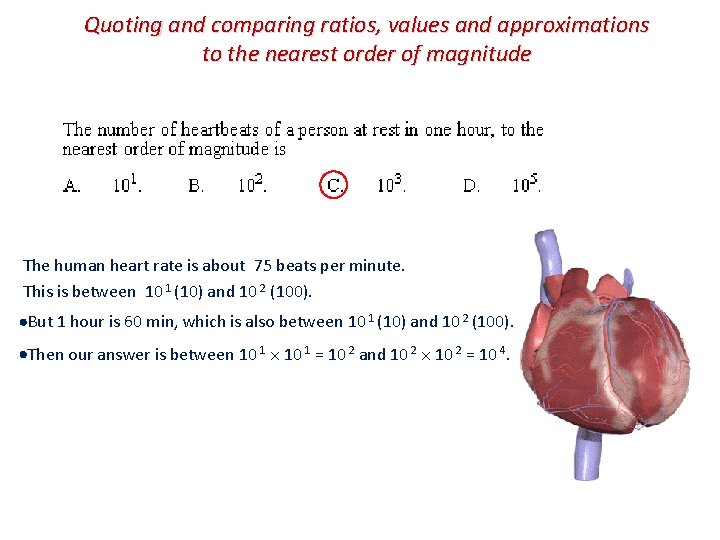
Quoting and comparing ratios, values and approximations to the nearest order of magnitude The human heart rate is about 75 beats per minute. This is between 10 1 (10) and 10 2 (100). But 1 hour is 60 min, which is also between 10 1 (10) and 10 2 (100). Then our answer is between 10 1 = 10 2 and 10 2 = 10 4.