
TOPIC 1 INTRODUCTION TO MALAYSIAN ECONOMY MALAYSIAN NATIONAL

- Slides: 21
TOPIC 1: INTRODUCTION TO MALAYSIAN ECONOMY MALAYSIAN NATIONAL INCOME ACCOUNTING, ECONOMIC GROWTH AND STRUCTURE. INTRODUCTION
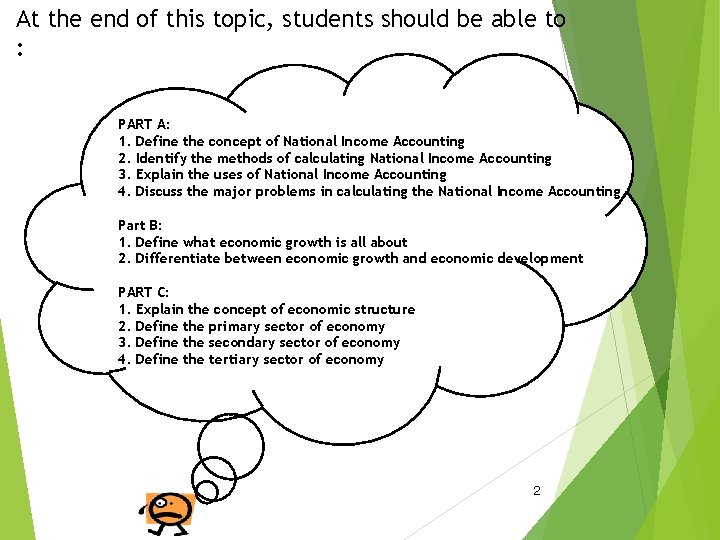
At the end of this topic, students should be able to : PART A: 1. Define the concept of National Income Accounting 2. Identify the methods of calculating National Income Accounting 3. Explain the uses of National Income Accounting 4. Discuss the major problems in calculating the National Income Accounting Part B: 1. Define what economic growth is all about 2. Differentiate between economic growth and economic development PART C: 1. Explain the concept of economic structure 2. Define the primary sector of economy 3. Define the secondary sector of economy 4. Define the tertiary sector of economy 2
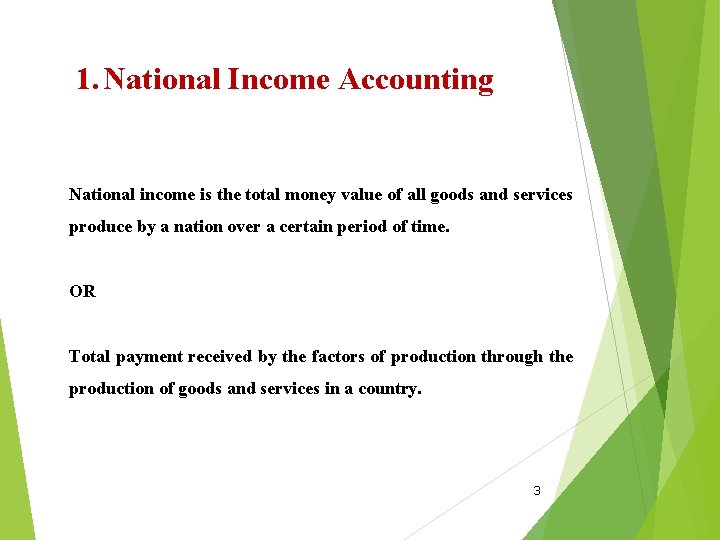
1. National Income Accounting National income is the total money value of all goods and services produce by a nation over a certain period of time. OR Total payment received by the factors of production through the production of goods and services in a country. 3
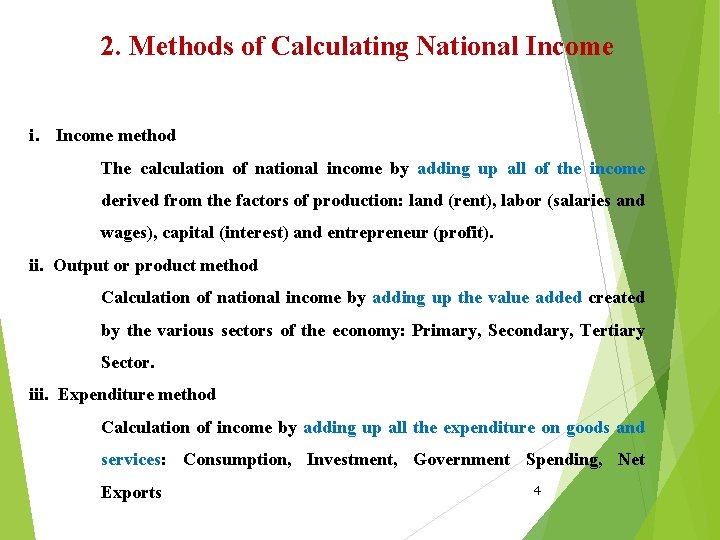
2. Methods of Calculating National Income i. Income method The calculation of national income by adding up all of the income derived from the factors of production: land (rent), labor (salaries and wages), capital (interest) and entrepreneur (profit). ii. Output or product method Calculation of national income by adding up the value added created by the various sectors of the economy: Primary, Secondary, Tertiary Sector. iii. Expenditure method Calculation of income by adding up all the expenditure on goods and services: Consumption, Investment, Government Spending, Net Exports 4
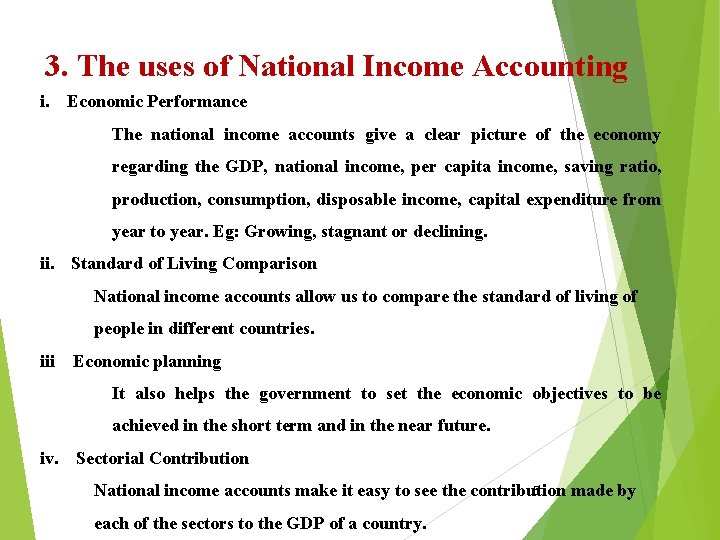
3. The uses of National Income Accounting i. Economic Performance The national income accounts give a clear picture of the economy regarding the GDP, national income, per capita income, saving ratio, production, consumption, disposable income, capital expenditure from year to year. Eg: Growing, stagnant or declining. ii. Standard of Living Comparison National income accounts allow us to compare the standard of living of people in different countries. iii Economic planning It also helps the government to set the economic objectives to be achieved in the short term and in the near future. iv. Sectorial Contribution 5 National income accounts make it easy to see the contribution made by each of the sectors to the GDP of a country.
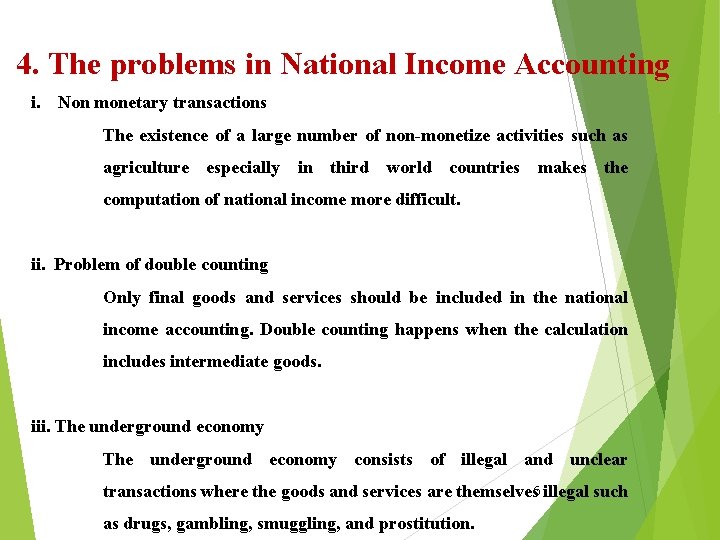
4. The problems in National Income Accounting i. Non monetary transactions The existence of a large number of non-monetize activities such as agriculture especially in third world countries makes the computation of national income more difficult. ii. Problem of double counting Only final goods and services should be included in the national income accounting. Double counting happens when the calculation includes intermediate goods. iii. The underground economy consists of illegal and unclear 6 transactions where the goods and services are themselves illegal such as drugs, gambling, smuggling, and prostitution.
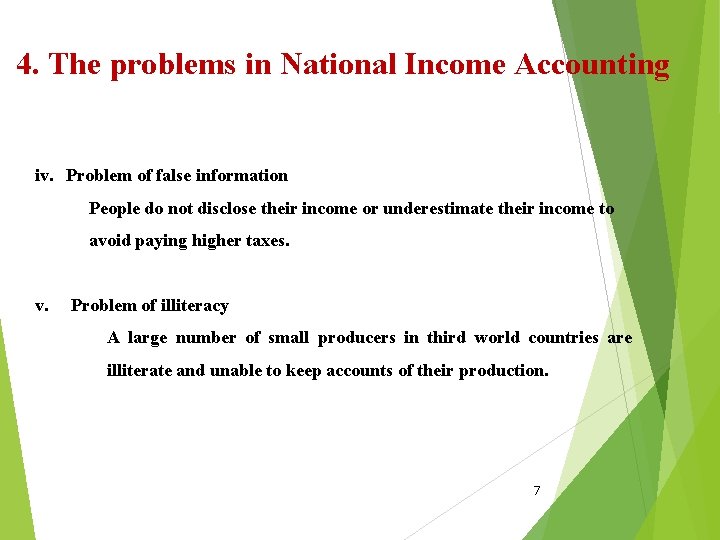
4. The problems in National Income Accounting iv. Problem of false information People do not disclose their income or underestimate their income to avoid paying higher taxes. v. Problem of illiteracy A large number of small producers in third world countries are illiterate and unable to keep accounts of their production. 7
8
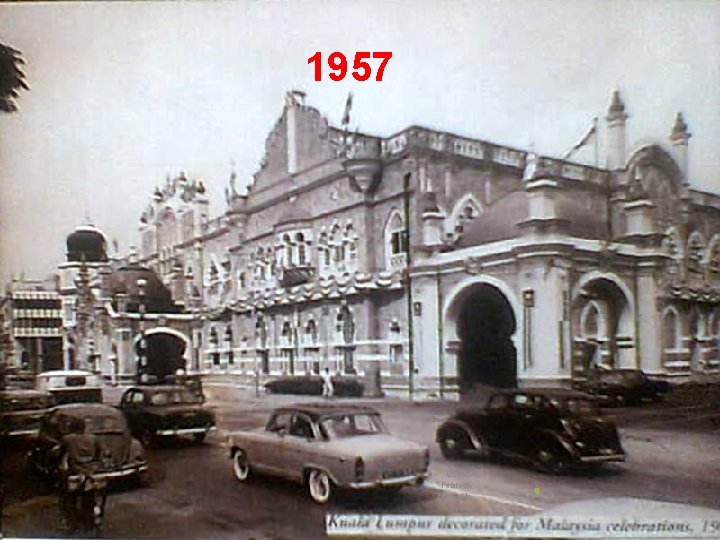
1957 © 2005 Pearson Educatio n, Inc. 9
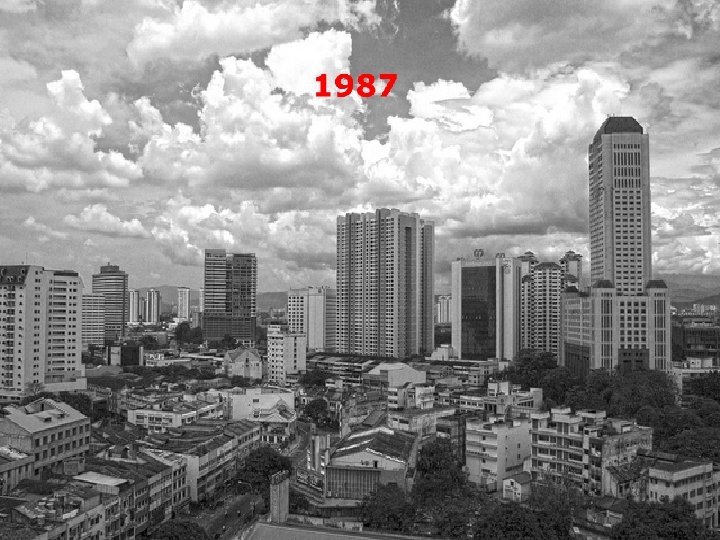
Chapter 1 © 200 5 Pears on Educa tion, Inc. 10
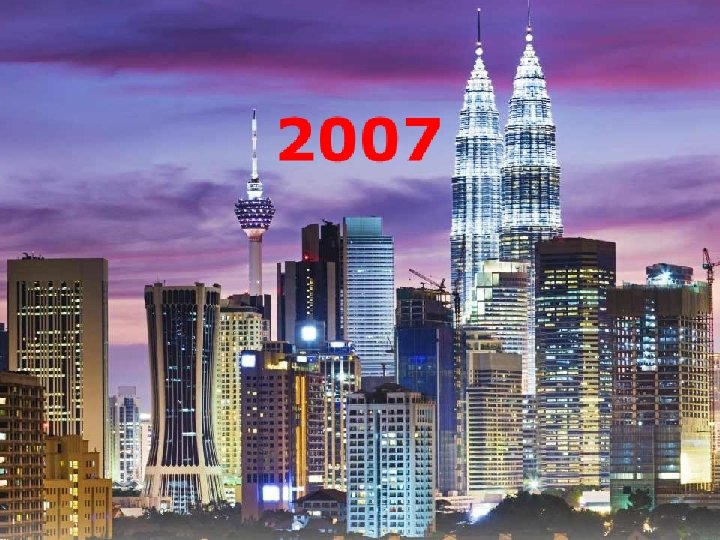
Chapter 1 © 200 5 Pears on Educa tion, Inc. 11
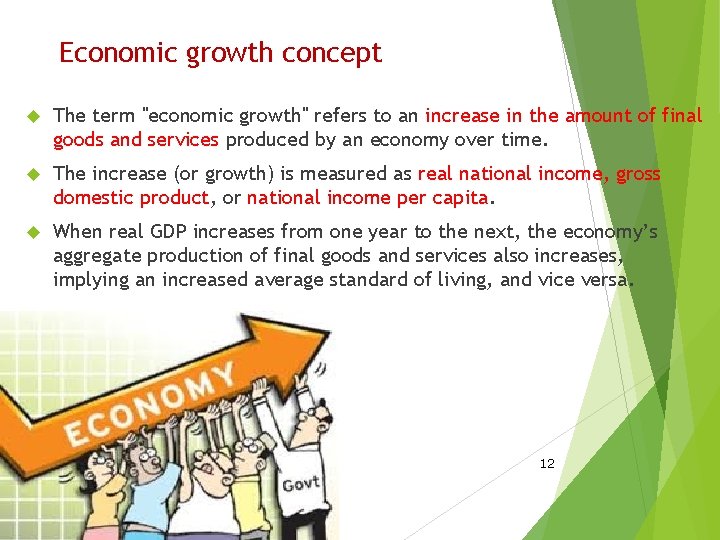
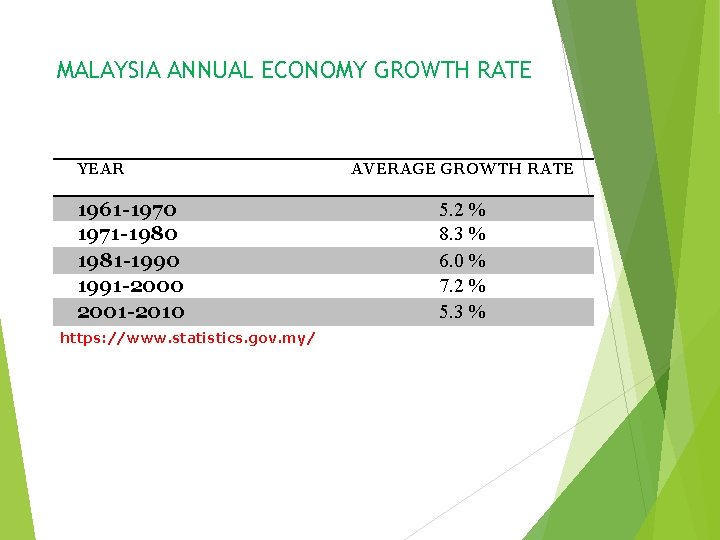
Economic growth concept The term "economic growth" refers to an increase in the amount of final goods and services produced by an economy over time. The increase (or growth) is measured as real national income, gross domestic product, or national income per capita. When real GDP increases from one year to the next, the economy’s aggregate production of final goods and services also increases, implying an increased average standard of living, and vice versa. 12
MALAYSIA ANNUAL ECONOMY GROWTH RATE YEAR 1961 -1970 1971 -1980 1981 -1990 1991 -2000 2001 -2010 https: //www. statistics. gov. my/ AVERAGE GROWTH RATE 5. 2 % 8. 3 % 6. 0 % 7. 2 % 5. 3 %
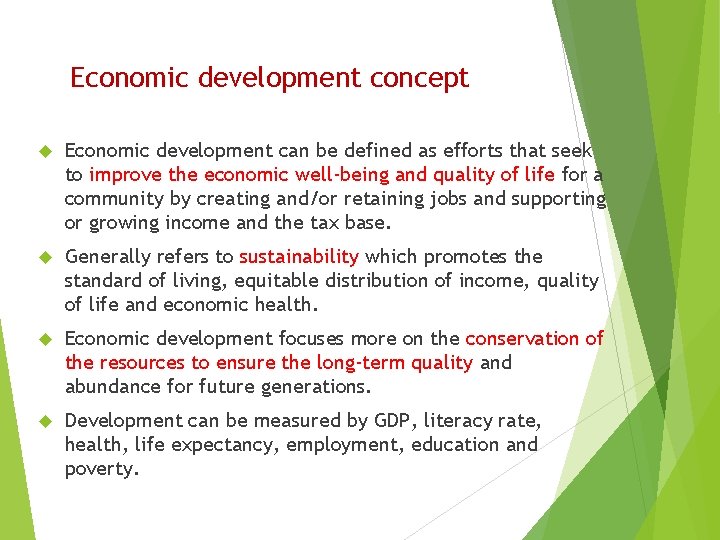
Economic development concept Economic development can be defined as efforts that seek to improve the economic well-being and quality of life for a community by creating and/or retaining jobs and supporting or growing income and the tax base. Generally refers to sustainability which promotes the standard of living, equitable distribution of income, quality of life and economic health. Economic development focuses more on the conservation of the resources to ensure the long-term quality and abundance for future generations. Development can be measured by GDP, literacy rate, health, life expectancy, employment, education and poverty.
15
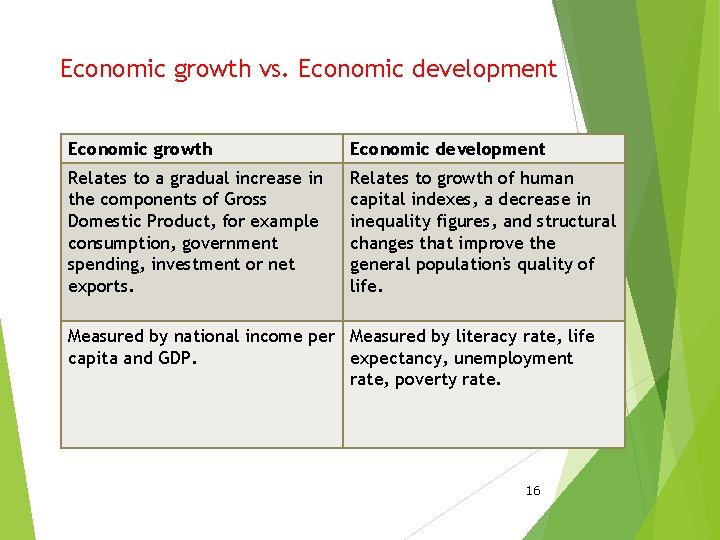
Economic growth vs. Economic development Economic growth Economic development Relates to a gradual increase in the components of Gross Domestic Product, for example consumption, government spending, investment or net exports. Relates to growth of human capital indexes, a decrease in inequality figures, and structural changes that improve the general population's quality of life. Measured by national income per Measured by literacy rate, life capita and GDP. expectancy, unemployment rate, poverty rate. 16
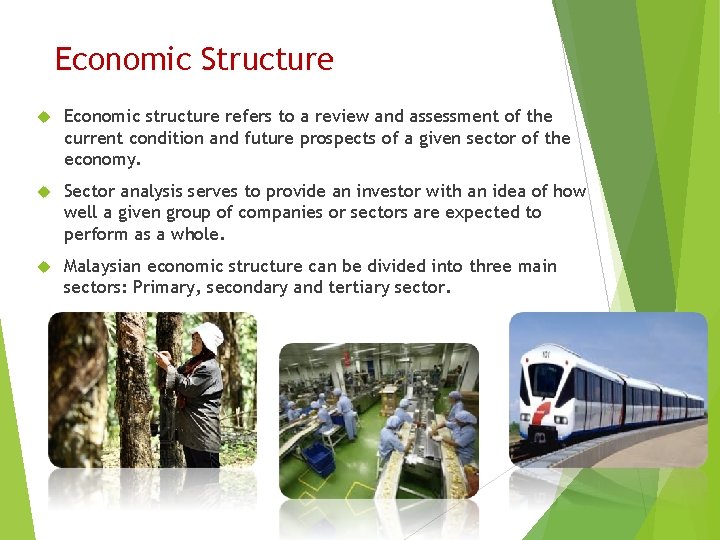
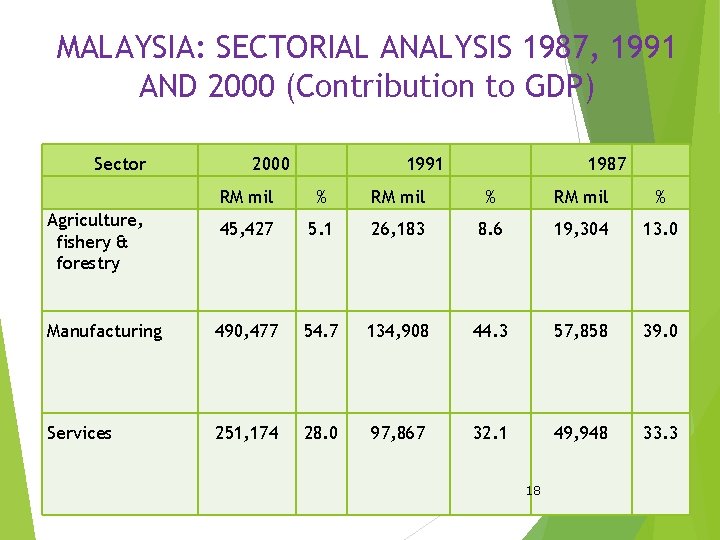
Economic Structure Economic structure refers to a review and assessment of the current condition and future prospects of a given sector of the economy. Sector analysis serves to provide an investor with an idea of how well a given group of companies or sectors are expected to perform as a whole. Malaysian economic structure can be divided into three main sectors: Primary, secondary and tertiary sector.
MALAYSIA: SECTORIAL ANALYSIS 1987, 1991 AND 2000 (Contribution to GDP) Sector 2000 1991 1987 RM mil % Agriculture, fishery & forestry 45, 427 5. 1 26, 183 8. 6 19, 304 13. 0 Manufacturing 490, 477 54. 7 134, 908 44. 3 57, 858 39. 0 Services 251, 174 28. 0 97, 867 32. 1 49, 948 33. 3 18
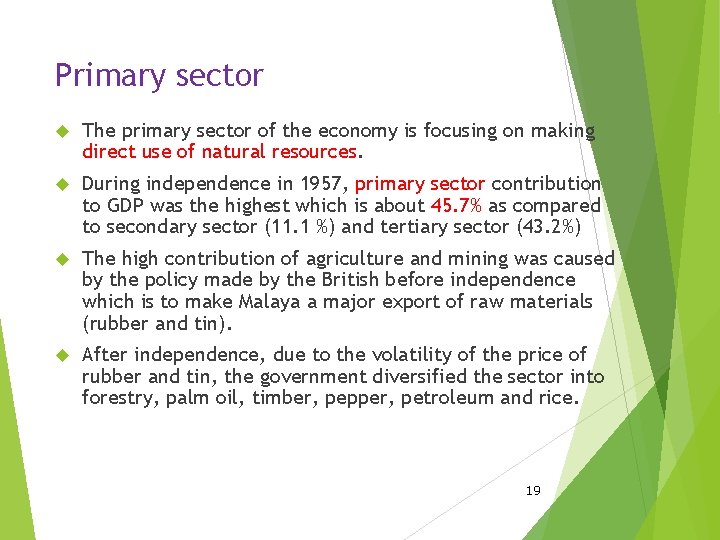
Primary sector The primary sector of the economy is focusing on making direct use of natural resources. During independence in 1957, primary sector contribution to GDP was the highest which is about 45. 7% as compared to secondary sector (11. 1 %) and tertiary sector (43. 2%) The high contribution of agriculture and mining was caused by the policy made by the British before independence which is to make Malaya a major export of raw materials (rubber and tin). After independence, due to the volatility of the price of rubber and tin, the government diversified the sector into forestry, palm oil, timber, pepper, petroleum and rice. 19
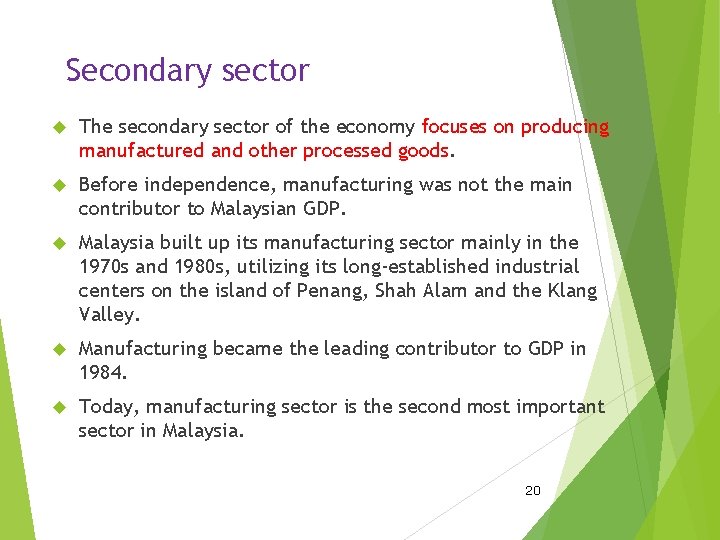
Secondary sector The secondary sector of the economy focuses on producing manufactured and other processed goods. Before independence, manufacturing was not the main contributor to Malaysian GDP. Malaysia built up its manufacturing sector mainly in the 1970 s and 1980 s, utilizing its long-established industrial centers on the island of Penang, Shah Alam and the Klang Valley. Manufacturing became the leading contributor to GDP in 1984. Today, manufacturing sector is the second most important sector in Malaysia. 20
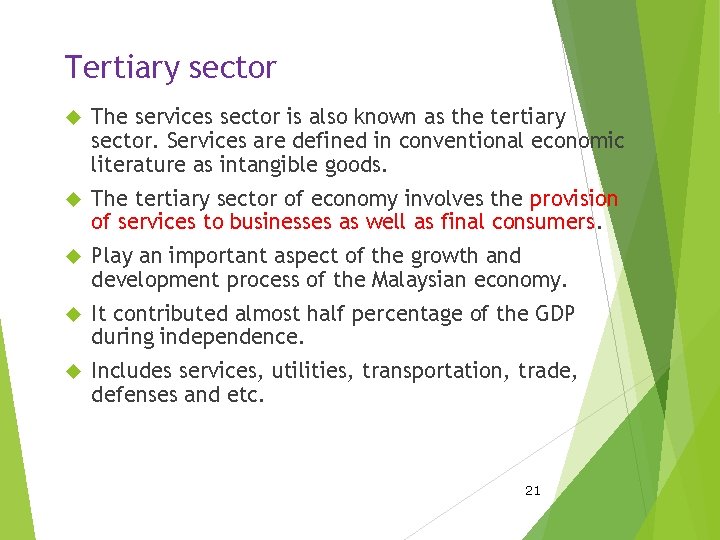
Tertiary sector The services sector is also known as the tertiary sector. Services are defined in conventional economic literature as intangible goods. The tertiary sector of economy involves the provision of services to businesses as well as final consumers. Play an important aspect of the growth and development process of the Malaysian economy. It contributed almost half percentage of the GDP during independence. Includes services, utilities, transportation, trade, defenses and etc. 21