
Topic 1 6 CELL DIVISION Topic Outline Cell









- Slides: 22
Topic 1. 6 CELL DIVISION
Topic Outline þ Cell Cycle þ Interphase þ Mitosis / Cytokinesis þ Mitotic Index þ Cell Cycle Regulation þ Cell Death þ Cancer Development Cell division is essential but must be controlled AUDIO
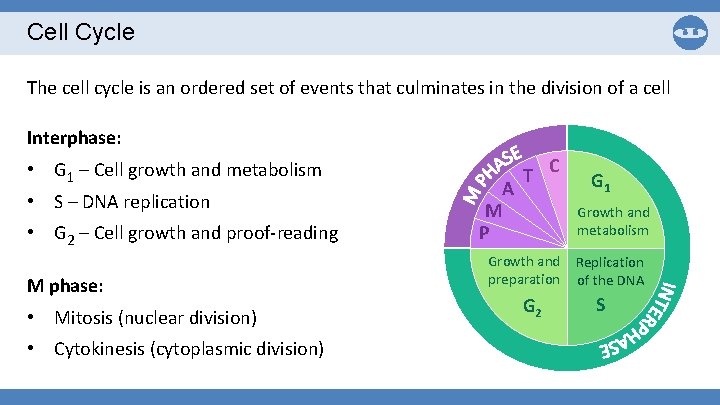
Cell Cycle The cell cycle is an ordered set of events that culminates in the division of a cell Interphase: • G 1 – Cell growth and metabolism • S – DNA replication • G 2 – Cell growth and proof-reading M phase: • Mitosis (nuclear division) • Cytokinesis (cytoplasmic division) A M P T C G 1 Growth and metabolism Growth and preparation G 2 Replication of the DNA S S
Interphase is an active period in the cell cycle when many key metabolic processes occur, including: • DNA replication (DNA is copied during S phase) • Organelle duplication (organelles copied) • Cell growth (cytoplasmic volume increases) • Transcription / translation (proteins produced) • Obtain nutrients (ensure sufficient material quantities) • Respiration (ATP stocks are needed for division process) Mnemonic: Doctor Interphase is an active phase of the cell cycle with many processes occurring in a nucleus and cytoplasm
S Phase (Interphase) DNA is replicated during the S phase of interphase • Normally, DNA is loosely packed as accessible chromatin within the nucleus • During mitosis, DNA condenses (supercoils) into tightly-packed chromosomes Replicated chromosomes will consist of genetically identical sister chromatids single chromatid chromosome (pre-replication) S phase Chromosomes condense by supercoiling during mitosis sister chromatid chromosome (post-replication)
Mitosis is the process of nuclear division, whereby each pair of sister chromatids are physically separated into two daughter nuclei that are genetically identical Mitotic division involves 4 stages: Prophase, Metaphase, Anaphase, Telophase • The division of the cell (via cytokinesis) occurs concurrently with telophase P M A T Mitosis is the division of the nucleus into two genetically identical daughter nuclei
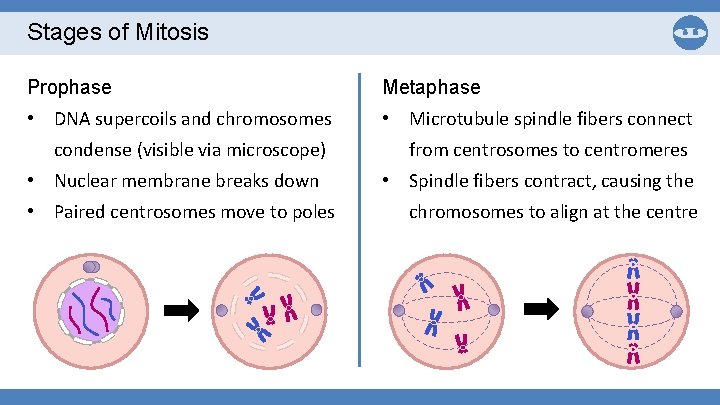
Stages of Mitosis Prophase Metaphase • DNA supercoils and chromosomes • Microtubule spindle fibers connect condense (visible via microscope) from centrosomes to centromeres • Nuclear membrane breaks down • Paired centrosomes move to poles • Spindle fibers contract, causing the chromosomes to align at the centre
Stages of Mitosis Anaphase Telophase • Spindle fiber contraction cause the • The chromosomes de-condense sister chromatids to separate and become identical chromosomes that move to opposite poles of cell • Nuclear membranes reform around the two identical chromosome sets • Cytokinesis occurs concurrently
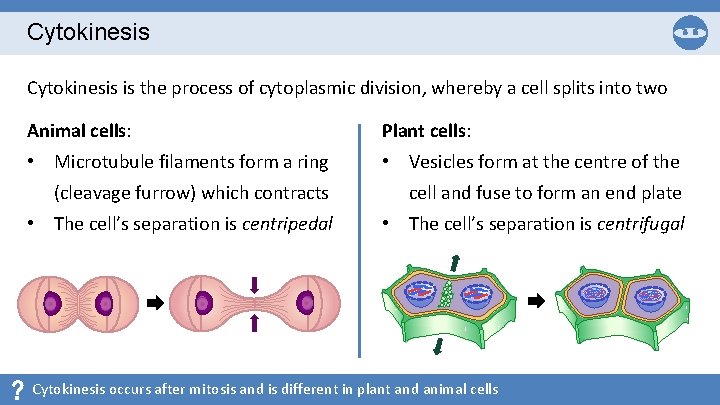
Cytokinesis is the process of cytoplasmic division, whereby a cell splits into two Animal cells: Plant cells: • Microtubule filaments form a ring • Vesicles form at the centre of the (cleavage furrow) which contracts cell and fuse to form an end plate • The cell’s separation is centripedal • The cell’s separation is centrifugal Cytokinesis occurs after mitosis and is different in plant and animal cells
Summary of Mitotic Division Mitotic division: • Occurs in body (somatic) cells • Involves a single division • Produces two daughter cells • Daughter cells are genetic clones Definition: Mitosis is the division of a cell to produce two genetically identical daughter cells Watch the above video outlining the mitotic division of a cell
Identifying Mitotic Phases Interphase Prophase Metaphase Anaphase Telophase Identification of the phases of mitosis in cells viewed with a microscope or in a micrograph
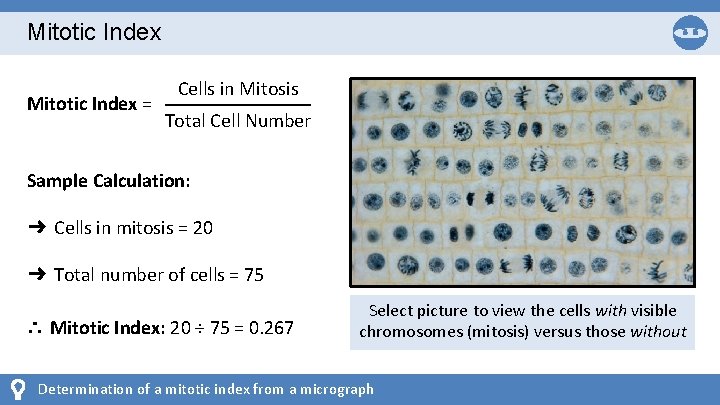
Mitotic Index = Cells in Mitosis Total Cell Number Sample Calculation: ➜ Cells in mitosis = 20 ➜ Total number of cells = 75 ∴ Mitotic Index: 20 ÷ 75 = 0. 267 Select picture to view the cells with visible chromosomes (mitosis) versus those without Determination of a mitotic index from a micrograph
Functions of Mitotic Division There are four key reasons why a cell might be required to divide mitotically: Tissue repair • Damaged or aged cells are replaced with new ones Organismal growth • Multicellular organisms can make additional cells Asexual reproduction • Used for natural cloning (e. g. vegetative propagation) Development of embryos • Zygotes divide and differentiate to form embryos Mnemonic: TOAD
Cell Cycle Regulation Cell cycle checkpoints are used to regulate the progression of a typical cell cycle • G 1 checkpoint ensures cell is prepared for the replication of DNA (S phase) • G 2 checkpoint controls mechanisms to ensure the cell is prepared for mitosis • M checkpoint ensures cell is ready for cytokinesis (i. e. checks non-disjunction) Some cells can enter a quiescent phase (G 0) M G 2 G 1 S G 1 G 0 (resting)
Cyclins are a family of regulatory proteins that control cell cycle progression • Cyclins activate cyclin dependent kinases (CDKs) by forming a complex • The complex phosphorylates a target protein to trigger a cell cycle event • After the event has occurred, cyclin is degraded and the CDK is inactivated P CDK Target protein phosphorylated Cyclins are involved in the control of the cell cycle ive t ac Complex formation CDK e CDK P tiv + ac in Cyclin CDK Degradation
Cell Death Cells have a limited proliferative capacity, after which division stops (Hayflick limit) • Cells will enter a senescence (ageing) phase, leading to eventual cellular death Cell death can either be uncontrolled (necrosis) or programmed (apoptosis) Burst NECROSIS Swell Condense NORMAL Fragment APOPTOSIS
Apoptosis versus Necrosis Apoptosis (cell ‘suicide’) Necrosis (cell ‘homicide’) • The controlled destruction of a cell • The premature death of a cell due in response to molecular signals to injury or nutritional deprivation • Involves mitochondrial proteins • Cell becomes destabilised and lyses • Cell contents are packaged into • Cell contents are released into the vesicles and recycled by the body tissues, leading to inflammation
Cancer is caused by uncontrolled cell division and can occur in any tissue or organ Tumors are the abnormal cellular growths formed as a result of cancer: • Primary tumors remain in the originating tissue (i. e. benign growths) • Secondary tumors have invaded neighboring tissues (i. e. malignant growths) Metastasis is the spread of cancerous tissue from one location to another • Secondary tumors are defined and treated according to the original cell type ➪ E. g. If breast cancer spreads to liver = secondary breast cancer of the liver Mutagens, oncogenes and metastasis are involved in the development of primary and secondary tumors
Mutagens A mutagen is an agent that causes a change in the genetic material of an organism • Mutagens that lead to the formation of cancer are further called carcinogens Radiation UV (sunlight) X-rays (medical) Chemicals Carcinogen (cigarettes) Processed foods Infectious Agents Cleaning products Viruses (HPV) Bacteria (Helicobacter) Mutagens, oncogenes and metastasis are involved in the development of primary and secondary tumors
Oncogenes An oncogene is a gene that has the potential to cause cancer Cancers may be caused by mutations to two basic classes of genes: • Proto-oncogenes code for proteins that promote cell growth and proliferation • Tumor suppressor genes code for proteins that repress cell cycle progression When a proto-oncogene is mutated it becomes a cancer-causing oncogene • Tumor suppressor genes are sometimes referred to as anti-oncogenes as they normally function to prevent the occurrence of cancer (may promote apoptosis) Mutagens, oncogenes and metastasis are involved in the development of primary and secondary tumors
Smoking There is a positive correlation between Cancer rates are higher in countries smoking and incidence of lung cancer with higher rates of cigarette smoking 120 Lung cancer – Age 35 -44 (per 100, 000 population) Incidence of cancer (per 100, 000 men) 500 400 300 200 100 0 10 20 30 USA 100 40 Cigarettes per day The correlation between smoking and the incidence of cancers Belgium 80 Italy 60 France 40 20 0 UK Canada Greece Portugal Japan USA – never smoked 500 Ireland 1500 Finland 2500 Manufactured cigarettes per adult (1950)
Topic Review Can you do the following? • Outline the phases of the cell cycle • List processes that occur during interphase • Describe the stages of mitosis • Compare cytokinesis in animal and plant cells • Calculate mitotic index from micrographs • Discuss the role of cyclin in cell cycle regulation • Outline the causes and consequences of cancer