
Top Ten Reasons for Why the Selectivity Filter






- Slides: 46
“Top Ten Reasons for Why the Selectivity Filter is the Gate” Mark L. * Chapman Antonius M. J. Van. Dongen (*) “Letterman”
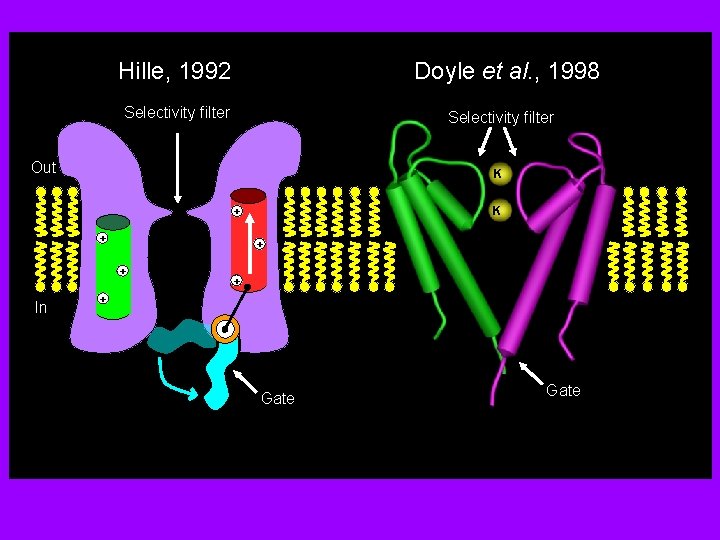
Hille, 1992 Doyle et al. , 1998 Selectivity filter Out K K + + In + + Gate
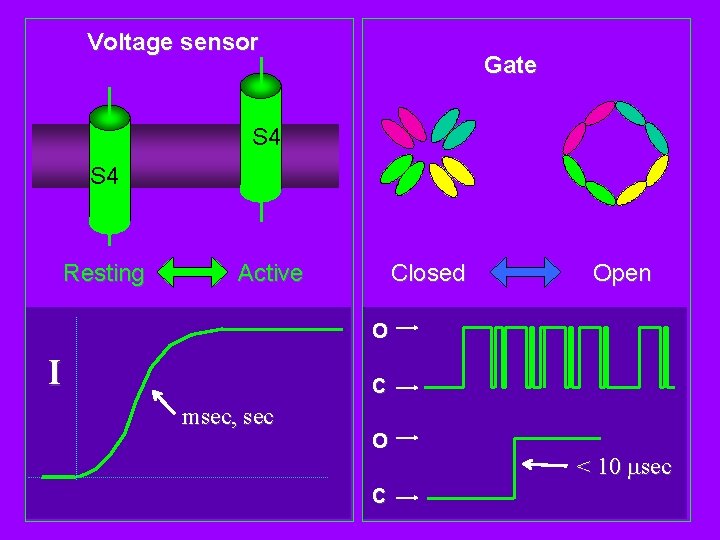
Voltage sensor Gate S 4 Resting Active Closed Open O I C msec, sec O C < 10 msec
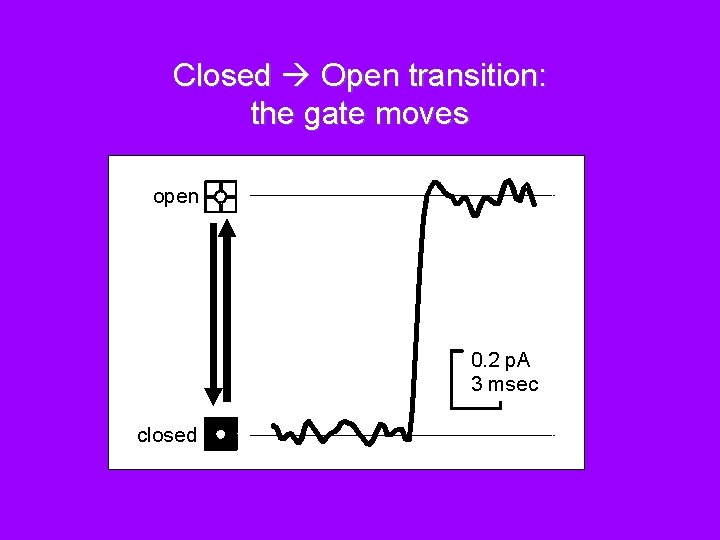
Closed Open transition: the gate moves open 0. 2 p. A 3 msec closed
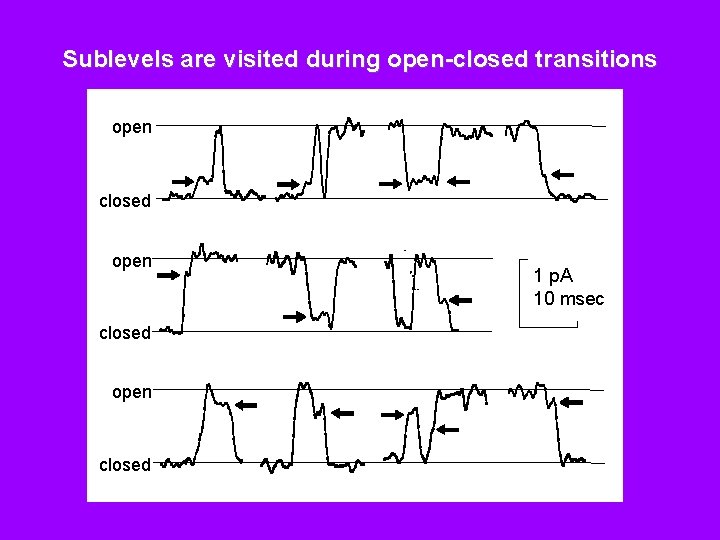
Sublevels are visited during open-closed transitions open closed 1 p. A 10 msec
Subunit composition and closed open transition open H 3 H 2 a H 1 closed H 2 b 0. 2 p. A 3 msec
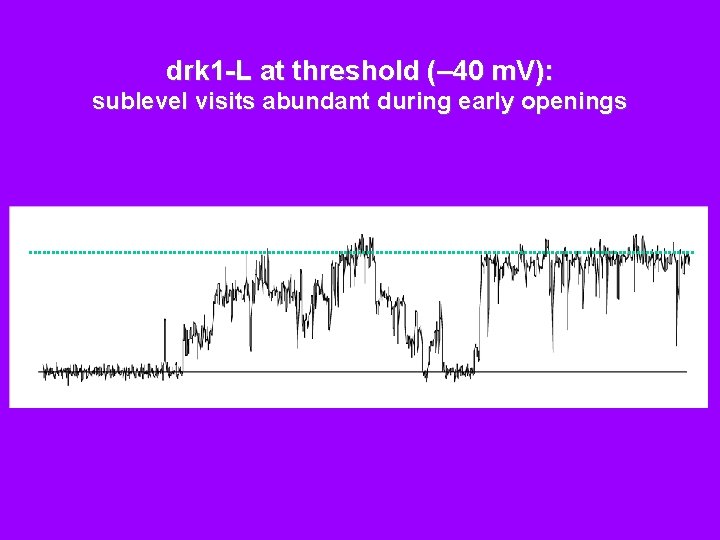
drk 1 -L at threshold (– 40 m. V): sublevel visits abundant during early openings
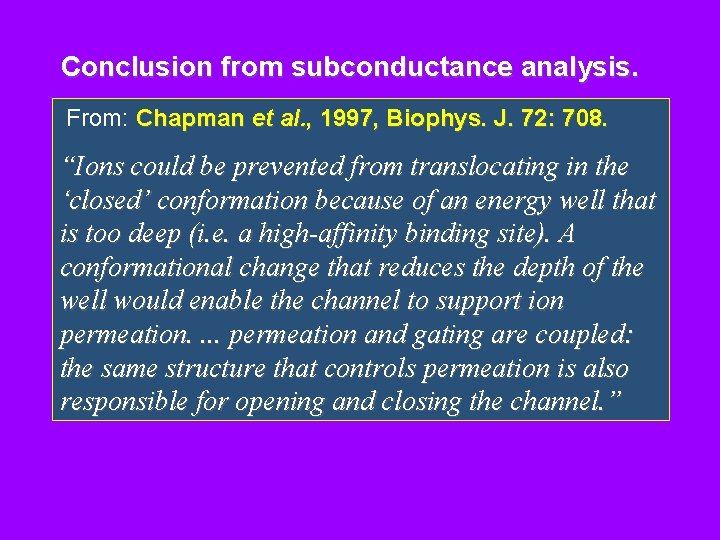
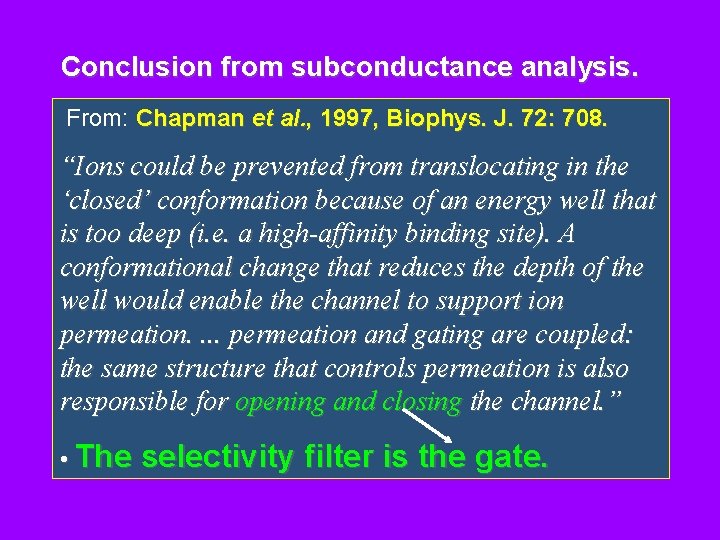
Conclusion from subconductance analysis. From: Chapman et al. , 1997, Biophys. J. 72: 708. “Ions could be prevented from translocating in the ‘closed’ conformation because of an energy well that is too deep (i. e. a high-affinity binding site). A conformational change that reduces the depth of the well would enable the channel to support ion permeation. . permeation and gating are coupled: the same structure that controls permeation is also responsible for opening and closing the channel. ”
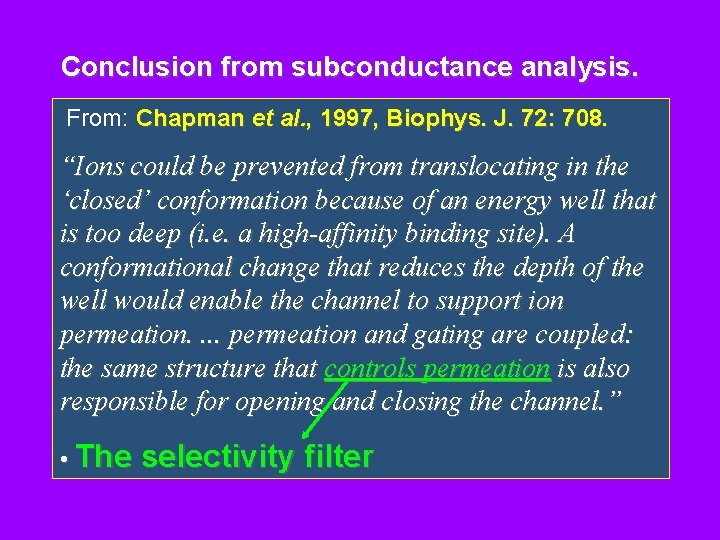
Conclusion from subconductance analysis. From: Chapman et al. , 1997, Biophys. J. 72: 708. “Ions could be prevented from translocating in the ‘closed’ conformation because of an energy well that is too deep (i. e. a high-affinity binding site). A conformational change that reduces the depth of the well would enable the channel to support ion permeation. . permeation and gating are coupled: the same structure that controls permeation is also responsible for opening and closing the channel. ” • The selectivity filter
Conclusion from subconductance analysis. From: Chapman et al. , 1997, Biophys. J. 72: 708. “Ions could be prevented from translocating in the ‘closed’ conformation because of an energy well that is too deep (i. e. a high-affinity binding site). A conformational change that reduces the depth of the well would enable the channel to support ion permeation. . permeation and gating are coupled: the same structure that controls permeation is also responsible for opening and closing the channel. ” • The selectivity filter is the gate.
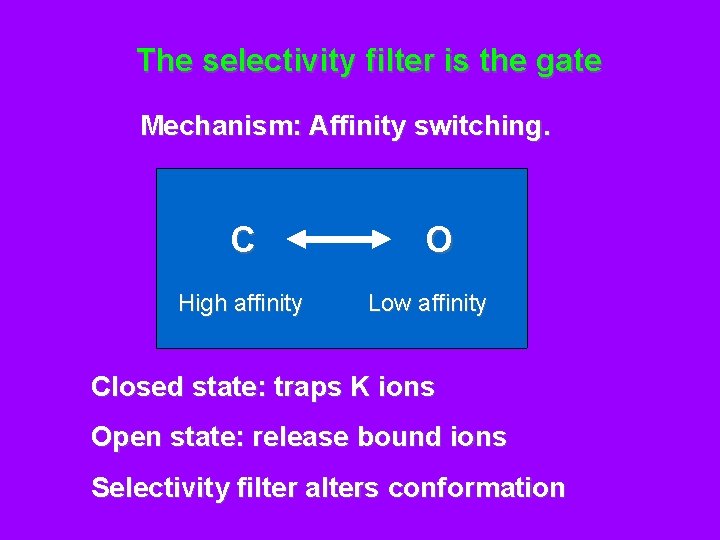
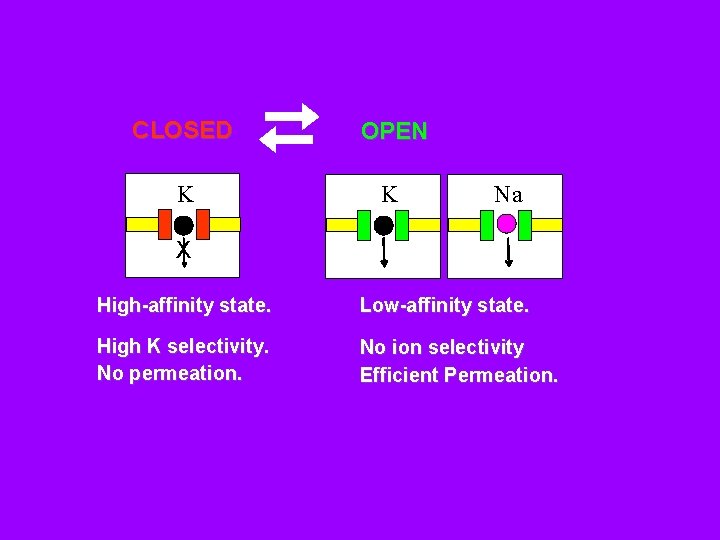
The selectivity filter is the gate Mechanism: Affinity switching. C High affinity O Low affinity Closed state: traps K ions Open state: release bound ions Selectivity filter alters conformation
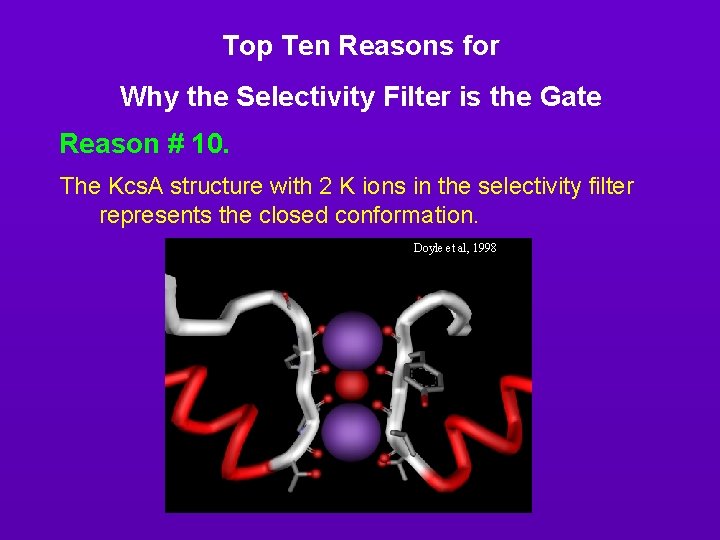
Top Ten Reasons for Why the Selectivity Filter is the Gate Reason # 10. The Kcs. A structure with 2 K ions in the selectivity filter represents the closed conformation. Doyle et al, 1998
Top Ten Reasons for Why the Selectivity Filter is the Gate Reason # 10. The Kcs. A structure with 2 K ions in the selectivity filter represents the closed conformation. The structure was obtained at a p. H where the channel is closed (Clapham 1999, Cell 97: 547 -550)
Top Ten Reasons for Why the Selectivity Filter is the Gate Reason # 10. The Kcs. A structure with 2 K ions in the selectivity filter represents the closed conformation. The structure was obtained at a p. H where the channel is closed (Clapham 1999, Cell 97: 547 -550) The electrophysiological properties of the open Kcs. A channel are incompatible with the published crystal structure (Meuser et al. , 1999, FEBS Letters 462: 447 -452).
Top Ten Reasons for Why the Selectivity Filter is the Gate Reason # 9. The selectivity filter has a different conformation in the open an closed state.
Top Ten Reasons for Why the Selectivity Filter is the Gate Reason # 9. The selectivity filter has a different conformation in the open an closed state. In the open state, single Kcs. A channels: • are poorly ion selective • permeate partially hydrated K ions • have a wider diameter than seen in the crystal structure. (Meuser et al. , 1999, FEBS Letters 462: 447).
Top Ten Reasons for Why the Selectivity Filter is the Gate Reason # 8. Permeant ions bind with high affinity in the pore.
Top Ten Reasons for Why the Selectivity Filter is the Gate Reason # 8. Permeant ions bind with high affinity in the pore. This was first described for Ca 2+ ions in Ca channels Armstrong & Neyton, 1991, Ann. N. Y. Acad. Sci. 635: 18 -25; Kuo & Hess, 1993, J. Physiol. 466: 657 -682; Yang et al. , 1993, Nature 366: 158 -161; Ellinor et al. , 1995, Neuron 15: 1121 -1132. Polo-Parada, & Korn, 1997, J. Gen. Physiol. 109: 693 -702;
Top Ten Reasons for Why the Selectivity Filter is the Gate Reason # 8. Permeant ions bind with high affinity in the pore. K ions also bind with high affinity in the K channel pore: m. M K concentrations block Na conductance Kiss et al. , 1998, J. Gen. Physiol. 111: 195 -206; Immke & Korn, 2000, J. Gen. Physiol. 115: 509 -518.
Top Ten Reasons for Why the Selectivity Filter is the Gate Reason # 8. Permeant ions bind with high affinity in the pore. K ions also bind with high affinity in the K channel pore: m. M K concentrations block Na conductance Kiss et al. , 1998, J. Gen. Physiol. 111: 195 -206; Immke & Korn, 2000, J. Gen. Physiol. 115: 509 -518. Short closed times in single channel records result from K ions acting as pore blockers Choe et al. , 1998. J. Gen. Physiol. 112: 433 -446.
Top Ten Reasons for Why the Selectivity Filter is the Gate Reason # 7. An alternative is needed for the cytoplasmic constriction acting as a gate, since it is not universally found.
Top Ten Reasons for Why the Selectivity Filter is the Gate Reason # 7. An alternative is needed for the cytoplasmic constriction acting as a gate, since it is not universally found. Inward rectifying K channels have a wide internal entrance (Lu et al. , 1999, PNAS 96: 9926).
Top Ten Reasons for Why the Selectivity Filter is the Gate Reason # 7. An alternative is needed for the cytoplasmic constriction acting as a gate, since it is not universally found. Inward rectifying K channels have a wide internal entrance (Lu et al. , 1999, PNAS 96: 9926). Glutamate receptors, which have an inverted topology, have a wide external vestibule (Kuner et al. , 1996, Neuron 17: 343).
Top Ten Reasons for Why the Selectivity Filter is the Gate Reason # 7. An alternative is needed for the cytoplasmic constriction acting as a gate, since it is not universally found. Inward rectifying K channels have a wide internal entrance (Lu et al. , 1999, PNAS 96: 9926). Glutamate receptors, which have an inverted topology, have a wide external vestibule (Kuner et al. , 1996, Neuron 17: 343). In CNG 1, the cytoplasmic constriction does not prevent K ions from entering the vestibule. (Flynn and Zagotta, this meeting)
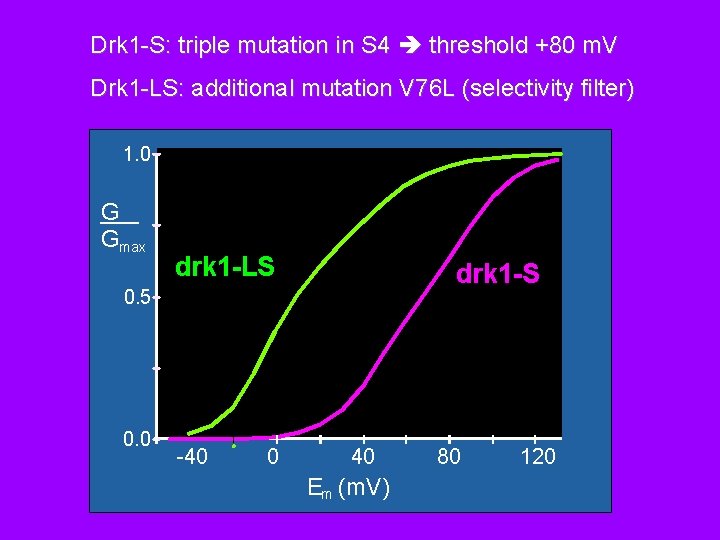
Top Ten Reasons for Why the Selectivity Filter is the Gate Reason # 6. There is a strong coupling between sensor movement and the conformation of the selectivity filter. The effect of mutations in S 4 on activation properties depends critically on whether the selectivity filter contains a Val or Leu at position 76.
Drk 1 -S: triple mutation in S 4 threshold +80 m. V Drk 1 -LS: additional mutation V 76 L (selectivity filter) 1. 0 G Gmax drk 1 -LS drk 1 -S 0. 5 0. 0 -40 0 40 Em (m. V) 80 120
Top Ten Reasons for Why the Selectivity Filter is the Gate Reason # 5. Open state stability is determined by the permeating ion species, linking gating to selectivity. (Spruce et al. , 1989, J. Physiol. 411: 597).
Top Ten Reasons for Why the Selectivity Filter is the Gate Reason # 5. Open state stability is determined by the permeating ion species, linking gating to selectivity. Spruce et al. , 1989, J. Physiol. 411: 597. Open times are very different for K and Rb in Kcs. A. Lisa Heginbotham (personal communication) Eduardo Perozo et al. (this meeting)
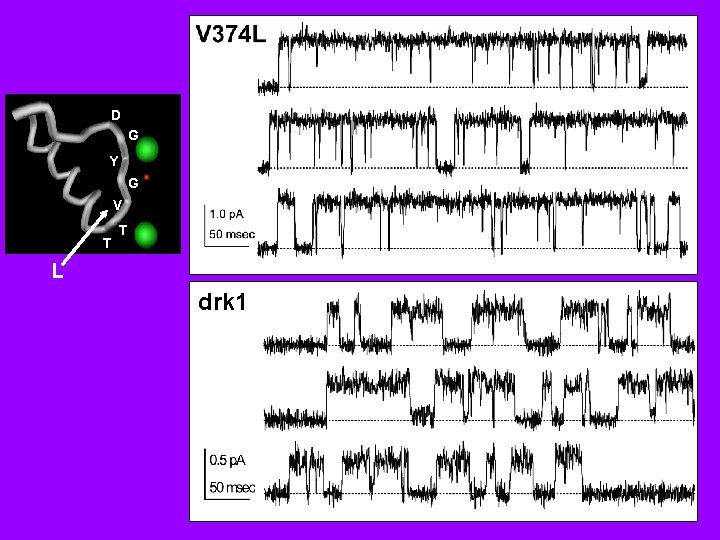
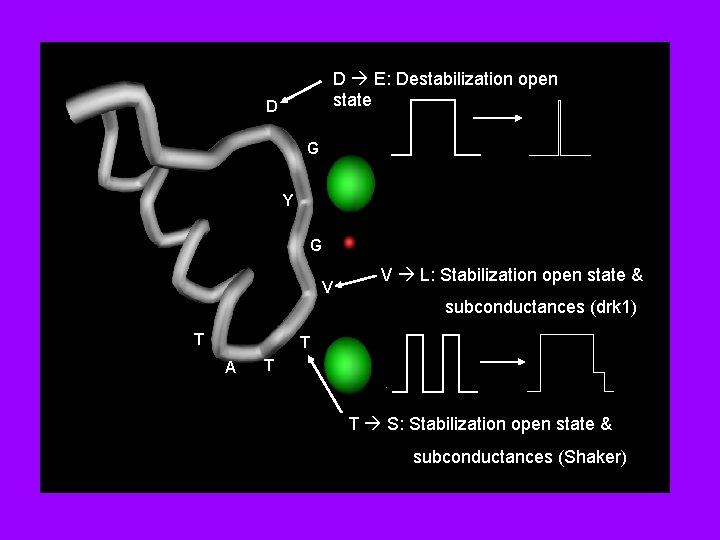
Top Ten Reasons for Why the Selectivity Filter is the Gate Reason # 4. Mutations in the selectivity filter affect single channel gating.
E D 378 E D G Y G V T T 0. 5 p. A 50 msec drk 1
D G Y G V T T L drk 1
D E: Destabilization open state D G Y G V V L: Stabilization open state & subconductances (drk 1) T T A T T S: Stabilization open state & subconductances (Shaker)
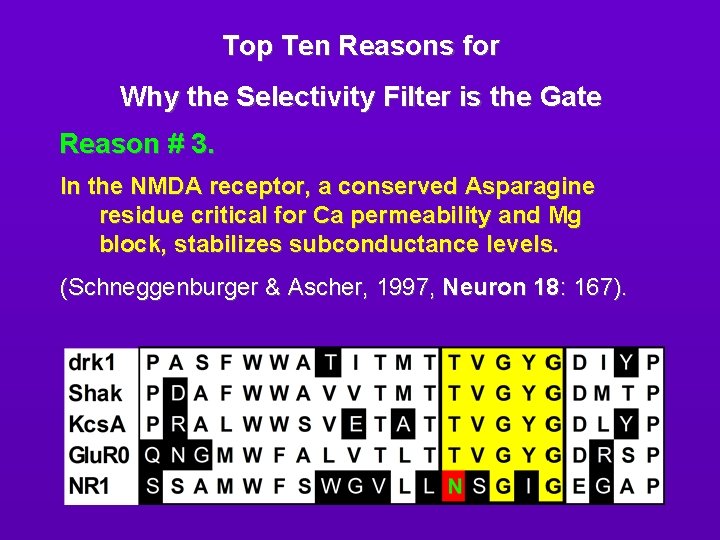
Top Ten Reasons for Why the Selectivity Filter is the Gate Reason # 3. In the NMDA receptor, a conserved Asparagine residue critical for Ca permeability and Mg block, stabilizes subconductance levels. (Schneggenburger & Ascher, 1997, Neuron 18: 167).
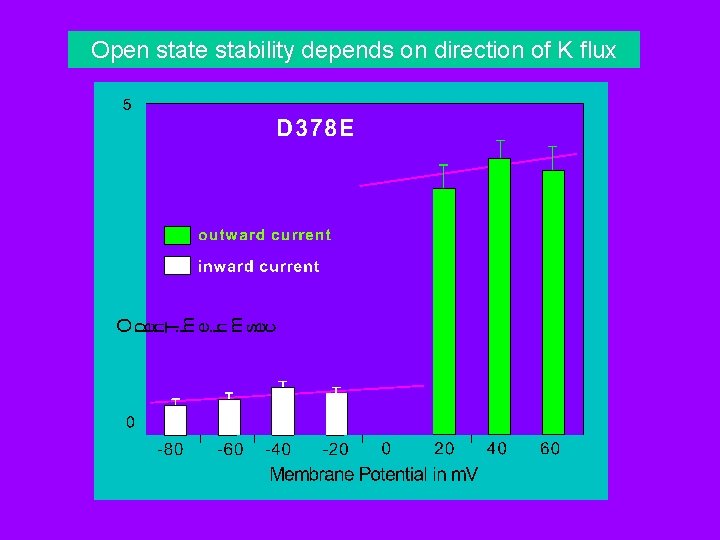
Top Ten Reasons for Why the Selectivity Filter is the Gate Reason # 2. The direction of the K flux determines: • the open state stability in drk 1. • which (sub)conductance levels predominate in Kcs. A (Meuser et al. , 1999, FEBS Lett. 462: 447).
Open state stability depends on direction of K flux
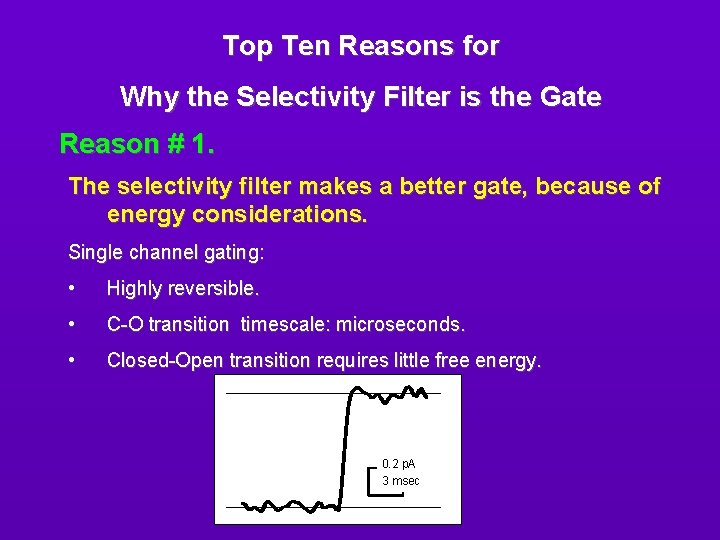
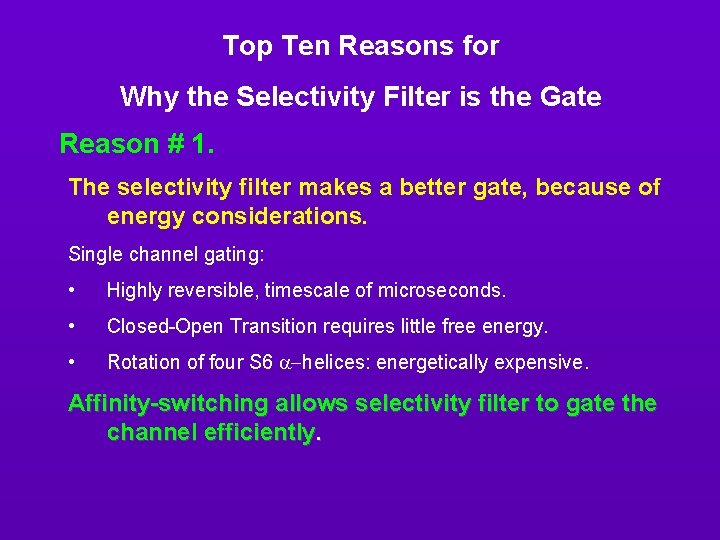
Top Ten Reasons for Why the Selectivity Filter is the Gate Reason # 1. The selectivity filter makes a better gate, because of energy considerations.
Top Ten Reasons for Why the Selectivity Filter is the Gate Reason # 1. The selectivity filter makes a better gate, because of energy considerations. Single channel gating: • Highly reversible. • C-O transition timescale: microseconds. • Closed-Open transition requires little free energy. 0. 2 p. A 3 msec
Top Ten Reasons for Why the Selectivity Filter is the Gate Reason # 1. The selectivity filter makes a better gate, because of energy considerations. Single channel gating: • Highly reversible, timescale of microseconds. • Closed-Open transition requires little free energy. Rotation of 4 S 6 a-helices: energetically expensive
Top Ten Reasons for Why the Selectivity Filter is the Gate Reason # 1. The selectivity filter makes a better gate, because of energy considerations. Single channel gating: • Highly reversible, timescale of microseconds. • Closed-Open Transition requires little free energy. • Rotation of four S 6 a-helices: energetically expensive. Affinity-switching allows selectivity filter to gate the channel efficiently.
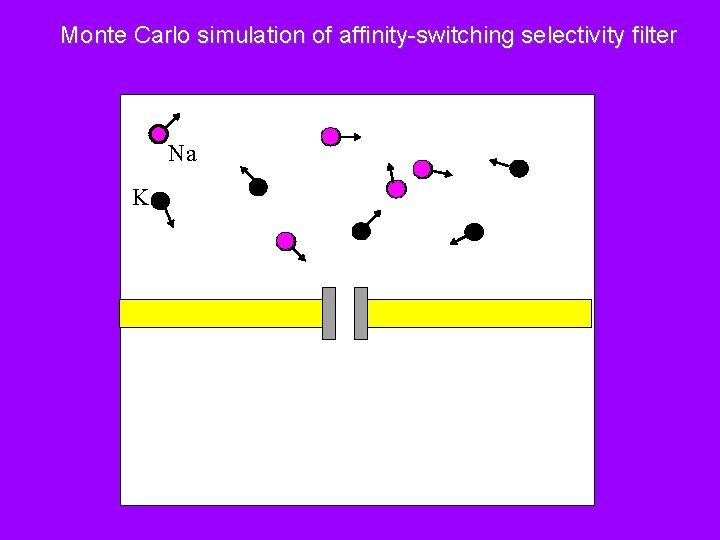
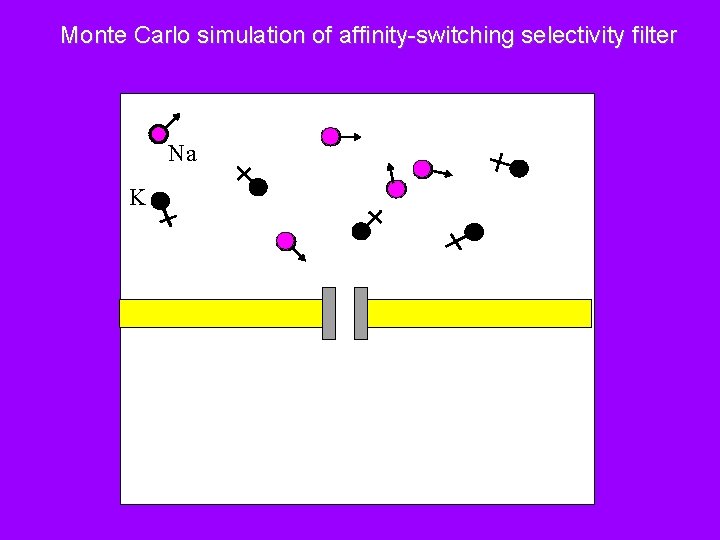
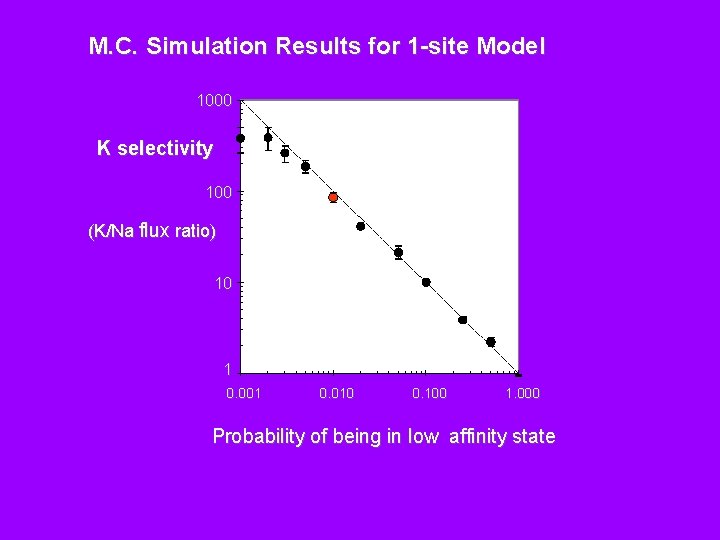
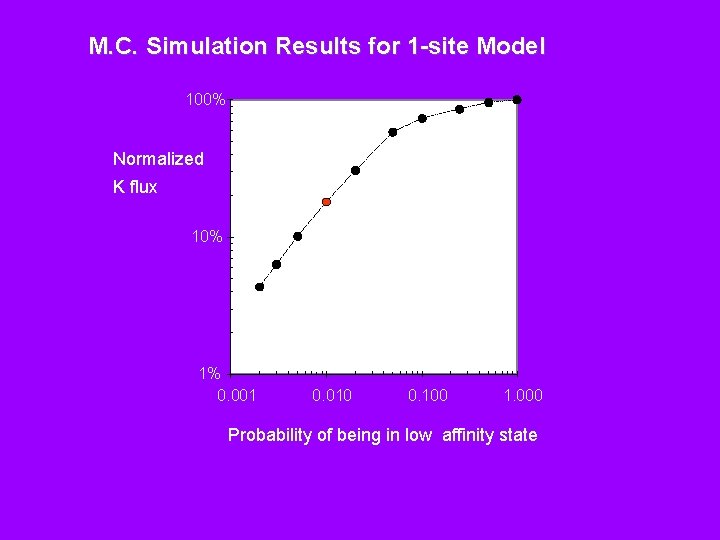
Monte Carlo simulation of affinity-switching selectivity filter Na K
Monte Carlo simulation of affinity-switching selectivity filter Na K
CLOSED OPEN K K Na X High-affinity state. Low-affinity state. High K selectivity. No permeation. No ion selectivity Efficient Permeation.
M. C. Simulation Results for 1 -site Model 1000 K selectivity 100 (K/Na flux ratio) 10 1 0. 001 0. 010 0. 100 1. 000 Probability of being in low affinity state
M. C. Simulation Results for 1 -site Model 100% Normalized K flux 10% 1% 0. 001 0. 010 0. 100 1. 000 Probability of being in low affinity state
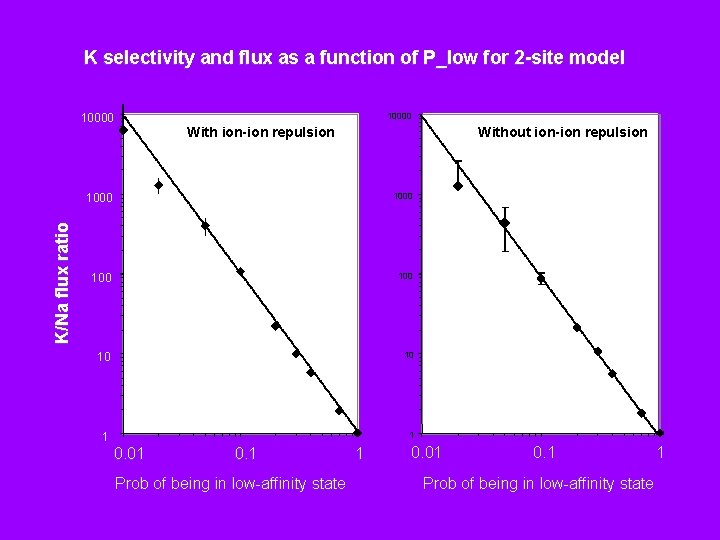
K selectivity and flux as a function of P_low for 2 -site model 10000 K/Na flux ratio 10000 Without ion-ion repulsion With ion-ion repulsion 1000 100 10 10 1 1 0. 01 0. 1 Prob of being in low-affinity state 1
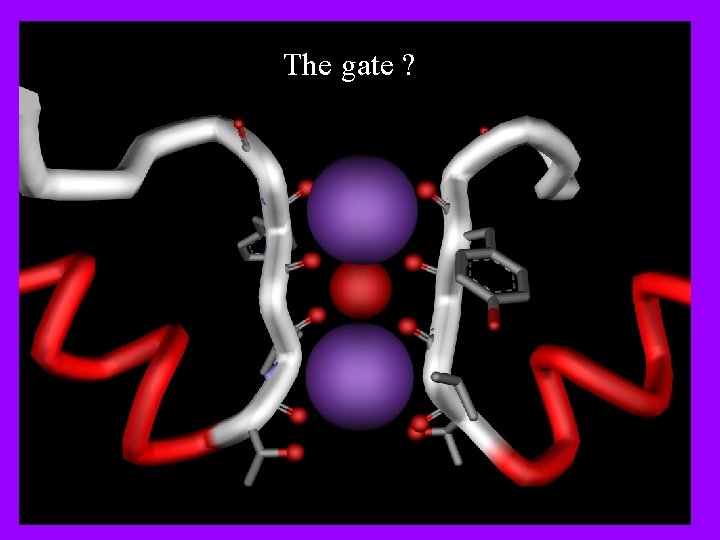
The gate ?