
Top physics Peter Uwer HumboldtUniversitt Berlin Why are

Top physics Peter Uwer Humboldt-Universität Berlin
Why are we interested in top-quarks ? 1) Top-quark = heaviest elementary particle discovered so far Questions: § Is the top-quark point-like ? § Why is the top-quark so heavy ? § How is the mass generated ? Important testground for theoretical developments Many interesting phenomena/aspects Interesting per se Required for precision 2
Why are we interested in top-quarks ? 2) Top-quarks ─ a sensitive tool to explore the electroweak symmetry breaking Top-quark plays special role in many extensions of the Standard Model, ideal tool to search for new physics 1) + 2) Precise measurements of its properties, search for possible deviations i. e. anomalous couplings Important: precise predictions possible, only “two” input parameters: CKM matrix + top-quark mass 3
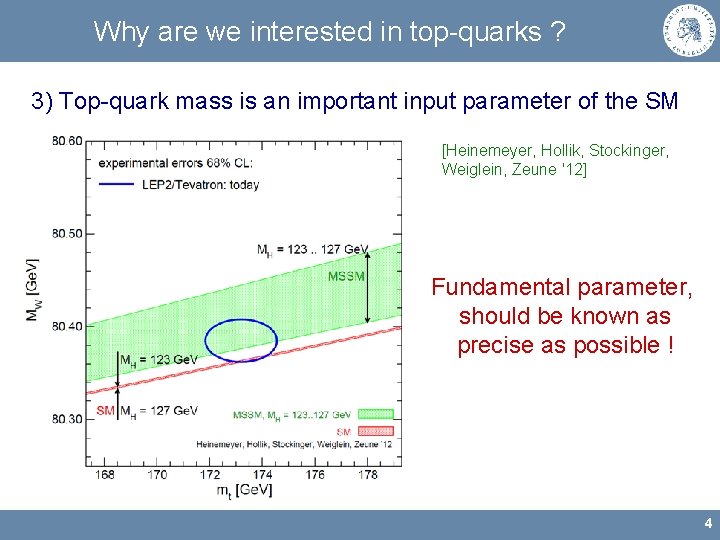
Why are we interested in top-quarks ? 3) Top-quark mass is an important input parameter of the SM [Heinemeyer, Hollik, Stockinger, Weiglein, Zeune '12] Fundamental parameter, should be known as precise as possible ! 4
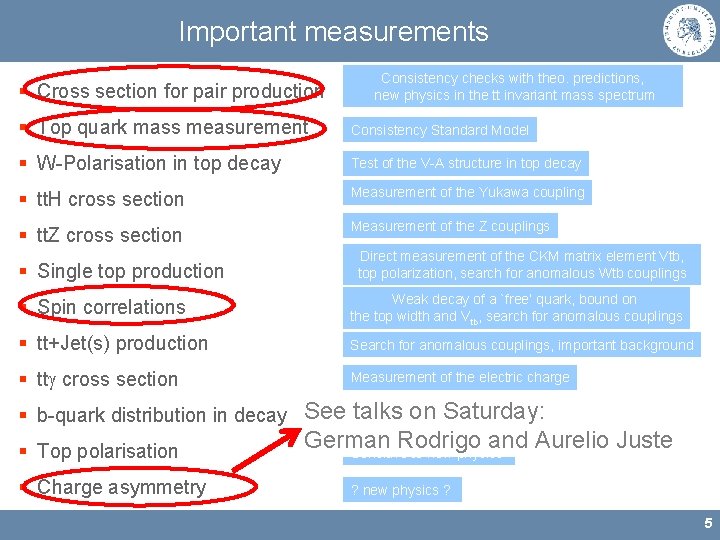
Important measurements § Cross section for pair production Consistency checks with theo. predictions, new physics in the tt invariant mass spectrum § Top quark mass measurement Consistency Standard Model § W-Polarisation in top decay Test of the V-A structure in top decay § tt. H cross section Measurement of the Yukawa coupling § tt. Z cross section Measurement of the Z couplings § Single top production Direct measurement of the CKM matrix element Vtb, top polarization, search for anomalous Wtb couplings § Spin correlations Weak decay of a `free’ quark, bound on the top width and Vtb, search for anomalous couplings § tt+Jet(s) production Search for anomalous couplings, important background § ttg cross section Measurement of the electric charge to new physics t b. H+ talks on Saturday: § b-quark distribution in decay See Sensitive § Top polarisation § Charge asymmetry German Rodrigo and Aurelio Juste Sensitive to new physics ? 5
Cross section for top-quark pair production 6
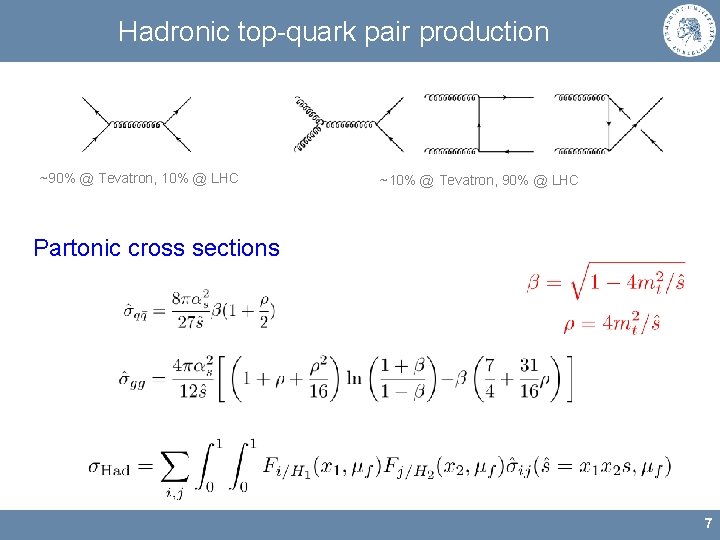
Hadronic top-quark pair production ~90% @ Tevatron, 10% @ LHC ~10% @ Tevatron, 90% @ LHC Partonic cross sections 7
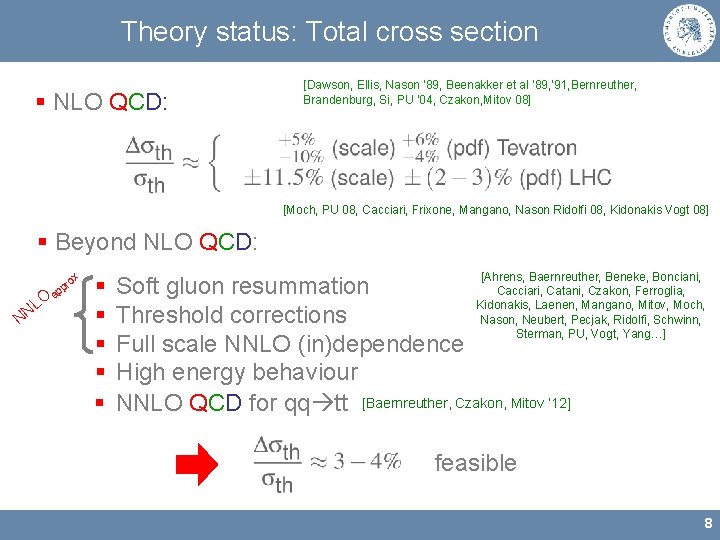
Theory status: Total cross section § NLO QCD: [Dawson, Ellis, Nason ’ 89, Beenakker et al ’ 89, ’ 91, Bernreuther, Brandenburg, Si, PU ’ 04, Czakon, Mitov 08] [Moch, PU 08, Cacciari, Frixone, Mangano, Nason Ridolfi 08, Kidonakis Vogt 08] § Beyond NLO QCD: O L N N x ro p ap § § § [Ahrens, Baernreuther, Beneke, Bonciani, Soft gluon resummation Cacciari, Catani, Czakon, Ferroglia, Kidonakis, Laenen, Mangano, Mitov, Moch, Threshold corrections Nason, Neubert, Pecjak, Ridolfi, Schwinn, Sterman, PU, Vogt, Yang…] Full scale NNLO (in)dependence High energy behaviour NNLO QCD for qq tt [Baernreuther, Czakon, Mitov ‘ 12] feasible 8
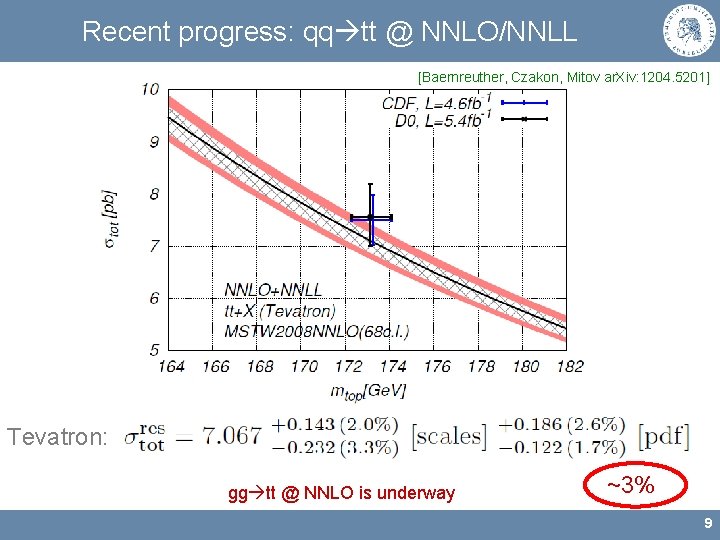
Recent progress: qq tt @ NNLO/NNLL [Baernreuther, Czakon, Mitov ar. Xiv: 1204. 5201] Tevatron: gg tt @ NNLO is underway ~3% 9
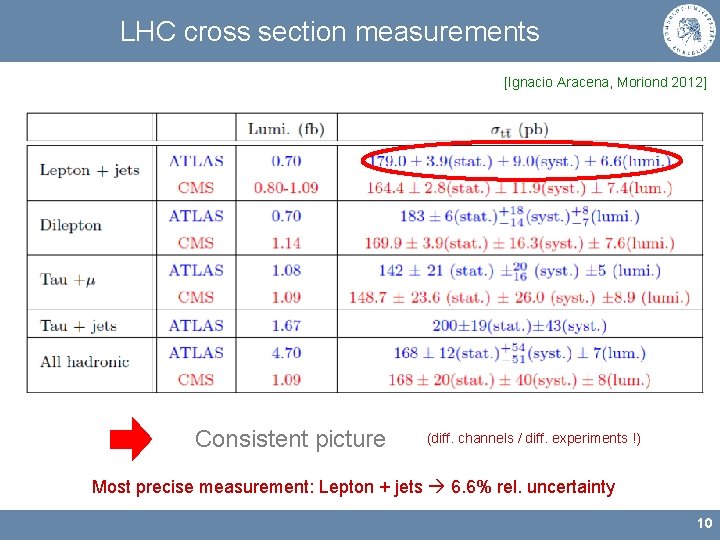
LHC cross section measurements [Ignacio Aracena, Moriond 2012] Consistent picture (diff. channels / diff. experiments !) Most precise measurement: Lepton + jets 6. 6% rel. uncertainty 10
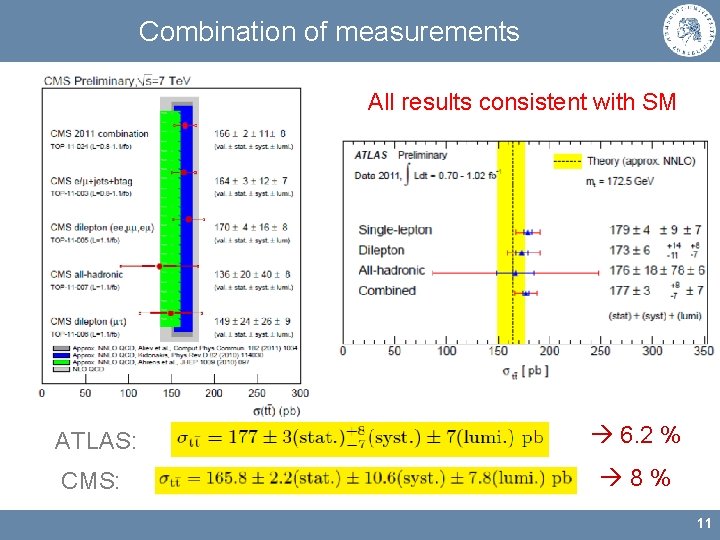
Combination of measurements All results consistent with SM ATLAS: 6. 2 % CMS: 8% 11
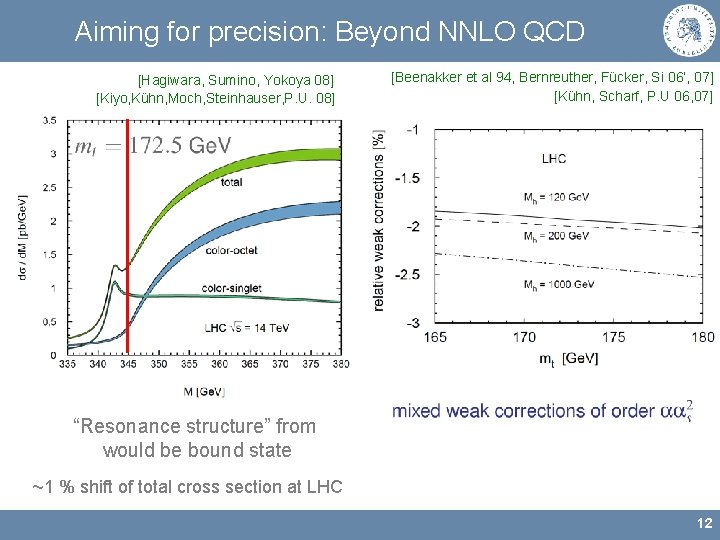
Aiming for precision: Beyond NNLO QCD [Hagiwara, Sumino, Yokoya 08] [Kiyo, Kühn, Moch, Steinhauser, P. U. 08] [Beenakker et al 94, Bernreuther, Fücker, Si 06’, 07] [Kühn, Scharf, P. U 06, 07] “Resonance structure” from would be bound state ~1 % shift of total cross section at LHC 12
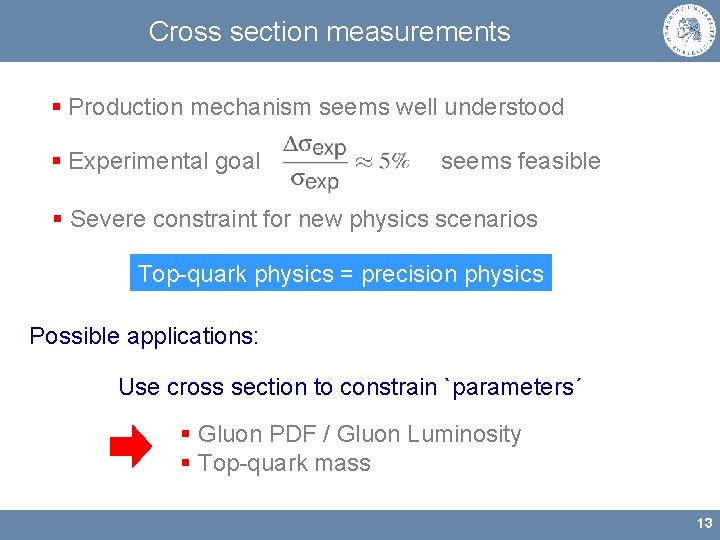
Cross section measurements § Production mechanism seems well understood § Experimental goal seems feasible § Severe constraint for new physics scenarios Top-quark physics = precision physics Possible applications: Use cross section to constrain `parameters´ § Gluon PDF / Gluon Luminosity § Top-quark mass 13
The top-quark mass 14
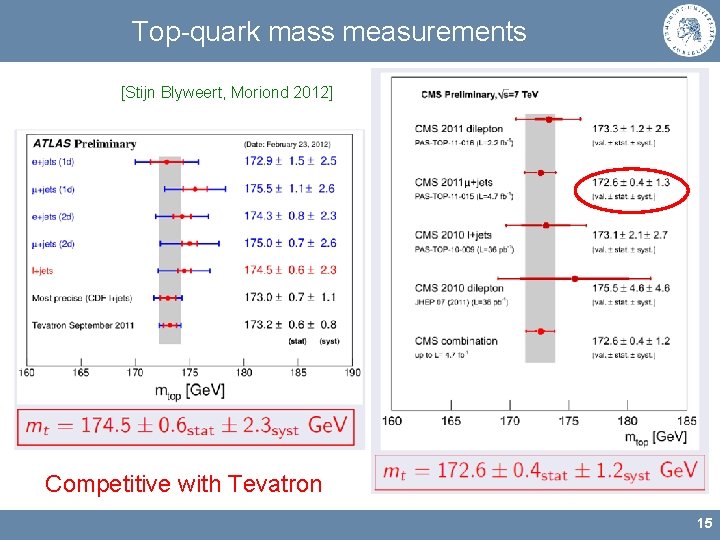
Top-quark mass measurements [Stijn Blyweert, Moriond 2012] Competitive with Tevatron 15
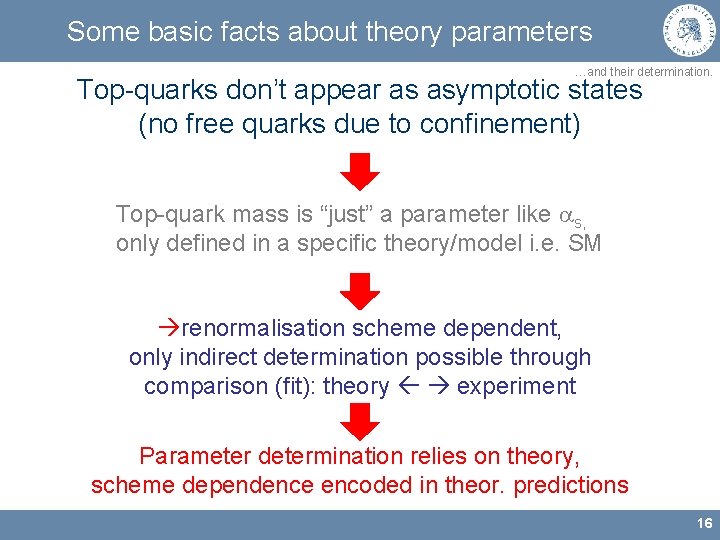
Some basic facts about theory parameters …and their determination. Top-quarks don’t appear as asymptotic states (no free quarks due to confinement) Top-quark mass is “just” a parameter like as, only defined in a specific theory/model i. e. SM renormalisation scheme dependent, only indirect determination possible through comparison (fit): theory experiment Parameter determination relies on theory, scheme dependence encoded in theor. predictions 16
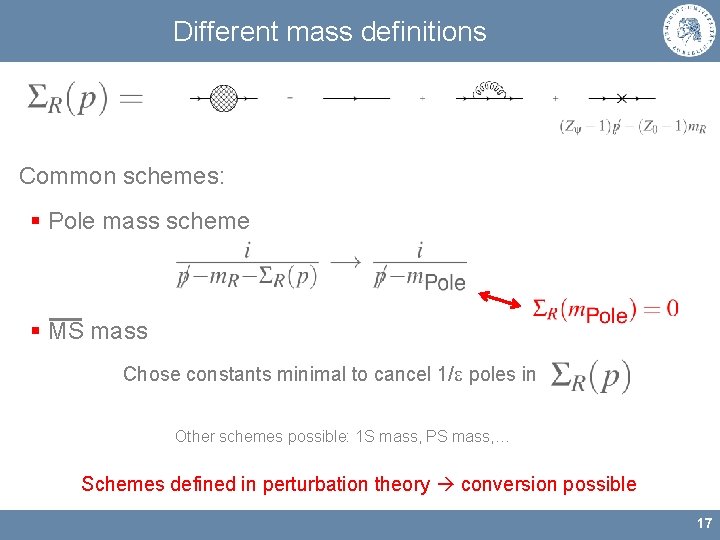
Different mass definitions Common schemes: § Pole mass scheme § MS mass Chose constants minimal to cancel 1/e poles in Other schemes possible: 1 S mass, PS mass, … Schemes defined in perturbation theory conversion possible 17
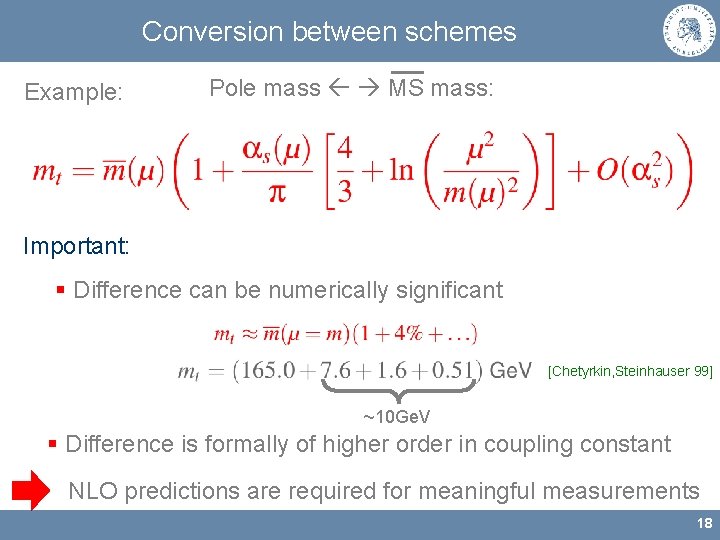
Conversion between schemes Example: Pole mass MS mass: Important: § Difference can be numerically significant [Chetyrkin, Steinhauser 99] ~10 Ge. V § Difference is formally of higher order in coupling constant NLO predictions are required for meaningful measurements 18
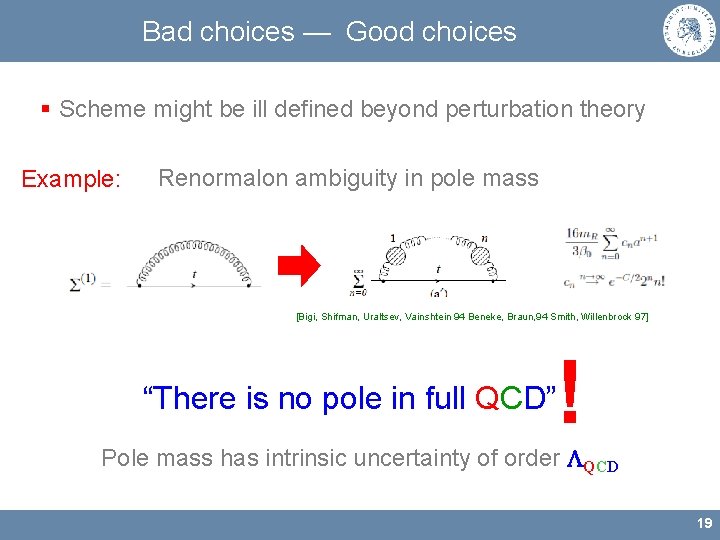
Bad choices — Good choices § Scheme might be ill defined beyond perturbation theory Example: Renormalon ambiguity in pole mass [Bigi, Shifman, Uraltsev, Vainshtein 94 Beneke, Braun, 94 Smith, Willenbrock 97] ! “There is no pole in full QCD” Pole mass has intrinsic uncertainty of order LQCD 19
Template method & kinematic reconstruction Present measurements: § Distribution: invariant masse of top quark decay products § Rely mostly on parton shower predictions § No NLO so far available (? ) Main issues: § Corrections due to color reconnection / non perturbative physics ( momentum reconstruction of color triplet…) § Precise mass definition ? How important ? 20
Impact on current measurements Different channels and different experiments give consistent results Large effects unlikely Possible improvements of current measurements: Template method: § Study additional distributions / observables § Compare with NLO templates Matrix element method § Matrix element method at NLO Alternative measurements ? 21
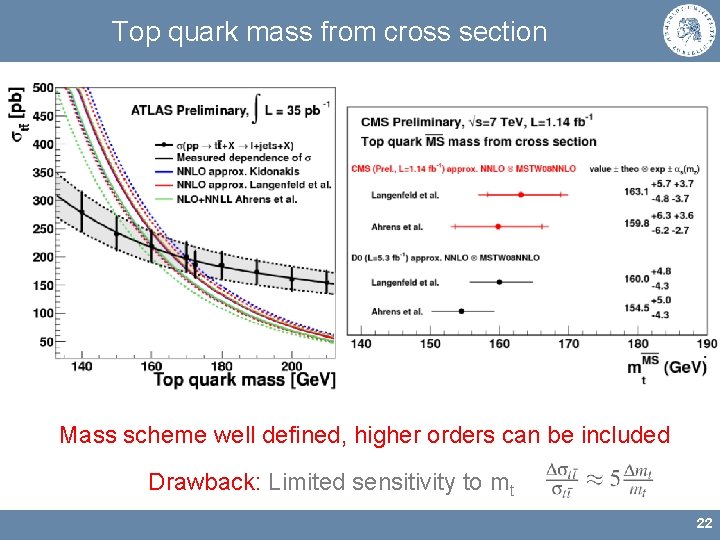
Top quark mass from cross section Mass scheme well defined, higher orders can be included Drawback: Limited sensitivity to mt 22
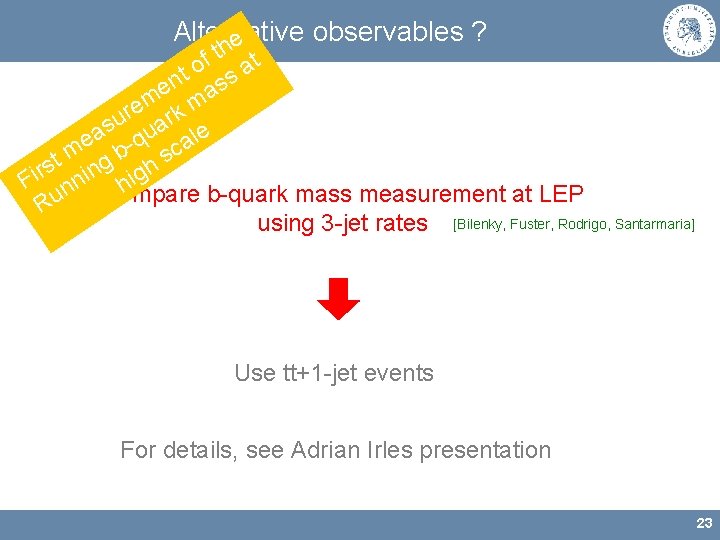
Alternative observables ? e th t f o sa t n as e m m e r u ark s a -qu ale e m g b sc t s in igh r i F nn Compare h b-quark mass measurement at LEP u R using 3 -jet rates [Bilenky, Fuster, Rodrigo, Santarmaria] Use tt+1 -jet events For details, see Adrian Irles presentation 23
Spin correlations in top-quark pair production 24
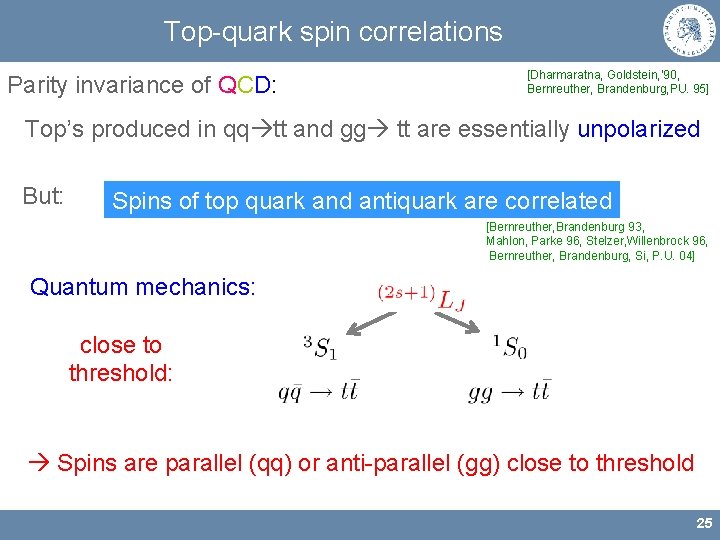
Top-quark spin correlations Parity invariance of QCD: [Dharmaratna, Goldstein, ’ 90, Bernreuther, Brandenburg, PU. 95] Top’s produced in qq tt and gg tt are essentially unpolarized But: Spins of top quark and antiquark are correlated [Bernreuther, Brandenburg 93, Mahlon, Parke 96, Stelzer, Willenbrock 96, Bernreuther, Brandenburg, Si, P. U. 04] Quantum mechanics: close to threshold: Spins are parallel (qq) or anti-parallel (gg) close to threshold 25
Why are spin correlations interesting ? § You also measured the charge asymmetry…. § LHC can improve a lot compared to Tevatron § Sensitive test of production and decay, may put severe constrains on new physics scenarios 26
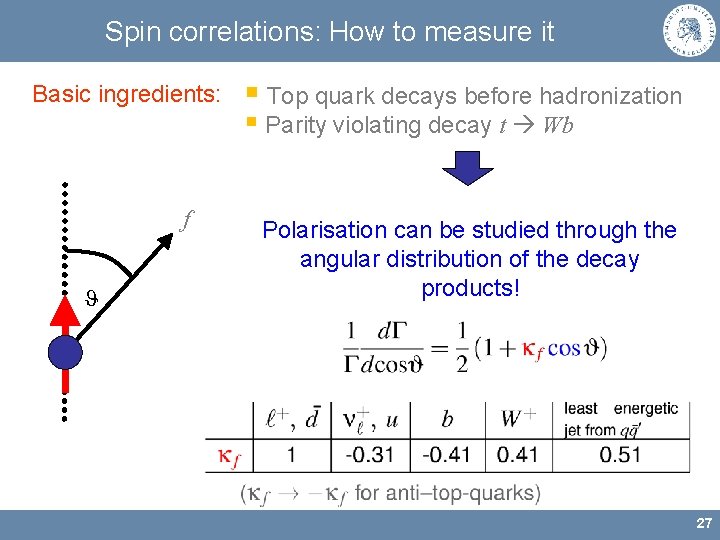
Spin correlations: How to measure it Basic ingredients: f § Top quark decays before hadronization § Parity violating decay t Wb Polarisation can be studied through the angular distribution of the decay products! 27
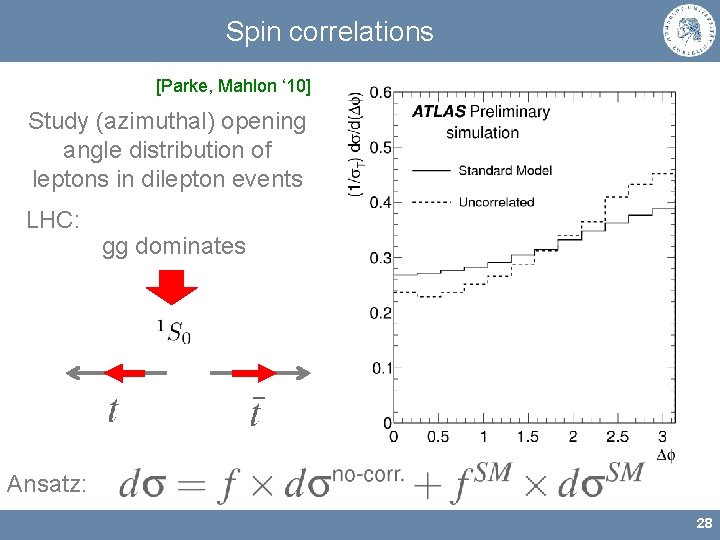
Spin correlations [Parke, Mahlon ‘ 10] Study (azimuthal) opening angle distribution of leptons in dilepton events LHC: gg dominates Ansatz: 28
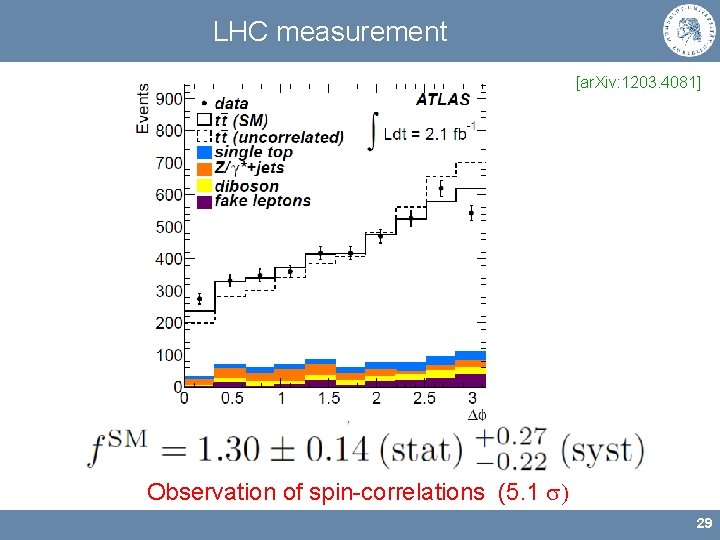
LHC measurement [ar. Xiv: 1203. 4081] Observation of spin-correlations (5. 1 s) 29
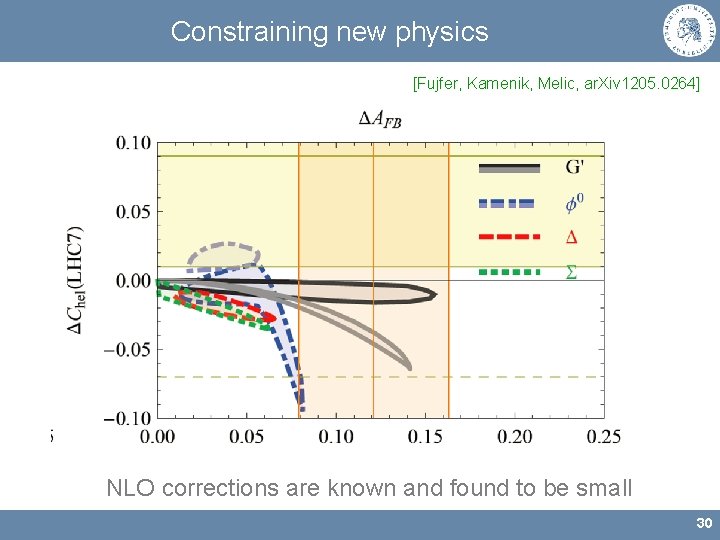
Constraining new physics [Fujfer, Kamenik, Melic, ar. Xiv 1205. 0264] NLO corrections are known and found to be small 30
Summary § Tremendous progress in the recent past § Top-quark physics is now precision physics § Already after one year: LHC is competitive or even better than Tevatron § Ideal laboratory to search for new physics 31

Thank you for your attention !
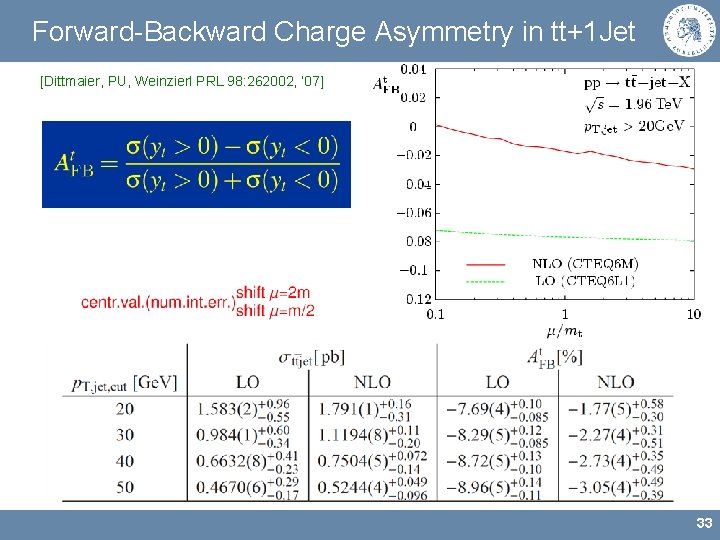
Forward-Backward Charge Asymmetry in tt+1 Jet [Dittmaier, PU, Weinzierl PRL 98: 262002, ’ 07] 33
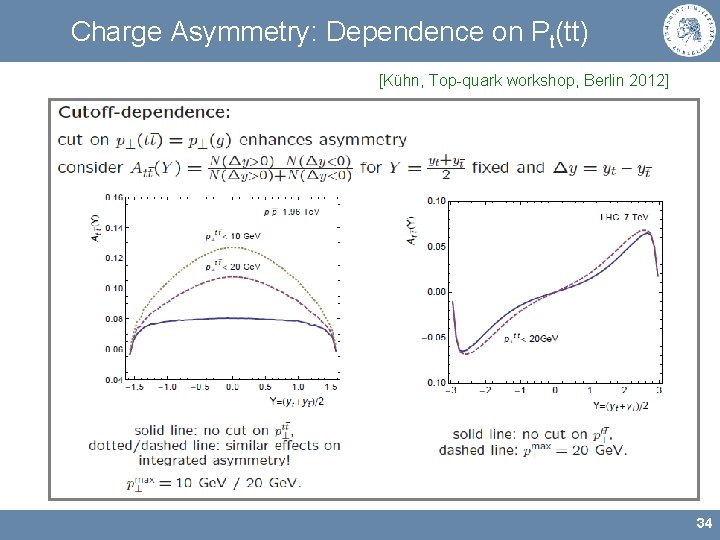
Charge Asymmetry: Dependence on Pt(tt) [Kühn, Top-quark workshop, Berlin 2012] 34
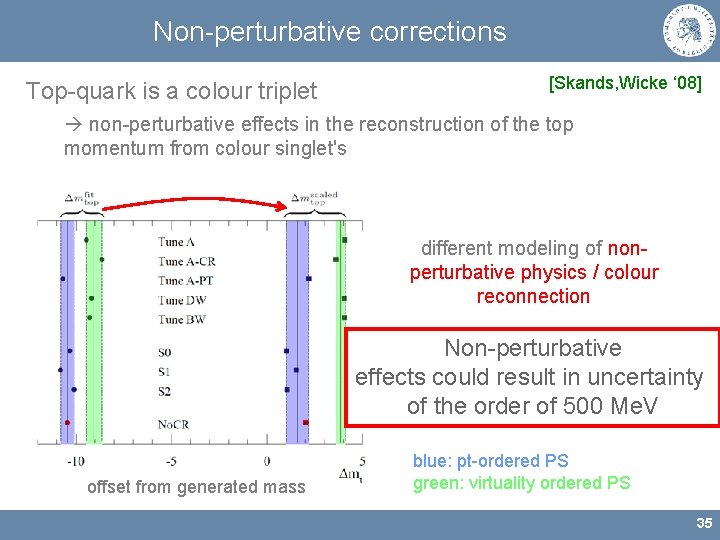
Non-perturbative corrections Top-quark is a colour triplet [Skands, Wicke ‘ 08] non-perturbative effects in the reconstruction of the top momentum from colour singlet's different modeling of nonperturbative physics / colour reconnection Non-perturbative effects could result in uncertainty of the order of 500 Me. V offset from generated mass blue: pt-ordered PS green: virtuality ordered PS 35
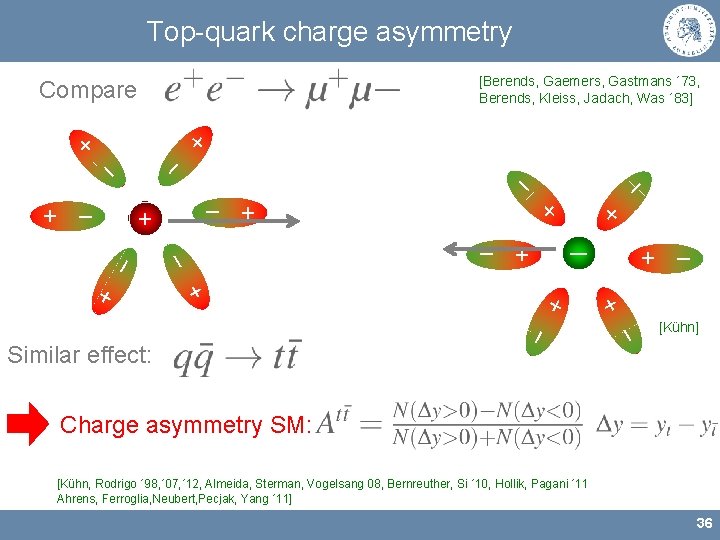
Top-quark charge asymmetry [Berends, Gaemers, Gastmans ´ 73, Berends, Kleiss, Jadach, Was ´ 83] Compare + + – ─ + – Charge asymmetry SM: – – Similar effect: + + – – + – [Kühn] - [Kühn, Rodrigo ´ 98, ´ 07, ´ 12, Almeida, Sterman, Vogelsang 08, Bernreuther, Si ´ 10, Hollik, Pagani ´ 11 Ahrens, Ferroglia, Neubert, Pecjak, Yang ´ 11] 36
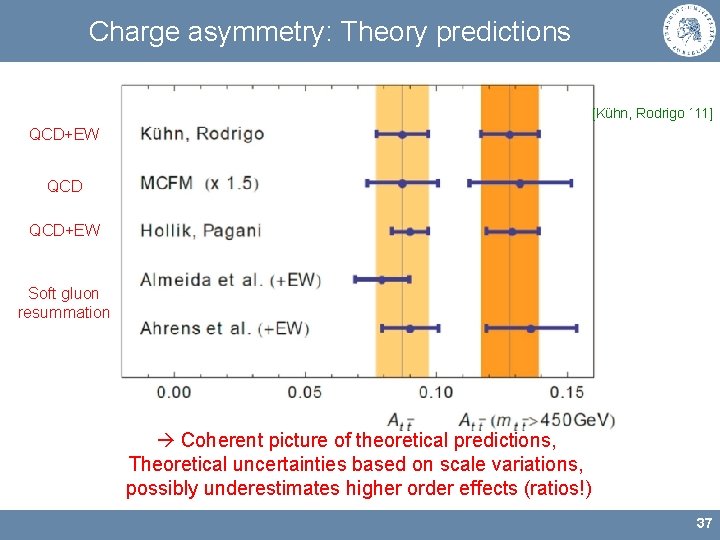
Charge asymmetry: Theory predictions [Kühn, Rodrigo ´ 11] QCD+EW Soft gluon resummation Coherent picture of theoretical predictions, Theoretical uncertainties based on scale variations, possibly underestimates higher order effects (ratios!) 37
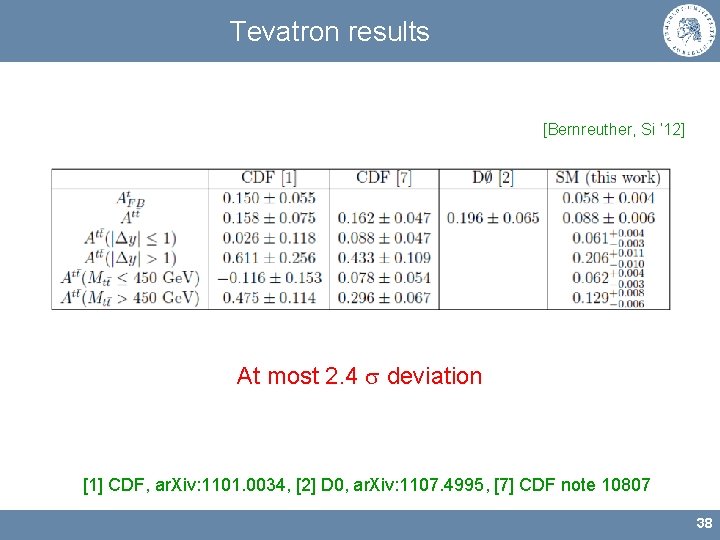
Tevatron results [Bernreuther, Si ’ 12] At most 2. 4 s deviation [1] CDF, ar. Xiv: 1101. 0034, [2] D 0, ar. Xiv: 1107. 4995, [7] CDF note 10807 38
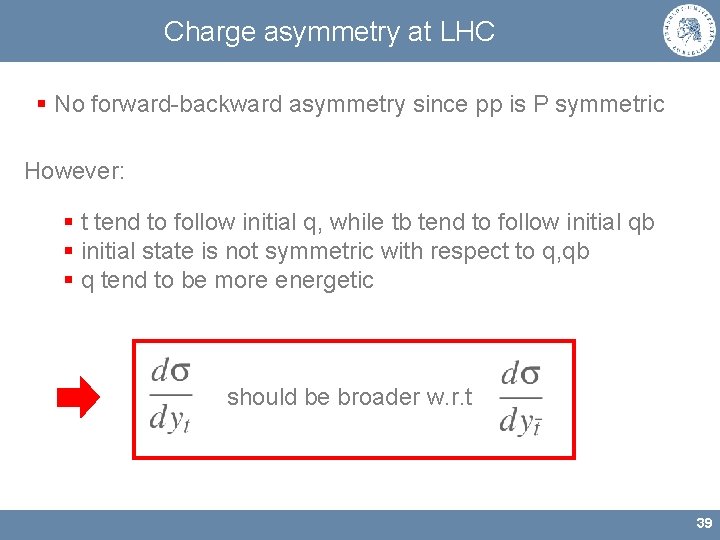
Charge asymmetry at LHC § No forward-backward asymmetry since pp is P symmetric However: § t tend to follow initial q, while tb tend to follow initial qb § initial state is not symmetric with respect to q, qb § q tend to be more energetic should be broader w. r. t 39
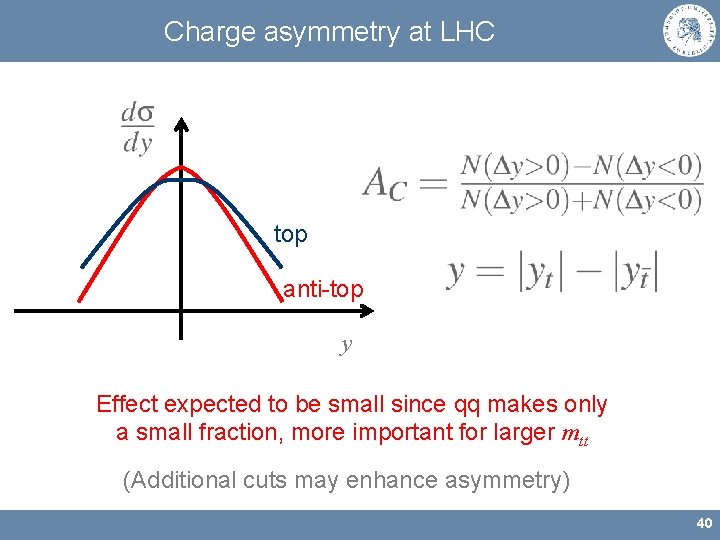
Charge asymmetry at LHC top anti-top y Effect expected to be small since qq makes only a small fraction, more important for larger mtt (Additional cuts may enhance asymmetry) 40
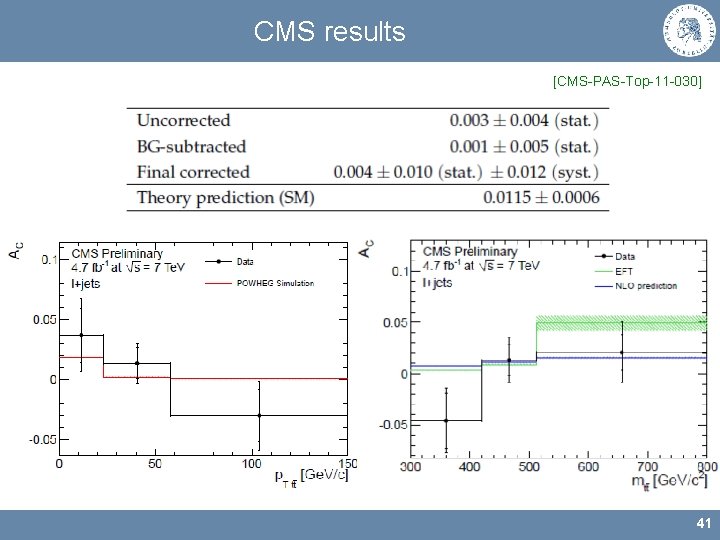
CMS results [CMS-PAS-Top-11 -030] 41
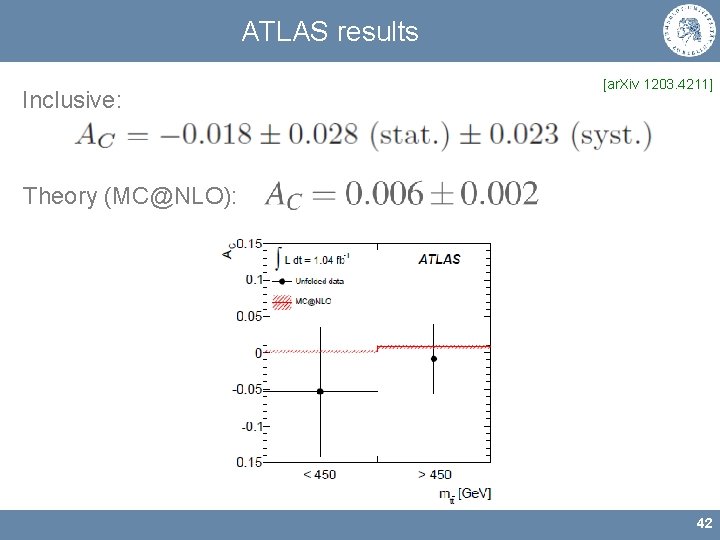
ATLAS results Inclusive: [ar. Xiv 1203. 4211] Theory (MC@NLO): 42
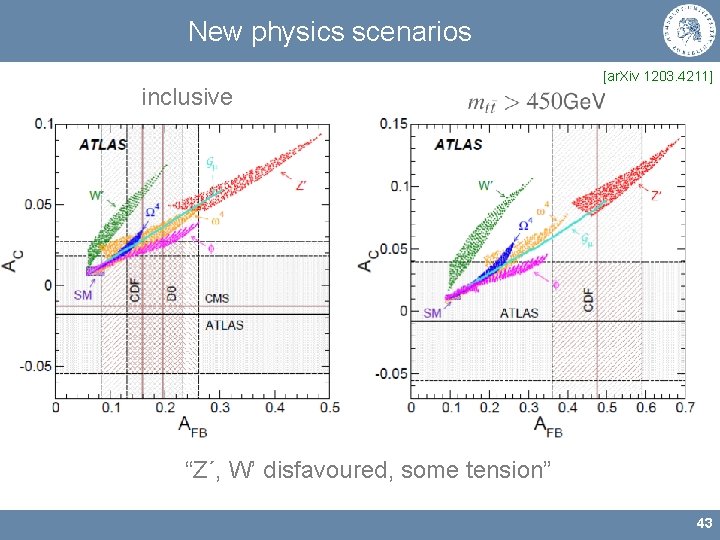
New physics scenarios inclusive [ar. Xiv 1203. 4211] “Z´, W’ disfavoured, some tension” 43
Final remarks on asymmetry § Discrepancy has reduced with new CDF measurement § Theory is only LO, in ttj where also NLO is known, large higher-order corrections observed § Charge asymmetry very sensitive to Pt(tt) § LHC uncertainties are still large No conclusive picture yet Future: Improve current measurements Look into observables which can be measured at LHC and Tevatron [Aguilar Saavedra, Juste ‘ 12] 44
- Slides: 44