
Top Down Perception And What its Like to
- Slides: 27
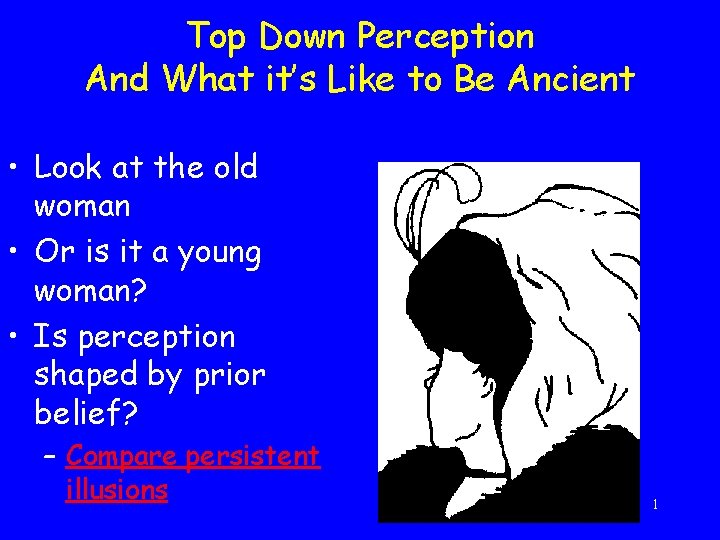
Top Down Perception And What it’s Like to Be Ancient • Look at the old woman • Or is it a young woman? • Is perception shaped by prior belief? – Compare persistent illusions 1
Early Ancient Greek Philosophers and Questions 2000 Years Before Science • Is the physical universe orderly or random? – Some change appears regular; some does not. Why? – Is the universe determined by capricious gods or something fixed, constant and knowable? 2
Philosophy and the Quest for Knowledge of Order • Presocratics = Philosophers before the time of Socrates (470 -399 BC) • Some Presocratics Accept the reality of orderly change; others deny 3
Presocratics Who Affirm the Reality and Intelligibility of Change • Thales (600 BC) & Reductionism – Things aren’t what they appear to be – Contrary to appearance, everything is really water! 4
Thales – So: all change is regular, predictable and determined by the internal nature of water – We can understand everything just by understanding what water really is – Explanation by reduction to the unobservable 5
Pythagoras (560 BC) • Everything is number (even music!) • Pythagorean formula shows how abstract thought (as opposed to perception) can reveal the true nature of things • Abstracta (numbers) are real! • Understand change and reality through mathematics, not perception 6
Heraclitus (540 BC) • Perpetual Flux: “you can’t step into the same river twice” • Logos = Abstract Law that ensures the necessity and constancy of the pattern of change • Logos is knowable only through the process of abstract thought 7
Democritus (460 BC) • Posits – Atoms – the Void (space) – Swerve • All atoms are physically the same and internally undifferentiated or simple • Explanation of change by reductive appeal to number, position, and motion of atoms 8
Presocratics Who Deny Reality of Change, Motion, Plurality and Reject Perception • Doubting motion and plurality – Magicians and illusionists entertain us by presenting illusions that impress us as “convincing” although we know to be misleading – Familiar illusions of apparent motion show that what seems to move might actually be at rest – Viewed through a prism, a single object can appear to be many 9
Parmenides (500 BC) • Appearance of change is illusory • Change typically presupposes plurality of objects but appearance of plurality is also illusory 10
• Monism of Parmenides – The thesis that only one thing the One -exists – the One is itself internally simple and lacking any form of differentiation – the One is ineffable & is incomprehensible 11
An Argument for Monism • If change were possible, then something (e. g. a butterfly) could come from nothing – I. e. x finally becomes a butterfly only if x originally is not-a-butterfly – Not-being-a-butterfly = being nothing = nothing 12
• But it is impossible that something come from nothing – I. e. , it is impossible that a butterfly come from nothing – So, change is impossible; it is only illusory 13
Argument against plurality • Plurality = the existence of many different things, eg. X and Y • Of course, most people believe in plurality, but this is a mistake for the following reason: 14
• If X is not Y, then X = the absence of Y • But the absence of Y = nothing • Hence, if X is not Y, then X = nothing! • If X = nothing, then X does not exist, which contradicts plurality! • So, the very idea of plurality is contradictory and, hence, impossible! • Thus, Monism must be true! 15
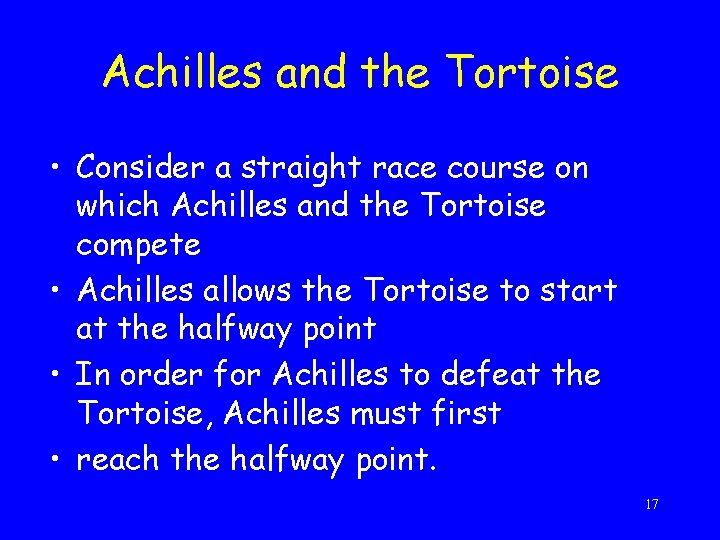
Zeno (Parmenides’ Student) • All change is motion; but motion is impossible as shown by the following example that generalizes to all supposed cases of motion: 16
Achilles and the Tortoise • Consider a straight race course on which Achilles and the Tortoise compete • Achilles allows the Tortoise to start at the halfway point • In order for Achilles to defeat the Tortoise, Achilles must first • reach the halfway point. 17
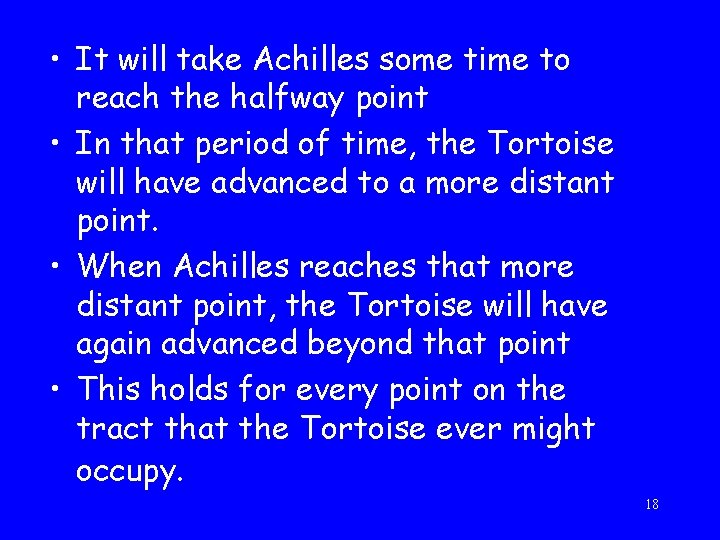
• It will take Achilles some time to reach the halfway point • In that period of time, the Tortoise will have advanced to a more distant point. • When Achilles reaches that more distant point, the Tortoise will have again advanced beyond that point • This holds for every point on the tract that the Tortoise ever might occupy. 18
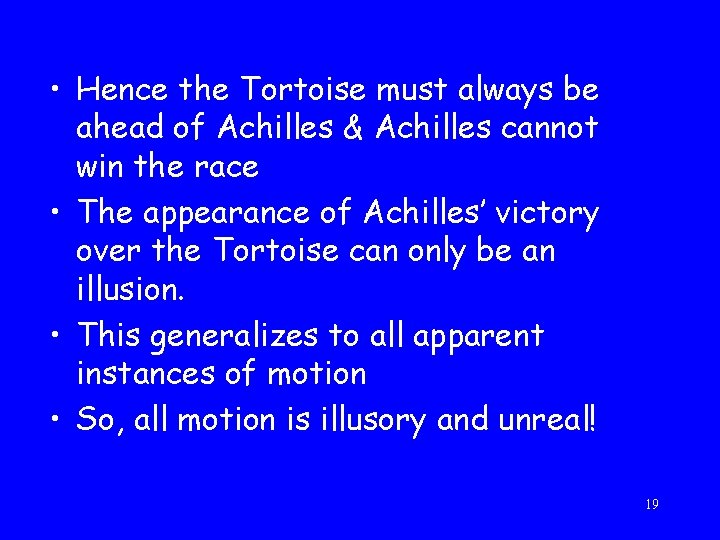
• Hence the Tortoise must always be ahead of Achilles & Achilles cannot win the race • The appearance of Achilles’ victory over the Tortoise can only be an illusion. • This generalizes to all apparent instances of motion • So, all motion is illusory and unreal! 19
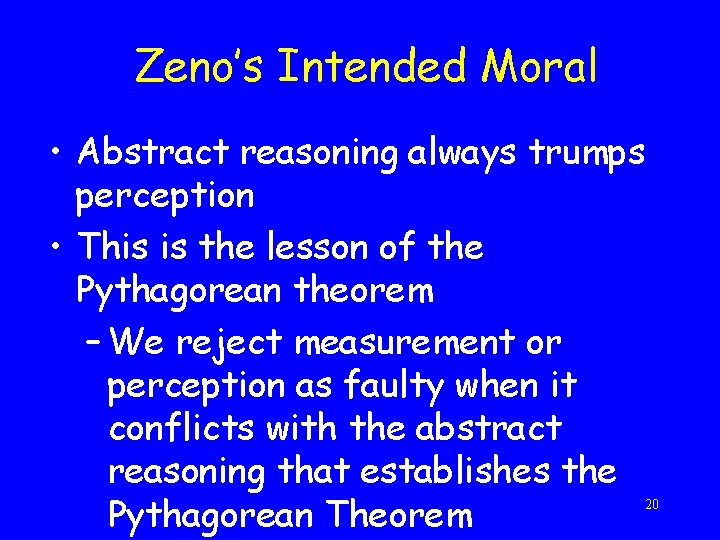
Zeno’s Intended Moral • Abstract reasoning always trumps perception • This is the lesson of the Pythagorean theorem – We reject measurement or perception as faulty when it conflicts with the abstract reasoning that establishes the Pythagorean Theorem 20
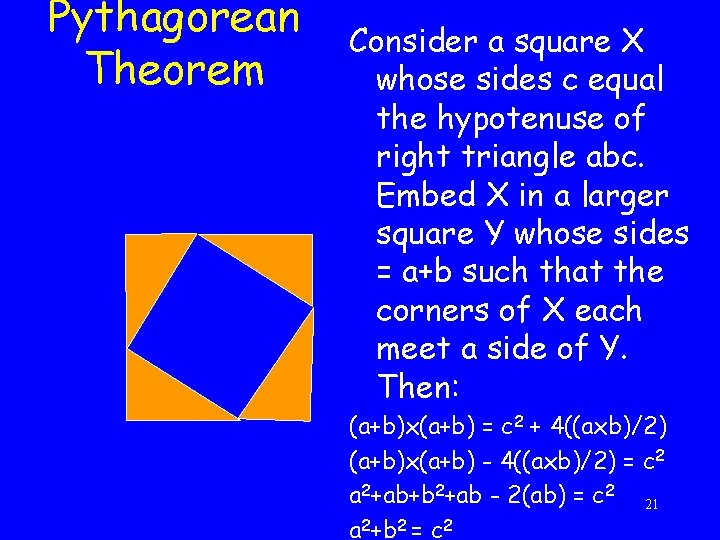
Pythagorean Theorem Consider a square X whose sides c equal the hypotenuse of right triangle abc. Embed X in a larger square Y whose sides = a+b such that the corners of X each meet a side of Y. Then: (a+b)x(a+b) = c 2 + 4((axb)/2) (a+b)x(a+b) - 4((axb)/2) = c 2 a 2+ab+b 2+ab - 2(ab) = c 2 21 a 2+b 2 = c 2
Significance of the Pythagorean Theorem • No appeal to sensation – use of an arbitrary triangle • Appeal only to definitions, axioms and abstract/logical/mathematical proof • Universal and Necessary • Perception Can’t Disconfirm 22
Irrational Roots & Odd Entities • Consider a right triangle where the square root of c 2 is an irrational number or consider (a number that cannot be represented as the ratio of rational numbers) • Or, consider 23
• If we cannot represent irrational numbers, can we think of them or understand them? • How can a hypotenuse of a real triangle be an irrational length? • On the strength of abstract reasoning we adopt these oddities 24
Back to Zeno • Confidence in the Pythagorean Theorem, odd though it is, trumps the “disconfirming measurements of observation • Since we go this far with the Pythagorean theorem, should we also accept Zeno’s paradox and reject motion as illusory along with perception? 25
Summary of Parmenides and Zeno • Monism is true; motion and plurality are impossible and illusory • Favor Abstract Reasoning over Perception • Distinguish knowledge from mere (false) opinion 26
• Knowledge requires a certain unchanging representation that corresponds to what is represented – Knowledge is like a photograph • What changes cannot be so represented – A photograph, which is fixed, cannot accurately depict what is in flux • So, knowledge of change is impossible • What is real can be known, so change 27 can’t be real