
Top Down Approach 1 Ball milling method One
Top - Down Approach : 1. Ball milling method One of the top-down approach is ball milling method. In ball milling, small hard balls are allowed to rotate inside a container and then it is made to fall on a solid with high force to crush the solid into nano crystal. Ball milling is also known as mechanical alloying or crushing. The hardened steel or tungsten carbide balls are put in a container d material.

The container is closed with tight lids. When the container is rotating around the central axis, the material is forced to press against the walls. The milling balls impart energy on collision and produce smaller grain size of nano particle. Few milligram to several kilograms of nanoparticles can be synthesized in a short time. This technique can be operated at large scale.

. Fig. 1. Schematic representation of the principle of mechanical milling
2. Electro-deposition Method This technique is used generally in electroplating and in the production of nano-films. In this technique, two electrodes (anode E 1 and cathode E 2) are immersed inside the electrolyte [aqueous solutions of salt, acids etc]. When the current is passed through the electrodes, certain mass of substance is liberated from one electrode say for example from electrode E 1 and is deposited on the surface of the other electrode say E 2 and hence forms a thin nano - film on the surface of the electrode E 2. The thickness of the nano-films can be adjusted by controlling the current and the time of deposition. These films are mechanically robust, highly flat and uniform.
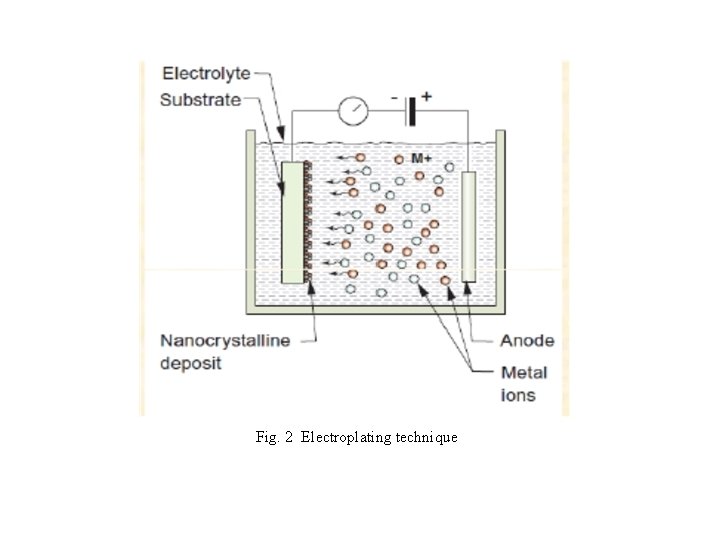
Fig. 2 Electroplating technique
The principle of electrodeposition is inducing chemical reactions in an aqueous electrolyte solution with the help of applied voltage, e. g. this is the process of using electrical current to coat an electrically conductive object with a relatively thin layer of metal. This method is relevant to deposition of nanostructured materials include metal oxides and chalcogenides. Electrodeposition is relatively cheap and can be performed at low temperatures which will minimize interdiffusion of materials in the se of a multilayered thin film preparation.
The film thickness can be controlled by monitoring the amount of charge delivered, whereas the deposition rate can be followed by the variation of the current with time. The composition and defect chemistry can be controlled by the magnitude of the applied potential, which can be used to deposit nonequilibrium phases. Pulsing or cycling the applied current or potential in a solution containing a mixture of precursors allows the production of a multilayered material.
The potential during the pulse will determine the species deposited whilst the thickness of individual layers is determined by the charge passed. Alternatively, the substrate can be transferred periodically from one electrolytic cell to another. The final films can range in thickness from a few nanometers to tens of microns and can be deposited onto large specimen areas of complex shape, making the process highly suitable for industrial use.
Thermodynamic and Kinetics of Electrodeposition. The nucleation of nanostructures on the electrode substrate is influenced by the crystal structure of the substrate, specific free surface energy, adhesion energy, lattice orientation of the electrode surface, and crystallographic lattice mismatch at the nucleus-substrate interface boundary.
. The final size distribution of the electrodeposits strongly depends on the kinetics of the nucleation and growth: . Instantaneous nucleation: all the nuclei form instantaneously on the electrode substrate, and subsequently grow with the time of electrodeposition. . Progressive nucleation: the number of nuclei that are formed is a function of time of electrodeposition. These nuclei gradually grow and overlap, and therefore, the progressive nucleation process exhibits zones of reduced nucleation rate around the growing stable nuclei.
- Slides: 10