
Top 5 Estate Planning Consideration for 2020 Financial





- Slides: 44
Top 5 Estate Planning Consideration for 2020 Financial Planning Association of Greater Indiana Presented by: Brian A. Eagle, J. D. Eagle & Fein, P. C. www. Eagleand. Fein. com
2 Overview • Spousal Lifetime Access Trust • Family Trust Basis Opportunity Exempt Trust Basis Opportunity • SECURE Act – Roth IRA Conversions • SECURE Act – IRA Relocation to Life Insurance • SECURE Act – Testamentary Charitable Planning 8500 Keystone Crossing, Suite 555, Indianapolis, IN 46240 Phone: (317) 726 -1714 www. eagleandfein. com Fax: (317) 475 -1270 Facebook. com/Eagleand. Fein
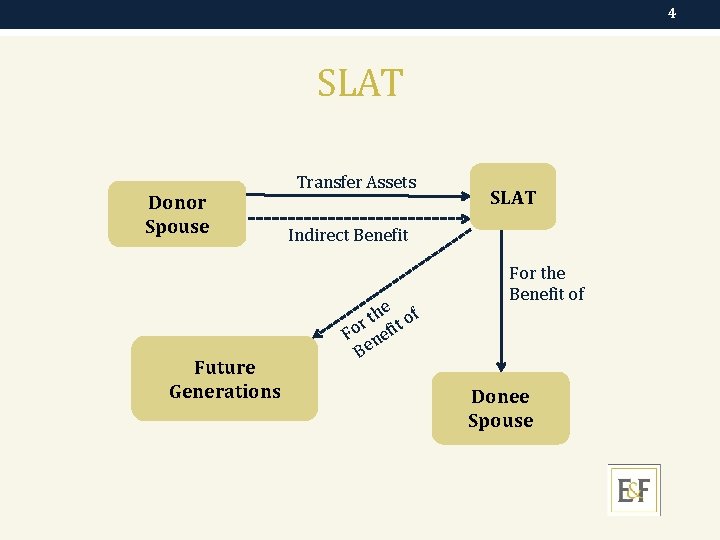
3 Spousal Lifetime Access Trust (SLAT) § A SLAT is a type of trust in which a spouse creates a trust for the benefit of the other spouse with the remainder interest passing to “heirs. ” § The purpose is to provide cash flow to the spouse-beneficiary while keeping the assets secure from creditors.
4 SLAT Donor Spouse Future Generations Transfer Assets SLAT Indirect Benefit he of t r t Fo nefi Be For the Benefit of Donee Spouse
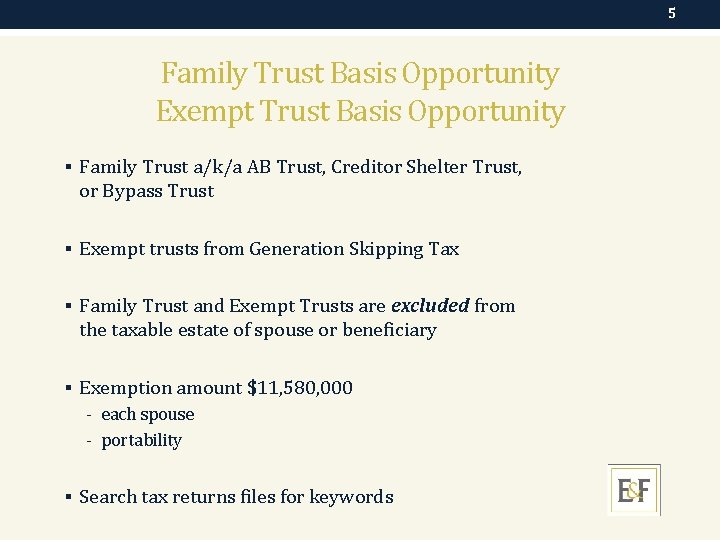
5 Family Trust Basis Opportunity Exempt Trust Basis Opportunity § Family Trust a/k/a AB Trust, Creditor Shelter Trust, or Bypass Trust § Exempt trusts from Generation Skipping Tax § Family Trust and Exempt Trusts are excluded from the taxable estate of spouse or beneficiary § Exemption amount $11, 580, 000 - each spouse - portability § Search tax returns files for keywords
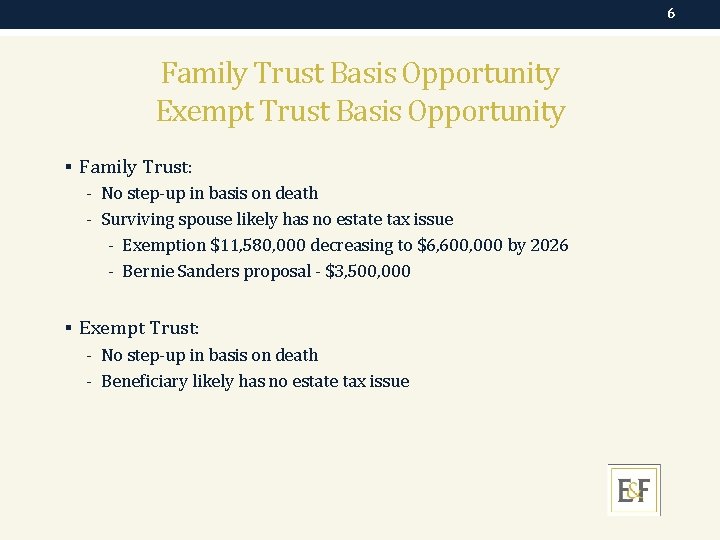
6 Family Trust Basis Opportunity Exempt Trust Basis Opportunity § Family Trust: - No step-up in basis on death - Surviving spouse likely has no estate tax issue - Exemption $11, 580, 000 decreasing to $6, 600, 000 by 2026 - Bernie Sanders proposal - $3, 500, 000 § Exempt Trust: - No step-up in basis on death - Beneficiary likely has no estate tax issue
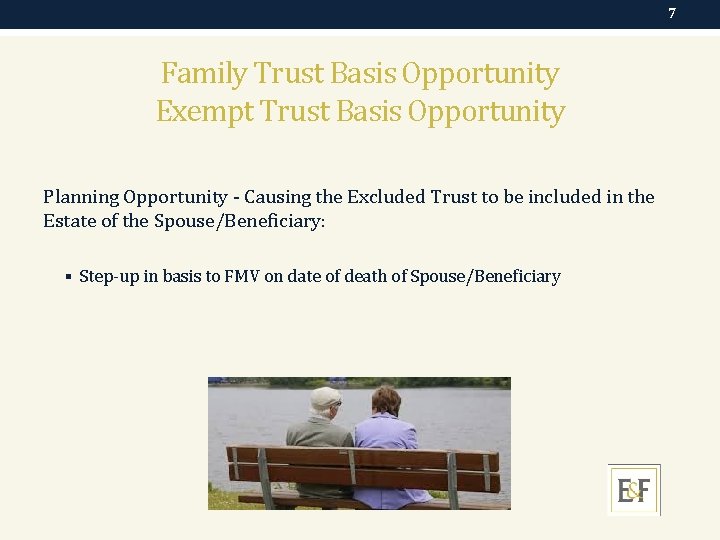
7 Family Trust Basis Opportunity Exempt Trust Basis Opportunity Planning Opportunity - Causing the Excluded Trust to be included in the Estate of the Spouse/Beneficiary: § Step-up in basis to FMV on date of death of Spouse/Beneficiary
8 Family Trust Basis Opportunity Exempt Trust Basis Opportunity § How to accomplish: - Court Modify to Terminate Trust - Ind. Code § 30 -4 -3 -24. 4 - Court Modification to Add Special General Power of Appointment - Power of Appt. – limited to exercise in favor descendants and/or credits - Allowing for appointment to credits cause estate inclusions - Can add Independent Trustee Provision that allows Independent Trust turn off the Power of Appointment if laws can unfavorable
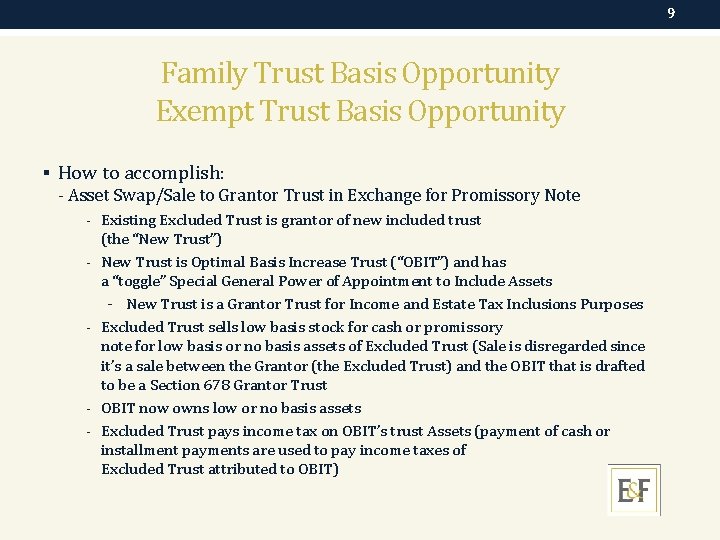
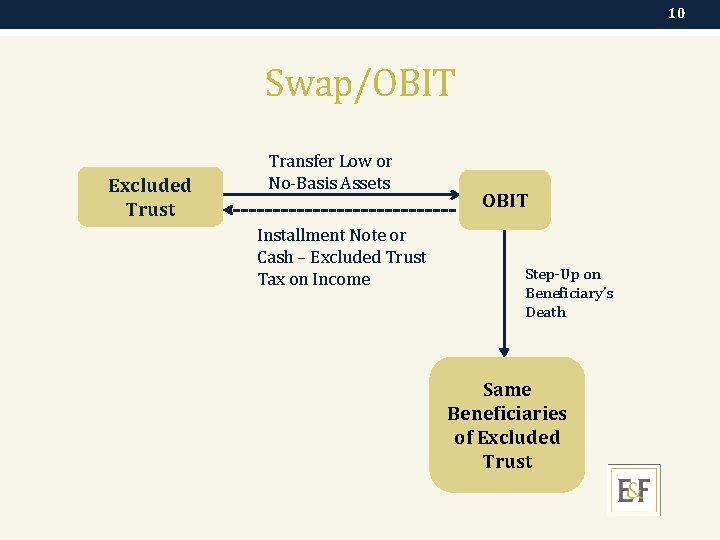
9 Family Trust Basis Opportunity Exempt Trust Basis Opportunity § How to accomplish: - Asset Swap/Sale to Grantor Trust in Exchange for Promissory Note - Existing Excluded Trust is grantor of new included trust - - - (the “New Trust”) New Trust is Optimal Basis Increase Trust (“OBIT”) and has a “toggle” Special General Power of Appointment to Include Assets - New Trust is a Grantor Trust for Income and Estate Tax Inclusions Purposes Excluded Trust sells low basis stock for cash or promissory note for low basis or no basis assets of Excluded Trust (Sale is disregarded since it’s a sale between the Grantor (the Excluded Trust) and the OBIT that is drafted to be a Section 678 Grantor Trust OBIT now owns low or no basis assets Excluded Trust pays income tax on OBIT’s trust Assets (payment of cash or installment payments are used to pay income taxes of Excluded Trust attributed to OBIT)
10 Swap/OBIT Excluded Trust Transfer Low or No-Basis Assets Installment Note or Cash – Excluded Trust Tax on Income OBIT Step-Up on Beneficiary’s Death Same Beneficiaries of Excluded Trust
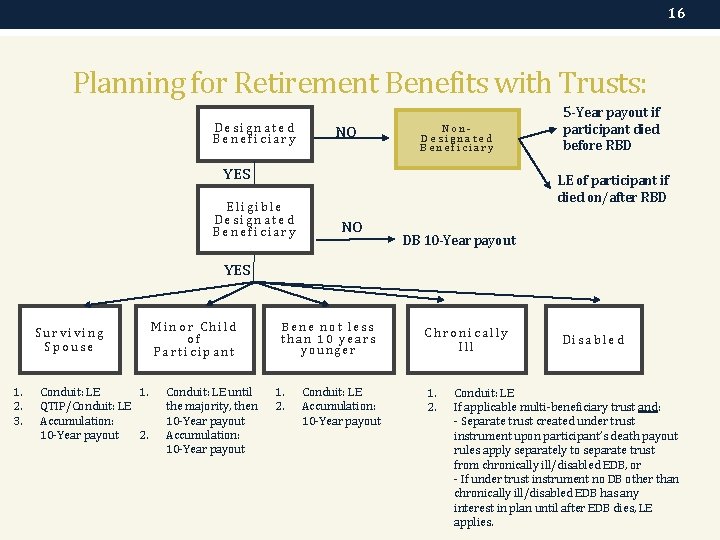
11 SECURE Act – 3 Beneficiary Categories § Non-Designated Beneficiary § 5 -Year Rule for benefits of participants who died before their RBD § Participants remaining life expectancy is participant died on or after their RBD (“the Ghost Rule”) § Designated Beneficiary § 10 -Year Rule: All amounts must be distributed by 12/31 of the year that contains the 10 th anniversary of the date of death § Eligible Designated Beneficiary
12 SECURE Act – Eligible Designated Beneficiary § Requires most non-spouse beneficiaries to withdraw inherited account balances within 10 year of the account owner’s death. § Exceptions for beneficiaries who are either – “Eligible Designated Beneficiaries” § Surviving Spouse § Minor Children of Participant § Beneficiary not less than 10 years younger than participant § Chronically Ill § Disabled
13 SECURE Act – Eligible Designated Beneficiary § On the subsequent death of the Eligible Designated Beneficiary: Ten Year Rule applies
14 See-Through Trusts – Still Apply Under the SECURE Act § Requirements: § The Trust must be valid under state law. § The Trust must be irrevocable or become irrevocable upon the death of the original owner. § The Trust’s underlying beneficiaries must (all) be identifiable individuals. § There can be neither charities nor non-living humans such as pets. § The Trust or detailed beneficiary list must be furnished to the IRA custodian or Plan Administrator by 10/31 in the year after death.
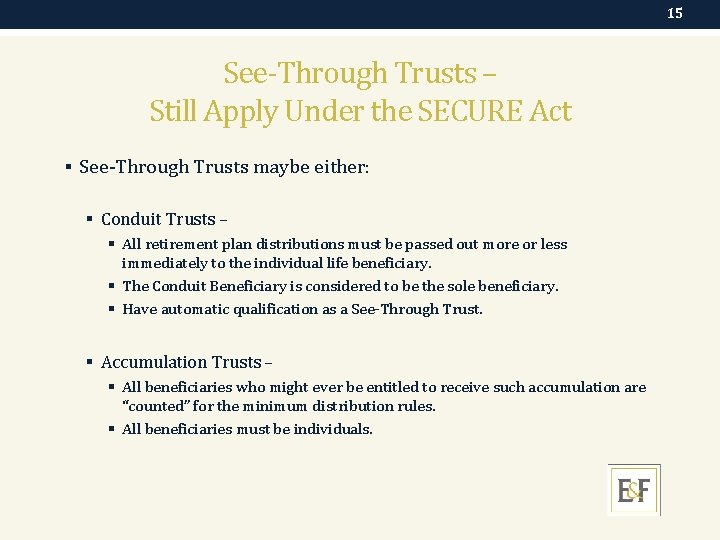
15 See-Through Trusts – Still Apply Under the SECURE Act § See-Through Trusts maybe either: § Conduit Trusts – § All retirement plan distributions must be passed out more or less immediately to the individual life beneficiary. § The Conduit Beneficiary is considered to be the sole beneficiary. § Have automatic qualification as a See-Through Trust. § Accumulation Trusts – § All beneficiaries who might ever be entitled to receive such accumulation are “counted” for the minimum distribution rules. § All beneficiaries must be individuals.
16 Planning for Retirement Benefits with Trusts: Designated Beneficiary NO Non. Designated Beneficiary YES Eligible Designated Beneficiary 5 -Year payout if participant died before RBD LE of participant if died on/after RBD NO DB 10 -Year payout YES Surviving Spouse 1. 2. 3. Conduit: LE 1. QTIP/Conduit: LE Accumulation: 10 -Year payout 2. Minor Child of Participant Conduit: LE until the majority, then 10 -Year payout Accumulation: 10 -Year payout Bene not less than 10 years younger 1. 2. Conduit: LE Accumulation: 10 -Year payout Chronically Ill 1. 2. Disabled Conduit: LE If applicable multi-beneficiary trust and: - Separate trust created under trust instrument upon participant’s death payout rules apply separately to separate trust from chronically ill/disabled EDB, or - If under trust instrument no DB other than chronically ill/disabled EDB has any interest in plan until after EDB dies, LE applies.
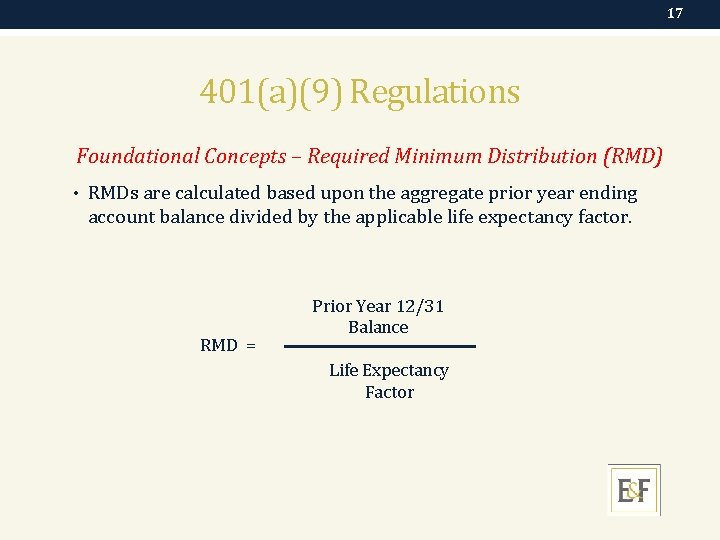
17 401(a)(9) Regulations Foundational Concepts – Required Minimum Distribution (RMD) • RMDs are calculated based upon the aggregate prior year ending account balance divided by the applicable life expectancy factor. RMD = Prior Year 12/31 Balance Life Expectancy Factor
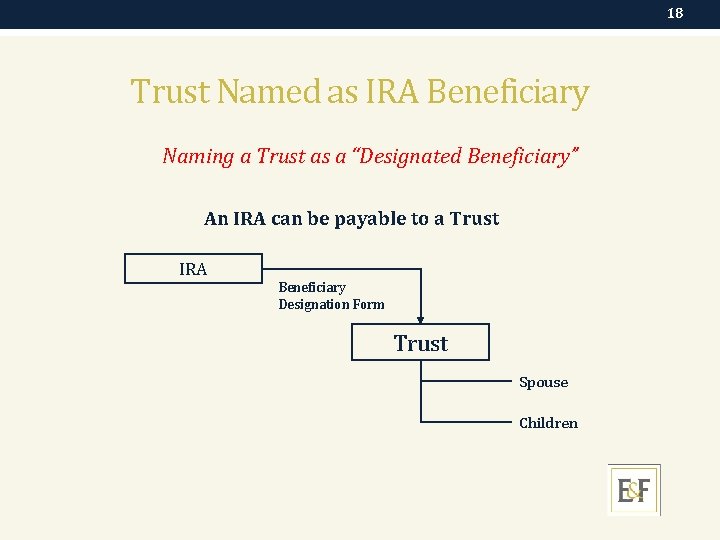
18 Trust Named as IRA Beneficiary Naming a Trust as a “Designated Beneficiary” An IRA can be payable to a Trust IRA Beneficiary Designation Form Trust Spouse Children
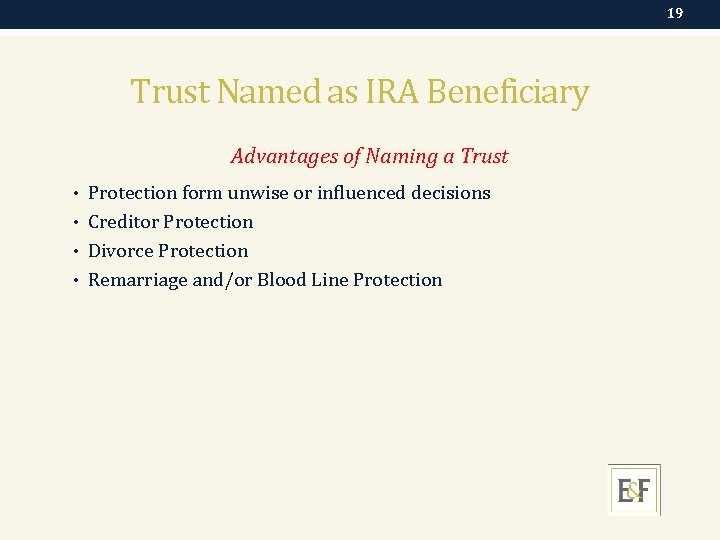
19 Trust Named as IRA Beneficiary Advantages of Naming a Trust • Protection form unwise or influenced decisions • Creditor Protection • Divorce Protection • Remarriage and/or Blood Line Protection
20 The Conduit Trust Crisis
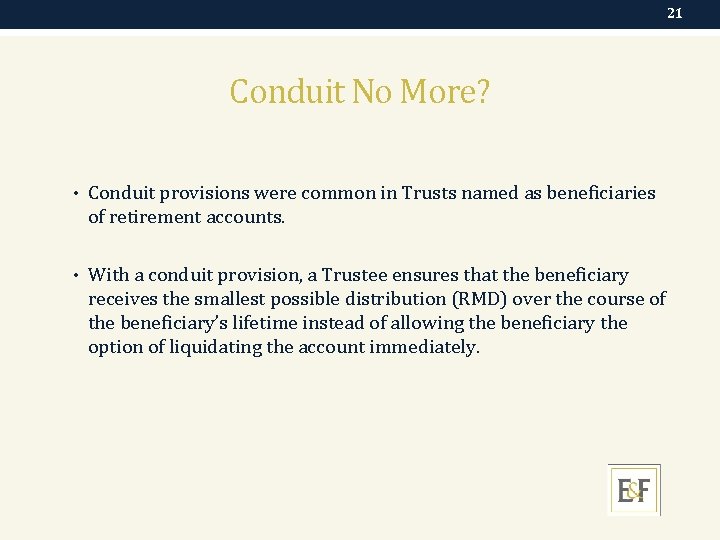
21 Conduit No More? • Conduit provisions were common in Trusts named as beneficiaries of retirement accounts. • With a conduit provision, a Trustee ensures that the beneficiary receives the smallest possible distribution (RMD) over the course of the beneficiary’s lifetime instead of allowing the beneficiary the option of liquidating the account immediately.
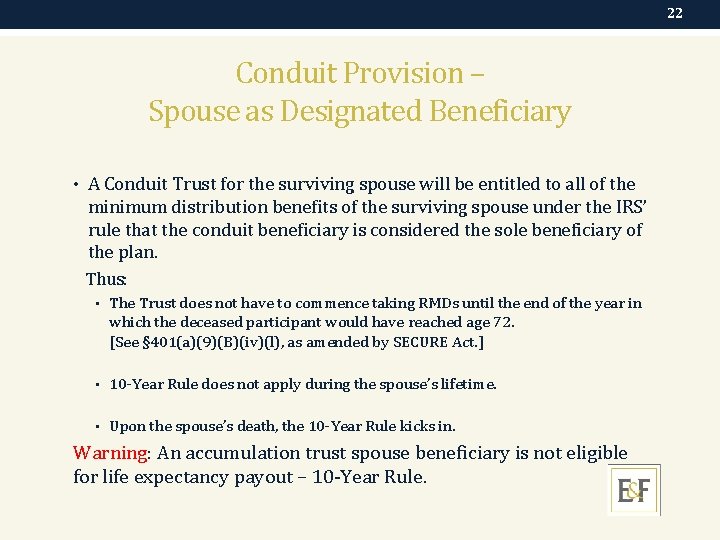
22 Conduit Provision – Spouse as Designated Beneficiary • A Conduit Trust for the surviving spouse will be entitled to all of the minimum distribution benefits of the surviving spouse under the IRS’ rule that the conduit beneficiary is considered the sole beneficiary of the plan. Thus: • The Trust does not have to commence taking RMDs until the end of the year in which the deceased participant would have reached age 72. [See § 401(a)(9)(B)(iv)(l), as amended by SECURE Act. ] • 10 -Year Rule does not apply during the spouse’s lifetime. • Upon the spouse’s death, the 10 -Year Rule kicks in. Warning: An accumulation trust spouse beneficiary is not eligible for life expectancy payout – 10 -Year Rule.
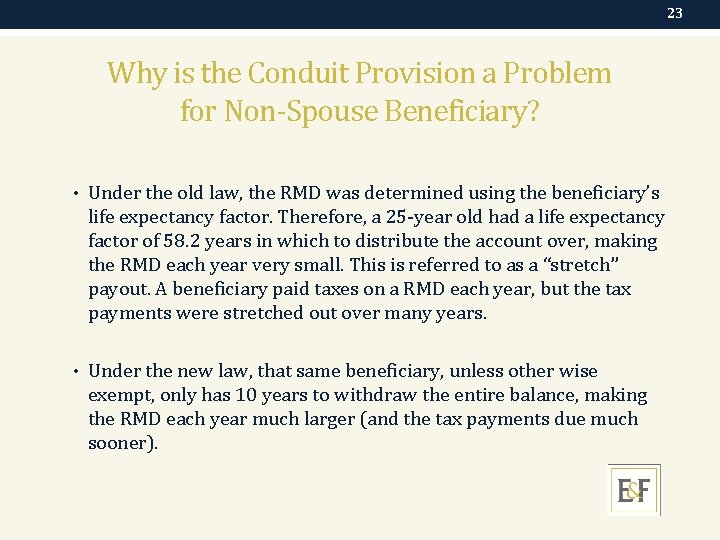
23 Why is the Conduit Provision a Problem for Non-Spouse Beneficiary? • Under the old law, the RMD was determined using the beneficiary’s life expectancy factor. Therefore, a 25 -year old had a life expectancy factor of 58. 2 years in which to distribute the account over, making the RMD each year very small. This is referred to as a “stretch” payout. A beneficiary paid taxes on a RMD each year, but the tax payments were stretched out over many years. • Under the new law, that same beneficiary, unless other wise exempt, only has 10 years to withdraw the entire balance, making the RMD each year much larger (and the tax payments due much sooner).
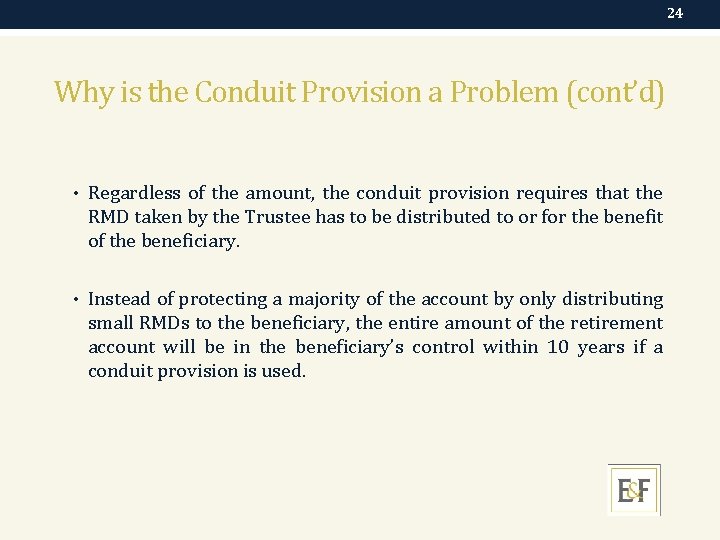
24 Why is the Conduit Provision a Problem (cont’d) • Regardless of the amount, the conduit provision requires that the RMD taken by the Trustee has to be distributed to or for the benefit of the beneficiary. • Instead of protecting a majority of the account by only distributing small RMDs to the beneficiary, the entire amount of the retirement account will be in the beneficiary’s control within 10 years if a conduit provision is used.
25 How Do We Solve This Problem?
26 The Big Decision • Most non-spouse beneficiaries must withdraw the entire balance of the retirement account within 10 years, and • The income tax due is accelerated. • Do we save on taxes or protect the retirement account from the beneficiary's (or a some of each): • unwise/influenced decisions, • creditors/lawsuits, • divorce, and/or • remarriage/blood line protections?
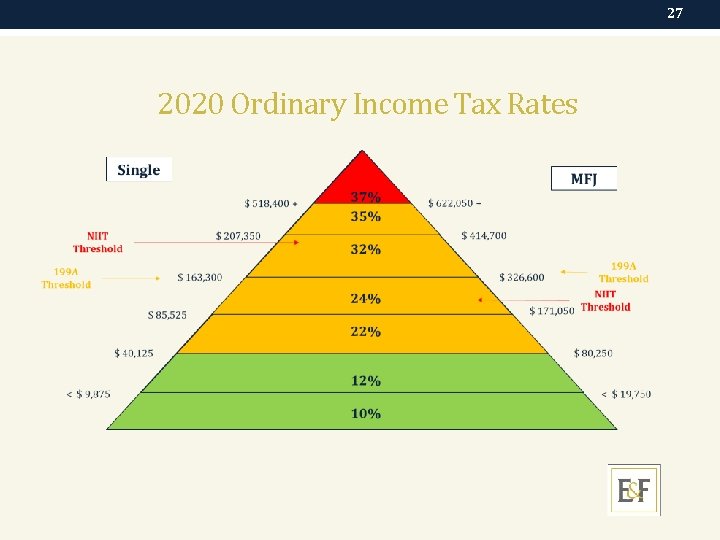
27 2020 Ordinary Income Tax Rates
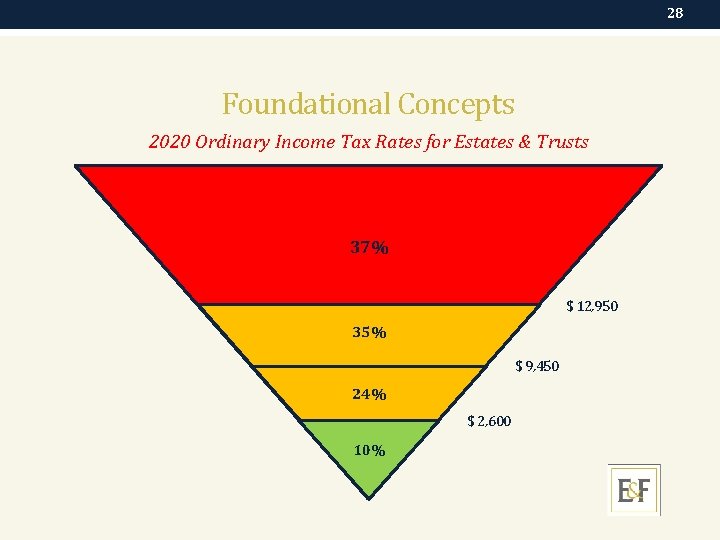
28 Foundational Concepts 2020 Ordinary Income Tax Rates for Estates & Trusts 37% $ 12, 950 35% $ 9, 450 24% $ 2, 600 10%
29 Review and Amend Documents Now • We need to review client’s documents as soon as possible to determine what is going to happen to their retirement account(s). • If we previously used a conduit provision, we need to consider amending or updating the Trust to prevent the beneficiary from getting the entire balance within 10 years of the participants death. • Consider using an Accumulation Trust.
30 Solution No. 1 – Roth IRA Conversions • Convert Traditional IRAs into Roth IRAs during participant’s lifetime • Income taxed on conversion • No distribution required at Required Beginning Date • Spread distributions over many years and lower brackets • 100% of growth is tax exempt
31 Solution No. 1 – Roth IRA Conversions • Convertible accounts include: • Traditional IRAs • 401(k) plans • Profit sharing plans • 403(b) annuity plans • 457 plans • “Inherited” 401(k) plans [see Notice 2008 -30] • Non-Convertible accounts include: • “Inherited” IRAs and Education IRAs
32 Solution No. 1 – Roth IRA Conversions • The more time the better – younger clients age 60+ • Keep in mind “floors” (e. g. for social security and Medicare Part B&D, Income Related Monthly Adjustment Amount “IRMAA”) • Taxpayer that has a large Charitable Deduction or Charitable Deduction Carryforward (Lifetime CLAT with Roth Conversion) • Taxpayer who can pay the income tax with other funds • Taxpayer who desires to use IRA assets to fund their Basic Exclusion Amount and/or desires remarriage protection or protections for children • Generally lower taxes during lifetime rather than after death
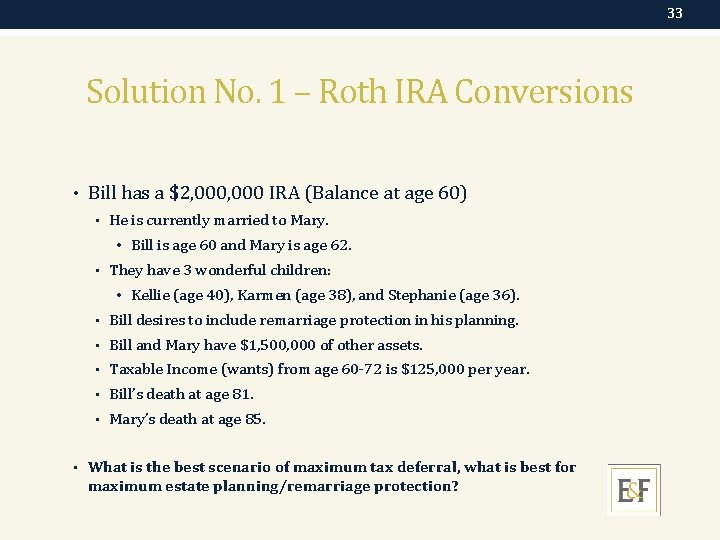
33 Solution No. 1 – Roth IRA Conversions • Bill has a $2, 000 IRA (Balance at age 60) • He is currently married to Mary. • Bill is age 60 and Mary is age 62. • They have 3 wonderful children: • Kellie (age 40), Karmen (age 38), and Stephanie (age 36). • Bill desires to include remarriage protection in his planning. • Bill and Mary have $1, 500, 000 of other assets. • Taxable Income (wants) from age 60 -72 is $125, 000 per year. • Bill’s death at age 81. • Mary’s death at age 85. • What is the best scenario of maximum tax deferral, what is best for maximum estate planning/remarriage protection?
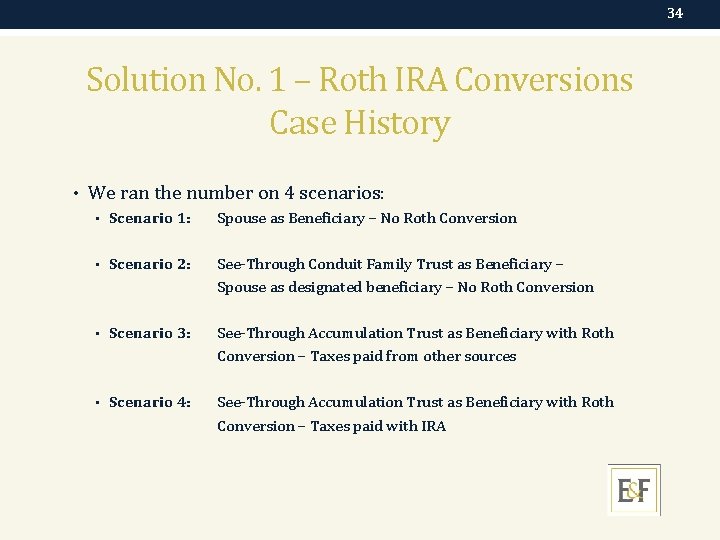
34 Solution No. 1 – Roth IRA Conversions Case History • We ran the number on 4 scenarios: • Scenario 1: Spouse as Beneficiary – No Roth Conversion • Scenario 2: See-Through Conduit Family Trust as Beneficiary – Spouse as designated beneficiary – No Roth Conversion • Scenario 3: See-Through Accumulation Trust as Beneficiary with Roth Conversion – Taxes paid from other sources • Scenario 4: See-Through Accumulation Trust as Beneficiary with Roth Conversion – Taxes paid with IRA
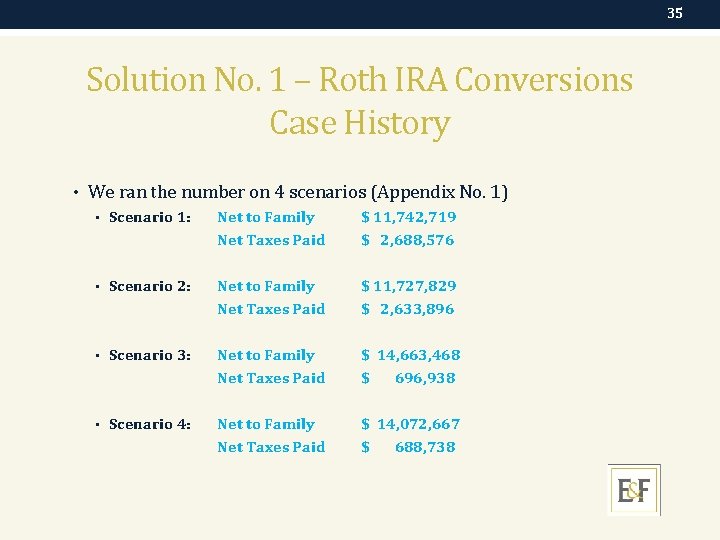
35 Solution No. 1 – Roth IRA Conversions Case History • We ran the number on 4 scenarios (Appendix No. 1) • Scenario 1: Net to Family $ 11, 742, 719 Net Taxes Paid $ 2, 688, 576 • Scenario 2: Net to Family Net Taxes Paid $ 11, 727, 829 $ 2, 633, 896 • Scenario 3: Net to Family Net Taxes Paid $ 14, 663, 468 $ 696, 938 • Scenario 4: Net to Family Net Taxes Paid $ 14, 072, 667 $ 688, 738
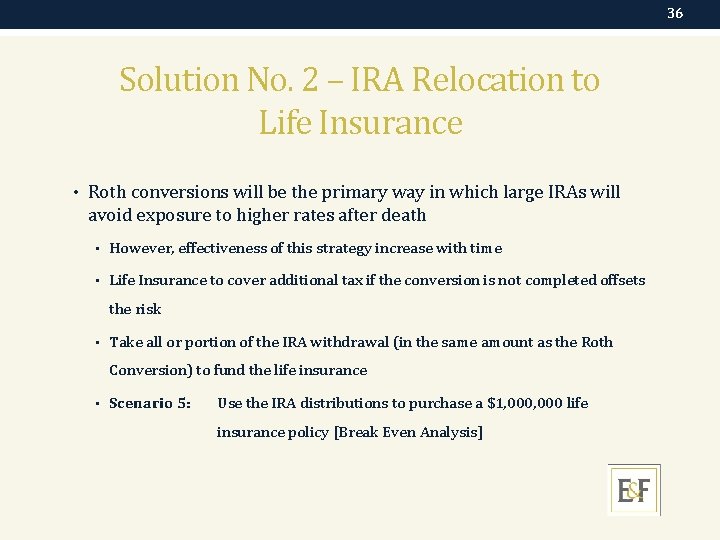
36 Solution No. 2 – IRA Relocation to Life Insurance • Roth conversions will be the primary way in which large IRAs will avoid exposure to higher rates after death • However, effectiveness of this strategy increase with time • Life Insurance to cover additional tax if the conversion is not completed offsets the risk • Take all or portion of the IRA withdrawal (in the same amount as the Roth Conversion) to fund the life insurance • Scenario 5: Use the IRA distributions to purchase a $1, 000 life insurance policy [Break Even Analysis]
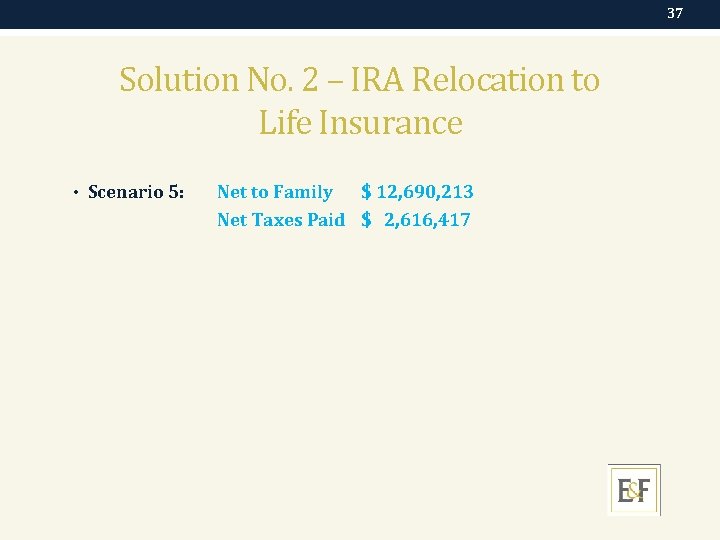
37 Solution No. 2 – IRA Relocation to Life Insurance • Scenario 5: Net to Family $ 12, 690, 213 Net Taxes Paid $ 2, 616, 417
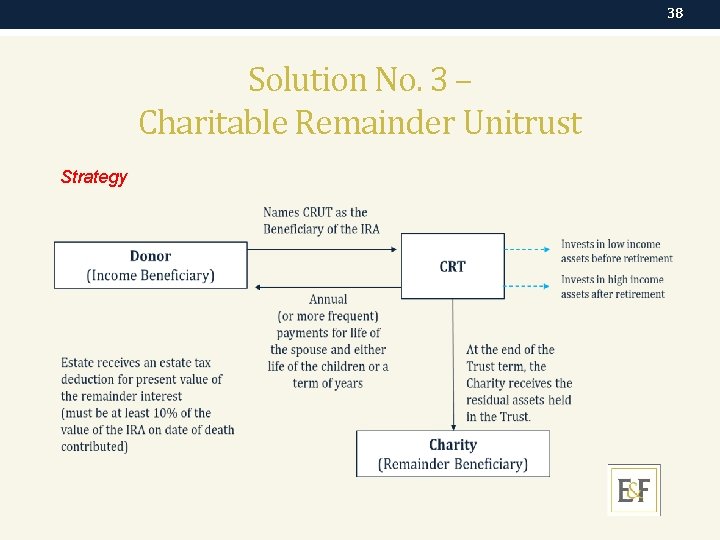
38 Solution No. 3 – Charitable Remainder Unitrust Strategy
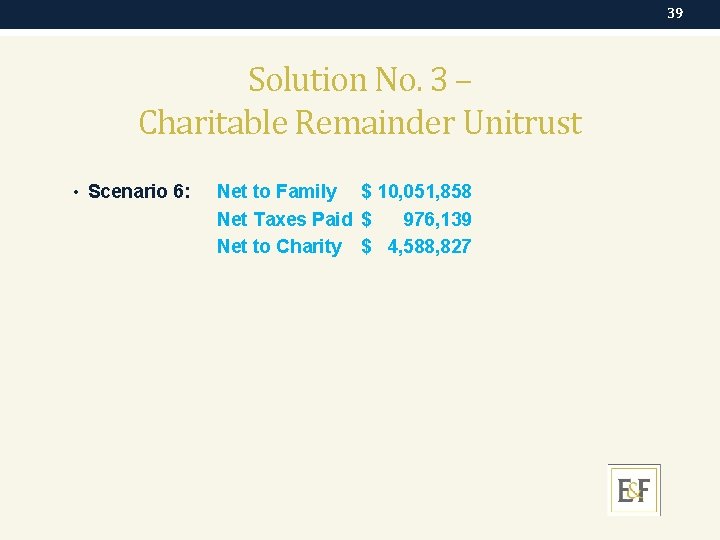
39 Solution No. 3 – Charitable Remainder Unitrust • Scenario 6: Net to Family $ 10, 051, 858 Net Taxes Paid $ 976, 139 Net to Charity $ 4, 588, 827
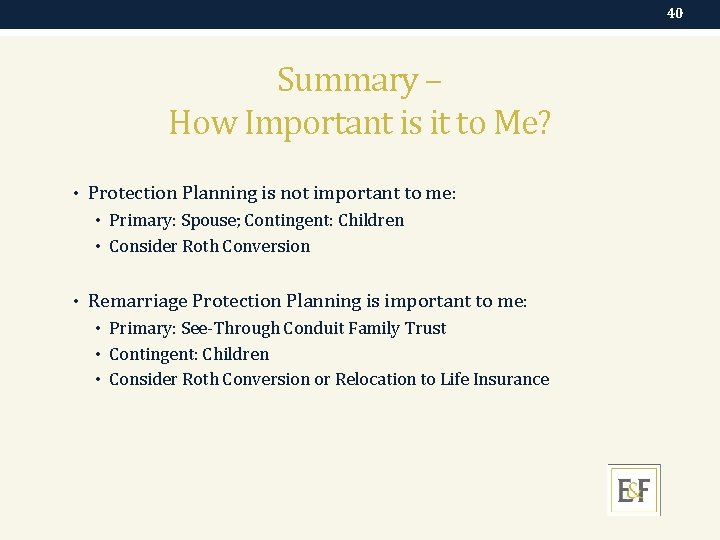
40 Summary – How Important is it to Me? • Protection Planning is not important to me: • Primary: Spouse; Contingent: Children • Consider Roth Conversion • Remarriage Protection Planning is important to me: • Primary: See-Through Conduit Family Trust • Contingent: Children • Consider Roth Conversion or Relocation to Life Insurance
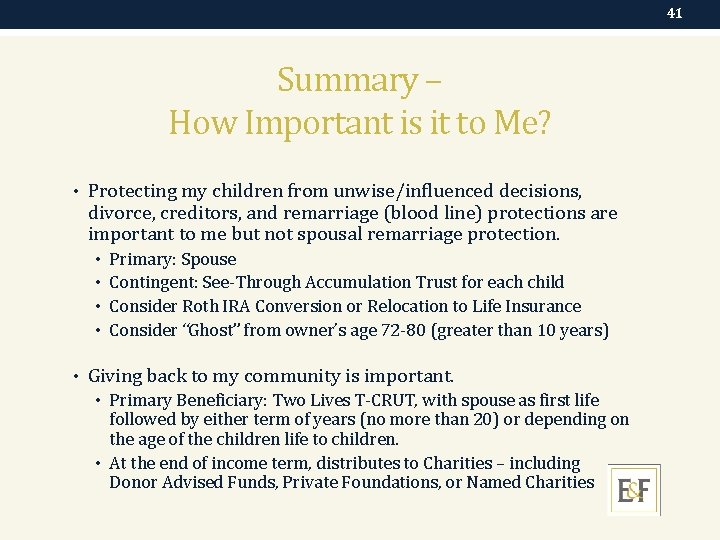
41 Summary – How Important is it to Me? • Protecting my children from unwise/influenced decisions, divorce, creditors, and remarriage (blood line) protections are important to me but not spousal remarriage protection. • Primary: Spouse • Contingent: See-Through Accumulation Trust for each child • Consider Roth IRA Conversion or Relocation to Life Insurance • Consider “Ghost” from owner’s age 72 -80 (greater than 10 years) • Giving back to my community is important. • Primary Beneficiary: Two Lives T-CRUT, with spouse as first life followed by either term of years (no more than 20) or depending on the age of the children life to children. • At the end of income term, distributes to Charities – including Donor Advised Funds, Private Foundations, or Named Charities
42 What should I do next? Ask your clients the “How Important” questions. As necessary, coordinate with experience estates planning attorney. Create a Beneficiary Roth IRA Conversion Analysis.
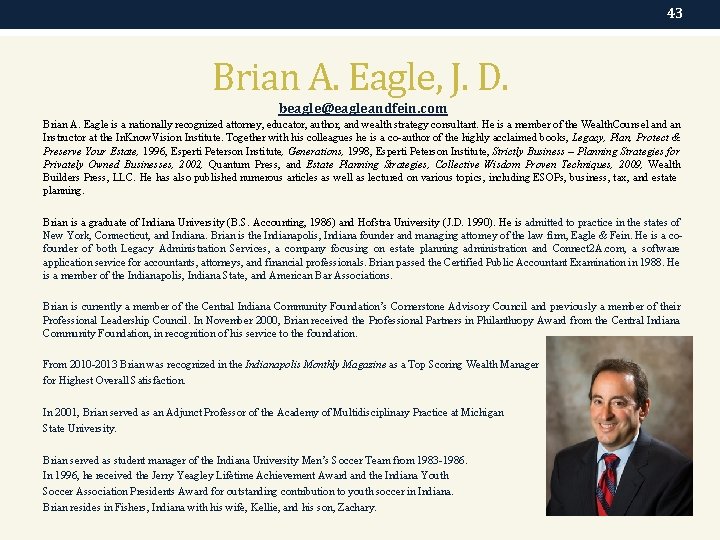
43 Brian A. Eagle, J. D. beagle@eagleandfein. com Brian A. Eagle is a nationally recognized attorney, educator, author, and wealth strategy consultant. He is a member of the Wealth. Counsel and an Instructor at the In. Know. Vision Institute. Together with his colleagues he is a co-author of the highly acclaimed books, Legacy, Plan, Protect & Preserve Your Estate, 1996, Esperti Peterson Institute, Generations, 1998, Esperti Peterson Institute, Strictly Business – Planning Strategies for Privately Owned Businesses, 2002, Quantum Press, and Estate Planning Strategies, Collective Wisdom Proven Techniques, 2009, Wealth Builders Press, LLC. He has also published numerous articles as well as lectured on various topics, including ESOPs, business, tax, and estate planning. Brian is a graduate of Indiana University (B. S. Accounting, 1986) and Hofstra University (J. D. 1990). He is admitted to practice in the states of New York, Connecticut, and Indiana. Brian is the Indianapolis, Indiana founder and managing attorney of the law firm, Eagle & Fein. He is a cofounder of both Legacy Administration Services, a company focusing on estate planning administration and Connect 2 A. com, a software application service for accountants, attorneys, and financial professionals. Brian passed the Certified Public Accountant Examination in 1988. He is a member of the Indianapolis, Indiana State, and American Bar Associations. Brian is currently a member of the Central Indiana Community Foundation’s Cornerstone Advisory Council and previously a member of their Professional Leadership Council. In November 2000, Brian received the Professional Partners in Philanthropy Award from the Central Indiana Community Foundation, in recognition of his service to the foundation. From 2010 -2013 Brian was recognized in the Indianapolis Monthly Magazine as a Top Scoring Wealth Manager for Highest Overall Satisfaction. In 2001, Brian served as an Adjunct Professor of the Academy of Multidisciplinary Practice at Michigan State University. Brian served as student manager of the Indiana University Men’s Soccer Team from 1983 -1986. In 1996, he received the Jerry Yeagley Lifetime Achievement Award and the Indiana Youth Soccer Association Presidents Award for outstanding contribution to youth soccer in Indiana. Brian resides in Fishers, Indiana with his wife, Kellie, and his son, Zachary.
44 Eagle & Fein, P. C. Inspiring People to Plan • Areas of Practice: - Estate Planning - Wealth Strategies Design - Business Succession Planning - ESOPs - Corporate Counsel - Business Transactions - Estate / Trust Administration - Elder Law / VA & Medicaid Planning - Probate & Trust Litigation Brian A. Eagle Managing Attorney 8500 Keystone Crossing, Suite 555, Indianapolis, IN 46240 Phone: (317) 726 -1714 www. eagleandfein. com Fax: (317) 475 -1270 Facebook. com/Eagleand. Fein Carol J. Greer Associate Attorney Scott J. Linneweber Associate Attorney