
TOOTH SEPERATION MATRICING Department Of Conservative and Endodontics


- Slides: 73
TOOTH SEPERATION& MATRICING Department Of Conservative and Endodontics
§INTRODUCTION §DEFNITIONS §NEED FOR TOOTH SEPARATION §METHODS OF TOOTH SEPARATION §MATRICING Dentistry Explorer
INTRODUCTION • Seperation of teeth may be necessary inorder to • Improve convenience form of dentist • Prevent damage to teeth & supporting tissues • Achieve functional contacts, contours & occlusion during restorations. Dentistry Explorer
DEFNITION Tooth movement or separation of teeth can be defined as the process of separating the involved teeth slightly away from each other or bringing them closer to each other or changing their spatial position in one or more dimensions. . Dentistry Explorer
NEED FOR TOOTH SEPARATION 1. DIAGNOSIS of initial proximal caries not seen on radiograph 2. CAVITY PREPARATION- adequate access in class 11 & class 111 cavity preparation 3. MATRIX PLACEMENT 4. POLISHING RESTORATION-polishing proximal surfaces of class 111 & class 1 V restoration 5. REPOSITIONING DRIFTED TEETH 6. REMOVAL OF FOREIGN OBJECTS Dentistry Explorer
METHODS OF TOOTH SEPARATION §Slow or delayed separation. §Rapid or immediate separation. Dentistry Explorer
SLOW OR DELAYED SEPARATION §Causes slow movement of teeth over a period of several days or weeks §Indications- tilted, drifted or rotated tooth in which rapid movement is not possible §Advantage- no periodontal damage §Disadvantage- time consuming & require many visits Dentistry Explorer
Methods of achieving slow separation 1 Separating rubber rings or bands 2 Rubber dam sheet 3 Ligature wire or copper wire 4 Gutta percha sticks 5 Oversized temporary crowns 6 Fixed orthodontic appliance Dentistry Explorer
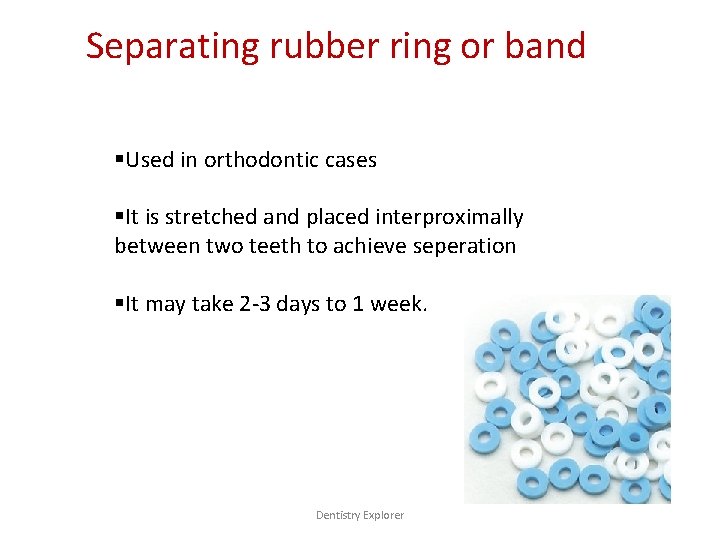
Separating rubber ring or band §Used in orthodontic cases §It is stretched and placed interproximally between two teeth to achieve seperation §It may take 2 -3 days to 1 week. Dentistry Explorer
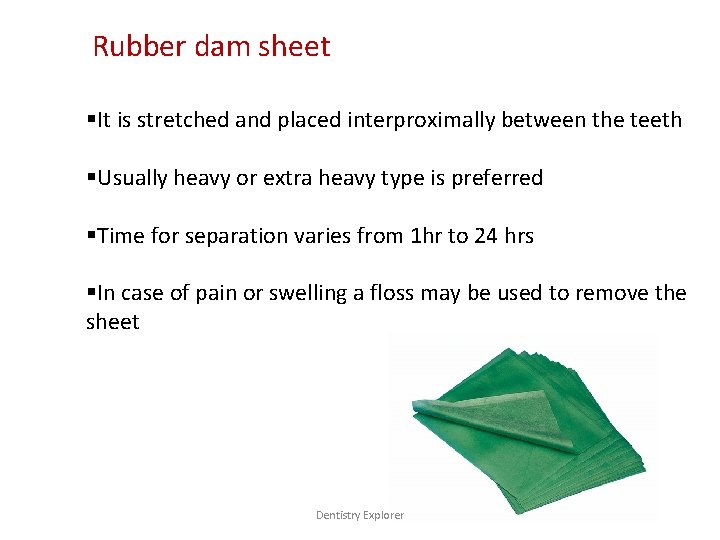
Rubber dam sheet §It is stretched and placed interproximally between the teeth §Usually heavy or extra heavy type is preferred §Time for separation varies from 1 hr to 24 hrs §In case of pain or swelling a floss may be used to remove the sheet Dentistry Explorer
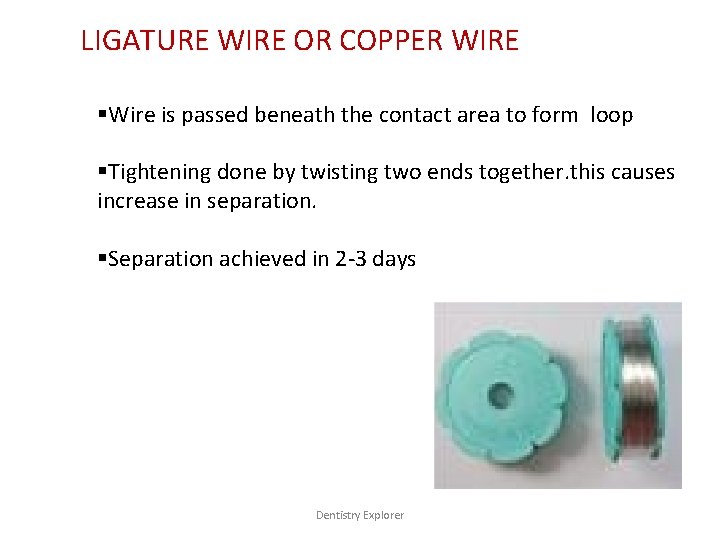
LIGATURE WIRE OR COPPER WIRE §Wire is passed beneath the contact area to form loop §Tightening done by twisting two ends together. this causes increase in separation. §Separation achieved in 2 -3 days Dentistry Explorer
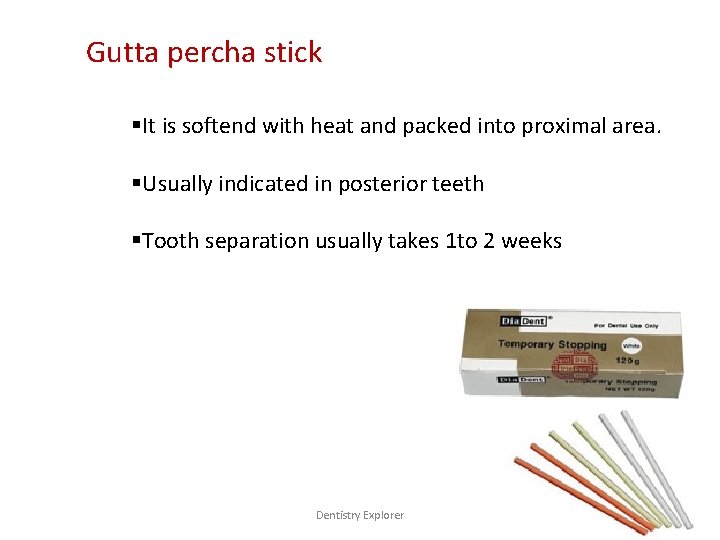
Gutta percha stick §It is softend with heat and packed into proximal area. §Usually indicated in posterior teeth §Tooth separation usually takes 1 to 2 weeks Dentistry Explorer
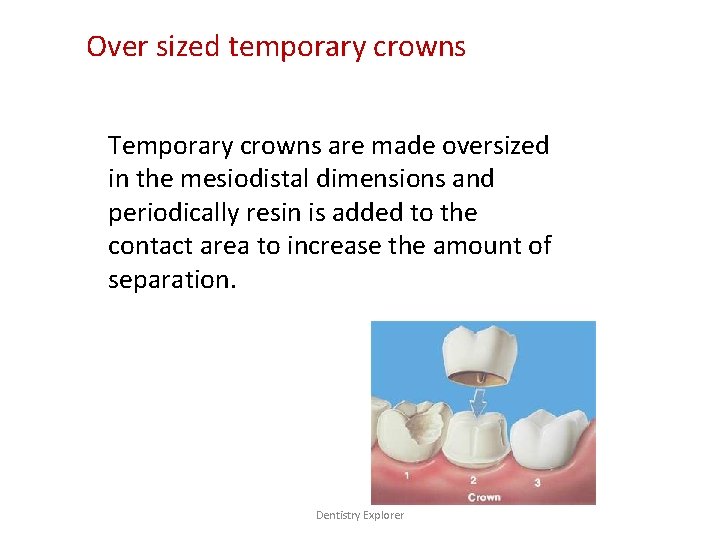
Over sized temporary crowns Temporary crowns are made oversized in the mesiodistal dimensions and periodically resin is added to the contact area to increase the amount of separation. Dentistry Explorer
Orthodontic appliances Indicated only when extensive repositioning of tooth required Most predictable and effective method. . Dentistry Explorer
RAPID OR IMMEDIATE SEPARATION §Here tooth movement achieved rapidly over a short period of time §It is achieved by two methods 1. Wedge principle 2. Traction principle Dentistry Explorer
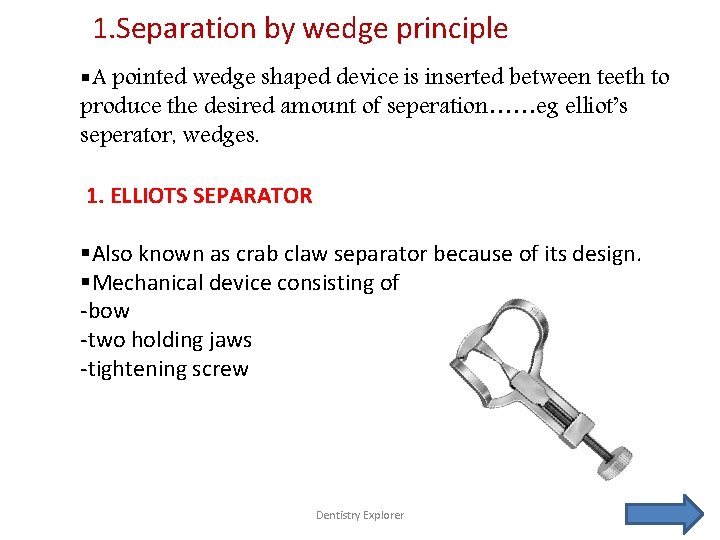
1. Separation by wedge principle §A pointed wedge shaped device is inserted between teeth to produce the desired amount of seperation……eg elliot’s seperator, wedges. 1. ELLIOTS SEPARATOR §Also known as crab claw separator because of its design. §Mechanical device consisting of -bow -two holding jaws -tightening screw Dentistry Explorer
§Clockwise rotation of tightening screw moves contacting teeth apart §Two holding jaws are positioned gingival to the contact area without damaging the interproximal area §Separation should not be more than thickness of pdl, ie, 0. 2 -0. 5 mm §Used for examination and polishing of final restoration. Dentistry Explorer
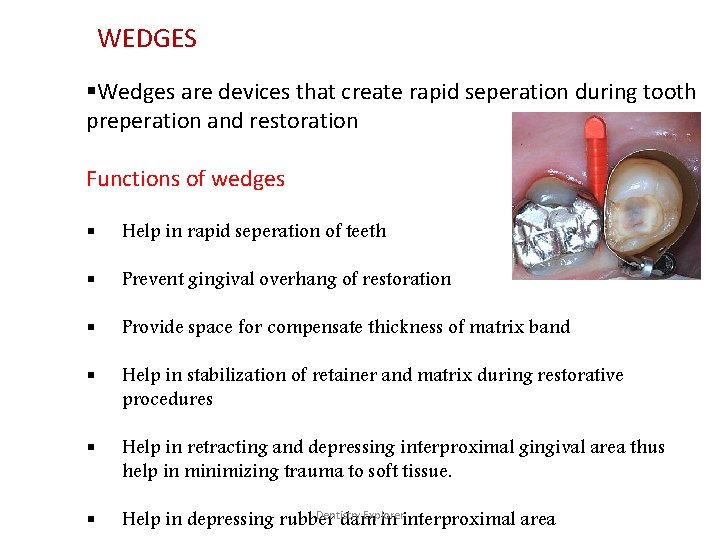
WEDGES §Wedges are devices that create rapid seperation during tooth preperation and restoration Functions of wedges § Help in rapid seperation of teeth § Prevent gingival overhang of restoration § Provide space for compensate thickness of matrix band § Help in stabilization of retainer and matrix during restorative procedures § Help in retracting and depressing interproximal gingival area thus help in minimizing trauma to soft tissue. § Dentistry Explorer Help in depressing rubber dam in interproximal area
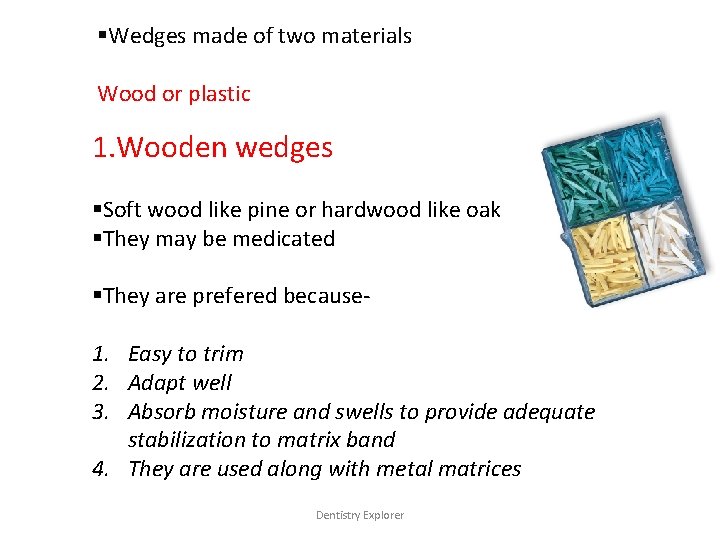
§Wedges made of two materials Wood or plastic 1. Wooden wedges §Soft wood like pine or hardwood like oak §They may be medicated §They are prefered because 1. Easy to trim 2. Adapt well 3. Absorb moisture and swells to provide adequate stabilization to matrix band 4. They are used along with metal matrices Dentistry Explorer
§Wooden wedges can be of two shapes §Triangular or round §Triangular wedges are commercially available §Prefered for cavities with deep gingival margin §It has got an apex and a base §Apex usually lies in the gingival portion of contact area. §Base lies in contact with gingiva , this helps in stabilization and retraction of gingiva §Used in tooth preperation with deep gingival margin. Dentistry Explorer
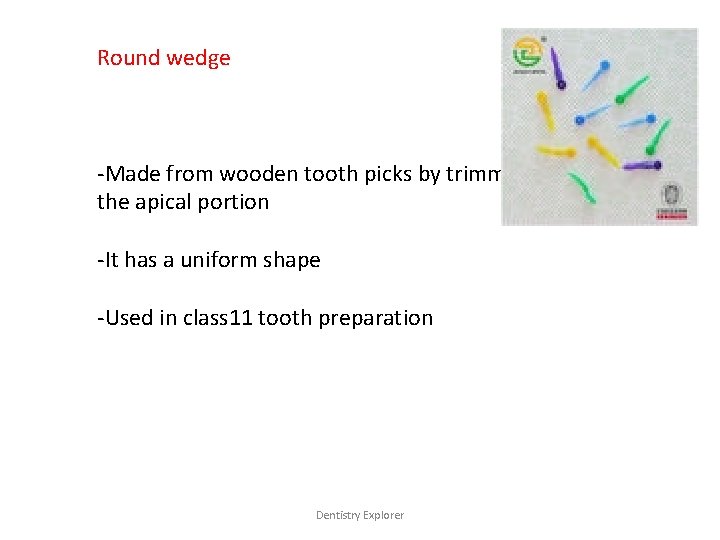
Round wedge -Made from wooden tooth picks by trimming the apical portion -It has a uniform shape -Used in class 11 tooth preparation Dentistry Explorer
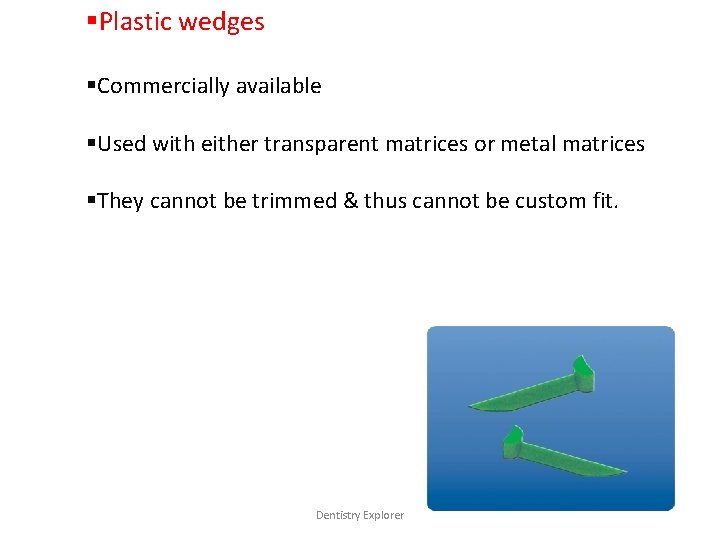
§Plastic wedges §Commercially available §Used with either transparent matrices or metal matrices §They cannot be trimmed & thus cannot be custom fit. Dentistry Explorer
§Light transmitting wedges. §Special plastic wedges which are transparent and have a light reflecting core §Used with transparent matrices while placing class 11 composite restoration. §Transmits 90 -95% incident light §It helps in reducing polymerization shrinkage as it transmits light. §Better adaptability Dentistry Explorer
PLACEMENT AND LOCATION OF WEDGES §Correct location of the wedge is in the gingival embrasure below the contact area, §Select the appropriate wedge depending on the clinical situation §Wooden wedges can be trimmed with a knife or scalpel to produce a custom fit §Wedge is usually placed from the lingual embrasure which is normally larger in size §If it interferes with tongue it can be placed from buccal side. §Length of the wedge should be only 0. 5 inch or 1. 3 cm so that it does not irritate tongue or the cheek. §After placement wedge should be firm and stable. Dentistry Explorer
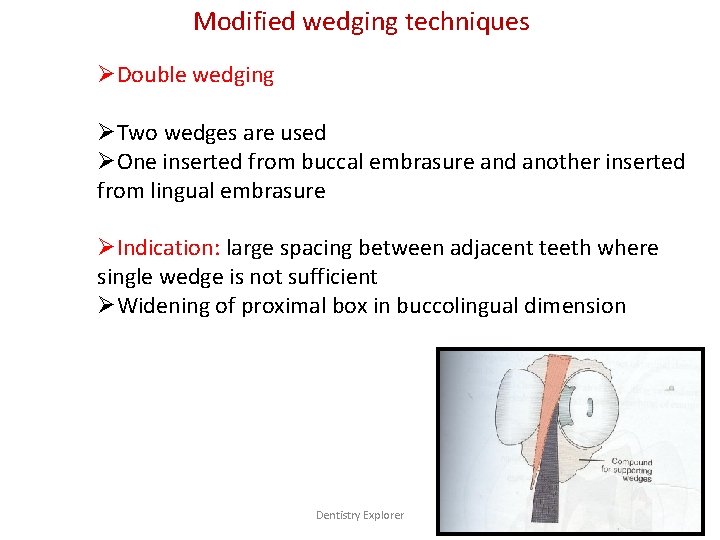
Modified wedging techniques ØDouble wedging ØTwo wedges are used ØOne inserted from buccal embrasure and another inserted from lingual embrasure ØIndication: large spacing between adjacent teeth where single wedge is not sufficient ØWidening of proximal box in buccolingual dimension Dentistry Explorer
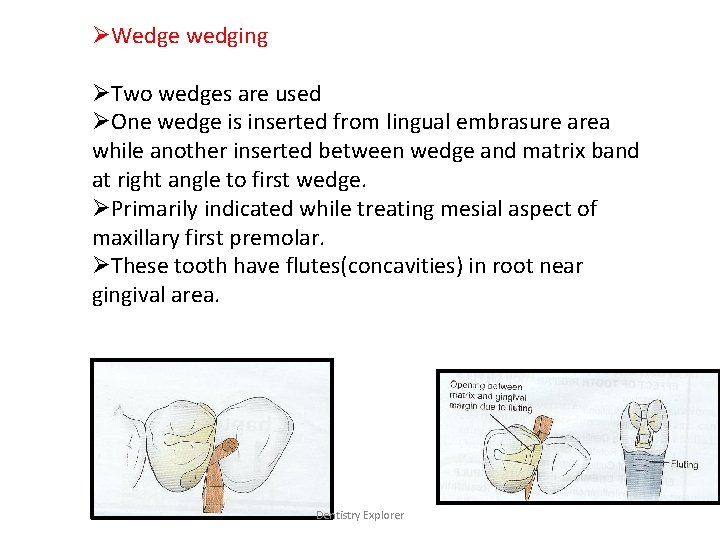
ØWedge wedging ØTwo wedges are used ØOne wedge is inserted from lingual embrasure area while another inserted between wedge and matrix band at right angle to first wedge. ØPrimarily indicated while treating mesial aspect of maxillary first premolar. ØThese tooth have flutes(concavities) in root near gingival area. Dentistry Explorer
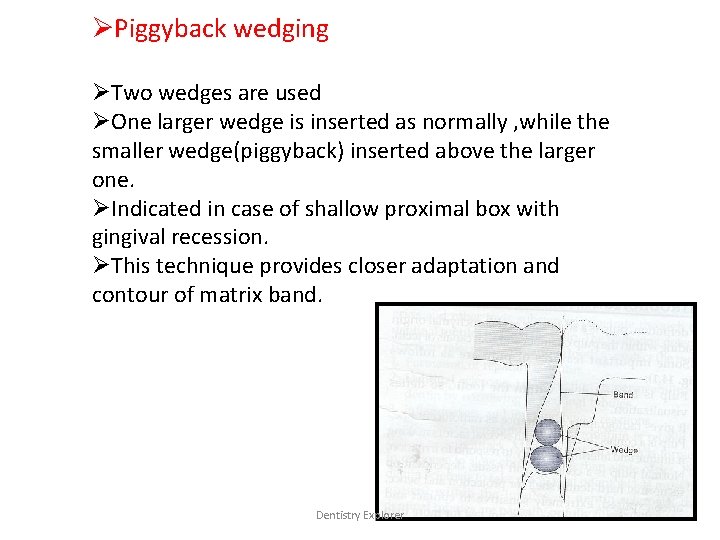
ØPiggyback wedging ØTwo wedges are used ØOne larger wedge is inserted as normally , while the smaller wedge(piggyback) inserted above the larger one. ØIndicated in case of shallow proximal box with gingival recession. ØThis technique provides closer adaptation and contour of matrix band. Dentistry Explorer
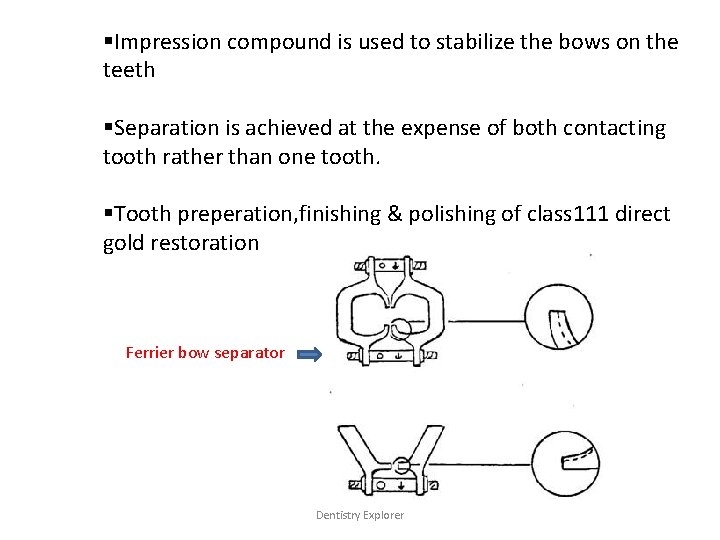
§ 2. Separation by traction principle §This employs a mechanical device to engage the proximal surfaces of contacting teeth and bodily moves them apart to bring about seperation. §eg: ferriers double bow seperator §This mechanical device has two bows. §The jaws of each bow engages the embrasure of the contacting teeth gingival to contact area §A wrench is used to turn the threaded bars slowly to create adequate separation Dentistry Explorer
§Impression compound is used to stabilize the bows on the teeth §Separation is achieved at the expense of both contacting tooth rather than one tooth. §Tooth preperation, finishing & polishing of class 111 direct gold restoration Ferrier bow separator Dentistry Explorer
MATRICING ØDEFINITIONS Ø‘Matricing ‘-is the procedure whereby a temporary wall is created opposite to axial walls, surrounding areas of the tooth structure that were lost during cavity preperation… Ø‘Matrix’-is a device used during restorative procedures to hold the plastic restorative material within the tooth while it is setting… Introduced by Dr. Louis Jack in 1871 Dentistry Explorer
Ideal requirements of a matrix §Ease of application§Ease of use- the retainer or its handle should not interfere with the condensation of the restoration or patient comfort §Ease of removal §Rigidity-the matrix should be rigid enough to confine the restorative material as it is condensed under presssure and should not get displaced easily from its position §Provide proper proximal contact and contour. Dentistry Explorer
§Positive proximal pressure-the matrix should exert a positive pressure against the adjacent tooth during insertion of the restoration so that after its removal normal contact between teeth is established §Non reactive-it should not react or stick to the restorative material. §Inexpensive §Easy to sterilize Dentistry Explorer
Functions of matrix ØTo confine restorative material while it is hardening. ØTo establish optimal contacts and contours for the restoration. ØTo prevent gingival overhangs of restoration. ØTo provide acceptable surface texture for restoration. Dentistry Explorer
Parts of matrix ØRetainer-it holds the band in desired position and shape. ØIt may be a metallic ring, mechanical device, dental floss or impression compound. ØBand-It is a piece of metal or polymeric material used to give support and give form to the restorative material during its insertion and hardening. ØCommonly used materials for matrix bands are 1. 2. 3. 4. Stainless steel Polyacetate Cellulose nitrate Dentistry Explorer
The bands are usually available as strips of various dimensions 0. 001 -0. 002 inch thickness Width- 3/16 or ¼th inches for permanent teeth 5/16 th inch width for deciduous teeth Matrix band should extend 2 mm above marginal ridge height and 1 mm below gingival margin of the preparation. Dentistry Explorer
ØClassification of matrices ØDepending on type of band material ØStainless steel ØCopper band ØCellulose acetate ØPolyacetate ØDepending on its preparation ØCustom made or anatomic matrix eg; compound supported matrix ØMechanical matrix eg; ivory no. 1 and ivory no. 8 ØDepending on mode of retention 1. with retainer eg: tofflemire, ivory no. 1 and ivory no 8 matrices 2. without retainer eg: automatrix Dentistry Explorer
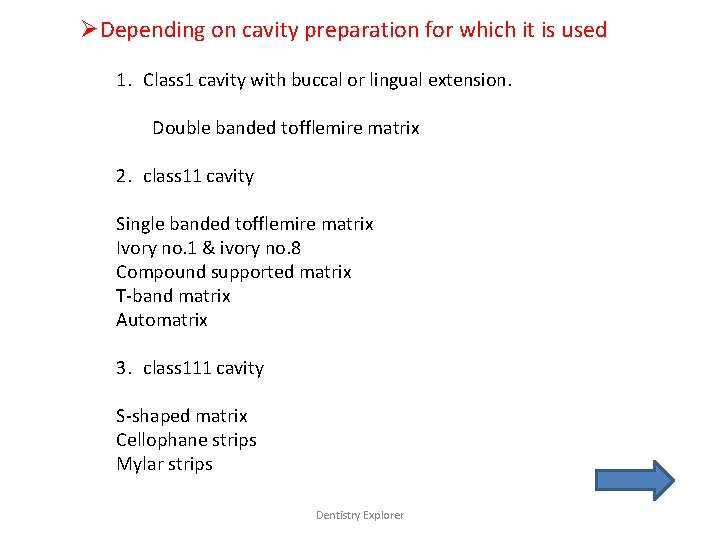
ØDepending on cavity preparation for which it is used 1. Class 1 cavity with buccal or lingual extension. Double banded tofflemire matrix 2. class 11 cavity Single banded tofflemire matrix Ivory no. 1 & ivory no. 8 Compound supported matrix T-band matrix Automatrix 3. class 111 cavity S-shaped matrix Cellophane strips Mylar strips Dentistry Explorer
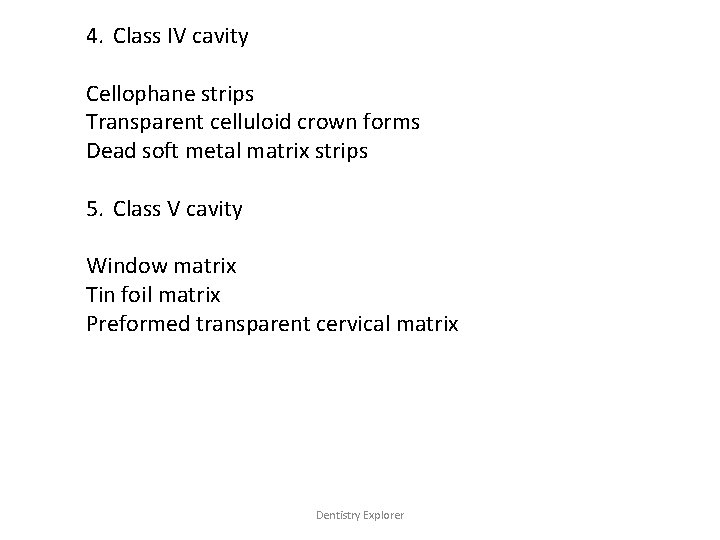
4. Class IV cavity Cellophane strips Transparent celluloid crown forms Dead soft metal matrix strips 5. Class V cavity Window matrix Tin foil matrix Preformed transparent cervical matrix Dentistry Explorer
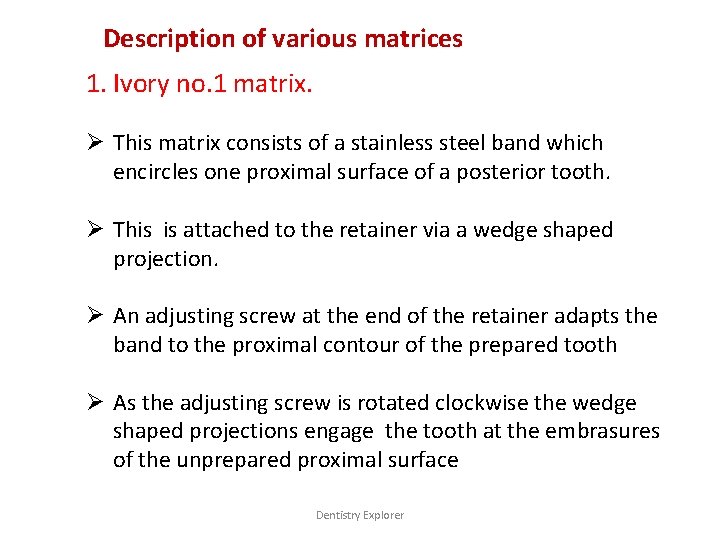
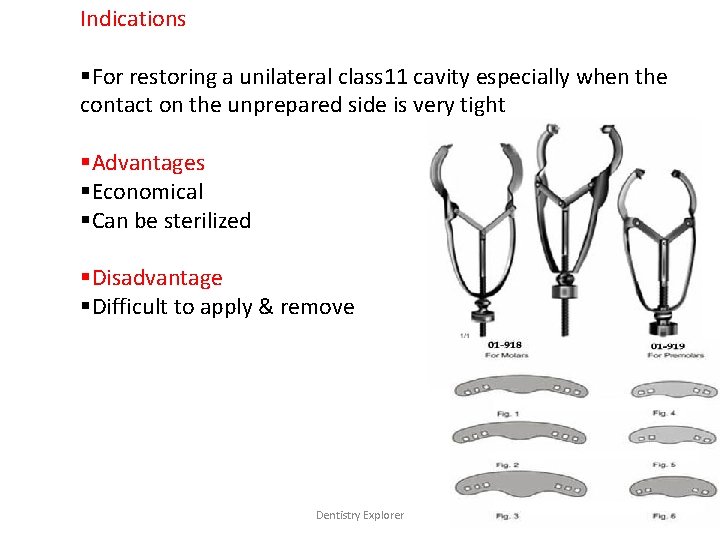
Description of various matrices 1. Ivory no. 1 matrix. Ø This matrix consists of a stainless steel band which encircles one proximal surface of a posterior tooth. Ø This is attached to the retainer via a wedge shaped projection. Ø An adjusting screw at the end of the retainer adapts the band to the proximal contour of the prepared tooth Ø As the adjusting screw is rotated clockwise the wedge shaped projections engage the tooth at the embrasures of the unprepared proximal surface Dentistry Explorer
Indications §For restoring a unilateral class 11 cavity especially when the contact on the unprepared side is very tight §Advantages §Economical §Can be sterilized §Disadvantage §Difficult to apply & remove Dentistry Explorer
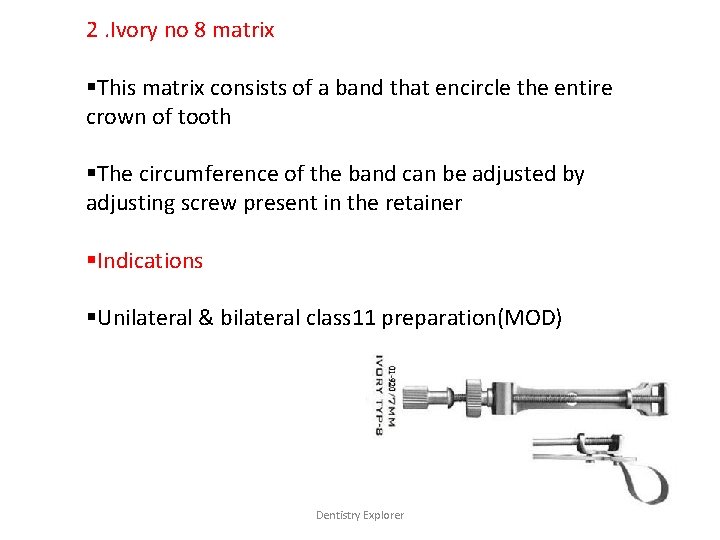
2. Ivory no 8 matrix §This matrix consists of a band that encircle the entire crown of tooth §The circumference of the band can be adjusted by adjusting screw present in the retainer §Indications §Unilateral & bilateral class 11 preparation(MOD) Dentistry Explorer
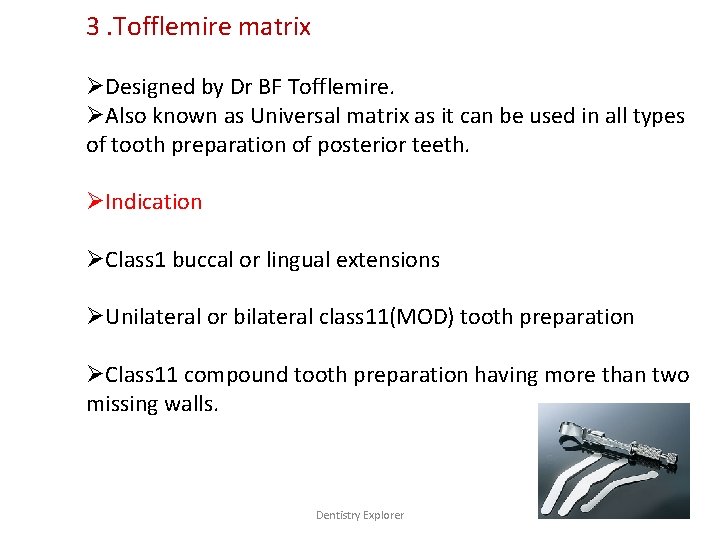
3. Tofflemire matrix ØDesigned by Dr BF Tofflemire. ØAlso known as Universal matrix as it can be used in all types of tooth preparation of posterior teeth. ØIndication ØClass 1 buccal or lingual extensions ØUnilateral or bilateral class 11(MOD) tooth preparation ØClass 11 compound tooth preparation having more than two missing walls. Dentistry Explorer
§Advantages §Ease of use §Provide good contact & contour for most amalgam restoration §Rigid & stable §Disadvantages §Does not provide optimum contour & contact for posterior composite restorations §Not useful for extensive class 11 restoration. Dentistry Explorer
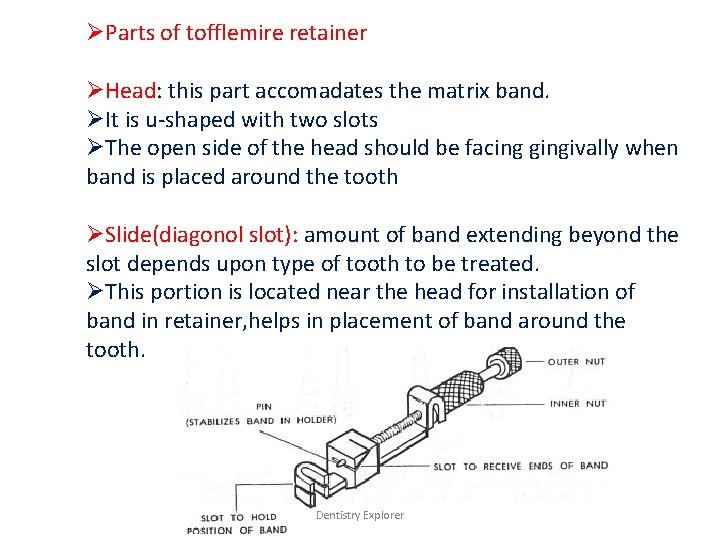
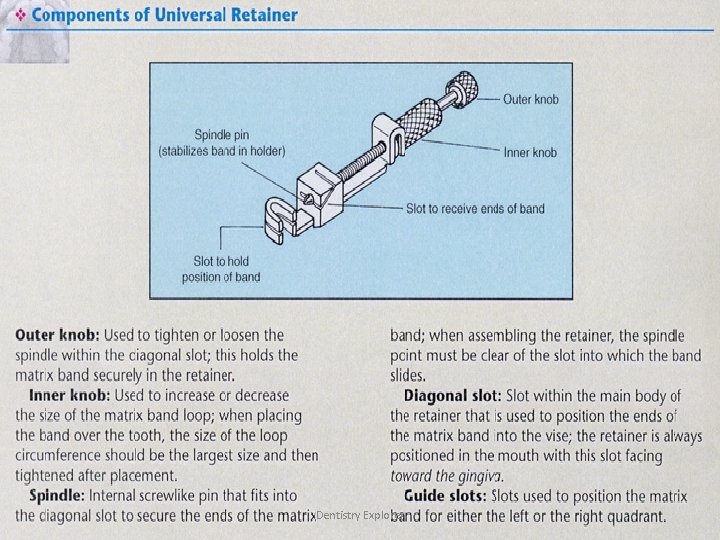
ØParts of tofflemire retainer ØHead: this part accomadates the matrix band. ØIt is u-shaped with two slots ØThe open side of the head should be facing gingivally when band is placed around the tooth ØSlide(diagonol slot): amount of band extending beyond the slot depends upon type of tooth to be treated. ØThis portion is located near the head for installation of band in retainer, helps in placement of band around the tooth. Dentistry Explorer
ØKnurled nuts Ø 1. Two knurled nuts in retainer a- large knurled nut-near the matrix band ØAlso known as rotating spindle ØHelps in adapting the loop of matrix band against the tooth ØHelps in adjusting the size of loop of matrix band against the tooth. b-small knurled nut ØHelps in tightening the band to the retainer ØAssembly of retainer ØThe loop extending from retainer can project in following ways Østraight-used near anterior teeth Øleft/right-used mostly in posterior areas of oral cavity. Dentistry Explorer
Dentistry Explorer
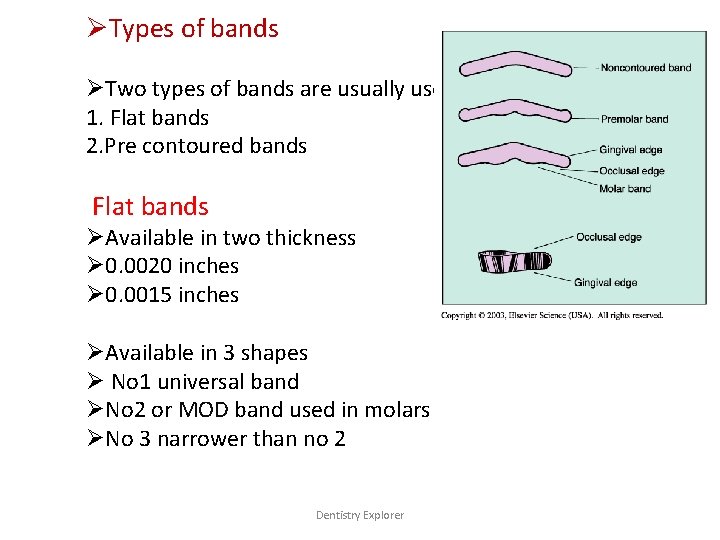
ØTypes of bands ØTwo types of bands are usually used 1. Flat bands 2. Pre contoured bands Flat bands ØAvailable in two thickness Ø 0. 0020 inches Ø 0. 0015 inches ØAvailable in 3 shapes Ø No 1 universal band ØNo 2 or MOD band used in molars ØNo 3 narrower than no 2 Dentistry Explorer
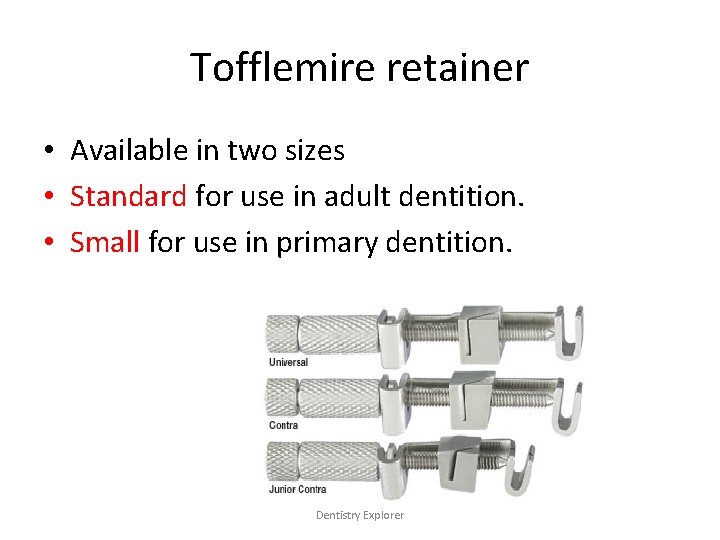
Tofflemire retainer • Available in two sizes • Standard for use in adult dentition. • Small for use in primary dentition. Dentistry Explorer
OPERATIVE INSTRUCTION FOR PLACEMENT 1. First open the large knurled nut so that the slide is atleast ¼ inches from the head. 2. Hold the knurled nut (large) with one hand , open the small nut in opposite direction for clearence of diagonal slot for reception of matrix band 3. Two ends of matrix band are secured together to form loop or either form preformed loop 4. Place the ends of band in diagonal slot 5. Then small knurled nut is tightened to secure the band to the retainer. 6. After securing the band tightly to the retainer it is placed around the tooth to be restored 7. For final adaptation of matrix band to tooth, tighten the large knurled nut 8. Wedge placement: wedge should be placed after the retainer and band fitted to the tooth. always insert the wedge from widest embrasure area Dentistry Explorer
Procedure for removal §Removal of retainer §Small knurled nut is moved counter clockwise to free the band from the retainer §While rotating the smaller knurled nut, hold the larger nut §Keep the index finger on the occlusal surface of band to stabilize the band §Removal of band §Carefully remove band from each contact point §Support the occlusal surface of restoration. while removing the band a condensor can be held against the marginal ridge of restoration §Do not pull band in occlusal direction rather move the band in facial or lingual direction §Band can be cut near to the teeth on the lingual side and try to pull it from buccal side. Dentistry Explorer
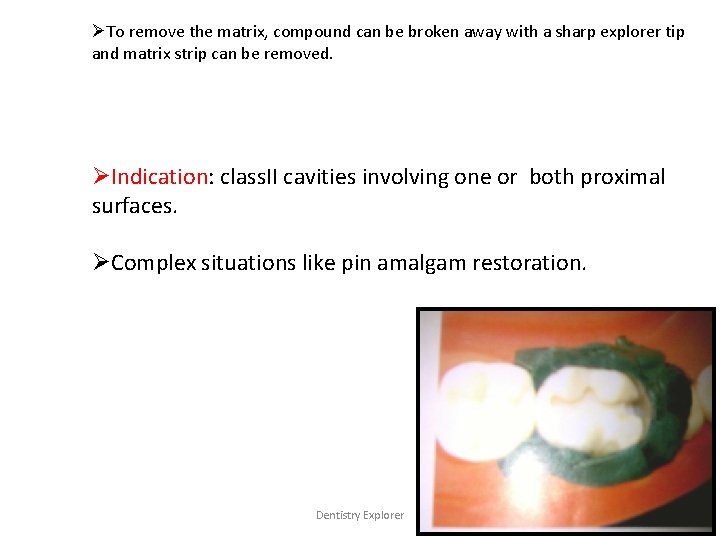
4. Compound supported matrix , custom made or anatomical matrix. ØIntroduced by sweeney. ØIt is entirely hand made and contoured specifically for each individual. ØEmploys a 5/16 th inch wide, 0. 002 inch length stainless steel band. ØThe band is contoured with an egg shaped burnisher on a paper pad to achieve the approximate proximal as well as facial and lingual contours of prepared tooth. ØThe band is positioned and stabilized by applying softened impression compound facially, lingually and occlusally over the occlusal surface of adjacent tooth. ØFollowing this amalgam condensation and carving can be completed. Dentistry Explorer
ØTo remove the matrix, compound can be broken away with a sharp explorer tip and matrix strip can be removed. ØIndication: class. II cavities involving one or both proximal surfaces. ØComplex situations like pin amalgam restoration. Dentistry Explorer
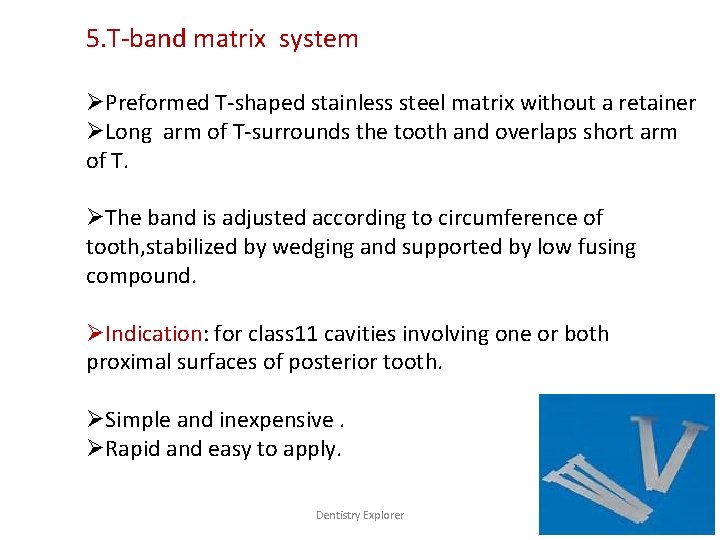
5. T-band matrix system ØPreformed T-shaped stainless steel matrix without a retainer ØLong arm of T-surrounds the tooth and overlaps short arm of T. ØThe band is adjusted according to circumference of tooth, stabilized by wedging and supported by low fusing compound. ØIndication: for class 11 cavities involving one or both proximal surfaces of posterior tooth. ØSimple and inexpensive. ØRapid and easy to apply. Dentistry Explorer
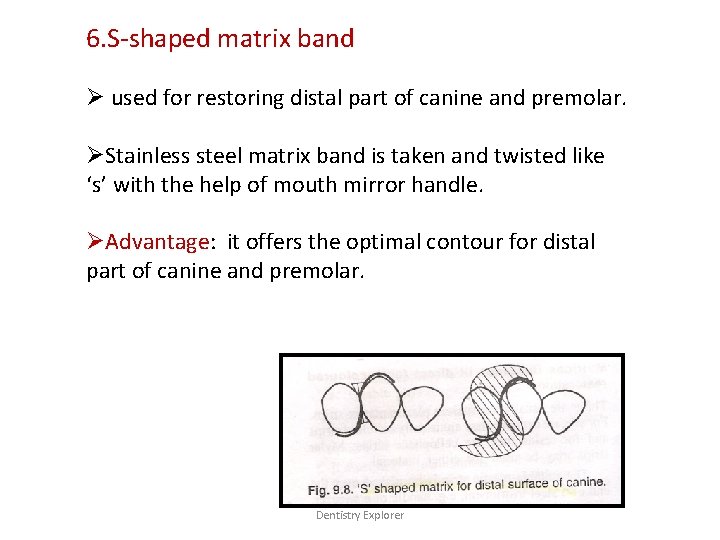
6. S-shaped matrix band Ø used for restoring distal part of canine and premolar. ØStainless steel matrix band is taken and twisted like ‘s’ with the help of mouth mirror handle. ØAdvantage: it offers the optimal contour for distal part of canine and premolar. Dentistry Explorer
7. Precontoured matrix ØConsists of small, precontoured dead soft metal matrices ready for application to tooth. ØThey are selected according to the tooth to be restored and wedged to adapt to gingival contour. ØFollowing this, the band is held in place by a flexible metal ring called Bi. Tine ring. Øeg: palodent bitine matrix system, composi-tight matrix system. ØUsed for both amalgam and composite restorations. ØEasy to apply and provides slight tooth seperation. ØTight contacts may prevent insertion of band ØExpensive. Dentistry Explorer
Dentistry Explorer
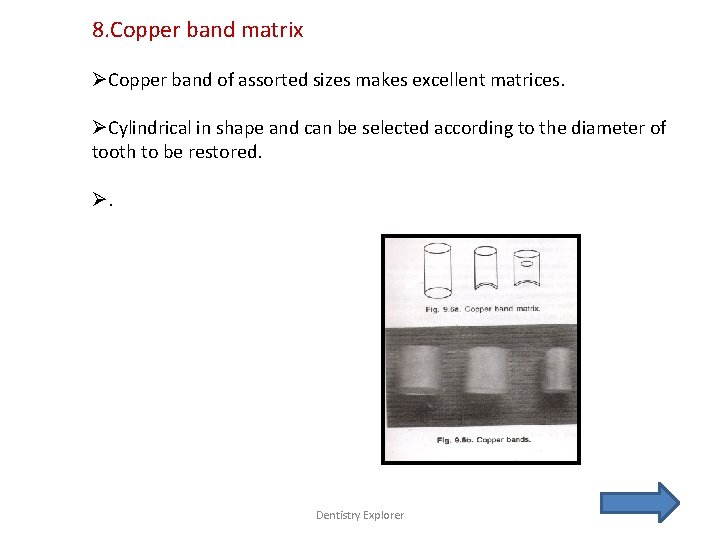
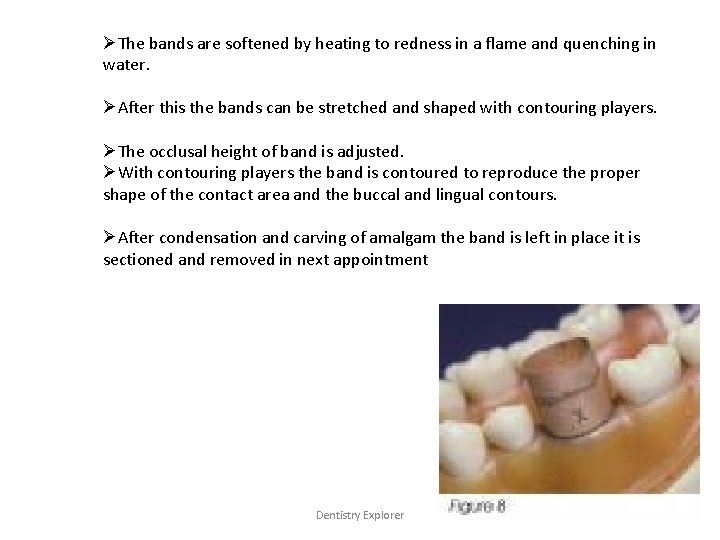
8. Copper band matrix ØCopper band of assorted sizes makes excellent matrices. ØCylindrical in shape and can be selected according to the diameter of tooth to be restored. Ø. Dentistry Explorer
ØThe bands are softened by heating to redness in a flame and quenching in water. ØAfter this the bands can be stretched and shaped with contouring players. ØThe occlusal height of band is adjusted. ØWith contouring players the band is contoured to reproduce the proper shape of the contact area and the buccal and lingual contours. ØAfter condensation and carving of amalgam the band is left in place it is sectioned and removed in next appointment Dentistry Explorer
ØIndication: for badly broken teeth especially those receiving pin amalgam restoration. ØFor complex situations like class. II cavities with large buccal or lingual extensions. ØAdvantage: provide excellent contour. ØDisadvantage: time consuming. Dentistry Explorer
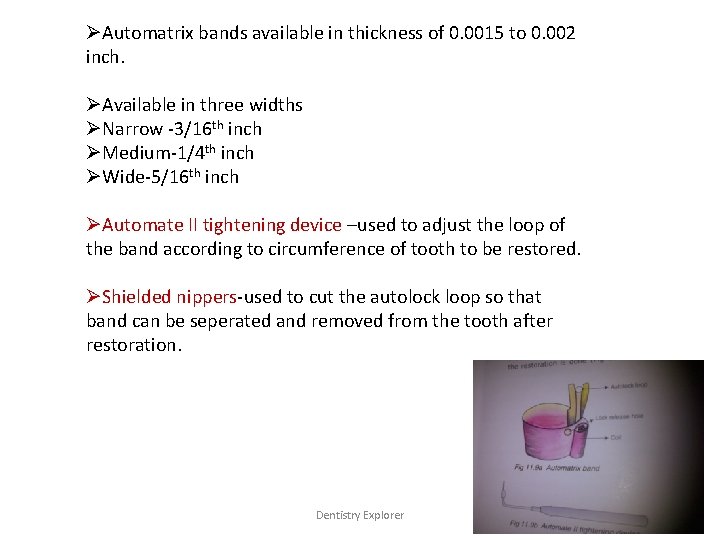
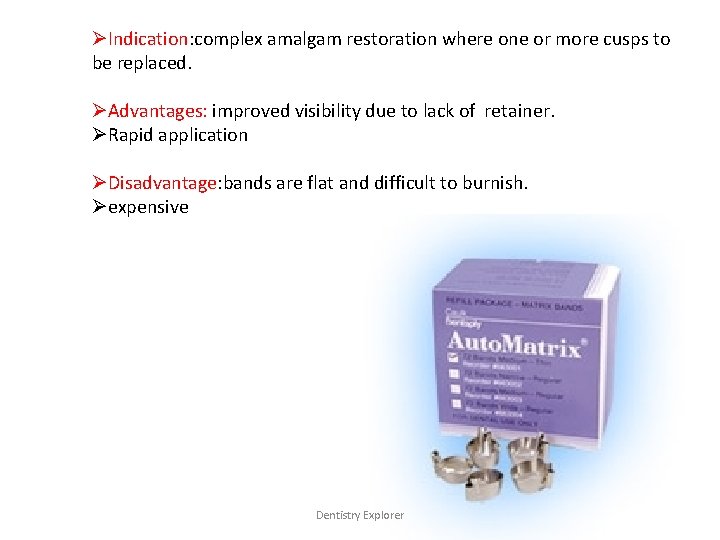
9 Automatrix System � The automatrix system is an alternative to a universal retainer. � There is no retainer used to hold the band in place. � Bands are already formed into a circle and are available in assorted sizes in both metal and plastic. � Each band has a coil like autolock loop. � A tightening wrench is inserted into the coil and turned clockwise to tighten the band. � When finished, the tightening wrench is inserted into the coil and turned counterclockwise to loosen the band. � Removing pliers are used to cut the band. Dentistry Explorer
ØAutomatrix bands available in thickness of 0. 0015 to 0. 002 inch. ØAvailable in three widths ØNarrow -3/16 th inch ØMedium-1/4 th inch ØWide-5/16 th inch ØAutomate II tightening device –used to adjust the loop of the band according to circumference of tooth to be restored. ØShielded nippers-used to cut the autolock loop so that band can be seperated and removed from the tooth after restoration. Dentistry Explorer
ØIndication: complex amalgam restoration where one or more cusps to be replaced. ØAdvantages: improved visibility due to lack of retainer. ØRapid application ØDisadvantage: bands are flat and difficult to burnish. Øexpensive Dentistry Explorer
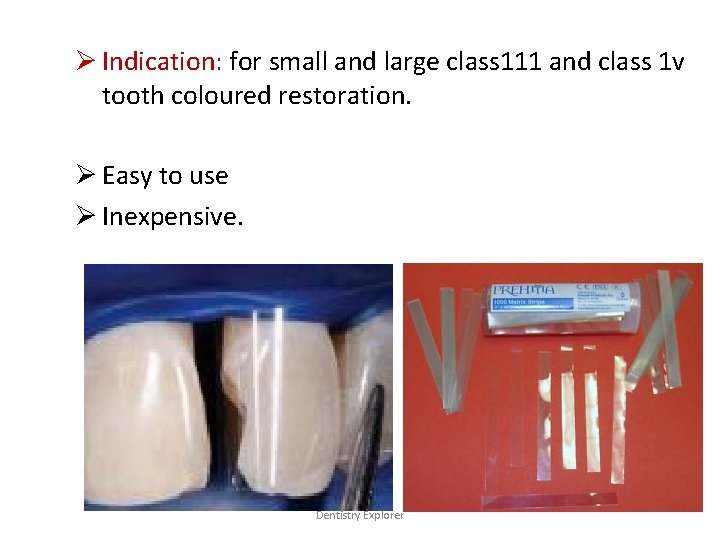
10. Clear plastic matrix ØTransparent plastic strips are employed as matrices for tooth coloured restoration. ØThey allow light to pass through them during polymerisation of composite resin. ØThey can be of different types: ØCelluloid(cellulose nitrate) strips used for silicate cements. ØCellophane(cellulose acetate)used for resins. ØMylar strips used for composite and silicate restorations. ØAfter inserting the composite resin material the matrix is pulled tightly around the tooth following which light curing is done. Dentistry Explorer
Ø Indication: for small and large class 111 and class 1 v tooth coloured restoration. Ø Easy to use Ø Inexpensive. Dentistry Explorer
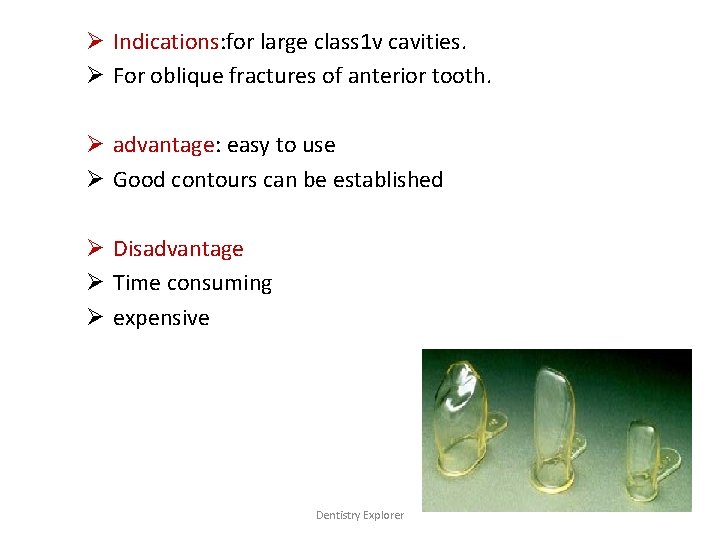
11. Transparent plastic crown form matrix ØCommercially available transparent plastic crown forms ØAvailable in various sizes and contours for anterior tooth. ØA suitable crown form can be selected for prepared tooth and trimmed to fit 1 mm past the prepared margins ØThe contact area in the crown form is thinned with an abrasive disk so that once matrix is removed the restoration contacts the adjacent tooth. ØThe bulk of composite resin is loaded into crown form. ØThen it is positioned over the tooth and light curing is done. ØAfter curing the crown form can be slit with a bur and removed. Dentistry Explorer
Ø Indications: for large class 1 v cavities. Ø For oblique fractures of anterior tooth. Ø advantage: easy to use Ø Good contours can be established Ø Disadvantage Ø Time consuming Ø expensive Dentistry Explorer
12. Window matrix • Modification of tofflemire matrix. • Used for class. V amalgam restoration. • The contra angled tofflemire retainer is applied on the lingual side of the tooth. • A window is cut in the band slightly smaller than the outline of the cavity. • Wedges are placed interproximally to stabilize band. • Following this amalgam can be condensed through window and contoured using carvers. Dentistry Explorer
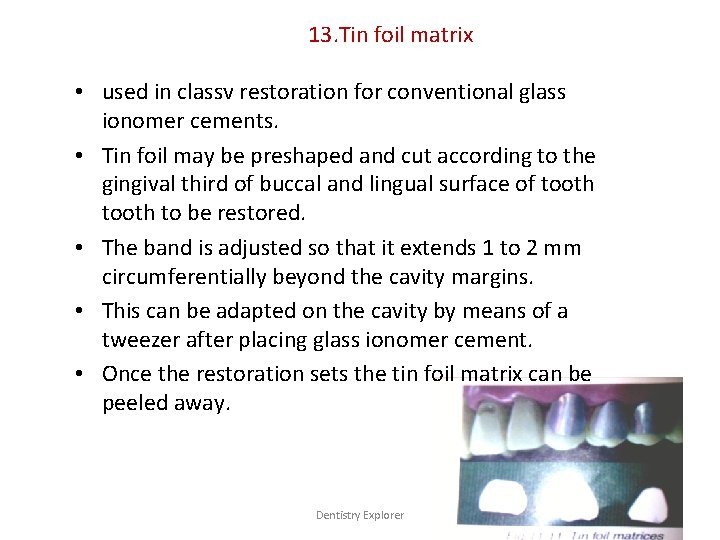
13. Tin foil matrix • used in classv restoration for conventional glass ionomer cements. • Tin foil may be preshaped and cut according to the gingival third of buccal and lingual surface of tooth to be restored. • The band is adjusted so that it extends 1 to 2 mm circumferentially beyond the cavity margins. • This can be adapted on the cavity by means of a tweezer after placing glass ionomer cement. • Once the restoration sets the tin foil matrix can be peeled away. Dentistry Explorer
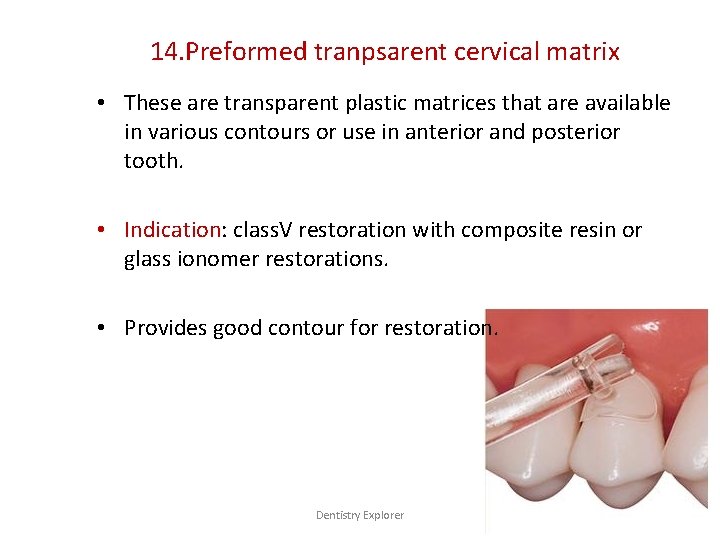
14. Preformed tranpsarent cervical matrix • These are transparent plastic matrices that are available in various contours or use in anterior and posterior tooth. • Indication: class. V restoration with composite resin or glass ionomer restorations. • Provides good contour for restoration. Dentistry Explorer
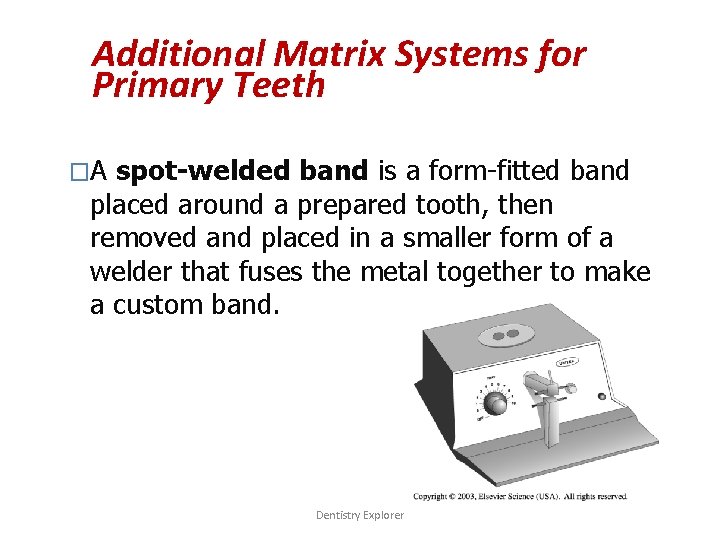
Additional Matrix Systems for Primary Teeth �A spot-welded band is a form-fitted band placed around a prepared tooth, then removed and placed in a smaller form of a welder that fuses the metal together to make a custom band. Dentistry Explorer
CONSEQUENCE OF NON RESTORING PROXIMAL AREAS • Food impaction leading to recurrent caries. • Change in occlusion and intercuspal relations. • Rotation and drifting of teeth. • Trauma to periodontium. Dentistry Explorer
CONCLUSION � The clinician should have an adequate knowledge of the anatomical and functional aspects of contacts and contours so as to reproduce them with ideal restorative materials. Extensive knowledge about the matricing serves as a guide to reproduce near to normal contacts between teeth which in turn help to maintain the oral cavity in sound health. Selection of the matrix should be based on its ease of use and efficiency to provide optimum contacts and contours. Dentistry Explorer
• Thank You Dentistry Explorer