
Tools to Support IEP Teamwork Presented by Rose
Tools to Support IEP Teamwork Presented by: Rose Spidell, Senior Education Ombuds Hosted by: Shoreline Special Needs PTSA November 7, 2019, 7: 30 -8: 30 pm www. oeo. wa. gov 1 -866 -297 -2597

History of the OEO Tackling the Opportunity Gap in k-12 Washington State Public Schools Founded by the state legislature in 2006 OEO’s Mission: We work with families, communities, and schools to navigate educational challenges and increase collaborative problem-solving so that every student can fully participate in and benefit from public education in Washington. 2
What OEO Does We listen. We inform. We help solve problems. CASEWORK TRAININGS & OUTREACH POLICY Read more about how we work with families, educators and community professionals on our website: www. oeo. wa. gov/contact. 3
Focus for Today Becoming comfortable with Tools designed to support IEP Teamwork: • Evaluations • Annual Goal Progress Reports • Prior Written Notices 4
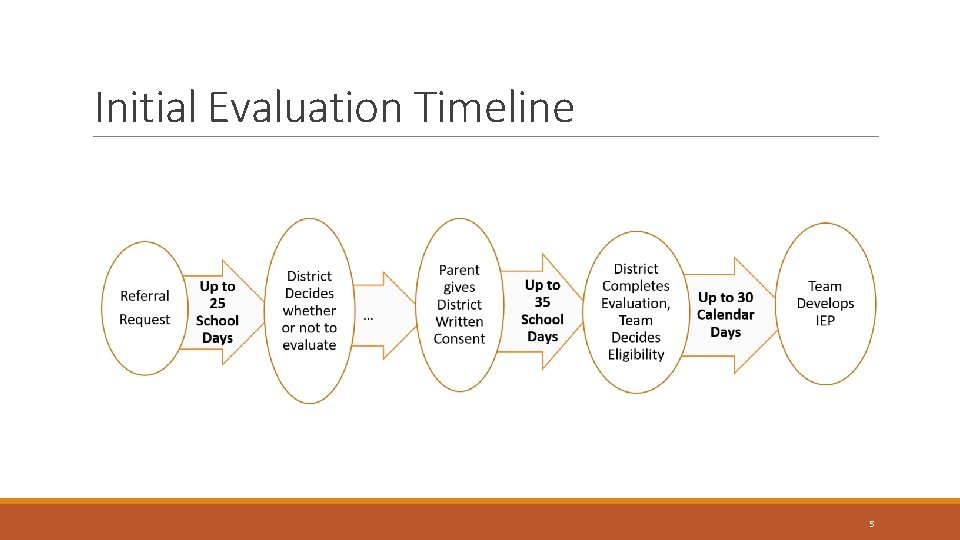
Initial Evaluation Timeline 5
Evaluation What role can you play in planning the Evaluation process for your child? When you have finished reading an Evaluation Report, what do you hope to understand? 6
Reviewing Evaluation Reports • Does it give a full picture of my child’s strengths and challenges? • Does it accurately describe my child? • Does it address the concerns that I have about my child’s progress at school? • Does it explain what kind of supports my child needs? • Does it raise new questions? 7
Hypothetical Your friend’s child has been diagnosed with ADHD, anxiety and ODD (oppositional defiance disorder). They have had increasing difficulty meeting behavioral expectations at school. They have been connected with a mental health counselor outside of school and have had a 504 plan that allows them to take breaks when they get frustrated. They are falling behind academically and a decision is made to evaluate for special education services. Your friend asks you what they should think about when they meet with the school psychologist to sign the evaluation consent form. What areas of concern do you think your friend could/should ask to have included in this evaluation? Why? 8
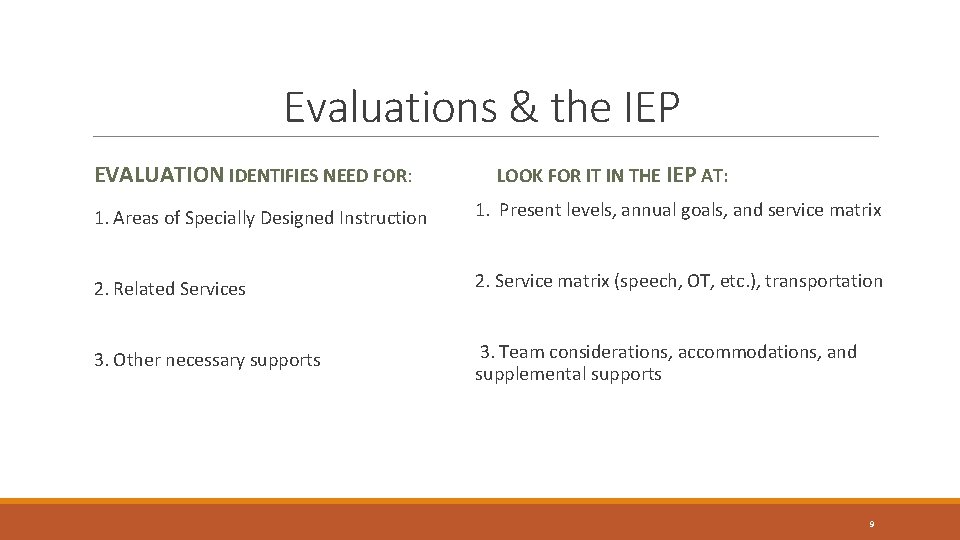
Evaluations & the IEP EVALUATION IDENTIFIES NEED FOR: LOOK FOR IT IN THE IEP AT: 1. Areas of Specially Designed Instruction 1. Present levels, annual goals, and service matrix 2. Related Services 2. Service matrix (speech, OT, etc. ), transportation 3. Other necessary supports 3. Team considerations, accommodations, and supplemental supports 9
Re-evaluations - At least every 3 years unless the district and parent agree it is unnecessary; - Or more often, if a student’s needs change and the current evaluation does not provide enough information for the IEP team; - or if the child’s parent or teacher requests it; but - Not more than once a year unless the parent and district agree. Note: re-evaluations are generally required before a “change in placement” (from more or less restrictive/inclusive settings, or other significant change). Requests for early re-evaluation, in one or more areas of concern, should also be IN WRITING, and can be given to the child’s IEP case manager or a school psychologist. 10
Hypothetical You are hearing from your child who just started middle school (6 th grade) that they can no longer keep up, it’s all too much. You have been hearing a little bit from some of the new teachers that your child has not been responsive to their directions, and has not been turning in homework, especially in math. Your child has had an IEP since first grade. There was a reevaluation in 4 th grade, and since then, your child has spent about one hour a day in the resource room to work on reading and writing goals and one social emotional goal and 30 minutes a week with speech. You decide to ask for an IEP meeting. What are some steps you can take to prepare for the meeting? You decide to review the most recent evaluation report – what are you going to be looking for? 11
Setting Goals & Tracking Progress How does a team decide what goals to include in an IEP? Where can you find information about how progress will be monitored and reported on your child’s IEP goals? 12
Present Levels of Performance & Measurable Annual Goals Present levels of performance: describe the student’s current abilities and challenges in each academic and functional area affected by disability; Measurable Annual Goals: • Identify particular skills, • That will be targeted with specially designed instruction, • To enable the student to be involved in and make progress in the general education curriculum, and • Meet each of the other needs that result from the child’s disability. 13
Goals & FAPE (Free Appropriate Public Education) The IEP outlines the plan for how each child will be provided a “FAPE. ” The goals in the IEP describe the progress the team expects the student will be able to make if they receive the services and supports described in the IEP. If a child is not making progress on their goals, that is a signal for the IEP team to review and revisit the plan. What are some steps a team can take if a student is not making progress on their goals? 14
Tracking the Team’s Work – the “PWN” Prior Written Notices: when a decision is made about eligibility, evaluation, placement or “FAPE” The PWN is required when: §a district proposes an action or change, or §a parent makes a request and a district agrees or rejects it It must explain the action requested or proposed, the decision made, and the reasons for it. It must be translated into a parent’s native language if the parent does not read English. 15
Hypothetical You went to the IEP meeting for your 6 th grader. You asked if the team could add some time for math in the resource room and they said they would need to evaluate that area first. You asked for an early re-evaluation, and the team agreed. You learned at the meeting that your child has been sent out of class several times for what the teacher described as refusal to follow directions; you asked if an FBA (functional behavior assessment) was needed and the team said no, not yet, let’s try working with the teacher on some different strategies first. What will you look for in the PWN that follows this meeting? 16
Questions/Discussion How do you understand the connection between evaluations and IEPs? What role can you play in helping to monitor whether the IEP is working? How can you help make sure there is a clear record of important decisions about your child’s education? 17
Stay in Touch with OEO Contact Us: Receive Updates and News: Online: www. oeo. wa. gov OEO Newsletter Sign Up: Email: oeoinfo@gov. wa. gov https: //public. govdelivery. com/accounts/WAGOV/s ubscriber/new? category_id=WAGOV_C 5 Toll free phone: 1 -866 -297 -2597 (interpreter services available) Facebook: https: //www. facebook. com/WAEducation. Ombuds/ Facebook en Español (Spanish): Find webinars, guides and toolkits: https: //oeo. wa. gov/en/about-us/webinars https: //www. facebook. com/Ombudsde. Educacion/ Twitter: @Ed. Ombuds https: //oeo. wa. gov/en/about-us/publications-andresources-families 18
- Slides: 18