
Tools of the Biologist The Incredible World of
Tools of the Biologist The Incredible World of Microscopes video
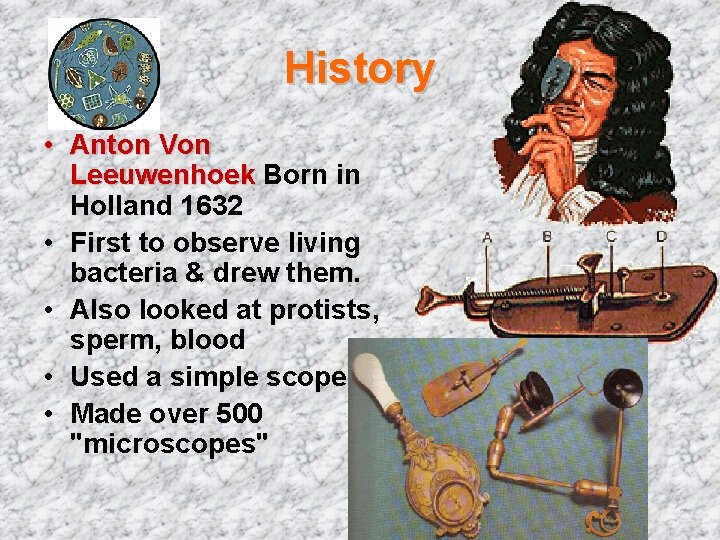
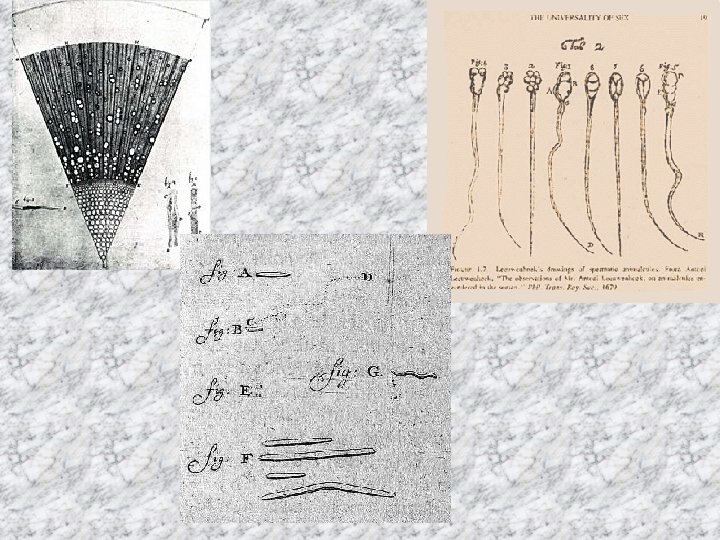
History • Anton Von Leeuwenhoek Born in Holland 1632 • First to observe living bacteria & drew them. • Also looked at protists, sperm, blood • Used a simple scope • Made over 500 "microscopes"
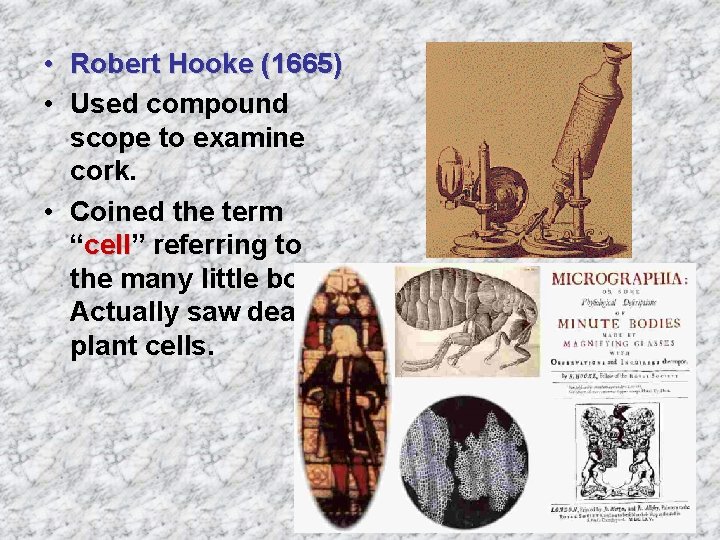
• Robert Hooke (1665) • Used compound scope to examine cork. • Coined the term “cell” cell referring to the many little boxes. Actually saw dead plant cells.
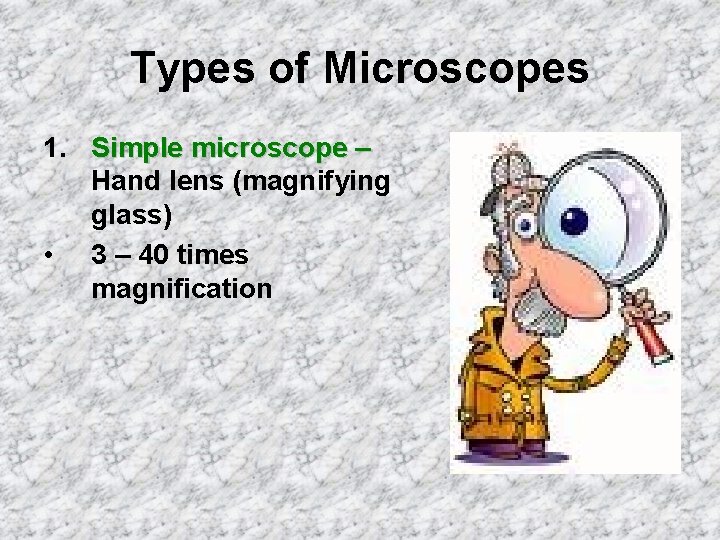
Types of Microscopes 1. Simple microscope – Hand lens (magnifying glass) • 3 – 40 times magnification
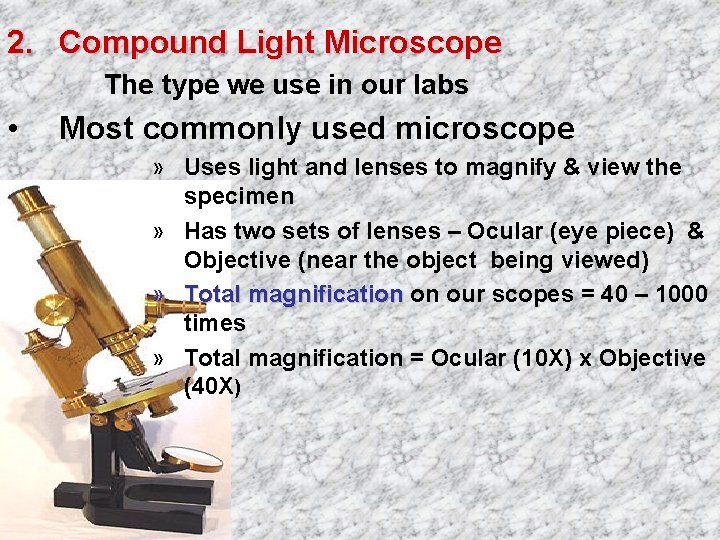
2. Compound Light Microscope The type we use in our labs • Most commonly used microscope » Uses light and lenses to magnify & view the specimen » Has two sets of lenses – Ocular (eye piece) & Objective (near the object being viewed) » Total magnification on our scopes = 40 – 1000 times » Total magnification = Ocular (10 X) x Objective (40 X)
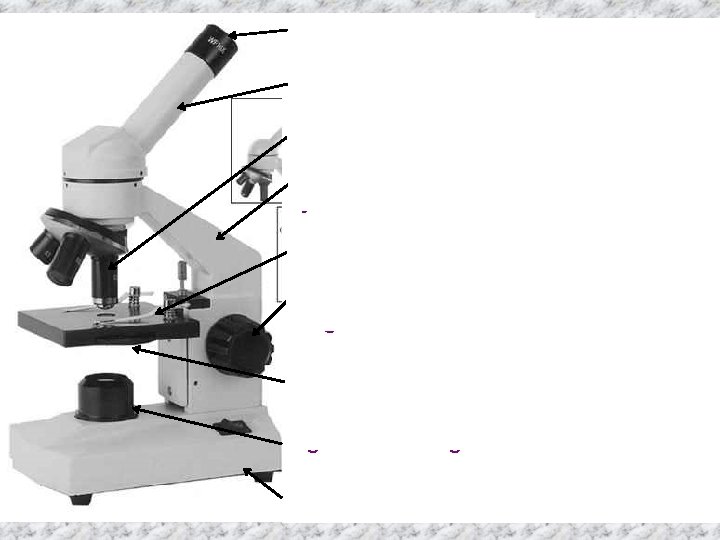
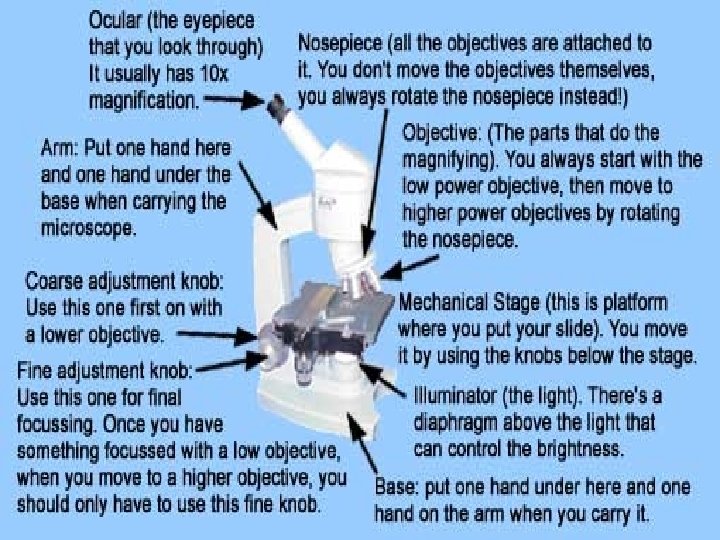
Ocular – Eye piece Neck – Supports the eyepiece. Objectives – 4 – 100 x magnification Arm – Supports neck and objectives. Carry by this Stage and clips – Holds slides in place Adjustments – Coarse & Fine. Focuses image Diaphragm – Controls the amount of light coming through the stage Light – Electric light source Base – Bottom of scope. One hand goes underneath
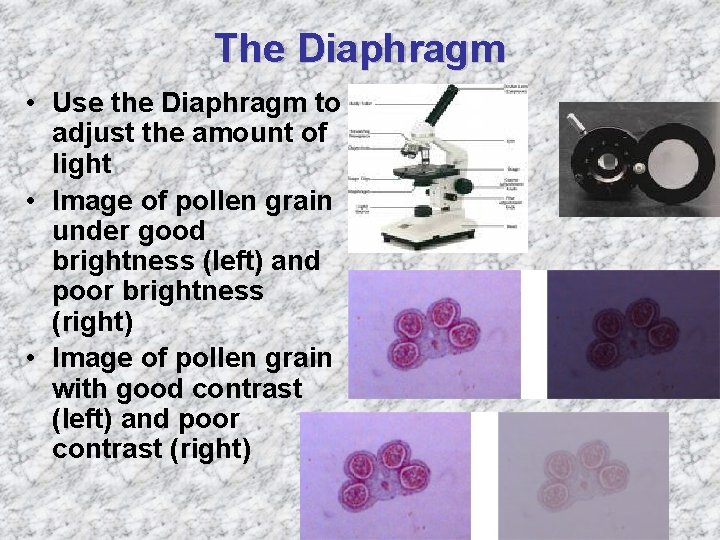
The Diaphragm • Use the Diaphragm to adjust the amount of light • Image of pollen grain under good brightness (left) and poor brightness (right) • Image of pollen grain with good contrast (left) and poor contrast (right)
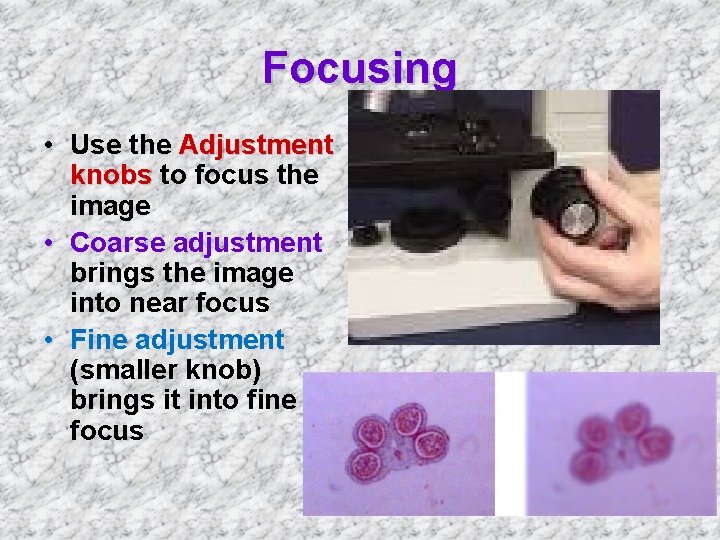
Focusing • Use the Adjustment knobs to focus the image • Coarse adjustment brings the image into near focus • Fine adjustment (smaller knob) brings it into fine focus
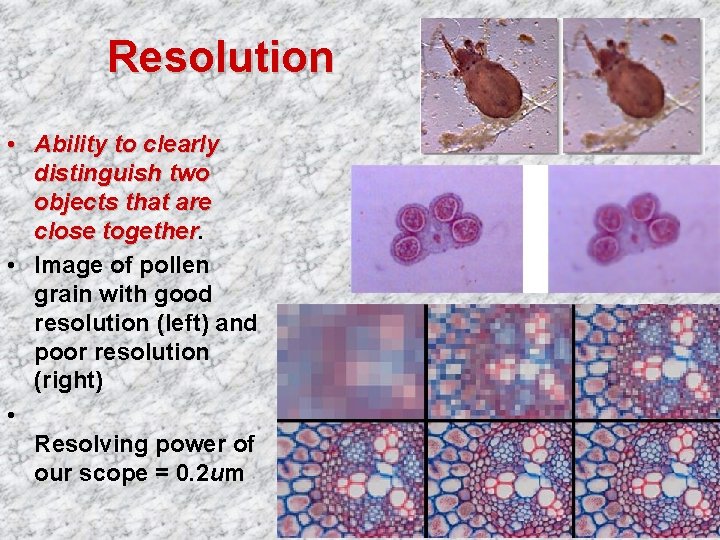
Resolution • Ability to clearly distinguish two objects that are close together • Image of pollen grain with good resolution (left) and poor resolution (right) • Resolving power of our scope = 0. 2 um
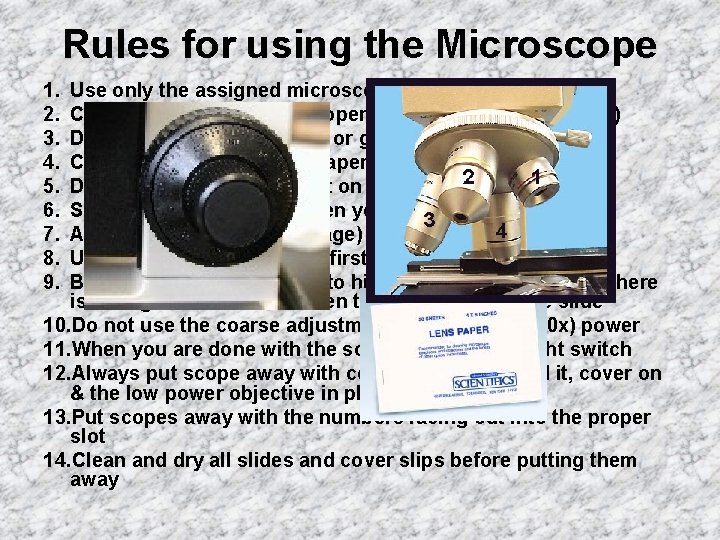
Rules for using the Microscope 1. 2. 3. 4. 5. 6. 7. 8. 9. Use only the assigned microscope Carry & place the scope properly (6 cm from edge of table) Do not let the cords dangle or get into the sinks Clean lens only with lens paper. NO FINGERS! Do not reuse the same spot on your lens paper Start on low (4 x) power when you start your observations Always focus (move the stage) away from the slide Use the coarse adjustment first then the fine adjustment Be careful when switching to high (40 x) power to se that there is enough clearance between the objective and the slide 10. Do not use the coarse adjustment knob on high (40 x) power 11. When you are done with the scope, turn off the light switch 12. Always put scope away with cord wrapped around it, cover on & the low power objective in place 13. Put scopes away with the numbers facing out into the proper slot 14. Clean and dry all slides and cover slips before putting them away
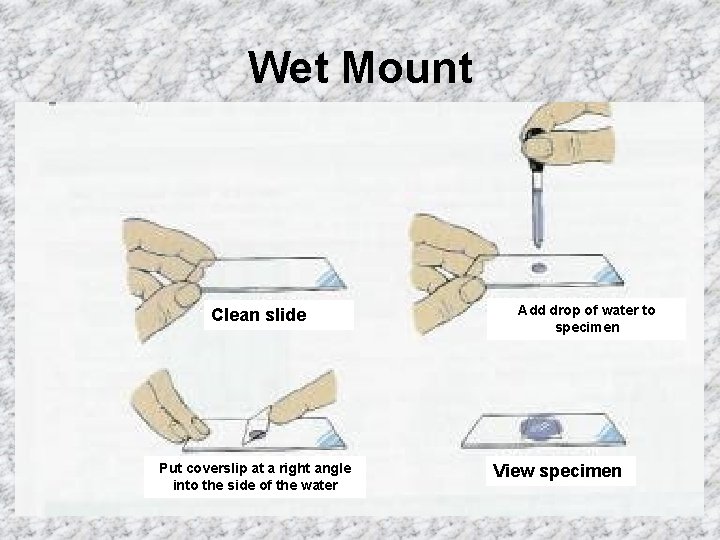
Wet Mount Clean slide Put coverslip at a right angle into the side of the water Add drop of water to specimen View specimen
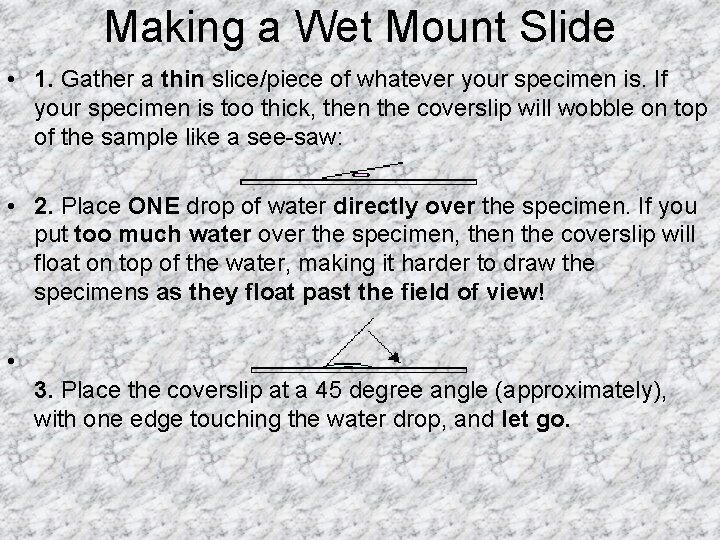
Making a Wet Mount Slide • 1. Gather a thin slice/piece of whatever your specimen is. If your specimen is too thick, then the coverslip will wobble on top of the sample like a see-saw: • 2. Place ONE drop of water directly over the specimen. If you put too much water over the specimen, then the coverslip will float on top of the water, making it harder to draw the specimens as they float past the field of view! • 3. Place the coverslip at a 45 degree angle (approximately), with one edge touching the water drop, and let go.
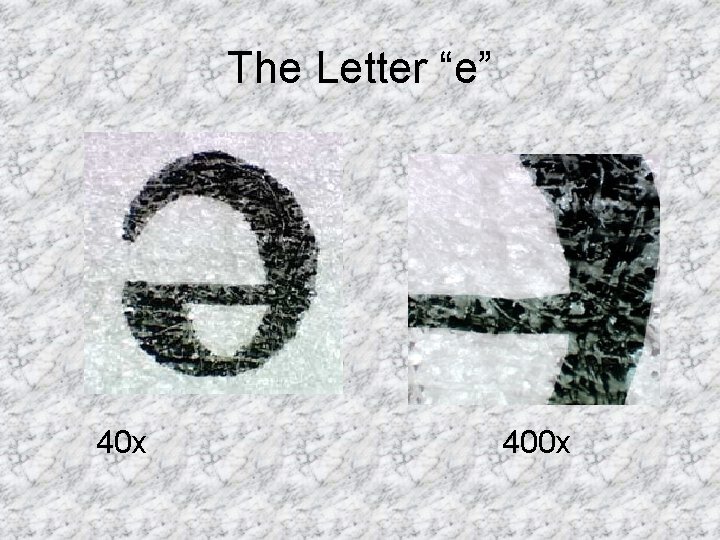
The Letter “e” 40 x 400 x
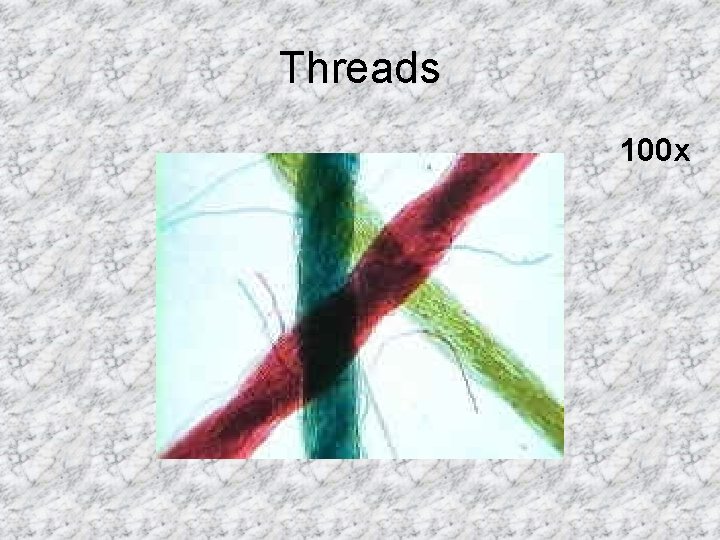
Threads 100 x
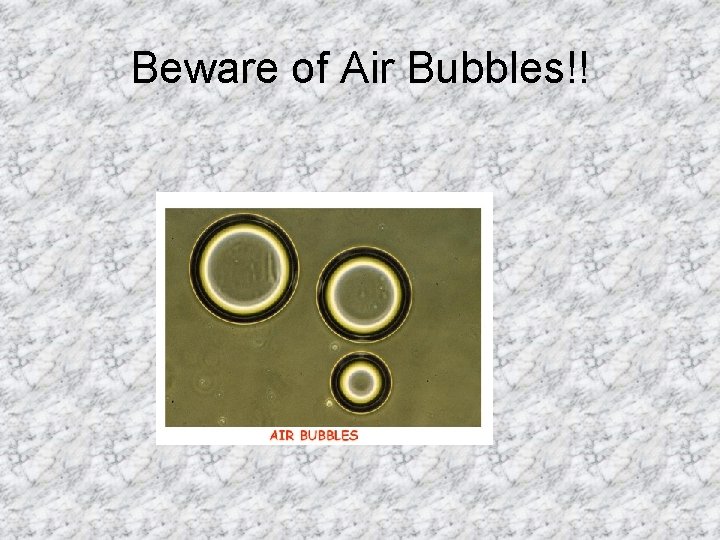
Beware of Air Bubbles!!
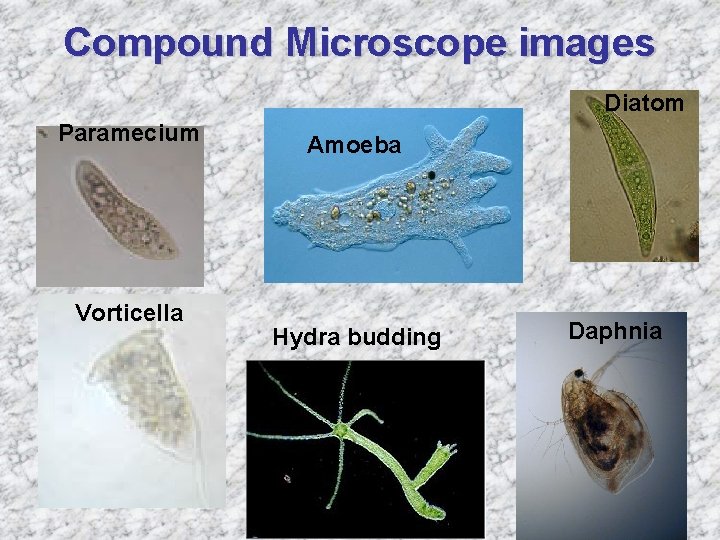
Compound Microscope images Diatom Paramecium Vorticella Amoeba Hydra budding Daphnia
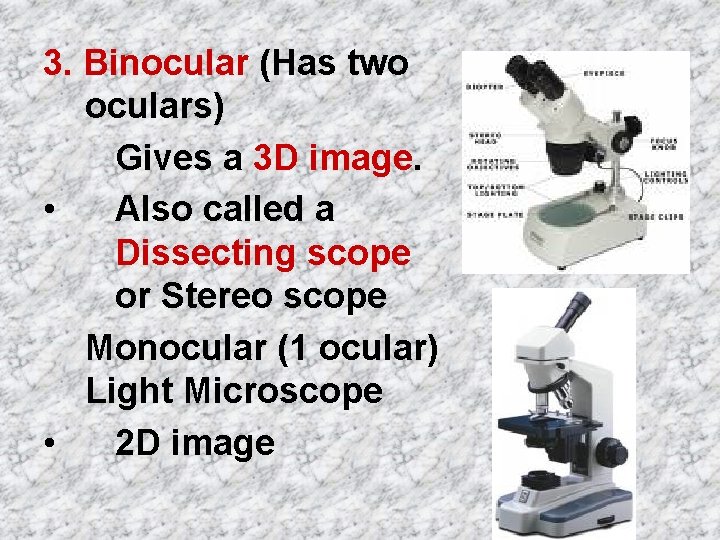
3. Binocular (Has two oculars) Gives a 3 D image. • Also called a Dissecting scope or Stereo scope Monocular (1 ocular) Light Microscope • 2 D image
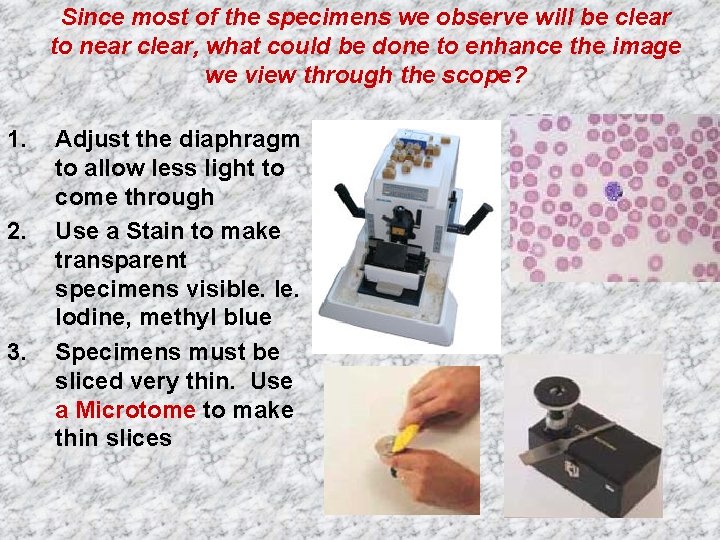
Since most of the specimens we observe will be clear to near clear, what could be done to enhance the image we view through the scope? 1. 2. 3. Adjust the diaphragm to allow less light to come through Use a Stain to make transparent specimens visible. Iodine, methyl blue Specimens must be sliced very thin. Use a Microtome to make thin slices
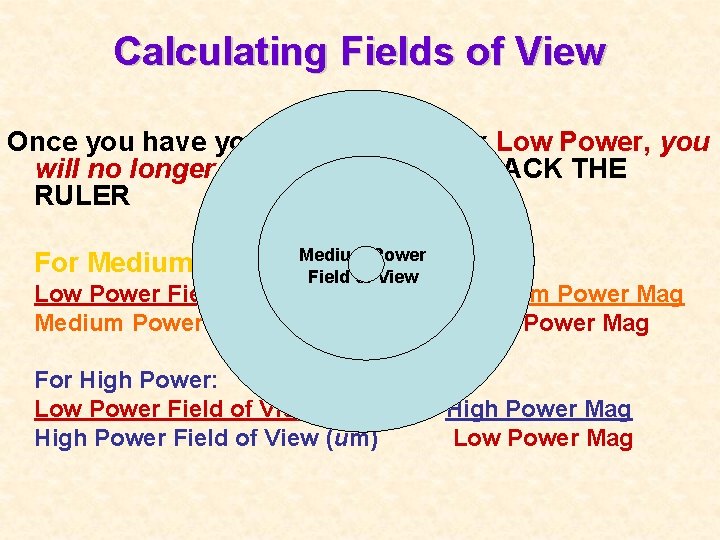
Calculating Fields of View Once you have your field of view for Low Power, you will no longer use the ruler: GIVE BACK THE RULER Medium Power For Medium Power: Low Power Field of View (um) = Medium Power Field of View (um) For High Power: Low Power Field of View (um = High Power Field of View (um) Medium Power Mag Low Power Mag High Power Mag Low Power Mag
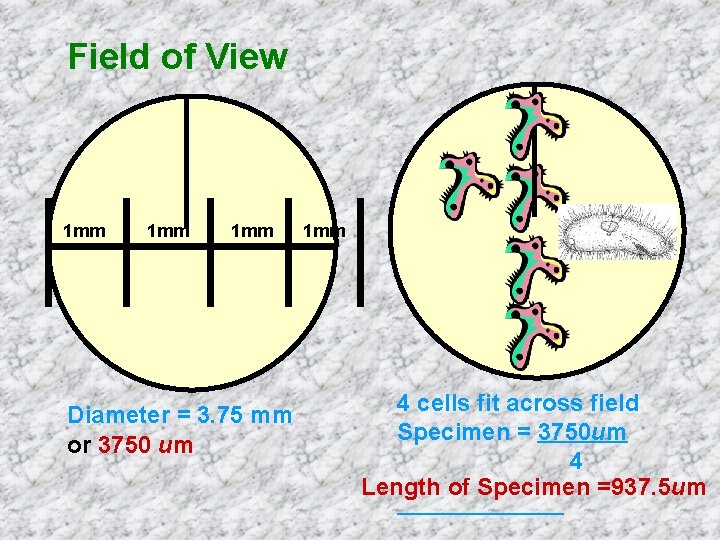
Field of View 1 mm 1 mm Diameter = 3. 75 mm or 3750 um 1 mm 4 cells fit across field Specimen = 3750 um 4 Length of Specimen =937. 5 um
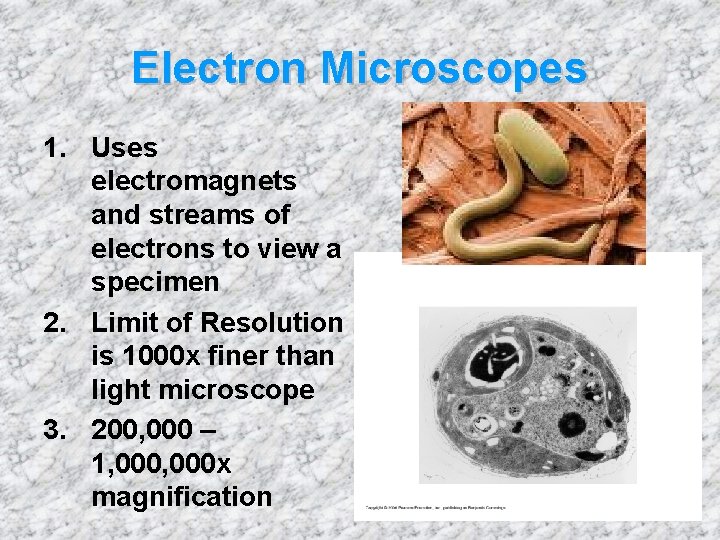
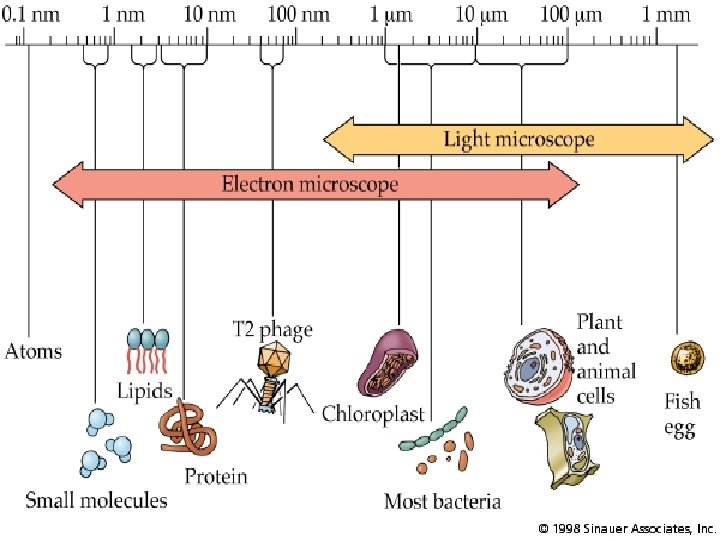
Electron Microscopes 1. Uses electromagnets and streams of electrons to view a specimen 2. Limit of Resolution is 1000 x finer than light microscope 3. 200, 000 – 1, 000 x magnification
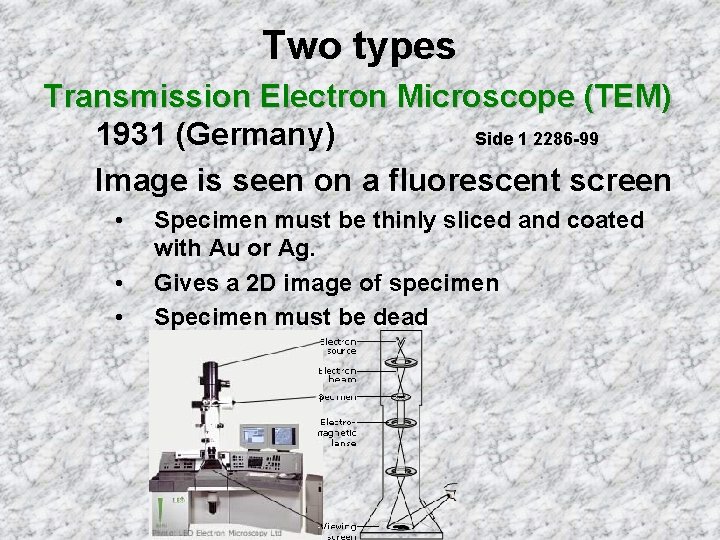
Two types Transmission Electron Microscope (TEM) 1931 (Germany) Side 1 2286 -99 Image is seen on a fluorescent screen • • • Specimen must be thinly sliced and coated with Au or Ag. Gives a 2 D image of specimen Specimen must be dead
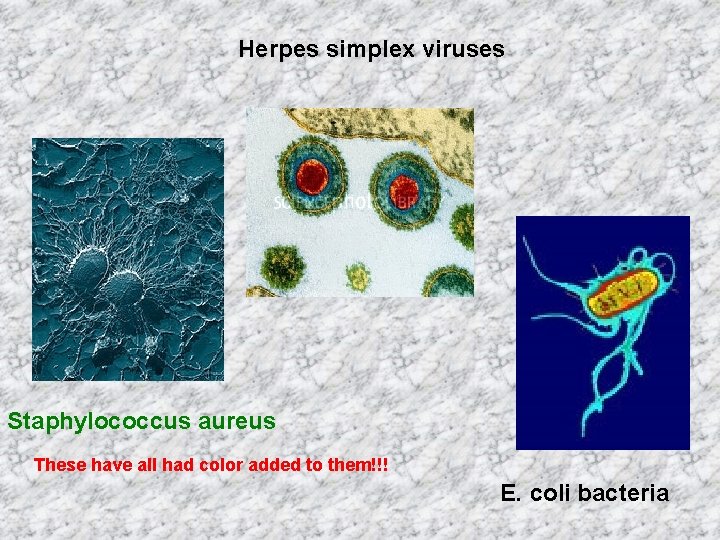
Herpes simplex viruses Staphylococcus aureus These have all had color added to them!!! E. coli bacteria
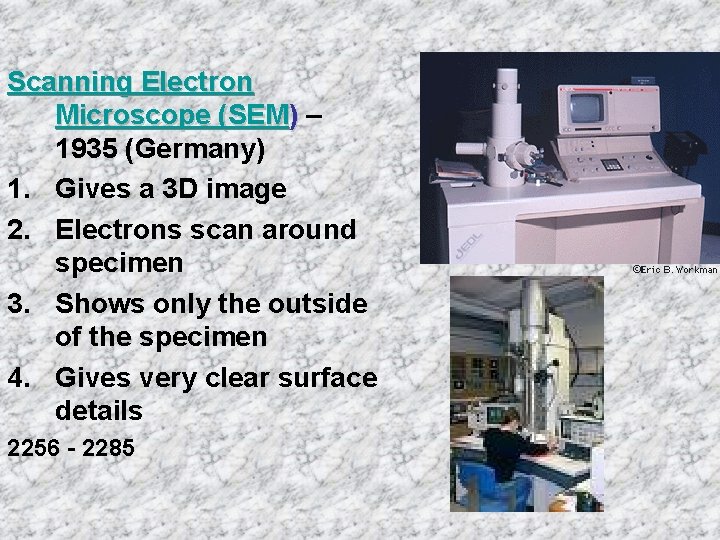
Scanning Electron Microscope (SEM) – 1935 (Germany) 1. Gives a 3 D image 2. Electrons scan around specimen 3. Shows only the outside of the specimen 4. Gives very clear surface details 2256 - 2285
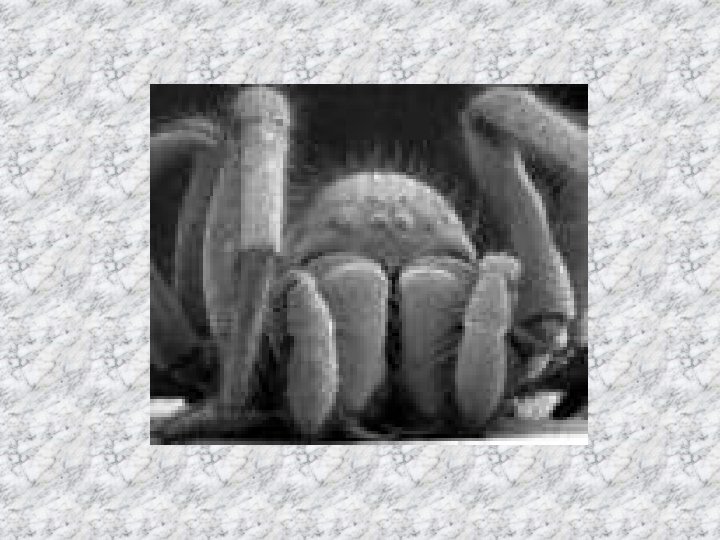
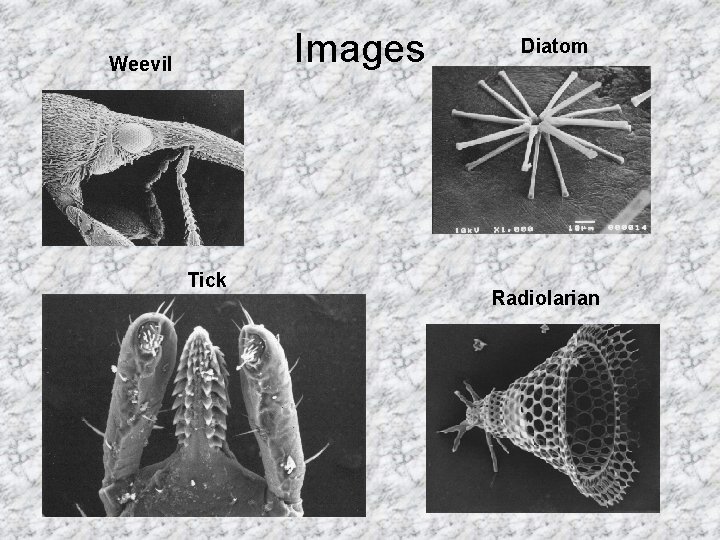
Images Weevil Tick Diatom Radiolarian
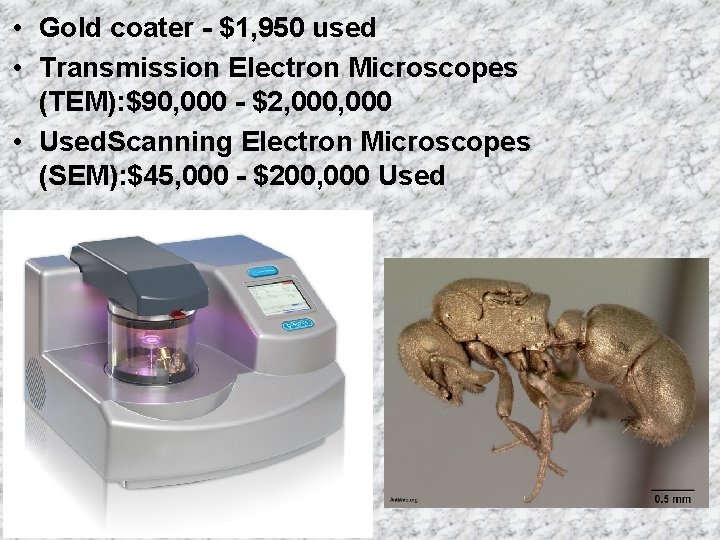
• Gold coater - $1, 950 used • Transmission Electron Microscopes (TEM): $90, 000 - $2, 000 • Used. Scanning Electron Microscopes (SEM): $45, 000 - $200, 000 Used
Limitations of Electron Microscopes 1. Specimens must be very thin (TEM) 2. Specimens must be stained or coated 3. Specimens must be dried out (Mounting chamber is vacuum sealed) 4. Specimens must be dead 5. Black and white images only! Any color you may see is added in
- Slides: 31