
TOOLS OF MONETARY POLICY 1 INTRODUCTION In this







- Slides: 76
TOOLS OF MONETARY POLICY 1
INTRODUCTION • In this lesson we examine the conventional tools of monetary policy that the CB uses to control the money supply and interest rate. 2
INTRODUCTION • The CB’s use of these policy tools has an important effect on interest rates and economic activity. • Therefore, it is vital to understand how CB wields them in practice and how relatively useful each tool is. 3
INTRODUCTION • We begin with the tools of monetary policy. • Then we study a supply and demand analysis of the market for bank reserves to explain how the CB’s setting for the tools of monetary policy influence the interest rate. 4
CONVENTIONAL MONETARY POLICY TOOLS 5
INTRODUCTION • During normal times, the CB uses four conventional monetary policy tools to control the money supply and interest rates. • These are – open market operations (OMO), – discount policy, – reserve requirements, – and the interest paid on reserves. 6
Open Market Operations 7
Open Market Operations • Open market operations (OMO) are the central bank’s purchases or sales of securities in the open market. 8
Open Market Operations • OMO are the most important conventional monetary policy tool, because they are the primary determinants of changes in monetary base, money supply and interest rates. 9
Open Market Operations • Open market purchases expand reserves and monetary base, thereby increasing the money supply and lowering short-term interest rates. • Open market sales decrease monetary base and money supply, and increase the interest rate. 10
Discount Lending 11
Discount Lending • The facility at which the banks can barrow reserves from the CB is called the discount lending. 12
Discount Lending • The discount lending allows commercial bank to borrow money from the CB, usually on a short-term basis, to meet temporary shortages of liquidity. • The interest rate charged on such loans by the CB is called the discount rate. 13
Reserve Requirements 14
Reserve Requirements • Commercial banks have to hold a fraction of their deposits as reserves. • The reserve requirement ratio is determined by CB. • These required reserves are in the form of deposits made with the CB or cash stored physically in the bank vault. 15
Reserve Requirements • In Chapter 7, we have seen how the changes in the required reserve ratio affect bank reserves, monetary base and money supply. 16
Interest on Reserves 17
Interest on Reserves • The CB generally makes an interest payment to commercial banks for their deposits. • The difference between the market interest rate and interest rate on reserves is the opportunity cost of holding excess reserves by commercial banks. 18
Interest on Reserves • Thus, the CB can influence the commercial banks’ willingness for holding excess reserves by changing the interest rate on reserves and therefore the opportunity cost of holding them. 19
Interest on Reserves • As we have already seen, the excess reserve ratio is one of the determinants of money multiplier and money supply. * 20
THE MARKET FOR RESERVES AND THE FUNDS RATE 21
THE MARKET FOR RESERVES AND THE FUNDS RATE • The interest rate charged on loans in the interbank money market is determined in the interbank reserves market by the supply of and demand for reserves. 22
Demand For Reserves 23
Demand For Reserves • Bank reserves have two components: – required reserves – and excess reserves. • Required reserves equal the required reserve ratio times the amount of deposits on which reserves are required. • Excess reserves are the additional reserves banks choose to hold. 24
Demand For Reserves • Therefore, the quantity of reserves demanded by banks = required reserves + the quantity of excess reserves demanded. 25
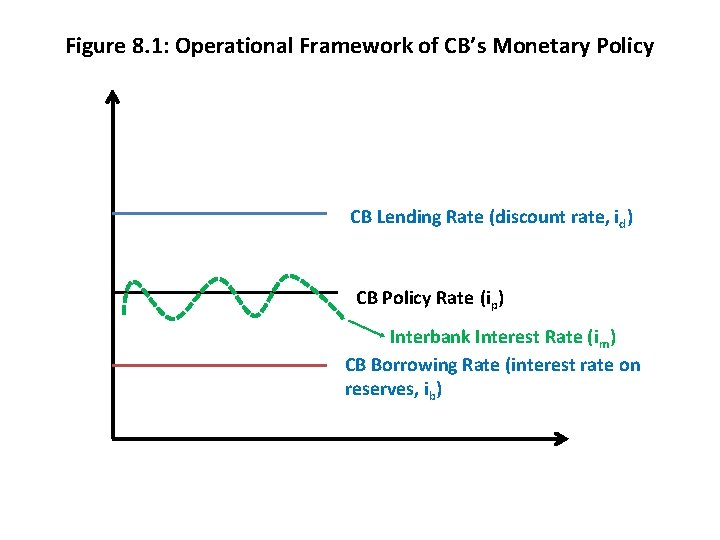
Demand For Reserves • There are three different interest rates in the funds market: – The discount rate (CB lending rate), – interest rate on reserves (CB borrowing rate), – and interbank interest rate* 26
Figure 8. 1: Operational Framework of CB’s Monetary Policy CB Lending Rate (discount rate, id) CB Policy Rate (ip) Interbank Interest Rate (im) CB Borrowing Rate (interest rate on reserves, ib)
Demand For Reserves • The discount rate and interest rate on reserves are decided and implemented by the CB. • Interbank interest rate is determined in the interbank funds market by the supply of and demand for funds. 28
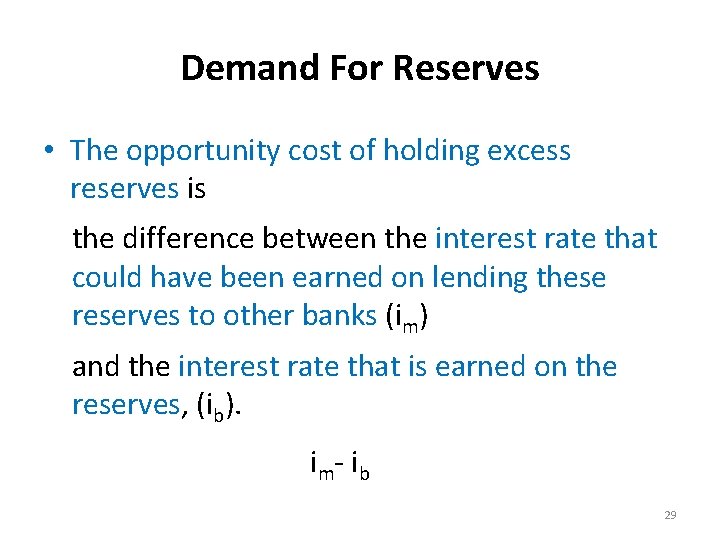
Demand For Reserves • The opportunity cost of holding excess reserves is the difference between the interest rate that could have been earned on lending these reserves to other banks (im) and the interest rate that is earned on the reserves, (ib). im- ib 29
Demand For Reserves • When the interbank interest rate is above the rate paid on reserves (ib), as the interbank rate decreases, the opportunity cost of holding excess reserves falls. • The quantity of reserves demanded rises, ceteris paribus. 30
Demand For Reserves • Consequently, there is a negative relationship between the interbank interest rate and the quantity of fund demanded. • When the interbank interest rate falls the quantity of fund demanded increases. 31
Demand For Reserves • However, if the interbank rate begins to fall below the interest rate paid on reserves (ib), banks would not lend to other banks in the overnight market at a lower interest rate. • Instead, they would just keep on adding to their holdings of excess reserves indefinitely. 32
Demand For Reserves • The result is that the interbank interest rate cannot be lower than the interest rate on reserves. • The CB targets an interest rate for the interbank money market. • This targeted interest rate is called the policy rate(ip). 33
Supply of Reserves 34
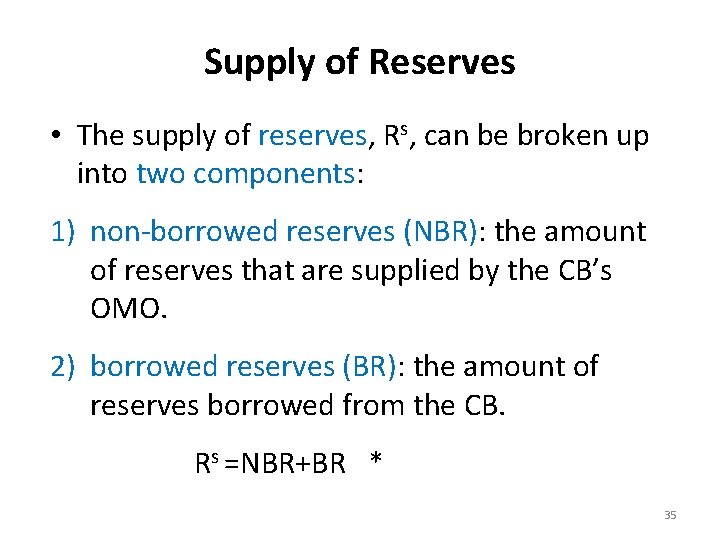
Supply of Reserves • The supply of reserves, Rs, can be broken up into two components: 1) non-borrowed reserves (NBR): the amount of reserves that are supplied by the CB’s OMO. 2) borrowed reserves (BR): the amount of reserves borrowed from the CB. Rs =NBR+BR * 35
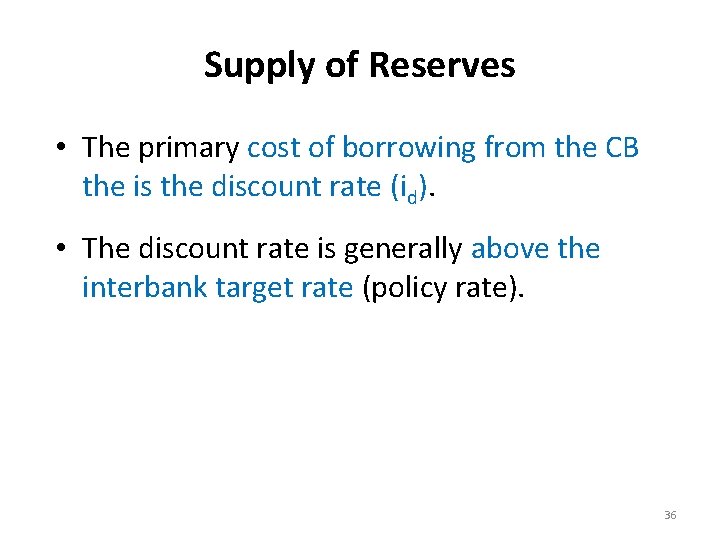
Supply of Reserves • The primary cost of borrowing from the CB the is the discount rate (id). • The discount rate is generally above the interbank target rate (policy rate). 36
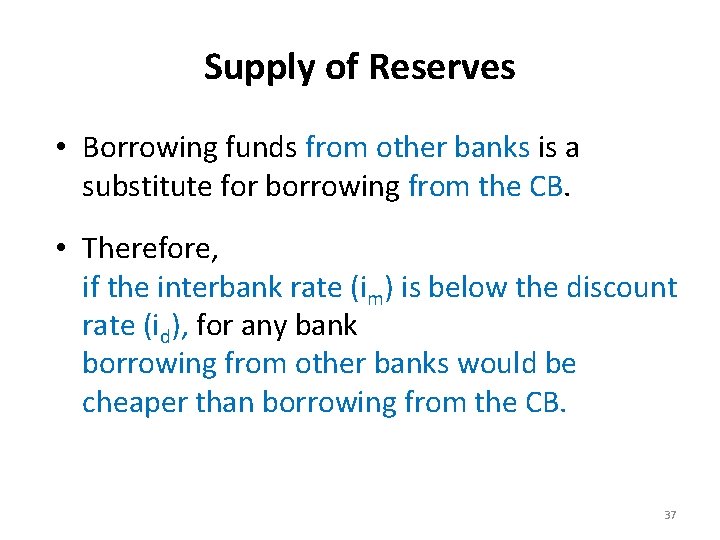
Supply of Reserves • Borrowing funds from other banks is a substitute for borrowing from the CB. • Therefore, if the interbank rate (im) is below the discount rate (id), for any bank borrowing from other banks would be cheaper than borrowing from the CB. 37
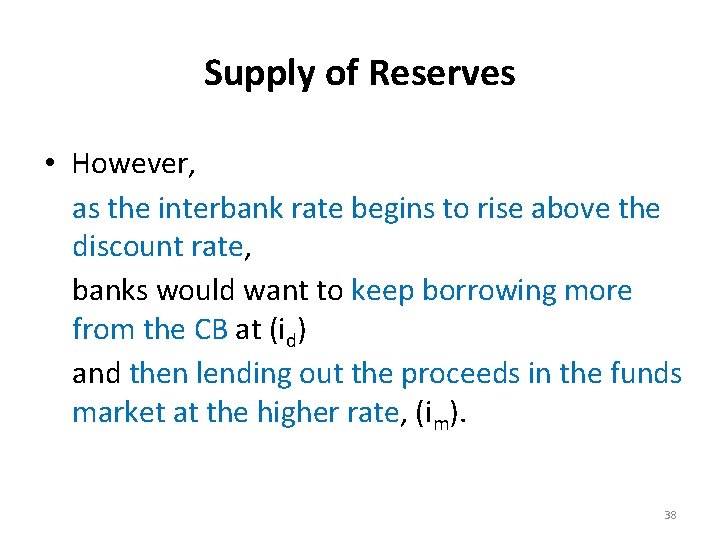
Supply of Reserves • However, as the interbank rate begins to rise above the discount rate, banks would want to keep borrowing more from the CB at (id) and then lending out the proceeds in the funds market at the higher rate, (im). 38
Supply of Reserves • The result is that the interbank interest rate cannot be higher than the discount rate. 39
Supply of Reserves • When the interbank interest rate is lower than the discount rate, banks do not prefer borrowing from the CB, and borrowed reserves are zero. • Therefore, total supply of funds is limited to nonborrowed reserves; that is, reserves provided by the CB through OMO. 40
Market Equilibrium 41
Market Equilibrium • Market equilibrium occurs when the quantity of reserves demanded equals the quantity supplied, Rs = Rd. • When the interbank rate is above the equilibrium rate more reserves are supplied than demanded (excess supply) and so interbank rate falls. 42
Market Equilibrium • When the interbank rate is below the equilibrium rate, more reserves are demanded than supplied (excess demand) and so the interbank rate rises. 43
HOW THE CB CAN AFFECT THE MARKET RATE 44
HOW THE CB CAN AFFECT THE MARKET RATE • The CB can influence the market for reserves and the equilibrium interest rate by using the monetary policy tools. 45
Open Market Operations 46
Open Market Operations • The OMO of the CB change non-borrowed reserves (NBR), and therefore, the supply of funds. • The effect of an OMO on the interbank interest rate depends on whether this rate is higher than or equal to the interest rate paid on reserves. 47
Open Market Operations • Normally, the interbank interest rate is higher than the interest rate paid on reserves, and an increase in money supply (NBR) by open market purchase will lower the interbank interest rate. 48
Open Market Operations • On the other hand, an open market sale decreases the quantity of reserves supplied (NBR), and causes the interbank rate to rise. • The conclusion is: An open market purchase causes the interbank rate to fall, whereas an open market sale causes it to rise. 49
Discount Lending 50
Discount Lending • Changes in discount rate affect the borrowed reserves (BR), and therefore, the supply of funds. • The effect of a discount rate change depends on whether the interbank interest rate is lower than discount rate. 51
Discount Lending • When the interbank interest rate is lower than the discount rate, if the CB lowers the discount rate, no change occurs in the equilibrium interbank rate, unless the reduction in discount rate is higher than the difference between discount rate and interbank rate. 52
Discount Lending • The reason is that, when the interbank interest rate is lower than the discount rate, borrowed reserves will be zero and the reduction in discount rate will have no effect on the funds supply. 53
Discount Lending • Since the CB usually keeps the discount rate above its target for the interbank rate this is the typical situation. • The conclusion is: Most changes in the discount rate have no effect on the interbank interest rate. 54
Reserve Requirements 55
Reserve Requirements • When the required reserve ratio is increased by the CB, required reserves increase and the demand for reserves rises at any given interest rate, and interbank interest rate rises. 56
Reserve Requirements • Similarly, when the CB lowers the required reserve ratio, the quantity of reserves demanded falls, and the interbank interest rate falls. 57
Interest on Reserves 58
Interest on Reserves • In the usual case, where the interbank interest rate is higher than the interest rate on reserves, when the interest rate on reserves is raised the interbank rate does not change, unless the rise in the interest paid on reserves is higher than the difference between the two rates. 59
Interest on Reserves • However, if the interbank rate is at the interest rate paid on reserves, a rise in the interest rate on reserves will raise the interbank rate. 60
Relative Advantages of the Different Tools 61
Relative Advantages of the Different Tools • OMO are the most important conventional monetary policy tool because they have four basic advantages over the other tools: 62
Relative Advantages of the Different Tools 1) The CB has complete control over the volume of OMO. 63
Relative Advantages of the Different Tools 2)OMO are flexible and precise: they can be used to any extent. No matter how small a change in reserves or monetary base is desired, OMO can achieve it with a small purchase or sale of securities. Conversely, if the desired change in reserves or the monetary base is very large, the OMO tool is strong enough to do the job through a very large purchase or sale of securities. 64
Relative Advantages of the Different Tools 3)OMO are easily reversed. If a mistake is made in conducting an OMO, the CB can immediately reverse it. 65
Relative Advantages of the Different Tools 4)OMO can be implemented quickly; they involve no administrative delays. Changes to reserve requirements, on the other hand, take time to implement because banks must be given advance warning so they can adjust their computer system to calculate required reserves. 66
Relative Advantages of the Different Tools Also, since it is costly to adjust computer systems, reversing a change in reserve requirements would be burdensome to banks. 67
Relative Advantages of the Different Tools • There are two situations in which the other tools have advantages over OMO. 68
Relative Advantages of the Different Tools • One is when the CB wants to raise interest rates after banks have accumulated large amount of excess reserves. • In this case, the market rate can be raised by increasing the interest rates on reserves, which avoids the need to conduct massive OMO to raise the market rate by reducing reserves. 69
Relative Advantages of the Different Tools • The second is when discount policy can be used by the CB to perform its role of the lender of last resort. 70
How the CB Limits Fluctuations in The Interbank Rate? 71
The CB Limits Fluctuations in The Interbank Rate • The CB limits fluctuations in the interbank interest rate by the discount lending and paying interest on reserves. • We can use our supply and demand analysis of the market for reserves to see why. 72
The CB Limits Fluctuations in The Interbank • Suppose that initially the interbank interest rate is between the interest rate paid on reserves and the discount rate. • If the demand for reserves has a large unexpected increase, this will push the interbank interest rate up until it will be equal to discount rate. 73
The CB Limits Fluctuations in The Interbank • No matter how big the increase in the demand is, the interbank interest rate will stay at this level because banks will increase their borrowing from the CB to match the increase in demand. 74
The CB Limits Fluctuations in The Interbank • Similarly, if the demand for reserves has a large unexpected decrease, this will push the interbank interest rate down until it will become equal to the interest rate paid on reserves. 75
The CB Limits Fluctuations in The Interbank • No matter how big the fall in demand is, the interbank rate will stay at this rate, because excess reserves will keep on increasing so that the quantity demanded of reserves equals the quantity of reserves supplied. 76