
TOOLS FOR PUBLIC CLOUDS PRIVATE CLOUDS ENTERPRISE NETWORKS
TOOLS FOR PUBLIC CLOUDS, PRIVATE CLOUDS, ENTERPRISE NETWORKS, ISPs, . . . NETWORK VERIFICATION: WHEN CLARKE MEETS CERF George Varghese UCLA (with collaborators from CMU, MSR, Stanford, UCLA) 1
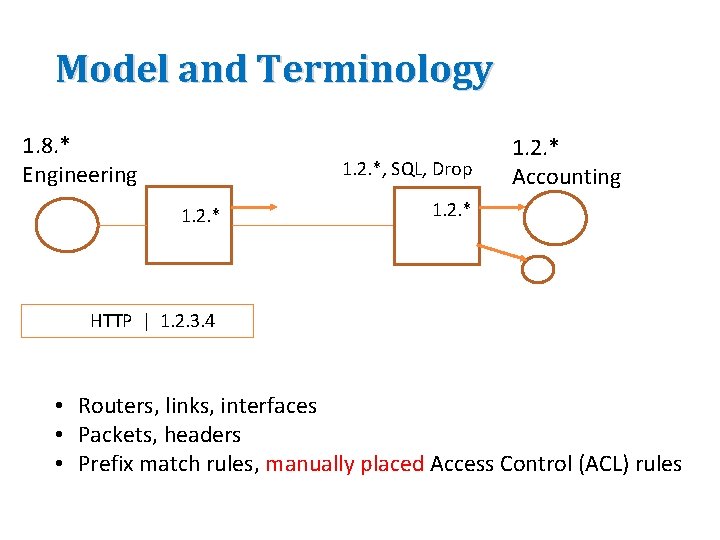
Model and Terminology 1. 8. * Engineering 1. 2. *, SQL, Drop 1. 2. * Accounting 1. 2. * 1. HTTP | 1. 2. 3. 4 • Routers, links, interfaces • Packets, headers • Prefix match rules, manually placed Access Control (ACL) rules
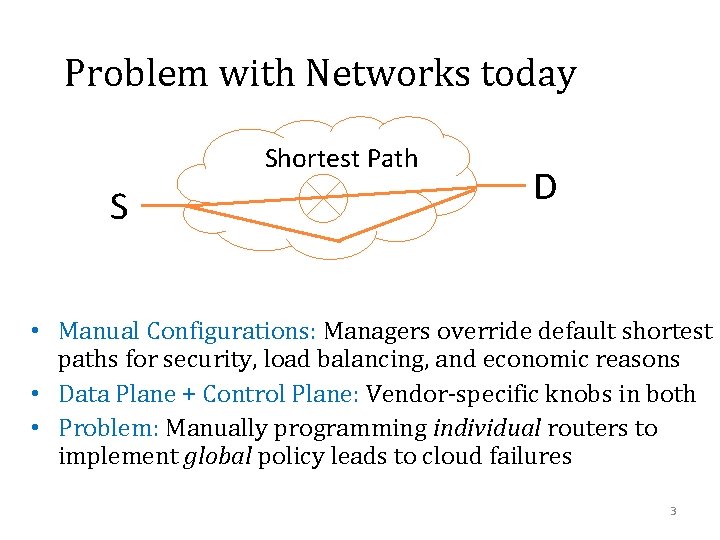
Problem with Networks today Shortest Path S D • Manual Configurations: Managers override default shortest paths for security, load balancing, and economic reasons • Data Plane + Control Plane: Vendor-specific knobs in both • Problem: Manually programming individual routers to implement global policy leads to cloud failures 3
Manual Traffic “steering knobs” • Data forwarding/Data Plane: o Access Control Lists (predicates on headers) VLANs (a way to virtualize networks) o MAC Bridging Rules (ACLs at the Ethernet Level) o • Routing/ Control Plane: o o o Communities: equivalence classes on routes via a tag Static routes: a manager supplied route Local preference: “priority” of a route at this router regardless of global cost of the route Managers use all these knobs for isolation, economics 4
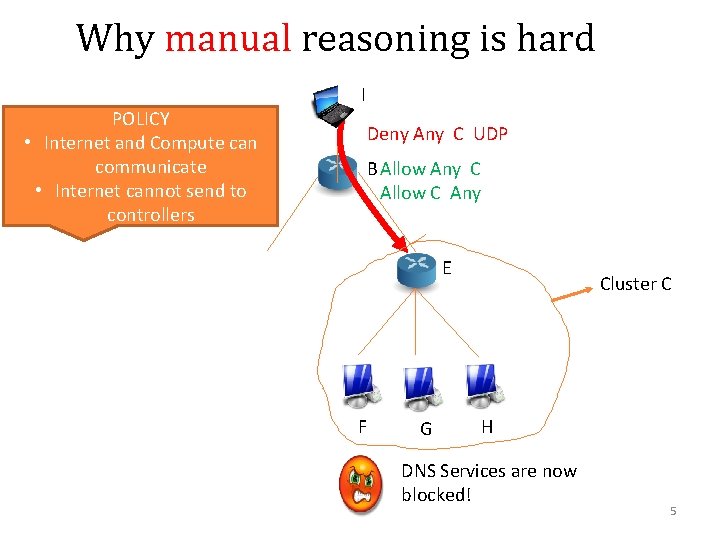
Why manual reasoning is hard POLICY • Internet and Compute can communicate • Internet cannot send to controllers I Deny Any C UDP B Allow Any C Allow C Any E F G Cluster C H DNS Services are now blocked! 5
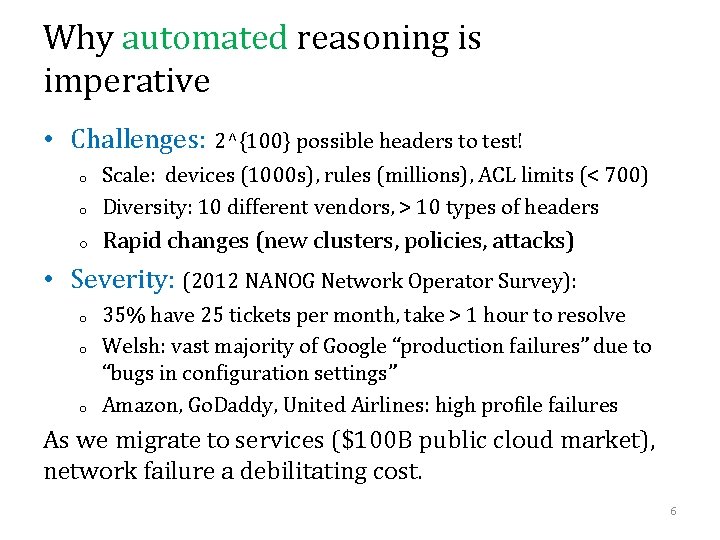
Why automated reasoning is imperative • Challenges: 2^{100} possible headers to test! o Scale: devices (1000 s), rules (millions), ACL limits (< 700) Diversity: 10 different vendors, > 10 types of headers o Rapid changes (new clusters, policies, attacks) o • Severity: (2012 NANOG Network Operator Survey): o o o 35% have 25 tickets per month, take > 1 hour to resolve Welsh: vast majority of Google “production failures” due to “bugs in configuration settings” Amazon, Go. Daddy, United Airlines: high profile failures As we migrate to services ($100 B public cloud market), network failure a debilitating cost. 6
Simple questions hard to answer today o o Which packets from A can reach B? Is Group X provably isolated from Group Y? Is the network causing poor performance or the server? Why is my backbone utilization poor? NEED BOTTOM UP ANALYSIS OF EXISTING SYSTEMS 7
Formal methods have been used to verify (check all cases) large programs and chips (FMCAD!) Can we use formal methods across all headers, & inputs for large clouds? 8
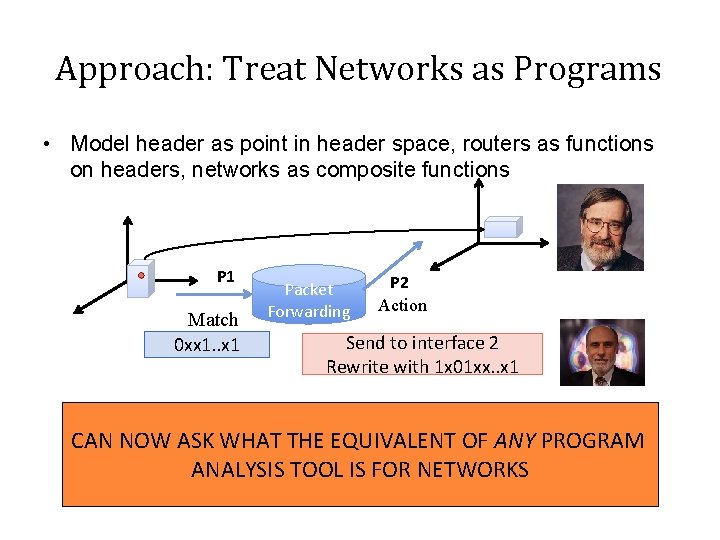
Approach: Treat Networks as Programs • Model header as point in header space, routers as functions on headers, networks as composite functions P 1 Match 0 xx 1. . x 1 Packet Forwarding P 2 Action Send to interface 2 Rewrite with 1 x 01 xx. . x 1 CAN NOW ASK WHAT THE EQUIVALENT OF ANY PROGRAM ANALYSIS TOOL IS FOR NETWORKS 9
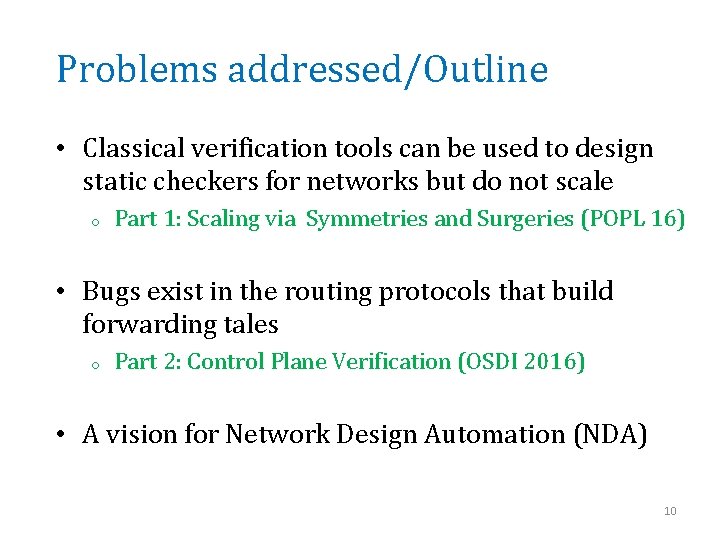
Problems addressed/Outline • Classical verification tools can be used to design static checkers for networks but do not scale o Part 1: Scaling via Symmetries and Surgeries (POPL 16) • Bugs exist in the routing protocols that build forwarding tales o Part 2: Control Plane Verification (OSDI 2016) • A vision for Network Design Automation (NDA) 10
Scaling Network Verification Control Plane Verification Scaling Network Verification (Plotkin, Bjorner, Lopes, Rybalchenko, Varghese, POPL 2016) - exploiting regularities in networks - symmetries and surgeries 11
![Formal Network Model [HSA 12] • 1 - Model sets of packets based on](http://slidetodoc.com/presentation_image/6a3050dcd4c9b8a73125bf422b23b44b/image-12.jpg "Formal Network Model [HSA 12] • 1 - Model sets of packets based on")
Formal Network Model [HSA 12] • 1 - Model sets of packets based on relevant header bits, as subsets of a {0, 1, *}L space – the Header Space • 2 – Define union, intersection on Header Spaces • 3 – Abstract networking boxes (Cisco routers, Juniper Firewalls) as transfer functions on sets of headers • 4– Compute packets that can reach across a path as composition of Transfer Functions of routers on path • 5. Find all packets that reach between every pair of nodes and check against reachability specification All Network boxes modelled as a Transfer Function: 12
![Computing Reachability [HSA 12] All Packets that A can possibly send to box 2](http://slidetodoc.com/presentation_image/6a3050dcd4c9b8a73125bf422b23b44b/image-13.jpg "Computing Reachability [HSA 12] All Packets that A can possibly send to box 2")
Computing Reachability [HSA 12] All Packets that A can possibly send to box 2 through box 1 A Box 1 Box 2 T 2(T 1(X, A)) T 1(X, A) T 4(T 1(X, A)) All Packets that A can possibly send to box 4 through box 1 Box 4 Box 3 B T 3(T 2(T 1(X, A)) U T 3(T 4(T 1(X, A)) COMPLEXITY DEPENDS ON HEADERS, PATHS, NUMBER OF RULES 13
Unfortunately, in practice. . . • Header space equivalencing: 1 query in < 1 sec. Major improvement over standard verification tools like SAT solvers and model checkers • But our data centers: 100, 000 hosts, 1 million rules, 1000 s of routers, 100 bits of header • So N^2 pairs takes 5 days to verify all specs. 14
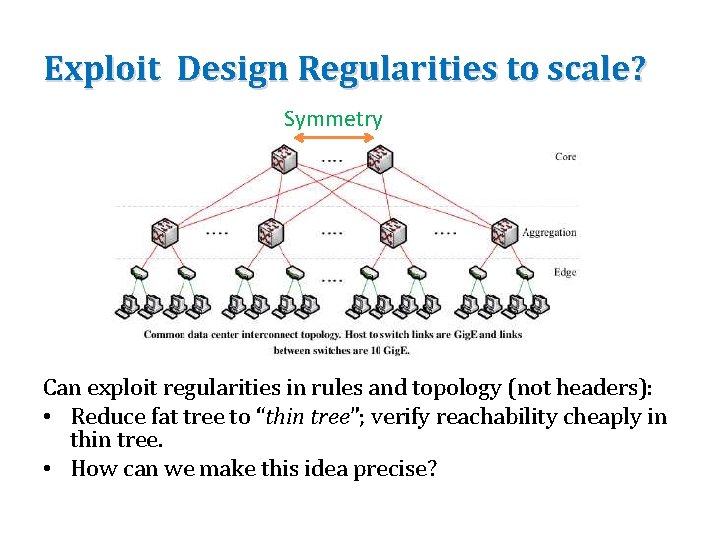
Exploit Design Regularities to scale? Symmetry Can exploit regularities in rules and topology (not headers): • Reduce fat tree to “thin tree”; verify reachability cheaply in thin tree. • How can we make this idea precise?
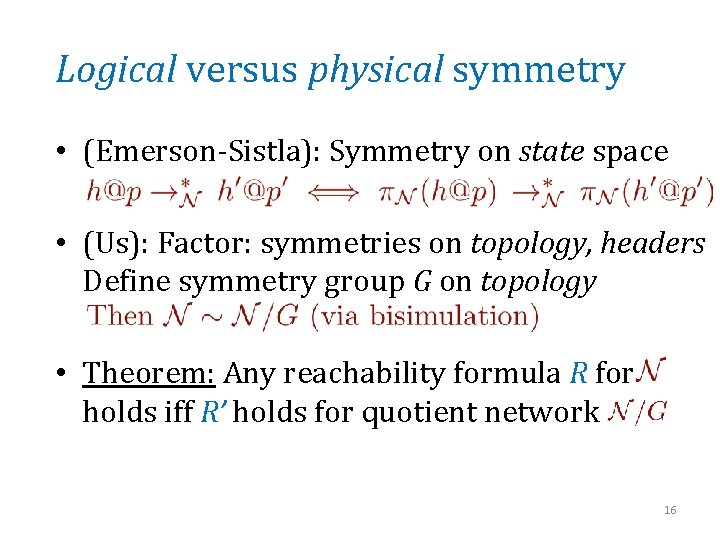
Logical versus physical symmetry • (Emerson-Sistla): Symmetry on state space • (Us): Factor: symmetries on topology, headers Define symmetry group G on topology • Theorem: Any reachability formula R for holds iff R’ holds for quotient network 16
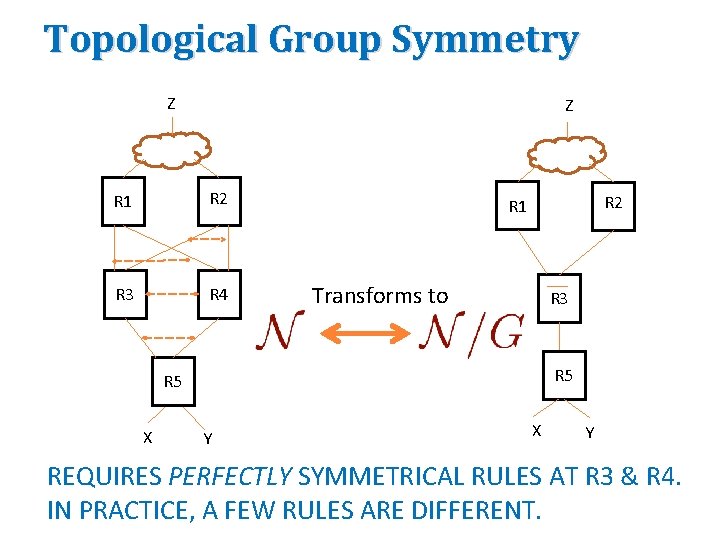
Topological Group Symmetry Z Z R 1 R 2 R 3 R 4 R 2 R 1 Transforms to R 3 R 5 X Y REQUIRES PERFECTLY SYMMETRICAL RULES AT R 3 & R 4. IN PRACTICE, A FEW RULES ARE DIFFERENT.
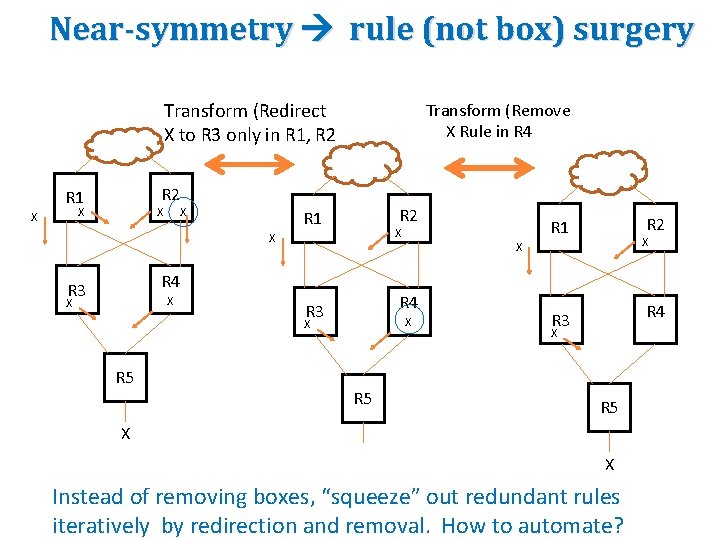
Near-symmetry rule (not box) surgery Transform (Redirect X to R 3 only in R 1, R 2 Transform (Remove X Rule in R 4 R 2 R 1 X X X R 4 R 3 X X R 5 X X R 4 R 3 R 2 R 1 X R 4 R 3 X R 5 X X Instead of removing boxes, “squeeze” out redundant rules iteratively by redirection and removal. How to automate?
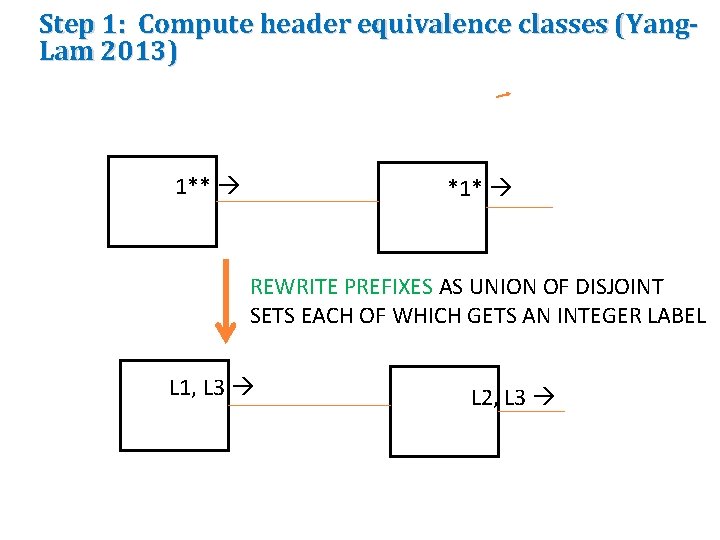
Step 1: Compute header equivalence classes (Yang. Lam 2013) 1** *1* REWRITE PREFIXES AS UNION OF DISJOINT SETS EACH OF WHICH GETS AN INTEGER LABEL L 1, L 3 L 2, L 3
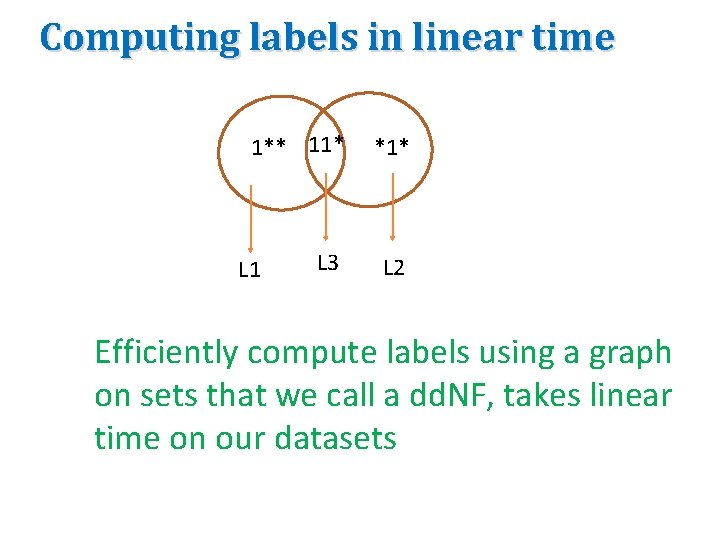
Computing labels in linear time 1** 11* *1* L 3 L 2 L 1 Efficiently compute labels using a graph on sets that we call a dd. NF, takes linear time on our datasets
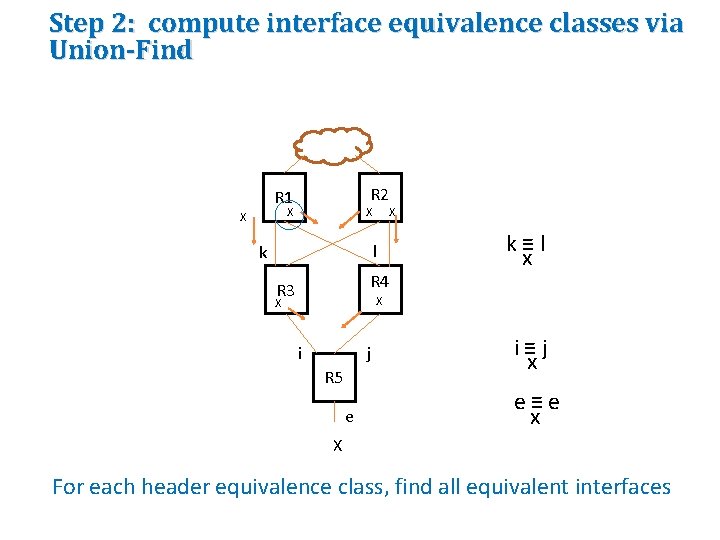
Step 2: compute interface equivalence classes via Union-Find R 2 R 1 X X X l k R 4 R 3 k ≡ l x X X i j R 5 e i ≡ j x e ≡ e x X For each header equivalence class, find all equivalent interfaces
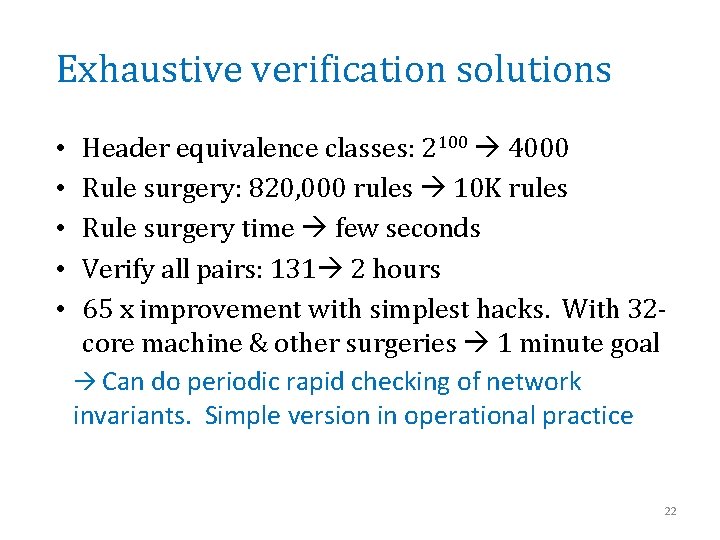
Exhaustive verification solutions • • • Header equivalence classes: 2100 4000 Rule surgery: 820, 000 rules 10 K rules Rule surgery time few seconds Verify all pairs: 131 2 hours 65 x improvement with simplest hacks. With 32 core machine & other surgeries 1 minute goal Can do periodic rapid checking of network invariants. Simple version in operational practice 22
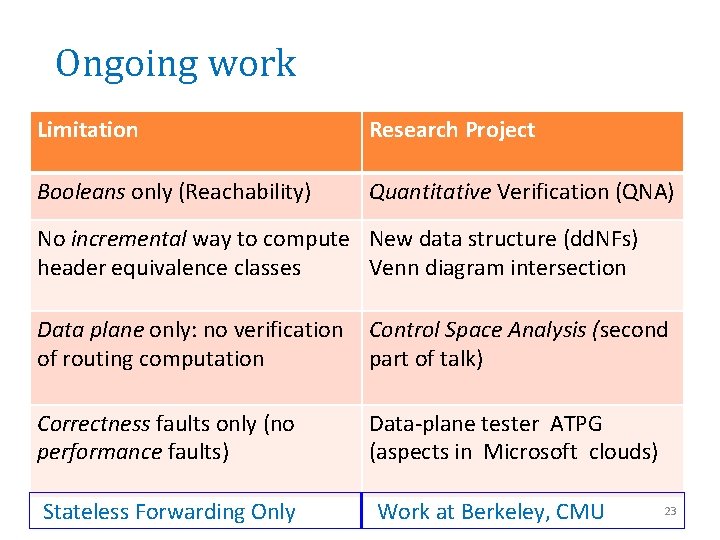
Ongoing work Limitation Research Project Booleans only (Reachability) Quantitative Verification (QNA) No incremental way to compute New data structure (dd. NFs) header equivalence classes Venn diagram intersection Data plane only: no verification Control Space Analysis (second of routing computation part of talk) Correctness faults only (no performance faults) Data-plane tester ATPG (aspects in Microsoft clouds) Stateless Forwarding Only Work at Berkeley, CMU 23
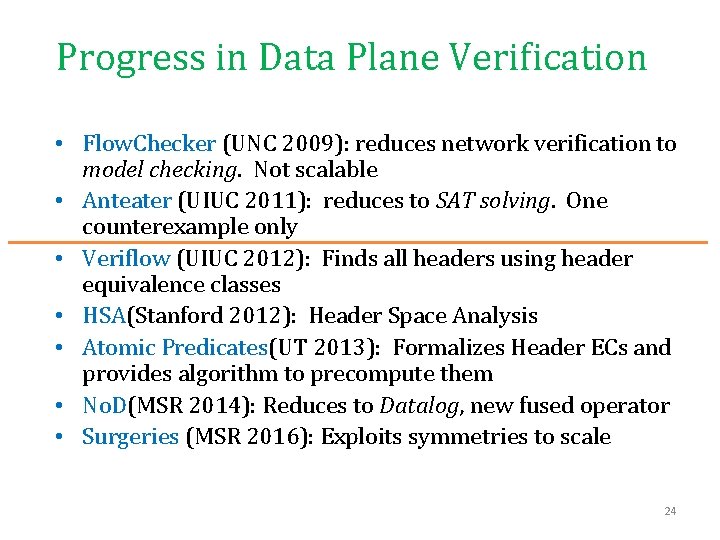
Progress in Data Plane Verification • Flow. Checker (UNC 2009): reduces network verification to model checking. Not scalable • Anteater (UIUC 2011): reduces to SAT solving. One counterexample only • Veriflow (UIUC 2012): Finds all headers using header equivalence classes • HSA(Stanford 2012): Header Space Analysis • Atomic Predicates(UT 2013): Formalizes Header ECs and provides algorithm to precompute them • No. D(MSR 2014): Reduces to Datalog, new fused operator • Surgeries (MSR 2016): Exploits symmetries to scale 24
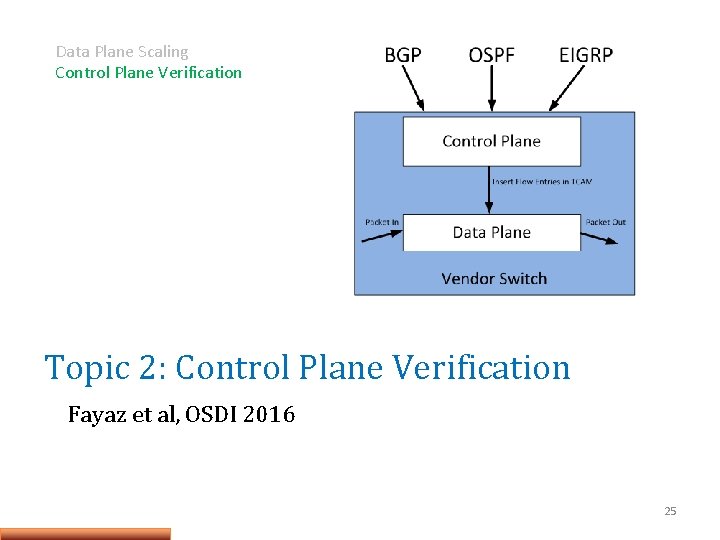
Data Plane Scaling Control Plane Verification Topic 2: Control Plane Verification Fayaz et al, OSDI 2016 25
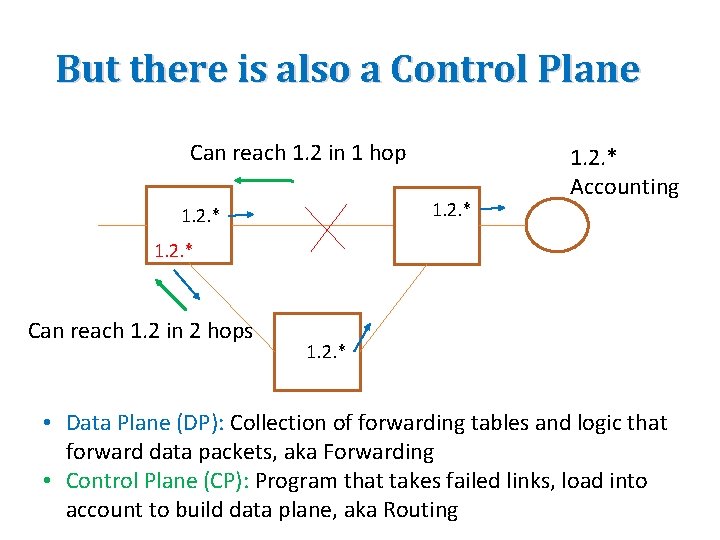
But there is also a Control Plane Can reach 1. 2 in 1 hop 1. 2. * Accounting 1. 2. * Can reach 1. 2 in 2 hops 1. 2. * • Data Plane (DP): Collection of forwarding tables and logic that forward data packets, aka Forwarding • Control Plane (CP): Program that takes failed links, load into account to build data plane, aka Routing
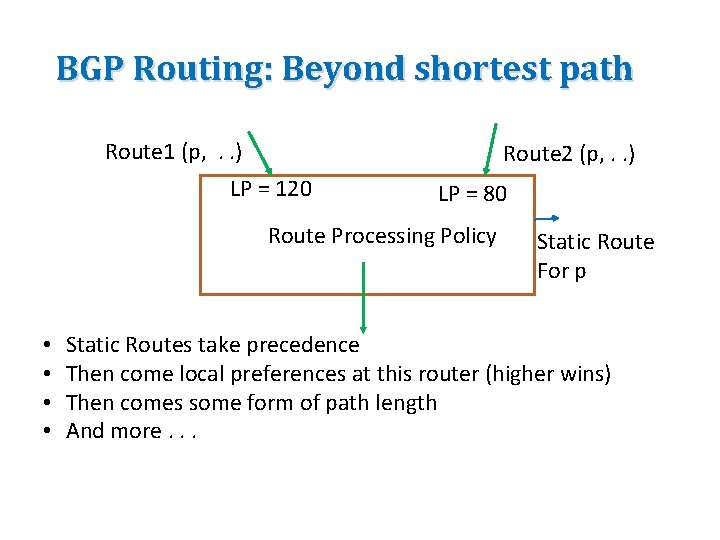
BGP Routing: Beyond shortest path Route 1 (p, . . ) Route 2 (p, . . ) LP = 120 LP = 80 Route Processing Policy • • Static Route For p Static Routes take precedence Then come local preferences at this router (higher wins) Then comes some form of path length And more. . .
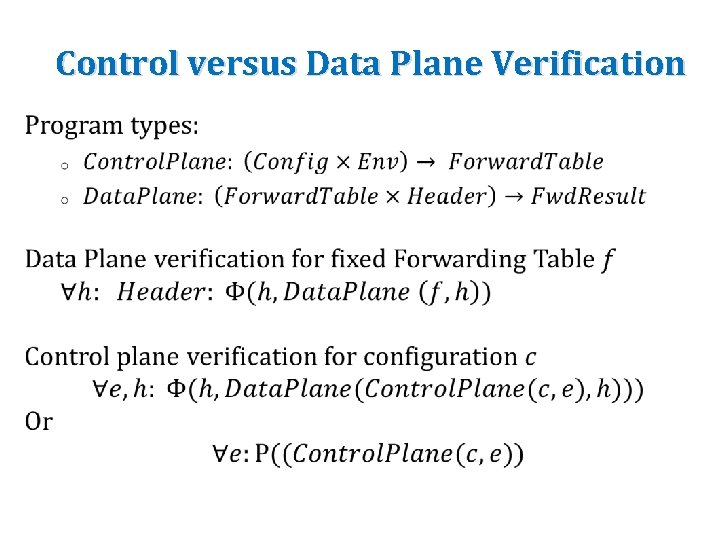
Control versus Data Plane Verification •
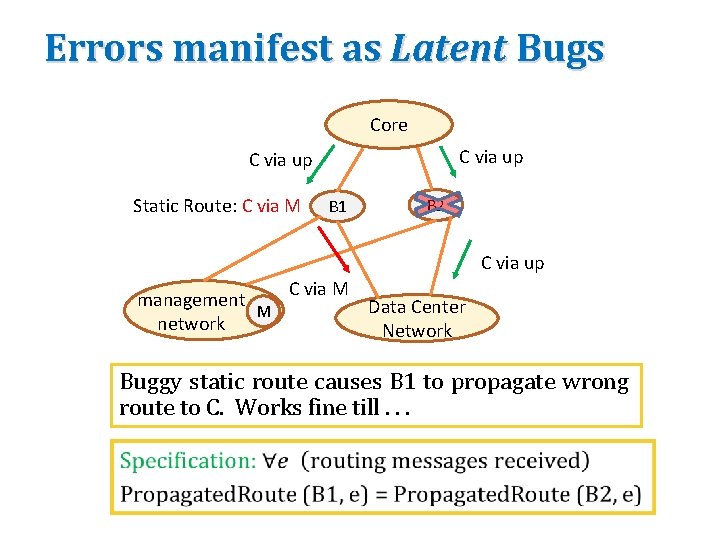
Errors manifest as Latent Bugs Core C via up Static Route: C via M B 1 B 2 C via up management M network C via M Data Center Network Buggy static route causes B 1 to propagate wrong route to C. Works fine till. . .
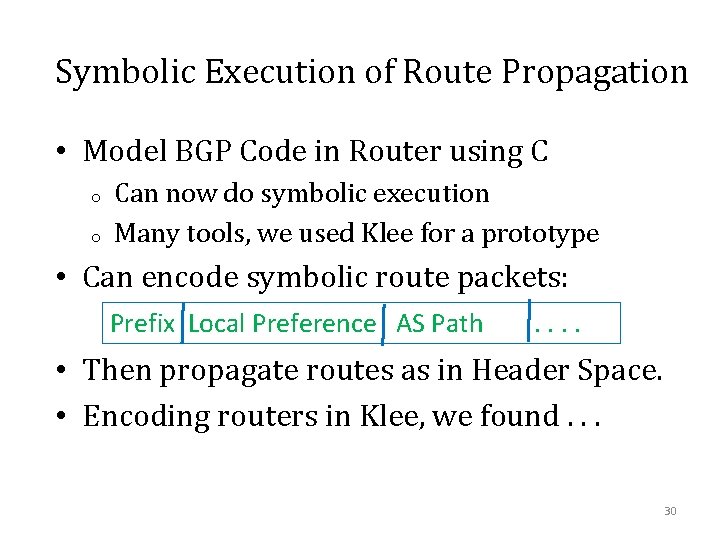
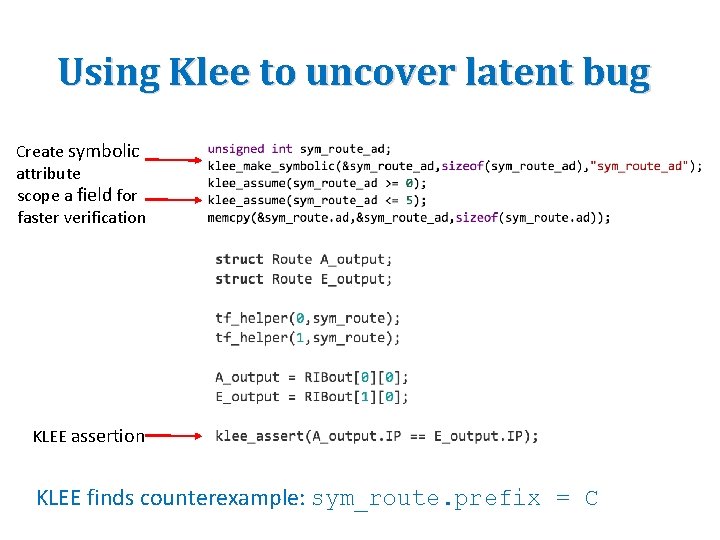
Symbolic Execution of Route Propagation • Model BGP Code in Router using C o o Can now do symbolic execution Many tools, we used Klee for a prototype • Can encode symbolic route packets: Prefix Local Preference AS Path . . • Then propagate routes as in Header Space. • Encoding routers in Klee, we found. . . 30
Using Klee to uncover latent bug Create symbolic attribute scope a field for faster verification KLEE assertion KLEE finds counterexample: sym_route. prefix = C
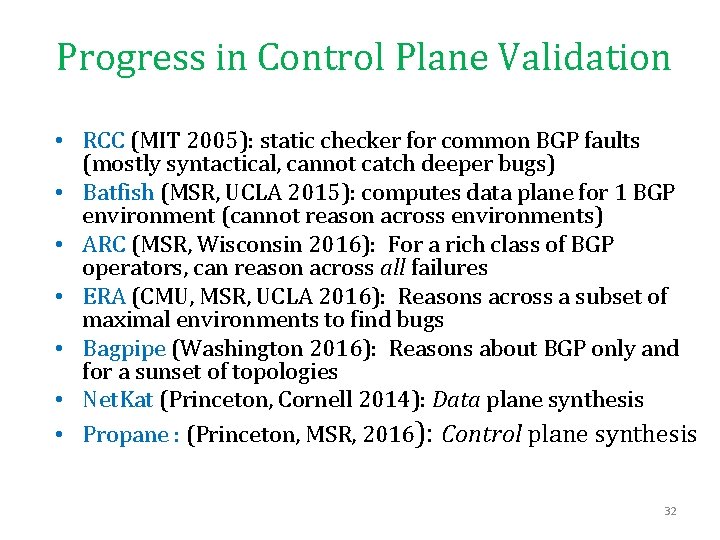
Progress in Control Plane Validation • RCC (MIT 2005): static checker for common BGP faults (mostly syntactical, cannot catch deeper bugs) • Batfish (MSR, UCLA 2015): computes data plane for 1 BGP environment (cannot reason across environments) • ARC (MSR, Wisconsin 2016): For a rich class of BGP operators, can reason across all failures • ERA (CMU, MSR, UCLA 2016): Reasons across a subset of maximal environments to find bugs • Bagpipe (Washington 2016): Reasons about BGP only and for a sunset of topologies • Net. Kat (Princeton, Cornell 2014): Data plane synthesis • Propane : (Princeton, MSR, 2016): Control plane synthesis 32
NETWORK DESIGN AUTOMATION? 33
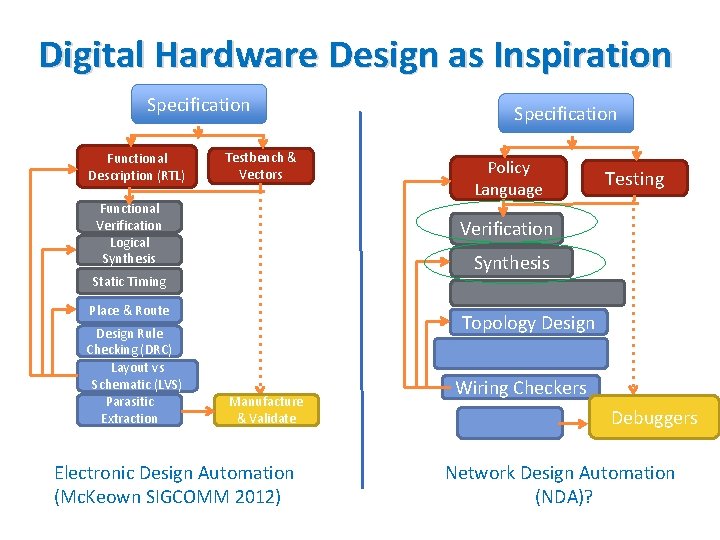
Digital Hardware Design as Inspiration Specification Functional Description (RTL) Testbench & Vectors Functional Verification Logical Synthesis Policy Language Testing Verification Synthesis Static Timing Place & Route Design Rule Checking (DRC) Layout vs Schematic (LVS) Parasitic Extraction Specification Topology Design Manufacture & Validate Electronic Design Automation (Mc. Keown SIGCOMM 2012) Wiring Checkers Debuggers Network Design Automation (NDA)?
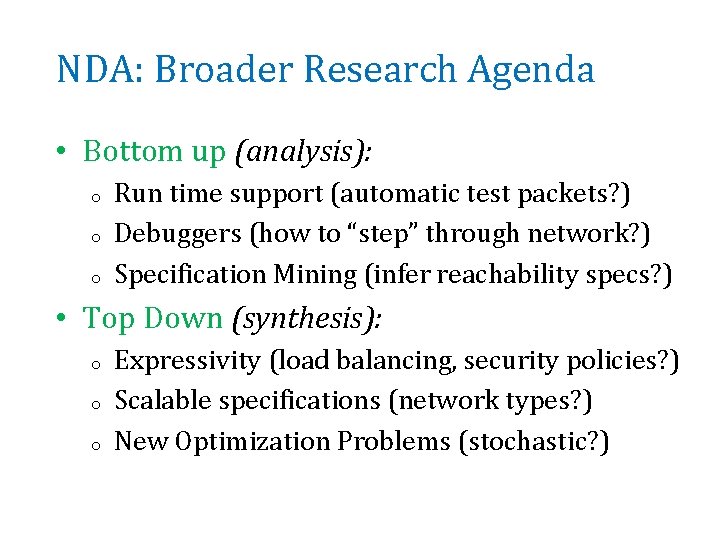
NDA: Broader Research Agenda • Bottom up (analysis): o o o Run time support (automatic test packets? ) Debuggers (how to “step” through network? ) Specification Mining (infer reachability specs? ) • Top Down (synthesis): o o o Expressivity (load balancing, security policies? ) Scalable specifications (network types? ) New Optimization Problems (stochastic? )
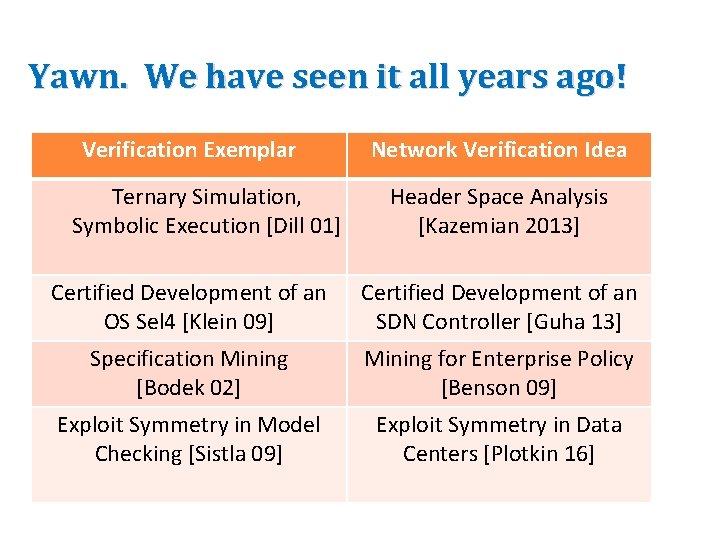
Yawn. We have seen it all years ago! Verification Exemplar Ternary Simulation, Symbolic Execution [Dill 01] Network Verification Idea Header Space Analysis [Kazemian 2013] Certified Development of an OS Sel 4 [Klein 09] Certified Development of an SDN Controller [Guha 13] Specification Mining [Bodek 02] Mining for Enterprise Policy [Benson 09] Exploit Symmetry in Model Checking [Sistla 09] Exploit Symmetry in Data Centers [Plotkin 16]
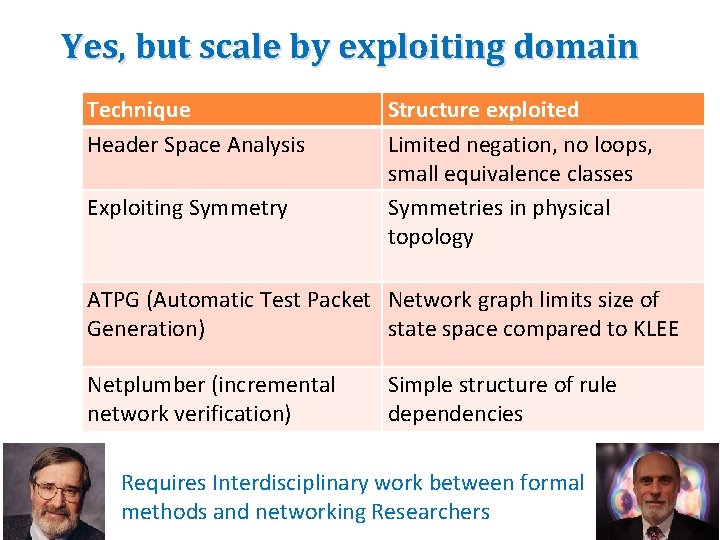
Yes, but scale by exploiting domain Technique Header Space Analysis Exploiting Symmetry Structure exploited Limited negation, no loops, small equivalence classes Symmetries in physical topology ATPG (Automatic Test Packet Network graph limits size of Generation) state space compared to KLEE Netplumber (incremental network verification) Simple structure of rule dependencies Requires Interdisciplinary work between formal methods and networking Researchers
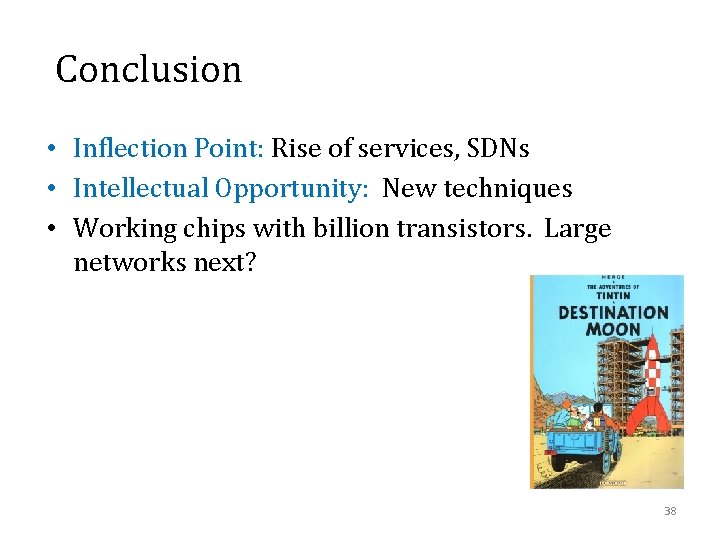
Conclusion • Inflection Point: Rise of services, SDNs • Intellectual Opportunity: New techniques • Working chips with billion transistors. Large networks next? 38
Thanks • (MSR): N. Bjorner, N. Lopes, R. Mahajan, G. Plotkin, • (CMU): S. Fayaz, V. Sekar • (Stanford): P. Kazemian, N. Mc. Keown • (UCLA): A. Fogel, T. Millstein 39
- Slides: 39