
Tools for Parents How to Teach Good Behavior
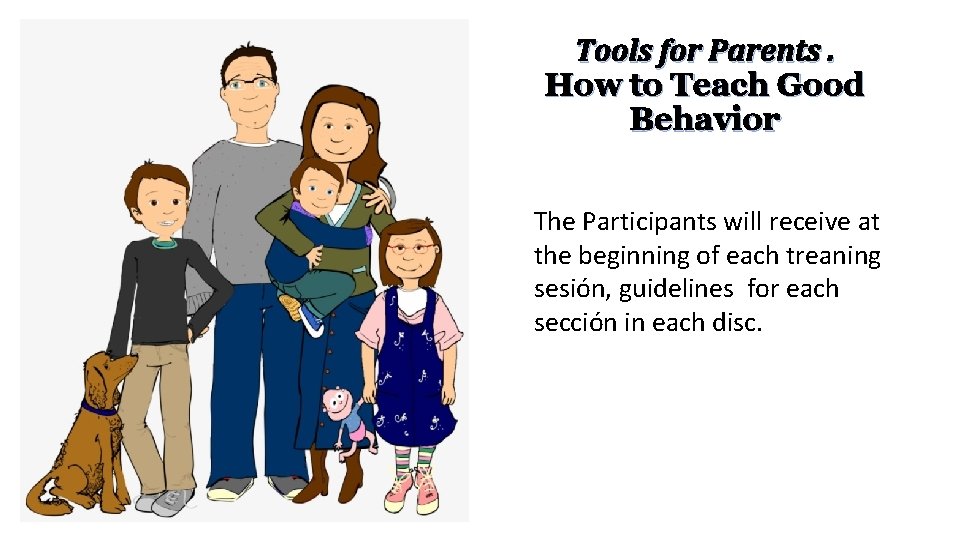
Tools for Parents. How to Teach Good Behavior The Participants will receive at the beginning of each treaning sesión, guidelines for each sección in each disc.
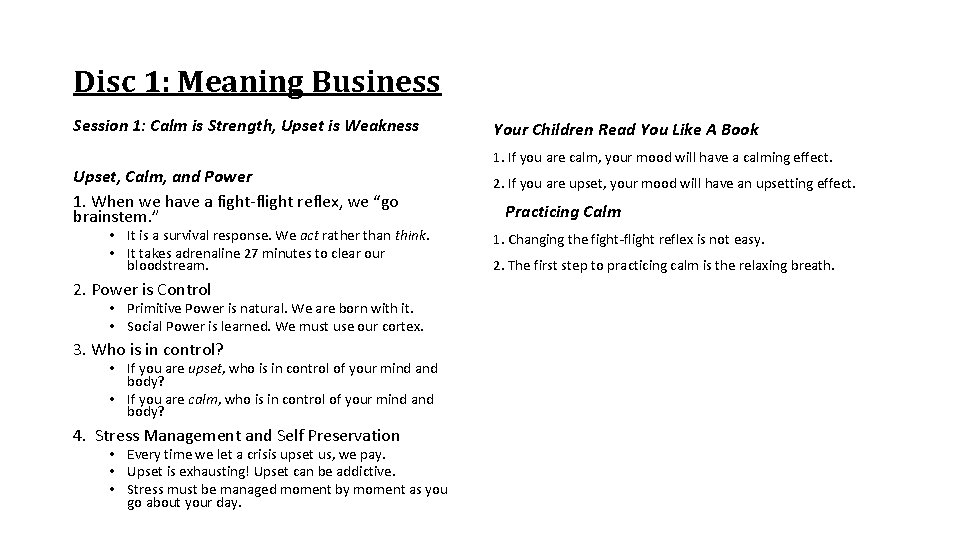
Disc 1: Meaning Business Session 1: Calm is Strength, Upset is Weakness Upset, Calm, and Power 1. When we have a fight-flight reflex, we “go brainstem. ” • It is a survival response. We act rather than think. • It takes adrenaline 27 minutes to clear our bloodstream. 2. Power is Control • Primitive Power is natural. We are born with it. • Social Power is learned. We must use our cortex. 3. Who is in control? • If you are upset, who is in control of your mind and body? • If you are calm, who is in control of your mind and body? 4. Stress Management and Self Preservation • Every time we let a crisis upset us, we pay. • Upset is exhausting! Upset can be addictive. • Stress must be managed moment by moment as you go about your day. Your Children Read You Like A Book 1. If you are calm, your mood will have a calming effect. 2. If you are upset, your mood will have an upsetting effect. Practicing Calm 1. Changing the fight-flight reflex is not easy. 2. The first step to practicing calm is the relaxing breath.
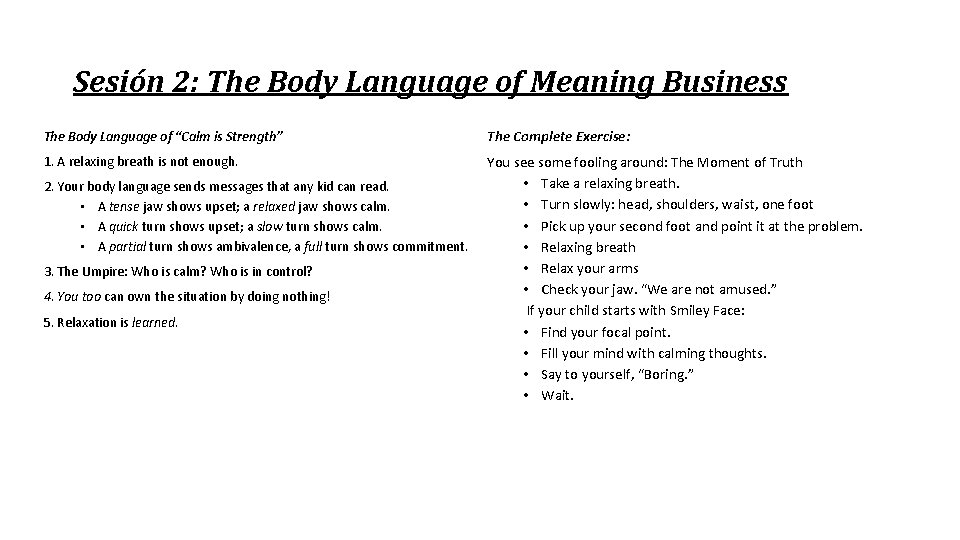
Sesión 2: The Body Language of Meaning Business The Body Language of “Calm is Strength” The Complete Exercise: 1. A relaxing breath is not enough. You see some fooling around: The Moment of Truth • Take a relaxing breath. • Turn slowly: head, shoulders, waist, one foot • Pick up your second foot and point it at the problem. • Relaxing breath • Relax your arms • Check your jaw. “We are not amused. ” If your child starts with Smiley Face: • Find your focal point. • Fill your mind with calming thoughts. • Say to yourself, “Boring. ” • Wait. 2. Your body language sends messages that any kid can read. • A tense jaw shows upset; a relaxed jaw shows calm. • A quick turn shows upset; a slow turn shows calm. • A partial turn shows ambivalence, a full turn shows commitment. 3. The Umpire: Who is calm? Who is in control? 4. You too can own the situation by doing nothing! 5. Relaxation is learned.
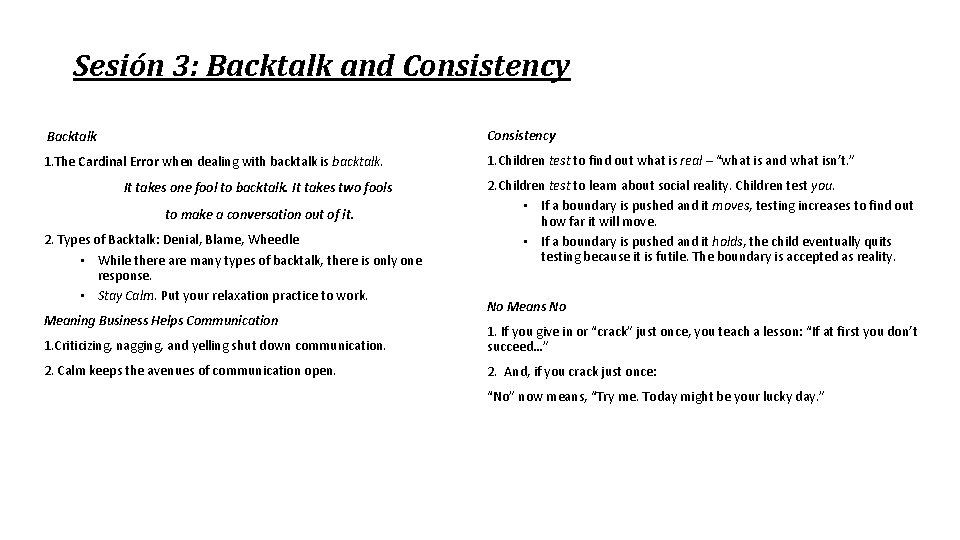
Sesión 3: Backtalk and Consistency Backtalk Consistency 1. The Cardinal Error when dealing with backtalk is backtalk. 1. Children test to find out what is real – “what is and what isn’t. ” It takes one fool to backtalk. It takes two fools to make a conversation out of it. 2. Types of Backtalk: Denial, Blame, Wheedle • While there are many types of backtalk, there is only one response. • Stay Calm. Put your relaxation practice to work. Meaning Business Helps Communication 2. Children test to learn about social reality. Children test you. • If a boundary is pushed and it moves, testing increases to find out how far it will move. • If a boundary is pushed and it holds, the child eventually quits testing because it is futile. The boundary is accepted as reality. No Means No 1. Criticizing, nagging, and yelling shut down communication. 1. If you give in or “crack” just once, you teach a lesson: “If at first you don’t succeed…” 2. Calm keeps the avenues of communication open. 2. And, if you crack just once: “No” now means, “Try me. Today might be your lucky day. ”
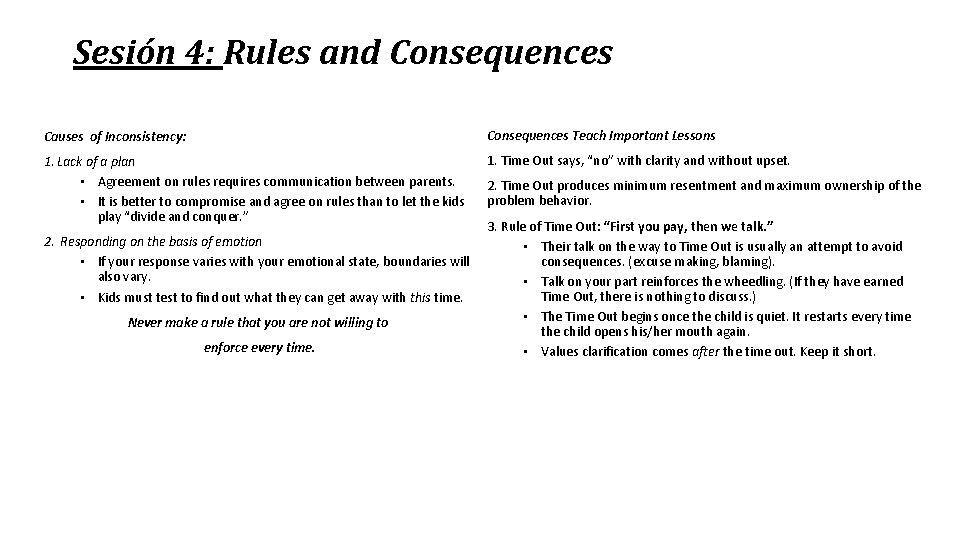
Sesión 4: Rules and Consequences Causes of Inconsistency: Consequences Teach Important Lessons 1. Lack of a plan • Agreement on rules requires communication between parents. • It is better to compromise and agree on rules than to let the kids play “divide and conquer. ” 1. Time Out says, “no” with clarity and without upset. 2. Responding on the basis of emotion • If your response varies with your emotional state, boundaries will also vary. • Kids must test to find out what they can get away with this time. Never make a rule that you are not willing to enforce every time. 2. Time Out produces minimum resentment and maximum ownership of the problem behavior. 3. Rule of Time Out: “First you pay, then we talk. ” • Their talk on the way to Time Out is usually an attempt to avoid consequences. (excuse making, blaming). • Talk on your part reinforces the wheedling. (If they have earned Time Out, there is nothing to discuss. ) • The Time Out begins once the child is quiet. It restarts every time the child opens his/her mouth again. • Values clarification comes after the time out. Keep it short.
- Slides: 5