
Tools for Building and Execution of Multiscale Applications
Tools for Building and Execution of Multiscale Applications Marian Bubak AGH Krakow PL and University of Amsterdam NL Grzegorz Dyk and Daniel Harezlak ACC Cyfronet AGH Krakow PL on behalf of the MAPPER Consortium http: //www. mapper-project. eu/ 3 July 2012 Summer School 2012, MTA SZTAKI, Budapest, HU The Mapper project receives funding from the EC's Seventh Framework Programme (FP 7/2007 -2013) under grant agreement n° RI-261507.
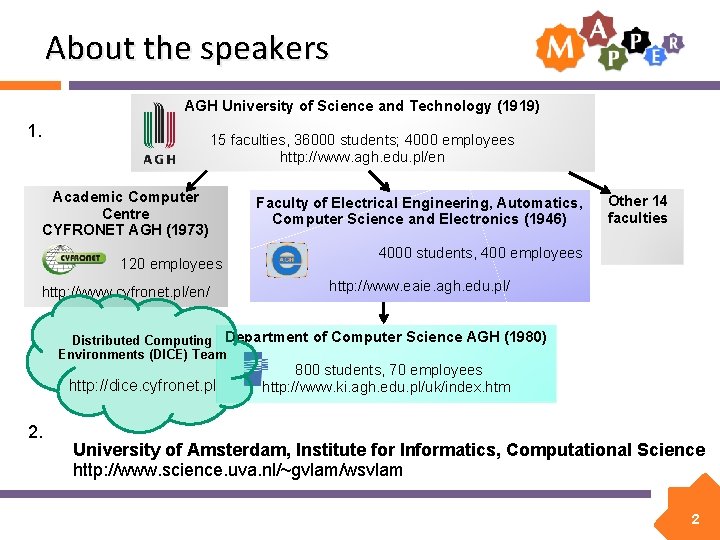
About the speakers AGH University of Science and Technology (1919) 1. 15 faculties, 36000 students; 4000 employees http: //www. agh. edu. pl/en Academic Computer Centre CYFRONET AGH (1973) 120 employees http: //www. cyfronet. pl/en/ Faculty of Electrical Engineering, Automatics, Computer Science and Electronics (1946) Other 14 faculties 4000 students, 400 employees http: //www. eaie. agh. edu. pl/ Distributed Computing Department of Computer Science AGH (1980) Environments (DICE) Team http: //dice. cyfronet. pl 2. 800 students, 70 employees http: //www. ki. agh. edu. pl/uk/index. htm University of Amsterdam, Institute for Informatics, Computational Science http: //www. science. uva. nl/~gvlam/wsvlam 2
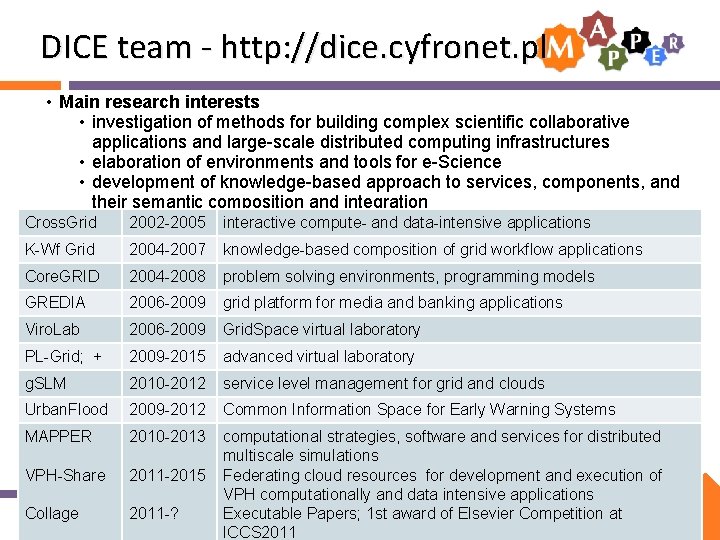
DICE team - http: //dice. cyfronet. pl • Main research interests • investigation of methods for building complex scientific collaborative applications and large-scale distributed computing infrastructures • elaboration of environments and tools for e-Science • development of knowledge-based approach to services, components, and their semantic composition and integration Cross. Grid 2002 -2005 interactive compute- and data-intensive applications K-Wf Grid 2004 -2007 knowledge-based composition of grid workflow applications Core. GRID 2004 -2008 problem solving environments, programming models GREDIA 2006 -2009 grid platform for media and banking applications Viro. Lab 2006 -2009 Grid. Space virtual laboratory PL-Grid; + 2009 -2015 advanced virtual laboratory g. SLM 2010 -2012 service level management for grid and clouds Urban. Flood 2009 -2012 Common Information Space for Early Warning Systems MAPPER 2010 -2013 VPH-Share 2011 -2015 Collage 2011 -? computational strategies, software and services for distributed multiscale simulations Federating cloud resources for development and execution of VPH computationally and data intensive applications Executable Papers; 1 st award of Elsevier Competition at ICCS 2011 3
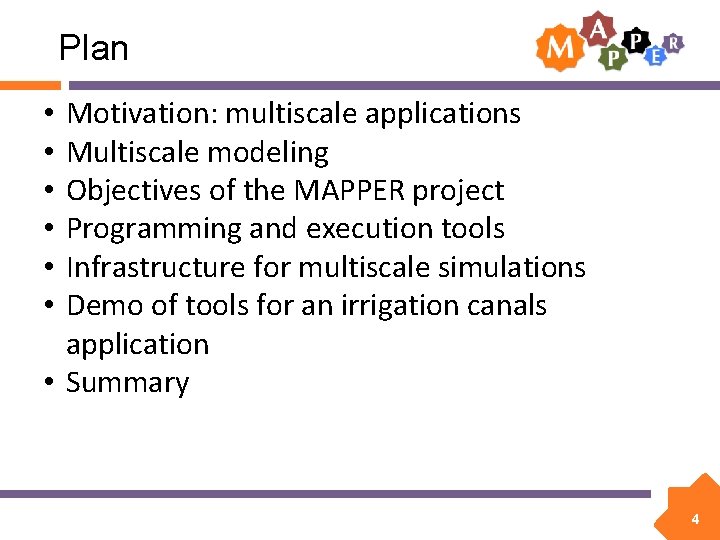
Plan Motivation: multiscale applications Multiscale modeling Objectives of the MAPPER project Programming and execution tools Infrastructure for multiscale simulations Demo of tools for an irrigation canals application • Summary • • • 4
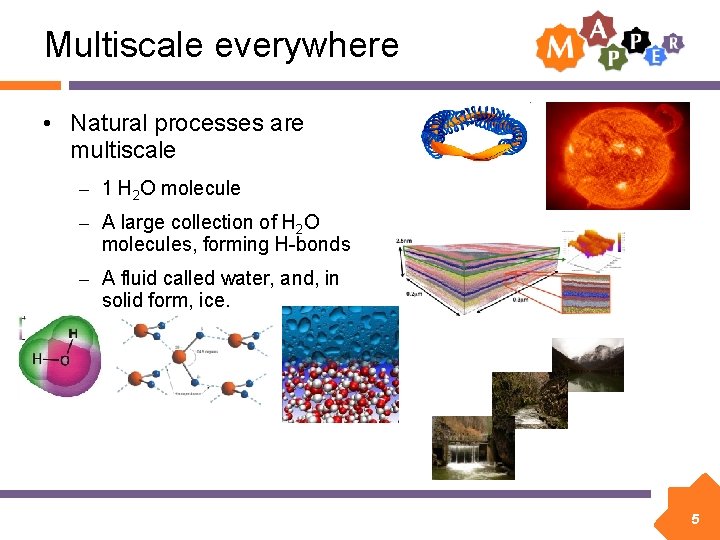
Multiscale everywhere • Natural processes are multiscale – 1 H 2 O molecule – A large collection of H 2 O molecules, forming H-bonds – A fluid called water, and, in solid form, ice. 5
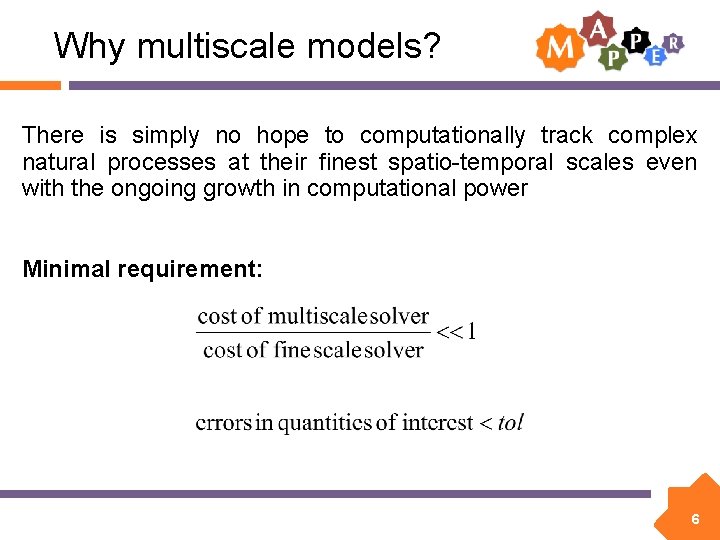
Why multiscale models? There is simply no hope to computationally track complex natural processes at their finest spatio-temporal scales even with the ongoing growth in computational power Minimal requirement: 6

From multiscale to single scale spatial scale • Identify the relevant scales on the scale separation map L • Design specific models which solve each scale • Assess errors of a method • Couple the subsystems using an appropriate method Dx Dt T temporal scale 7
Multiscale computing • Inherently hybrid models are best serviced by different types of computing environments • Simulations in three dimensions require large scale computing capabilities. • Such large scale hybrid models require a distributed computing ecosystem, where parts of the multiscale model are executed on the most appropriate computing resource. • Distributed Multiscale Computing 8
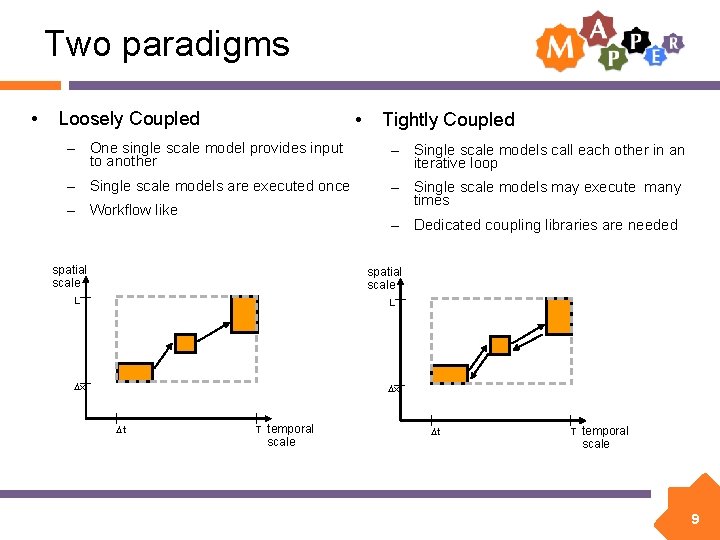
Two paradigms • Loosely Coupled • Tightly Coupled – One single scale model provides input to another – Single scale models call each other in an iterative loop – Single scale models are executed once – Single scale models may execute many times – Workflow like – Dedicated coupling libraries are needed spatial scale L L Dx Dx Dt T temporal scale 9
MAPPER Multiscale APPlications on European e-inf. Rastructures ät sit er r ck t zu V. lan af er E. -P ch g d n ax lls n fte M ese eru cha G erd ns Fo isse W a isk kn e s. T er a alm kol Ch ögs H a ev en f. G yo sit er iv Un niv -U ns ilia im ax M ig- n dw he Lu ünc M o- wa icz la rn nis e Go ta wi ia. S ako em im Kr ad cza w Ak tni ica Hu tasz S e eg g tin pu g an m kin zn rco or Po pe etw Su d N re an nt Ce er lst f. U yo sit er iv Un oll C ity rs ive n Un ndo Lo of ity rs am ive erd Un mst A 10
Motivation: user needs Fusion VPH Computional Biology Material Science Engineering Distributed Multiscale Computing Needs 11
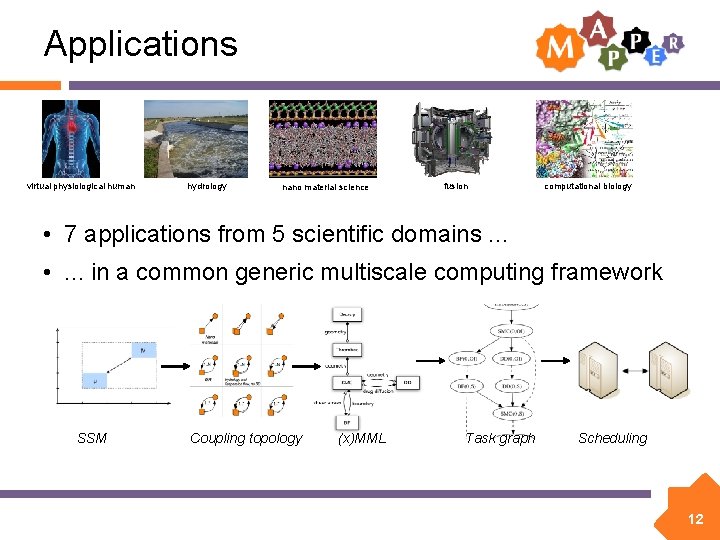
Applications virtual physiological human hydrology nano material science fusion computational biology • 7 applications from 5 scientific domains. . . • . . . in a common generic multiscale computing framework SSM Coupling topology (x)MML Task graph Scheduling 12
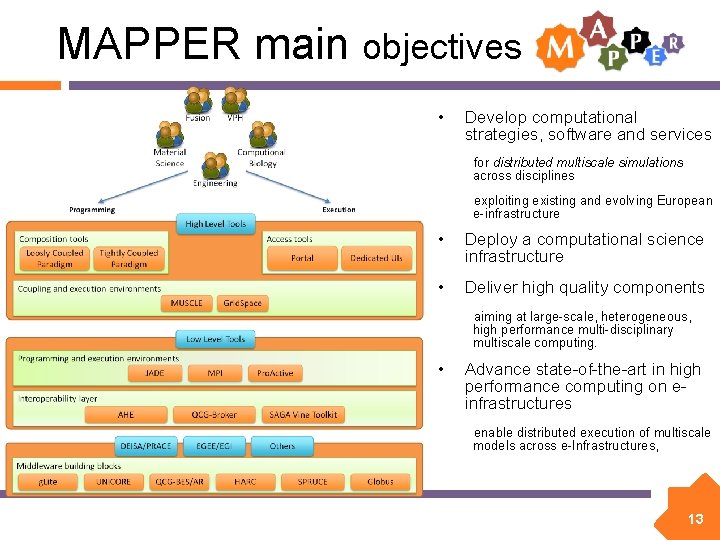
MAPPER main objectives • Develop computational strategies, software and services for distributed multiscale simulations across disciplines exploiting existing and evolving European e-infrastructure • Deploy a computational science infrastructure • Deliver high quality components aiming at large-scale, heterogeneous, high performance multi-disciplinary multiscale computing. • Advance state-of-the-art in high performance computing on einfrastructures enable distributed execution of multiscale models across e-Infrastructures, 13
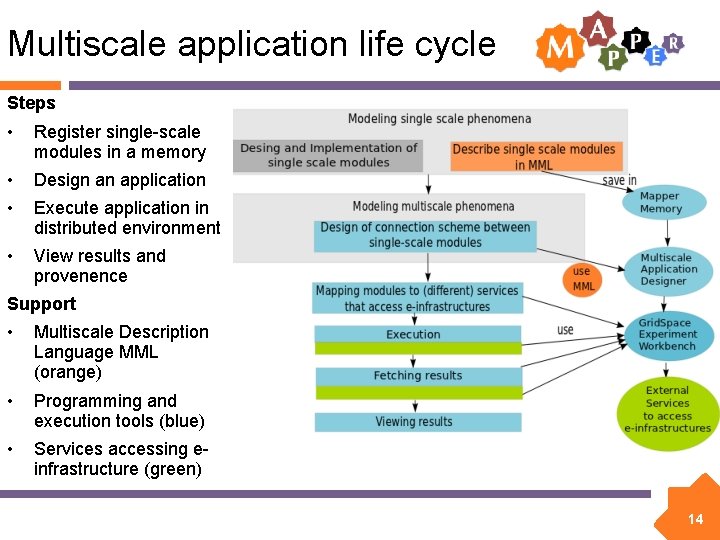
Multiscale application life cycle Steps • Register single-scale modules in a memory • Design an application • Execute application in distributed environment • View results and provenence Support • Multiscale Description Language MML (orange) • Programming and execution tools (blue) • Services accessing einfrastructure (green) 14
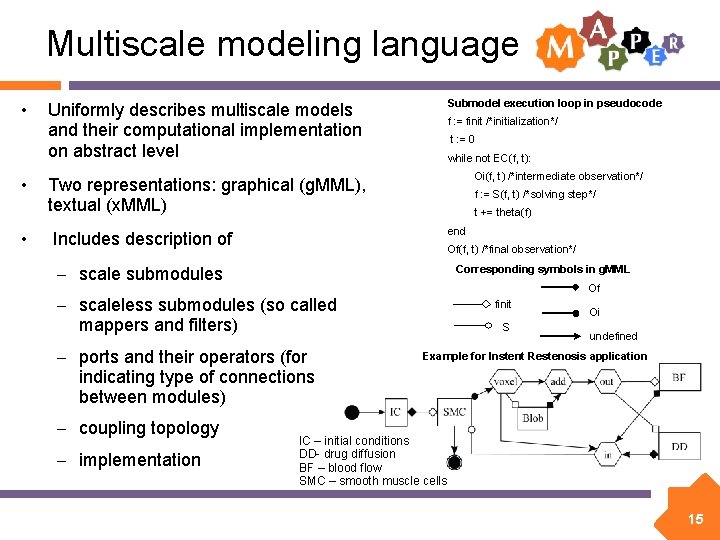
Multiscale modeling language • • • Submodel execution loop in pseudocode Uniformly describes multiscale models and their computational implementation on abstract level f : = finit /*initialization*/ t : = 0 while not EC(f, t): Oi(f, t) /*intermediate observation*/ Two representations: graphical (g. MML), textual (x. MML) f : = S(f, t) /*solving step*/ t += theta(f) end Includes description of Of(f, t) /*final observation*/ – scale submodules Corresponding symbols in g. MML Of – scaleless submodules (so called mappers and filters) – ports and their operators (for indicating type of connections between modules) – coupling topology – implementation finit S Oi undefined Example for Instent Restenosis application IC – initial conditions DD- drug diffusion BF – blood flow SMC – smooth muscle cells 15
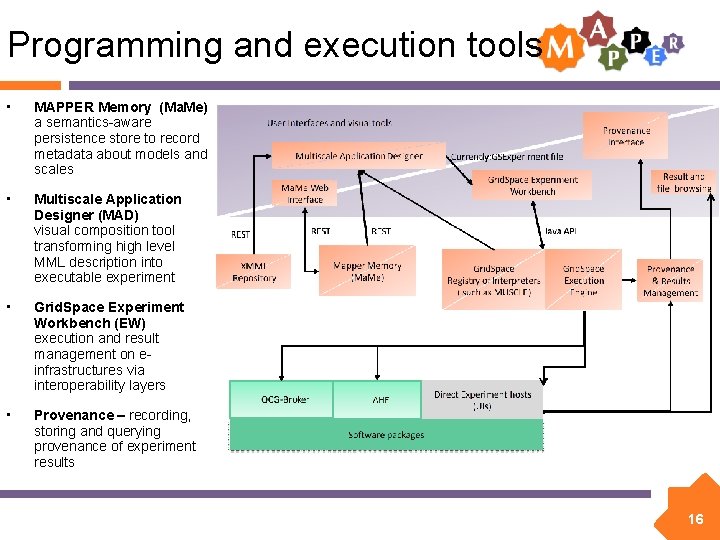
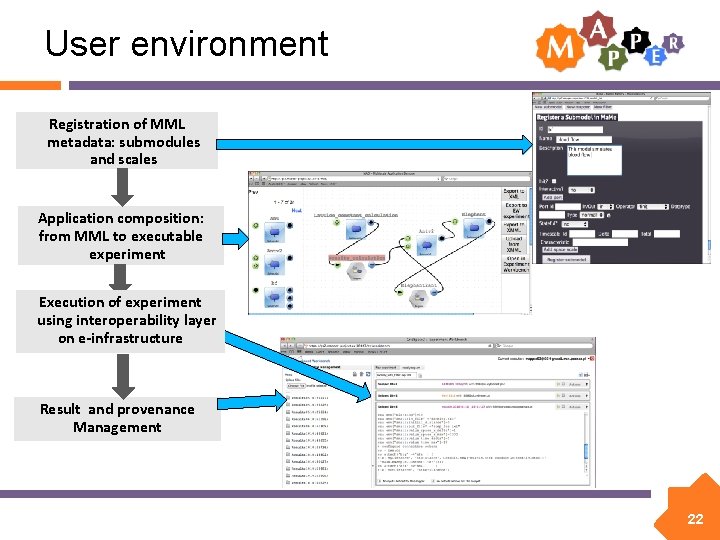
Programming and execution tools • MAPPER Memory (Ma. Me) a semantics-aware persistence store to record metadata about models and scales • Multiscale Application Designer (MAD) visual composition tool transforming high level MML description into executable experiment • Grid. Space Experiment Workbench (EW) execution and result management on einfrastructures via interoperability layers • Provenance – recording, storing and querying provenance of experiment results 16
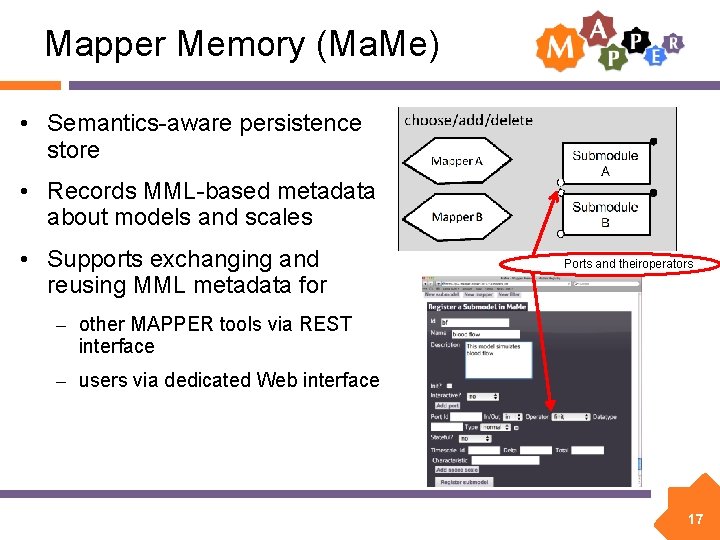
Mapper Memory (Ma. Me) • Semantics-aware persistence store • Records MML-based metadata about models and scales • Supports exchanging and reusing MML metadata for Ports and theiroperators – other MAPPER tools via REST interface – users via dedicated Web interface 17
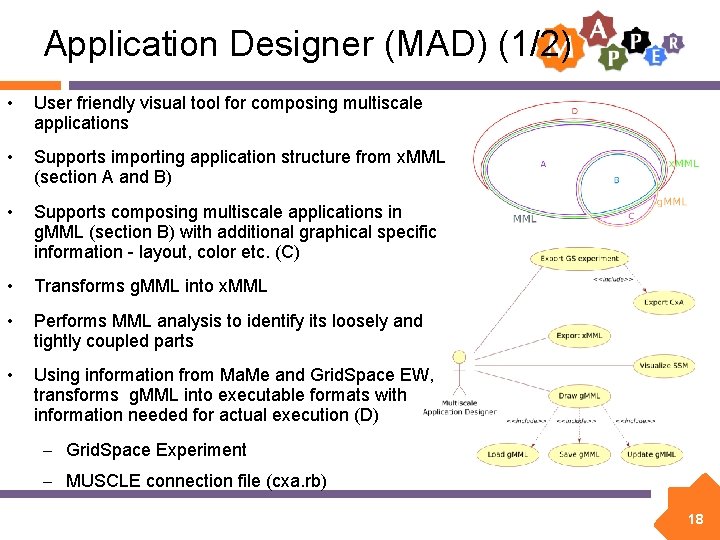
Application Designer (MAD) (1/2) • User friendly visual tool for composing multiscale applications • Supports importing application structure from x. MML (section A and B) • Supports composing multiscale applications in g. MML (section B) with additional graphical specific information - layout, color etc. (C) • Transforms g. MML into x. MML • Performs MML analysis to identify its loosely and tightly coupled parts • Using information from Ma. Me and Grid. Space EW, transforms g. MML into executable formats with information needed for actual execution (D) – Grid. Space Experiment – MUSCLE connection file (cxa. rb) 18
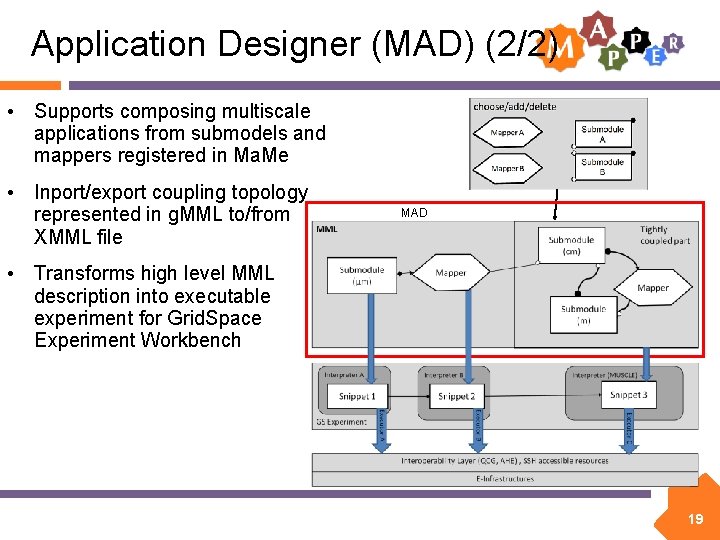
Application Designer (MAD) (2/2) • Supports composing multiscale applications from submodels and mappers registered in Ma. Me • Inport/export coupling topology represented in g. MML to/from XMML file MAD • Transforms high level MML description into executable experiment for Grid. Space Experiment Workbench 19
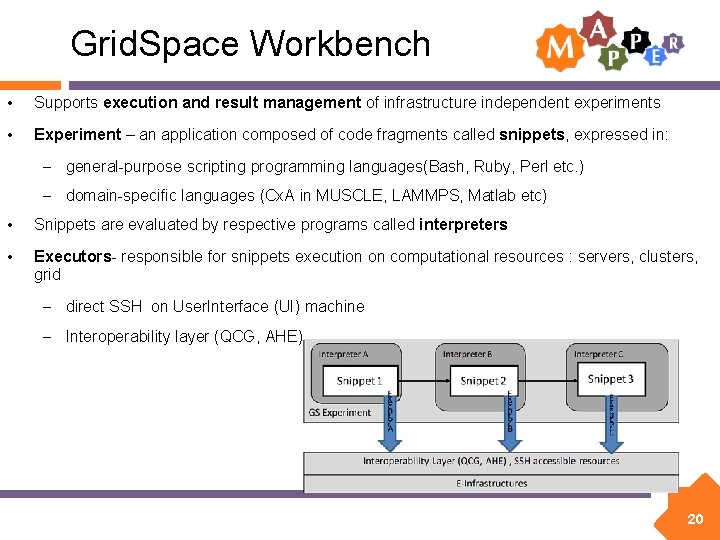
Grid. Space Workbench • Supports execution and result management of infrastructure independent experiments • Experiment – an application composed of code fragments called snippets, expressed in: – general-purpose scripting programming languages(Bash, Ruby, Perl etc. ) – domain-specific languages (Cx. A in MUSCLE, LAMMPS, Matlab etc) • Snippets are evaluated by respective programs called interpreters • Executors- responsible for snippets execution on computational resources : servers, clusters, grid – direct SSH on User. Interface (UI) machine – Interoperability layer (QCG, AHE) 20
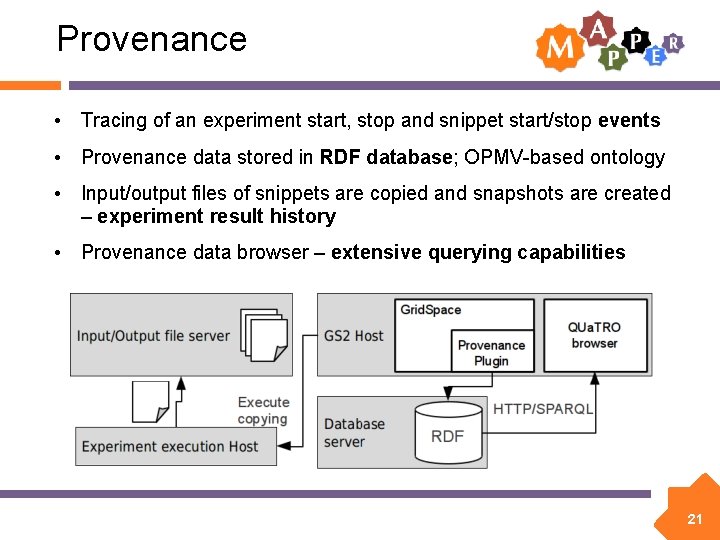
Provenance • Tracing of an experiment start, stop and snippet start/stop events • Provenance data stored in RDF database; OPMV-based ontology • Input/output files of snippets are copied and snapshots are created – experiment result history • Provenance data browser – extensive querying capabilities 21
User environment Registration of MML metadata: submodules and scales Application composition: from MML to executable experiment Execution of experiment using interoperability layer on e-infrastructure Result and provenance Management 22
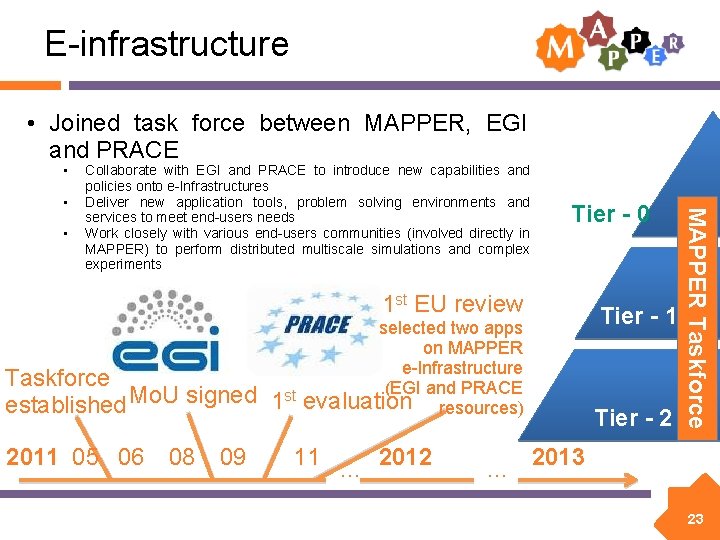
E-infrastructure • Joined task force between MAPPER, EGI and PRACE • • Tier - 0 1 st EU review Taskforce established Mo. U signed 2011 05 06 08 09 selected two apps on MAPPER e-Infrastructure (EGI and PRACE st 1 evaluation resources) 11 … 2012 Tier - 1 Tier - 2 MAPPER Taskforce • Collaborate with EGI and PRACE to introduce new capabilities and policies onto e-Infrastructures Deliver new application tools, problem solving environments and services to meet end-users needs Work closely with various end-users communities (involved directly in MAPPER) to perform distributed multiscale simulations and complex experiments … 2013 23
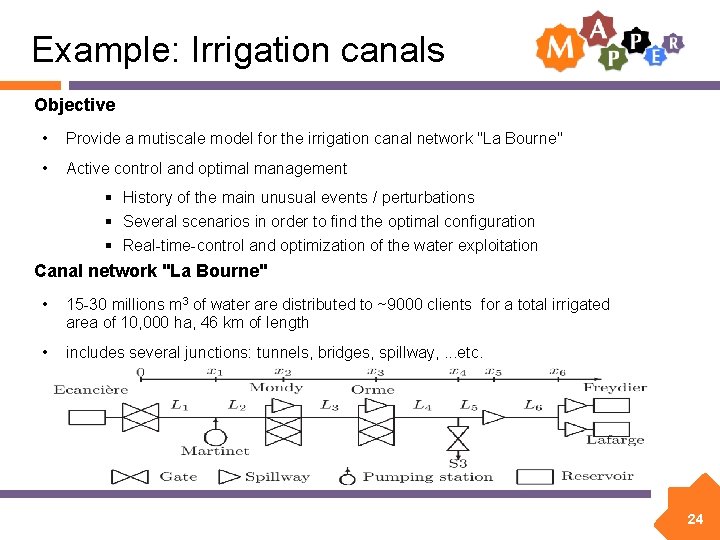
Example: Irrigation canals Objective • Provide a mutiscale model for the irrigation canal network "La Bourne" • Active control and optimal management § History of the main unusual events / perturbations § Several scenarios in order to find the optimal configuration § Real-time-control and optimization of the water exploitation Canal network "La Bourne" • 15 -30 millions m 3 of water are distributed to ~9000 clients for a total irrigated area of 10, 000 ha, 46 km of length • includes several junctions: tunnels, bridges, spillway, . . . etc. 24
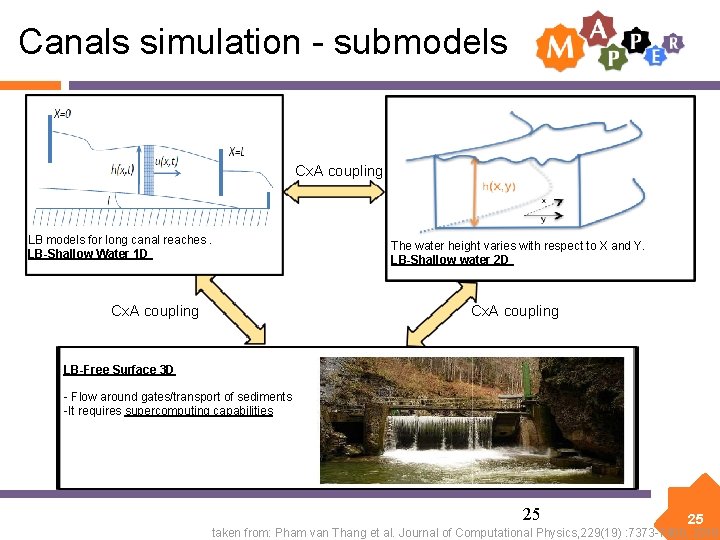
Canals simulation - submodels Cx. A coupling LB models for long canal reaches. LB-Shallow Water 1 D Cx. A coupling The water height varies with respect to X and Y. LB-Shallow water 2 D Cx. A coupling LB-Free Surface 3 D - Flow around gates/transport of sediments -It requires supercomputing capabilities 25 25 taken from: Pham van Thang et al. Journal of Computational Physics, 229(19) : 7373 -7400, 2010.
Demos • Canals application life cycle (Daniel) • Provenance at work (Grzegorz) 26
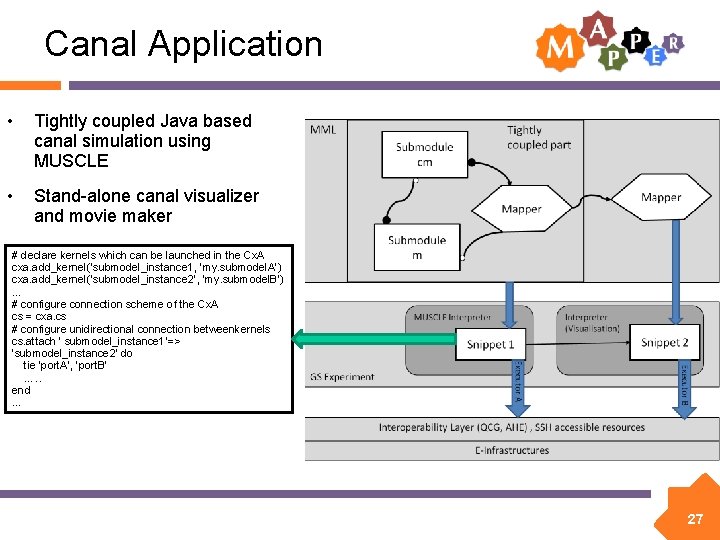
Canal Application • Tightly coupled Java based canal simulation using MUSCLE • Stand-alone canal visualizer and movie maker # declare kernels which can be launched in the Cx. A cxa. add_kernel(’submodel_instance 1, ’my. submodel. A’) cxa. add_kernel(’submodel_instance 2’, ’my. submodel. B’) … # configure connection scheme of the Cx. A cs = cxa. cs # configure unidirectional connection betweenkernels cs. attach ’ submodel_instance 1’=> ’submodel_instance 2’ do tie ’port. A’, ’port. B’ …. . end … 27
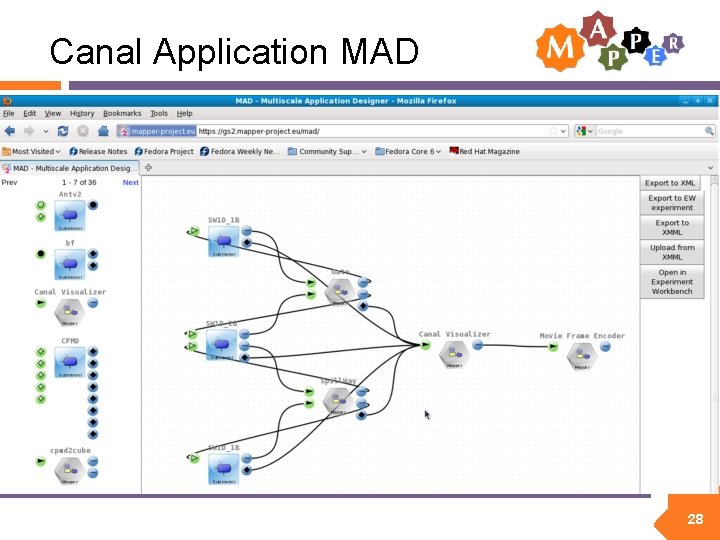
Canal Application MAD 28
Summary • Elaboration of a concept of an environment supporting developers and users of multiscale applications for grid, HPC and cloud infrastructures • Design of the formalism for describing structures of multiscale applications • Enabling efficient access to e-infrastructures • Validation of the formalism against real applications structure by using tools • Proof of concept for transforming high level formal description to actual execution using e-infrastructures 29
More about MAPPER http: //www. mapper-project. eu/ http: //dice. cyfronet. pl/ 30
And more at … dice. cyfronet. pl www. science. uva. nl/~gvlam/wsvlam www. plgrid. pl www. cyfronet. pl/cgw 12 31
- Slides: 31