
Tools for automatically combining biochemical and cell organization
Tools for automatically combining biochemical and cell organization models Devin Sullivan
Motivation • Fluorescence microscopy provides a tool for understanding the impact of spatial organization on the biochemistry of cells. • Simulating biochemical systems within these geometries can improve our understanding of these systems. • Current methods of obtaining such geometries from images is not sufficient for accurately capturing the variability among cells

Benefits of generative models • Represents organelle localization, size and shape more accurately than segmentation • Provides a continuous space for synthesizing and subsequently analyzing changes in cell geometries
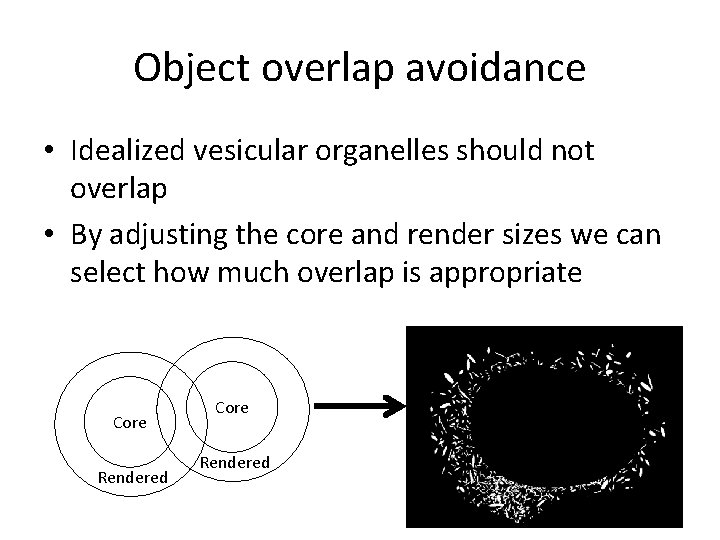
Object overlap avoidance • Idealized vesicular organelles should not overlap • By adjusting the core and render sizes we can select how much overlap is appropriate Core Rendered
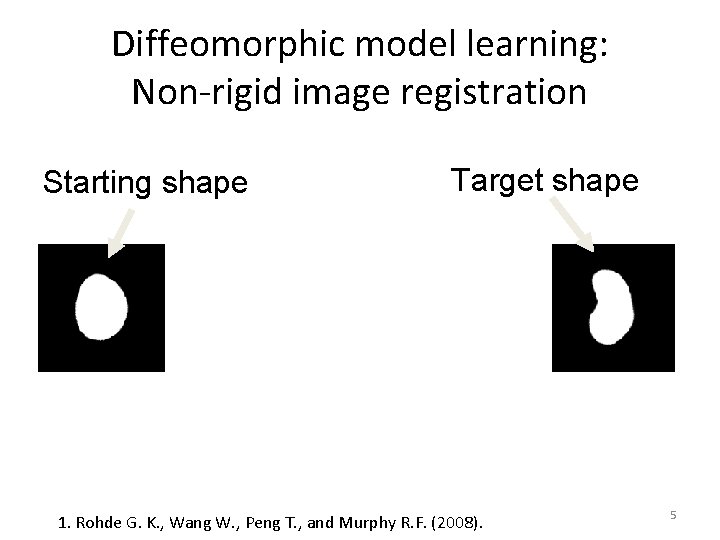
Diffeomorphic model learning: Non-rigid image registration Starting shape Target shape 1. Rohde G. K. , Wang W. , Peng T. , and Murphy R. F. (2008). 5
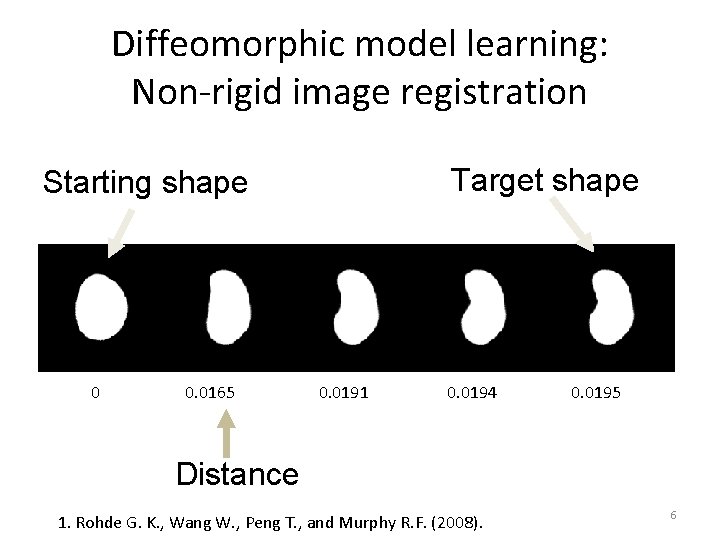
Diffeomorphic model learning: Non-rigid image registration Target shape Starting shape 0 0. 0165 0. 0191 0. 0194 0. 0195 Distance 1. Rohde G. K. , Wang W. , Peng T. , and Murphy R. F. (2008). 6
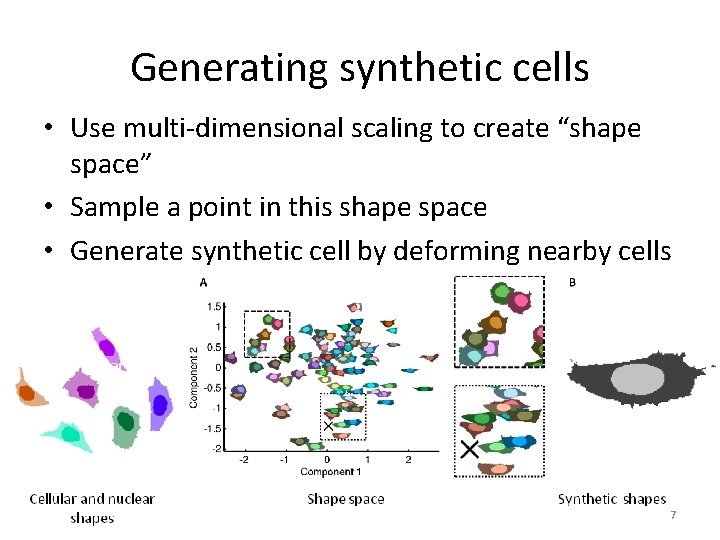
Generating synthetic cells • Use multi-dimensional scaling to create “shape space” • Sample a point in this shape space • Generate synthetic cell by deforming nearby cells Starting cell 7

Cell shape dynamics Increasing DNA intensity • How a cell might change over time Cell Shape time
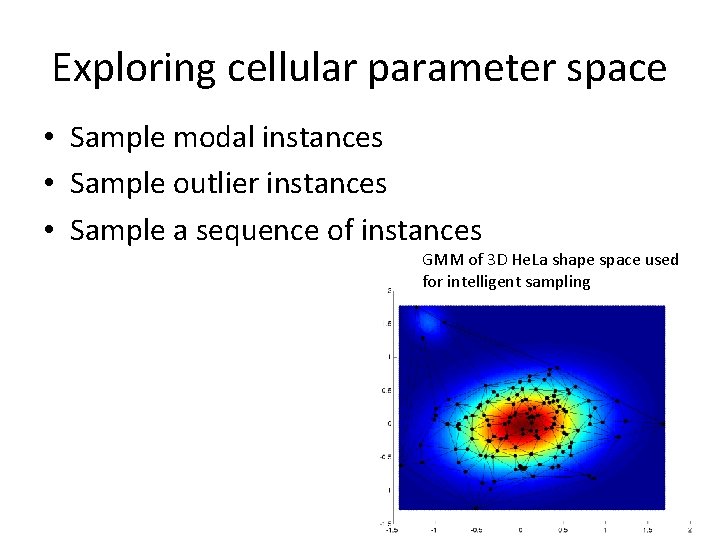
Exploring cellular parameter space • Sample modal instances • Sample outlier instances • Sample a sequence of instances GMM of 3 D He. La shape space used for intelligent sampling
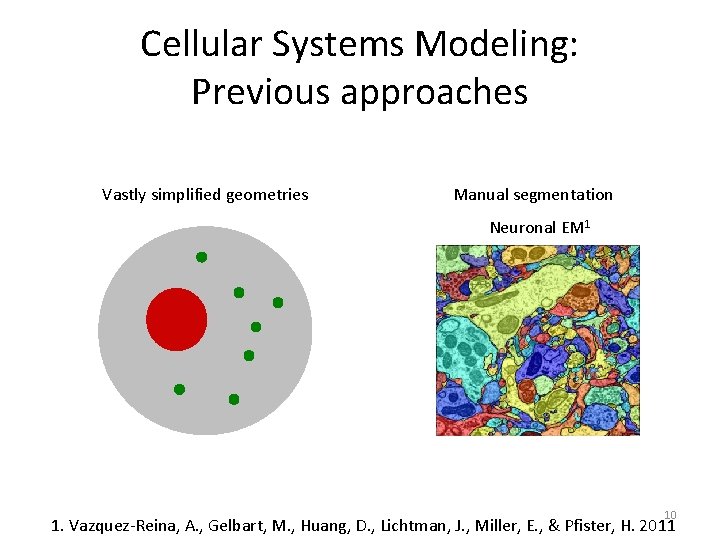
Cellular Systems Modeling: Previous approaches Vastly simplified geometries Manual segmentation Neuronal EM 1 10 1. Vazquez-Reina, A. , Gelbart, M. , Huang, D. , Lichtman, J. , Miller, E. , & Pfister, H. 2011
High-throughput spatially realistic simulations • Study the effects of spatial variance caused by – Cell cycle – Diseases – Drugs – Inherent cell variance • Model large systems with high spatial realism • Validate generative model accuracies 11
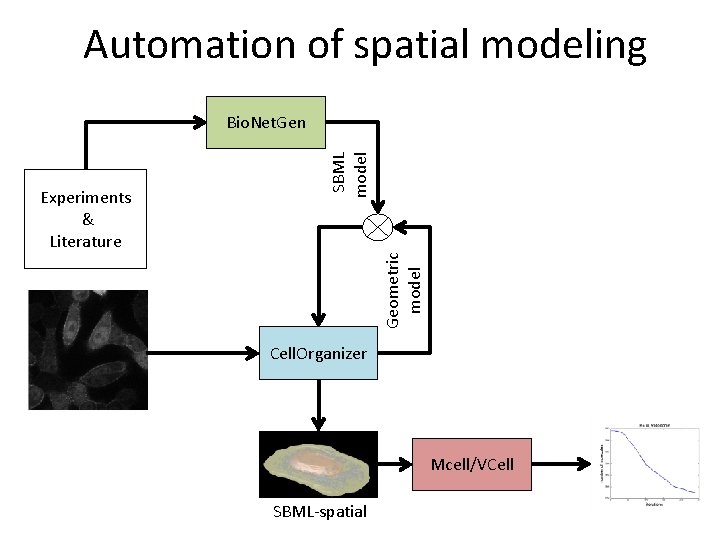
Automation of spatial modeling Geometric model Experiments & Literature SBML model Bio. Net. Gen Cell. Organizer Mcell/VCell SBML-spatial

Automation of spatial modeling Step 1: Biochemical systems modeling Geometric model Experiments & Literature SBML model Bio. Net. Gen Cell. Organizer Mcell/VCell SBML-spatial+SBML
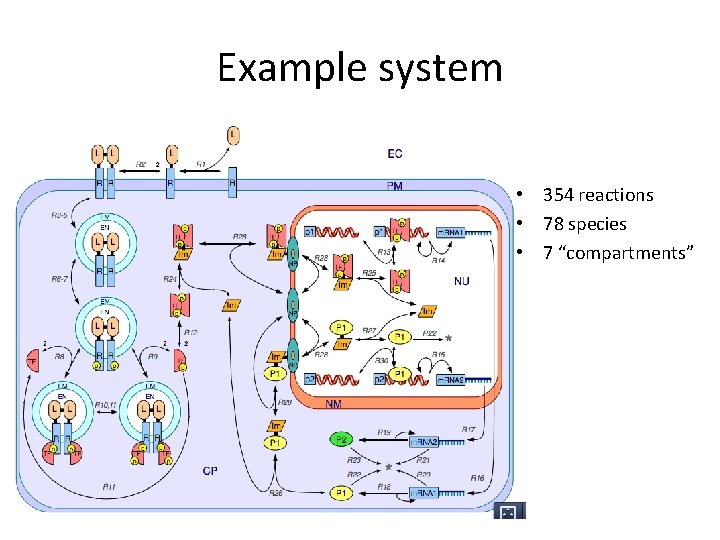
Example system • 354 reactions • 78 species • 7 “compartments”
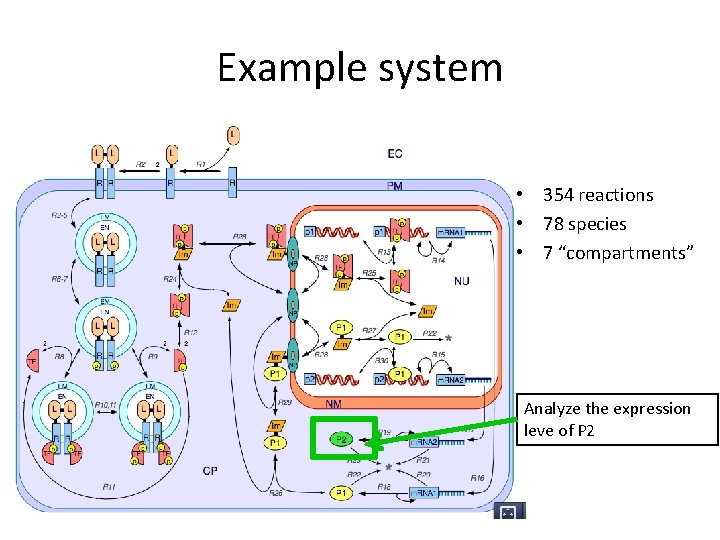
Example system • 354 reactions • 78 species • 7 “compartments” Analyze the expression leve of P 2
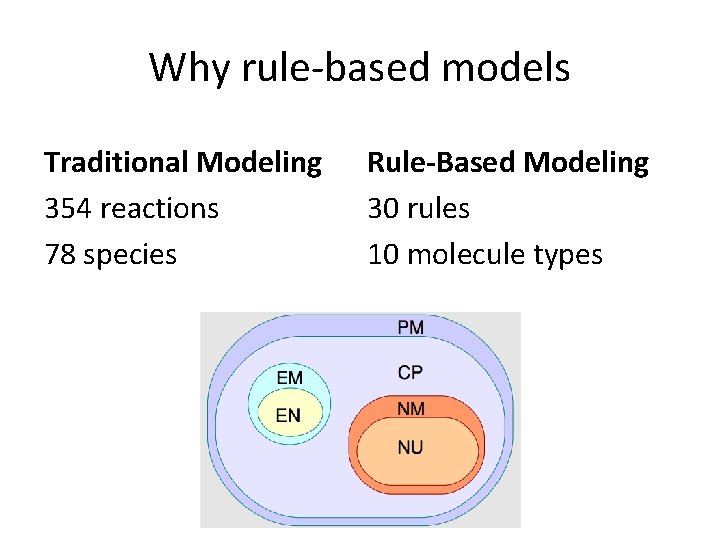
Why rule-based models Traditional Modeling 354 reactions 78 species Rule-Based Modeling 30 rules 10 molecule types
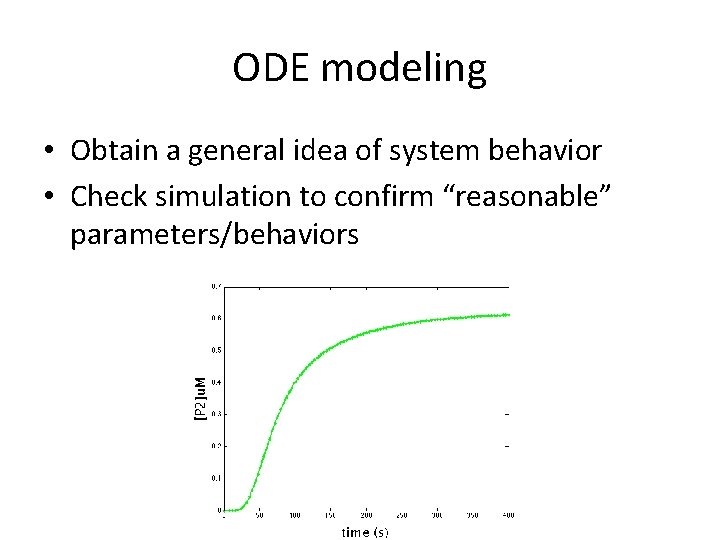
ODE modeling • Obtain a general idea of system behavior • Check simulation to confirm “reasonable” parameters/behaviors
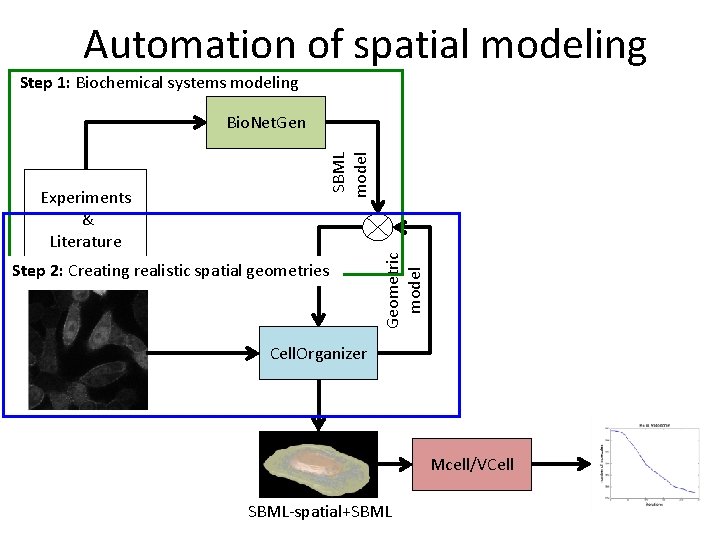
Automation of spatial modeling Step 1: Biochemical systems modeling Step 2: Creating realistic spatial geometries Geometric model Experiments & Literature SBML model Bio. Net. Gen Cell. Organizer Mcell/VCell SBML-spatial+SBML

Identifying compartments • Extract compartment information from SBML • Identify relevant models using string matching • Generate SBML-spatial instances with biochemistry and necessary geometries BNGL SBML Cell. Organizer Models: Nuclear Cell Lysosome Endosome Mitochondria Microtubule Nucleosome SBML-spatial+SBML
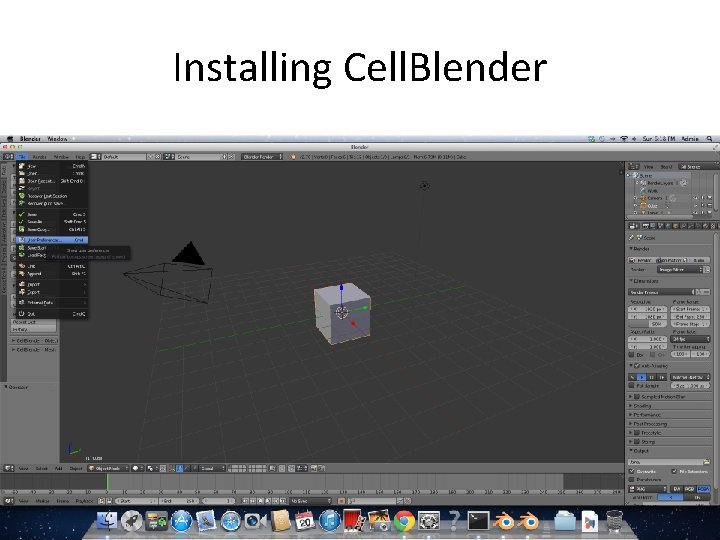
Installing Cell. Blender

Installing Cell. Blender
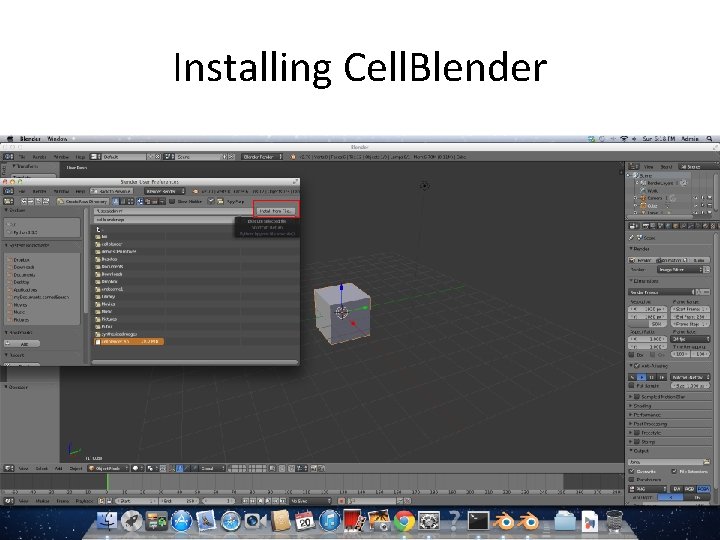
Installing Cell. Blender

Installing Cell. Blender

Importing SBML-spatial
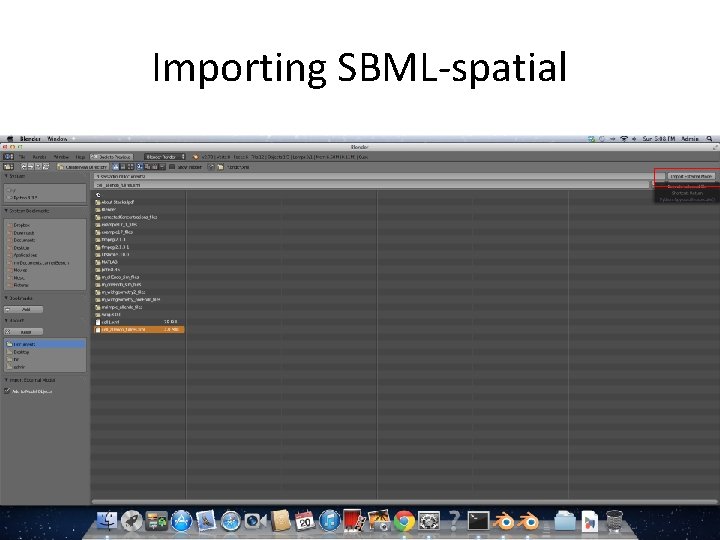
Importing SBML-spatial

Importing SBML-spatial Auto imports Geometries AND Biochemistry!
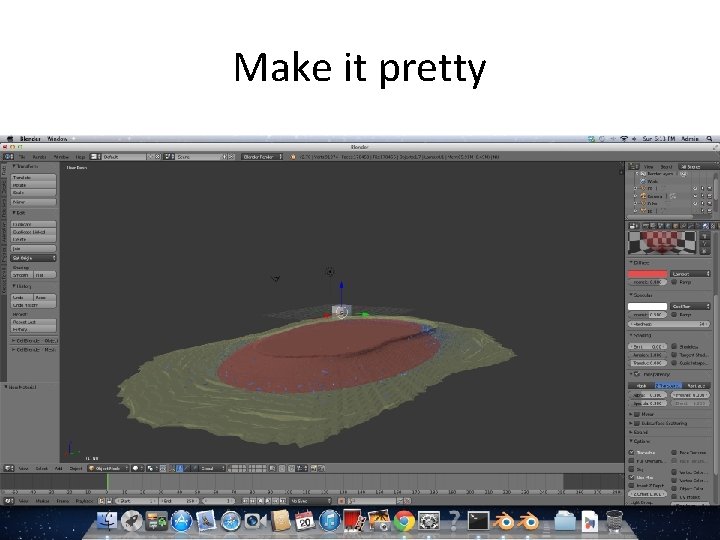
Make it pretty

Manual tuning • Fixing meshes – Must have consistent normals – Must be manifold – Must be watertight • Partition use/tuning to speed up simulations – Increases speed >1000 x!
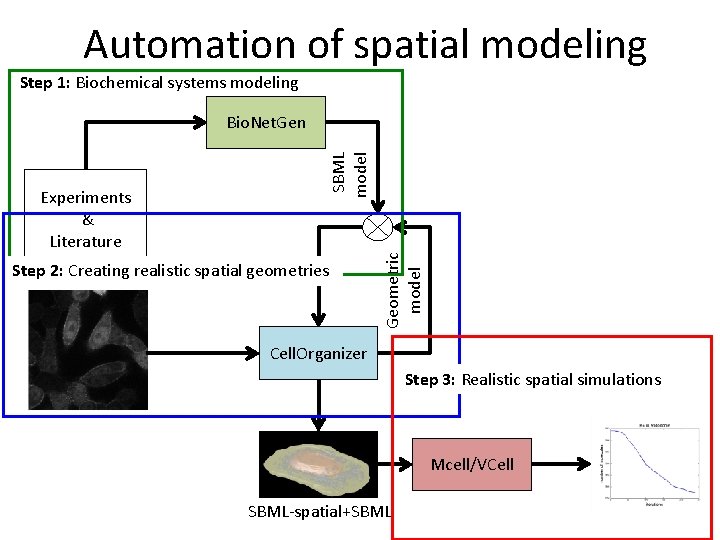
Automation of spatial modeling Step 1: Biochemical systems modeling Step 2: Creating realistic spatial geometries Geometric model Experiments & Literature SBML model Bio. Net. Gen Cell. Organizer Step 3: Realistic spatial simulations Mcell/VCell SBML-spatial+SBML
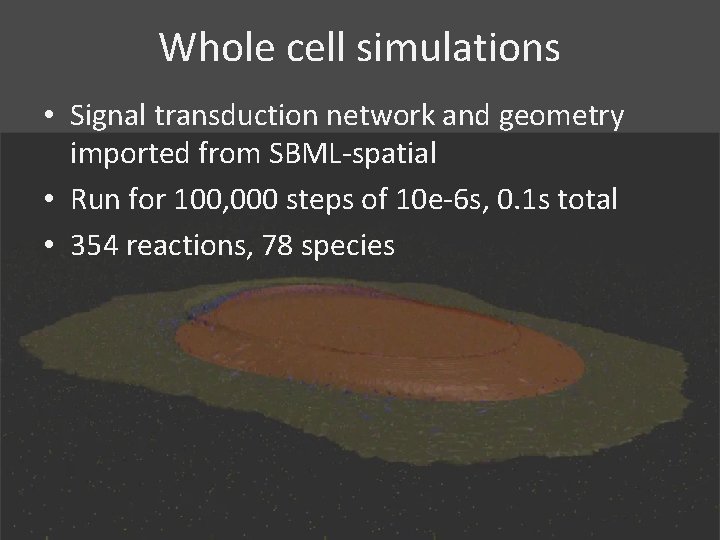
Whole cell simulations • Signal transduction network and geometry imported from SBML-spatial • Run for 100, 000 steps of 10 e-6 s, 0. 1 s total • 354 reactions, 78 species

Conclusions • Can build complex biochemical networks using Rule-based modeling (BNGL) • Can intelligently sample realistic cellular and organelle geometries • Can automatically combine biochemistry with appropriate geometric models • Can simulate whole cell bio-chemical systems in realistic geometries with minimal manual effort • Can now perform high-throughput spatial modeling of cells

Acknowledgments Automation of simulations • Jose Juan Tapia • Jacob Czech • Rohan Arepally • Markus Dittrich Cell. Organizer • Gregory Johnson • Ivan Cao-Berg Advisor Robert Murphy
- Slides: 32