
Tools and Equipments used for Apparel Construction Presented
- Slides: 49
Tools and Equipments used for Apparel Construction Presented by, Dr. Ila Jogi Mahila Mahavdyalaya, Karad
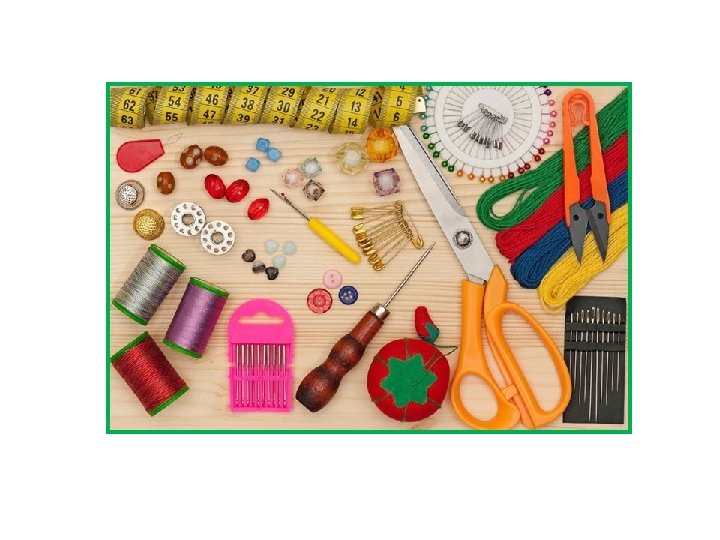
• In the present day culture, sewing has become mostly a mass manufacturing trade. • Sewing tools and equipments are needed for sewing which aid in construction of garments of good quality and appearance. • Sewing equipment and tools will visualise the use of different tools used in apparel construction. A good knowledge of these tools help in using the appropriate tool for overall quality of the product prepared besides making the task of easy for the beginner. • The equipments and tools are broadly categorized into Measuring, Drafting, Marking, Cutting, Sewing and Pressing tools. A box with compartment is necessary to arrange these tools in one place.
Why is it important to know the tools and equipment used in sewing? The importance of defining the tools and equipment in sewing is two-fold. • First, it will give you a way to calculate startup costs and, • Secondly, in learning the functions of sewing tools and equipment, you will be able to define exactly what sort of duties a person in this industry performs.
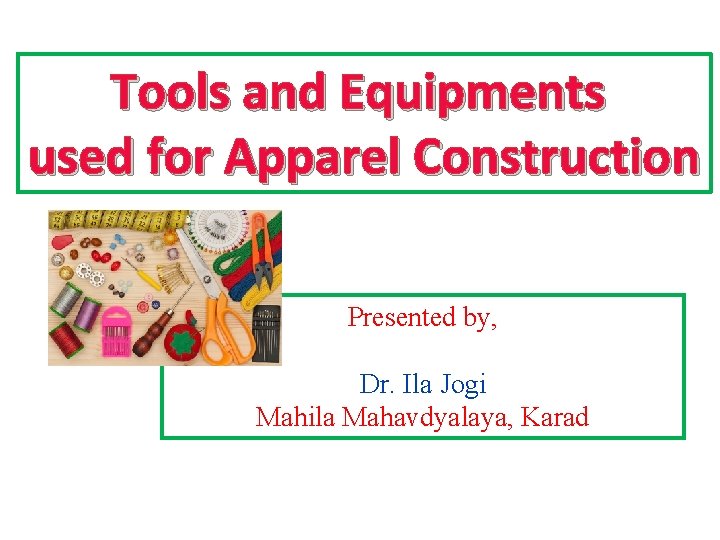
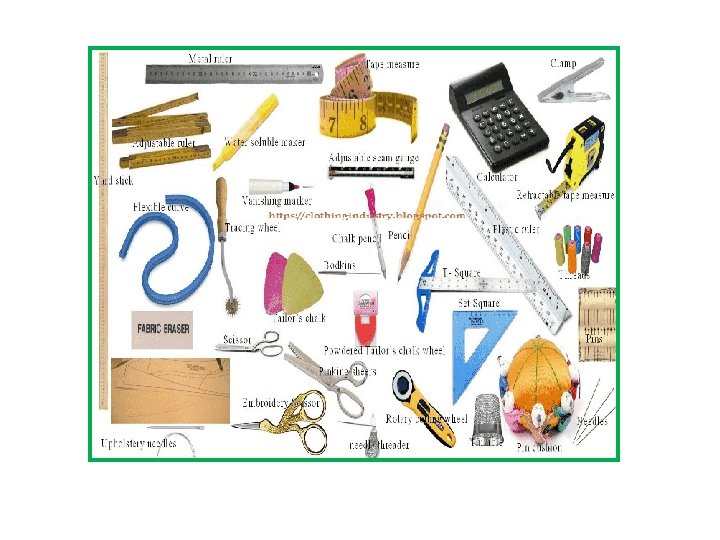
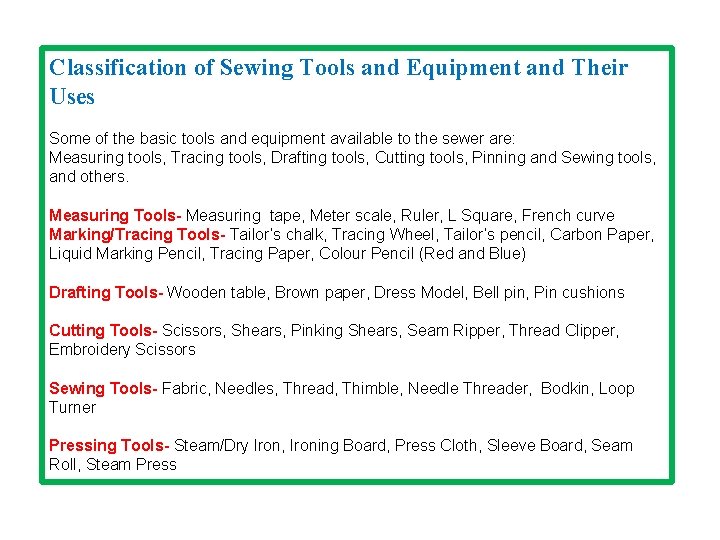
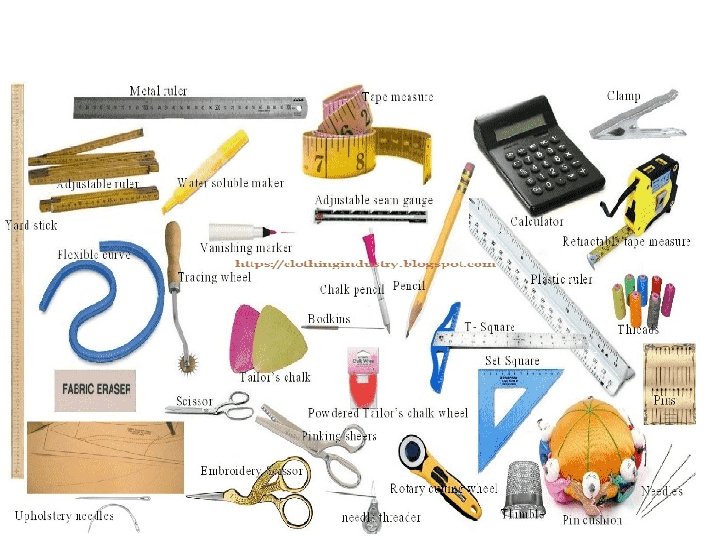
Classification of Sewing Tools and Equipment and Their Uses Some of the basic tools and equipment available to the sewer are: Measuring tools, Tracing tools, Drafting tools, Cutting tools, Pinning and Sewing tools, and others. Measuring Tools- Measuring tape, Meter scale, Ruler, L Square, French curve Marking/Tracing Tools- Tailor’s chalk, Tracing Wheel, Tailor’s pencil, Carbon Paper, Liquid Marking Pencil, Tracing Paper, Colour Pencil (Red and Blue) Drafting Tools- Wooden table, Brown paper, Dress Model, Bell pin, Pin cushions Cutting Tools- Scissors, Shears, Pinking Shears, Seam Ripper, Thread Clipper, Embroidery Scissors Sewing Tools- Fabric, Needles, Thread, Thimble, Needle Threader, Bodkin, Loop Turner Pressing Tools- Steam/Dry Iron, Ironing Board, Press Cloth, Sleeve Board, Seam Roll, Steam Press
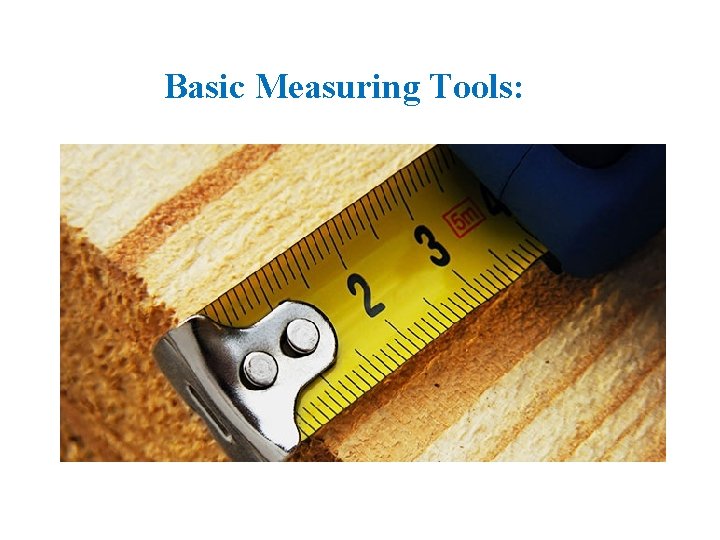
Basic Measuring Tools:
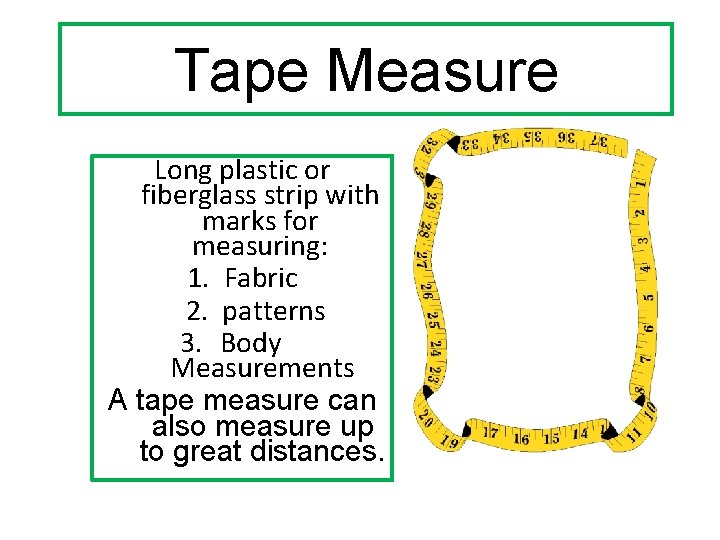
Tape Measure Long plastic or fiberglass strip with marks for measuring: 1. Fabric 2. patterns 3. Body Measurements A tape measure can also measure up to great distances.
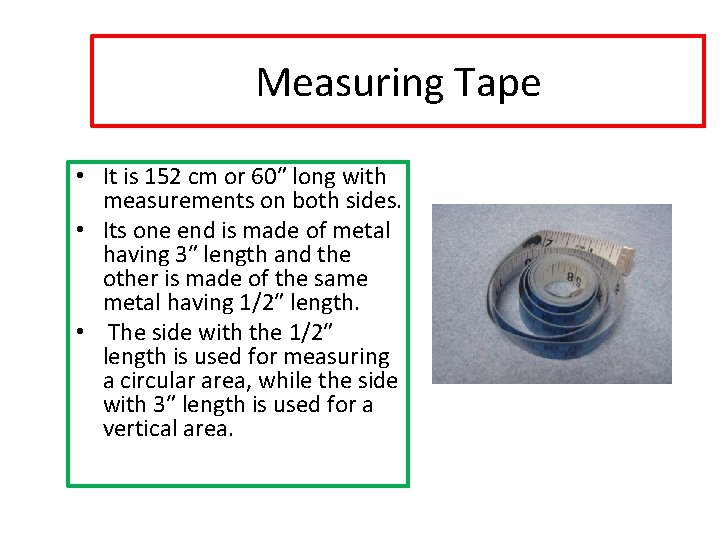
Measuring Tape • It is 152 cm or 60″ long with measurements on both sides. • Its one end is made of metal having 3″ length and the other is made of the same metal having 1/2″ length. • The side with the 1/2″ length is used for measuring a circular area, while the side with 3″ length is used for a vertical area.
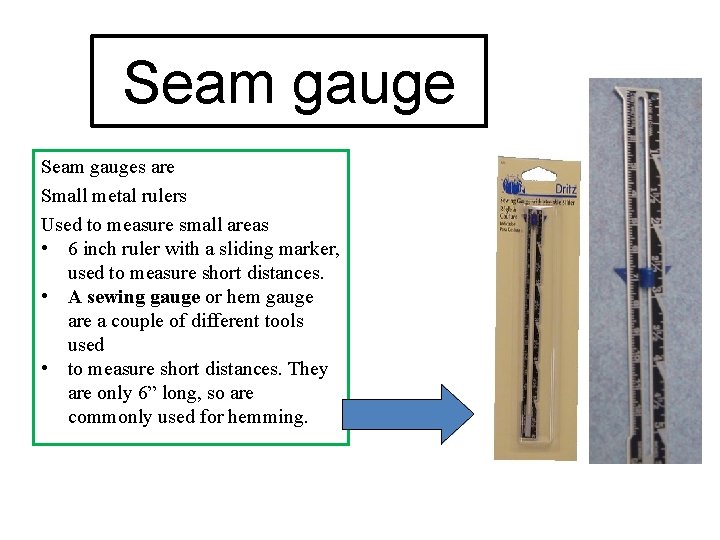
Seam gauges are Small metal rulers Used to measure small areas • 6 inch ruler with a sliding marker, used to measure short distances. • A sewing gauge or hem gauge are a couple of different tools used • to measure short distances. They are only 6” long, so are commonly used for hemming.
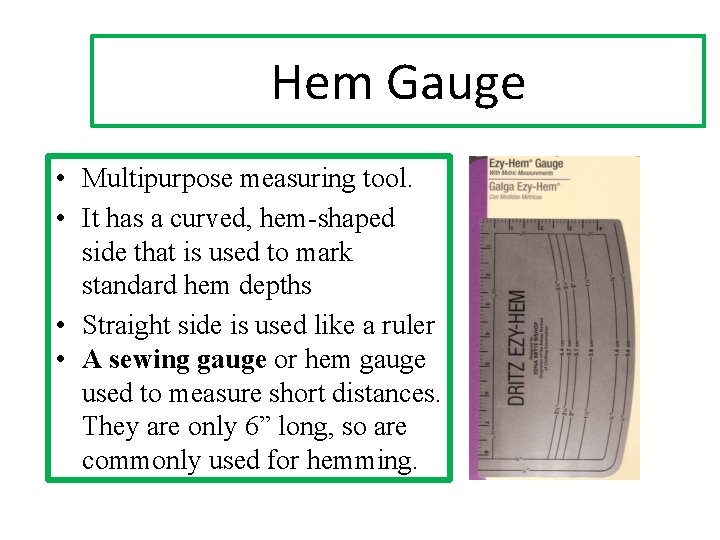
Hem Gauge • Multipurpose measuring tool. • It has a curved, hem-shaped side that is used to mark standard hem depths • Straight side is used like a ruler • A sewing gauge or hem gauge used to measure short distances. They are only 6” long, so are commonly used for hemming.
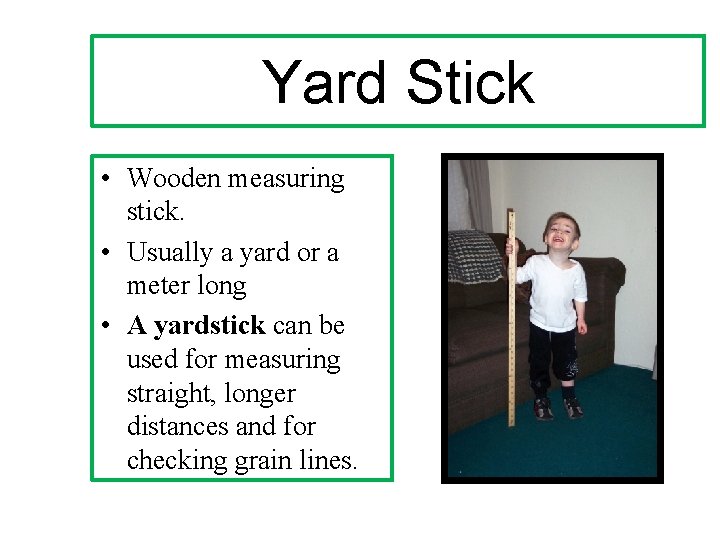
Yard Stick • Wooden measuring stick. • Usually a yard or a meter long • A yardstick can be used for measuring straight, longer distances and for checking grain lines.
Measuring stand • Measuring stand: This stand is used to measure long garments such as long overcoats, frocks or gowns, as well as flare of the garment. In this stand, a rod of aluminium is fitted on the stand. The rod has a graduated scale, which gives the vertical measurement.
Drafting Tools • • • Drafting equipment is used for making paper patterns. This is the second stage of pattern making. Using the measurements taken, the drafting is carried out according to the design of a garment. The following drafting equipment is used: L-scale: It is called a triscale or L-scale and is made of wood or steel. The L-scale has one arm, which measures 12″ and the other arm is 24″. It is used for drafting on brown paper to draw perpendicular lines. Leg shaper: It is made of wood or plastic. Either 24″ or 36″ lengths are available. It is used to measure and shape the interior part of the leg Tailor’s art curve: It is made of plastic or wood. This is used to draw curves in the drafting. French curve: This is made of transparent plastic. It helps in marking shapes of the neck, depth of sides and bottom of the garments. Compass: It is mainly used for making a curve for umbrella cloth. Drafting table: It is a wooden table of 3′ height, 4′ wide and 6′ long. The surface should be smooth and firm.
Drafting Tools • Milton cloth: It is a thick, blue coloured woolen cloth used for drafting. It is mostly used for practising drafts by students. The surface can be brushed and reused until correct drafting is obtained. • Brush: A brush is used on Milton cloth to rub the mistakes while drafting. • Brown paper: It is used for drafting by placing on the drafting table. While using brown paper, a grain line should be followed. Pencil: Pencil is used for marking on brown paper. Rubber: It is frequently used for deleting mistakes. Good quality rubber, which does not leave black lines, should be selected. • Sewing table: Sewing table is necessary for laying out your patterns, fabrics, and for keeping your tools all in one place. You might prefer a table that can be lowered or raised, depending on whether you prefer to sit or stand.
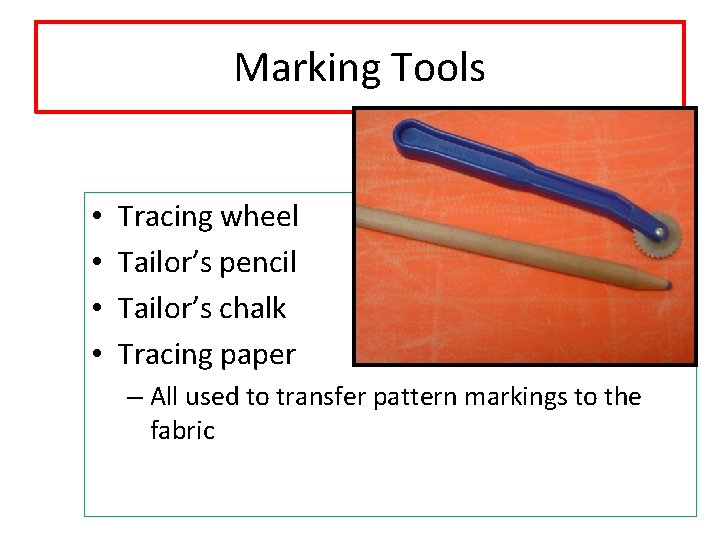
Marking Tools • • Tracing wheel Tailor’s pencil Tailor’s chalk Tracing paper – All used to transfer pattern markings to the fabric
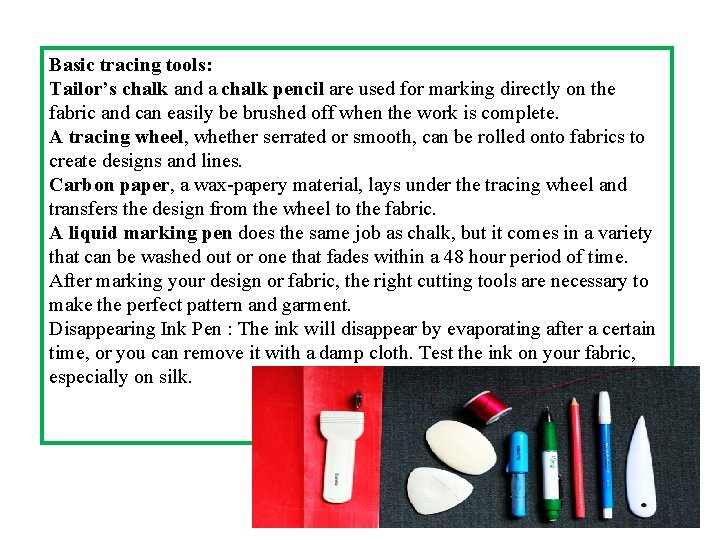
Basic tracing tools: Tailor’s chalk and a chalk pencil are used for marking directly on the fabric and can easily be brushed off when the work is complete. A tracing wheel, whether serrated or smooth, can be rolled onto fabrics to create designs and lines. Carbon paper, a wax-papery material, lays under the tracing wheel and transfers the design from the wheel to the fabric. A liquid marking pen does the same job as chalk, but it comes in a variety that can be washed out or one that fades within a 48 hour period of time. After marking your design or fabric, the right cutting tools are necessary to make the perfect pattern and garment. Disappearing Ink Pen : The ink will disappear by evaporating after a certain time, or you can remove it with a damp cloth. Test the ink on your fabric, especially on silk.
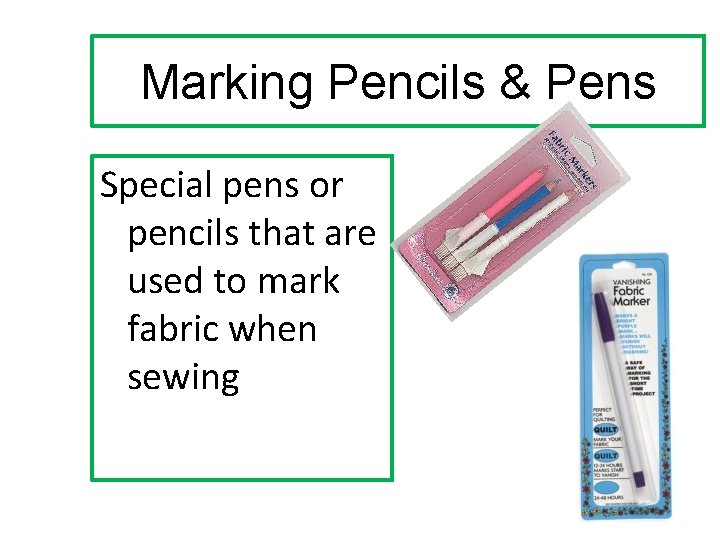
Marking Pencils & Pens Special pens or pencils that are used to mark fabric when sewing
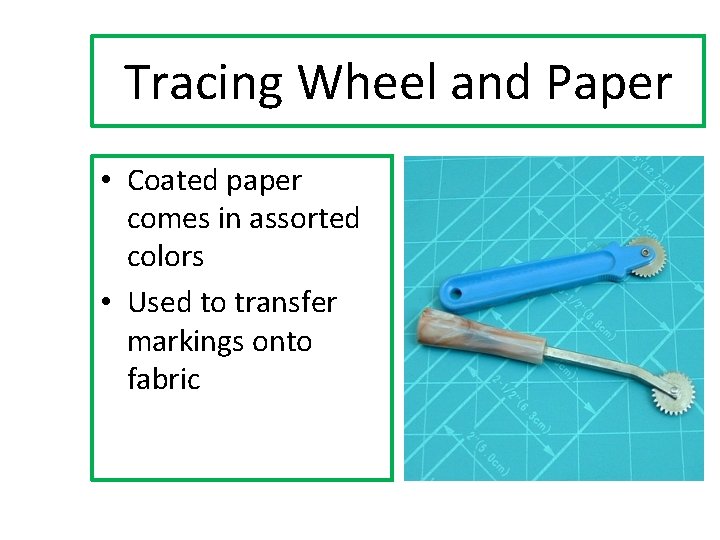
Tracing Wheel and Paper • Coated paper comes in assorted colors • Used to transfer markings onto fabric
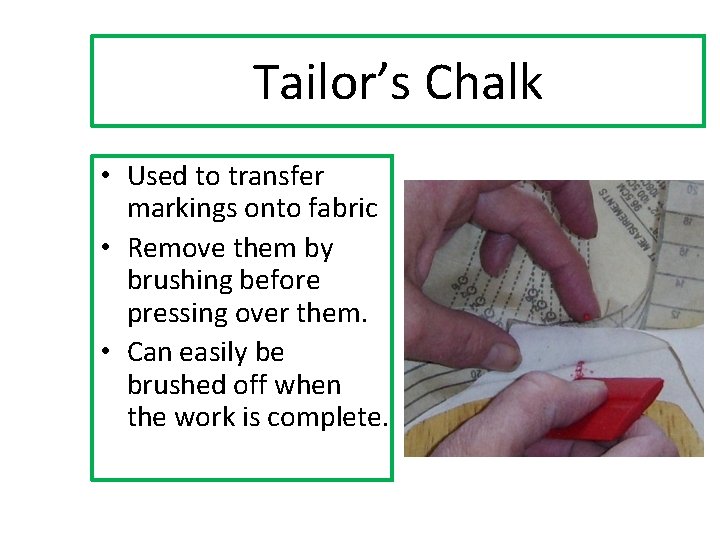
Tailor’s Chalk • Used to transfer markings onto fabric • Remove them by brushing before pressing over them. • Can easily be brushed off when the work is complete.
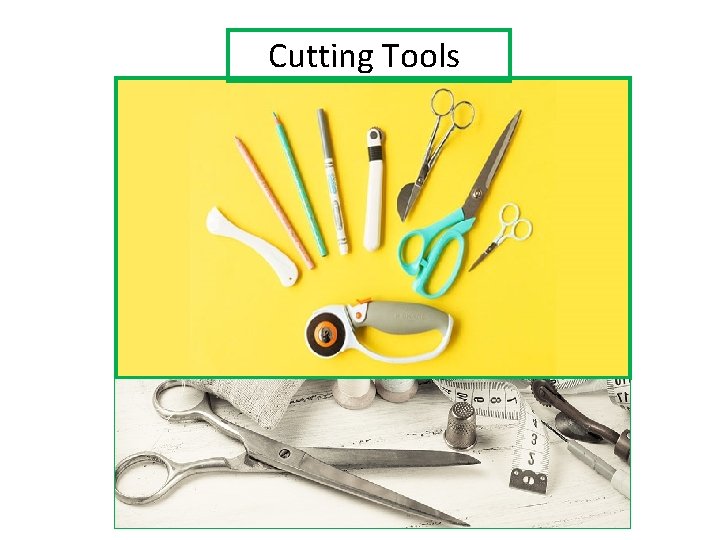
Cutting Tools
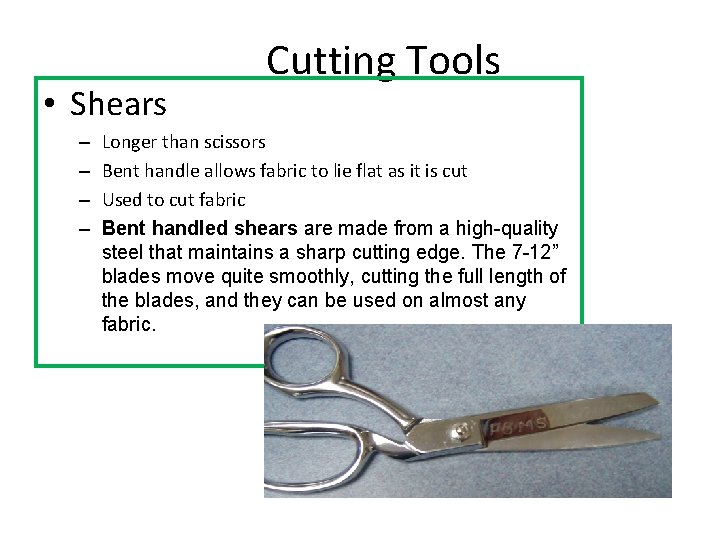
• Shears – – Cutting Tools Longer than scissors Bent handle allows fabric to lie flat as it is cut Used to cut fabric Bent handled shears are made from a high-quality steel that maintains a sharp cutting edge. The 7 -12” blades move quite smoothly, cutting the full length of the blades, and they can be used on almost any fabric.
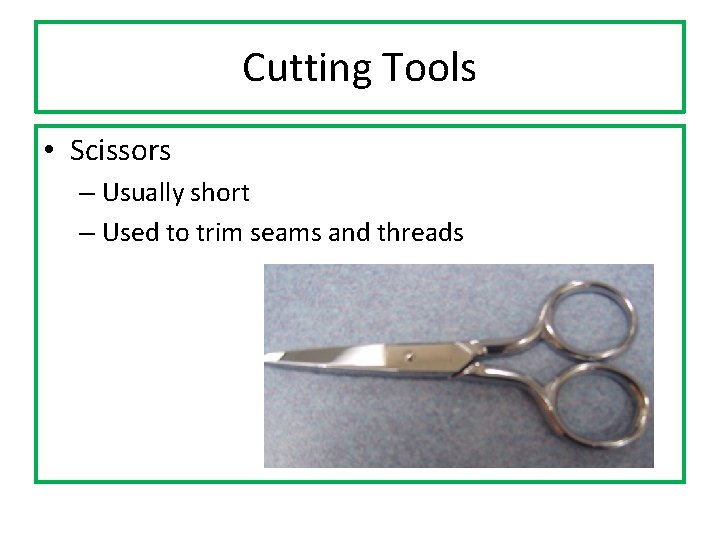
Cutting Tools • Scissors – Usually short – Used to trim seams and threads
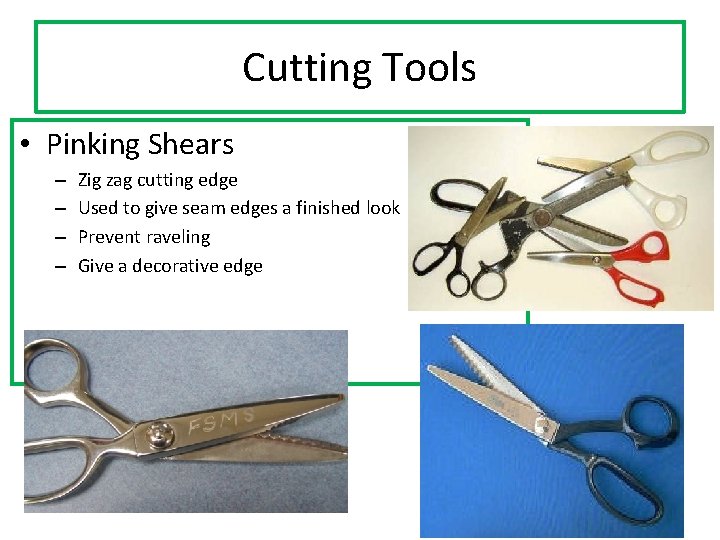
Cutting Tools • Pinking Shears – – Zig zag cutting edge Used to give seam edges a finished look Prevent raveling Give a decorative edge
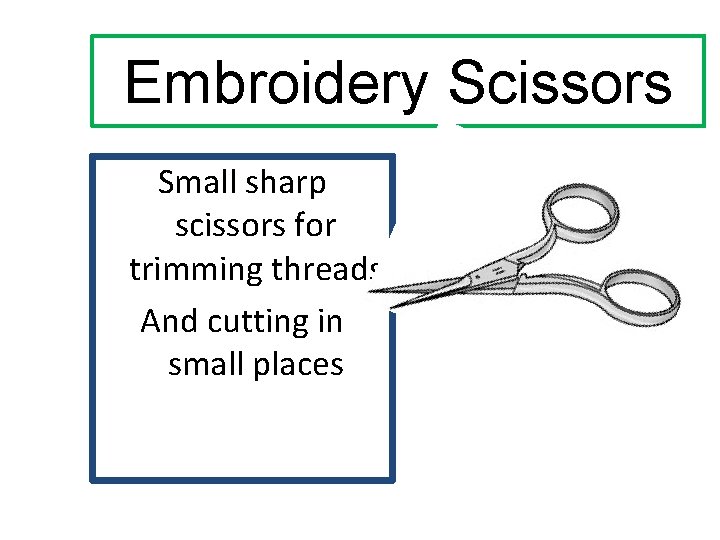
Embroidery Scissors Small sharp scissors for trimming threads And cutting in small places
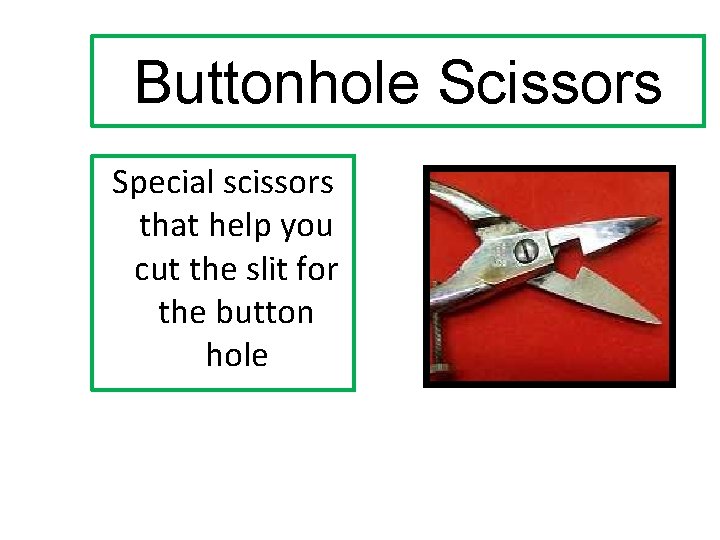
Buttonhole Scissors Special scissors that help you cut the slit for the button hole
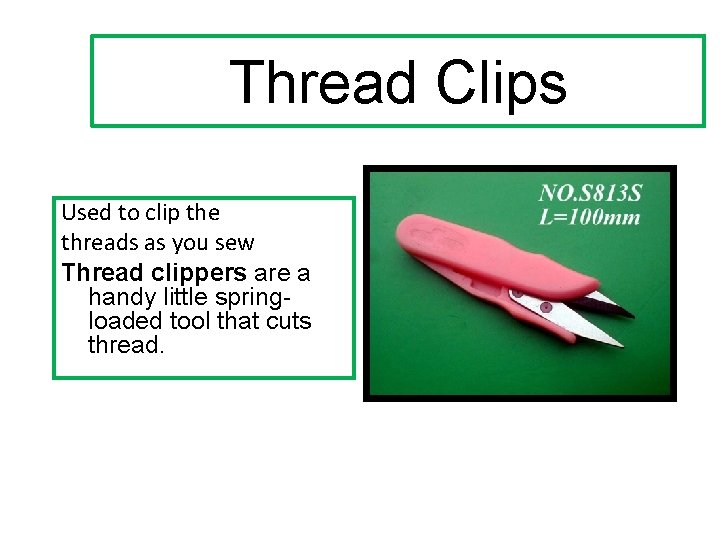
Thread Clips Used to clip the threads as you sew Thread clippers are a handy little springloaded tool that cuts thread.
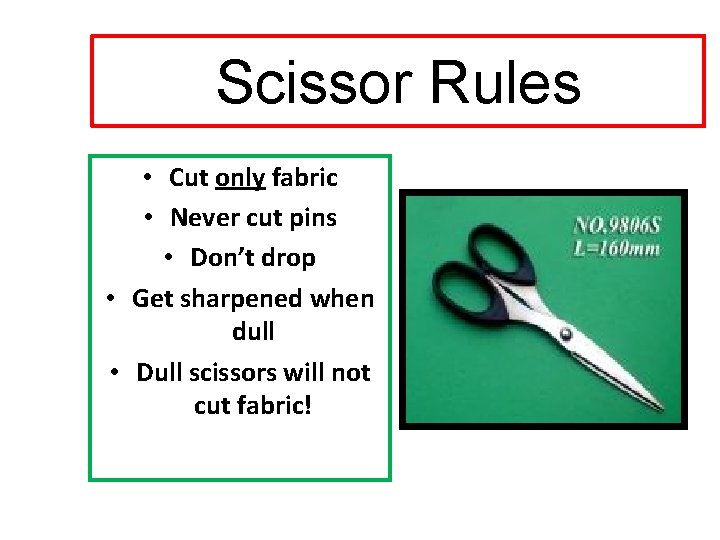
Scissor Rules • Cut only fabric • Never cut pins • Don’t drop • Get sharpened when dull • Dull scissors will not cut fabric!
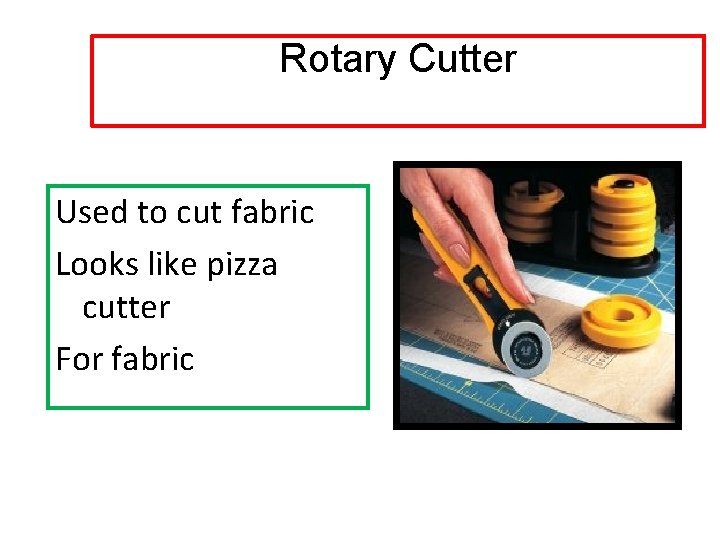
Rotary Cutter Used to cut fabric Looks like pizza cutter For fabric
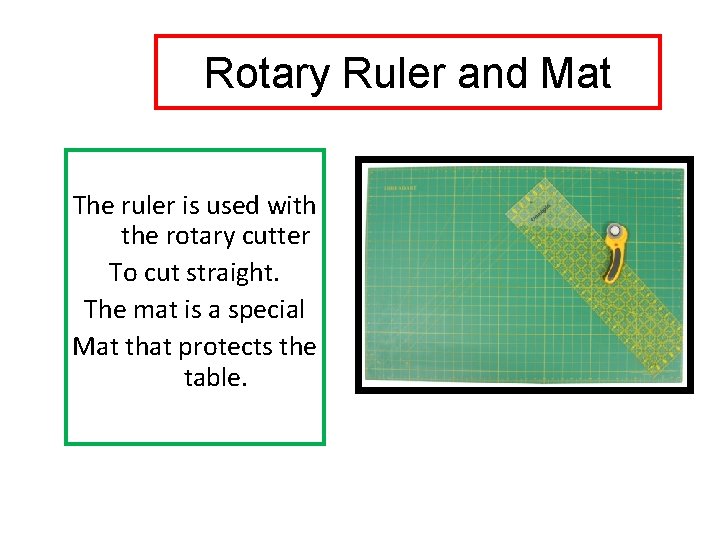
Rotary Ruler and Mat The ruler is used with the rotary cutter To cut straight. The mat is a special Mat that protects the table.
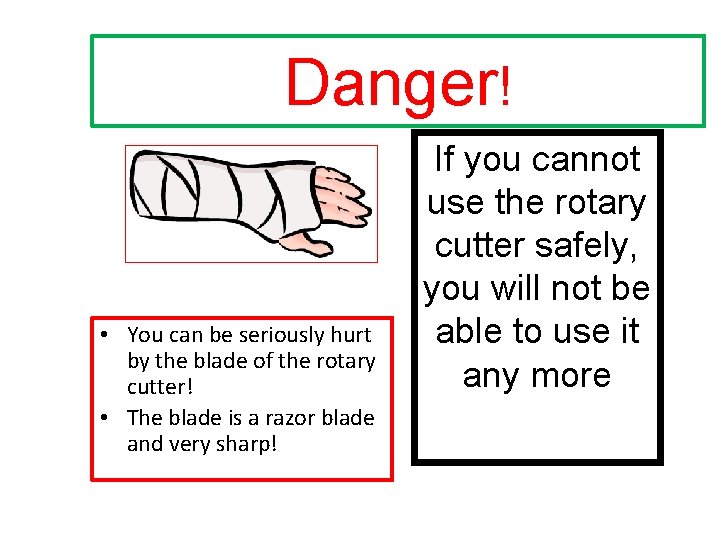
Danger! • You can be seriously hurt by the blade of the rotary cutter! • The blade is a razor blade and very sharp! If you cannot use the rotary cutter safely, you will not be able to use it any more
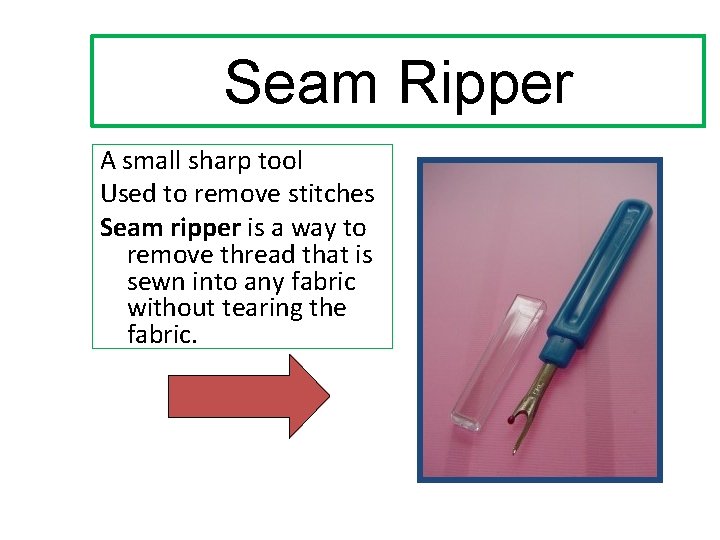
Seam Ripper A small sharp tool Used to remove stitches Seam ripper is a way to remove thread that is sewn into any fabric without tearing the fabric.
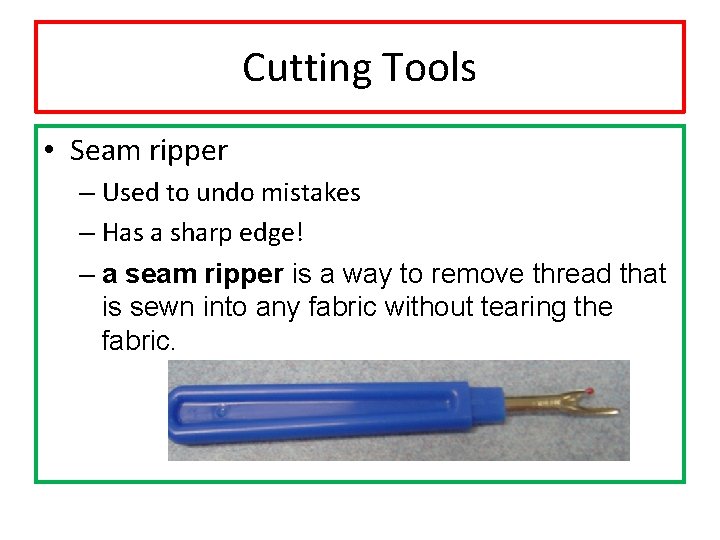
Cutting Tools • Seam ripper – Used to undo mistakes – Has a sharp edge! – a seam ripper is a way to remove thread that is sewn into any fabric without tearing the fabric.
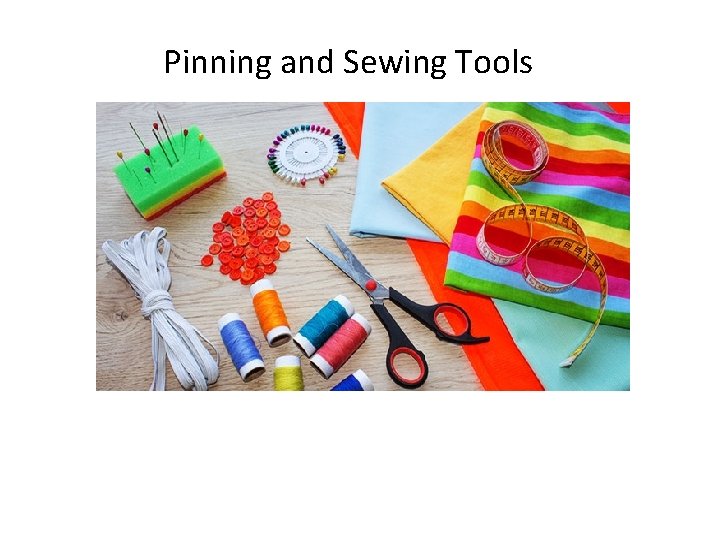
Pinning and Sewing Tools
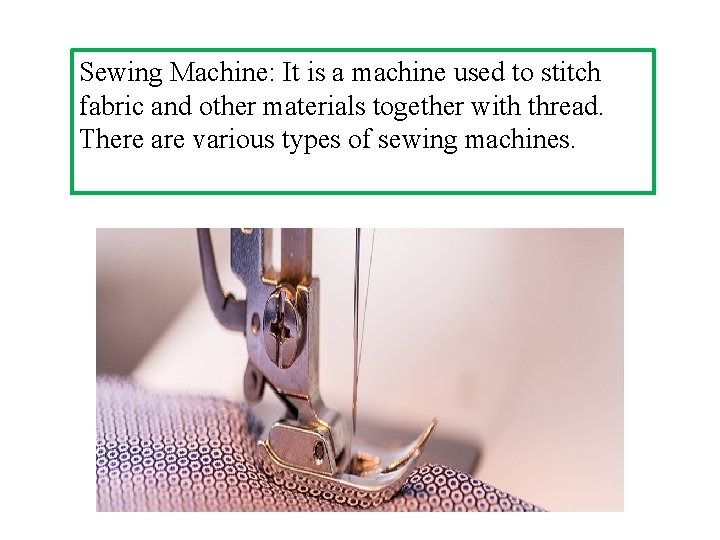
Sewing Machine: It is a machine used to stitch fabric and other materials together with thread. There are various types of sewing machines.
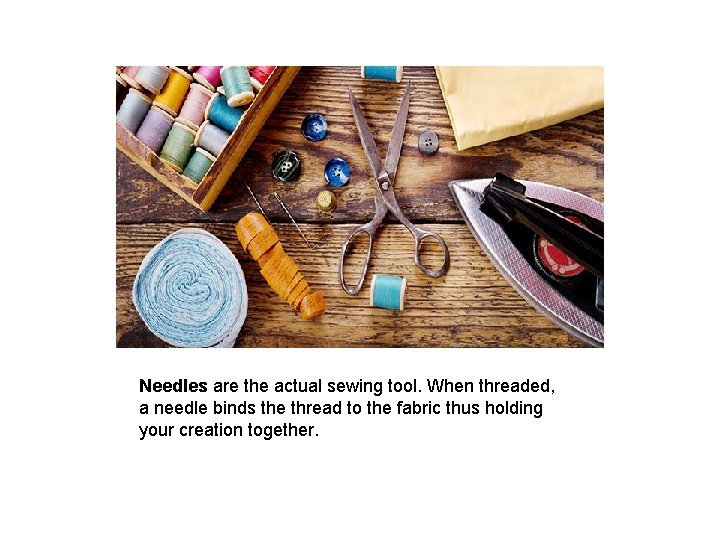
Needles are the actual sewing tool. When threaded, a needle binds the thread to the fabric thus holding your creation together.
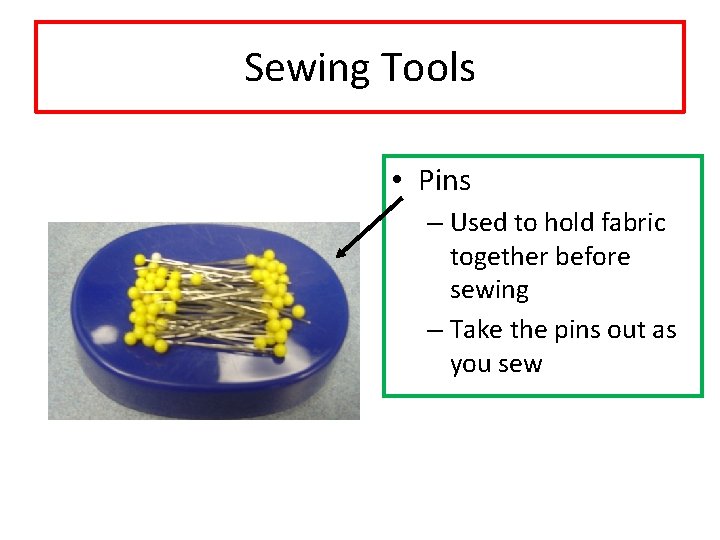
Sewing Tools • Pins – Used to hold fabric together before sewing – Take the pins out as you sew
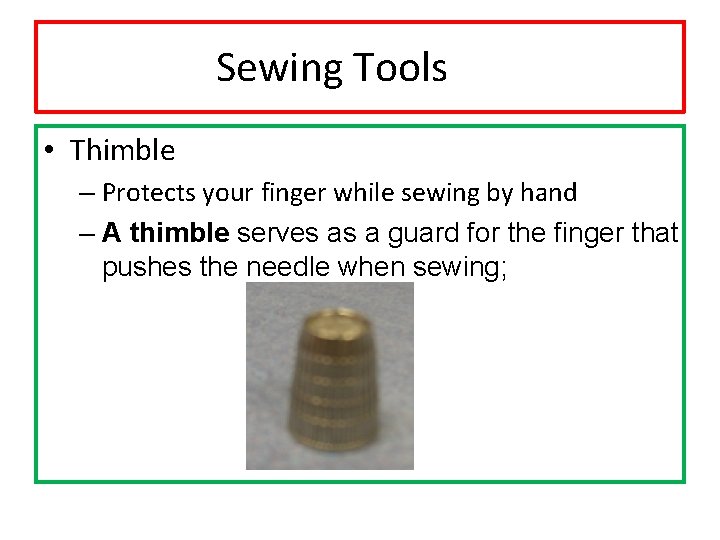
Sewing Tools • Thimble – Protects your finger while sewing by hand – A thimble serves as a guard for the finger that pushes the needle when sewing;
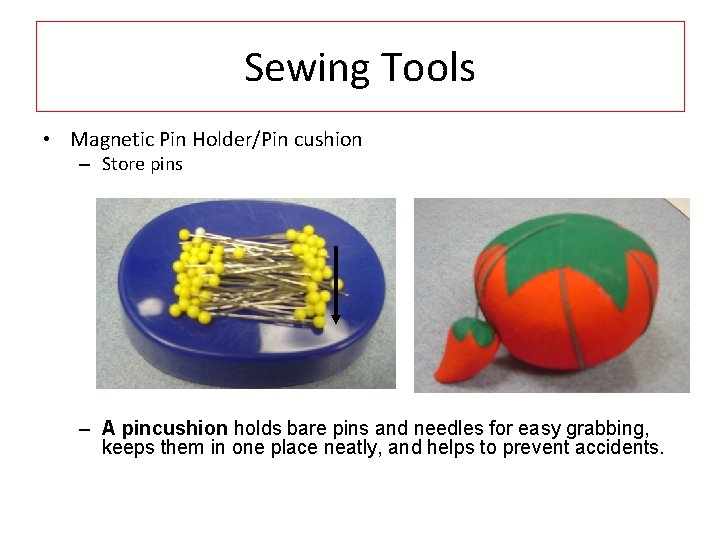
Sewing Tools • Magnetic Pin Holder/Pin cushion – Store pins – A pincushion holds bare pins and needles for easy grabbing, keeps them in one place neatly, and helps to prevent accidents.
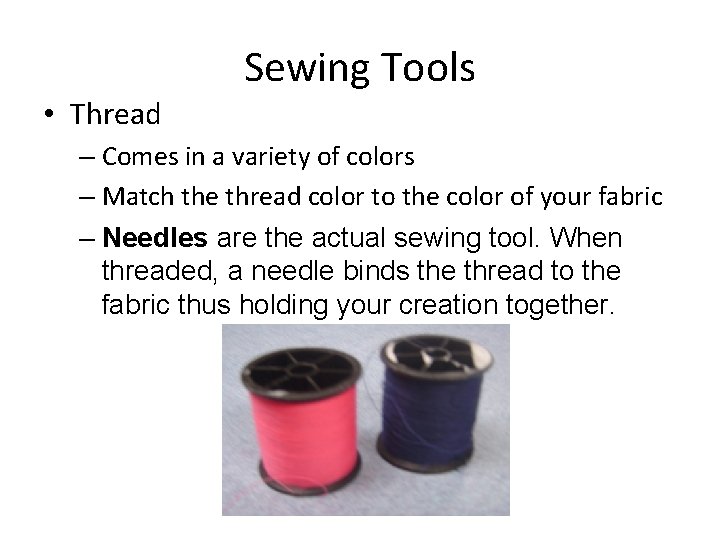
• Thread Sewing Tools – Comes in a variety of colors – Match the thread color to the color of your fabric – Needles are the actual sewing tool. When threaded, a needle binds the thread to the fabric thus holding your creation together.
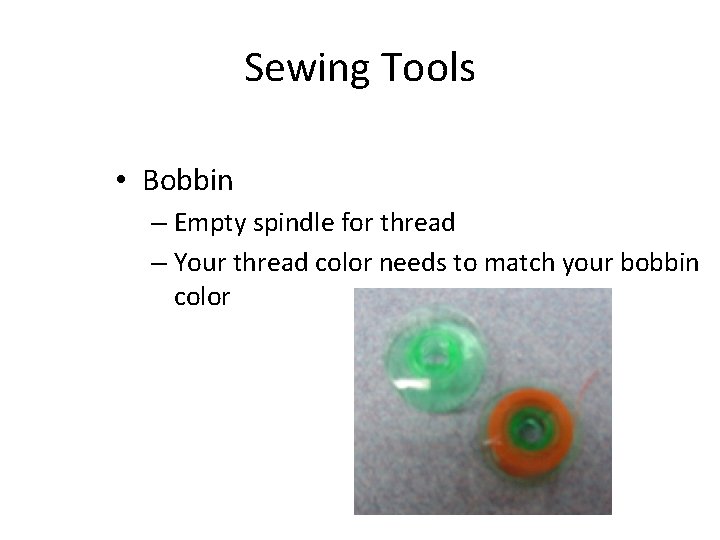
Sewing Tools • Bobbin – Empty spindle for thread – Your thread color needs to match your bobbin color
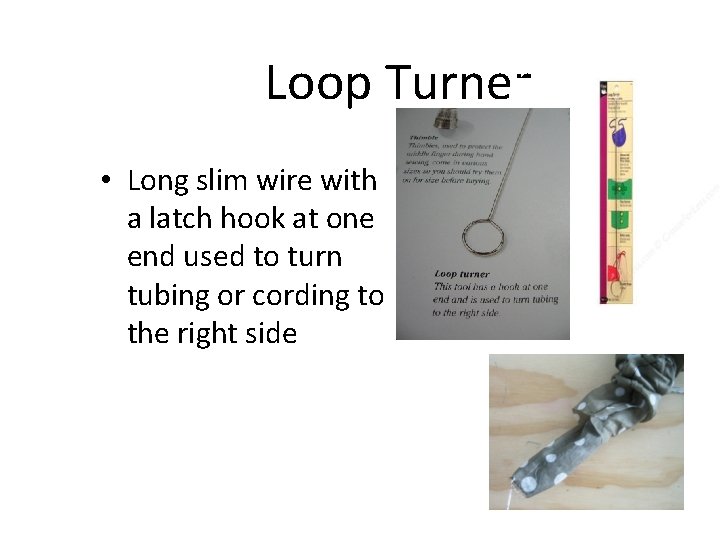
Loop Turner • Long slim wire with a latch hook at one end used to turn tubing or cording to the right side
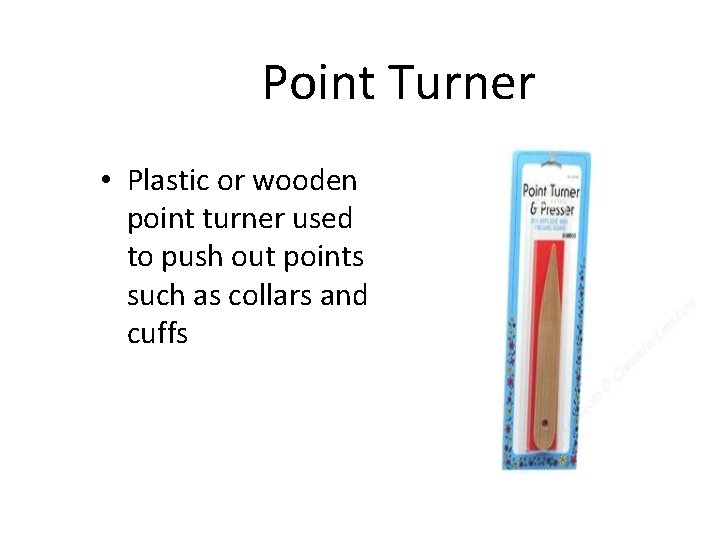
Point Turner • Plastic or wooden point turner used to push out points such as collars and cuffs
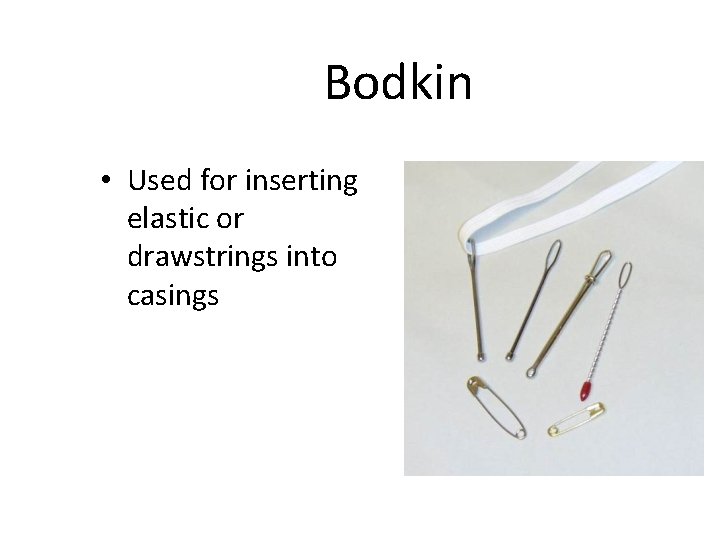
Bodkin • Used for inserting elastic or drawstrings into casings
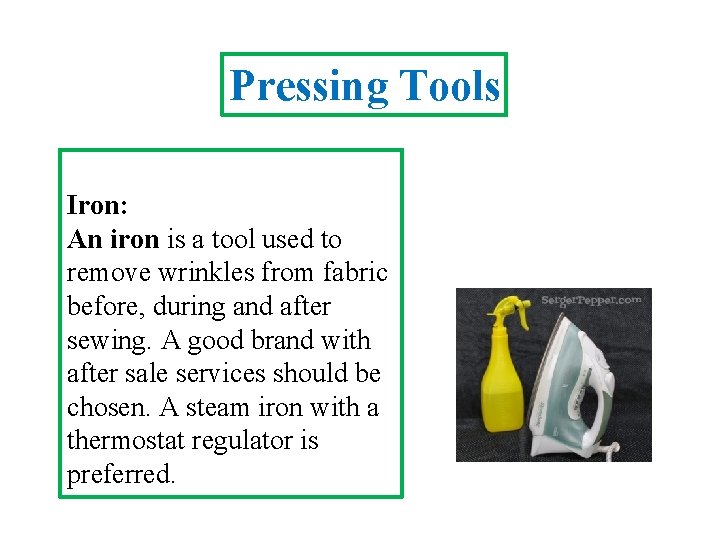
Pressing Tools Iron: An iron is a tool used to remove wrinkles from fabric before, during and after sewing. A good brand with after sale services should be chosen. A steam iron with a thermostat regulator is preferred.
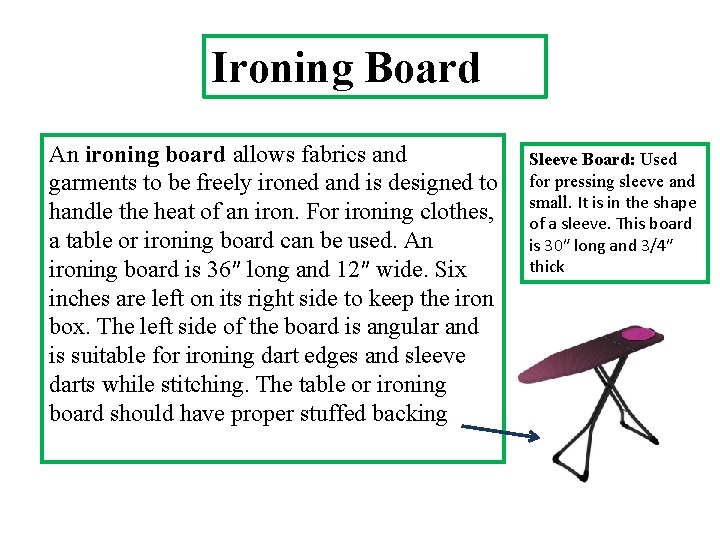
Ironing Board An ironing board allows fabrics and garments to be freely ironed and is designed to handle the heat of an iron. For ironing clothes, a table or ironing board can be used. An ironing board is 36″ long and 12″ wide. Six inches are left on its right side to keep the iron box. The left side of the board is angular and is suitable for ironing dart edges and sleeve darts while stitching. The table or ironing board should have proper stuffed backing Sleeve Board: Used for pressing sleeve and small. It is in the shape of a sleeve. This board is 30″ long and 3/4″ thick
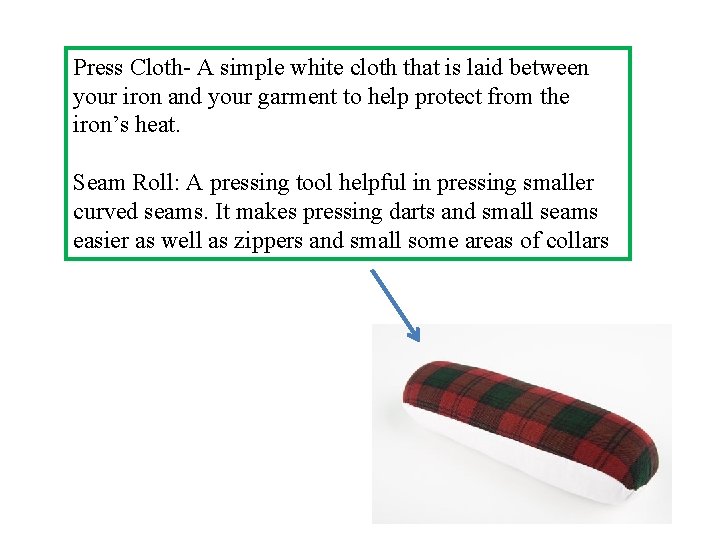
Press Cloth- A simple white cloth that is laid between your iron and your garment to help protect from the iron’s heat. Seam Roll: A pressing tool helpful in pressing smaller curved seams. It makes pressing darts and small seams easier as well as zippers and small some areas of collars
n a Th … u o y k