
TOOLKIT TO BETTER UNDERSTAND THE ACGME RESIDENT SURVEY
TOOLKIT TO BETTER UNDERSTAND THE ACGME RESIDENT SURVEY BROUGHT TO YOU BY APDIM COUNCIL JANUARY 2020
THE PURPOSE OF THE SURVEY • The survey is conducted annually and contains questions about your clinical and educational experiences as well as your learning environment • The data gathered in the survey is confidential and only aggregate program level data is provided by the ACGME to administrators and program directors • The ACGME uses data from the resident survey as one of several tools that help determine program accreditation and to identify any potential problem areas in a program
SURVEY IS FOR YOUR CURRENT ACADEMIC YEAR EXPERIENCE • The survey is asking you about your experience over the course of the current academic year (from July 1 to June 30) • This includes your experience in the inpatient and outpatient settings, so please consider the entire year in your replies
SOME TERMS ARE CONFUSING. . . • In-House Call: In-house call refers to duty hours in addition to the regular resident workday that are spent within an institution so that residents are immediately available, as needed, for clinical duties. In-house call does NOT include night float, being on call from home, or regularly scheduled overnight duties. In-house call refers to resident shifts that approach or exceed 24 hours • The Q 3 limit applies to overnight in-house call, not to shorter shifts. The Q 3 limit does not apply to a series of night shifts without daytime assignments (which would be a night float rotation) • Night float: Is a rotation designed to eliminate in-house call or assist other residents during the night
SOME TERMS ARE CONFUSING. . . • Cross-coverage is the term used to describe coverage of patients that a team member would provide for another resident on their patient care team. For example, if John and Mary are interns on the same team, Mary would provide cross-coverage of John’s patients on Saturday when John has the day off, and John would provide cross-coverage of Mary’s patients on Sunday when Mary has the day off • Assignment is synonymous with a clinical rotation (not a writing or reflective assignment)
EDUCATION VS. NON-PHYSICIAN OBLIGATIONS • Education includes providing care for patients in the clinical setting, in addition to didactic and small group teaching sessions • Non-physician obligations: are those duties which in most institutions are performed by nursing and allied health professionals, transport services or clerical staff. It is understood that while residents, like nonresident physicians, may be expected to do any of these things on occasion, these should not be performed routinely by residents and must be kept to a minimum to optimize resident education. Examples: – transport of patients from the wards or units for procedures elsewhere in the hospital – routine blood drawing for lab tests – routine monitoring of patients when off the ward – clerical duties such as scheduling tests and appointments
WORK HOURS • Clinical and educational work periods must not exceed 24 hours of continuous scheduled clinical assignments, with an additional 4 hours which may be used for activities related to patient safety, such as transitions of care and/or resident education • Additional new patient care responsibilities must not occur during these 4 hours. In rare circumstances, a resident may stay to care for a severely ill patient, attend to the humanistic needs of a patient or family, or attend a unique educational event
WORK HOURS CONTINUED • The 80 hours limit and 1 day off in 7 are averaged over 4 weeks. For example, it is allowable to work 90 hours one week, as long as you work 70 hours in another. It is allowable to have 0 days off one week, and 2 days off the next • Included in the work hours are all in-house clinical and educational activities, clinical work done from home, and all moonlighting. Residents must have at least 14 hours free of clinical work and education after 24 hours of in-house call • See specifics on the next slide • See NY State exception on slide 10
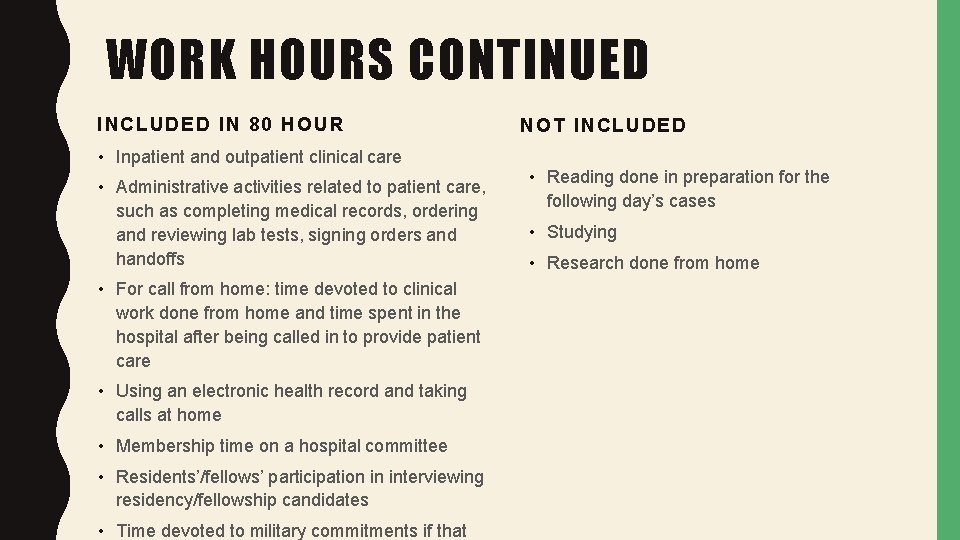
WORK HOURS CONTINUED INCLUDED IN 80 HOUR NOT INCLUDED • Inpatient and outpatient clinical care • Administrative activities related to patient care, such as completing medical records, ordering and reviewing lab tests, signing orders and handoffs • For call from home: time devoted to clinical work done from home and time spent in the hospital after being called in to provide patient care • Using an electronic health record and taking calls at home • Membership time on a hospital committee • Residents’/fellows’ participation in interviewing residency/fellowship candidates • Time devoted to military commitments if that • Reading done in preparation for the following day’s cases • Studying • Research done from home
WORK HOURS: NY STATE EXCEPTION In NY state, the Bell Commission requires 1 day off in 7 with no averaging. On week 1 you can be off on Sunday and work Monday through Saturday and during Week 2 work Sunday through Friday and be off on Saturday
DATA ABOUT PRACTICE HABITS • Residents receive information about their practice habits. Examples may include hospital core measures relevant to the specialty as a whole, QI projects outcomes, hand hygiene data, or any data from the hospital about your habits as a group • This can also be data from the ambulatory setting including your panel data on chronic disease and preventive measures that you receive in clinic
OPPORTUNITY FOR SCHOLARLY ACTIVITY Scholarly activity opportunities include: • PMID articles (publications in Pub Med) • Conference presentations (abstracts, posters, and presentations at international, regional meetings) • Quality improvement projects • Case reports • Chapters or textbooks published • Participation in funded or non-funded basic science or clinical outcomes research project • Lecture or presentation (such as grand rounds, or case presentations of at least 30 minutes duration) within the sponsoring institution or program • This does not necessarily mean you had to partake of the opportunity as the question is asking if the opportunity is available to residents
WORKING IN AN INTERPROFESSIONAL TEAM • Interprofessional teams are those that include any of the following: fellows, nurses, pharmacists, case managers, social workers, and other allied health personnel • The teams do not have to be embedded into your rounding time, and can be external to rounding time in the inpatient setting • In clinic or ambulatory settings, this includes all work with nurses, medical assistants, pharmacists, case managers, and social workers; even if this does not occur during the patient visit
FEEDBACK AFTER ASSIGNMENTS • ACGME defines “assignments” as rotations • While you may have other assignments such as scholarly work, journal clubs, and the like that are specific to your program, this is not the purpose of this question • Feedback can be written (as in a written evaluation) or verbal – the ACGME may ask you about both
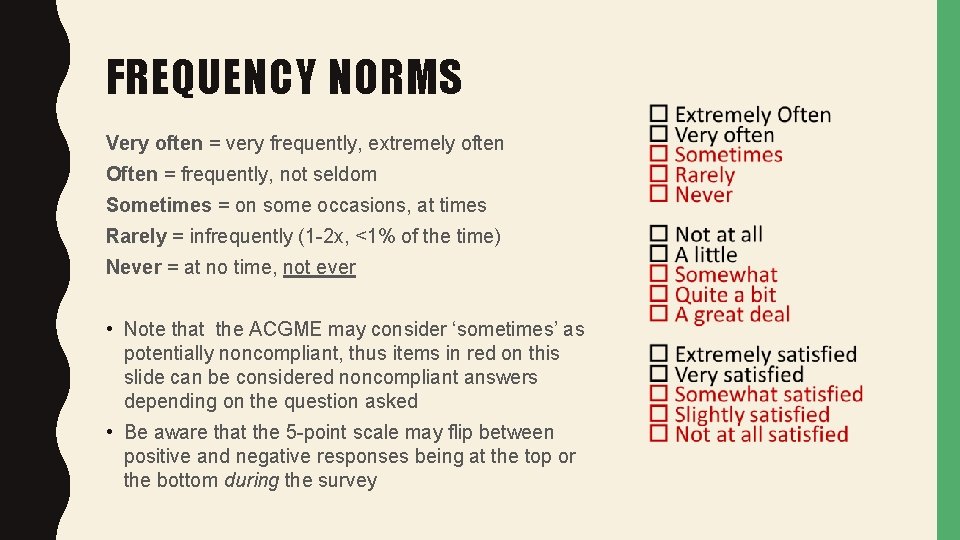
FREQUENCY NORMS Very often = very frequently, extremely often Often = frequently, not seldom Sometimes = on some occasions, at times Rarely = infrequently (1 -2 x, <1% of the time) Never = at no time, not ever • Note that the ACGME may consider ‘sometimes’ as potentially noncompliant, thus items in red on this slide can be considered noncompliant answers depending on the question asked • Be aware that the 5 -point scale may flip between positive and negative responses being at the top or the bottom during the survey
TRANSITIONING CARE WHEN FATIGUED • The question is asking whethere are mechanisms in place that allow residents to transition care when they are fatigued • This can include a jeopardy system to take over call, a coverage system among in-house residents to allow the fatigued resident to go off duty, a coverage system where the fellow or attending takes over call, a way to “stop” new admits or duties and transition to another care team member
LOGISTICS OF THE SURVEY • Your program will let you know when the survey is scheduled – typically it is a 5 -week window in early spring • You will receive an email from the ACGME with instructions for taking the survey. This email may get routed to your junk mail folder so please check you junk mail if you can’t find the email • The ACGME encourages you to ask your program for clarification regarding questions or terminology used in the survey that you do not understand
- Slides: 17