
TOOLBOX TALK SILICA DUST For Managers and OHS
TOOLBOX TALK. SILICA DUST For Managers and OHS Officers Know the exposure, use the controls, reduce your risk cancer. org. au/workplacecancer For information and support call us on 13 11 20 | KNOW Workplace Cancer Managers and OHS Officers Toolbox Talk Silica
Silica Dust: The Risks Introducing the risks from silica dust – a briefing for managers 2| KNOW Workplace Cancer Managers and OHS Officers Toolbox Talk Silica
Silica dust can give you cancer. 3| KNOW Workplace Cancer Managers and OHS Officers Toolbox Talk Silica
Setting the scene. • Silica is a natural mineral that makes up a large part of materials like sandstone and granite • Engineered or artificial stone benchtops contain up to 95% silica • It’s also found in many common products such as concrete and bricks • Silica dust is created when silica is broken down and released into the air when people carry out tasks such as cutting, drilling or grinding • Breathing in silica dust can damage people’s lungs and can lead to serious diseases, including lung cancer and silicosis 4| KNOW Workplace Cancer Managers and OHS Officers Toolbox Talk Silica
Why is this our problem? • We need to consider our workers and their exposure to silica dust • As a responsible business, we want to make sure that people don’t get harmed at work • In Australia, there is a legal duty to check the level of risk from silica dust exposure • By law, employers are required to ensure the health and safety of their workers at their workplace and have the duty to control the risks associated with work • … Are our competitors or suppliers doing this better than us? 5| KNOW Workplace Cancer Managers and OHS Officers Toolbox Talk Silica
In Australia 600, 000 workers exposed to silica dust at work each year 6| KNOW Workplace Cancer Managers and OHS Officers Toolbox Talk Silica
An estimated 5758 of these workers will develop lung cancer over the course of their life 7| KNOW Workplace Cancer Managers and OHS Officers Toolbox Talk Silica
Recommended exposure limit • The mandatory limit for silica dust exposure in Australia is currently 0. 1 mg/m 3 over an eight-hour day • This is currently under review by Safe Work Australia and it has been proposed to reduce this to 0. 05 mg/m 3 • There is currently no evidence to suggest there is a safe level of silica dust exposure 8| KNOW Workplace Cancer Managers and OHS Officers Toolbox Talk Silica
What’s our first step? Check if: • Employees are working with materials containing silica • Silica dust levels in your workplace has potential to exceed the exposure limit (an occupational hygienist can assist with this) • Recommended control measures are in place to reduce exposure 9| KNOW Workplace Cancer Managers and OHS Officers Toolbox Talk Silica
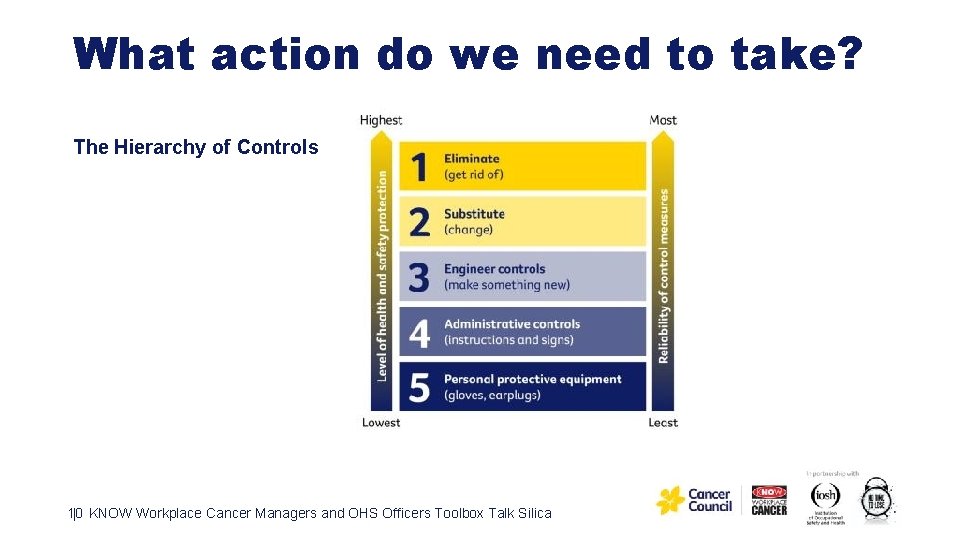
What action do we need to take? The Hierarchy of Controls 10 | KNOW Workplace Cancer Managers and OHS Officers Toolbox Talk Silica
What action do we need to take? There are things we can do to safeguard our workforce, for example: • Using materials with lower silica levels; eliminate the use of artificial stone • Selecting the correct equipment for the job with dust suppression features • Use local exhaust ventilation systems • Ensure tools have on-tool extraction • Use water suppression whenever possible • Wear properly fitting respiratory protective equipment 11 | KNOW Workplace Cancer Managers and OHS Officers Toolbox Talk Silica
Thank you for listening. cancer. org. au/workplacecancer For information and support call us on 13 11 20 | KNOW Workplace Cancer Managers and OHS Officers Toolbox Talk Silica
- Slides: 12