
TOOLBOX TALK 015 WASTE MANAGEMENT Created 9082015 Rev
TOOLBOX TALK 015 WASTE MANAGEMENT Created 9/08/2015; Rev 2 Toolbox Talk 015 – Waste Management 1
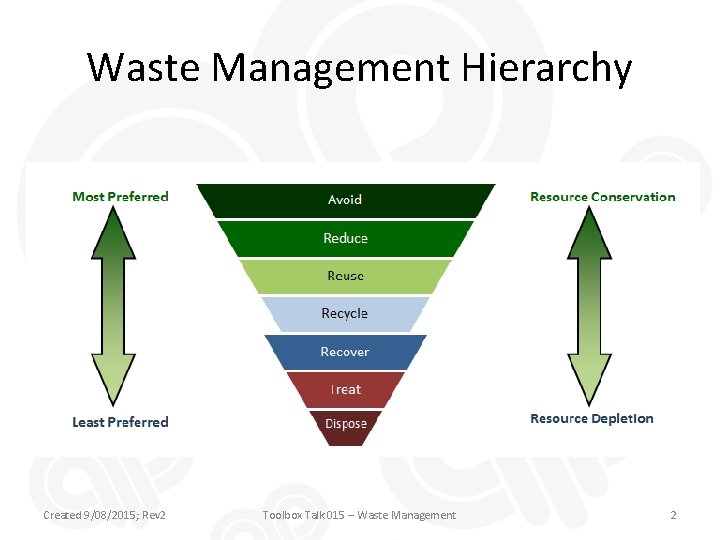
Waste Management Hierarchy Created 9/08/2015; Rev 2 Toolbox Talk 015 – Waste Management 2
Waste Management Hierarchy • One of the key principles underlying waste management is to ensure that waste is dealt with as high up the Waste Management Hierarchy as possible. • Since all waste disposal options have some impact on the environment, the only way to avoid impact is not to produce waste in the first place, and waste avoidance is therefore at the top of the hierarchy. Created 9/08/2015; Rev 2 Toolbox Talk 015 – Waste Management 3
Waste Management Hierarchy • Re-use, followed by recovery techniques (recycling, composting and generating energy from waste) follow, while disposal to landfill or by incineration, the worst options, are at the bottom of the hierarchy. Created 9/08/2015; Rev 2 Toolbox Talk 015 – Waste Management 4
• In deciding what is the most appropriate disposal route, both environmental and economic costs and benefits need to be considered. – This decision should be reached taking into account all the costs and impacts associated with waste disposal, including those associated with the movement of waste. • Wherever possible the Proximity Principle should be applied. – This recognises that transporting waste has environmental, social and economic costs so as a general rule, waste should be dealt with as near to the place of production as possible. Created 9/08/2015; Rev 2 Toolbox Talk 015 – Waste Management 5
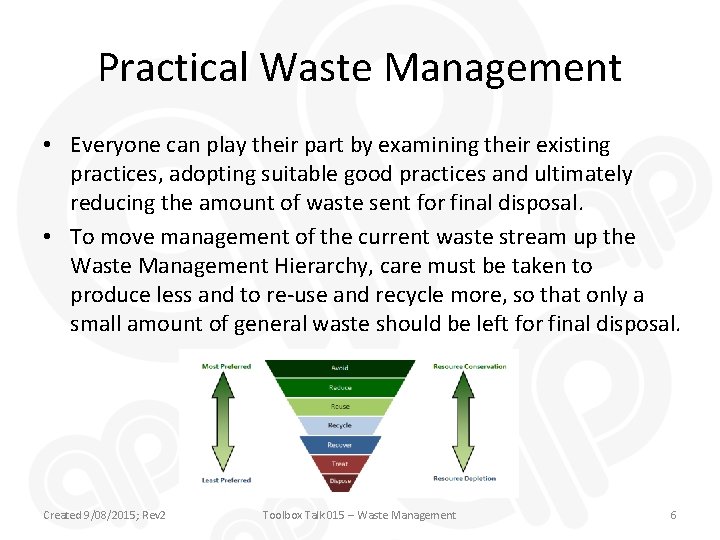
Practical Waste Management • Everyone can play their part by examining their existing practices, adopting suitable good practices and ultimately reducing the amount of waste sent for final disposal. • To move management of the current waste stream up the Waste Management Hierarchy, care must be taken to produce less and to re-use and recycle more, so that only a small amount of general waste should be left for final disposal. Created 9/08/2015; Rev 2 Toolbox Talk 015 – Waste Management 6
Practice what we preach! For example to reduce paper usage in the site office we can: • Double-side all photocopying and printing. • Circulate one copy of memos, minutes etc. or use email. • Use the back of scrap paper - for internal notes, as a note pad, or for general notes. • Ensure that fax machines do not produce header or report sheets. • Reuse envelopes internally in preference to purchased transit envelopes. • Buy recycled paper products wherever possible. • Check printing in ‘print preview’ and eliminate any pages that have only one or two words on them • Revise procedures and SOPs to be smaller in size to reduce printing Created 9/08/2015; Rev 2 Toolbox Talk 015 – Waste Management 7
Practice what we preach! • For example when working on site we can: – Reuse timber formwork – Reuse slings for alternative means (with tag cut off and visual indication that it cannot be used for lifts) – Reuse design steelwork for other projects (i. e. modify the steel shutters for other rail projects, modify the marine pile leader for other projects) • Reusing helps to extend the life of raw materials by keeping them in circulation for longer. • In environmental terms this is beneficial, since it reduces the need to harvest/extract and process raw materials, and is less polluting than sending materials that are no longer needed to landfill. Created 9/08/2015; Rev 2 Toolbox Talk 015 – Waste Management 8
Practice what we preach! • For example when on site we can: – Request minimal packaging or recycled packaging from our suppliers (i. e. requesting pallets to come shrink wrapped in recyclable plastic) – Reuse packaging (i. e. timber pallets) – Buy resources made from recycled materials – Buy locally or lease products locally (i. e. local plant & equipment hire) – Utilise local services (i. e. use training providers in the nearest town so you cut out the environmental effects of airplane emissions/vehicle emissions from driving long distances) • Cost and quality considerations need not be undermined when environmental issues are taken into account within purchasing and procurement decisions. • Significant environmental gains and reductions in waste can be achieved with small adjustments to the purchasing decision press. Created 9/08/2015; Rev 2 Toolbox Talk 015 – Waste Management 9
Ask yourself: • If an item cannot be used by you, can it be used by someone else in your organisation? – Circulate by email that you have an unwanted desk, chair, filing cabinet, formwork, piling equipment etc. Alternatively can it be used outside your organisation, for example a charity? • If the item is broken or obsolete can it be repaired or upgraded? – Sometimes the initial cost of the repair or upgrade is perceived to be a restricting factor, but the extended life of the item makes it worthwhile in the long term. • Is the item suitable to be used for another purpose? – For example boxes, originally used for the delivery of computer paper, could be used as recycling trays or for temporary storage of other items. Created 9/08/2015; Rev 2 Toolbox Talk 015 – Waste Management 10
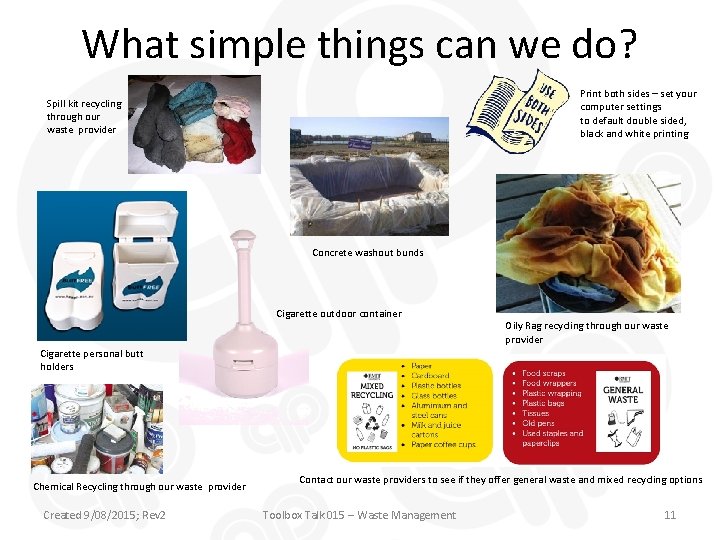
What simple things can we do? Print both sides – set your computer settings to default double sided, black and white printing Spill kit recycling through our waste provider Concrete washout bunds Cigarette outdoor container Oily Rag recycling through our waste provider Cigarette personal butt holders Chemical Recycling through our waste provider Created 9/08/2015; Rev 2 Contact our waste providers to see if they offer general waste and mixed recycling options Toolbox Talk 015 – Waste Management 11
Questions? Environment and Sustainability – Leadership – Safety – Integrity – Innovation – Created 9/08/2015; Rev 2 Continuous Improvement Toolbox Talk 015 – Waste Management 12
- Slides: 12