
TOOLBOX TALK 011 RAISING AND SOLVING SAFETY HEALTH
TOOLBOX TALK 011 RAISING AND SOLVING SAFETY & HEALTH ISSUES Created 11/07/2015; Rev 1 Toolbox Talk 011 – Raising & Solving Safety and Health Issues 1
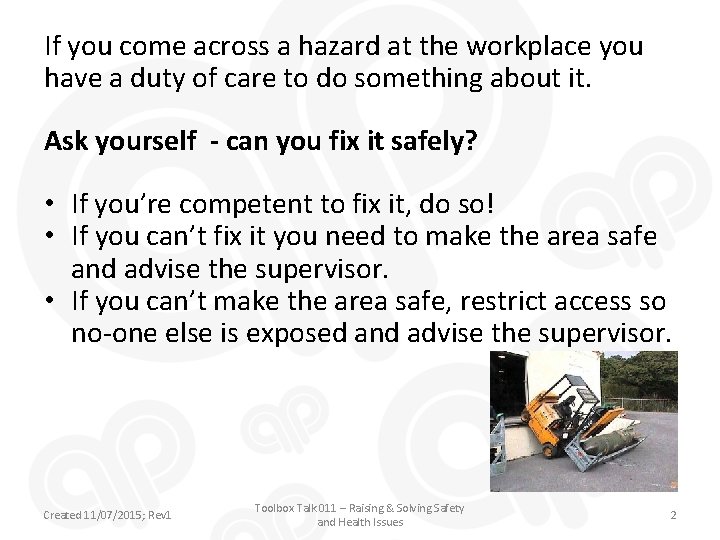
If you come across a hazard at the workplace you have a duty of care to do something about it. Ask yourself - can you fix it safely? • If you’re competent to fix it, do so! • If you can’t fix it you need to make the area safe and advise the supervisor. • If you can’t make the area safe, restrict access so no-one else is exposed and advise the supervisor. Created 11/07/2015; Rev 1 Toolbox Talk 011 – Raising & Solving Safety and Health Issues 2
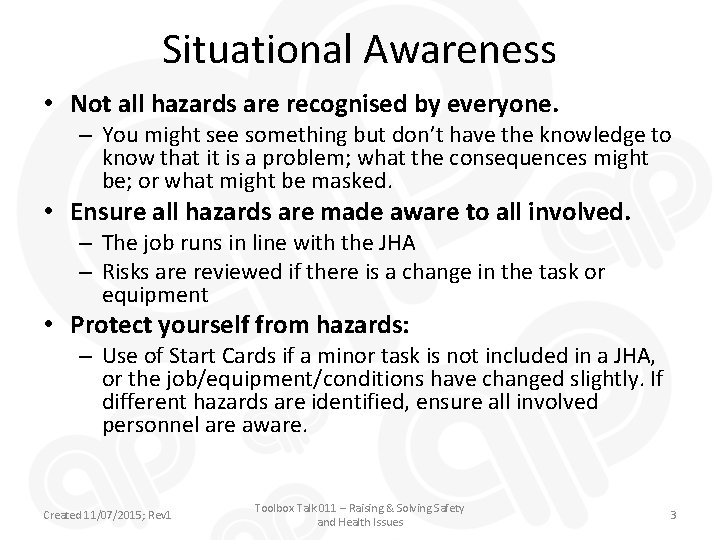
Situational Awareness • Not all hazards are recognised by everyone. – You might see something but don’t have the knowledge to know that it is a problem; what the consequences might be; or what might be masked. • Ensure all hazards are made aware to all involved. – The job runs in line with the JHA – Risks are reviewed if there is a change in the task or equipment • Protect yourself from hazards: – Use of Start Cards if a minor task is not included in a JHA, or the job/equipment/conditions have changed slightly. If different hazards are identified, ensure all involved personnel are aware. Created 11/07/2015; Rev 1 Toolbox Talk 011 – Raising & Solving Safety and Health Issues 3
Created 11/07/2015; Rev 1 Toolbox Talk 011 – Raising & Solving Safety and Health Issues 4
Reporting & Recording If the incident is not reported or recorded (regardless of regulatory requirements): • No opportunity to identify trends over time (lessons learnt may be lost) • Lack of injury/illness improvement opportunities • Defects aren’t reported to appropriate people to minimise damage in the future/rectify defects appropriately. • Potential incidents occurring from root causes. • No opportunity to improve work practices. • We must report, to prevent a recurrence and potential escalation of incidents. Created 11/07/2015; Rev 1 Toolbox Talk 011 – Raising & Solving Safety and Health Issues 5
Can’t fix it? Tell someone Who do you report to? • Tell your supervisor immediately/as soon as possible • Inform HSE Advisor • Issue addressed to workforce and updates communicated • If you can’t fix the hazard you need to make the area safe then report to your Supervisor/line manager so the problem can be addressed as quickly as possible. • Ideally, how to tackle the issue should be discussed with the team, supervisor and HSE Advisor to develop a solution and control measures. Created 11/07/2015; Rev 1 Toolbox Talk 011 – Raising & Solving Safety and Health Issues 6
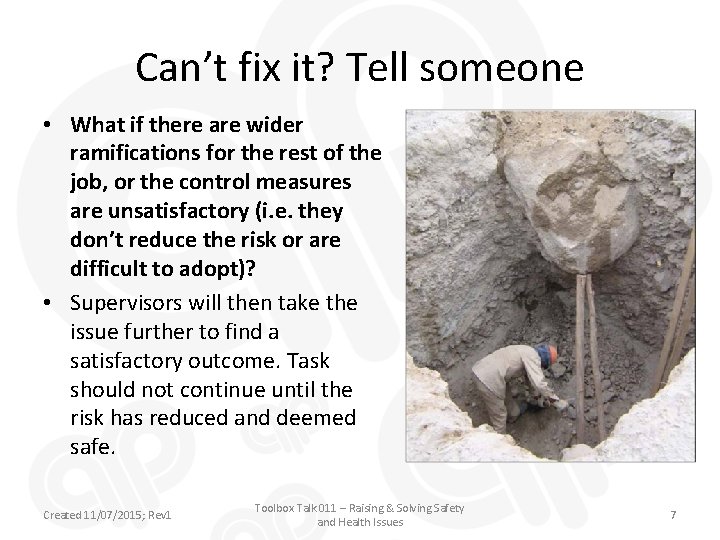
Can’t fix it? Tell someone • What if there are wider ramifications for the rest of the job, or the control measures are unsatisfactory (i. e. they don’t reduce the risk or are difficult to adopt)? • Supervisors will then take the issue further to find a satisfactory outcome. Task should not continue until the risk has reduced and deemed safe. Created 11/07/2015; Rev 1 Toolbox Talk 011 – Raising & Solving Safety and Health Issues 7
Our Procedure • Following an incident, the Project Manager/Site Supervisor shall ensure that: § Area is made safe to contain the incident site and to prevent further incident from occurring § Any injuries are treated by a first Aider § Management are communicated with regarding the incident § Scene is preserved (i. e. secured awaiting investigation from the incident investigation team) § Workers involved are tested for substance abuse § Photos/videos/sketches of the scene are taken § Perishable evidence is preserved and photographed in situ § Witnesses/participants are identified and scheduled to conduct an interview as soon as possible § Incident Report form is submitted to HSEQ Manager and HSEQ Officer via email § Investigation commences (if deemed necessary) Created 11/07/2015; Rev 1 Toolbox Talk 011 – Raising & Solving Safety and Health Issues 8
Reporting/Recording • Incidents need to be reported immediately, where as recording needs to be done within these time frames: – 24 hours – Note incident details and initial information, and submit form to Project Manager/Site Supervisor for submission to the HSEQ Manager & HSEQ Officer – 48 Hours – Note all injury details, notification to Regulator/State Authority details, and potential incident causes and submit form to Project Manager/Site Supervisor for submission to the HSEQ Manager and HSEQ Officer – 72 Hours – Note the corrective actions and corrective actions follow-up and submit form to Project Manager/Site Supervisor for submission to the HSEQ Manager and HSEQ Officer. Created 11/07/2015; Rev 1 Toolbox Talk 011 – Raising & Solving Safety and Health Issues 9
Reporting/Recording • Near Misses – Where a near miss is considered to be serious because of the potential to cause a high risk injury or property damage, the near miss shall be investigated, recorded and reported. • Report Only – An incident with no injury or consequence can be reported as a ‘report only’, which is a neutral report (i. e. it has no negative or positive connotations, and will not negatively affect the project, HSE stats etc. ) Created 11/07/2015; Rev 1 Toolbox Talk 011 – Raising & Solving Safety and Health Issues 10
Review and Communication of Controls If there is any occurrence of a Major Incident, Serious Near Miss or Personal Injury onsite, then: • Appropriate JHA for the work activity (associated with the incident) shall be reviewed to verify if the implemented control measures are still adequate to eliminate or further reduce the risk of the Incident re -occurring in the future. Created 11/07/2015; Rev 1 Toolbox Talk 011 – Raising & Solving Safety and Health Issues 11
Review and Communication of Controls • Where appropriate, new or revised control measures should be proposed and implemented and the relevant personnel briefed or re-inducted onto this revised JHA. • Records of such re-induction shall be maintained via the signatures of the relevant workers and date of induction on the revised JHA Created 11/07/2015; Rev 1 Toolbox Talk 011 – Raising & Solving Safety and Health Issues 12
Review and Communication of Controls • The incident shall be discussed and communicated to site personnel in communication forum such as Tool Box or Daily Pre-Start Meetings. In particular, the cause(s) of the Incident and appropriate Corrective Action(s) taken should be discussed with the workers. • A safety alert will be sent out by the HSE Advisor (or Relevant Engineer / Site Supervisor) to inform all Austral sites about the incident, corrective actions, learning’s from the incident etc. Created 11/07/2015; Rev 1 Toolbox Talk 011 – Raising & Solving Safety and Health Issues 13
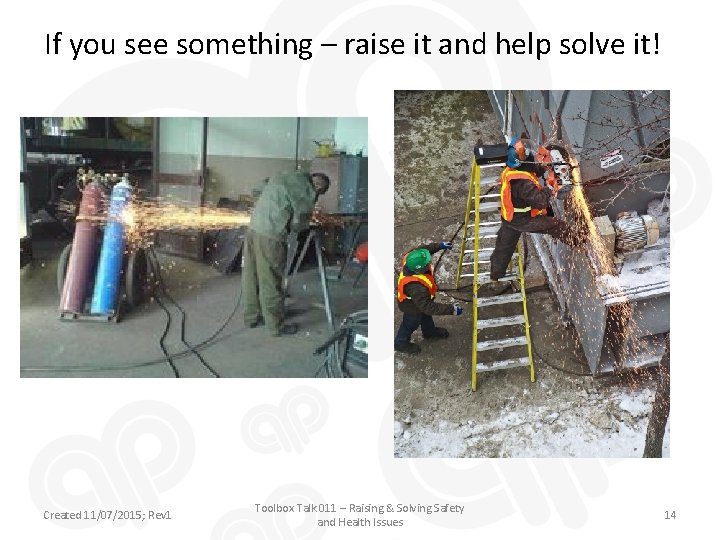
If you see something – raise it and help solve it! Created 11/07/2015; Rev 1 Toolbox Talk 011 – Raising & Solving Safety and Health Issues 14
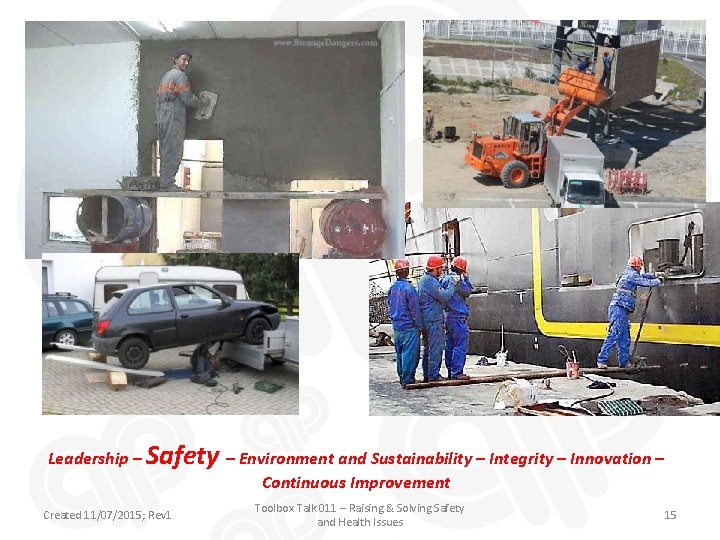
Leadership – Safety – Environment and Sustainability – Integrity – Innovation – Continuous Improvement Created 11/07/2015; Rev 1 Toolbox Talk 011 – Raising & Solving Safety and Health Issues 15
- Slides: 15